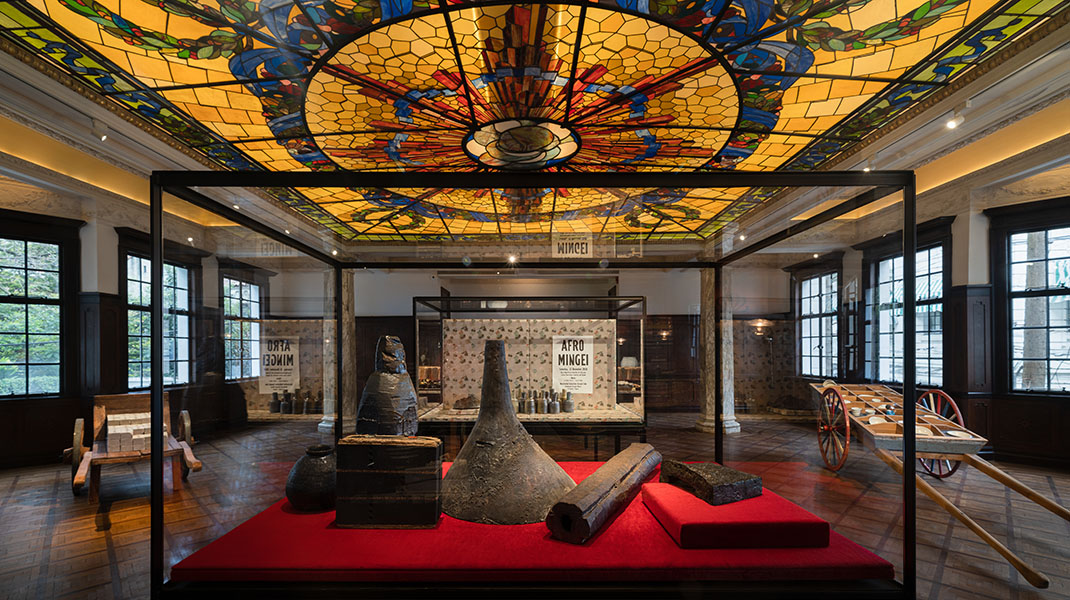
Theaster Gates: China Cabinet at Prada Rong Zhai, Shanghai, March 11 – May 23, 2021

“Prada presents ‘China Cabinet’, an exhibition project by artist Theaster Gates, with the support of Fondazione Prada. It is on view at Prada Rong Zhai, a 1918 historic residence in Shanghai restored by Prada and reopened in October 2017.

Invited to reimagine the spaces of Prada Rong Zhai in an unprecedented way, Theaster Gates shows his ceramics body of work and reveals the link that exists between this activity as a ceramist and those as a visual artist, a performer, a professor, a urban planner and a community activist. For ‘China Cabinet’, Gates conceived a three chapter story that unfolds in the rooms on the building’s first floor. Over the course of this narrative, the setting changes and the artist’s role evolves from guest to ghost to host. From being the object of an exhibition that examines the roots of his creative process, he becomes a subject who reveals the economic potential and the production context of his work. He then assumes the role of a possible new host of Prada Rong Zhai.” — Prada Rong Zhai

Exhibition views of “Theaster Gates: China Cabinet” at Prada Rong Zhai, March 11 – May 23, 2021. Photos: Alessandro Wang. Courtesy Prada Rong Zhai.

Theaster Gates. Photo: Delfino Sisto Legnani

Awol Erizku: New Visions for Iris, Public Art Fund at JCDecaux Bus Shelters in New York City & Chicago, through June 20, 2021

“Public Art Fund presents New Visions for Iris, a 350-site photography exhibition by multidisciplinary artist Awol Erizku. On view at 200 JCDecaux bus shelters across New York City and 150 in Chicago, this is the first time Public Art Fund stages an exhibition concurrently in these two cities. This body of 13 photographs presents a new visual lexicon that explores the liminal space between imagination, spirituality, and image making, and was inspired by the recent birth of Erizku’s daughter—Iris—as a starting point for future dialogue with her about identity and our challenging times. Comprising still-lifes, portraits, and depictions of birds, the suite of new work challenges the traditional Western canon and alludes to genre painting and pictorial styles in contemporary advertising. Creating visual poems, Erizku imagines an inclusive reinvention of our shared public spaces that challenge the status quo of typical commercial images. New Visions for Iris is Erizku’s first solo public exhibition and will be on view from February 24 through June 20, 2021.” — Public Art Fund

“My image-making process is a reflection of how I encounter the world. It allows me to explore alternate possibilities and novel ways of engaging with the world around me,” says artist Awol Erizku. “These works function as both propositions and questions about what else is in dire need of invigoration, which also come with a great deal of responsibility when displayed in public space. As a father, I think about how to raise a daughter in this world and explain cultural parameters and gray areas; I want my daughter Iris to grow up with these images so they’re the norm for her. With New Visions for Iris I want to reflect a less fixed, rigid, institutional understanding of the spaces we occupy.”

Awol Erizku, Arrival, 2020. Roosevelt Ave. between 69th St. & 68th St., Queens. Courtesy the artist
Awol Erizku, Arrival, 2020. 125th St. between Frederick Douglass Blvd. & Saint Nicholas Ave., Manhattan. Courtesy the artist
Awol Erizku. Pharoah Whispers, 2020. Roosevelt Ave. between 64th St. & 63rd St., Queens. Courtesy the artist
Awol Erizku, 632, 2020. Roosevelt Ave. between 63rd St. & 64th St., Queens. Courtesy the artist
Awol Erizku, Park Match, 2020. Roosevelt Ave. between Skilman Ave. and 55th St., Queens. Courtesy the artist
Awol Erizku, CDCR (Interior Reflections), 2020. Roosevelt Ave. between Skilman Ave. and 55th St., Queens. Courtesy the artist
Awol Erizku, 13 Months of Sunshine, 2020. 125th St. between 5th Ave. & Malcolm X Blvd., Manhattan. Courtesy the artist

Photographic work as a part of Awol Erizku: New Visions for Iris, an exhibition on 350 JCDecaux bus shelter displays across New York City and Chicago, February 24 to June 20, 2021.

Photos: Nicholas Knight. Courtesy of Public Art Fund, NY.

Alexander Calder: Modern from the Start at The Museum of Modern Art, March 14 – August 7, 2021

“The Museum of Modern Art presents Alexander Calder: Modern from the Start, a focused look at one of the most well-known and beloved artists of the 20th century through the lens of his relationship with MoMA. Alexander Calder: Modern from the Start includes approximately 70 artworks paired with film, historical photographs, and other archival materials drawn from MoMA’s collection and augmented by key loans from the Calder Foundation, New York. The exhibition is organized by Cara Manes, Associate Curator, with Zuna Maza and Makayla Bailey, Curatorial Fellows, Department of Painting and Sculpture.

 The exhibition takes as a point of departure the idea that Alexander Calder (American, 1898– 1976) assumed the unofficial role of the Museum’s ‘house artist’ during its formative years. His work was first exhibited at MoMA in 1930, months after the institution opened its doors, and he was among only a handful of artists selected by the Museum’s founding director, Alfred H. Barr Jr., for inclusion in his two landmark 1936 exhibitions, Cubism and Abstract Art and Fantastic Art, Dada, Surrealism. To inaugurate the then-new Goodwin and Stone Building in 1939, Calder was commissioned to make a hanging mobile for its interior ‘Bauhaus Staircase’; the resulting Lobster Trap and Fish Tail still hangs there today.” — The Museum of Modern Art  

Installation views of Alexander Calder: Modern from the Start, The Museum of Modern Art, New York, March 14, 2021 – August 7, 2021 © 2021 The Museum of Modern Art. Photos: Robert Gerhardt

Publicity photograph of Calder during the installation of “Alexander Calder” (September 29, 1943–January 16, 1944). 1943. Gelatin silver print, 3 3/4 x 4 3/4″ (9.5 x 12 cm). Photographic Archive, The Museum of Modern Art Archives, New York. © 2021 Calder Foundation, New York / Artists Rights Society (ARS), New York

Images courtesy The Museum of Modern Art.

Julie Mehretu at Whitney Museum of American Art, March 25 – August 8, 2021

“Co-organized by the Los Angeles County Museum of Art and the Whitney Museum of American Art, Julie Mehretu is a midcareer survey that unites more than seventy paintings and works on paper dating from 1996 to the present, reflecting the breadth of Mehretu’s multilayered practice. Born in Addis Ababa, Ethiopia, in 1970 and based in New York City, Mehretu has created new forms and found unexpected resonances by drawing on the histories of art and human civilization. Her play with scale and technique, as evident in intimate drawings, large canvases, and complex forms of printmaking, will be explored in depth. Filling the Whitney’s entire fifth floor gallery, the exhibition takes advantage of the expansive and open space to create dramatic vistas of Mehretu’s often panoramic paintings. The first-ever comprehensive survey of Mehretu’s career, Julie Mehretu is organized by Christine Y. Kim, curator of contemporary art at LACMA, with Rujeko Hockley, assistant curator at the Whitney.” — Whitney Museum of American Art

“Few artistic encounters are more thrilling than standing close to one of Julie Mehretu’s monumental canvases, enveloped in its fullness, color, forms, and symbolic content. Mehretu’s conviction and mastery of composition and brushwork—along with the sheer energy and full-on commitment of her execution—endow her works with a life force, presence, and presentness,” said Adam D. Weinberg, Alice Pratt Brown Director of the Whitney. “The Whitney Museum is particularly pleased to co-organize this midcareer survey with LACMA, and we are thrilled to continue our longstanding and close relationship with the artist, who has been included in numerous group exhibitions at the Whitney, beginning with the 2004 Biennial.” 

Julie Mehretu, Untitled 2, 1999. Ink and polymer on canvas mounted to board, 59 ¾ × 71 ¾ inches (151.77 x 182.25 cm). Private collection, courtesy of White Cube © Julie Mehretu
Julie Mehretu, Retopistics: A Renegade Excavation, 2001. Ink and acrylic on canvas, 101 ½ × 208 ½ inches (257.81 × 529.59 cm). Crystal Bridges Museum of American Art, Bentonville, Arkansas 2013.28. © Julie Mehretu
Julie Mehretu, Black City, 2007. Ink and acrylic on canvas, 120 x 192 inches (304.8 x 487.7 cm). Pinault Collection, Paris, France. © Julie Mehretu
Julie Mehretu, Mogamma (A Painting in Four Parts) (1 of 4), 2012. Ink and acrylic on canvas, 180 × 144 inches (457.2 × 365.76 cm). Guggenheim Abu Dhabi. © Julie Mehretu
Julie Mehretu, Mogamma (A Painting in Four Parts) (2 of 4), 2012. Ink and acrylic on canvas, 180 x 144 in. (457.2 x 365.8 cm) © Julie Mehretu
Julie Mehretu, Epigraph, Damascus, 2016. Photogravure, sugar lift aquatint, spit bite aquatint, and open bite on six panels, 97 ½ × 226 inches (247.65 × 574.04 cm). Edition 13 of 16 + 2 AP. Los Angeles County Museum of Art, gift of Kelvin and Hana Davis through the 2018. Collectors Committee M.2018.188a–f Printed by BORCH Editions, Copenhagen © Julie Mehretu
Julie Mehretu, Conjured Parts (eye), Ferguson, 2016. Ink and acrylic on canvas, 84 x 96 inches (213.4 x 243.8 cm). The Broad Art Foundation, Los Angeles. © Julie Mehretu
Julie Mehretu, Hineni (E. 3:4), 2018. Ink and acrylic on canvas, 96 × 120 inches (243.84 × 304.8 cm). Centre Pompidou, Paris, Musée national d’art moderne/Centre de création industrielle; gift of George Economou, 2019. © Julie Mehretu

Images courtesy Whitney Museum of American Art.

Awaken: A Tibetan Buddhist Journey Toward Enlightenment at The Rubin Museum of Art, March 12, 2021 – January 3, 2022.  

“The Rubin Museum of Art invites visitors to unplug and discover the possibility to free their minds with ‘Awaken: A Tibetan Buddhist Journey Toward Enlightenment’. Organized by the Virginia Museum of Fine Arts, this traveling exhibition guides visitors on a journey toward enlightenment, showcasing the power of Tibetan Buddhist art to focus and refine awareness, and highlighting the inextricable relationship between artistic endeavor and spiritual practice in Tibetan Buddhism. The exhibition has been re-imagined and adapted for the Rubin Museum’s galleries and features 35 traditional objects, including 14 from the Rubin Museum’s collection, with two contemporary works by Nepal born, Tibetan American artist Tsherin Sherpa.

The exhibition introduces the central teachings of Tibetan Buddhism as visitors progress through ten milestones on the journey from the chaos of ordinary life to the awakened states of awareness. At the entrance, visitors encounter a video collage reflecting our fragmented, overstimulated contemporary world. It echoes the main idea in Tsherin Sherpa’s abstracted 16-panel painting Luxation 1 (2016), which presents a split, incomplete view of a deity. From the start, the exhibition points to a central question: are we truly awake? Or are we lulled asleep by the ordinary world’s clamor and therefore blind to the true nature of reality and destined to suffer? As a way out of the chaos, the show presents a path of transformation facilitated by Tibetan Buddhist art in which the practitioner progresses toward awareness and enlightenment with the help from a guide, allies, and a map.” — The Rubin Museum of Art

Installation views of “Awaken: a Tibetan Buddhist Journey Toward Enlightenment,” organized by the Virginia Museum of Fine Arts, presented by the Rubin Museum of Art, March 12, 2021 – January 3, 2022, Photos by David De Armas, Courtesy of the Rubin Museum of Art.

Tsherin Sherpa (American, b. 1968, Nepal); Luxation 1; 2016; acrylic on sixteen stretched cotton canvases; each 18 x 18 in. (45.7 x 45.7 cm); Virginia Museum of Fine Arts, Adolph D. and Wilkins C. Williams Fund; 2017.195a–p.
Standing Crowned Buddha with Four Scenes of His Life; Southern Magadha region, Bihar, India; ca. 1050–1100; Basalt; 41 x 20 x 7 in. (104.1 x 50.8 x 17.8 cm); Asian Art Museum of San Francisco The Avery Brundage Collection, B65S11.
Vajrabhairava; Sino-Tibetan; 15th century or later; polychromed wood; 53 1/4 x 50 3/4 x 30 3/4 in. (135.3 x 128.9 x 78.1 cm); Virginia Museum of Fine Arts, E. Rhodes and Leona B. Carpenter Foundation and Arthur and Margaret Glasgow Fund; 93.13a–oo.

“The title ‘Awaken’ references the word ‘Buddha,’ which means ‘awake,’” says Rubin Museum Curator of Himalayan Art Elena Pakhoutova. “To be awake is to see the full picture of existence: to understand that all things are ever-changing and interconnected, and that nothing exists by itself. By recognizing this, we can begin to glimpse at what an awakened state of mind is.”

“Awaken: A Tibetan Buddhist Journey Toward Enlightenment” is organized by the Virginia Museum of Fine Arts. It was originally curated by John Henry Rice, E. Rhodes and Leona B. Carpenter Curator of South Asian and Islamic Art, Virginia Museum of Fine Arts, and Jeffrey Durham, Associate Curator of Himalayan Art, Asian Art Museum of San Francisco. At the Rubin Museum of Art it was curated by Elena Pakhoutova, Curator of Himalayan Art, Rubin Museum of Art.

The Frick Reframed: The Frick Collection Presents Highlights Reconsidered at Frick Madison, opens March 18, 2021

“The Frick Collection launches Frick Madison, the long-awaited public opening of its temporary new home on Madison Avenue. Frick Madison invites audiences to experience the beloved holdings of the institution, reframed in a completely new context. Serving as the Frick’s temporary home for the next two years while its historic buildings at 1 East 70th Street undergo renovation, Frick Madison marks the first time that a substantial gathering of collection highlights will be presented outside the walls of the museum’s Gilded Age mansion. In a departure from the Frick’s customary presentation style, works are organized at Frick Madison chronologically and by region, allowing for fresh juxtapositions and new insights about the treasured paintings and sculptures by Bellini, Clodion, Gainsborough, Goya, Holbein, Houdon, Ingres, Piero della Francesca, Rembrandt, Titian, Turner, Velázquez, Vermeer, Whistler, and many others. The installation also spotlights the Frick’s impressive holdings of decorative arts and sculpture, as well as rarely seen works, including the entirety of canvases from the famed series by Jean-Honoré Fragonard, shown together for the first time in the institution’s history. Frick Madison is located at 945 Madison Avenue at 75th Street, the former site of the Met Breuer and, previously, the Whitney Museum of American Art, which commissioned the building in 1966 by architect Marcel Breuer.” — Frick Collection

 Second-Floor Installation 

Room 1: Jean Barbet’s Angel, 1475, greets visitors on the second floor of Frick Madison, the temporary new home of The Frick Collection; photo: Joe Coscia
Room 2: Portraits by Hans Holbein the Younger face off at Frick Madison: Sir Thomas More (left), 1527, oil on panel, and Thomas Cromwell (right), ca. 1532–33, oil on panel, The Frick Collection; photo: Joe Coscia
Room 3: Dutch portraits by Frans Hals, with a view through to Rembrandt’s Self-Portrait, 1658, as shown at Frick Madison by The Frick Collection; photo: Joe Coscia
Room 4: Rembrandt’s Self-Portrait (left), 1658, and The Polish Rider (right), ca. 1655, as shown at Frick Madison by The Frick Collection; photo: Joe Coscia
Room 5: Three of the Frick’s eight portraits by Van Dyck, as shown at Frick Madison by The Frick Collection; photo: Joe Coscia
Room 6: Vermeer’s Mistress and Maid (left) and Officer and Laughing Girl (right), as shown at Frick Madison by The Frick Collection; photo: Joe Coscia

 Third-Floor Installation

Room 7: The third-floor galleries at Frick Madison begin with three rare marble examples of Italian Renaissance portrait sculpture. By Laurana and Verrocchio, they date to the 1470s. The next room features early Italian religious painting from The Frick Collection, including works by Paolo Veneziano and Piero della Francesca; photo: Joe Coscia
Room 9: Two rare and infrequently displayed seventeenth-century Indian Mughal carpets from The Frick Collection occupy this gallery at Frick Madison; photo: Joe Coscia
Room 10: A dramatic display of European and Asian porcelain (ca. 1500–ca. 1900) is featured in this Frick Madison room, reflecting deep cultural interaction in the history of the medium. Remarkable examples of eighteenth-century French furniture from The Frick Collection are also shown; photo: Joe Coscia
Room 11: This grand gallery of Italian Renaissance paintings includes work by Veronese (back right wall) as well as Titian. Centrally located is a bronze by Francesco da Sangallo, placed atop a replica of its original base. To the left, in Room 12, are works by later Venetian masters Guardi, Tiepolo, and Carriera; photo: Joe Coscia
Room 13: Bellini’s St. Francis in the Desert, one of the Frick’s most important and loved works, is displayed in isolation, paired with one of the iconic trapezoidal windows Marcel Breuer conceived for the building; photo: Joe Coscia
Room 14: This gallery of bronze works features a case of extraordinary classically inspired statuettes; in the foreground, a large-scale version of Giambologna’s Nessus and Deianira (attributed to Tacca); photo: Joe Coscia
Room 15: This gallery features all nine Spanish paintings acquired by Henry Clay Frick. On the left wall are works by Goya, including The Forge. On the back wall is the iconic portrait King Philip IV of Spain by Velázquez; photo: Joe Coscia
Room 15: This gallery features all nine Spanish paintings acquired by Henry Clay Frick. On the right wall are works by Murillo and El Greco. On the back wall is the iconic portrait King Philip IV of Spain by Velázquez;photo: Joe Coscia

 Fourth-Floor Installation

Room 18: This gallery of French eighteenth-century paintings brings together works by Boucher (left wall) and Chardin (at right); photo: Joe Coscia
Room 19: In this gallery of French decorative arts, a remarkable side table of blue Turquin marble and gilt-bronze mounts by Pierre Gouthière is shown with a secretaire by Riesener commissioned for Marie-Antoinette. Additional works by Gouthière and Sèvres are displayed above these important pieces of furniture; photo: Joe Coscia
Room 24: Four grand panels of Fragonard’s series The Progress of Love are shown together at Frick Madison in a gallery illuminated by one of Marcel Breuer’s trapezoidal windows. This view shows two of the 1771–72 paintings, with two later overdoors visible in the next gallery; photo: Joe Coscia
Room 25: Later works by Fragonard are shown in a gallery that completes the cycle, with a gathering of cupid-themed overdoors (at left), shown with the ca. 1790–91 painting Reverie; photo: Joe Coscia
Room 23: Nineteenth-century French Neoclassical works are shown in this gallery, among them painted portraits by Ingres and David, and an expressive terracotta bust by Chinard in the center; photo: Joe Coscia
Room 20: Works by British landscape rivals Turner (right) and Constable (left) are shown in this gallery; photo: Joe Coscia
Room 21: The Frick Collection is home to remarkable works of British portraiture, many seen in this gallery, with works by Gainsborough at left, Romney at center, and Hogarth and Reynolds at right; photo: Joe Coscia
Room 21: There are more paintings by Gainsborough at The Frick Collection than any other New York City museum. The wall of this Frick Madison gallery features five of the artist’s works, with his scene The Mall in St. James’s Park at center; photo: Joe Coscia
Room 21: The Frick Collection is home to striking works of British portraiture, including two paintings by Reynolds that flank the view of Constable’s White Horse in the gallery beyond; photo: Joe Coscia
Room 22: The Frick Collection houses more works by American-born James McNeill Whistler than by any other artist. This view shows three of four full-length portraits on display in a Frick Madison gallery; photo: Joe Coscia

“From the very beginning we sought to marry our holdings with Marcel Breuer’s great modernist building, with the intention of revealing the Frick’s strengths in a new way, while inspiring fresh conversations and observations. Throughout the installation, we’ve maintained the core value of the Frick experience: offering visitors the opportunity to study works of art in a direct and immediate way, surrounded by a beautiful and peaceful environment. Rather than trying to recreate the rooms of the mansion, we celebrate this architectural icon, hoping audiences emerge with new understandings of both its features and spaces, and of our remarkable and very distinct collection.” — Xavier F. Salomon, Deputy Director and Peter Jay Sharp Chief Curator

Images courtesy Frick Collection.

Simon Fujiwara: Who the Bær at Fondazione Prada Milan, April 29 – September 27, 2021

“The work of artist Simon Fujiwara (London, UK, 1982; lives and works in Berlin) is a personal exploration of the human desire that underpins tourist attractions, historical icons, celebrities, ‘edutainment,’ and neo-capitalism. In this seductive yet fraught arena, his work reveals the paradox of our simultaneous quest for fantasy and authenticity in the culture we consume. In his recent exhibitions — which include a full-scale reconstruction of the Anne Frank House (Hope House, 2017), a ‘rebranding campaign’ of his former high school art teacher (Joanne, 2016-2018), and a theme park ride that takes you into the world of YouTube (Empathy I, 2018),— we observe a distorted reflection of the real world through the artist’s fantastical and sometimes disturbing universe.

For this new site-specific project conceived for the ground floor of the Podium in the Milan premises of Fondazione Prada, Simon Fujiwara introduces audiences to the fairytale world of Who the Bær, an original cartoon character that inhabits a fantasy universe created by the artist. Who the Bær is a cartoon bear without a clear character – ‘Who’ as they are known, seems to have not yet developed a strong personality or instincts, they have no history, defined gender or even sexuality. Who the Bær only knows that they are an image, and they seek to define themselves in a world of other images. The world of Who the Bær is a flat, online world of pictures, yet one full of endless possibilities. Who the Bær can transform or adapt into any image they encounter, taking on the attributes and identities of those depicted within the image – human, animal or even object. In this sense the fantastical world of Who the Bær is a world of freedom: Who can be whoever they wish to be, Who can transcend time and place, Who can be both subject and object. Yet Who the Bær may never be able to overcome their one true challenge – to become anything more than just an image.” — Fondazione Prada

Simon Fujiwara. Drawing image for “Who the Bær”, 2020. Artwork: Simon Fujiwara / Photo: Bas Princen. Courtesy the artist.
Simon Fujiwara. Drawing image for “Who the Bær”, 2020. Courtesy the artist.
Simon Fujiwara. Drawing image for “Who the Bær”, 2020. Courtesy the artist; Dvir Gallery, Tel Aviv/ Brussels; GioMARCONI, Milan; Taro Nasu, Tokyo; Esther Schipper, Berlin. Photos © André Carvalho and Tugba Carvalho – CHROMA.
Simon Fujiwara. Drawing image for “Who the Bær”, 2020. Courtesy the artist; Dvir Gallery, Tel Aviv/ Brussels; GioMARCONI, Milan; Taro Nasu, Tokyo; Esther Schipper, Berlin. Image attribution: Breast Self-Exam Illustration, 1984, U.S. National Cancer Institute/ National Institutes of Health, ID 2149. Photos © André Carvalho and Tugba Carvalho – CHROMA.
Simon Fujiwara. Drawing images for “Who the Bær”, 2020. Courtesy the artist; Dvir Gallery, Tel Aviv/ Brussels; GioMARCONI, Milan; Taro Nasu, Tokyo; Esther Schipper, Berlin. Image attribution: Albrecht Dürer, Adam and Eve, 1507, online gallery Museo del Prado, Madrid. Photos © André Carvalho and Tugba Carvalho – CHROMA.
Simon Fujiwara. Drawing images for “Who the Bær”, 2020. Courtesy the artist; Dvir Gallery, Tel Aviv/ Brussels; GioMARCONI, Milan; Taro Nasu, Tokyo; Esther Schipper, Berlin. Image attribution: 9 ‘I’ For Identity: Reflections on Ageing with a Disability – Scientific Figure on ResearchGate / Diane Roberts, The University of Manchester. Photos © André Carvalho and Tugba Carvalho – CHROMA.
Simon Fujiwara. Sculptures for “Who the Bær”, 2020. Courtesy the artist; Dvir Gallery, Tel Aviv/ Brussels; GioMARCONI, Milan; Taro Nasu, Tokyo; Esther Schipper, Berlin. Photos © Jörg von Bruchhausen.

“Who the Bær” is completed by a publication, which is part of Fondazione Prada’s Quaderni series. Conceived as an illustrated story book, it includes a conversation with the artist. The adventures of Who the Bær can be experienced on Instagram following their official account @whothebaer.

Images courtesy Fondazione Prada.

Conversations in Drawing: Seven Centuries of Art from the Gray Collection at The Morgan Library & Museum, February 19 – June 6, 2021

“The Morgan Library & Museum proudly presents an exhibition celebrating the remarkable collection of drawings assembled by one of America’s foremost art dealers, Richard Gray, and his wife, the art historian Mary L. Gray. Encompassing works made in Europe and the United States between the fifteenth and the twenty-first century, the Gray Collection represents a stimulating survey of key aspects in the long and distinguished history of drawing. Conversations in Drawing: Seven Centuries of Art from the Gray Collection includes many outstanding works from the collection, which was amassed over the course of nearly fifty years. 

 While there are many examples of sheets by established artists— Rubens, Boucher, Degas, Van Gogh, Seurat, Matisse, Picasso, and Hockney, among others—the Grays were more interested in skill than celebrity, and many of the exceptional drawings in their collection bear the names of lesser-known draftsmen. In all eras, keenly aware of their place in the history of art, many of the artists consistently engaged in lively conversations with the works of their contemporaries and forebears. Juxtaposing drawings from distinct periods and places, Conversations in Drawing also explores these visual connections, highlighting the the continuities and innovations that have emerged over the course of the medium’s evolution.” — The Morgan Library & Museum

François Boucher (1703-1770). Study of a draped woman leaning on a pedestal, 1759-61. Black chalk, with stumping, and white chalk, on buff paper. The Art Institute of Chicago, gift of Richard and Mary L. Gray; 2019.835. Photography by Art Institute of Chicago Imaging Department.
Annibale Carracci (1560-1609). Study of Hercules resting, with separate studies of his head and foot, 1595-97. Black chalk, heightened with white chalk, on blue paper, incised The Art Institute of Chicago, gift of Richard and Mary L. Gray; 2019.838. Photography by Jamie Stukenberg, Professional Graphics Inc.
Paul Cézanne (1839-1906). Bather with Outstretched Arms, 1874-1877. Graphite on pieced paper. The Art Institute of Chicago, gift of Richard and Mary L. Gray; 2019.840. Photography by Jamie Stukenberg, Professional Graphics Inc.
Honoré Daumier (1808-1879). Study of Two Men (Spectators), 1863-65 Pen and black ink, brush and wash, and graphite, over black chalk. Richard and Mary L. Gray, promised gift to the Morgan Library & Museum. Photography by Jamie Stukenberg, Professional Graphics Inc.
Jacques Louis David (1748-1825). Nude soldiers gesticulating with their weapons, 1796-97. Black chalk, and pen and ink, with touches of white chalk. The Art Institute of Chicago, gift of Richard and Mary L. Gray; 2019.841. Photography by Art Institute of Chicago Imaging Department.
Edgar Degas (1834-1917). Study of Dancers, 1895-1900. Charcoal and pastel on pale-pink paper (discolored to tan). Gray Family Collection. Photography by Jamie Stukenberg, Professional Graphics Inc.
Giovanni Domenico Tiepolo (1727-1804). Puchinello collapses on the road, ca. 1791 Pen and brown ink, and brush and brown washes, over traces of charcoal. The Art Institute of Chicago, gift of Richard and Mary L. Gray; 2019.869. Photography by Art Institute of Chicago Imaging Department.
Giovanni Francesco Barbieri, called Guercino (1591-1666). The triumphant Hercules with the vanquished Hydra, ca. 1618. Pen and brown ink, and brush and brown wash, on buff paper. The Art Institute of Chicago, gift of Richard and Mary L. Gray; 2019.879. Photography by Art Institute of Chicago Imaging Department.
Jean-Auguste-Dominique Ingres (1780-1867). Comtesse Charles d’Agoult (Born Marie de Flavigny) and Her Daughter Claire d’Agoult, 1849. Graphite, heightened with white opaque watercolor, with touches of yellow watercolor. The Art Institute of Chicago, gift of Richard and Mary L. Gray; 2019.852. Photography by Art Institute of Chicago Imaging Department.
Peter Paul Rubens (1577-1640). Nude youth in the pose of the Spinario, Ca. 1610-1616. Black chalk with white chalk. The Art Institute of Chicago, gift of Richard and Mary L. Gray; 2019.863. Photography by Jamie Stukenberg, Professional Graphics Inc.
Georges Seurat (1859-1891). Landscape, ca. 1881. Black Conté crayon. The Art Institute of Chicago, gift of Richard and Mary L. Gray; 2019.866. Photography by Jamie Stukenberg, Professional Graphics Inc.
Vincent van Gogh (1853-1890). Avenue of Pollard Birches and Poplars , 1884 Reed pen and iron-gall ink. Richard and Mary L. Gray, promised gift to the Art Institute of Chicago. Photography by Jamie Stukenberg, Professional Graphics Inc.
Giovanni Battista Naldini (1535-1591). Study of a Seated Youth, ca. 1575. Black chalk, with touches of white chalk, squared in red chalk. Richard and Mary L. Gray, promised gift to the Morgan Library & Museum. Photography by Art Institute of Chicago Imaging Department.
Pablo Picasso (1881–1973) Two Dancers, 1925 © 2021 Estate of Pablo Picasso / Artists Rights Society (ARS), New York Photo by Jamie Stukenberg, Professional Graphics Inc.

Conversations in Drawing: Seven Centuries of Art from the Gray Collection was organized by The Art Institute of Chicago in cooperation with the Morgan Library & Museum.

Images courtesy The Morgan Library & Museum.  

Grief and Grievance: Art and Mourning in America at New Museum, February 17 – June 6, 2021

 “The New Museum is proud to present ‘Grief and Grievance: Art and Mourning in America,’ an exhibition originally conceived by Okwui Enwezor (1963-2019) for the New Museum, and presented with curatorial support from advisors Naomi Beckwith, Massimiliano Gioni, Glenn Ligon, and Mark Nash. ‘Grief and Grievance’ is an intergenerational exhibition bringing together thirty-seven artists working in a variety of mediums who have addressed the concept of mourning, commemoration, and loss as a direct response to the national emergency of racist violence experienced by Black communities across America. The exhibition further considers the intertwined phenomena of Black grief and a politically orchestrated white grievance, as each structures and defines contemporary American social and political life. Included in ‘Grief and Grievance’ are works encompassing video, painting, sculpture, installation, photography, sound, and performance made in the last decade, along with several key historical works and a series of new commissions created in response to the concept of the exhibition.” — New Museum

Lisa Phillips, Toby Devan Lewis Director, New Museum, states: “‘Grief and Grievance: Art and Mourning in America’ is a tribute to Okwui Enwezor’s courage, relentless focus, and fierce intelligence as a giant in our field and one of the most important curators of his generation. His presence remains vivid, as does his legacy to transform the history of art and exhibition-making. We are honored that Okwui embraced our invitation to present his exhibition at the New Museum, an exhibition that confronts the uncomfortable truths and ongoing pain of racial injustice in America. Okwui’s vision and the voices of the artists selected for this exhibition could not be more relevant.”

All images: “Grief and Grievance: Art and Mourning in America,” 2021. Exhibition views: New Museum, New York. Photos: Dario Lasagni. Courtesy New Museum.

The artists on view include: Terry Adkins, Jean-Michel Basquiat, Kevin Beasley, Dawoud Bey, Mark Bradford, Garrett Bradley, Melvin Edwards, LaToya Ruby Frazier, Charles Gaines, Ellen Gallagher, Theaster Gates, Arthur Jafa, Daniel LaRue Johnson, Rashid Johnson, Jennie C. Jones, Kahlil Joseph, Deana Lawson, Simone Leigh, Glenn Ligon, Kerry James Marshall, Tiona Nekkia McClodden, Julie Mehretu, Okwui Okpokwasili, Adam Pendleton, Julia Phillips, Howardena Pindell, Cameron Rowland, Lorna Simpson, Sable Elyse Smith, Tyshawn Sorey, Diamond Stingily, Henry Taylor, Hank Willis Thomas, Kara Walker, Nari Ward, Carrie Mae Weems, and Jack Whitten.

Selections from the Collection of Dr. H. Russell Albright at New Orleans Museum of Art (NOMA), through July 4th, 2021

“Noted radiologist and art collector Dr. H. Russell Albright (1934-2017) bequeathed his extensive and important photography collection to the New Orleans Museum of Art (NOMA), and left a fund to create an endowment in support of the museum’s Department of Photographs. Dr. Albright had a long and significant relationship with NOMA, filling many roles over the span of 30 years, ranging from Trustee to longtime Fellow.

With his bequest to NOMA, Albright gave almost 400 works to the museum, more than 350 of which were photographs. Of these, the majority are by acknowledged contemporary masters such as Cindy Sherman, Lorna Simpson, Nan Goldin, and Thomas Ruff, and the collection also includes a smaller group of excellent prints by earlier twentieth century artists such a Man Ray, Brassaï, and Doris Ulmann. Additionally, substantial and generous works were gifted to the modern and contemporary art department, the decorative arts department, and the African art department.” — New Orleans Museum of Art

“Russell Albright’s eye was incredibly discerning, a trait that is visible across his collection, be it in his selection of a rich modernist print from the 1930s or a powerful contemporary photograph” says Russell Lord, NOMA’s Freeman Family Curator of Photographs. “Albright never shied away from adventurous or even controversial images, amassing a collection that is as critical as it is beautiful.”

Bill Brandt (British, born Germany, 1904-1983). Parlourmaid and Under-Parlourmaid Ready to Serve Dinner, ca. 1934. Gelatin silver prin. Gift of H. Russell Albright, M.D.
Brassai (Gyula Halasz) (Hungarian-French, 1899-1984). Lovers, Rue Saint Denis, 1931. Gelatin silver print. Gift and bequest of H. Russell Albright, M.D.
Manuel Alvarez Bravo (Mexican, 1902-2002). And At Night It Moans, ca. 1945. Gelatin silver print. Gift and bequest of H. Russell Albright, M.D.
Sally Mann (American, born 1951). Deep South, Untitled (Stick), 1998. Gelatin silver print, toned with tea. Bequest of H. Russell Albright, M.D.
Robert Mapplethorpe (American, 1946-1989). New Orleans Interior, 1982. Gelatin silver print. Bequest of H. Russell Albright, M.D.
Man Ray (American, 1890-1976). Nude Portrait of Nusch Eluard from Facile, 1935. Gelatin silver print. Gift and bequest of H. Russell Albright, M.D.
Cindy Sherman (American, born 1954). Untitled #225, 1990. Chromogenic print. Gift and bequest of H. Russell Albright, M. M.D.

Images courtesy New Orleans Museum of Art.

No Ocean Between Us at San Antonio Museum of Art (SAMA), February 12, 2021 – May 9, 2021

No Ocean Between Us: Art of Asian Diasporas in Latin America & The Caribbean, 1945–Present features approximately 65 works of modern and contemporary art by Latin American and Caribbean artists of Asian descent. This exhibition highlights artists whose work reflects the global dialogues between their Asian heritages and their Latin American or Caribbean identities, as well as the major artistic movements of their times. Included in the exhibition are paintings, works on paper, sculptures, and mixed media works by artists from Argentina, Brazil, Cuba, Guyana, Mexico, Panama, Suriname, and Trinidad and Tobago.
 
No Ocean Between Us provides context to understanding the complex and multifaceted nature of cultural diversity in modern Latin American and Caribbean societies. The exhibition allows the viewer to explore how an artist’s unique experience of migration shaped their work. Inspired by the permanent collection of the Art Museum of the Americas of the Organization of American States, the exhibition features works by Brazilian artists Manabu Mabe, Tomie Ohtake, Yukata Toyota, Tikashi Fukushima, and Kazuo Wakabashi; Argentine artist Kasuya Sakai; Peruvian artists Venancio Shinki, Arturo Kubotta, Carlos Runcie Tanaka, and Eduardo Tokeshi; Trinidadian artist M.P. Alladin; Mexican artist Luis Nishizawa; Cuban artist Wifredo Lam; and Surinamese artist Soeki Irodikromo.” — San Antonio Museum of Art

Manabu Mabe, Agonia (Agony), 1963, oil on canvas. © OAS AMA | Art Museum of the Americas Collection. Gift of Francisco Matarazzo Sobrinho.
Manabu Mabe, Solemn Pact, 1980, acrylic and oil on canvas. © OAS AMA | Art Museum of the Americas Collection.
M. P. Alladin, Las Palmas (The Palms), 1973, acrylic on canvas. © OAS AMA | Art Museum of the Americas Collection.
Tikashi Fukushima, Verde (Green), 1972, oil on canvas. © OAS AMA | Art Museum of the Americas Collection.
Soeki Irodikromo, Untitled, 1986, oil on canvas. © OAS AMA | Art Museum of the Americas Collection. Gift of the Government of Suriname.
Wilfredo Lam, Retrato, 1982, lithograph. © OAS AMA | Art Museum of the Americas Collection.
Wilfredo Lam, Untitled, 1965, charcoal and pastel. © OAS AMA | Art Museum of the Americas Collection.
Venancio Shinki , Tierras Bien, c. 1968, oil on canvas. © OAS AMA | Art Museum of the Americas Collection.
Yutaka, Toyota, Em Tempo Anterior ao Nada (In the Time before Nothing), 1970, mixed media. © OAS AMA | Art Museum of the Americas Collection.
Carlos Runcie Tanaka, Vessel Object, 1989, clay. © OAS AMA | Art Museum of the Americas Collection.
Carlos Runcie Tanaka, Jarron (Vase), 1988, clay. © OAS AMA | Art Museum of the Americas Collection.
Arturo Kubotta, Cosmic Sedimentation, 1963, mixed media. © OAS AMA | Art Museum of the Americas Collection. Gift of Bernice Weinstein.
Tomie Ohtake, Untitled, 1968, oil on canvas. © OAS AMA | Art Museum of the Americas

“Cross-cultural exchanges and dialogues have had an incredible impact on the development of global art movements and continue to shape the creation of art today. No Ocean Between Us offers an opportunity to learn about the under-explored influences of Asian artists in Latin America and Caribbean, as well as the history and contemporary identities of the region. This is a growing area of study, and I am excited to share the incredible work of the featured artists with our audiences,” said Lucía Abramovich Sánchez, SAMA’s Associate Curator of Latin American Art. “This exhibition also establishes interesting connections with the Museum’s extensive Latin American and Asian art collections, expanding the narratives that we can tell across our permanent and special exhibition galleries.”

Images courtesy San Antonio Museum of Art.

Neïl Beloufa: Digital Mourning at Pirelli HangarBicocca, February 17 – July 18, 2021

Digital Mourning, curated by Roberta Tenconi, is the first major solo exhibition devoted to Neïl Beloufa in an Italian institution, and it stems from a reflection on the current times and on the concept of life in our digital world. Right from the title, the exhibition alludes to one of the most striking paradoxes of contemporary society, which is the existence in a technological world and its parallel disappearance. The association of the two words—’digital’ and ‘mourning’—comes about in the encounter between an artificial world and the absence of life, in a dimension in which life itself is simulated by means of models specially created to understand its true essence. 

Playing on a combination and intermingling of genres, Digital Mourning is a complex new multimedia installation conceived specifically for the space of the Shed at Pirelli HangarBicocca, presenting, at the same time, a retrospective of Neïl Beloufa’s video works. The exhibition consists of a wide selection of films and video works that retrace the artist’s career from his debut (with Kempinski, 2007) through to his most recent productions, few of which are projected inside multimedia installations originally designed for them by the artist. Together, these form part of a computerised activation and re-editing system that abolishes any hierarchy between the different types of information.” — Pirelli HangarBicocca

Neïl Beloufa. Screen Talk, 2020 – ongoing. Installation view, Pirelli HangarBicocca, Milan, 2021. Courtesy Bad Manner’s Paris/Miami/Ibiza, kamel mennour, Paris/London, François Ghebaly, Los Angeles, Mendes Wood DM a ZERO…, Milan. Courtesy Pirelli HangarBicocca, Milan. Photo: Agostino Osio.
Neïl Beloufa. Exhibition view, “Digital Mourning”, Pirelli HangarBicocca, Milan, 2021. Courtesy Pirelli HangarBicocca, Milan Photo: Agostino Osio.
Neïl Beloufa. Exhibition view, “Digital Mourning”, Pirelli HangarBicocca, Milan, 2021. Courtesy Pirelli HangarBicocca, Milan. Photo: Agostino Osio.
Neïl Beloufa. La morale de l’histoire, 2019/2021. Installation view, Pirelli HangarBicocca, 2021. Courtesy the artist and Kamel Mennour, Paris/London. Courtesy Pirelli HangarBicocca, Milano, 2021. Photo: Agostino Osio.