Louise Bourgeois, Freud’s Daughter at The Jewish Museum, May 21 – September 12, 2021

“The Jewish Museum presents Louise Bourgeois, Freud’s Daughter, an exhibition that explores Bourgeois’s complex and ambivalent relationship with Freudian psychoanalysis. Curated by Philip Larratt-Smith, the exhibition showcases a selection of Bourgeois’s psychoanalytic writings — many of them presented to the public for the first time — along with nearly 50 works from throughout her career, including the Personages of the late 1940s; the organic forms in plaster and latex of the 1960s; the pivotal installation The Destruction of the Father (1974); Passage Dangereux (1997), the largest of the artist’s Cell installations; and the fabric sculptures from the last 15 years of her life. The exhibition will be on view at the Jewish Museum from May 21 through September 12, 2021.” — The Jewish Museum  

Larratt-Smith said, “Bourgeois’s psychoanalytic writings profoundly recalibrate our understanding of her artistic trajectory and motivational impulses. They do not explain or demystify her art, but rather represent a freestanding corpus of writing that display her unusual literary gifts and underline her enduring engagement with analysis. They highlight the centrality of her Oedipal deadlock as the traumatic kernel of her psychic organization. And they complicate the narrative of early childhood trauma which the artist herself fostered, encouraging instead a more nuanced appreciation of this relationship which she often spoke about.” 

At Oedipus time I never had a chance. — Louise Bourgeois

Conscious and Unconscious, 2008. Fabric, rubber, thread, and stainless steel, 69 x 37 x 18 1/2″; 175.3 x 94 x 47 cm. Vitrine: 88 1/2 x 66 x 37″; 224.8 x 167.6 x 94 cm. Collection The Easton Foundation.
Hysterical, 2001. Fabric, stainless steel, glass, wood, and lead, 18 x 8 x 6 1/4 “; 45.7 x 20.3 x 15.9 cm. Collection The Easton Foundation.
Louise Bourgeois, Cicle of “Worries”, loose sheet of writing, April 24, 1952.
Louise Bourgeois, When I do not “attack” I do not feel myself alive. Loose sheet of writing, c. 1961.
Passage Dangereux (detail), 1997. Metal, wood, tapestry, rubber, marble, steel, glass, bronze, bones, flax, and mirrors, 104 x 140 x 345″; 264.2 x 355.6 x 876.3 cm. 8’7″ x 11’7″ x 28’8”; 22.1 x 29.72 x 73.15 cm. Private collection, courtesy of Hauser and Wirth Collection Services.
The Destruction of the Father, 1974-2017. Archival polyurethane resin, wood, fabric, and red light, 93 5/8 x 142 5/8 x 97 7/8″; 237.8 x 362.3 x 248.6 cm. Collection The Easton Foundation.

All works by Louise Bourgeois © The Easton Foundation. Images courtesy The Jewish Museum.

Louise Bourgeois, Freud’s Daughter is curated by Philip Larratt-Smith, Guest Curator, and coordinated by Shira Backer, Leon Levy Assistant Curator, The Jewish Museum.

Fotoclubismo: Brazilian Modernist Photography, 1946–1964 at The Museum of Modern Art, May 8 – September 26, 2021

“The Museum of Modern Art presents Fotoclubismo: Brazilian Modernist Photography, 1946–1964, the first museum exhibition of Brazilian modernist photography outside of Brazil. On view May 8 – September 26, 2021, the exhibition focuses on the unforgettable creative achievements of São Paulo’s Foto-Cine Clube Bandeirante, a group of amateur photographers widely heralded in Brazil, but essentially unknown to European and North American audiences. Fotoclubismo is comprised of over 60 photographs drawn generously from MoMA’s collection; together, they bring forward the extraordinary range of achievements of this group, provide valuable insight into the way photographic aesthetics were framed in the 1950s, and afford opportunities to reflect on the significance of amateur status today. The exhibition is organized by Sarah Meister, Curator, with Dana Ostrander, Curatorial Assistant, Department of Photography.” — The Museum of Modern Art

Installation views of Fotoclubismo: Brazilian Modernist Photography, 1946–1964, on view May 8, 2021 through September 26, 2021. The Museum of Modern Art, New York. Photos: Jonathan Muzikar.

Images courtesy The Museum of Modern Art.

Terence Gower: The Good Neighbour at Americas Society, May 12 – July 17, 2021

“Americas Society presents Terence Gower: The Good Neighbour, a solo exhibition focused on the Canadian artist’s relationship with Mexico since the early 1990s. The exhibition offers an overview of his work from his arrival in Mexico City in 1993 to his involvement with the city’s bustling international art scene, dubbed the ‘multinational Mexican underground’ by Olivier Debroise.

Following his formation in the photo conceptual scene in Vancouver, Gower arrived in Mexico and began researching Mexican modernism. He focused particularly on architecture to deconstruct traditional dichotomies of design and craft, of high and low culture, and the role of social class in the development of the distinct modernisms of Mexico.

The title of the exhibition–the Canadian spelling is intentional–refers to the economic policy established by Franklin D. Roosevelt to reshape the relationship between the United States and Latin America. Created in the context of increasing globalization following the NAFTA agreement in 1994, Gower’s works about Mexico offer a critical analysis of contemporary Mexican society, as well as the history of neo-conceptualism in the Americas.” — Americas Society

Installation views of Terence Gower: The Good Neighbour at Americas Society. (Images: Alexander Perrelli). 

Terence Gower: The Good Neighbour is not simply a study of Gower’s works in and about Mexico, but also a tool to explore the country’s modern cultural history through works that recount and at the same time question the official national narratives of identity,” says Aimé Iglesias Lukin, Director and Chief Curator of Visual arts, Americas Society and curator of the exhibition. “In the trinational system of cultural exchange proposed by NAFTA since the early 1990s, Gower’s diplomatic strategy seems to be that of a double agent—the good neighbor that observes, highlights, twists, and disarms the established logic behind the national identities at play.”

Images courtesy Americas Society.

The Slipstream: Reflection, Resilience, and Resistance in the Art of Our Time at Brooklyn Museum, May 14, 2021 – March 20, 2022

The Slipstream: Reflection, Resilience, and Resistance in the Art of Our Time draws examples from the Brooklyn Museum’s renowned collection of contemporary art to contemplate the profound disruption that occurred in 2020. Borrowing its title from an aeronautical term that refers to the pull of the current that is left in the wake of a large and powerful object, the exhibition examines the placement and displacement of power that runs throughout American history and continues today. In the slipstream of 2020, the confluence of the devastating effects of the pandemic, civil unrest across the United States, a contested Presidential election, and unchecked climate change will continue to shape conversations about the state of the nation and world. The exhibition seeks to hold space for individuals to find their feelings of fear, grief, vulnerability, anger, isolation, and despair—as well as those of joy, determination, and love—reflected in the art.

Centering artists of color, The Slipstream features works created by multiple generations of artists dating from the 1960s to the present day. More than sixty artworks, in a variety of mediums and styles, are organized in seven sections around themes such as collective power, family ties, spiritual well-being, relationships to nature, and the simple rituals of daily life.” — Brooklyn Museum   

Derek Fordjour (American, born 1974). Blue Horn, 2017. Oil pastel, charcoal, acrylic, cardboard, and carved newspaper mounted on canvas, 60 × 40 in. (152.4 × 101.6 cm). Brooklyn Museum; Gift of Tiffany Hott, 2019.31. © Derek Fordjour. (Photo: Brooklyn Museum)
Shinique Smith (American, born 1971). Gravity of Love, 2013. Ink, acrylic, paper, and fabric collage on wood panel, 84 × 84 × 2 1/4 in. (213.4 × 213.4 × 5.7 cm). Brooklyn Museum; Alfred T. White Fund, 2013.29.1. © Shinique Smith. (Photo: Brooklyn Museum)
Mark Bradford (American, born 1961). Jheri Now, Curl Later, 2001. Mixed media on canvas, 72 × 84 in. (182.9 × 213.4cm). Brooklyn Museum; Gift of the Contemporary Art Council and purchased with funds given by Dr. and Mrs. Philip J. Kozinn, 2001.85. © Mark Bradford. (Photo: Brooklyn Museum)
Hew Locke (Scottish, born 1959). Koh-i-noor, 2005. Mixed media, 116 × 86 × 25 in. (294.6 × 218.4 × 63.5 cm). Brooklyn Museum; Gift of Charles Diamond and bequest of Richard J. Kempe, by exchange, 2007.54. © Hew Locke. (Photo: FXP Photography)
Mounir Fatmi (Moroccan, born 1970). Maximum Sensation, 2010. Fifty skateboards, plastic, metal, textile, 5 × 8 × 31 11/16 in. (12.7 × 20.3 × 80.5 cm). Brooklyn Museum; Purchase gift of Stephanie and Tim Ingrassia and John and Barbara Vogelstein, 2010.67. © Mounir Fatmi. (Photo: Brooklyn Museum)
Byron Kim (American, born 1961). Sunday Painting 2/18/07, 2007. Acrylic and gouache on canvas mounted on panel, 14 × 14 in. (35.6 × 35.6 cm). Brooklyn Museum; Gift of the Contemporary Art Council in honor of Eugenie Tsai and Patrick Amsellem, 2011.37.1. © Byron Kim/Courtesy of James Cohan Gallery, New York/SHANGHAI. (Photo: Brooklyn Museum)
El Anatsui (Ghanaian, born 1944). Black Block, 2010. Aluminum and copper wire, 207 × 133 1/2 in., 67 lb. (525.8 × 339.1 cm, 30.39 kg). Brooklyn Museum; Bequest of William K. Jacobs, Jr., by exchange, 2013.7a–b. Courtesy of the artist’s gallery. © El Anatsui. (Photo: Brooklyn Museum)
Jack Whitten (American, born 1939). Black Monolith II (For Ralph Ellison), 1994. Acrylic, molasses, copper, salt, coal, ash, chocolate, onion, herbs, rust, eggshell, razor blade on canvas, 58 × 52 in. (147.3 × 132.1 cm). Brooklyn Museum; William K. Jacobs, Jr. Fund, 2014.65. © Jack Whitten
Karon Davis (American, born 1977). Nicotine, 2016. Plaster, cloth, oil paint, synthetic hair, clothing, wire, shredded bills, coffee cup, wood, mirror, cigarette, 50 1/2 × 50 1/4 × 31 in. (128.3 × 127.6 × 78.7 cm). Brooklyn Museum; Purchase gift of Beth Rudin DeWoody, 2018.2.
Jeffrey Gibson (Mississippi Choctaw-Cherokee, born 1972). WHEN FIRE IS APPLIED TO A STONE IT CRACKS, 2019. Acrylic on canvas, glass beads, and artificial sinew, 78 × 78 in. (198.1 × 198.1 cm). Brooklyn Museum; William K. Jacobs, Jr. Fund, 2020.20. © Jeffrey Gibson. (Photo: John Lusis)
Jonathan Lyndon Chase (American, born 1989). Loose Chain, 2020. Spray paint, glitter, plastic diamond, and acrylic on canvas, 36 × 36 in. (91.4 × 91.4 cm). Brooklyn Museum; 2020.29. (Photo: Brooklyn Museum)
Arthur Jafa (American, born 1960). Still from akingdoncomethas, 2018. Single-channel video (color, sound): 1 hour, 41 min. Brooklyn Museum; Gift of the Contemporary Art Committee and William K. Jacobs, Jr. Fund, 2018.22. © Arthur Jafa
Diedrick Brackens (American, born 1989). when no softness came, 2019. Cotton and acrylic yarn, 96 × 96 in. (243.8 × 243.8 cm). Brooklyn Museum; Purchased with funds given by The LIFEWTR Fund at Frieze New York 2019, 2019.12. (Photo: courtesy of Various Small Fires L.A.)

“The concept of the slipstream provides a vantage point from which to contemplate what has just passed while still feeling its pull, and to consider meaningful ways to move forward,” says Eugenie Tsai. “The exhibition underscores the Brooklyn Museum’s longstanding commitment to building a collection that reflects diversity, equity, inclusion, and access, and to presenting art that centers the stories of people of color. We are very grateful to our benefactors for making it possible to represent these narratives, since many of the exhibition’s artworks have been generously gifted to the Museum.” 

The Slipstream: Reflection, Resilience, and Resistance in the Art of Our Time is curated by Eugenie Tsai, John and Barbara Vogelstein Senior Curator, Contemporary Art, with Joseph Shaikewitz, Curatorial Assistant, Arts of the Americas and Europe, Brooklyn Museum.

Images courtesy Brooklyn Museum.

Christian Nyampeta: Sometimes It Was Beautiful and The Hugo Boss Prize 2020: Deana Lawson, Centropy at Solomon R. Guggenheim Museum

Christian Nyampeta: Sometimes It Was Beautiful

“From April 30 through June 21, the Solomon R. Guggenheim Museum presents the exhibition Christian Nyampeta: Sometimes It Was Beautiful. Inspired by Senegalese writer and film director Ousmane Sembène’s idea of cinema as a collective learning environment, artist, filmmaker, and writer Christian Nyampeta transforms the Guggenheim’s rotunda into a venue for collective feeling and cooperative thinking. With his 2018 film Sometimes It Was Beautiful as the centerpiece, the immersive installation comprises film, audio, videos and drawings. This project explores proposals for reimagining the earth as a whole and a shelter for all who inhabit it.” — Solomon R. Guggenheim Museum

Christian Nyampeta: Sometimes It Was Beautiful is organized by Xiaoyu Weng, The Robert H. N. Ho Family Foundation Associate Curator.

Installation views: Christian Nyampeta: Sometimes It Was Beautiful, Solomon R. Guggenheim Museum, New York, on view April 30–June 21, 2021. Photos: David Heald © Solomon R. Guggenheim Foundation.

Christian Nyampeta: Sometimes It Was Beautiful is part of the exhibition program Re/Projections: Video, Film, and Performance for the Rotunda, March 19-September 6, 2021

The Hugo Boss Prize 2020: Deana Lawson, Centropy

“From May 7–October 11, 2021, an exhibition of new and recent works by artist Deana Lawson, winner of the Hugo Boss Prize 2020, is on view at the Solomon R. Guggenheim Museum. Lawson’s presentation includes large-scale photographs and holograms. In addition, the museum is producing a film exploring Lawson’s practice that will be released in the early fall. Selected by a jury of international critics and curators, Lawson is the thirteenth artist to receive the biennial prize, which was established in 1996 to recognize significant achievement in contemporary art. Since the inception of the award, the associated solo exhibitions have offered an open platform for artists to present projects that realize their current creative thinking, and have formed an anchor of the Guggenheim’s contemporary program.” — Solomon R. Guggenheim Museum

The Hugo Boss Prize 2020: Deana Lawson, Centropy is organized by Katherine Brinson, Daskalopoulos Curator, Contemporary Art, and Ashley James, Associate Curator, Contemporary Art. 

Deana Lawson, Chief, 2019. Pigment print. © Deana Lawson, courtesy of Sikkema Jenkins & Co., New York; and David Kordansky Gallery, Los Angeles.
Deana Lawson, Barrington and Father, 2021. Pigment print, 73 3/4 × 57 7/8 in. (187.3 × 147 cm). © Deana Lawson, courtesy the artist and Sikkema Jenkins & Co., New York.
Deana Lawson, Young Grandmother, 2019 © Deana Lawson, courtesy of Sikkema Jenkins & Co., New York; David Kordansky Gallery, Los Angeles.

Images courtesy Solomon R. Guggenheim Museum.

Nam June Paik at San Francisco Museum of Modern Art (SFMOMA), May 8 – October 3, 2021

“The San Francisco Museum of Modern Art (SFMOMA) will present the exclusive U.S. exhibition of Nam June Paik, a major retrospective of Paik’s radical and experimental art. One of the first truly global artists, Paik (1932–2006) foresaw the importance of mass media and new technologies, coining the phrase ‘electronic superhighway’ in 1974 to predict the future of communication in an internet age. The exhibition will celebrate his multidisciplinary and collaborative practice that encompassed art, music, performance and technology, all in dialogue with philosophies and traditions from both Eastern and Western cultures.

Bringing together over 200 works across all media spanning a five-decade career, from early compositions and performances to large-scale video installations and global satellite projects, Nam June Paik offers an in-depth understanding of the artist’s trailblazing practice. Paik’s innovative, irreverent and entertaining works were informed by his musical background and his vision of an interconnected future. Organized by SFMOMA and Tate Modern, London, with additional presentations at the Stedelijk Museum Amsterdam and the National Gallery Singapore, the retrospective will be the first major Paik show in the U.S. in over 20 years and the first ever largescale survey of his work on the West Coast.” — San Francisco Museum of Modern Art

Nam June Paik, Sistine Chapel, 1993 (installation view, Tate); courtesy the Estate of Nam June Paik; © Estate of Nam June Paik; photo: Andrew Dunkley © Tate
Nam June Paik, TV Garden, 1974–77/2002 (installation view, Stedelijk Museum Amsterdam); Kunstsammlung Nordrhein-Westfalen, Düsseldorf; © Estate of Nam June Paik; photo: Peter Tijhuis
Timm Rautert, Nam June Paik lying among televisions, Zürich, 1991; © Timm Rautert
Nam June Paik, Random Access (Record Shishkebab), 1963/1979; Arter, Istanbul; © Estate of Nam June Paik; photo: Arter Collection, Istanbul; flufoto
Nam June Paik, Magnet TV, 1965; Whitney Museum of American Art, New York, purchase with funds from Dieter Rosenkranz; © Estate of Nam June Paik; photo: courtesy the Whitney Museum of American Art, New York
Nam June Paik, TV Cello, 1971; collection Walker Art Center, T.B. Walker Acquisition Fund, 1992, Minneapolis, formerly the collection of Otto Piene and Elizabeth Goldring, Massachusetts; © Estate of Nam June Paik
Nam June Paik, Egg Grows, 1984–89; San Francisco Museum of Modern Art, Accessions Committee Fund: gift of Elaine McKeon, Byron R. Meyer, Madeleine Haas Russell, and Mr. and Mrs. Robert A. Swanson; © Estate of Nam June Paik; photo: Johnna Arnold
Nam June Paik, Merce / Digital, 1988; collection Roselyne Chroman Swig, San Francisco; © Estate of Nam June Paik
Nam June Paik, One Candle (Candle Projection), 1989 (installation view, Tate); courtesy the Estate of Nam June Paik; © Estate of Nam June Paik; photo: Jon Huffman
Nam June Paik, Chongro Cross, 1991; San Francisco Museum of Modern Art, Phyllis C. Wattis Fund for Major Accessions; © Estate of Nam June Paik; photo: Katherine Du Tiel
Nam June Paik, Untitled (John Cage), 1996; San Francisco Museum of Modern Art, gift of the Hakuta family; © Estate of Nam June Paik; photo: Don Ross
Nam June Paik, One Candle (also known as Candle TV), 2004; courtesy the Estate of Nam June Paik; © Estate of Nam June Paik; photo: Jon Huffman
Nam June Paik, Self-Portrait, 2005; San Francisco Museum of Modern Art, Phyllis C. Wattis Fund for Major Accessions; © Estate of Nam June Paik; photo: Katherine Du Tiel

“Nam June Paik is famous for being the historic father of video art, but his groundbreaking and contemporary influence is even more based on his crossover between all media,” said Rudolf Frieling, curator of media arts at SFMOMA. “Paik’s radical visual and musical aesthetic has a natural home here on the West Coast as a place for global connectivity.”

Nam June Paik is curated by Rudolf Frieling, Curator of Media Arts, San Francisco Museum of Modern Art, and Sook-Kyung Lee, Senior Research Curator, Tate, with Andrea Nitsche-Krupp, Assistant Curator, SFMOMA. The exhibition is organized by the San Francisco Museum of Modern Art and Tate Modern, London, in collaboration with Stedelijk Museum Amsterdam and National Gallery Singapore.

Images courtesy San Francisco Museum of Modern Art.

Senga Nengudi: Topologies at Philadelphia Museum of Art, May 2 – July 25, 2021

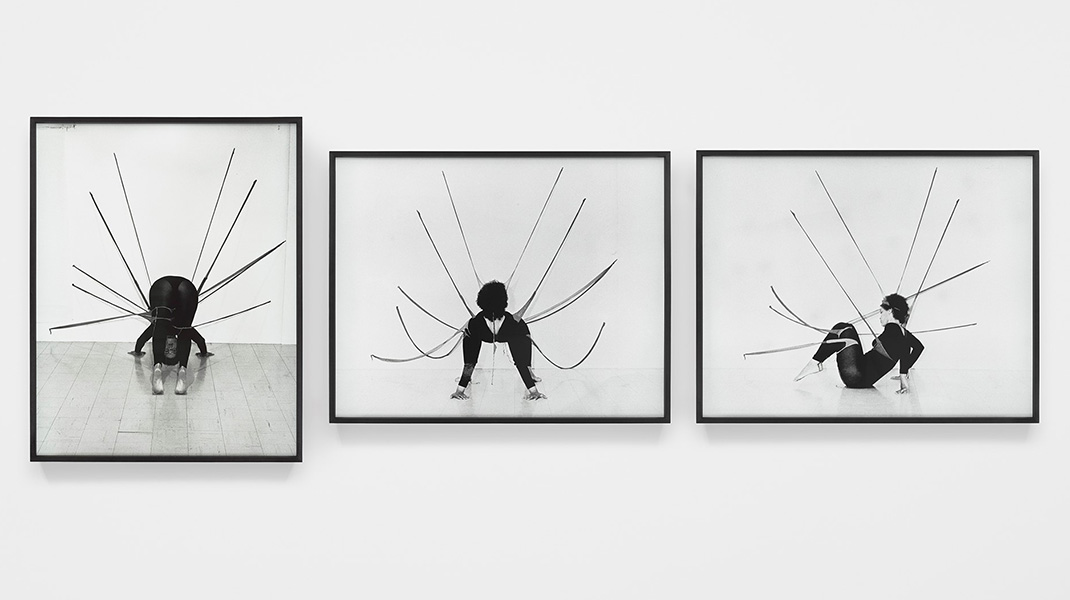
“The Philadelphia Museum of Art will be the only East Coast venue for a major traveling exhibition devoted to Senga Nengudi, a leading figure of the 1970s Black American avant-garde and a pioneering artist of our time. Marked by her innovative use of everyday materials that range from water and sand to pantyhose and air conditioning units, Nengudi’s work bridges the mediums of sculpture and performance, offering a cross-disciplinary investigation into the personal experiences of the Black female body and the collective practices of community and ritual. Senga Nengudi: Topologies will trace the expansive range of the artist’s career and context from the 1970s to today through a combination of more than 70 artworks, including sculptures, environmental installations, and archival documentation. Shown together, they affirm Nengudi’s pivotal role in redefining the possibilities of sculpture and abstraction, and exemplify the continuing vitality and urgency of her practice. The exhibition will be presented in the museum’s Dorrance Special Exhibition Galleries and is accompanied by a major catalogue.” — Philadelphia Museum of Art

 “My art responds to being Black, being a woman, and being of a certain age. The artworks you’ll see on display represent someone who has had children, cared for her mother, and experienced many of the things life has to offer.” — Senga Nengudi

“Water Composition I,” 1970; reconstructed 2020 by Senga Nengudi. © Senga Nengudi.
“Inside/Outside,” 1977 by Senga Nengudi. Städtische Galerie im Lenbachhaus und Kunstbau München, Sammlung KiCo. © Senga Nengudi.
“Rubber Maid,” 2011 by Senga Nengudi Collection of Amy Gold and Brett Gorvy. Thomas Erben Gallery, New York; Lévy Gorvy, New York and London. © Senga Nengudi.
“Untitled contact sheet,” 1977 by Senga Nengudi. Senga Nengudi Papers, Amistad Research Center, New Orleans, La. © Senga Nengudi.
“Performance Piece” (detail), 1977 by Senga Nengudi. Activated by Maren Hassinger. Photograph by Harmon Outlaw. Städtische Galerie im Lenbachhaus und Kunstbau München, Sammlung KiCo. © Senga Nengudi.
“Performance Piece,” 1977 by Senga Nengudi. Activated by Maren Hassinger. Photographs by Harmon Outlaw. Courtesy of Sprüth Magers, Thomas Erben Gallery, and Lévy Gorvy. © Senga Nengudi.
“Untitled,” 1977 by Senga Nengudi. Archives of American Art, Smithsonian Institution, Senga Nengudi Papers, 1948–2016. © Senga Nengudi.
“Study for Mesh Mirage,” 1978 by Senga Nengudi. Photograph by Adam Avila. Courtesy of ProWinkoProArt Collection. © Senga Nengudi.
“Ceremony for Freeway Fets” (detail), 1978 by Senga Nengudi. Photograph by Roderick Kwaku Young. Städtische Galerie im Lenbachhaus und Kunstbau München, Sammlung KiCo © Senga Nengudi.
“Masked Taping,” 1978/79 by Senga Nengudi. Photograph by Adam Avila. Denver Art Museum: Purchased with funds from Contemporary Alliance, 2020.565A-C. Courtesy of Sprüth Magers, Thomas Erben Gallery, and Lévy Gorvy. © Senga Nengudi.
“A.C.Q. I,” 2016-2017 by Senga Nengudi. Denver Art Museum: Purchased with funds from the Contemporary Collectors’ Circle with additional support from Vicki and Kent Logan, Catherine Dews Edwards and Philip Edwards, Craig Ponzio, and Ellen and Morris Susman, 2020.566.1-3. © Senga Nengudi.
“Warp Trance” (detail), 2007 by Senga Nengudi, in collaboration with The Fabric Workshop and Museum, Philadelphia. Multi-channel audio/video installation. Sound composition by Butch Morris. Photograph by Aaron Igler. Photo courtesy of the artist and The Fabric Workshop and Museum.
Portrait of Senga Nengudi, 2014. Photo © Ron Pollard, courtesy of Senga Nengudi.

Timothy Rub, The George D. Widener Director and Chief Executive Officer of the Philadelphia Museum of Art, said: “We are delighted to bring this beautiful exhibition to Philadelphia as it culminates a wonderful itinerary that included Germany, Brazil, and Denver. It presents us with a rare opportunity to explore the artist’s extraordinary development in its full depth and breadth, and by placing her achievements into such a rich context we can see clearly just how salient her art continues to be for us today.”

Amanda Sroka, Assistant Curator of Contemporary Art and organizer of the Philadelphia Museum of Art exhibition, said: “Marking the grand finale of this international traveling exhibition, the presentation at the Philadelphia Museum of Art stands as a celebration of Senga Nengudi’s place in the history of art and a testimony to the enduring relevance of her work in the present. Generous in spirit and radical in form, Nengudi’s artworks offer an invitation for connection—with ourselves, with one another, and with the world.”

The Organizing Curator is Stephanie Weber, Curator for Contemporary Art, Lenbachhaus Munich. In Philadelphia, the exhibition is curated by Amanda Sroka, Assistant Curator of Contemporary Art, with support from Alexis Assam, Constance E. Clayton Fellow.

Images courtesy Philadelphia Museum of Art.

Lonnie Holley: Tangled Up in De Kooning’s Fence at South Etna Montauk, May 1 – August 29, 2021

“On May 1st, the newly formed non-profit South Etna Montauk Foundation will launch its 2021 exhibition program with Lonnie Holley: Tangled Up in De Kooning’s Fence, an exhibition of new works created by the venerated Alabama-born artist during his recent residency at the Elaine de Kooning House in East Hampton. An astonishingly prolific polymath who is equally accomplished in sculpture, painting, experimental music, poetry, film, video, and performance, Holley used the winter 2020 residency on Long Island – a period of rare solitude for the peripatetic artist during the COVID-19 pandemic lockdown – to experiment with and extend his visual language. By drawing inspiration for his breakthroughs from the unique atmosphere of the East End, Holley’s work suggests connections in the narrative of American art between the inventive ‘craft’ traditions of Southern African-American artmaking, and the breakthroughs of the 20th century modernists who lived and painted in the Hamptons.” — South Etna Montauk

Lonnie Holley, Removal of the Shadows, 2020. Enamel and mixed media on canvas; 58 x 103 in (147.3 x 261.6 cm). Courtesy the artist and South Etna Montauk Foundation.
Lonnie Holley, The River of Tears, 2020. Acrylic and mixed media on wood panel; 48 x 48 in (121.9 x 121.9 cm).
Lonnie Holley, She Wore Our Chains, 2020. Framed found photograph with spray paint and mixed media; 19 1/4 x 15 1/4 in (48.9 x 38.7 cm). Courtesy the artist and South Etna Montauk Foundation.
Lonnie Holley, Down in the Country Where the Old Things Remain, 2020. Acrylic and spray paint, quilted fabric stretch over wood panel; 48 x 48 in (121.9 x 121.9 cm). Courtesy the artist and South Etna Montauk Foundation.
Lonnie Holley, From Nothing to Everything, 2020. Acrylic and spray paint, quilted fabric stretch over wood panel; 48 x 48 in (121.9 x 121.9 cm). Courtesy the artist and South Etna Montauk Foundation.
Lonnie Holley, Without Skin, 2020. Acrylic and spray paint, quilted fabric stretch over wood panel; 48 x 48 in (121.9 x 121.9 cm). Courtesy the artist and South Etna Montauk Foundation.
Lonnie Holley, Reaching Towards the Power, 2020. Spray-paint and mixed media; 11 x 15 in (27.9 x 38.1 cm). Courtesy the artist and South Etna Montauk Foundation.
Lonnie Holley, She Was As Wild As Her Garden (Elaine), 2020. Spray-paint and mixed media; 22 x 30 in (55.9 x 76.2 cm). Courtesy the artist and South Etna Montauk Foundation.
Lonnie Holley, The Children of the Plantation (Me, Mary, and Jennie), 2020. Spray-paint and mixed media; 22 1/2 x 30 1/2 in (57.1 x 77.5 cm). Courtesy the artist and South Etna Montauk Foundation.
Portrait of Lonnie Holley in East Hampton. Photo: Katherine McMahon. Courtesy the artist and South Etna Montauk Foundation.

Lonnie Holley: Tangled Up in De Kooning’s Fence is curated by Alison M. Gingeras.

The exhibition coincides with Everything That Wasn’t White, Holley’s solo exhibition at the Parrish Art Museum in Watermill, April 24 – September 6, 2021. Both exhibitions feature a range of paintings, sculptures, and works on paper that Holley made over the course of his residency on the East End.

Bruce McCall’s New York at New-York Historical Society, April 23 – August 15, 2021

“Showcasing the vibrant and humorous work of the prolific artist, Bruce McCall’s New York presents colorful visions of a fantastical version of New York City—where pterodactyls fly down Central Park West, King Kongs wait to audition for the role of a lifetime, rooftop farms reach far up into the sky, and ubiquitous orange parking tickets are part of the fall foliage. On view in the Pam and Scott Schafler Gallery at the New-York Historical Society and curated by Associate Curator of Exhibitions Cristian Petru Panaite, Bruce McCall’s New York features more than 40 zany paintings that transport visitors to an often retro-futuristic New York and invite them to ponder what the city is or could be.

Canadian-born author and artist Bruce McCall (b. 1935), who moved to New York City in 1964, has contributed to virtually every prominent magazine in North America, including Esquire and Vanity Fair, and was a member of the original National Lampoon. McCall has been a regular contributor to The New Yorker, where he has created more than 75 covers over four decades, a third of which are on display along with several never-before-seen progress drawings.” — New-York Historical Society

Bruce McCall, Polar Bears on 5th Avenue, 2013. Cover for The New Yorker, January 13, 2014. Gouache on board. Collection of John Freund and Linda Grais. Image courtesy of Bruce McCall.
Bruce McCall, Open Season, 2011. Cover for The New Yorker, November 7, 2011. Gouache on board. Collection of Lisa Ford. Image courtesy of Bruce McCall.
Bruce McCall, Easter Morning, 1999. Cover for The New Yorker, April 5, 1999. Gouache on board. Collection of Barbara and Frank Peters. Image courtesy of Bruce McCall.
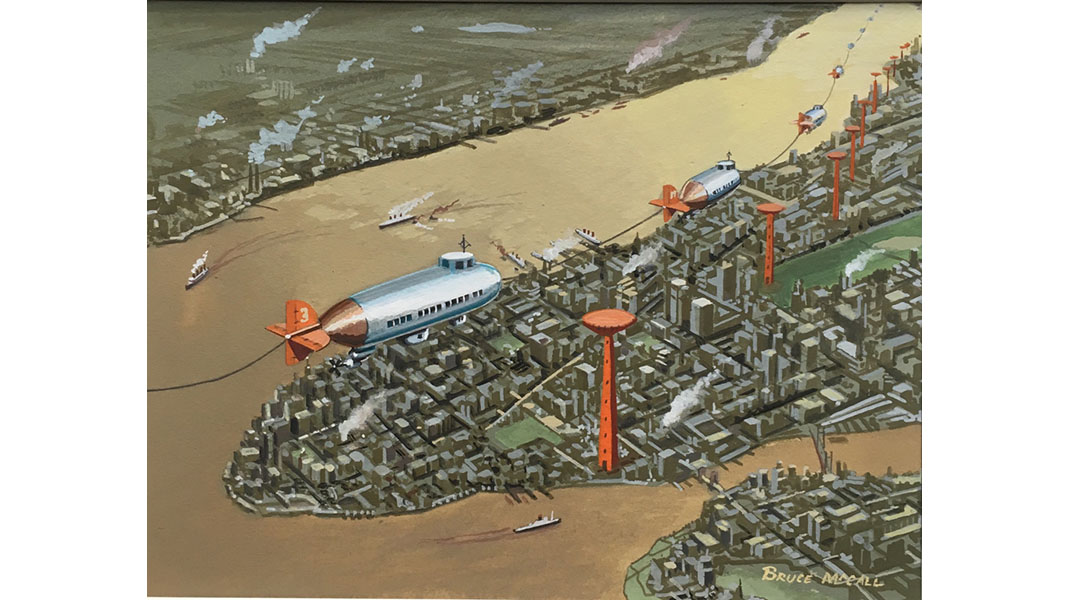
Bruce McCall, Zepp-Liner Over Manhattan, 2001. From “New York’s Transportation Future Is Coming Tomorrow,” The New Yorker, February 19, 2001. Gouache on board. Collection of Bruce McCall. Image courtesy of Bruce McCall.
Bruce McCall, King Kong Call, 1994. Cover for The New Yorker, January 23, 1995. Gouache on board. Collection of the Goodman Family. Image courtesy Bruce McCall.
Bruce McCall, Drawing stage for “Times Square Pasture,” 201. Pastel and ink on paper. Collection of Bruce McCall.
Bruce McCall, Opening Day, 2009. Cover for The New Yorker, March 30, 2009. Gouache on board. Collection of Lisa Ford. Image courtesy of Bruce McCall.
New York to the World mural as seen from 8th Avenue, ca. 2005. Image courtesy of Bruce McCall.
Bruce McCall, Moving Day, 2015. Cover for The New Yorker, February 2, 2015. Gouache on board.Collection of Ron Chernow. Image courtesy of Bruce McCall.
Bruce McCall at his drawing board working on Moving Day, 2015. Courtesy of Bruce McCall.

Images courtesy New-York Historical Society.

Dawoud Bey at Whitney Museum of American Art, April 17 – October 3, 2021

“Dawoud Bey (b. 1953) is recognized as one of the most innovative and influential photographers of his generation. Since the beginning of his career, Bey has used his camera to visualize communities and histories that have largely remained underrepresented or even unseen. Starting with his earliest body of work, Harlem, USA(1975–79), Bey has worked primarily in portraiture, making direct and psychologically resonant portrayals of socially marginalized subjects. The exhibition includes his early portraits of Harlem residents, large-scale color Polaroids, and a series of collaborative portraits of high school students, among others. Two recent bodies of work, The Birmingham Project (2012) and Night Coming Tenderly, Black (2017), render American history in forms at once lyrical and immediate. He sees making art as not just a kind of personal expression but as an act of social and political engagement, emphasizing the necessary work of artists and art institutions to break down obstacles to access, to convene communities, and to open dialogue.” — Whitney Museum of American Art

Dawoud Bey, A Boy in Front of the Loew’s 125th Street Movie Theater, Harlem, NY, 1976. Gelatin silver print, 14 x 11 in. (35.6 x 27.9 cm). © Dawoud Bey and courtesy of the artist, Sean Kelly Gallery, Stephen Daiter Gallery, and Rena Bransten Gallery.
Dawoud Bey, Three Women at a Parade, Harlem, NY, 1978. Gelatin silver print, 11 x 14 in. (27.9 x 35.6 cm). © Dawoud Bey and courtesy of the artist.
Dawoud Bey, A Young Man Resting on an Exercise Bike, Amityville, NY, 1988. Inkjet print, 30 x 40 in. (76.2 x 101.6 cm). © Dawoud Bey and courtesy of the artist, Sean Kelly Gallery, Stephen Daiter Gallery, and Rena Bransten Gallery.
Dawoud Bey, Two Girls from a Marching Band, Harlem, NY, 1990. Inkjet print, 30 x 40 in. (76.2 x 101.6 cm). © Dawoud Bey and courtesy of the artist, Sean Kelly Gallery, Stephen Daiter Gallery, and Rena Bransten Gallery.
Dawoud Bey, Hilary and Taro, 1992. Two dye diffusion transfer prints (Polaroids), 30 1/8 × 44 in. (76.5 × 111.8 cm). Whitney Museum of American Art, New York; purchase, with funds from the Photography Committee. © Dawoud Bey.
Dawoud Bey, Martina and Rhonda, 1993. Six dye diffusion transfer prints (Polaroid), 48 × 60 in. (121.9 × 152.4 cm). Whitney Museum of American Art, New York; gift of Eric Ceputis and David W. Williams 2018.82a-f. © Dawoud Bey.
Dawoud Bey, Gerard, Edgewater High School, Orlando, FL (2003). Inkjet print, 40 x 32 in. (101.6 x 81.3 cm). © Dawoud Bey and courtesy of the artist, Sean Kelly Gallery, Stephen Daiter Gallery, and Rena Bransten Gallery.
Dawoud Bey, Usha, Gateway High School, San Francisco, CA, 2006. Inkjet print, 40 x 32 in. (101.6 x 81.3 cm). © Dawoud Bey and courtesy of the artist, Sean Kelly Gallery, Stephen Daiter Gallery, and Rena Bransten Gallery.
Dawoud Bey, Don Sledge and Moses Austin, Birmingham, AL, 2012. Inkjet prints, 40 x 64 in. (101.6 cm x 162.56). Rennie Collection, Vancouver. © Dawoud Bey.
Dawoud Bey, Betty Selvage and Faith Speights, Birmingham, AL, 2012. Inkjet prints, 40 x 64 in. (101.6 cm x 162.56). Rennie Collection, Vancouver. © Dawoud Bey.
Dawoud Bey, Mathis Menefee and Cassandra Griffin, Birmingham, AL, 2012. Inkjet prints, 40 x 64 in. (101.6 cm x 162.56). Rennie Collection, Vancouver. © Dawoud Bey.
Dawoud Bey, Untitled #20 (Farmhouse and Picket Fence I), 2017. Gelatin silver print, 44 x 55 in. (111.8 x 139.7 cm). Collection of the San Francisco Museum of Modern Art; Accessions Committee Fund purchase. © Dawoud Bey.
Dawoud Bey, Girls, Ornaments, and Vacant Lot, 2016. Inkjet print, 40 3/8 x 48 1/4 x 2 in. (102.6 × 122.6 × 5.1 cm). © Dawoud Bey and courtesy of the artist, Sean Kelly Gallery, Stephen Daiter Gallery, and Rena Bransten Gallery.
Dawoud Bey, Tourists, Abyssinian Baptist Church, 2016. Inkjet print, 40 3/8 x 48 1/4 x 2 in. (102.6 × 122.6 × 5.1 cm). © Dawoud Bey and courtesy of the artist, Sean Kelly Gallery, Stephen Daiter Gallery, and Rena Bransten Gallery.

Dawoud Bey: An American Project is co-organized by the Whitney Museum of American Art and the San Francisco Museum of Modern Art. The exhibition is co-curated by Elisabeth Sherman, assistant curator at the Whitney, and Corey Keller, curator of photography at SFMOMA.

Images courtesy Whitney Museum of American Art.

Daniel Spoerri at Bank Austria Kunstforum Wien, through June 27, 2021*

“The Bank Austria Kunstforum Wien is dedicating a comprehensive retrospective to Daniel Spoerri. Born in 1930 in Galaţi/Romania as Daniel Feinstein, he emigrated to Zurich in 1942 – after his father had been murdered in during a Romanian pogrom. Today he lives and works in Vienna after stations in Paris, New York, Symi, Toggwil (Ueberstorf), Düsseldorf and more. In the Il Giardino di Daniel Spoerri in Seggiano in Tuscany, since 1997 he has also been addressing the sculptural work of fellow artists, including Eva Aeppli, Meret Oppenheim, Nam June Paik, Niki de Saint Phalle and Jean Tinguely. With his Snare Pictures (French: Tableaux piège), continuously developed since 1960, Spoerri inscribed himself into the history of art. The exhibition in the Bank Austria Kunstforum Wien enlarges the perspective on this artist and inspired collector who works in almost all artistic media and whose diverse work has focused for the last sixty years on social interactions and the sensuous perception of everyday things – especially pertaining to people’s sense of taste. Besides his assemblages and collages composed of everyday materials, the exhibition will also present his bronze sculptures produced as of 1970, the works related to script and textiles, and his actions, often performed in collaboration with other artists.” — Bank Austria Kunstforum

#26 Flohmarkt Wien, April 2016 (What remains) 2016. Assemblage of various objects, 110 × 140 × 27 cm. Private collection © Daniel Spoerri and Bildrecht, Vienna 2021. Photo: © the artist and Galerie Krinzinger
Rat’s Nest, 1977. Assemblage of various objects, 43 × 42,5 × 12,7 cm. Kunsten Museum of Modern Art Aalborg © Daniel Spoerri and Bildrecht, Vienna 2021.
Photo: © Niels Fabaek
Fluxus Pegasus, 1987. Assemblage of rug, electric light, horse head (acrylic paint on plaster), horsehair, shells and metal on wood, 99 × 145 × 35 cm. Courtesy of Conz Archive, Berlin © Daniel Spoerri and Bildrecht, Vienna, 2021. Photo: Giorgia Palmisano
Santo Grappa, 1971. Bronze cast of chair, cow skull and shoe, 160 × 41 × 64 cm. Museum of Modern Art Ludwig Foundation, Vienna, formerly acquired from the Hahn Collection, Cologne 2003 © Daniel Spoerri and Bildrecht, Vienna, 2021. Photo: © mumok – Museum of Modern Art Ludwig Foundation Vienna, formerly Hahn Collection, Cologne
Tableau piège (Restaurant Spoerri), 1972. Assemblage of tableware and food scraps on blue paper tablecloth, 70 × 70 × 40 cm. Bündner Kunstmuseum Chur, purchase
© Daniel Spoerri and Bildrecht, Vienna, 2021. Photo: Bündner Kunstmuseum Chur
Tableau piège (Restaurant Spoerri), 1970/1971. Assemblage of tableware, glasses, cutlery, napkins, remains of candles, food scraps and an ashtray containing cigarette butts, 71 × 71 × 34,5 cm. Kunstpalast, Düsseldorf © Daniel Spoerri and Bildrecht, Vienna, 2021. Photo: © Kunstpalast – ARTOTHEK
Restaurant de la City-Galerie , 1965. Assemblage of various objects on chipboard, 120 × 120 × 40 cm. Friedrich Christian Flick Collection in Hamburg Train station, Berlin © Daniel Spoerri and Bildrecht Vienna, 2021. Photo: Stefan Rötheli, Zurich
Object II of the cycle Objets de magie à la noix, 1966/1967. Assemblage of different objects, 43 x 65.2 x 26.8 cm. Museum Morsbroich, Leverkusen © Daniel Spoerri and Bildrecht, Vienna 2021. Photo: © Museum Morsbroich, Leverkusen
La Pharmacie Bretonne, 1972–1977. 117 labelled glass bottles filled with holy water, in a triptych with wings each divided into three parts offen | open: 119,7 × 88,5 × 8,4 cm geschlossen | closed: 119,7 × 44,5 × 16,8 cm. Museum of Modern Art Foundation Ludwig, Vienna, formerly Hahn Collection, Cologne © Daniel Spoerri and Bildrecht, Vienna 2021. Photo: © mumok – Museum of Modern Art Ludwig Foundation Vienna, formerly Hahn Collection, Cologne
Se laisser manger la laine sur le dos, 1965. Assemblage of various objects, 100 × 100 × 29 cm. Bischofberger Collection, Männedorf-Zurich, Switzerland © Daniel Spoerri and Bildrecht Vienna, 2021
Palette for Grégoire Müller, 1992. Assemblage of paint tubes, empty terpentine bottles, cleaning rags and various objects on wood, 92 × 214 × 20 cm. ZKM | Center for Art and Media Karlsruhe © Daniel Spoerri and Bildrecht, Vienna 2021. Photo: © Tilman Daiber
Daniel Spoerri. Room No 13, 1998. Bronze, 2.5 x 3 x 5 m. Fondazione Il Giardino di Daniel Spoerri © Daniel Spoerri and Bildrecht, Vienna 2021. Photo: © Susanne Neumann

Exhibition was curated by Veronika Rudorfer.

Images courtesy Bank Austria Kunstforum.

*Please note that the Bank Austria Kunstforum exhibiton house is currently closed due to lockdown.

Marginalia. Inside the Comics Art Collections at Nouveau Musée National de Monaco (NMNM)- Villa Sauber, April 1 – September 5, 2021

Marginalia. Inside the Comics Art Collections is an exploration of comic book art, a young art born at the same time as film and psychoanalysis, and which has frequently opted for marginality over convention, humour over academicism and counter-culture over received ideas.

Built around rare loans from public and private collections, the exhibition offers a chance to rethink the relationship between comic books and their acceptance by institutions, or how a medium that has always been split between counter-culture and mass culture has entered the museum space without giving up its transgressive vocation or boosting its commoditisation.

Following Freud’s traumarbeit (dream-work) model, Marginalia. Inside the Comics Art Collections invites visitors to discover over 350 works by some of the greatest comic book artists and honours the passion of those who find their work an endless source of fascination.

Marginalia are the small drawings located in the margins of Medieval manuscripts. Often secular, sometimes droll, always fascinating, they form a dialogue with the texts that they illuminate, explain or criticise and can be seen as the origins of comic books, a combination of drawing and writing which blossomed in the 20th century.” — NMNM

Guido Crepax. Marina, ca. 1969/1972. Ink and graphite on paper, 18,5 x 40,5 cm. Private collection, Paris © Archivio Crepax e Guido Crepax
Jochen Gerner. La Main au Collet, 2016. Acrylic on printed backing, 60 x 42 cm. Collection NMNM, n°2016.20.1 © Jochen Gerner © ADAGP, Paris, 2021. Photo credit: NMNM / François Fernandez
George Herriman. Krazy Kat, 1921. Ink on paper, 57 × 50 cm. Private collection, Paris © D.R.
George Herriman, Krazy Kat , ca. 1969/1972. Ink on paper, 42 x 52 cm. Private collection, Paris © D.R.
Milo Manara. Un Eté Indien, 1987 (scénario d’Hugo Pratt). Ink and watercolor on paper, 52,5 x 42 cm. Private collection, Paris © Milo Manara
Mandryka. Concombre masqué, s.d. Ink on paper, 50 x 42,5 cm. Private collection, Paris © Mandryka
Jean-Claude Mézières. Paris sera toujours Paris, 1999 (scénario de Pierre Christin). Ink on paper, 44 x 55 cm. Private collection, Paris © Jean-Claude Mézières
Richard Felton Outcault. The Yellow Kid , 1896. Ink on paper, 31 x 53 cm. Private collection, Paris © DR
Peyo. Les Schtroumpfs, 1939.Ink on paper, 51,5 x 40,5 cm. Private collection, Paris ©Peyo – 2021 – Licensed through I.M.P.S (Brussels) – http://www.smurfs.com
Benjamin Rabier. Le Tango, 1914. Ink on paper, 32 x 42 cm. Private collection, Paris © DR
François Schuiten. Les Cités Obscures. Couverture de l’Intégrale, volume 1 , 2017 (text by Benoît Peeters). Acrylic and graphite on paper, 44 x 57 cm. Private collection, Paris © François Schuiten
François Schuiten. Les Cités Obscures – L’ombre d’un doute, 2000 (text by Benoît Peeters). Acrylic and graphite on paper, 65 x 50 cm. Private collection, Paris © François Schuiten

Sempé. Untitled, s.d. Ink on paper, 34,5 x 31 cm. Private collection, Paris © J.J. Sempé – Courtesy of Galerie Martine Gossieaux

Exhibition Curator: Marie-Claude Beaud, Guest Curator: Damien MacDonald, Associate Curator: Stéphane Vacquier, Scientific Adviser: Didier Pasamonik, Scenography: Berger & Berger (Laurent P. Berger and Cyrille Berger).

Images courtesy Nouveau Musée National de Monaco.