Another Tradition: Drawings by Black Artists from the American South at The Morgan Library & Museum, September 24, 2021 – January 16, 2022

“In the last three decades, exhibitions and publications have established the rightful place of figures such as Dial and the quilters of Gee’s Bend, Alabama, in the canon of twentieth-century art. The focus has often been on the impressive works of assemblage—whether of found objects or fabric—that have emerged from the Southern United States. Artists only one or two generations removed from slavery, and subjected to the abuses of Jim Crow, developed ingenious formal techniques using found materials and skills learned outside the classroom and studio. Many, like Dial, Rowe, and Holley, exhibited their creations at their homes in elaborate ‘yard shows,’ drawing the attention of passersby and art-world figures alike.  

Another Tradition focuses on the genre of drawing, which, like assemblage, is an art of ‘making do.’ Its accessibility and directness have always appealed to both artists and their audiences. While some works in the exhibition were produced on traditional artist’s papers, others incorporate the unique qualities of found supports. The range of media includes watercolor, ballpoint pen, crayon, and even glitter. But the impact of these works ultimately transcends their innovative means. Although each of the eight artists represented speaks with a distinctive voice, the intimate space of the Morgan’s Thaw Gallery illuminates formal and thematic connections that arise from their shared geographies and experiences.” — The Morgan Library & Museum

Thornton Dial (1928 – 2016). Posing Movie Stars Holding the Freedom Bird, 1991. Watercolor and graphite on wove paper. 30 × 22 in. (76.2 × 55.9 cm). The Morgan Library & Museum, Gift of the Souls Grown Deep Foundation from the William S. Arnett Collection and purchase on the Manley Family Fund, 2018.97r. Photography by Janny Chiu, © Thornton Dial / Artists Rights Society (ARS), New York.
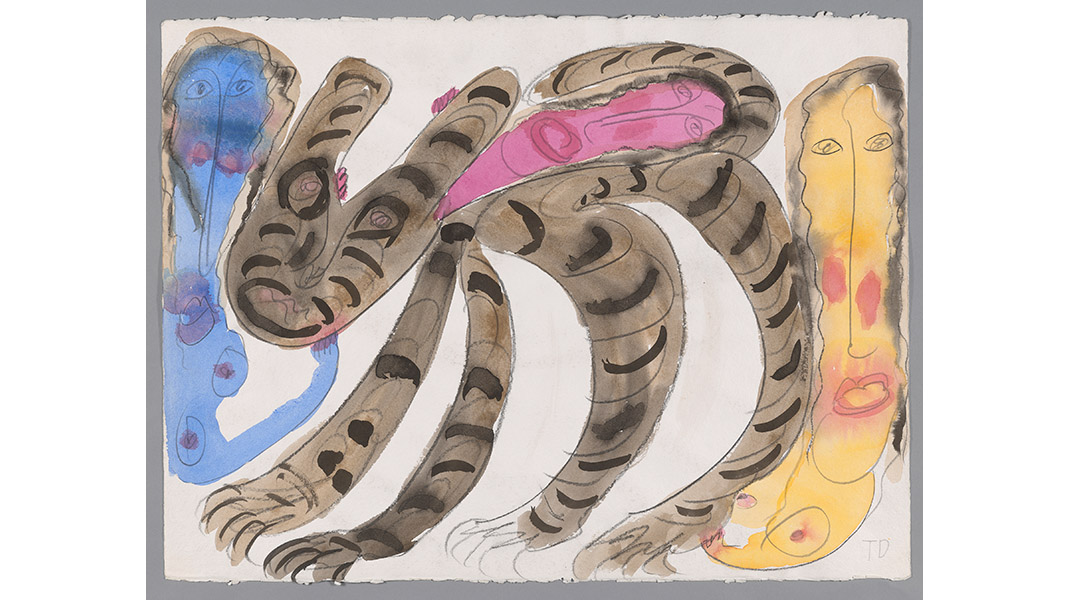
Thornton Dial (1928 – 2016). Ladies Stand by the Tiger, 1991. Watercolor, graphite, and fabricated black chalk on wove paper. 22 1/2 × 29 7/8 in. (57.2 × 75.9 cm). The Morgan Library & Museum, Gift of the Souls Grown Deep Foundation from the William S. Arnett Collection and purchase on the Manley Family Fund, 2018.98r. Photography by Janny Chiu, © Thornton Dial / Artists Rights Society (ARS), New York.
Nellie Mae Rowe (1900 – 1982). Untitled, 1978. Porous-point pen on black and white photographic print mounted on wove paper, mounted on plywood, with additions of white paint and oil pastel. 14 1/2 × 14 3/4 in. (36.8 × 37.5 cm). The Morgan Library & Museum, Gift of the Souls Grown Deep Foundation from the William S. Arnett Collection and purchase on the Manley Family Fund, 2018.100r. Photography by Janny Chiu.© 2021 Estate of Nellie Mae Rowe / Artists Rights Society (ARS), New York.
Nellie Mae Rowe (1900 – 1982). Untitled (Woman Talking to Animals), 1981. Black ballpoint pen, black porous-point pen, wax crayon, water-soluble oil pastel, and graphite on wove paper. 24 × 19 in. (61 × 48.3 cm). The Morgan Library & Museum, Gift of the Souls Grown Deep Foundation from the William S. Arnett Collection and purchase on the Manley Family Fund, 2018.101r. Photography by Janny Chiu. © 2021 Estate of Nellie Mae Rowe / Artists Rights Society (ARS), New York.
Henry Speller (1903 – 1997). Courthouse, 1986. Wax crayon, porous-point pen, and graphite on wove paper. 18 × 24 in. (45.7 × 61 cm). The Morgan Library & Museum, Gift of the Souls Grown Deep Foundation from the William S. Arnett Collection and purchase on the Manley Family Fund, 2018.102r. Photography by Janny Chiu.
Henry Speller (1903 – 1997). Glorie Jean and Her Friends, 1987. Porous-point pen, wax crayon, and graphite on wove paper. 18 × 24 in. (45.7 × 61 cm). The Morgan Library & Museum, Gift of the Souls Grown Deep Foundation from the William S. Arnett Collection and purchase on the Manley Family Fund, 2018.103r. Photography by Janny Chiu.
Luster Willis (1913 – 1990). Untitled, 1950s. Water-based paint on fabric. 19 1/2 × 17 in. (49.5 × 43.2 cm). The Morgan Library & Museum, Gift of the Souls Grown Deep Foundation from the William S. Arnett Collection and purchase on the Manley Family Fund, 2018.104. Photography by Janny Chiu. © 2021 Estate of Luster Willis / Artists Rights Society (ARS), New York.
Luster Willis (1913 – 1990). Standing Together, 1986. Tempera paint, glitter, glue, blue ballpoint pen, and graphite pencil on wove paper. 20 × 12 1/4 in. (50.8 × 31.1 cm). The Morgan Library & Museum, Gift of the Souls Grown Deep Foundation from the William S. Arnett Collection and purchase on the Manley Family Fund, 2018.105. Photography by Janny Chiu. © 2021 Estate of Luster Willis / Artists Rights Society (ARS), New York.
Purvis Young (1943 – 2010). Untitled. 1980s. Ink, watercolor, and crayon on collage of printed papers (recto and verso). 22 × 15 1/2 in. (55.9 × 39.4 cm). The Morgan Library & Museum, Gift of Daniel Aubry, 2017.389. Photography by Janny Chiu. © Larry T. Clemons / Gallery 721 / Artists Rights Society (ARS), New York.
Purvis Young (1943 – 2010). Sometimes I Get Emotion from the Game, early 1980s. Ballpoint and porous-point pen, on paper glued to found book. 12 1/4 × 17 3/4 in. (31.1 × 45.1 cm). The Morgan Library & Museum, Gift of the Souls Grown Deep Foundation from the William S. Arnett Collection and purchase on the Manley Family Fund, 2018.106. Photgoraphy courtesy of the Souls Grown Deep Foundation. © Larry T. Clemons / Gallery 721 / Artists Rights Society (ARS), New York.

“The acquisition of eleven works from the Souls Grown Deep Foundation in 2018 profoundly enriched our collection of modern and contemporary drawings,” said exhibition curator Rachel Federman, the Morgan’s Associate Curator of Modern and Contemporary Drawings. “Black artists from the South have contributed tremendously to the visual culture of the United States with extraordinary quilts and assemblage sculptures, but also, as this exhibition makes clear, in the realm of drawing.”

Images courtesy The Morgan Library & Museum.

Shigeko Kubota: Liquid Reality at The Museum of Modern Art, through January 1, 2022

“The Museum of Modern Art presents Shigeko Kubota: Liquid Reality, on view from August 21, 2021, through January 1, 2022. Likening video technology to a ‘new paintbrush,’ New York–based Shigeko Kubota (Japanese, 1937– 2015), whose career spanned more than five decades, was one of the first artists to commit to the video medium in the early 1970s. Formally trained as a sculptor, Kubota’s varied accomplishments as an artist, collaborator, curator, and critic helped to shape a pivotal period in the evolution of video as an art form. Shigeko Kubota: Liquid Reality is organized by Erica Papernik-Shimizu, Associate Curator, with the support of Veronika Molnar, Intern, Department of Media and Performance.

MoMA’s presentation takes its name from Kubota’s observation that, ‘[In] video’s reality, infinite variation becomes possible…freedom to dissolve, reconstruct, mutate all forms, shape, color, location, speed, scale…liquid reality.’ Featuring works from MoMA’s collection and key loans from the Shigeko Kubota Video Art Foundation, this exhibition highlights six intrepid video sculptures from a critical decade between 1976 and 1985, during which Kubota pivoted from her sculptural reinterpretations of works by artist Marcel Duchamp to her ‘autobiographical objects.” — MoMA

Shigeko Kubota. Berlin Diary: Thanks to My Ancestors. 1981. Cathode-ray tube monitor, crystal, ink, and twine. 9 × 8 × 11 in. (22.9 × 20.3 × 27.9 cm). The Museum of Modern Art, New York. The Modern Women’s Fund, 2021. © 2021 Estate of Shigeko Kubota / Licensed by VAGA at Artists Rights Society (ARS), NY. Courtesy Galerie Hubert Winter, Vienna. Digital Image © 2021 The Museum of Modern Art, New York. Photo by Denis Doorly.
Shigeko Kubota. Self-Portrait. ca. 1970- 71. Standard-definition video (color, silent). 5:24 min. The Museum of Modern Art, New York. Gift of the Shigeko Kubota Video Art Foundation, 2021. © 2021 Estate of Shigeko Kubota / Licensed by VAGA at Artists Rights Society (ARS), NY.
Shigeko Kubota. Duchampiana: Nude Descending a Staircase (1976). Standard-definition video and Super 8mm film transferred to video (color, silent; 5:21 min.), four cathode-ray tube monitors, and plywood. 66 1/4 × 30 15/16 × 67 in. (168.3 × 78.6 × 170.2 cm). The Museum of Modern Art, New York. Gift of Margot and John Ernst, Agnes Gund, and Barbara Pine, 1981. Artwork © 2021 Estate of Shigeko Kubota / Licensed by VAGA at Artists Rights Society (ARS), NY. Digital image © 2021 The Museum of Modern Art, New York. Photo by Denis Doorly.
Installation view of Shigeko Kubota: Liquid Reality, August 21, 2021–January 1, 2022 at The Museum of Modern Art, New York. Digital Image © 2021 The Museum of Modern Art, New York. Photo by Denis Doorly.
Shigeko Kubota. Three Mountains. 1976–79. Four-channel standard-definition video (color, sound; approx. 30 min. each), seven cathode-ray tube monitors, plywood, and mirrors, overall dimensions variable. Courtesy Shigeko Kubota Video Art Foundation. Artwork © 2021 Estate of Shigeko Kubota/Licensed by VAGA at Artists Rights Society (ARS), NY. Digital image © 2021 The Museum of Modern Art, New York. Photo by Denis Doorly.
Installation view of Shigeko Kubota: Liquid Reality, August 21, 2021–January 1, 2022 at The Museum of Modern Art, New York. Digital Image © 2021 The Museum of Modern Art, New York. Photo by Denis Doorly.
Shigeko Kubota. Detail of Niagara Falls I. 1985. Four-channel video (color, sound; 30:55 min.), ten cathode-ray tube monitors, plastic mirrors, plywood, water, and sprinkler system, 8 ft. × 54 in. × 8 ft. (243.8 × 137.2 × 243.8 cm). Courtesy Shigeko Kubota Video Art Foundation. © 2021 Estate of Shigeko Kubota / Licensed by VAGA at Artists Rights Society (ARS), NY. Digital image © 2021 The Museum of Modern Art, New York. Photo by Denis Doorly.
Shigeko Kubota. Video Haiku–Hanging Piece. 1981. Cathode-ray tube monitor, closed-circuit video camera, mirror, and plywood. Overall dimensions variable, mirror: 40 × 42 in. (101.6 × 106.7 cm). Courtesy Shigeko Kubota Video Art Foundation. Artwork © 2021 Estate of Shigeko Kubota / Licensed by VAGA at Artists Rights Society (ARS), NY. Digital image © 2021 The Museum of Modern Art, New York. Photo by Denis Doorly.
Shigeko Kubota. Detail of River. 1979-81. Three-channel standard-definition video (color, silent; approx. 32 min.), three cathode-ray tube monitors, stainless steel, plastic mirrors, water, and wave machine. Overall dimensions variable, basin: 22 × 9 × 4 ft. (670.6 × 274.3 × 121.9 cm). Courtesy Shigeko Kubota Video Art Foundation. Artwork © 2021 Estate of Shigeko Kubota / Licensed by VAGA at Artists Rights Society (ARS), NY. Digital image © 2021 The Museum of Modern Art, New York. Photo by Denis Doorly.

Associate Curator Erica Papernik-Shimizu explains, “Kubota’s ‘liquid reality’ positions video as both a total liberation from precedent and a way of life. Her visionary sculptures, through poetic contradictions and an economy of means, masterfully combine a bold interrogation of her own identity with prescient investigations of technology itself.”

Images courtesy The Museum of Modern Art.

Underground Modernist: E. McKnight Kauffer at Cooper Hewitt, Smithsonian Design Museum, September 10 – April 10, 2022

“Cooper Hewitt, Smithsonian Design Museum presents the largest-ever exhibition of works by E. McKnight Kauffer (American, 1890–1954), a pioneer of commercial art—the profession known today as graphic design. ‘Underground Modernist: E. McKnight Kauffer’ features some 200 objects to examine the designer’s impact and legacy across media.

Hailed in his lifetime as ‘the poster king,’ Kauffer brought design to many creative industries. He made modernism accessible by applying cutting-edge styles to designs for advertising, literature, theater, transportation and more. He adopted emerging avant-garde aesthetics in provocative ways to promote services and products.

Cooper Hewitt holds one of the most extensive collections of Kauffer’s designs in the world, comprising material in both the Drawings, Prints & Graphic Design department and the Archives department. The exhibition is organized by Caitlin Condell, associate curator and head of Drawings, Prints & Graphic Design at Cooper Hewitt, and Emily M. Orr, Ph.D., assistant curator of modern and contemporary American design at Cooper Hewitt.” — Cooper Hewitt

“The artist in advertising is a new kind of being,” Kauffer wrote in 1938. “His responsibilities are to my mind very considerable. It is his business constantly to correct values, to establish new ones, to stimulate advertising and help to make it something worthy of the civilization that needs it.”

Poster, A Subway Poster Pulls, 1947; Designed by E. McKnight Kauffer (American, 1890–1954); Published by New York Subway Advertising Company (New York, New York, USA); Screenprint; 76.2 × 116.8 cm (30 × 46 in.); Cooper Hewitt, Smithsonian Design Museum, Gift of Mrs. E. McKnight Kauffer, 1963-39-119; Photo: Matt Flynn © Smithsonian Institution
Costume design, Henry VIII for Catherine Parr, or Alexanderís Horse by Maurice Baring, 1925; Designed by E. McKnight Kauffer (American, 1890-1954); Brush and gouache, graphite; 47.3 x 31 cm (18 5/8 x 12 3/16 in.); Cooper Hewitt, Smithsonian Design Museum, Gift of Mrs. E. McKnight Kauffer, 1963-39-170; Photo: Matt Flynn © Smithsonian Institution
Poster, Soaring to Success! Daily Herald—the Early Bird, 1919; Designed by E. McKnight Kauffer (American, 1890–1954); Lithograph; Published by Daily Herald (London, England); Printed by T. B. Lawrence Ltd. (London, England); Courtesy of William W. Crouse
Poster, American Airlines to Paris, 1950; Published by American Airlines (Fort Worth, Texas); Lithograph; 107.1 × 79 cm (42 3/16 × 31 1/8 in.); Cooper Hewitt, Smithsonian Design Museum, Gift of Mrs. E. McKnight Kauffer, 1963-39-141; Photo: Matt Flynn © Smithsonian Institution
Poster, Aeroshell Lubricating Oil, 1932; Designed by E. McKnight Kauffer (American, 1890–1954); Published by Shell-Mex and BP Ltd. (London, England); Printed by Chorley & Pickersgill, Ltd. (London, England); Lithograph; 76.2 × 114.3 cm (30 × 45 in.); Merrill C. Berman Collection
Magazine cover, Harperís Bazaar, January 1940; designed ca. 1939; Designed by E. McKnight Kauffer (American, 1890-1954); Printed by Hazell, Watson & Viney (Aylesbury, England); Letterpress halftone; 33 x 25 cm (13 x 9 3/4 in.); Cooper Hewitt, Smithsonian Design Museum, Gift of Grace Schulman, 1997-134-1-8; Photo: Matt Flynn © Smithsonian Institution
Book cover, Invisible Man by Ralph Ellison, 1952; Published by Random House (New York, New York, USA); Lithograph; 21.5 × 14.5 cm (8 7/16 × 5 11/16 in.); Barbara Jakobson Collection; Photo: Matt Flynn © Smithsonian Institution
Poster, Power, The Nerve Centre of London’s Underground, 1930, printed 1931; Designed by E. McKnight Kauffer (American, 1890–1954); Published by Transport for London (London, England); Printed by Vincent Brooks, Day & Son (London, England); Lithograph; 101.6 × 61.4 cm (40 × 24 3/16 in.); Cooper Hewitt, Smithsonian Design Museum, Gift of Mrs. E. McKnight Kauffer, 1963-39-45; Photo: Matt Flynn © Smithsonian Institution
Book cover, Ulysses by James Joyce, 1922 (reprint ed. New York: Random House, 1949); Designed by E. McKnight Kauffer (American, 1890–1954); Lithograph; 21.2 × 14.5 cm (8 1/4 × 5 3/4 in.); Barbara Jakobson Collection; Photo: Matt Flynn © Smithsonian Institution
Poster, The Labour Woman, 1925; Published by Woman’s Labour League, Labour Party (England); Printed by London Caledonian Press Ltd. (London, England); Lithograph; 71.8 × 50.8 cm (28 1/4 in. × 20 in.); The Museum of Modern Art, New York, Gift of the designer, 1939; Digital Image © The Museum of Modern Art/Licensed by SCALA / Art Resource, NY
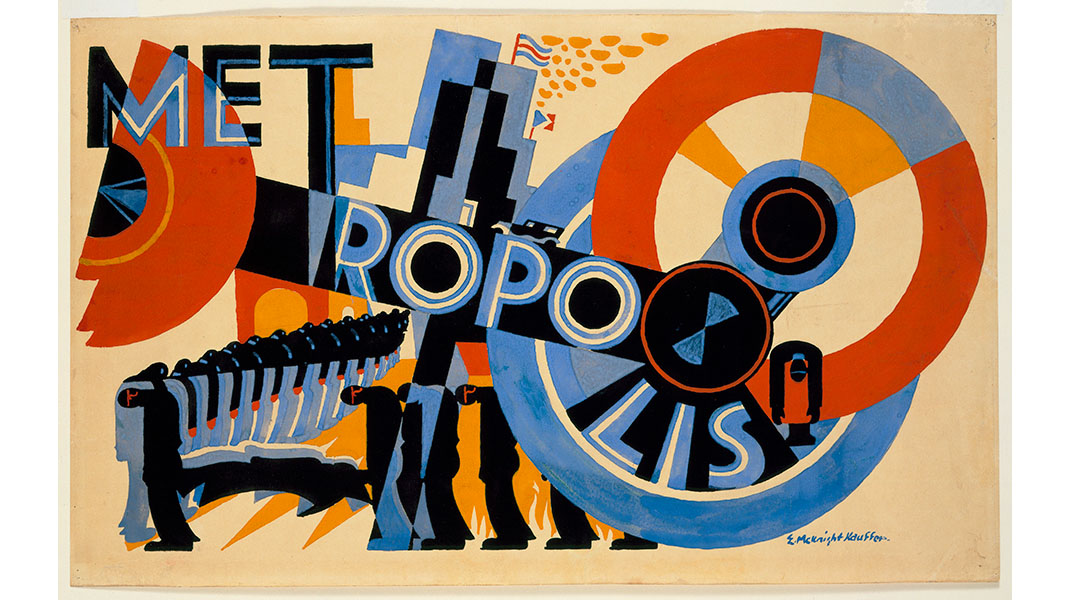
Drawing, Design for Metropolis by Fritz Lang, 1926; Brush and gouache; 74.9 x 43.2 cm (29 1/2 x 17 in.); The Museum of Modern Art, Given anonymously, 78.1961; Digital Image © The Museum of Modern Art/Licensed by SCALA / Art Resource, NY

“‘Underground Modernist’ reveals new stories and research to position Kauffer not simply as a designer of posters, but as a figure who applied the graphic arts broadly to creative pursuits,” Condell said. “He transformed the public’s perception of modernism and influenced the work of other equally significant artists, designers and writers on both sides of the Atlantic.”

“Drawing heavily on Cooper Hewitt’s unique holdings of Kauffer’s work, the exhibition explores the wide circulation and popular resonance of Kauffer’s designs,” Orr said. “Motivated by a desire to serve the public, Kauffer brought art closer to all people. He believed that advertising was an opportunity to introduce new visual expression.”

Images courtesy Cooper Hewitt, Smithsonian Design Museum.

Buglisi Dance Theatre and Lincoln Center Commemorate 20th Anniversary of September 11th with Reimagined Table of Silence Project 9/11

Buglisi Dance Theatre and Lincoln Center for the Performing Arts, in partnership with Dance/NYC, honor the 20th year since the events of 9/11, and current crises that face humanity today, with a livestreamed performance of the Table of Silence Project 9/11, the annual free public ritual for peace conceived and choreographed in 2011 by Jacqulyn Buglisi, Artistic Director of Buglisi Dance Theatre. Artistic collaborators for this year’s reimagined program are Composer/Music Director Daniel Bernard Roumain, spoken-word poet Marc Bamuthi Joseph, Buglisi Dance Theatre Co-Founder/Principal Dancer Terese Capucilli, and videographer Nel Shelby. This year’s presentation is part of Restart Stages.

“Through each iteration of the Table of Silence Project 9/11, we have connected the threads of every passing year since September 11th to weave a more profound and meaningful ritual,” said Ms. Buglisi. “Expressing so much of what makes us human, the Table of Silence Project ’s message of peace and healing is far-reaching and holds great relevance today. Our goal is to offer a transformative experience that honors the strength and resilience of our collective society.” 

Table of Silence Project 9/11. Photo © Terri Gold.
Table of Silence Project 9/11. Photo © Lincoln Center for the Performing Arts.
Table of Silence Project 9/11. Photo by Darial Sneed.
Dancer Lois Alexander ToS. Photo by Kokyat, Oberon’s Grove, 2011.
Daniel Bernard Roumain with Dancers/ Blakeley White-McGuire, Lloyd Knight ToS. Prologue, 9.11.20.
Table of Silence. Prologue. Photo by Paul B Goode, 2020.

The performance will begin this year with an excerpt of Ms. Buglisi’s masterwork Requiem, created in 2001 as an immediate response to 9/11. The livestream will also include the World Premiere of Études II, a film by Nel Shelby Productions that features dancers from around the world in movement stories inspired by the twelve repetitive sacred gestures of the Table of Silence Project

This year’s socially distanced performance will be live streamed from Lincoln Center beginning at 8:00am on Saturday, September 11, 2021 and will be available at LincolnCenter.org and on Lincoln Center’s Facebook Page. The video will also be available on-demand on LincolnCenter.org/TableOfSilenceProject and Facebook as well as Buglisi Dance Theatre’s YouTube channel following the premiere.

Images courtesy Lincoln Center for the Performing Arts.


Christian Dior: Designer of Dreams at Brooklyn Museum, September 10, 2021-February 20, 2022

Christian Dior: Designer of Dreams explores the more than seventy-year history of the House of Dior with over two hundred haute couture garments as well as photographs, archival videos, sketches, vintage perfume elements, accessories, and works from the Brooklyn Museum’s collection. Presented in the Museum’s magnificent 20,000-square-foot Beaux-Arts Court, designed by McKim, Mead & White in 1893, Christian Dior: Designer of Dreams is based on major exhibitions held at the Musée des Arts Décoratifs, Paris, in 2017, the Victoria and Albert Museum, London, in 2019, and the Long Museum West Bund, Shanghai, in 2020. The exhibition is curated by Dior scholar Florence Müller, Avenir Foundation Curator of Textile Art and Fashion, Denver Art Museum, in collaboration with Matthew Yokobosky, Senior Curator of Fashion and Material Culture, Brooklyn Museum.

With objects drawn primarily from the Dior archives, the exhibition includes a vast array of haute couture garments that exemplify many of the French couturier’s fabled silhouettes, including the ‘New Look,’ which debuted in 1947, just months before Dior would travel to the United States and open the Christian Dior New York branch. With his designs widely photographed and featured in leading publications, Dior became one of the world’s most recognized names in fashion. The exhibition also brings to life Dior’s many sources of inspiration—from the splendor of flowers and other natural forms to classical and contemporary art—that would influence the designers at the House of Dior for decades. A toile room, a tribute to the Ateliers, and adjacent galleries of couture garments showcase the excellence of Dior’s petites mains. The central atrium of the Beaux-Arts Court has been redesigned as an enchanted garden, and a concluding gallery showcases many celebrated dresses worn by movie stars from Grace Kelly to Jennifer Lawrence.” — Brooklyn Museum

Christian Dior (French, 1905–1957). Bar suit, afternoon ensemble with an ecru natural shantung jacket and black pleated wool crepe skirt. Haute Couture Spring–Summer 1947, Corolle line. Dior Héritage collection, Paris. (Composite scan: Katerina Jebb).
Fitting in a Christian Dior–New York salon with (left to right) Christian Dior, Raymonde Zehnacker, Marguerite Carré, Mrs. Knoll, and Mizza Bricard, 1948. Brooklyn Museum Libraries and Archives. BMA artist files.
Sketch New York by Christian Dior for the Haute Couture Spring–Summer 1947 collection. Dior Héritage collection, Paris. © Christian Dior.
Gordon Parks. Sylvie Hirsch in Dior skirt, Paris, France, 1949. Courtesy of and © The Gordon Parks Foundation.
Paul-César Helleu (French, 1859–1927). Woman Seated, circa 1895. Drypoint on wove paper, 20.75 × 12.75 (52.7 × 32.4 cm). Brooklyn Museum; Gift of Rodman A. Heeren, 60.203.5. (Photo: Brooklyn Museum).
Christian Dior (French, 1905–1957) and Guillaume (French, life dates unknown). Doll, Fashion (Afternoon Ensemble), 1949. Metal, plaster, hair, silk, straw, linen, 31 × 9 × 15 in. (78.7 × 22.9 × 38.1 cm). Brooklyn Museum; Gift of Syndicat de la Couture de Paris, 49.139.18. (Photo: Brooklyn Museum).
Giovanni Boldini (Italian, 1842–1931). Portrait of a Lady, 1912. Oil on canvas, 91 × 47.75 in. (231.1 × 121.3 cm). Brooklyn Museum; Anonymous Gift, 41.876. (Photo: Brooklyn Museum).
William Helburn. Dovima Under the El, NY, 1956. © William Helburn/Corbis via Getty Images.
Michael Ochs. Josephine Baker, 1951. © Michael Ochs Archives/Getty Images.
Marlene Dietrich in Alfred Hitchcock’s Stage Fright, 1950, wearing the Acacia suit. Haute Couture Spring–Summer 1949. © Donaldson Collection/Michael Ochs Archives/Getty Images.
Elizabeth Taylor wearing the Soirée à Rio dress when receiving the Oscar for Best Actress for her role in Butterfield 8, 1961. (Photo: MPTV Images).

Florence Müller, Avenir Foundation Curator of Textile Art and Fashion, Denver Art Museum, says, “As early as 1947, with his celebrated ‘New Look’ collection, Christian Dior transformed his sudden name recognition into the international expansion of his House, becoming a precursor of contemporary globalized fashion. The opening of the first New York branch, in 1948, was a prelude to this worldwide fame. Following on from the presentation of Christian Dior: Designer of Dreams in Paris and London, the new exhibition at the Brooklyn Museum pays tribute to this unique historic fashion adventure initiated between Paris and New York.”  

“The Brooklyn Museum has a long record of recognizing important contributions in the history of fashion design, from The Story of Silk (1934) to the groundbreaking Of Men Only (1976) to the recent Pierre Cardin: Future Fashion (2019) and now Christian Dior: Designer of Dreams. Each exemplifies the power of fashion to influence and shift visual culture at large,” says Matthew Yokobosky, Senior Curator of Fashion and Material Culture, Brooklyn Museum. “Today, the work of Maria Grazia Chiuri has reshaped the Dior dream for a new generation, with a worldview that brings with it inclusivity and respect as key philosophical directives. We couldn’t be more excited to present these innovative, beguiling—and technically outstanding—designs to our audiences.”

Images courtesy Brooklyn Museum.

Titian: Women, Myth & Power at Isabella Stewart Gardner Museum (ISGM), through January 2, 2022

“For the first time in more than four centuries, the epic series of mythological paintings by Titian, one of the most celebrated artists of the Renaissance, is reunited in Titian: Women, Myth & Power. The exhibition—jointly organized by The National Gallery, London; National Galleries of Scotland, Edinburgh; Museo Nacional del Prado, Madrid; and the Isabella Stewart Gardner Museum (ISGM)—brings together the Gardner’s masterpiece, The Rape of Europa, with its companion paintings from Spain, England, and Scotland. Titian: Women, Myth & Power makes its final, and only US, stop at the ISGM.

In 1550, Prince Philip, the future king of Spain and world’s most powerful ruler, commissioned Titian (Italian, about 1488–1576), the most famous artist in Europe, to create a group of paintings. Inspired by the ancient Roman poet Ovid’s Metamorphoses, Titian produced six large-scale canvases depicting stories from classical mythology. Calling the pictures ‘poesie’ or ‘painted poems,’ Titian expertly captured moments of intense drama, exploring themes of power, desire, and even death. The paintings, considered Titian’s tour de force, are among the most original visual interpretations of these classical myths, touchstones in European art history, and some of the greatest Renaissance works ever made.” — Isabella Stewart Gardner

Titian (Italian, about 1488–1576), The Rape of Europa, 1559–1562. Oil on canvas, 178 × 205 cm. Isabella Stewart Gardner Museum, Boston. © Isabella Stewart Gardner Museum, Boston.
Titian (Italian, 1488–1576), Perseus and Andromeda, about 1554–1556. Oil on canvas, 230 x 243 cm (90 9/16 x 95 11/16 in.) The Wallace Collection, London. Wallace Collection, London, UK/Bridgeman Images.
Titian (Italian, about 1488–1576), Venus and Adonis, about 1553–1554. Oil on canvas, 186 x 207 cm (73 1/4 x 81 1/2 in.) Museo Nacional del Prado, Madrid.
Titian (Italian, about 1488–1576), Diana and Actaeon, 1556–1559. Oil on canvas, 184.5 x 202.2 cm (72 5/8 x 79 5/8 in.) The National Gallery, London and National Gallery of Scotland, Edinburgh. © The National Gallery, London.
Titian (Italian, about 1488–1576), Diana and Callisto, 1556–1559. Oil on canvas, 187 x 204.5 cm (73 5/8 x 80 1/2 in.) The National Gallery, London and National Gallery of Scotland, Edinburgh. © The National Gallery, London.

“We are honored to partner with The National Gallery (London), National Galleries of Scotland, and Museo Nacional del Prado on this historic reunion of Titian masterworks,” says Peggy Fogelman, the ISGM’s Norma Jean Calderwood Director. “One hundred twenty-five years ago, The Rape of Europa became the centerpiece of Isabella’s collection and strengthened her resolve to create a world-class museum. Isabella would be delighted to witness her masterpiece reunited at the Gardner Museum with its partners, as well as the conversation and creativity it still inspires today.”

“Titian’s Europa is widely regarded as the most important Renaissance painting in the United States, and we are thrilled to see it return home as part of this unprecedented exhibition,” says Nathaniel Silver, exhibition curator and William and Lia Poorvu Curator of the Collection at the Gardner.

Images courtesy Isabella Stewart Gardner Museum.

Afterlives: Recovering the Lost Stories of Looted Art at The Jewish Museum, August 20, 2021 – January 9, 2022

“The Jewish Museum presents Afterlives: Recovering the Lost Stories of Looted Art, an exhibition that situates the subject of art looting during World War II within a unique thematic premise, focusing on the seizure and movement of works as they traveled through distribution centers, sites of recovery, and networks of collectors, before, during, and after the war. The exhibition includes paintings, drawings, and Judaica that survived this traumatic period of violence and upheaval against tremendous odds. By tracing the fascinating timelines of individual objects as they passed through hands and sites, their myriad stories are brought forward, often in dialogue with archival documents and photographs that connect them to history. 

Afterlives explores how surviving artworks and other precious objects were changed by those events; how they have moved through time, bearing witness to profound historical ruptures while also acting as enduring carriers of individual expression, knowledge, and creativity. The exhibition follows the paths taken by works of art across national borders, through military depots, and in and out of networks of collectors, looters, ideologues, and restitution organizations.” — The Jewish Museum

The Jewish Museum also commissioned four contemporary artists to create new works that address the resonance of the exhibition’s themes, Maria Eichhorn (b 1962 and based in Berlin), Hadar Gad (b. 1960 and based in Pardes Hanna-Karkur), Dor Guez (b. 1980 and based in Jaffa), and Lisa Oppenheim (b. 1975 and based in Brooklyn).

Pierre Bonnard, French, 1867–1947. Still Life with Guelder Roses, 1892, reworked in 1929. Oil on canvas. Nelson-Atkins Museum of Art, Kansas City, Missouri, gift of Mr. and Mrs. Herman R. Sutherland.
Franz Marc. The Large Blue Horses, 1911. Oil on canvas. Collection Walker Art Center, Minneapolis, gift of the T. B. Walker Foundation, Gilbert M. Walker Fund, 1942.
Max Pechstein. Landscape, 1912. Oil on canvas. Estate of Hugo Simon. © Pechstein Hamburg / Tökendorf / Artists Rights Society (ARS), New York; image provided by CNAC/MNAM, Dist. RMN-Grand Palais / Art Resource, New York. Photo by Philippe Migeat.
Henri Matisse. Girl in Yellow and Blue with Guitar, 1939. Oil on canvas, 25 x 19 1/2 in. The Art Institute of Chicago, Chicago © Succession H. Matisse / Artists Rights Society (ARS), New York; image provided by The Art Institute of Chicago / Art Resource, New York.
Henri Matisse. Daisies, 1939. Oil on canvas, 36 3/16 x 25 5/8 in. The Art Institute of Chicago, Chicago. © Succession H. Matisse / Artists Rights Society (ARS), New York; image provided by The Art Institute of Chicago / Art Resource, New York.
Marc Chagall, French, born in Vitebsk, Russian Empire (now Belarus), 1887–1985. Purim, 1916 or 1917. Oil on canvas. Philadelphia Museum of Art, the Louis E. Stern Collection, 1963.
Paul Cézanne, French, 1839–1906. Bather and Rocks, between 1860 and 1866. Oil on canvas, transferred from plaster Chrysler Museum of Art, Norfolk, Virginia, gift of Walter P. Chrysler, Jr.
George Grosz, American, born in Germany, 1893–1959. Approaching Storm, 1940. Oil on canvas board. Whitney Museum of American Art, New York, purchase.
Kurt Schwitters. Opened by Customs, 1937 or 1938. Paper, printed paper, oil, and graphite collaged on paper. Tate, London, purchased 1958.
Gustave Courbet, French, 1819–1877. Nude Reclining by the Sea, 1868. Oil on canvas. Philadelphia Museum of Art, the Louis E. Stern Collection, 1963.
Henri Fantin-Latour, French, 1836–1904. Self-Portrait, 1861. Oil on canvas. National Gallery of Art, Washington, DC, collection of Mr. and Mrs. Paul Mellon.
Room of the Martyrs, view from left. Archives du Ministère de l’Europe et des Affaires étrangère – La Courneuve.
Orphaned ceremonial objects in temporary storage at the Jewish Museum, c. 1949. Archives of the Jewish Museum, New York.

Afterlives: Recovering the Lost Stories of Looted Art is organized by Darsie Alexander, Susan and Elihu Rose Chief Curator, and Sam Sackeroff, Lerman-Neubauer Assistant Curator, The Jewish Museum. The exhibition is designed by Daniel Kershaw with graphic design by IN-FO.CO, Adam Michaels. Abigail Rapoport, Curator of Judaica, assisted in selecting ceremonial objects for the exhibition

Images courtesy The Jewish Museum.

Puppets of New York at Museum of the City of New York, opens August 13, 2021

“Museum of the City of New York presents the exhibition Puppets of New York, examining how puppetry has impacted New York City and scanning the tremendous influence the city has had on this artform all over the world. The exhibition features more than 100 puppets spanning New York City history, from theater, television, and street life, including Lamb Chop, Sesame Street, Avenue Q and Lion King on Broadway, avantgarde theater, parades, and more.

Puppets of New York covers three themes that emphasize the ubiquity of puppets in urban space—The Stage, The Set, and The Street—and shows the power of puppetry to reveal culture, politics, and art. The history of puppetry in New York is a powerful lens not only into rich cultural traditions and creative stagecraft, but into the dynamics of the multiple communities that have made New York New York.” — Museum of the City of New York

“New York City is a global capital of puppetry, where diverse communities and traditions intersect and collaborate, and where new innovations to the art form are born,” said Whitney Donhauser, Ronay Menschel Director and President of the Museum of the City of New York. “Our exhibition showcases the long history of puppetry in New York City and the influence of the city on this whimsical and adventurous art form.”

“Puppets are not just child’s play. They often reflect the cultural changes, diverse communities, and political events that impact urban life,” said Monxo López, the exhibition’s curator and a Mellon Postdoctoral Fellow at the Museum. “Immigrants from around the globe turned New York into a mosaic of puppetry traditions that both mirror their places of origin and blend with one another.” 

Installation views of Puppets of New York at Museum of the City of New York, August 13, 2021. Photos: Corrado Serra.

Puppets of New York is part of the partner programming for the International Puppet Fringe Festival (August 11-16, 2021), and is complemented by a companion exhibition downtown at The Clemente Soto Vélez Cultural and Educational Center.


AILEY, a documentary film by Jamila Wignot, opened in theatres July 23, 2021

“Alvin Ailey was a trailblazing pioneer who found salvation through dance. AILEY traces the full contours of this brilliant and enigmatic man whose search for the truth in movement resulted in enduring choreography that centers on the Black American experience with grace, strength, and unparalleled beauty. Told through Ailey’s own words and featuring evocative archival footage and interviews with those who intimately knew him, director Jamila Wignot weaves together a resonant biography of an elusive visionary.” — NEON

AILEY Trailer

“Nothing prepares you for the experience of Ailey—the emotional, spiritual, aural, and visual overwhelm the senses. As a filmmaker, I am drawn to stories about artists like Alvin Ailey—innovators who tenaciously follow their own voice and in doing redefined their chosen forms. Ailey’s dances—celebrations of African American beauty and history—did more than move bodies; they opened minds. His dances were revolutionary social statements that staked a claim as powerful in his own time as in ours: Black life is central to the American story and deserves a central place in American art and on the world stage. A working-class, gay, Black man, he rose to prominence in a society that made every effort to exclude him. He transformed the world of dance and made space for those of us on the margins—space for black artists like Rennie Harris and me.

I am inspired by subjective documentary portraits like Tom Volf’s Maria by Callas and Raoul Peck’s I Am Not Your Negro, and by the poetic cinematic approaches of films such as Barry Jenkins’ Moonlight and Terrence Malick’s Days of Heaven. My aim was to blend these influences into a sensorial, poetic documentary portrait.” — Jamila Wignot

AILEY was produced by Insignia Films and was acquired for distribution by NEON.

Closer to Life: Drawings and Works on Paper in the Marieluise Hessel Collection and With Pleasure: Pattern and Decoration in American Art 1972–1985 at Hessel Museum of Art

Closer to Life: Drawings and Works on Paper in the Marieluise Hessel Collection

“The exhibition of over 75 drawings and works on paper spans more than four decades of collecting by philanthropist, Marieluise Hessel, who co-founded the Center for Curatorial Studies in 1990.  Closer to Life tracks a lifetime of collecting that spans periods of Hessel’s life spent in Germany, Mexico and the United States. Accompanied by a fully illustrated catalog that documents the entire collection of more than 300 works on paper, the exhibition presents highlights that reverberate with questions of gender, sexuality, race and politics often through personal expression and individual concerns. Revisiting different artistic periods and contexts, the exhibition draws out both contrasts and comparisons between artists, modes of representation and the continuing vitality of drawing (and paper) as an artistic medium.” — Hessel Museum of Art

“The title of the exhibition Closer to Life refers to the intimacy of the act of drawing itself. The works on view, which extend beyond drawing per se, echo this sense of intimacy in the issues that they confront, and speak to the continuing vitality of works on paper as an artistic medium,” said Tom Eccles, Closer to Life co-curator and CCS Bard Executive Director. “This marks the first time CCS Bard has conducted an in-depth survey of these works on paper from the Hessel collection, which Marieluise has and continues to be so drawn to for their complexity and personal expression.”

Installation images of Closer to Life: Drawings and Works on Paper in the Marieluise Hessel Collection, June 26 through October 17, 2021. Hessel Museum of Art, Center for Curatorial Studies, Bard College, Annandale-on-Hudson, NY.

Closer to Life is curated by Tom Eccles and Amy Zion.

With Pleasure: Pattern and Decoration in American Art 1972–1985

“The exhibition marks the first large-scale North American survey of the groundbreaking women-led Pattern and Decoration (P&D) movement of the 1970s and ’80s, showcasing major works from the Hessel Collection alongside significant loans to trace the movement’s reach in postwar American art.

With Pleasure examines the Pattern and Decoration movement’s defiant embrace of forms traditionally coded as feminine, domestic, ornamental, or craft-based and thought to be categorically inferior to fine art. This expansive exhibition traces the movement’s broad reach in postwar American art by including artists widely regarded as comprising the core of the movement, such as Valerie Jaudon, Joyce Kozloff, Robert Kushner, Kim MacConnel, and Miriam Schapiro; artists whose contributions to Pattern and Decoration have been under recognized, such as Merion Estes, Dee Shapiro, Kendall Shaw, and Takako Yamaguchi; as well as artists who are not normally considered in the context of Pattern and Decoration, such as Emma Amos, Billy Al Bengston, Al Loving, and Betty Woodman.” — Hessel Museum of Art

Installation images of With Pleasure: Pattern and Decoration in American Art 1972-1985, June 26 – November 28, 2021. Hessel Museum of Art, Center for Curatorial Studies, Bard College, Annandale-on-Hudson, NY. Photos: Olympia Shannon. 

With Pleasure: Pattern and Decoration in American Art 1972–1985, originally on view at MOCA Grand Avenue, is organized by Anna Katz, Curator, with Rebecca Lowery, Assistant Curator, The Museum of Contemporary Art, Los Angeles.

Images courtesy Hessel Museum of Art.

Gillian Laub: Family Matters at International Center of Photography (ICP), September 24, 2021-January 10, 2022

“A new exhibition this fall at the International Center of Photography (ICP) offers renowned New York-based photographer Gillian Laub’s picture of an American family saga that feels both anguished and hopeful. Gillian Laub: Family Matters balances empathy with critical perspective, humor with horror, the closeness of family with the distance of the artist. The exhibition is curated by David Campany, ICP’s Managing Director of Programs, and coincides with the publication of a companion book by Aperture.” — ICP

“Photography is an ideal medium for mixed feelings and ambiguities,” said David Campany. “In the two decades it has taken Gillian Laub to tell the story of her family, she has walked the finest of lines between humor and anguish, empathy and tension, irony, and sincerity. There are no easy answers here, just the honest narration of a complicated life.”

“This project is an exploration of the conflicted feelings I have about where I come from—which includes people I love and treasure, but with whom, most recently in a divided America, I have also struggled mightily,” said Gillian Laub. “It is made with the intention to accept as well as to challenge—both them and myself.”

Gillian Laub, Grandpa helping Grandma out, 1999. © Gillian Laub
Gillian Laub, Grandma’s bedside table, 2004. © Gillian Laub
Gillian Laub, Chappaqua backyard, 2000. © Gillian Laub
Gillian Laub, Dad carving the turkey, 2004. © Gillian Laub
Gillian Laub, My cousin Jamie with captive audience, 2003. © Gillian Laub
Gillian Laub, Cooper, Nolan and Bailey, 2003. © Gillian Laub
Gillian Laub, Slater’s bris, 2007. © Gillian Laub
Gillian Laub, Wedding dress fitting, 2008. © Gillian Laub
Gillian Laub, Mom and Dad with the wedding planner, 2008. © Gillian Laub
Gillian Laub, End of summer, 2008. © Gillian Laub

The exhibition is in the museum’s new building at 79 Essex Street in New York. The fall/winter season at ICP also will feature the exhibitions Diana Markosian: Santa Barbara and INWARD: Reflections on Interiority.

Images courtesy International Center of Photography (ICP).

Nivola: Sandscapes at Magazzino Italian Art, through January 11, 2022

“Magazzino Italian Art presents a new special exhibition dedicated to the work of artist Costantino Nivola, Sardinian born and longtime resident of Springs, NY. Nivola: Sandscapes explores the artist’s pioneering process of sandcast sculpting. Featuring a selection of approximately 50 works from the early 1950s to the 1970s, including sandcast reliefs, carved concrete sculptures, and rarely seen maquettes of his most important architectural commissions, this focused presentation will examine the artistic process, range of influences, and notable impact that Nivola had on modern urban architecture and design.” — Magazzino Italian Art

Installation views of exhibition Nivola: Sandscapes at Magazzino Italian Art, Cold Spring, New York. (May 8, 2021 – January 10, 2022). Photos by Marco Anelli. Courtesy Magazzino Italian Art. 

Untitled [Maquette for the Continental Building, Philadelphia, PA], 1970. Sandcast plaster (negative relief). Overall dimensions: 21 x 80 1/8 x 2 in. (53.3 x 203.5 x 5 cm). Family of Costantino Nivola. Photo by Marco Anelli.
Untitled [Maquette for Bridgeport Post Newspaper Building, Bridgeport, CT], 1966. Sandcast plaster (negative relief), 4 panels (1 missing). Left: 33 5/8 x 32 1/8 x 2 3/4 in. (85.3 x 81.5 x 7 cm); center: 35 x 32 x 2 1/2 in. (88.9 x 81.3 x 6.4 cm); right: 38 1/4 x 32 x 3 in. (97.2 x 81.3 x 7.6 cm). Family of Costantino Nivola Photo by Marco Anelli.

 “At Magazzino, we aim to open a dialogue of artistic exchange between the U.S. and Italy. Nivola is a seminal figure in the history of Modernism, while also serving as a dynamic case study in understanding the experience of Italian immigrants to America in the Postwar period,” says Director Vittorio Calabrese. “The exhibition examines the inspirations that informed his artistic practice, including his use of Sardinian iconography, his formal design training, and his interest in creating artwork engaged with American culture. We are considering Nivola in light of our current moment, on the precipice of significant change that requires us, as a museum and a society, to advocate for the importance of art and artists in civic life.”  

The exhibition is curated by Magazzino’s 2020-21 Scholar-in-Residence, Teresa Kittler, with Chiara Mannarino, and is organized in collaboration with the Nivola Foundation and with the support of the Embassy of Italy in Washington D.C.

Images courtesy Magazzino Italian Art.