Waste No More by Eileen Fisher DesignWork at Ventura Centrale, Salone del Mobile, Milan, April 17 – 22, 2018

Eileen Fisher has dedicated her career to challenging the ways of the fashion industry. In 2015 with Vision2020, the company took a bold step in reaching its ambitious environmental and social goals. DesignWork is the company’s latest initiative; a creative exchange between makers who felt and stitch consumers’ used garments into beautiful and unique wall hangings, upholstery and accessories for interiors, hospitality and public space. The zero-waste works have been developed by longtime collaborator and artist Sigi Ahl, in partnership with a team at Eileen Fisher’s sorting and recycling facility in Irvington, New York. DesignWork is being displayed internationally for the first time at the 2018 Salone del Mobile in Milan and is curated by Lidewij Edelkoort and Philip Fimmano.

Fisher notes how “Textiles and apparel have a huge environmental impact — and our industry’s current model is unsustainable. We’re using up natural resources faster than they can be renewed. We’re making more and more stuff. And after each season, we toss out the old and move onto what’s next. Where does this mountain of used and unsold clothes go? Roughly 85% becomes waste in a landfill — including many of the items donated to charity.”

Edelkoort, observes how DesignWork blurs the boundaries between design, textiles and activism, fueling a new creative momentum for the company, calling it “A lifestyle brand found in the debris of overconsumption. When waste becomes wealth and culture, the circle has come around twice, empowering new ventures, gifting the world with true beauty.” Fisher expands upon how fashion’s modus operandi can be disrupted by providing renewable solutions: “What is new is how we’re scaling our systems to create a truly sustainable business model that’s circular by design.”

Neptune (2016), design by Sigi Ahl

Vulkan (2016), design: Carolina Bedoya

Venetian Bauhaus (2017); design: Sigi Ahl

Heatmap (2017), design: Sigi Ahl

Sibling Series Sister Red I (2017), design: Sigi Ahl

Red Squares (2017), design: Carolina Bedoya

Digital Rothko (2017), design: Sigi Ahl

City Fog (2016), design: Patricia Yomtov & Sigi Ahl

Floating Checkers (2017), design: Paulina Peguer & Carolina Bedoya

Denim City (2017), design: Carolina Bedoya

Eileen Fisher

Images courtesy Eileen Fisher DesignWork.

Van Gogh & Japan at Van Gogh Museum, Amsterdam, March 23 – June 24, 2018

“Van Gogh’s encounter with Japanese printmaking played a decisive role in the direction he took as an artist. During his time in Paris (1886–88) he became fascinated by ukiyo-e, nineteenth-century Japanese colour woodcuts, and began to collect them on a large scale.

What Van Gogh so admired about these colourful prints were the unconventional compositions, the large planes in bright colours and the focus on details in nature. The three remarkable paintings he made after Japanese prints while he was in Paris were his first exploration of this new artistic model.

Van Gogh swiftly came to identify Japanese art as a benchmark for his work, as we learn from the letters he wrote from Arles, where he moved in early 1888 with the idea that the South of France was ‘the equivalent of Japan’. He learnt to look ‘with a more Japanese eye’ and made ‘paintings like Japanese prints’. Van Gogh & Japan shows how Van Gogh began increasingly to work in the spirit of the oriental example, with the emphasis on a bold, colourful palette.

With some sixty paintings and drawings by Van Gogh and a large selection of Japanese prints, the exhibition explores the extent of Van Gogh’s admiration for this form of art and the fundamental impact it had on his work.” — Van Gogh Museum

“All my work is based to some extent on Japanese art…” Vincent to his brother Theo from Arles, 15 July 1888

Vincent van Gogh (1853 – 1890), Paris, October-November 1887. Bridge in the Rain (after Hiroshige), oil on canvas, 73.3 cm x 53.8 cm. Van Gogh Museum, Amsterdam (Vincent van Gogh Foundation)

Vincent van Gogh (1853 – 1890), Paris, October-November 1887. Courtesan (after Eisen), oil on canvas, 100.7 cm x 60.7 cm.  Van Gogh Museum, Amsterdam (Vincent van Gogh Foundation)

Vincent van Gogh (1853 – 1890), Saint-Rémy-de-Provence, February 1890. Almond Blossom, oil on canvas, 73.3 cm x 92.4 cm.  Van Gogh Museum, Amsterdam (Vincent van Gogh Foundation)

Vincent van Gogh (1853 – 1890), Arles, October 1888. The Bedroom, oil on canvas, 72.4 cm x 91.3 cm. Van Gogh Museum, Amsterdam (Vincent van Gogh Foundation)

Vincent van Gogh, Self-Portrait with Bandaged Ear, 1889. The Samuel Courtauld Trust, The Courtauld Gallery, London

Vincent van Gogh, La Crau with Peach Trees in Blossom, 1889. The Samuel Courtauld Trust, The Courtauld Gallery, London

Vincent van Gogh, La Crau with Peach Trees in Blossom, 1889. The Samuel Courtauld Trust, The Courtauld Gallery, London

Vincent van Gogh, The Arlésienne (Marie Ginoux), 1888 The Metropolitan Museum of Art, New York, Bequest of Sam A. Lewisohn, 1951

Vincent van Gogh, Woman Rocking the Cradle (Augustine Roulin), 1889, The Art Institute of Chicago, Helen Birch Bartlett Memorial Collection, 1926

Vincent van Gogh, Undergrowth with Two Figures, 1890. Cincinnati Art Museum, Bequest of Mary E. Johnston, 1967

Katsushika Hokusai, Under the Wave of Kanagawa, 1829-1833, Rijksmuseum, Amsterdam

Katsushika Hokusai, Fuji Seen from the Katakura Tea Plantation in the Suruga Province, 1831-1835. Rijksmuseum, Amsterdam, purchased with the support of the F.G. Waller-Fonds

Utagawa Hiroshige II, Lake Chūzenji in Shimotsuke Province, 1859-1861, Nationaal Museum voor Wereldculturen, Leiden

Utagawa Hiroshige II, Plum Garden at Kamata, 1857, Nationaal Museum voor Wereldculturen, Leiden

Van Gogh & Japan is a collaborative project with Hokkaido Shimbun Press and NHK (Japan Broadcasting Corporation), the Hokkaido Museum of Modern Art in Sapporo, the Tokyo Metropolitan Art Museum and The National Museum of Modern Art in Kyoto.

Images courtesy Van Gogh Museum.

A Giant Leap: The Transformation of Hasegawa Tōhaku at Japan Society Gallery, March 9 – May 6, 2018

A Giant Leap: The Transformation of Hasegawa Tōhaku is the first U.S. exhibition focused on the works and stylistic transformation of Hasegawa Tōhaku (1539—1610). A large, jagged pine tree, its branches wound with wisteria and its trunk edged with red azalea, a waterfall cascading into a deep blue stream, and dandelions and violets sprouting before a crab-apple tree; Hasegawa Tōhaku’s Flowers and Birds of Spring and Summer screen is one of the most important works on view in A Giant Leap and one of the most important in the study of Tōhaku at large, forming the “missing link” in the painter’s career.

Widely recognized as one of Japan’s most beloved painters and artistic innovators, this exhibition marks a rare showing of his remarkable painted screens and scrolls in the U.S., including four Important Cultural Properties on loan from Japanese collections. A Giant Leap especially highlights research that reveals his paintings, formerly attributed to two separate painters (“Nobuharu” and “Tōhaku”), to be the work of a single person. To experience Tōhaku’s works as though they were in a Buddhist temple, visitors to Japan Society Gallery have the opportunity to sit barefooted and on the floor in close proximity to an uncased, high-quality facsimile of Tōhaku’s famous painted pine trees screen.” — Japan Society

Hasegawa Tōhaku (Nobuharu). Flowers and Birds of Spring and Summer, ca. 1580s (Azuchi–Momoyama period). Six-panel folding screen; ink, color, and gold on gilded paper. Private Collection, New York.

Hasegawa Tōhaku. Willows in Four Seasons, late 16th century (Momoyama period). Pair of six-panel folding screens; ink, color, and gold on paper. London Gallery, Tokyo

Hasegawa Tōhaku. Willows in Four Seasons, late 16th century (Momoyama period). Pair of six-panel folding screens; ink, color, and gold on paper. London Gallery, Tokyo

Hasegawa School. Willow, Bridge, and Waterwheel (or Uji Bridge), early 17th century (Momoyama period). Pair of six-panel folding screens; ink, color, and copper on gilded paper. Jane and Raphael Bernstein Collection, New Jersey

Hasegawa School. Willow, Bridge, and Waterwheel (or Uji Bridge), early 17th century (Momoyama period). Pair of six-panel folding screens; ink, color, and copper on gilded paper. Jane and Raphael Bernstein Collection, New Jersey

Hasegawa Tōhaku (Nobuharu). Portrait of Priest Nichigyō, 1572 (Momoyama period). Hanging scroll, ink and color on silk Honpōji, Kyoto. Important Cultural Property

Hasegawa Tōhaku. Portrait of Priest Nittsū, 1608 (Momoyama period). Hanging scroll, ink and color on silk. Honpōji, Kyoto. Important Cultural Property

Hasegawa Tōhaku. Cranes in Bamboo Grove, 16th century (Momoyama period). Pair of six-panel folding screens; ink on paper. Idemitsu Museum of Arts, Tokyo

Hasegawa Tōhaku. Cranes in Bamboo Grove, 16th century (Momoyama period). Pair of six-panel folding screens; ink on paper. Idemitsu Museum of Arts, Tokyo

Hasegawa Tōhaku. Crows on Pine and White Herons on Willow, 16th century (Momoyama period). Pair of six-panel folding screen; ink on paper. Idemitsu Museum of Arts, Tokyo

Hasegawa Tōhaku. Crows on Pine and White Herons on Willow, 16th century (Momoyama period). Pair of six-panel folding screen; ink on paper. Idemitsu Museum of Arts, Tokyo

The exhibition is conceived and supervised by Dr. Miyeko Murase (Professor Emerita, Art History and Archaeology Department, Columbia University and former special consultant for Japanese Art, Asia Department, The Metropolitan Museum of Art) with Dr. Masatomo Kawai (professor emeritus, Keio University and director, Chiba City Museum of Art) in consultation with Yukie Kamiya, director of Japan Society Gallery.

Images courtesy Japan Society.

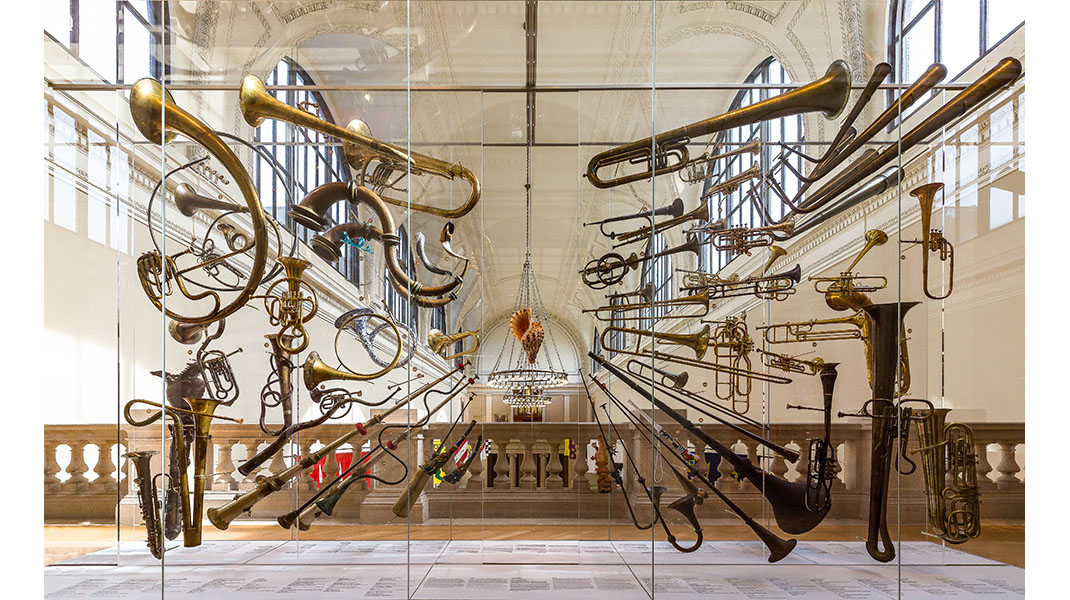
The Art of Music: The André Mertens Galleries for Musical Instruments at The Met Fifth Avenue, Reopened March 22, 2018

Photographs by Corrado Serra.

“Music is central to nearly all aspects of human endeavor and culture. Through the theme of the art of music, these galleries explore the artistry of music and instruments across 4,000 years of history and around the globe in the diverse context of the Met’s encyclopedic collections.

This gallery is organized chronologically to illustrate that people worldwide have simultaneously created extraordinary music and instruments for millennia. Such a global perspective enables us to identify underlying commonalities in the creation and function of the instruments encountered here. The use of music and instruments to express status, identity, and spirituality, and the impact of trade, changing tastes, availability of materials, and emerging technologies are shared elements that span the sweep of time and geography.

Although primarily intended to be heard, instruments also function as powerful vehicles of visual expression and are often prized as works of art in their own right. As such, their appearance frequently reflects contemporary style, and the production techniques and materials used to make them are shared with other art forms. Here, related objects and paintings are displayed to illustrate the universal presence of music and instruments in art and society.” — Introductory Wall Text

The André Mertens Galleries for Musical Instruments “The Art of Music” is organized by Jayson Kerr Dobney, Frederick P. Rose Curator in Charge in the Department of Musical Instruments; Ken Moore, Curator Emeritus in the Department of Musical Instruments; and Bradley Strauchen-Scherer, Associate Curator in the Department of Musical Instruments

Marc Camille Chaimowicz: Your Place or Mine … at The Jewish Museum, March 16 – August 5, 2018

“Marc Camille Chaimowicz’s pluralistic practice encompasses painting, drawing, collage, book making, sculpture, and installation as well as ceramics, furniture, lighting, textiles, and wallpaper. He emerged as an artist in the early 1970s with groundbreaking performative installations that infused everyday life with art and politics and stood at the intersection of the gay liberation and feminist movements. In the years that followed, he moved his artistic activities into his home, an inward turn that is the starting point for Your Place or Mine . . . . This slyly provocative title positions the exhibition as a temporary connection between visitor and artist, who extends an invitation to enter his world.

Chaimowicz’s artworks, made between 1978 and the present, are arranged to evoke a series of places: a home, library, and park. In these spaces, interiority and conviviality, private contemplation and sociability are commingled, at odds, and in flux. He challenges dichotomies, pivoting between fine art and design, public and private, masculine and feminine, past and present.

The Jewish Museum building was originally a family home. Its once-lived-in rooms, with their ornamental flourishes, offer the perfect setting for an artist preoccupied with the psychological, imaginative dimensions of domestic spaces, objects, and rituals. These act as source and subject of his work, which brings value to decoration, intimacy, and the interior life of the artist.

Chaimowicz was born in postwar Paris. His Polish Jewish father, a mathematician at the Institut Curie, survived the Nazi Occupation of France, but never spoke of that time. His French Catholic mother was a seamstress for the couturier Pacin. In pursuit of new beginnings, the family moved to England when Chaimowicz was eight years old, eventually settling in London. He finally returned to Paris in May 1968 to witness the student uprisings there, events that shaped his career. He enfolds his rebelliousness in beauty, one ofmany dualities that he fluidly negotiates and that resonates across his life and work.” — Introductory Wall Text by Kelly Taxter, Associate Curator

Installation views of the exhibition Marc Camille Chaimowicz: Your Place or Mine…, March 16 – August 5, 2018, The Jewish Museum, NY. Photos by: Jason Mandella

Marc Camille Chaimowicz. Series One, Drawing No. 9 (Agey, August 24th), 1995. Pencil, ink and gouache on paper, 12 1/5 x 9½ in. (31 x 24 cm)

Marc Camille Chaimowicz: Your Place or Mine… is organized by Kelly Taxter, Associate Curator, The Jewish Museum, in association with the Serpentine Galleries, London. The exhibition is designed by New Affiliates (Jaffer Kolb, Ivi Diamantopoulou).

Images courtesy The Jewish Museum.

Like Life: Sculpture, Color, and the Body (1300–Now) at The Met Breuer, March 21 – July 22, 2018

Photographs by Corrado Serra.

“From the Renaissance to the nineteenth century, artists working in the Western classical tradition favored idealized statuary. Typically, marble sculptures of the flawless human form were set high on pedestals and made otherworldly by their lack of color. By contrast, within the same period we also encounter highly realistic sculptures intended to persuade us that some kind of life is present. The contexts for such works were wildly divergent—for worship, to record anatomical discovery, and for popular entertainment. Challenging widely accepted notions of great sculpture, these lifelike figures were relegated to art’s aesthetic margins. With the advent of modernism in the twentieth century, the relevance of figuration and realism was further questioned. Artists have nonetheless continued to engage with the intellectual and psychological potency, the uncanniness and visceral power, of the sculpted body’s ability to resemble life.

Arranged thematically, works from fourteenth-century Europe to the global present are juxtaposed to explore how and why artists blur distinctions between original and replica, between life and art. Contending with the traditions of Western aesthetics, yet often going beyond that canon, artists have taken approaches that are surprisingly similar. Foremost among them is the use of color to mimic skin. Others include the use of pliable, fleshy materials such as wax or the integration of clothing, human hair, and textiles. Despite these material similarities, the sculptures on view embody dramatically shifting attitudes, some profoundly disturbing, toward gender, race, class, sexuality, and religion over seven hundred years.

Like Life thus provides a point of departure for examining historical and contemporary preconceptions of what constitutes a work of art, as well as emotional, physical, and aesthetic responses to the human body across time.” — Introductory Wall Text

Exhibition view of section “The Presumption of White”

Left: Frank Benson, Human Statue, 2005. Right: Jeff Koons, Michael Jackson and Bubbles, 1988

Exhibition view of section “Likeness”

Front: Tip Toland, The Whistlers, 2005

Right: Johan Gregor van der Schardt, Self-portrait, ca. 1573

Exhibition view of section “Likeness”

Rigoberto Torres, Shorty Working in the C & R Statuary Corp. 1985 and Raul with Bust of Ruth Fernandez, 1998

Duane Hanson, Housewife, 1969–1970

Exhibition view of section “Desire for Life”

Left:  Jeff Koons, Buster Keaton, 1988. Right: Palmesel, 15th century

Left: Edgar Degas, The Little Fourteen-Year-Old Dancer, model executed ca. 1880, cast 1922. Right: Yinka Shonibare MBE, Girl Ballerina, 2007

Exhibition view of section “Proxy Figures”

Hans Bellmer, La Demi-poupée, 1972

Left: Mary Sibande, Rubber Soul, Monument of Aspiration, 2011. Right: Elmgreen & Dragset, The Experiment, 2012

Exhibition view of section “Layered Realities”

Right: Sokari Douglas Camp, Material Salsa, 2011

Exhibition view of section “Figuring Flesh”

Title image: Duane Hanson, Housepainter II, 1984

Like Life: Sculpture, Color, and the Body (1300–Now) is curated by Luke Syson, Iris and B. Gerald Cantor Chairman of European Sculpture and Decorative Arts, and Sheena Wagstaff, Leonard A. Lauder Chairman of Modern and Contemporary Art, both at The Met, with Brinda Kumar, Assistant Curator of Modern and Contemporary Art, The Met, and Emerson Bowyer, Searle Associate Curator of European Painting and Sculpture at the Art Institute of Chicago, with the assistance of Elyse Nelson, Research Associate, European Sculpture and Decorative Arts, The Met.

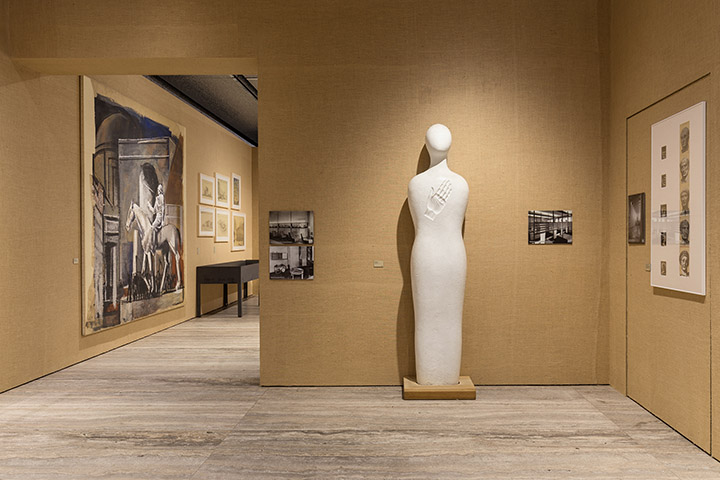
Post Zang Tumb Tuuum. Art Life Politics: Italia 1918–1943 at Fondazione Prada, through June 25, 2018

“Fondazione Prada presents Post Zang Tumb Tuuum. Art Life Politics: Italia 1918–1943, at its Milan venue. Conceived and curated by Germano Celant, the exhibition explores the world of art and culture in Italy in the interwar years. Based on documentary and photographic evidence of the time, it reconstructs the spatial, temporal, social and political contexts in which the works of art were created and exhibited, and the way in which they were interpreted and received by the public of the time.

Between 1918 and 1943 Italy was marked by the crisis of the liberal state and the establishment of fascism, and by the ongoing interdependence of artistic research, social dynamics and political activity. As emphasized by Jacques Rancière in his book Le partage du sensible. Esthétique et politique (The Politics of Aesthetics. The Distribution of the Sensible) (2000), art never exists in abstraction, but comes into being and takes shape within a given historic and cultural context. From this point of view, political and aesthetic aspects are interwoven. Taking this hypothesis as a starting point, the documents and photographs that prompted the selection of works in the exhibition offer a record of the artistic and cultural production of the period, taking into account the multifaceted contexts and settings in which it was exhibited: these include artists’ studios, private collections, large public events and exhibitions of Italian art both in Italy and abroad, architectural designs and city planning, graphic arts and the first examples of industrial furniture production. According to Germano Celant, the documentation found and presented in this exhibition ‘offers a summary of the communicative function of a work of art, and tells a real story that lies outside of the theoretical discourse of an artifact.’ As ‘means of cultural understanding’, an expression coined by David Summers, ‘they ensure that an art object has a particular territory, that of appearing to a broader audience, in given social and political situations’.” — Fondazione Prada

Exhibition views of Post Zang Tumb Tuuum. Art Life Politics: Italia 1918-1943. Photo Delfino Sisto Legnani and Marco Cappelletti. Fondazione Prada, Milano. Courtesy Fondazione Prada.

The exhibition design, conceived by New York studio 2×4 in conjunction with the curator, provides an immersive experience consisting of twenty partial reconstructions of public and private exhibition rooms. These full-size recreations from period photographs contain original works by artists of the period.

Being: New Photography 2018 at The Museum of Modern Art, March 18, 2018 – August 19, 2018

“The Museum of Modern Art presents Being: New Photography 2018, the latest presentation in MoMA’s celebrated New Photography exhibition series. Since its inception in 1985, New Photography has introduced more than 100 artists from around the globe, and it is a key component of the Museum’s contemporary program. Every two years, New Photography presents urgent and compelling ideas in recent photography and photo-based art. This year’s edition, Being, asks how photography can capture what it means to be human. The exhibition includes over 80 new and recent works by 17 artists from eight countries. While at various stages in their careers, all are presenting their work at the Museum for the first time.

At a time when questions about the rights, responsibilities, and dangers inherent in being represented—and in representing others—are being debated around the world, the works featured in Being call attention to assumptions about how individuals are depicted and perceived. Many challenge the conventions of photographic portraiture, or use tactics such as masking, cropping, or fragmenting to disorient the viewer. In others, snapshots or found images are taken from their original context and placed in a new one to reveal hidden stories. While some of the works might be considered straightforward representations of individuals, others do not include images of the human body at all. Together, they explore how personhood is expressed today, and offer timely perspectives on issues of privacy and exposure; the formation of communities; and gender, heritage, and psychology.” — MoMA

Installation photographs by Corrado Serra.

Adelita Husni-Bey. The Council, 2018

Andrzej Steinbach. Untitled from the series Figur I, Figur II, 2015

Andrzej Steinbach. Untitled from the series Gesellschaft beginnt mit drei, 2017

Aida Muluneh. Left to right: Fragments, The Morning Bride, Strength in Honor, The Departure, 2016

Left: Paul Mpagi Sepuya. A Sitting for Matthew, 2015. Center and right: Em Rooney. Pictures, Keychains, Freedom Ladder2016; Elliot2015; Outer Frame for Elliot (The Sawdust Ring), 2015

Left: Paul Mpagi Sepuya. Left to right: Untitled, 2017; A Ground (0083), 2015; Mirror Ground Study (_1990600), 2016

Huong Ngo and Hong-An Truong. The opposite of looking is not invisibility. The opposite of yellow is not gold, 2016

Stephanie Syjuco. Left to right: Cargo Cults: Head Bundle, Cargo Cults: Java Bunny, 2013-16

Left: Shilpa Gupta. Untitled, 2014. Right: Stephanie Syjuco. Cargo Cults: Basket Woman, 2013-16

Front: Carmen Winant. My Birth, 2018

Harold Mendez. Left to right: At the edge of the Necrópolis, Consent not to be a single being, Sin nombre, 2017-18

B. Ingrid Olson. Left to right: Felt Angle, box for standing, 2017; Headbox, 2017; Model for a folded room, bound girdle, 2017

B. Ingrid Olson. Left to right: Firing Distance, Surrounding Bone, 2016; Mutter: skeleton of the house under construction, 2017

Sofia Borges. Left to right: Yellow Chalk, 2017; Painting, Brain and Face, 2017

Joanna Piotrowska. Left to right: XXXI, FROWST, 2013-14; Untitled, 2016; XXIII, FROWST, 2013-14; Untitled, 2016; XXXIII, FROWST, 2013-14

Being: New Photography 2018 is organized by Lucy Gallun, Assistant Curator, Department of Photography.

Unknown Tibet: The Tucci Expeditions and Buddhist Painting at Asia Society Museum, through May 20, 2018

Photographs by Corrado Serra.

“The world knew very little about the Himalayan region when Italian scholar and explorer Giuseppe Tucci (1894–1984) began his work around one hundred years ago. His contributions to the understanding of Tibet, including Tibetan Buddhism, in the West have been enormous and the materials he was able to gather for future study impressive. Unknown Tibet: The Tucci Expeditions and Buddhist Painting presents a selection of the paintings he acquired during his travels. Tucci obtained expedition permits that included permission to acquire and export original source materials for scientific study. The paintings he acquired were purchased, gifted, or found and deemed too badly damaged or incomplete for cult use by the Tibetan communities. Those in this exhibition, all recently conserved, are now in the collection and care of the Museum of Civilisation-Museum of Oriental Art “Giuseppe Tucci” in Rome, to which Tucci and his wife Francesca Bonardi Tucci bequeathed all of their possessions.

Tucci’s life was framed by two World Wars, a worldwide economic depression, and—shortly after his last journey to Tibet—the destruction of Tibetan monastic culture. The turbulent times and the four years Tucci spent in the military during World War I—two of which were at the front line—had a profound effect on him. He was a highly intellectual, multi-lingual scholar with an antipathy to military solutions and a dedication to the pursuit of intercultural dialogue. During his lifetime, he received many high honors from many countries in Europe and Asia, and his scientific legacy is still fundamental to the research of Tibetan culture today. Tucci’s bibliography of more than four hundred entries attests to the expansiveness of his interests and talents.

Tucci was also one of the most important explorers of the century. Among his scientific travels were eight major expeditions to Tibet, from 1928 to 1948, which are the focus of this exhibition. The selection of paintings and reproductions of photographs from three Italian photographers represent the roughly five thousand miles Tucci trekked across the Tibetan cultural zone, which extends far beyond the present borders of the Tibetan Autonomous Region in China. They also challenge us to envision very distant points in time and place: Italy at the beginning of the twentieth century, pre-modern Tibet, and the culture of ancient Tibet that expanded and blossomed from the twelfth century.” — Introductory Wall Text

Right: Amitāyus, ca. 16th century.

Left: Śākyamuni in the Bhadrakalpa, 15th century. Center: Buddha Śākyamuni, 15th century. Right: Buddha Śākyamuni, 18th century

The Sixteen Arhats (Neten, gNas brtan) – Nāgasena Arhat, 17th century

The Sixteen Arhats (Neten, gNas brtan) – Nāgasena Arhat, 17th century

Seated Buddha in Dharmachakra-mudra, probably the Buddha Shakyamuni, India, Uttar Pradesh; Gupta period, ca. late 5th–early 6th century

Left to right: A Bhutanese Hierarch Jigme Sengge (‘Jigs med seng ge), Last quarter of 18th century; Drikungpa or Drukpa Kagyu Lama, 16th century; Guru Rinpoche and his Eight Emanations, 16th-17th centuries; Tamdrin and other emanations of Guru Rinpoche, 19th century; Padmasaṃbhava and the teaching activities of Guru Rinpoche, 18th century

Installation view

Left to right: Green Tārā (Śyāmatārā, sGrol ljang), Mid-19th century; Avalokiteśvara Ṣaḍakṣarī (sPyan ras gzigs yi ge drug pa), 19th century; Heruka, 19th century; Uṣṇīṣavijayā (gTsug tor rnam rgyal ma), 19th century; White Tārā (Sitatārā, sGrol dkar), 19th century

Left: Vajradhātumaṇḍala (rDo rje dbyings kyi dkyil ’khor), 1875

Installation view

Left: Butön Rinchendrub (Bu ston rin chen grub), 16th century

Left: Panchen Lama, Early 17th century. Right: Tsongkhapa and scenes from his life, 18th century

Left: Vaiśravana, 14th century. Center: Bardo Thödrol (bar do thos grol) Vajra-Heruka in Yab-Yum, ninth day meditation, 18th century (?). Right: Black Garuḍa (Khyung nag po), 18th century

Left: Black Garuḍa (Khyung nag po), 18th century. Right: Bon po deity Tsewang Rigzin (Tshe dbang rig ’dzin), 19th century.

Installation view

Left: Bon po deity Tsewang Rigzin (Tshe dbang rig ’dzin), 19th century. Right: Astrological / Divination chart (Sipaho, Srid pa ho), 19th century

Unknown Tibet: The Tucci Expeditions and Buddhist Painting was organized was organized by Dr. Adriana Proser, Asia  Society’s John H. Foster Senior Curator for Traditional Asian Art, and guest curator Dr. Deborah Klimburg‐Salter, University Professor Emeritus, CIRDIS, Institute for Art History, University of Vienna; and Associate, Department of South Asian Studies, Harvard University.

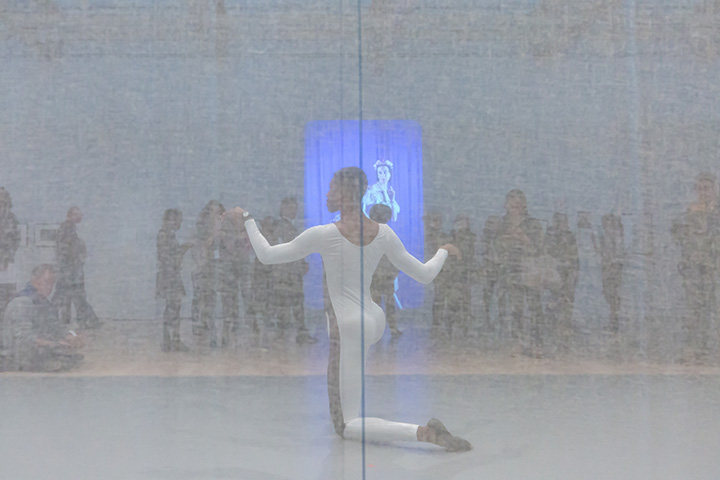
Nick Mauss: Transmissions at Whitney Museum of American Art, March 16 – May 14, 2018

Photographs by Corrado Serra.

“For this exhibition, Nick Mauss (b. 1980, New York, NY) explores the history of American modernist ballet, continuing a hybrid mode of working he has pursued for a decade in which the roles of curator, artist, choreographer, scholar, and performer converge. New works by Mauss—ranging from scores for a ballet to scenic design, décor elements, and live performance—will appear alongside pieces from the Whitney’s collection and those of other institutions, including the Kinsey Institute for Sex, Gender, and Reproduction and the Jerome Robbins Dance Division of the New York Public Library. Central to the exhibition is a ballet conceived by Mauss in close collaboration with dancers, in response to archival material and the constellation of objects in the show.

In the current vogue for contemporary dance in museums, the legacy of ballet remains relatively unexamined. This exhibition will consider the intersections of ballet with the visual arts, theater, fashion, and new representations of the body. Focusing on New York’s role in a transatlantic exchange of ballet and surrealist aesthetics, the show presents a vision of American modernist ballet as an artistic catalyst, filter, and vibrant, shared vocabulary. Through the intertwined languages of ballet, painting, photography, and sculpture, Mauss also mines a pre-queer history within the realm of supposedly straight cultural production of the 1930s and 1940s. The exhibition itself is a hybrid of a historical presentation and an unfolding artistic proposition that forges new modes of attention, viewing, and an engagement with history in the present.” — Whitney Museum

Top: Nick Mauss, re-creation of the costume Paul Cadmus designed for Filling Station, 2018. Bottom: Elie Nadelman, Dancing Figure, c.1916-18.

Nick Mauss: Transmissions is organized by Scott Rothkopf, Deputy Director for Programs and Nancy and Steve Crown Family Chief Curator, and Elisabeth Sussman, Sondra Gilman Curator of Photography, with Greta Hartenstein, senior curatorial assistant, and Allie Tepper, curatorial project assistant.

Human+: The Future of Our Species at Palazzo delle Esposizioni, Roma, through July 1, 2018

“Cyborgs, superhumans and clones. Evolution or extinction? What does it mean to be a human today. What will it feel like to be a human a hundred years from now? Technological capabilities are increasing at a rapid pace—should we continue to embrace modifications to our minds, bodies and daily lives, or are there boundaries we shouldn’t overstep?

HUMAN+: The Future of Our Species is an exhibition that explores potential future trajectories of humankind by considering the implications of both historical and emerging technologies. The ‘plus’ symbol in Human+ implies a positive direction for the future of our species. But what is that direction? For the majority of the 20th century, progress has been measured by increased speed and efficiency—faster, better, stronger—but the side effects have been fatter, sadder and exhausted. Our definition of success needs to be recalibrated.

The 21st century will be characterized by the confluence of fields such as biotechnology, robotics and artificial intelligence. Manipulating biological processes, controlling digital and mechanical machines and creating non-biological intelligence above and beyond what humans can comprehend— these advances raise ethical questions about the appropriation of life and the alteration of the self. The converging forces of these and other currents will lead us to a new and unknown place.

From subtle provocations to grand gestures, the artworks in this exhibition consider how these changes might be adopted and assimilated. The value in speculation is not prediction, but reflection. What are we striving for? We are designing our future, consciously or not, and every creator, whatever their discipline, will play a part in this process. In this exhibition artists, designers and scientists speculate on and imagine many possible futures. Now it’s your turn.” — Palazzo delle Esposizioni

Section 1: Augmented Abilities

Aimée Mullins, Gambe da ghepardo (Cheetah legs). Installation. Photo: Howard Schatz

Lorenz Potthast, Casco deceleratore (Decelerator helmet),  2014. Installation. Photo courtesy the artist.

Section 2: Encountering Others

Louis-Philippe Demers, Area V5: Robotica sociale interattiva (Interactive social robotics), 2009-2010. Installation. Photo: CCCB Barcelona

Louis-Philippe Demers, Detail of Area V5: Robotica sociale interattiva (Interactive social robotics), 2009-2010

Yves Gellie, Part of a series of portraits of humanoid robots. Versione umana 2.0 (Human version 2.0), 2007 – 2009. Photographic print. Photo courtesy the artist. Courtesy Baudoin Lebon

Yves Gellie, Part of a series of portraits of humanoid robots. Versione umana 2.0 (Human version 2.0), 2007 – 2009. Photographic print. Photo courtesy the artist. Courtesy Baudoin Lebon

Section 3: Authoring Environments

Laura Allcorn, Progetto di impollinazione umana (Project of human pollination), 2009. Installation. Photo courtesy the artist

Anthony Dunne & Fiona Raby, Foraggieri (Foragers), 2009. Installation. Photo: Jason Evans

Section 4: Life at the Edges

Agatha Haines, Trasfigurazioni (Transfiguration), 2013. Installation. Photo: Agatha Haines

Tissue Culture & Art Project, Oron Catts & Ionat Zurr. Bambole scacciapensieri semiviventi (Semi-alive dolls that make thoughts disappear). Installation, 2000. Photo Courtesy CCCB Barcelona – La Fotografica 2015

Section 5: Human, Superhuman?

Donato Piccolo, Leonardo sogna le nuvole (Leonardo dreams of clouds), 2014. Kinetic sculpture (latex, oil, aluminum, smoke machine, electronic components), cm 120 x 45 x 23. Courtesy l’artista e Galerie Mazzoli. Photo: Angelo Sabatiello

Donato Piccolo, Detail of Leonardo sogna le nuvole (Leonardo dreams of clouds), 2014

Section 5 was curated by Valentino Catricalà, Fondazione Mondo Digitale.

The exhibition was conceived and shown for the first time at Science Gallery, Trinity College Dublin. The touring version is co-produced by Science Gallery, Trinity College Dublin and Centre de Cultura Contemporània de Barcelona.

Human+: The Future of Our Species was curated by Cathrine Kramer.

Images courtesy Palazzo delle Esposizioni.

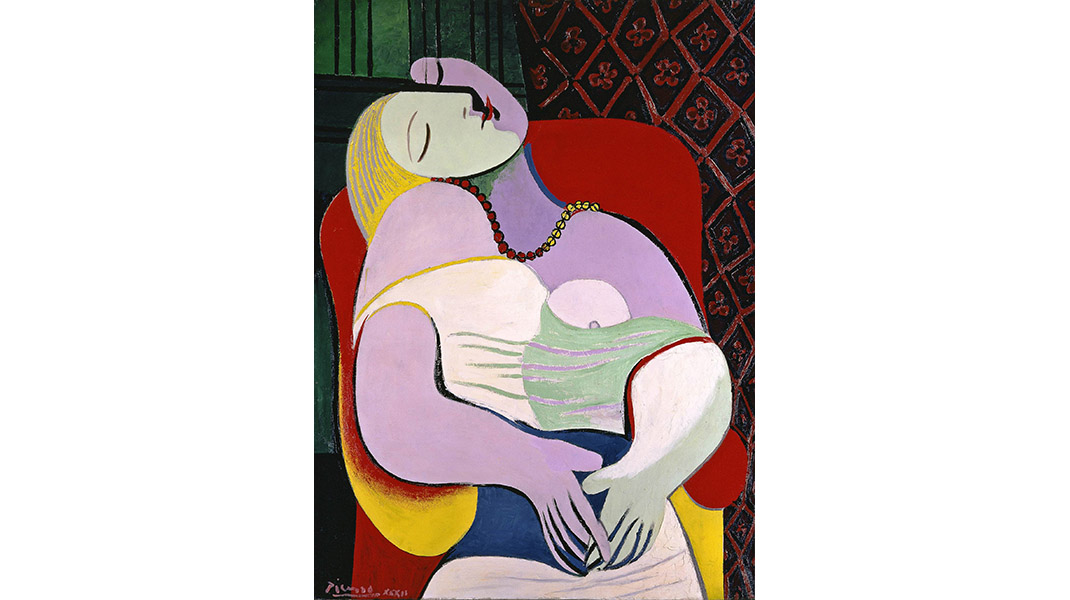
The EY Exhibition: Picasso 1932 – Love, Fame, Tragedy at Tate Modern, March 8 – September 9, 2018

“45 years after the artist’s death, Tate Modern stages its first ever solo exhibition of Pablo Picasso’s work, one of the most ambitious shows in the museum’s history. The EY Exhibition: Picasso 1932 – Love, Fame, Tragedy takes visitors on a month-by-month journey through 1932, a time so pivotal in Picasso’s life and work that it has been called his ‘year of wonders’. More than 100 outstanding paintings, sculptures and works on paper demonstrate his prolific and restlessly inventive character, stripping away common myths to reveal the man and the artist in his full complexity and richness.” — Tate Modern

Achim Borchardt-Hume, Director of Exhibitions, Tate Modern, and co-curator of the exhibition said: ‘Picasso famously described painting as “just another form of keeping a diary”. This exhibition invites you to get close to the artist, to his ways of thinking and working, and to the tribulations of his personal life at a pivotal moment in his career. Visitors will be able to walk through 12 months of Picasso’s life and creative decision-making, to see many of his most ground-breaking and best-loved works in a surprising new light.’

Nancy Ireson, Curator of International Art, Tate, and co-curator of the exhibition said:
‘We are thrilled to be reuniting some of Picasso’s greatest works of art for the first time in 86 years, many of which are rarely shown in public. Displaying them in the order in which they were made demonstrates just how intensely creative 1932 was for Picasso, revealing his explosive energy to a new generation’

Pablo Picasso, Nude Woman in a Red Armchair (Femme nue dans un fauteuil rouge), 1932. Oil paint on canvas, 1299 x 972 mm. Tate. Purchased 1953 © Succession Picasso/DACS London, 2017

Pablo Picasso, Reclining Nude (Femme nue couchée), 
1932. Oil paint on canvas, 
1300 x 1610 mm. 
Private Collection
© Succession Picasso/DACS London, 2018

Pablo Picasso, 
The Rescue (Le sauvetage), 1932
. Oil paint on canvas, 
1445 x 1122 x 77 mm. 
Fondation Beyeler, Riehen/Basel, Sammlung Beyeler
© Succession Picasso/DACS London, 2018

Pablo Picasso, 
Woman on the Beach (Nu sur la plage), 
1932. 
Oil paint on canvas
, 330 x 400 mm
. The Penrose Collection © Succession Picasso/DACS London, 2018

Pablo Picasso, 
Le Rêve (The Dream), 
1932. Oil paint on canvas, 1299 x 968 mm. 
Private collection 
© Succession Picasso/DACS London, 2018

Pablo Picasso, Young Woman with Mandolin (Jeune Fille à la mandoline), 1932. Oil paint on board,  838.2 x 669.9 x 63.5 mm. The University of Michigan Museum of Art, Ann Arbor, Michigan. Gift of The Carey Walker Foundation © Succession Picasso/DACS London, 2018

Pablo Picasso, 
Nude, Green Leaves and Bust (Femme nue, feuilles et buste), 
1932
. Oil paint on canvas, 
1620 x 1300 mm
. Private Collection
© Succession Picasso/DACS London, 2018

Cecil Beaton. 
Pablo Picasso, rue La Boétie, 1933, Paris 
©The Cecil Beaton Studio Archive at Sotheby’s

Images courtesy Tate Modern.