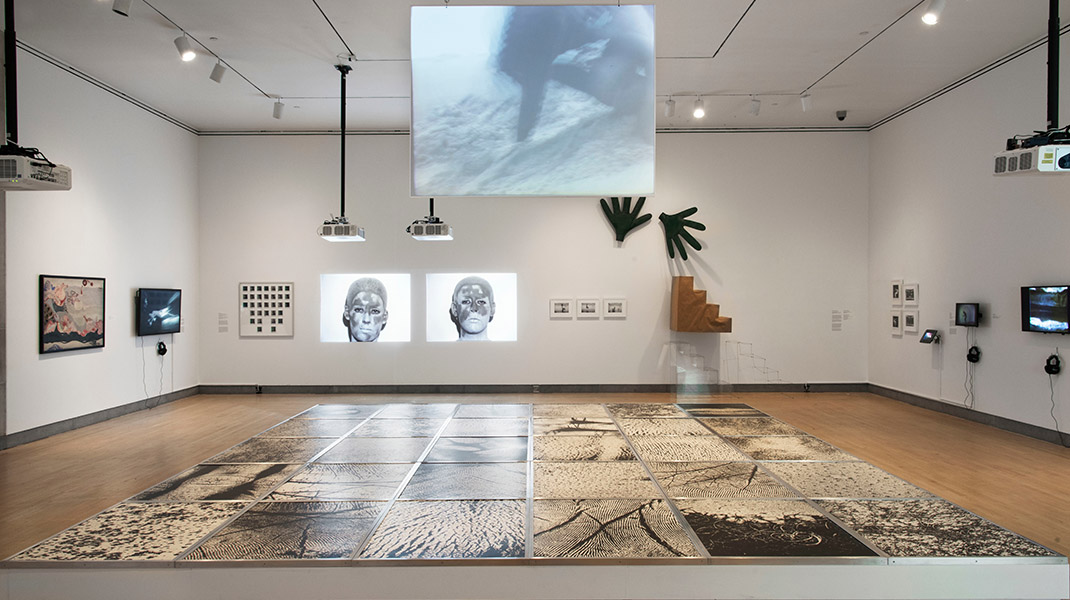
Chaim Soutine: Flesh at The Jewish Museum, May 4 – September 16, 2018

“Chaim Soutine (1893–1943) is one of the twentieth century’s great painters of still life. In the Paris of the 1920s, Soutine was a double outsider—an immigrant Jew and a modernist. Guided by his expressive artistic instincts, he both embraced the traditional genre of still life and exploded it. 

Still-life painting offers an opportunity for an artist to display technical skill and to explore aspects of color, composition, and brushwork. At the Louvre, Soutine studied the canvases of the Old Masters: careful and elaborate arrangements of flowers, fruit, and other food, including hunters’ trophies of game. He transformed such precedents into contorted and turbulent paintings of dead animals, imbued with suffering and anxiety. 

Soutine was born in a Jewish village in the Lithuanian part of western Russia (now Belarus). The region was plagued with anti-Semitic violence—thousands of Jews were killed in pogroms during his childhood. At age twenty, after studying art at the academy in Vilnius for three years, he moved to Paris, the artistic and intellectual center of Europe in the twenties. There, he lived and worked alongside other Jewish emigré artists, including Moïse Kisling, Ossip Zadkine, Jacques Lipchitz, and Amedeo Modigliani, who became a close friend. 

Soutine’s harsh and wrenching portrayals — of beef carcasses, plucked fowl, fish, and game — create a parallel between the animal and human, between beauty and pain. His still-life paintings, produced over a period of thirty years, express with visceral power his painterly mastery and personal passion.” — Introductory Wall Text, Stephen Brown, Neubauer Family Foundation Associate Curator; Esti Dunow and Maurice Tuchman, Consulting Curators

“They say Courbet could give in his nudes all the character of Paris. I want to show all that is Paris in the carcass of an ox.” — Chaim Soutine

Chaim Soutine, Still Life with Fruit, 1919, oil on canvas. Private Collection. Photograph by Reginart Collections

Chaim Soutine, Fish, Peppers, Onions, c. 1919, oil on canvas. Barnes Foundation, Merion and Philadelphia, Pennsylvania. Image provided by The Barnes Foundation

Chaim Soutine, Still Life with Rayfish, c. 1924, oil on canvas. Metropolitan Museum of Art, The Mr. and Mrs. Klaus G. Perls Collection, 1997. Artwork © Artists Rights Society (ARS), New York; Image provided by The Metropolitan Museum of Art / Art Resource, NY

Chaim Soutine, Chicken Hung Before a Brick Wall, 1925, oil on canvas. Kunstmuseum Bern, Switzerland. Artwork © Artists Rights Society (ARS), New York; Image provided by Erich Lessing / Art Resource, NY

Chaim Soutine, Hanging Turkey, c. 1925, oil on canvas. Private Collection, courtesy of McClain Gallery, Houston. Artwork © Artists Rights Society (ARS), New York; Image provided by The Henry and Rose Pearlman Collection / Art Resource, New York; photograph by Bruce M. White

Chaim Soutine, Dead Fowl, 1926, oil on canvas. Art Institute of Chicago, Joseph Winterbotham Collection, 1937.167. Artwork © Artists Rights Society (ARS), New York; Image provided by the Art Institute of Chicago / Art Resource, NY

Chaim Soutine, Hanging Turkey, c. 1925, oil on canvas. Private Collection, courtesy of McClain Gallery, Houston. Artwork © Artists Rights Society (ARS), New York

Chaim Soutine, Carcass of Beef, c. 1925, oil on canvas. Collection of Albright-Knox Art Gallery, Buffalo, New York; Room of Contemporary Art Fund, 1939 (RCA1939:13.2). Artwork © Artists Rights Society (ARS), New York

Chaim Soutine, The Rabbit, c. 1924, oil on canvas. Private collection, New York. Artwork © Artists Rights Society (ARS), New York. Photograph by Joshua Nefsky

Chaim Soutine, Plucked Goose, c. 1933, oil on panel. Private Collection. Artwork © Artists Rights Society (ARS), New York. Photograph by Joshua Nefsky.

Chaim Soutine, Sheep Behind a Fence, c. 1940, oil on canvas. Private Collection. Artwork © Artists Rights Society (ARS), New York

Soutine at Chatel-Guyon in central France (Puy-de- Dome), 1928. Image provided by the Kluver/Martin Archive

The exhibition is organized by Stephen Brown, Neubauer Family Foundation Associate Curator, The Jewish Museum, with consulting curators Esti Dunow and Maurice Tuchman, authors of Chaim Soutine (1893-1943) catalogue raisonné (1993).

Images courtesy The Jewish Museum.

Lee Friedlander in Louisiana & Lee Friedlander: American Musicians at The New Orleans Museum of Art (NOMA), April 27 – August 12, 2018

“A major exhibition of Lee Friedlander (American, born 1934), one of the most famous living American photographers. Lee Friedlander in Louisiana explores the ways in which Louisiana, and New Orleans in particular, have had a profound impact on the career of this important artist, while also highlighting Friedlander’s significance as a documentarian of the local music community. Comprised of vintage prints and never before seen images, the photographs of jazz musicians, monuments, and street life demonstrate how Louisiana has been central to the development of one of the country’s most influential photographers.

Lee Friedlander’s relationship with New Orleans began in 1957 when he first visited the city as an employee of Atlantic Records to produce portraits for album covers. From that point on, he would be a frequent visitor to the city, training his camera on second line parades, crowded streetcars, and the evolving architecture of downtown. In what is now known as his signature style, Friedlander welcomes reflections, shadows, and obstructions that transform the people and places of New Orleans into playful pictures that are both visual puzzles, and humanistic documents.” — NOMA

Lee Friedlander in Louisiana

New Orleans, Louisiana, 1968. Gelatin silver print. Museum Purchase through the National Endowment for the Arts Grant

New Orleans, Louisiana, 1969. Gelatin silver print. Courtesy of the artist and Fraenkel Gallery, San Francisco

New Orleans, Louisiana, 1961. Gelatin silver print. Courtesy of the artist and Fraenkel Gallery, San Francisco

New Orleans, Louisiana, 1967. Gelatin silver print. Courtesy of the artist and Fraenkel Gallery, San Francisco

New Orleans, Louisiana, 1958. Gelatin silver print. Private Collection, San Francisco

Lafayette, Louisiana, 1968. Gelatin silver print. Courtesy of the artist and Fraenkel Gallery, San Francisco

New Orleans, Louisiana, 1959. Gelatin silver print. Courtesy of the artist and Fraenkel Gallery, San Francisco

Lee Friedlander: American Musicians

Tammy Wynette, 1971. Iris print on rag paper. Courtesy of the artist and Fraenkel Gallery, San Francisco

John Coltrane, 1960. Iris print on rag paper. Courtesy of the artist and Fraenkel Gallery, San Francisco

Johnny Cash, 1969. Iris print on rag paper. Courtesy of the artist and Fraenkel Gallery, San Francisco

Ray Charles, 1958. Iris print on rag paper. Courtesy of the artist and Fraenkel Gallery, San Francisco

Aretha Franklin, 1968. Iris print on rag paper. Courtesy of the artist and Fraenkel Gallery, San Francisco

Champion Jack Dupree, 1958. Iris print on rag paper. Courtesy of the artist and Fraenkel Gallery, San Francisco

“As an artist whose images straddle the border of art and document, Friedlander was uniquely positioned to preserve the social and visual phenomena of New Orleans, creating a varied body of work that is as humanistic as it is artistic,” said Susan Taylor, NOMA’s Montine McDaniel Freeman Director. “We are delighted to be the first institution to examine the scope and influence of Friedlander’s work in New Orleans on the fields of photography, music, and history.”

“While everyone is trying to get the perfect picture, Lee Friedlander’s approach seems to declare that photographs should be about how the world exists, not how we want it to be,” said Russell Lord, Freeman Family Curator of Photographs. “Lee Friedlander in Louisiana is, therefore, both a fitting tribute to a great American photographer, but also a tribute to this city’s rich visual and social character during its Tricentennial year.”

Images courtesy of The New Orleans Museum of Art.

Shape of Light: 100 Years of Photography and Abstract Art at Tate Modern, May 2 – October 14, 2018

“A major new exhibition at Tate Modern will reveal the intertwined stories of photography and abstract art. Shape of Light: 100 Years of Photography and Abstract Art will be the first show of this scale to explore photography in relation to the development of abstraction, from the early experiments of the 1910s to the digital innovations of the 21st century. Featuring over 300 works by more than 100 artists, the exhibition will explore the history of abstract photography side-by-side with iconic paintings and sculptures.

Shape of Light will place moments of radical innovation in photography within the wider context of abstract art, such as Alvin Langdon Coburn’s pioneering ‘vortographs’ from 1917. This relationship between media will be explored through the juxtaposition of works by painters and photographers, such as cubist works by George Braque and Pierre Dubreuil or the abstract expressionism of Jackson Pollock and Otto Steinert’s ‘luminograms’. Abstractions from the human body associated with surrealism will include André Kertesz’s Distorsions, Imogen Cunningham’s Triangles and Bill Brandt’s Baie des Anges, Frances 1958, exhibited together with a major painting by Joan Miró. Elsewhere the focus will be on artists whose practice spans diverse media, such as László Moholy-Nagy and Man Ray.

The exhibition will also acknowledge the impact of MoMA’s landmark photography exhibition of 1960, The Sense of Abstraction. Installation photographs of this pioneering show will be displayed with some of the works originally featured in the exhibition, including important works by Edward Weston, Aaron Siskind and a series by Man Ray that has not been exhibited since the MoMA show, 58 years ago.” — Tate Modern

Antony Cairns, born 1980. 
LDN5_051, 
2017. Courtesy of the artist
© Antony Cairns

Barbara Kasten, b.1936. Photogenic Painting, Untitled 74/13, 1974. Photograph, salted paper print, 558 x 762 mm. Courtesy the artist, Thomas Dane Gallery and Bortolami Gallery, New York 
© Barbara Kasten

Daisuke Yokota, b.1983. Untitled, 
2014. 
Courtesy the artist and Jean-Kenta Gauthier Gallery 
© Daisuke Yokota

James Welling, born 1951, Untitled
, 1986. Photograph, C-print on paper, 254 x 203 mm. Jack Kirkland Collection, Nottingham © James Welling. Courtesy the artist and David Zwirner, New York/London/Hong Kong and Maureen Paley, London

Alvin Langdon Coburn, 1882-1966. Vortograph, 1917. Photograph, gelatin silver print on paper, 283 x 214 mm. Courtesy of the George Eastman Museum NY 
© The Universal Order.

Marta Hoepffner, 1912–2000. Homage to Kandinsky, 
1937. Photograph, gelatin silver print on paper, 387 x 278 mm. Stadtmuseum Hofheim am Taunus © Estate Marta Hoepffner

Wassily Kandinsky, 1866-1944. Swinging
, 1925. Oil paint on board, 705 x 502 mm. Tate

Man Ray, 1890-1976. Unconcerned Photograph, 1959
. Museum of Modern Art, New York 
© Man Ray Trust/ADAGP, Paris and DACS, London 2018

Imogen Cunningham, 1883-1976. Triangles, 1928, printed 1947-60. Photograph, gelatin silver print on paper, 119 x 93 mm. Pierre Brahm
© Imogen Cunningham Trust. All rights reserved

Joan Miró, 1893-1983. Painting
, 1927. Tempera and oil paint on canvas, 972 x 1302 mm. Tate
© Succession Miro/ADAGP, Paris and DACS, London 2018

Pierre Dubreuil, 1872-1944. Interpretation Picasso: The Railway, 
c. 1911. Photograph, gelatin silver print on paper, 238 x 194 mm. Centre Pompidou, Paris Musée national d’art moderne-Centre de création industrielle

Luo Bonian, 1911-2002. Untitled, 
1930s. Courtesy The Three Shadows Photography Art Centre, Beijing 
© Luo Bonian

Edward Ruscha, b.1937. Gilmore Drive-In Theater – 6201 W. Third St., 1967, printed 2013. Photograph, gelatin silver prints on paper, 356 x 279 mm. Courtesy Ed Ruscha and Gagosian Gallery © Ed Ruscha

Jackson Pollock, 1912-1956. Number 23, 1948. Enamel on gesso on paper, 575 x 784 mm. Tate: Presented by the Friends of the Tate Gallery (purchased out of funds provided by Mr and Mrs H.J. Heinz II and H.J. Heinz Co. Ltd) 1960 © ARS, NY and DACS, London 2018

Otto Steinert, 1915-1978. Luminogram II,  1952. Photograph, gelatin silver print on paper, 302 x 401 mm. Jack Kirkland Collection Nottingham © Estate Otto Steinert, Museum Folkwang, Essen

Shape of Light is curated curated by Simon Baker, Senior Curator, International Art (Photography), Tate Modern and Emmanuelle de l’Ecotais, Curator for Photography, Musée d’Art moderne de la Ville de Paris with Shoair Mavlian and Sarah Allen, Assistant Curators, Tate Modern.

Images courtesy Tate Modern.

The Metropolis in Latin America, 1830-1930 at Americas Society, through June 30, 2018

The Metropolis in Latin America, 1830-1930 is an exhibition that explores the impact that a century of accelerated urbanization as well as political and social transformations had on the architectural landscapes of six Latin American capitals: Buenos Aires, Havana, Lima, Mexico City, Rio de Janeiro, and Santiago de Chile. The exhibition features rare maps, engravings, drawings, photographs, books, and videos that range from Hernán Cortés’ map of Tenochtitlán (1524) to Le Corbusier’s sketches made during his visit to Buenos Aires (1929).

“The juncture that followed the processes of independence from Mexico to Argentina triggered a myriad of local initiatives that led to the re-organization of the cities from the newly freed republics to the nation-states before the Second World War,” explained Americas Society Visual Arts Director and Chief Curator Gabriela Rangel. “Metropolis is an effort that reveals the importance of archival research within a period that have been mostly overseen in the U.S. scholarship on Latin America. After Americas Society’s exploration of the emergence of mid-century modern design through our 2015 exhibition MODERNO: Design for Living in Brazil, Mexico, and Venezuela 1940-1978, we aim to present a previous step in the configuration of modern impulses and projects for the urban environment in small cities and big capitals.” 

“During the almost four centuries of colonial rule, town planning was a key tool to build cities that had to be commercially functional and militarily strategic,” commented exhibition curator and The Getty Research Institute’s Associate Curator of Latin American Collections Idurre Alonso. “This exhibition traces the changes of six major capitals as independence, industrialization, and exchange of ideas altered their built environments and eventually transformed them into monumental, modern metropolises.”

Isaak Tirion (Dutch, 1705–1765). Platte Grond van Lima, de Hoofdstad van Peru (Plan of Lima, Capital of Peru), ca. 1760, engraving, 8 1/4 x 12 in. Los Angeles, Getty Research Institute

Eduardo Laplante (French, 1818–1860). La Habana: Panorama general de la ciudad y su bahía (Havana: Panorama of the City and Bay), ca. mid-1850s, lithograph, 22 1/2 x 34 1/4 in. Los Angeles, Getty Research Institute

Marc Ferrez (Brazilian, 1843–1923). Vue Prise de Santa Thereza, Rio de Janeiro (View from Santa Theresa), ca. 1890s, albumen print, 7 x 13 3/4 in. Los Angeles, Getty Research Institute

Unknown photographer. Avenue de Mayo, Buenos Aires, 1914, gelatin silver prints in “Travel Albums from Paul Fleury’s Trips to Switzerland, the Middle East, India, Asia, and South America,” 1896–1918. Los Angeles, Getty Research Institute

Unknown photographer. Avenue de Mayo, Buenos Aires, 1914, gelatin silver prints in “Travel Albums from Paul Fleury’s Trips to Switzerland, the Middle East, India, Asia, and South America,” 1896–1918. Los Angeles, Getty Research Institute

Charles Betts Waite (American, 1861–1927) photographer. Francisco Jiménez (Mexican), architect. Miguel Noreña (Mexican, 1839–1894), sculptor. Cuauhtémoc Statue, City of Mexico, ca. 1907, gelatin silver print, 8 1/8 x 5 in. Los Angeles, Getty Research Institute

Nathaniel Currier (American, 1813–1888). La Alameda de Mexico – The Public Park of Mexico, 1848, hand-colored lithograph, 10 x 14 in. Los Angeles, Getty Research Institute

Augusto Cesar de Malta Campos (Brazilian, 1864–1957).P. Mal [Praça Marechal] Floriano, Rio-Brasil (Marechal Floriano Square, Rio de Janeiro), 1927 , gelatin silver print, 7 x 9 1/4 in. Los Angeles, Getty Research Institute

Unknown photographer. View on Santa Lucía Hill, Santiago de Chile, ca. 1870–1890, albumen print, 11 1/8 x 13 3/4 in. Los Angeles, Getty Research Institute

Unknown photographer. Dock Sud, Buenos Aires, 1906, gelatin silver prints, 6 3/4 x 27 1/2 in. Los Angeles, Getty Research Institute

Charles Betts Waite (American, 1861–1927). Raymond Special on the Metlac Bridge, Mexico City-Veracruz, ca. 1897, gelatin silver print, 7 3/4 x 9 1/2 in. Los Angeles, Getty Research Institute

N. D. Photo (French studio, active 1870s–1880s). Pavilion of Mexico, Paris, albumen print in Eugene Bigot, “L’architecture a l’Exposition Universelle de 1889: Principales constructions du Champ-de-Mars et de l’Esplanade des Invalides,” ca. 1889, Los Angeles, Getty Research Institute

Francisco Mujica (Mexican, 1899–1979). The City of the Future: Hundred Story City in Neo-American Style, offset lithograph in History of the Skyscraper (Paris: Archaeology & Architecture Press, 1929), pl. 134. Los Angeles, Getty Research Institute

Alfred Donat Agache (French, 1875–1959). Perspectiva da praça do Castello idealisada pelo professor Alfred Agache como centro principal dos negocios, Rio de Janeiro (Perspective View of the Castle Square Designed by Professor Alfred Agache as the Main Business Center), chromolithograph in Cidade do Rio de Janeiro: Remodelação-Extensão e Embellezamento (Paris: Foyer Brésilien, 1930), pp. 176–177. Los Angeles, Getty Research Institute

The Metropolis in Latin America, 1830-1930 has been organized by The Getty Research Institute, Los Angeles, and was previously on view as part of Pacific Standard Time: LA/LA at the Getty Center. Curated by Idurre Alonso and Maristella Casciato.

Images courtesy Americas Society.

Radical Women: Latin American Art, 1960–1985 at Brooklyn Museum, through July 22, 2018

Radical Women: Latin American Art, 1960–1985 is the first comprehensive exhibition to explore the pioneering artistic practices of Latin American and Latina women artists during a tumultuous and transformational period in the history of the Americas and the development of contemporary art. The exhibition includes more than 260 works—including photography, video, and other experimental mediums, as well as paintings, sculpture, and prints—by more than 120 artists working in 15 countries.

“Poetic and political, topics explored in the exhibition include self-portraiture, body landscape, and feminisms,” explained Andrea Giunta, co-curator of the exhibition at the Hammer Museum. “These themes draw together the artworks across national and geographic boundaries, making the case for parallel practices by artists often working in very different cultural conditions.”

Catherine Morris, Sackler Senior Curator for the Elizabeth A. Sackler Center for Feminist Art, and co-curator of the Brooklyn presentation, added, “The exhibition is a remarkable scholarly achievement, expanding the canon and complicating known narratives of conceptual art and radical art-making, while building on the legacy of important and ambitious exhibitions at the Elizabeth A. Sackler Center for Feminist Art, including We Wanted a Revolution: Black Radical Women, 1965–85, Materializing “Six Years”: Lucy R. Lippard and the Emergence of Conceptual Art, and Seductive Subversion: Women Pop Artists, 1958–1968.”

Installation views of Radical Women: Latin American Art, 1960-1985, Brooklyn Museum, April 13, 2018 through July 22, 2018. Photos by Jonathan Dorado, Brooklyn Museum.

Radical Women: Latin American Art, 1960–1985 is organized by the Hammer Museum, Los Angeles, as part of Pacific Standard Time: LA/LA, an initiative of the Getty with arts institutions across Southern California, and guest curated by Cecilia Fajardo-Hill and Andrea Giunta with Marcela Guerrero, former curatorial fellow. The Brooklyn presentation is organized by Catherine Morris, Sackler Senior Curator for the Elizabeth A. Sackler Center for Feminist Art, and Carmen Hermo, Assistant Curator for the Elizabeth A. Sackler Center for Feminist Art, Brooklyn Museum. 

Images courtesy Brooklyn Museum.

The Roof Garden Commission: Huma Bhabha, We Come in Peace at The Met Fifth Avenue, April 17 – October 28, 2018

“Huma Bhabha’s We Come in Peace borrows its title from the classic American science-fiction film The Day the Earth Stood Still (1951), a tale of first contact between humans and aliens. Its two huge sculptures—the five-headed We Come in Peace and the prostrate Benaam (an Urdu word that translates as “without name”)—have landed on The Met’s Iris and B. Gerald Cantor Roof Garden for this year’s commission as works dislocated from time. Choreographing a dramatic mise-en-scène, the artist has positioned the figures like actors on a film set, hoping to elicit an array of narratives. 

Throughout her practice, Bhabha has proposed the body as a site of exchange. The figures here communicate notions of pain and survival: they can be read as both aching and defiant, in agony and unassailable, subjugated and valiant. Bhabha’s work has always had a political exigency and a responsiveness to social concerns; We Come in Peace is no exception. It is also a project in dialogue with art history, reflecting Bhabha’s interest in art across time and geography. In these sculptures, one might find references to works that range from ancient African and Indian sculpture to modern creations. 

Initially handcrafted to scale by the artist from ephemeral materials, such as cork, Styrofoam, air-dried clay, and plastic, the sculptures were then cast in bronze. As a result, Bhabha has fashioned not simply monumental forms but monuments. They retain the look of their original materials but now endure, their distressed, afflicted bodies speaking the common language of life’s precariousness, but also of survival.” — Introductory Wall Text 

Huma Bhabha (born 1962, Karachi, Pakistan). The Roof Garden Commission: Huma Bhabha, We Come in Peace. Installation view, The Metropolitan Museum of Art, 2018 © Huma Bhabha, courtesy of the artist and Salon 94. Image credit: The Metropolitan Museum of Art, Photograph by Hyla Skopitz

Benaam. Huma Bhabha (born 1962, Karachi, Pakistan). Installation view of Benaam (2018) for The Roof Garden Commission: Huma Bhabha, We Come in Peace at The Metropolitan Museum of Art, 2018 © Huma Bhabha, courtesy of the artist and Salon 94. Image credit: The Metropolitan Museum of Art, Photograph by Hyla Skopitz

We Come in Peace. Huma Bhabha (born 1962, Karachi, Pakistan). Installation view of We Come in Peace (2018) for The Roof Garden Commission: Huma Bhabha, We Come in Peace at The Metropolitan Museum of Art, 2018 © Huma Bhabha, courtesy of the artist and Salon 94. Image credit: The Metropolitan Museum of Art, Photograph by Hyla Skopitz

We Come in Peace (detail) © Huma Bhabha, courtesy of the artist and Salon 94. Image credit: The Metropolitan Museum of Art, Photograph by Hyla Skopitz

We Come in Peace (detail) © Huma Bhabha, courtesy of the artist and Salon 94. Image credit: The Metropolitan Museum of Art, Photograph by Hyla Skopitz

We Come in Peace (detail) © Huma Bhabha, courtesy of the artist and Salon 94. Image credit: The Metropolitan Museum of Art, Photograph by Hyla Skopitz

The Roof Garden Commission: Huma Bhabha, We Come in Peace was conceived by the artist in consultation with Sheena Wagstaff, Leonard A. Lauder Chairman of Modern and Contemporary Art, and Shanay Jhaveri, Assistant Curator of South Asian Art, both of The Met’s Department of Modern and Contemporary Art. It is the sixth in a series of site-specific commissions for the outdoor space. 

Images courtesy The Metropolitan Museum of Art.

Walk This Way: Footwear from the Stuart Weitzman Collection of Historic Shoes at New-York Historical Society, April 20 – October 8, 2018

Photographs by Corrado Serra. 

“The New-York Historical Society explores how shoes have transcended their utilitarian purpose to become representations of culture—coveted as objects of desire, designed with artistic consideration, and expressing complicated meanings of femininity, power, and aspiration for women and men alike. Walk This Way: Footwear from the Stuart Weitzman Collection of Historic Shoes highlights 100 pairs of shoes from the iconic designer’s extensive private collection, assembled over three decades with his wife Jane Gershon Weitzman.

Walk This Way will surprise and delight visitors with its unexpected lens on women’s history through Stuart Weitzman’s unparalleled historic footwear collection,’ says Dr. Louise Mirrer, president and CEO of the New-York Historical Society. ‘Shoes on view range from designs to be worn in the privacy of a woman’s home, shoes that American suffragists wore as they marched through city streets, ‘sexy’ heels that reflected changing norms of female aesthetics, and professional shoes suitable for the increasing numbers of women in the workforce. We are thrilled to be able to offer the public this unique opportunity to explore the private collection of a collector extraordinaire who is also America’s top shoe designer.’

The exhibition considers the story of the shoe from the perspectives of collection, consumption, presentation, and production. It explores larger trends in American economic history, from industrialization to the rise of consumer culture, with a focus on women’s contributions as producers, consumers, designers, and entrepreneurs.

As Stuart Weitzman himself expresses in the exhibition catalogue, shoes ‘tell an almost infinite number of stories. Stories of conformity and independence, culture and class, politics and performance’.” — New-York Historical Society

Walk This Way is coordinated by Valerie Paley—New-York Historical’s vice president, chief historian, and director of the Center for Women’s History—with Edward Maeder, consulting curator, and Jeanne Gardner Gutierrez, curatorial scholar in women’s history.

Sandra Muss: Permutations at OpenArtCode Florence in the Salone di Donatello of the Basilica of San Lorenzo, April 19 – May 8, 2018

Sandra Muss is one of fifty international artists who will be exhibiting in OpenArtCode Florence in the Salone di Donatello of the Basilica of San Lorenzo. This site has a rich history, forming part of the Opera Medicea Laurenziana complex, which features extraordinary work by artists such as Brunelleschi, Donatello, and Michelangelo. By bringing a collection of painting, sculpture, photography, digital art and installations into this space, curator Vito Abba initiates a dialogue between the Renaissance and contemporary art, connecting works created half a century apart.

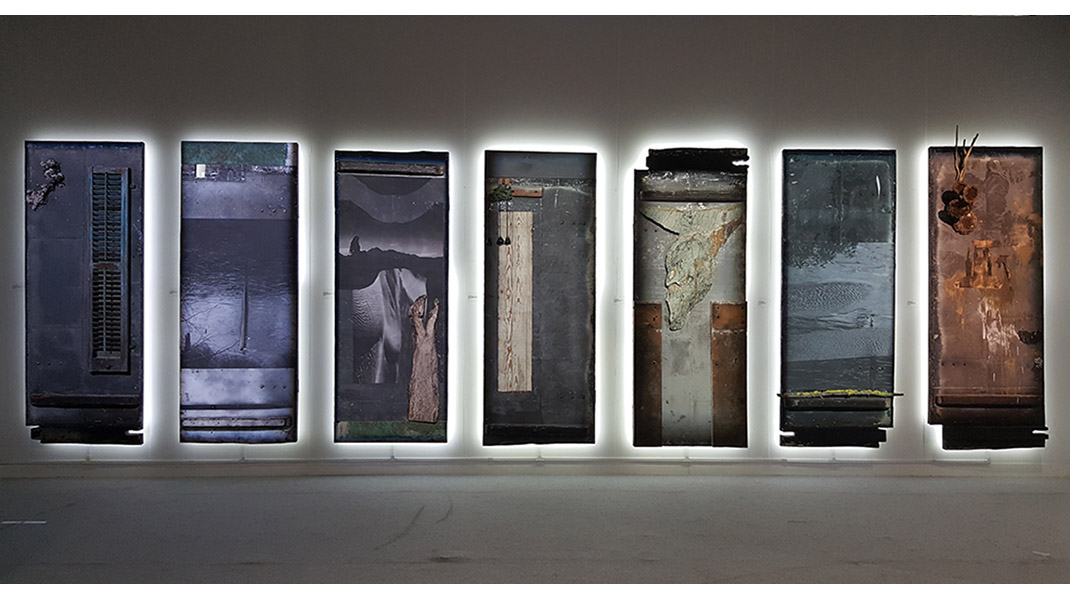
Permutations, Sandra Muss’ installation of seven nineteenth-century wooden doors illuminated by LED lights, will be prominently located at the end of the first aisle in the Salone di Donatello. Muss brings new life to these disused objects that, while formerly useful, have been discarded, corroded by the ravages of time. She imagines these doorways as gateways, portals between worlds that are thrilling, enlightening, and potentially transformative. This work draws from her travels to such diverse places as New Zealand, the Arctic Circle, and the Amazon. The way that Muss reflects on the passing of time, the mutation of everything, and the power of nature lend an immensely emotional, even spiritual, dimension to this work, one that is eminently suited to this religious site.

Door one, water, 2016. Transparent photo, found organic and inorganic material, unknown metal, wood, 92” x 35”

Door two, bouquet, 2016. Transparent photo, found organic and inorganic material, unknown metal, wood, 92” x 35”

Door three, underneath, 2016. Found organic and inorganic material, unknown metal, wood, 92” x 35”

Door four, desert meditation, 2016. Transparent photo, found organic and inorganic material, unknown metal, wood, 92” x 35”

Door five, animal, 2016. Found organic and inorganic material, unknown metal, wood, 92” x 35”

Door six, floating, 2016. Transparent photo, found organic and inorganic material, unknown metal, wood, 92” x 35”

Door seven, shutter, 2016. Found organic and inorganic material, unknown metal, wood, 92” x 35”


Permutations

Images courtesy Sandra Muss.

Visitors to Versailles (1682–1789) at The Met Fifth Avenue, April 16 – July 29, 2018

Photographs by Corrado Serra.

“Versailles, the royal residence of the Bourbon kings from 1682 until the French Revolution, was surely the most magnificent court in Europe. The palace and its gardens were also unusually public, allowing entry to anyone who was decently dressed. This strategy of openness was politically calculated, drawing on the long tradition of granting French subjects access to their ruler. From the moment Louis XIV transformed his father’s simple hunting lodge into the ultimate architectural expression of his absolute rule, travelers of all kinds flocked to see the king in his extraordinary setting. 

What was it like to visit Versailles? Who went there and what did they think of what they saw? This exhibition explores the experiences of various types of travelers as they toured the Hall of Mirrors, strolled through the expansive gardens, witnessed the arrival of diplomatic missions, or watched the royal family dine. Its narrative is drawn from letters, diaries, and reports from the period, and these histories are made tangible through a dazzling array of art objects, sculpture, costume, and paintings. There were some practical matters all travelers considered: how to reach Versailles, how to dress at court, and what sights to see. Nonetheless, specific visitors had vastly differing kinds of encounters with the royal family and the spaces they inhabited, depending on their rank and the reason for the trip. What gifts did they bring or receive? What souvenirs might they take home?” — Introductory Wall Text 

Installation view of section “Getting Dressed for Court”. Front: Sedan Chair. French, ca. 1785

Installation view of section “Getting Dressed for Court”

Detail of Dress (robe à la française). French, ca. 1770–75

Doll’s Court Gown. French, ca. 1769–75

Dress (robe à l’anglaise). French, 1785–87

Installation view of section “The Gardens”

Detail of Model of the Ambassadors’ Staircase. Charles Arquinet (French, 1900–1992), 1958

Louis XV (detail). Augustin Oudart Justina (French, died 1743), ca. 1717

Left & right: Pair of Pedestals. André Charles Boulle (French, Paris 1642–1732 Paris), ca. 1684. Center: Fall-Front Secretary on Stand. Attributed to Adam Weisweiler (Rhineland 1744–1820 Paris). French, 1784

Installation view of section “Overseas Embassies”

Top: Lacquer Cabinet. Japanese, 17th century. Bottom: Cannon. Siamese, before 1686

Claude André Deseine. (French, Paris 1740–1823 Petit-Gentilly). Left: Nephew of Muhammad Osman Khan, 1788. Right: Muhammad Osman Khan, 1788

Installation view of “Incognito and Private Visitors”

Left: The Birth of Bacchus. Sèvres Manufactory. French, after 1783. Right: Beauty Crowned by the Graces. Sèvres Manufactory, after a model by Louis Simon Boizot (1743–1809). French, after 1775

Installation view of section “Tourists and Souvenirs”

Installation view of section “Tourists and Souvenirs”

The Marriage of the Dauphin Louis Ferdinand to Marie Thérèse, Infanta of Spain. French, 1745

Benjamin Franklin. Joseph Siffred Duplessis (1725–1802); frame attributed to François Charles Buteux (1732–1788). French, 1778

Drop-Front Secretary and Commode. Jean Henri Riesener (Gladbeck, Germany 1734–1806 Paris). French, 1783. The Metropolitan Museum of Art, New York, Bequest of William K. Vanderbilt, 1920

Visitors to Versailles (1682–1789) is organized by Daniëlle Kisluk-Grosheide, the Henry R. Kravis Curator in the Department of European Sculpture and Decorative Arts at The Met, and Bertrand Rondot, Senior Curator at the Palace of Versailles.

Terry Winters: Facts and Fictions at The Drawing Center, April 6 – August 12, 2018

“The Drawing Center presents an overview of Terry Winters’s drawings from 1980 to the present, the first such exhibition in the United States. It will include a selection of large-scale works on paper and a wide span of smaller drawings as well as a suite of rarely seen drawings created between 2006 and 2016 in vitrines. Unlike typical retrospectives, this presentation is organized with an eye to morphological relationships so that, as viewers move through the gallery, they will recall and ideally return to earlier related images. The show foregrounds the overarching theme of Winters’s practice: the impulse to make sense, however fictively, of the manner in which the visible world is constructed and received.

A leading figure in the art world for four decades, Terry Winters became well-known in the 1980s for his materially-conscious drawings and paintings. Mobilizing the patterns and schema that undergird physical and intellectual life, Winters has developed his own pictorial language wherein, for example, graphs, networks, and knots describe complex encounters between biological drives, technological systems, and mental processes. Winters’s mature work is ostensibly abstract in that it does not typically depict recognizable objects or scenes, and yet, it is in no way divorced from the real world. On the contrary, Winters incorporates and modifies found images—often seemingly objective data from scientific renderings—in order to reveal the way in which these motifs are framed and affected by human intention. As Winters observes: ‘Although technical images are the product of human activity, these images also seem free from subjective decision-making. … I use this found imagery as a model, to see how information can be torqued or tweaked, made more poetic and expressive’.” — The Drawing Center

Terry Winters, Schema (57), 1985–86. Graphite and watercolor on paper, 12 x 8 1/2 inches. Private collection.

Terry Winters, Linking Graphics, 2, 1999. Ink, graphite, and color pencil on paper, 30 1/2 x 44 1/4 inches. Collection of The Museum of Modern Art, New York, purchase. Image © The Museum of Modern Art/Licensed by SCALA / Art Resource, NY.

Terry Winters, Untitled (2), 1999. Gouache on paper, 44 1/4 x 30 1/2 inches. Private collection.

Terry Winters, 7-Fold Sequence, Two, 2008. Graphite on paper, 22 1/8 x 30 inches. Collection of the Museum of Fine Arts Boston, Virginia Herrick Deknatel Purchase Fund and museum purchase with funds donated by Davis and Carol Noble.

Terry Winters, Untitled (Page), 2011. Graphite on paper, 11 x 8 1/2 inches.

Terry Winters, Untitled, 2011. Graphite and gouache on paper, 22 1/4 x 30 inches.

Terry Winters: Facts and Fictions was organized by Claire Gilman, Chief Curator.

Images courtesy The Drawing Center.

Joan Jonas at Tate Modern, through August 5, 2018

“Tate Modern presents the largest survey of Joan Jonas’s work ever held in the UK. Jonas (b.1936, New York) is regarded as a pre-eminent figure in contemporary performance who continues to influence a younger generation of artists. Reflecting the way Jonas works across many different disciplines, this groundbreaking survey is the first of its kind at Tate, combining a gallery exhibition, a ten day live programme in the Tanks with performances by Jonas herself, and a film retrospective in the Starr Cinema. It reveals her powerful impact on contemporary art and her dedication to pushing boundaries to this day.

This immersive exhibition at Tate Modern celebrates Joan Jonas’s outstanding contribution to art over the last five decades, uniting some of the most important pieces from throughout her career. Early and late works are displayed alongside one another, reflecting Jonas’s practice of revisiting her own past, as can be seen in Juniper Tree an installation created in 1994 that evolved from performances staged in 1976 and 1978. Early works include the iconic video Organic Honey’s Visual Telepathy 1972 which explores female identity via the artist’s sexualised alter-ego, while recent installations include Reanimation 2010/13 and Stream or River, Flight or Pattern 2016-17 which broach the issues of climate change and animal extinction – subjects that are central to Jonas’s current practice.” — Tate Modern

Joan Jonas (b.1936). The Juniper Tree, 1976/ 1994. Installation – 24 works on silk, acrylic paint, wooden structure, string of 29 wooden balls, ladder, kimono, mirror, glass jars, 78 slides, box and other materials. Overall display dimensions variable. Tate, purchased 2008 Wilkinson Gallery, London, 2008. Photo courtesy Wilkinson Gallery, London, photo by Peter White © 2017 Joan Jonas : Artists Rights Society (ARS), New York : DACS, London.

Joan Jonas (b.1936). Lines in the Sand, 2002. Installation. Video (Lines in the Sand 2002/2005, colour, sound, 47:45 min),projection, blackboard, wooden structure, paint, video (Pillow Talk, 2002, colour, sound), monitor with performance video, green wooden couch, sand and relief box, plaster, photographs, paintings). Dimensions variable Museu d’Art Contemporani de Barcelona, 2007. Photo by Juan Andres Pegoraro. © 2017 Joan Jonas : Artists Rights Society (ARS), New York : DACS, London.

Joan Jonas (b.1936). Lines in the Sand, 2002. Installation. Video (Lines in the Sand 2002/2005, colour, sound, 47:45 min),projection, blackboard, wooden structure, paint, video (Pillow Talk, 2002, colour, sound), monitor with performance video, green wooden couch, sand and relief box, plaster, photographs, paintings). Dimensions variable. Museu d’Art Contemporani de Barcelona, 2007. Photo by Juan Andres Pegoraro. © 2017 Joan Jonas : Artists Rights Society (ARS), New York : DACS, London.

Joan Jonas (b.1936). Wolf Lights, The Shape, the Scent, The Feel of Things, 2005. Video still © 2017 Joan Jonas : Artists Rights Society (ARS), New York : DACS, London.

Joan Jonas (b.1936. Reanimation. Installation, 2010, 2012, 2014. Private collection. Photo by Thomas Müller. Courtesy the Artist and Gavin Brown’s enterprise, New York: Rome. © 2017 Joan Jonas : Artists Rights Society (ARS), New York : DACS, London.

Joan Jonas (b.1936). They Come to Us without a Word II, 2015. Performance at Teatro Piccolo Arsenale, Venice, Italy, 2015. Photo by Moira Ricci. © 2017 Joan Jonas : Artists Rights Society (ARS), New York : DACS, London.

Joan Jonas is curated in close collaboration with the artist by Andrea Lissoni, Senior Curator of International Art (Film), Tate Modern and Julienne Lorz, Curator, Haus der Kunst, Munich with Monika Bayer-Wermuth, Assistant Curator, Tate Modern. The show will tour to Haus der Kunst, Munich, in 2018.

Images courtesy Tate Modern.

Before the Fall: German and Austrian Art of the 1930s at Neue Galerie New York, through May 28, 2018

Before the Fall: German and Austrian Art of the 1930s is an exhibition devoted to the development of the arts in Germany and Austria during a decade marked by economic crisis, political disintegration, and social chaos.

The exhibition is organized by Dr. Olaf Peters, University Professor at Martin- Luther-Universität Halle-Wittenberg, and serves as the third in a trilogy of shows curated by Peters that focus on German history. The first of these three exhibitions, Degenerate Art: The Attack on Modern Art in Nazi Germany 1937, organized in 2014, examined the infamous traveling exhibition Entartete Kunst mounted by the National Socialist regime. The exhibition was an enormous popular and critical success. The second show, Berlin Metropolis: 1918-1933 on view in 2015, explored the critical role played by the city of Berlin in the growth of modern culture.

This exhibition, comprised of nearly 150 paintings and works on paper, traces the many routes traveled by and demonstrates the artistic developments that foreshadowed, reflected, and accompanied the beginning of World War II. Central topics of the exhibition are the reaction of the artists towards their historical circumstances, the development of style with regard to the appropriation of various artistic idioms, the personal fate of artists, and major political events that shaped the era.” — Neue Galerie

Max Beckmann (1884-1950). Self-Portrait with Horn, 1938. Oil on canvas. Neue Galerie New York and Private Collection © 2018 Artists Rights Society (ARS), New York / VG Bild-Kunst, Bonn

Felix Nussbaum (1904-1944). Self-Portrait in the Camp, 1940. Oil on panel. Neue Galerie New York © 2018 Artists Rights Society (ARS), New York / VG Bild-Kunst, Bonn

Otto Dix (1891-1969). Portrait of Johann Edwin Wolfensberger, 1929. Oil on panel. Neue Galerie New York © 2018 Artists Rights Society (ARS), New York / VG Bild-Kunst, Bonn

Rudolf Wacker (1893-1939). Two Heads, 1932. Oil on panel. Belvedere, Vienna Photo: © Belvedere, Vienna

Max Beckmann (1884-1950). Paris Society, 1931. Oil on canvas. The Solomon R. Guggenheim Museum, New York Photo credit: The Solomon R. Guggenheim Foundation/Art Resource, NY © 2018 Artists Rights Society (ARS), New York / VG Bild-Kunst, Bonn

Otto Dix (1891-1969). Mother and Eva, 1935. Oil on panel. Museum Folkwang, Essen Museum Folkwang Essen – ARTOTHEK © 2018 Artists Rights Society (ARS), New York / VG Bild-Kunst, Bonn

Richard Oelze (1900-1980). Expectation, 1935-36. Oil on canvas. The Museum of Modern Art, New York Digital Image © The Museum of Modern Art / Licensed by SCALA / Art Resource, NY

August Sander (1876-1964). Children Born Blind, 1930-31. Gelatin silver print. The Museum of Modern Art, New York © 2018 Die Photographische Sammlung / SK Stiftung Kultur – August Sander Archiv, Cologne; ARS, New York

Franz Sedlacek (1891-1945). Landscape with Rainbow, 1930. Oil on panel. University of Applied Arts Vienna, Collection and Archive © University of Applied Arts Vienna, Collection and Archive

Pandiscio Green is the designer of the exhibition and was also responsible for the installations for the previous two shows in the trilogy. Michele Oka Doner created a site-specific sculpture for the installation of this exhibition.

Images courtesy Neue Galerie.