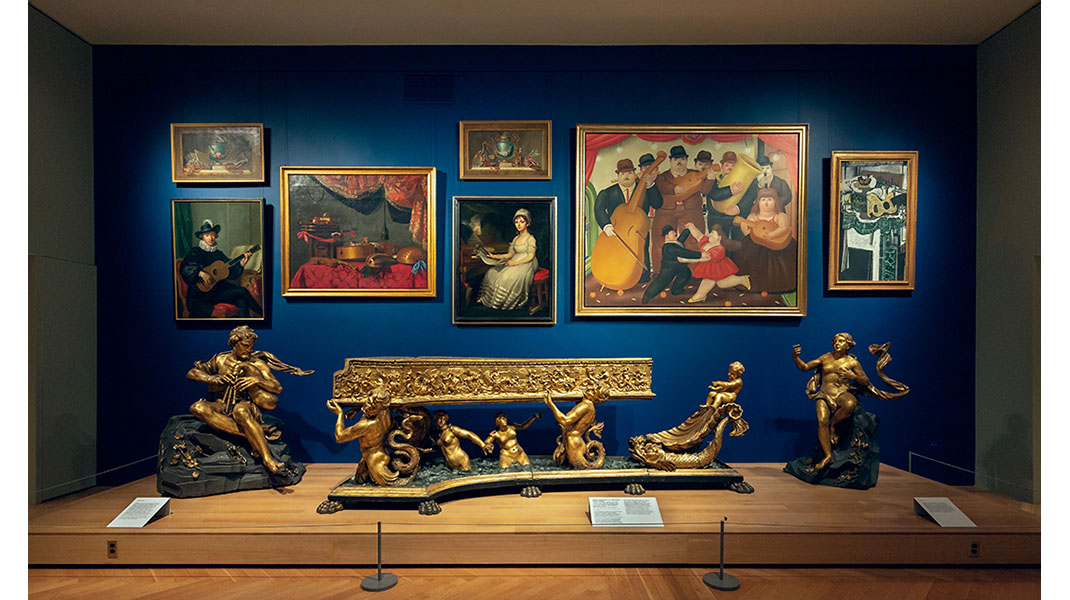
The Newly Renovated Gallery “Mapping the Art of Music”, The Met’s André Mertens Galleries for Musical Instruments, opens February 15, 2019

“The third and final phase of the nearly three-year project to renovate and reinterpret The Met’s André Mertens Galleries for Musical Instruments is now complete and the newest gallery opened to the public on February 15. The gallery includes over 250 musical instruments of various types-drums, strings, winds, keyboards, and more-dating from 200 B.C.E. to the present day, augmented by works from other Museum departments, including seven paintings, an imperial jade chime and scepter, and an Indonesian shadow puppet. The gallery also now includes an intimate concert space with a 7-by-25-foot stage and state-of-the-art recording and sound system that allows performances to be transmitted to the Museum’s main auditorium and beyond in the highest quality. Enhancing the gallery-viewing experience are two media kiosks featuring narratives on the Triangular Trade route and Silk Road (video footage available) as well as some 40 new Audio Guide stops.” — The Metropolitan Museum of Art

“Organized around the theme The Art of Music and punctuated with objects from across the Museum’s encyclopedic collection, the galleries present a new perspective on the interwoven world of music, art, innovation, and society,” said Bradley Strauchen-Scherer, Associate Curator of The Met’s Department of Musical Instruments, who oversaw the renovation project. “The reinterpretation of the galleries is a marked departure from typical displays of musical instruments that focus on typology and technical development.”

Photographs by Corrado Serra.

The Value of Good Design at The Museum of Modern Art, February 10 – June 15, 2019

Featuring objects from domestic furnishings and appliances to ceramics, glass, electronics, transport design, sporting goods, toys, and graphics, The Value of Good Design explores the democratizing potential of design, beginning with MoMA’s Good Design initiatives from the late 1930s through the 1950s, which championed well-designed, affordable contemporary products. The concept of Good Design also took hold well beyond the Museum, with governments on both sides of the Cold War divide embracing it as a vital tool of social and economic reconstruction and technological advancement in the years following World War II. This global scope is reflected in many of the items on view, from a mass-market Italian Fiat Cinquecento automobile and a Soviet-era East German Werra camera to a Japanese Sony television and a Brazilian bowl chair. These works join both iconic and unexpected items made in the US, such as the Eames La Chaise, a Chemex Coffee Maker, and Irwin Gershen’s Shrimp Cleaner. The exhibition also raises questions about what Good Design might mean today, and whether values from mid-century can be translated and redefined for a 21st-century audience. Visitors are invited to judge for themselves by trying out a few ‘good design’ classics still in production, and exploring how, through its design stores, MoMA continues to incubate new products and ideas in an international marketplace.” — MoMA 

Installation views: The Value of Good Design at The Museum of Modern Art, New York (February 10–June 15, 2019). Digital image © 2019 The Museum of Modern Art, New York. Photo: John Wronn

The Value of Good Design was organized by Juliet Kinchin, Curator, and Andrew Gardner, Curatorial Assistant, Department of Architecture and Design.

Images courtesy The Museum of Modern Art.

Nari Ward: We the People at New Museum, February 13 – May 26, 2019

“The first museum survey in New York of the work of Nari Ward (b. 1963, St. Andrew, Jamaica), the exhibition brings together works spanning Ward’s twenty-five-year career, installed across the three main floors of the Museum. Nari Ward: We the People is curated by Gary Carrion-Murayari, Kraus Family Curator; Massimiliano Gioni, Edlis Neeson Artistic Director; and Helga Christoffersen, Associate Curator. 

The exhibition features over thirty sculptures, paintings, videos, and large-scale installations from throughout Ward’s career, highlighting his status as one of the most important and influential sculptors working today. Since the early 1990s, Ward has produced his works by accumulating staggering amounts of humble materials and repurposing them in consistently surprising ways. 

His approach evokes a variety of creative acts of recycling and folk traditions from Jamaica, where he was born, as well as the material textures of Harlem, where he has lived and worked for the past twenty-five years. Yet Ward also relies on research into specific histories and sites to uncover connections among geographically and culturally disparate communities and to explore the tension between tradition and transformation.” — New Museum 

Photographs by Corrado Serra.

Hunger Cradle, 1996. Private Collection

Amazing Grace, 1993. Private Collection

Amazing Grace (detail), 1993. Private Collection

Crusader, 2005, Brooklyn Museum

Sky Juice, 1993, Whitney Museum of American Art

Front: Blue Window-Brick Vine, 1993, Columbus Museum of Art. Back: Iron Heavens, 1995, Collection Jeffrey Deitch

Glory, 2004. Courtesy the artist; Lehmann Maupin, New York, Hong Kong, and Seoul; and Galleria Continua, San Gimignano, Beijing, Les Moulins, and Havana

Installation view. Third floor

Exodus, 1993. Collection Jeffrey Deitch

Super Stud Salt Table, 1995/2019. Collection the artist; Lehmann Maupin, New York, Hong Kong, and Seoul; and Galleria Continua, San Gimignano, Beijing, Les Moulins, and Havana

Right: Carpet Angel, 1992, Museum of Contemporary Art, Los Angeles

Installation view. Fourth floor

Victoria Cabezas and Priscilla Monge: Give Me What You Ask For at Americas Society, February 13 – May 4, 2019

Give Me What You Ask For is the first exhibition to bring together the work of Victoria Cabezas (b. 1950) and Priscilla Monge (b. 1968), two Costa Rican artists from different generations. It explores how the two artists have challenged conventional art disciplines, including painting and sculpture, by drawing on their own lived experiences. Monge and Cabezas both use experimental artistic strategies to advocate for women and to critique established patriarchal structures.

“Pondering Cabezas and Monge’s paths helps us understand how the critical infrastructure in Central America has changed during the last four decades,” said Miguel A. López. “It also helps us recognize genealogies that show that women were, to a large extent, the catalysts for change in terms of the boundaries of the region’s contemporary art.” 

Victoria Cabezas.
 Sin título (Untitled), 1973. 
Polyptych, hand-colored gelatin silver prints,
 25 5⁄8 × 31 1/2 inches; 65 × 80 cm overall. 
Private Collection

Victoria Cabezas. Mujeres, gatos y televisores (Women, cats and televisions), 1983. Series of gum bichromate prints. Each 9 7⁄8 × 14 7⁄8 inches; 25 × 38 cm. Courtesy of the artist

Priscilla Monge. Dame lo que pides y pide lo que quieras (Give me what you ask for and ask for what you want), 1994. Oil on fabric,
 86 1/4 × 52 inches; 219 × 132.3 cm. Courtesy of the artist

Priscilla Monge. Pelota de fútbol (Soccer ball), 1999–2012. 
Sanitary napkins and black leather. 
Diameter 9 3/4 inches; 25 cm.
Courtesy of the artist

Victoria Cabezas and Priscilla Monge: Give Me What You Ask For is curated by Miguel A. López (Chief Curator of TEOR/éTica and Lado V, San José, Costa Rica).

Images courtesy Americas Society.

Mort Gerberg Cartoons: A New Yorker’s Perspective at New-York Historical Society, February 15 – May 5, 2019

“The first major museum exhibition featuring the work of Mort Gerberg, one of America’s most popular and beloved cartoonists. Throughout his career Gerberg’s work has been drawn from subjects ranging from social consciousness to music and sports. Known for combining artistry with intuitive wit, he chronicles and comments on contemporary events that become history. The more than 120 published cartoons, drawings, and sketch reportage featured in the exhibition cover a wide range of topics, such as life in New York City, women’s rights, old age, and politics.

Born in Brooklyn in 1931, Gerberg’s work has been regularly featured in The New Yorker, the Saturday Evening Post, and the Saturday Review, and numerous other publications. He has drawn syndicated newspaper comic strips, on television shows and websites, and edited or illustrated 45 books for adults and children, including his respected Cartooning: The Art and the Business.” — New-York Historical Society

Mort Gerberg, “No, not a ‘D’ – it’s a ‘B’! You know, like in Beowulf…Botticelli…Brahms…”, cartoon for the Saturday Review, 1965

Mort Gerberg, “Wait, those weren’t lies. That was spin!”, cartoon for the New Yorker, April 20, 1998

Mort Gerberg, “Castaway Island,” cartoon for the New Yorker, June 4, 2012

Mort Gerberg, “The thing is, you have to really want to change.”, cartoon for the New Yorker, April 20, 2014

Exhibition was curated by Marilyn Satin Kushner, curator and head, Department of Prints, Photographs, and Architectural Collections of the New-York Historical Society.

Images courtesy New-York Historical Society.

Frida Kahlo: Appearances Can Be Deceiving at Brooklyn Museum, February 8 – May 12, 2019

Frida Kahlo: Appearances Can Be Deceiving is the largest U.S. exhibition in ten years devoted to Frida Kahlo, and the first in the United States to display a collection of her personal possessions from the Casa Azul (Blue House), the artist’s lifelong home in Mexico City. The objects, ranging from clothing, jewelry, and cosmetics to letters and orthopedic corsets, will be presented alongside works by Kahlo—including ten key paintings and a selection of drawings—as well as photographs of the artist, all from the celebrated Jacques and Natasha Gelman Collection. Related historical film and ephemera, as well as objects from the Brooklyn Museum’s extensive holdings of Mesoamerican art, are also included. Offering an intimate glimpse into the artist’s life, Appearances Can Be Deceiving explores how politics, gender, clothing, national identities, and disability played a part in defining Kahlo’s self-presentation in her work and life.

After Kahlo’s death in 1954, her husband, muralist Diego Rivera, instructed that their personal belongings be locked away at the Blue House, not to be touched until 15 years after Rivera’s death. In 2004, these items were unearthed and inventoried. Making their U.S. debut are more than one hundred of Kahlo’s personal artifacts ranging from noteworthy examples of her iconic Tehuana clothing, contemporary and Mesoamerican jewelry, and some of the many hand-painted corsets and prosthetics used by the artist during her lifetime. Shedding new light on one of the most popular artists of the twentieth century, these objects illustrate how Kahlo crafted her appearance, and shaped her personal and public identity to reflect her cultural heritage and political beliefs while also addressing and incorporating her physical disabilities.” — Brooklyn Museum

Photographs by Corrado Serra.

Catherine Morris, Sackler Senior Curator, Brooklyn Museum, says, “Under-recognized in her lifetime, Kahlo has become a feminist icon over the past four decades. The prevailing narrative that women are too often defined by their clothes, their appearance, and their beauty was powerfully co-opted by Kahlo through the empowering and intentional choices she made to craft her own identity. The exhibition is titled after a drawing by Kahlo, in which she makes visible the disability that her striking Tehuana skirts and blouses covered. The show expands our understanding of Kahlo by revealing the unique power behind the ways she presented herself in the world and depicted herself in her art.”

Frida Kahlo: Appearances Can Be Deceiving is organized by Catherine Morris, Sackler Senior Curator for the Elizabeth A. Sackler Center for Feminist Art, and Lisa Small, Senior Curator, European Art, Brooklyn Museum, and is based on an exhibition at the V&A London. The Brooklyn exhibition is organized in collaboration with the Banco de México Diego Rivera and Frida Kahlo Museums Trust, and The Jacques and Natasha Gelman Collection of 20th Century Mexican Art and The Vergel Foundation.

For Freedoms: Where Do We Go From Here? at International Center of Photography (ICP), February 8 – April 28, 2019

“In the wake of the 2018 midterm elections, ICP’s new exhibition For Freedoms: Where Do We Go From Here? explores the role of art and visual representation in American civic life through the work of the For Freedoms collective. The exhibition features work from their 50 State Initiative—composed of a network of over 300 artists and 200 institutional partners—which featured concurrent exhibitions, art installations, and public programs as well as a nationwide artist-designed billboard campaign in all 50 states including DC and Puerto Rico, in the lead up to the midterm elections. Also central to the 50 State Initiative is the collective’s series of photographs that re-envision American artist Norman Rockwell’s Four Freedoms paintings—depicting freedom of speech, freedom of worship, freedom from want, and freedom from fear, as articulated by Franklin D. Roosevelt’s 1941 State of the Union address—which will be on the view for the first time. For Freedoms’ stylized scenes of the everyday reference Rockwell’s iconic style while bringing new, more inclusive representations of the country to the discussion of our core values. Members of For Freedoms will be in residence at the ICP Museum, which will serve as the collective’s headquarters for the duration of the exhibition.” — International Center of Photography

Hank Willis Thomas and Emily Shur. Freedom of Speech, 2018. Image courtesy of Hank Willis Thomas, Emily Shur, and For Freedoms.

Hank Willis Thomas and Emily Shur. Freedom of Worship, 2018. Image courtesy of Hank Willis Thomas, Emily Shur, and For Freedoms.

Hank Willis Thomas and Emily Shur. Freedom from Want, 2018. Image courtesy of Hank Willis Thomas, Emily Shur, and For Freedoms.

Hank Willis Thomas and Emily Shur. Freedom from Fear, 2018. Image courtesy of Hank Willis Thomas, Emily Shur, and For Freedoms.

For Freedoms in collaboration with the Gordon Parks Foundation, I Am You, Madison, Wisconsin, 2018, Photograph by Maryam Ladoni

“The ICP Museum show marks the first time that audiences will be able to view the 50 State Initiative and Four Freedoms images displayed side-by-side as a full series,” says Mark Lubell, Executive Director of the International Center of Photography. “We’re pleased that the ICP Museum will serve as an active space in which members of For Freedoms, nonprofits, and the public are invited to discuss the importance of civic engagement and to develop educational programming based on the project.” 

For Freedoms: Where Do We Go From Here? is organized by Ava Hess, exhibitions department manager, in collaboration with For Freedoms.

Images courtesy International Center of Photography.

Your Mirror: Portraits from the ICP Collection at International Center of Photography (ICP), February 8 – April 28, 2019

Your Mirror: Portraits from the ICP Collection—surveys the nuanced ways people present themselves for the camera, how and by whom they are represented, and who is deemed worthy of commemoration. Featuring a range of images including studio portraits, snapshots, and documentary photographs—all drawn from the ICP Collection—this exhibit features a daguerreotype of a bedridden woman by Southworth & Hawes, a cart-de-visite featuring Sojourner Truth holding her knitting, Samuel Fosso’s performative self-portraits, as well as an FBI wanted poster.” —  International Center of Photography

“We live in a hyper-photographic culture, where we are creating and capturing images of ourselves and others at a rapid pace,” says Erin Barnett, ICP’s director of exhibitions and collections. “With Your Mirror, which explores the historic context of portraiture, we aim to gain understanding of the ways in which people made— or didn’t make—decisions about how they were presented for the camera and for society. There couldn’t be a more important time to examine the ways in which photography shapes our ideas about others and ourselves.”

Robert Capa, [Robert Capa photographing John Steinbeck through a mirror, Moscow, USSR], August–September 1947. International Center of Photography, The Robert and Cornell Capa Archive (2010.91.516) © International Center of Photography/Magnum Photos

Samuel Fosso, Self Portrait, 1977. International Center of Photography, Purchase, with funds provided by the ICP Aquisitions Committee, 2004 (19.2004) © Samuel Fosso, Courtesy JM Patras/Paris

Marc Riboud, [Anti-Vietnam war demonstration, Washington], October 21, 1967. International Center of Photography (11.1975) © Marc Ribouc/ Magnum Photos

David Seidner, Jessye Norman, ca. 1995. International Center of Photography, David Seidner Archive (2007.65.5) © David Seidner Archive/ International Center of Photography

Sheng Qi, Memories (Me), 2000. International Center of Photography, Purchase, with funds provided by Anne and Joel Ehrenkranz, 2004 (7.2004) © Sheng Qi

Southworth & Hawes, [Unidentified Woman], ca. 1845-50. International Center of Photography, Gift of Samuel Lehr, 2010 (2010.123.2)

Unidentified Photographer, Missing: Call FBI, June 29, 1964. International Center of Photography, Anonymous Gift, 2005 (10.2005)

Unidentified Photographer, I Sell the Shadow to Support the Substance. Sojourner Truth, 1864. International Center of Photography, Purchase, with funds provided by the ICP Acquisitions Committee, 2003 (182.2003)

Unidentified Photographer, [Unidentified Woman at “Beach”], ca. 1880. International Center of Photography, Museum Purchase, 2009 (2009.3.1)

Nontsikelelo Veleko, Nonkululeko, 2003-2004. International Center of Photography, Purchase with funds provided by Gregory Miller, 2005 (2092.2005) ©Nonstikelelo Veleko / Courtesy of AFRONOVA Gallery

Weegee, [Frank Pape, arrested for strangling boy to death, New York], November 10, 1944. International Center of Photography, Weegee Archive (2068.1993). © Weegee/International Center of Photography

Your Mirror: Portraits from the ICP Collection is curated by Erin Barnett, director of exhibitions and collections, and Claartje van Dijk, assistant curator, collections.

Images courtesy International Center of Photography.

Bondye: Between and Beyond at New Orleans Museum of Art (NOMA), January 25 – June 16, 2019

The New Orleans Museum of Art (NOMA) presents Bondye: Between and Beyond featuring a series of sequined prayer flags by Tina Girouard with Haitian artists in Port-au-Prince, where she established a workshop with accomplished sequin artists such as Edgar Jean-Louis and George Valris. Inspired by the blend of Caribbean, African and European culture in her own Louisiana hometown, these flags reference a range of international traditions expressed in Vodou, from All Saints Day in France to New Orleans Mardi Gras and Haitian Kanaval. 

The elaborate  displayed in Bondye: Between and Beyond pay tribute to the spirits of Haitian Vodou. These unseen entities, or loa, act as intermediaries between the human and spirit worlds and exist in many nations and cultures, reflecting the melding of West African, Catholic and Haitian spiritual practices that inform the practice of Vodou. In Vodou ritual, sequined flags beckon these loa from beyond, bringing messages of faith and hope to the supreme spiritual force, known as Bondye, which represents pure goodness and the highest principle of the universe. 

Beginning in the 1960s, Tina Girouard was among a prominent group of artists from Louisiana who arrived on the national scene that included Keith Sonnier, Lynda Benglis, and Dickie Landry. These artists countered the more austere minimalist art being made at the time with exuberant color, eclectic compositions, and unorthodox new materials that reflected Louisiana’s diverse local culture. In works like these sequined flags, their art gave visibility to new voices and perspectives from within and beyond the borders of the United States.” — New Orleans Museum of Art

Photographs by Roman Alokhin, courtesy New Orleans Museum of Art.

Tina Girouard. LEGBA, c. 1992. Sequins, beads, fabric. 43 x 72 in. Collection of the Artist ©Tina Girouard.

Tina Girouard. TOUSSAINT, 1991. Sequins, beads, fabric, 43 x 72 in. Collection of the Artist ©Tina Girouard.

Tina Girouard. DAMBALA, 1991 Sequins, beads, fabric. 43 x 72 in. Collection of the Artist ©Tina Girouard.

Tina Girouard and George Valris. ERZULIE, 1991. Sequins, beads, fabric, 43 x 72 in. Collection of the Artist ©Tina Girouard

Tina Girouard. OGOU, 1992. Sequins, beads, fabric, 43 x 72 in. Collection of the Artist ©Tina Girouard

Tina Girouard. SIMBI, c. 1992. Sequins, beads, fabric, 43 x 72 in. Collection of the Artist

Tina Girouard. AGOUE, 1991. Sequins, beads, fabric, 43 x 72 in. Collection of the Artist ©Tina Girouard

Tina Girouard. LA SIRENE, c. 1995. Sequins, beads, fabric, 43 x 72 in. Collection of the Artist ©Tina Girouard

Tina Girouard. MARASSA, 1992. Sequins, beads, fabric, 43 x 72 in. Collection of the Artist ©Tina Girouard

Tina Girouard and Edgar Jean-Louis. AZACA, 1992. Sequins, beads, fabric, 43 x 72 in. Collection of the Artist ©Tina Girouard

Tina Girouard. BOUSSOU, 1991. Sequins, beads, fabric, 43 x 72 in. Collection of the Artist ©Tina Girouard

Tina Girouard. GRAND BOIS, 1991. Sequins, beads, fabric, 43 x 72 in. Collection of the Artist ©Tina Girouard

Tina Girouard. PAPA LOCO, 1991. Sequins, beads, fabric, 43 x 72 in. Collection of the Artist ©Tina Girouard

Tina Girouard. SOBO BADE, c. 1992. Sequins, beads, fabric, 43 x 72 in. Collection of the Artist ©Tina Girouard

 Bondye: Between and Beyond is co-curated by Nicolas Brierre Aziz, Curator of the Haitian Cultural Legacy Collection, and Katie A. Pfohl, Curator of Modern and Contemporary Art at NOMA.

Faith and Empire: Art and Politics in Tibetan Buddhism at The Rubin Museum of Art, February 1 – July 15, 2019

“How do political leaders rise to power? What gives them the right to rule? In some governments today, we imagine power comes from the democratic consent of the people. In other systems, power can manifest through sheer might alone or could be transferred through religious mandate. The force of religion to claim political power is a global phenomenon, and Tibetan Buddhism once offered such divine means to power and legitimacy to rule.

Faith and Empire explores the dynamic historical intersection of politics, religion, and art in Tibetan Buddhism. Through more than 60 objects from the 8th to the 19th century, the exhibition illuminates how Tibetan Buddhism presented a model of universal sacral kingship, whereby consecrated rulers were empowered to expand their realm, aided by the employment of ritual magic. Images were a primary means of political propagation, integral to magical tantric rites and embodiments of its power.

By the 12th century, Tibetan Buddhist masters became renowned across Northern Asia as bestowers of this anointed rule and occult power. Tibetans also used the mechanism of reincarnation as a means of succession, a unique form of political legitimacy that they brought to empires to the east.

Through the lens of Tibetan Buddhism’s potent historic political role in Asia, Faith and Empire seeks to place Himalayan art in a larger global context and shed light on an important but little-known aspect of power in the Tibetan tradition.” — The Rubin Museum of Art

Photographs by Corrado Serra.

Faith and Empire was curated by Karl Debreczeny.

Museo del Prado 1819-2019: A Place of Memory at Museo Nacional del Prado, Madrid, through March 10, 2019

“This exhibition looks back on two hundred years of history shared by the Museum and society, as well as focusing on Spain’s heritage policy, the developments that helped to build up the Museum’s collections, and the transformation of the Prado into a point of reference so that Spanish and foreign writers, intellectuals and artists could reflect on Spain’s past and the country’s collective identity. 

Organised around the art and documentary collections at the Prado (both visual and sound archives), which shall be exhibited alongside works by artists who have come into contact with the Museum over the last two centuries (such as Renoir, Manet, Chase, Picasso, Arikha, Rosales, Saura and Pollock, amongst others), the exhibition presents a total of 168 original works, 34 from different Spanish and foreign institutions, together with a significant variety of complementary materials such as documents, maps, pictures, photographs and audiovisual installations. 

Since the Museo Real opened its doors on 19th November 1819 with works from the Royal Collections, this institution has served as one of the leading depositaries for the history of Western art, a key point of reference for Spanish culture and an object of collective pride. Some two hundred years after it was founded, the Museo del Prado would like to reflect on all this and share its celebrations, especially with those who visit the exhibition, an exhibition designed to provide a rich insight into the Museum’s development and historical significance.” — Museo del Prado

Museo del Prado, view of the Queen Isabel II gallery. Juan Laurent y Minier, Photograph, 244 x 337 mm, h. 1879. Madrid, © Museo Nacional del Prado

Museo del Prado, view of the Velázquez gallery. José Lacoste y Borde, Photograph, 166 x 230 mm, 1900-1907. Madrid, © Museo Nacional del Prado

“Group of spectators in front of a copy, by Velázquez, Cebreros, Ávila, 13-17 de noviembre de 1932”. Madrid, Archivo fotográfico de la Residencia de Estudiantes © Museo Nacional del Prado

María Isabel de Braganza as Founder of the Museo del Prado, Bernardo López Piquer, 1829. Oil on canvas, 258 x 174 cm. Madrid, © Museo Nacional del Prado

Crucified Christ, Diego Velázquez. Oil on canvas, 248 x 169 cm, h. 1632. Madrid, © Museo Nacional del Prado

Dyptic with 42 monumental views of Spanish cities, Genaro Pérez Villaamil y Duquet. Oil on paper and panel, 172.5 x 89.4 x 14.5 cm, 1833-1838. Madrid, © Museo Nacional del Prado

In the Dresden gallery, Karl Louis Preusser, 1881. Oil on canvas, 68 x 87 cm. Dresden, © Albertinum | Galerie Neue Meister, Staatliche Kunstsammlungen

Scenes from Nastagio degli Onesti, Sandro Botticelli. Mixed technique on panel, 83.5 x 142.5 cm, 1483. Madrid, © Museo Nacional del Prado

The Countess of Chinchón, Francisco de Goya. Oil on canvas, 216 x 144 cm, 1800. Madrid, © Museo Nacional del Prado

Alice in the Mirror, William M. Chase. Oil on canvas, 89.5 x 81.2 cm. © Parrish Art Museum

Amazon, Édouard Manet. Oil on canvas, 73 x 52 cm, h. 1882. Madrid, © Museo Nacional Thyssen-Bornemisza

Las Meninas, Pablo Picasso. Oil on canvas, 129 x 161 cm, 18/9/1957. Barcelona, © Museu Picasso

The Antechamber, Equipo Crónica. Acrylic on canvas, 140.5 x 140.5 cm., 1968 Palma, © Colección Fundación Juan March, Museu Fundación Juan March

Museo del Prado 1819-2019: A Place of Memory was organised by Javier Portús, Chief Curator of Spanish Painting (up to 1700) at Museo del Prado.  

Title image: Exhibition galleries “1819-2019. A place of memory”. Photo © Museo Nacional del Prado. 

Images courtesy Museo del Prado.

Akari: Sculpture by Other Means and Akari Unfolded: A Collection by YMER&MALTA at The Noguchi Museum, through April 14, 2019

Akari: Sculpture by Other Means occupies the Museum’s second-floor galleries, with three distinct areas that together explore the versatility, impact, and flexibility of Noguchi’s exquisite paper-bamboo-and-wire lanterns. Including more than 100 Akari, representing about forty individual models, the exhibition allows visitors to experience the ways that Akari can create and transform space. Several installations, including a floor-to-ceiling Akari “cloud” and three Akari “rooms,” create a series of environments that convey the essential values of Akari, drawing on the organizational, structural, and ephemeral qualities of nature, and exemplifying Noguchi’s concept of light as both place and object. A substantial selection of archival material comprises vintage photographs, advertisements, and Akari brochures, all suggesting Noguchi’s thinking about the presentation of Akari as a continually shifting enterprise. 

Akari Unfolded: A Collection by YMER&MALTA presents 26 lamps created by this leading French design studio. Six designers were tasked with exploring the essential values of Akari and how Noguchi might work with new materials and processes to expand the wider universe of his light sculptures. The resulting designs are not variations on Akari, but an exciting proof of how Noguchi’s sophisticated hybridities, such as craft and industry, and tradition and progress, continue to provide a powerful model for contemporary design.” — The Noguchi Museum

Installation view, Akari in the Archives. Photo by Nicholas Knight. ©The Isamu Noguchi Foundation and Garden Museum / Artists Rights Society (ARS).

Installation view, Akari in the Archives. Photo by Nicholas Knight. ©The Isamu Noguchi Foundation and Garden Museum / Artists Rights Society (ARS).

Installation view, Akari in the Archives. Photo by Nicholas Knight. ©The Isamu Noguchi Foundation and Garden Museum / Artists Rights Society (ARS).

Isamu Noguchi, Paris Abstraction (1928), and Akari VB-13 (1986). ©The Isamu Noguchi Foundation and Garden Museum / Artists Rights Society (ARS).

(From left) Isamu Noguchi, Akari H (c.1977), 125F (1971), 15A (1953), and 32N (1969), on BB2 and BB3 bases (1954). ©The Isamu Noguchi Foundation and Garden Museum / Artists Rights Society (ARS).

Isamu Noguchi, Akari Cloud, Akari A, D and F series (c.1954–1971). ©The Isamu Noguchi Foundation and Garden Museum / Artists Rights Society (ARS).

Isamu Noguchi, Akari PL2 (c.1973), and Akari 1A, 1952 (inside). Wood enclosure by The Noguchi Museum (2018). ©The Isamu Noguchi Foundation and Garden Museum / Artists Rights Society (ARS).

Akari PL2 (c.1973). Wood enclosure by The Noguchi Museum (2018). Isamu Noguchi, Akari 200D for the 1986 Venice Biennale (1985). ©The Isamu Noguchi Foundation and Garden Museum / Artists Rights Society (ARS).

(From left) YMER&MALTA / Benjamin Graindorge, edaLight . Paper, metal, concrete, LED. YMER&MALTA / Sylvain Rieu Piquet, Galet . Resin, linen fiber, LED. YMER&MALTA / Sebastian Bergne, Poise . Paper, metal, LED. Courtesy of The Noguchi Museum.

(From left) YMER&MALTA / Sebastian Bergne, Poise . Paper, metal, LED. YMER&MALTA / Nendo, Light Fragments . Acrylic, metal, LED. YMER&MALTA / Océane Delain, Belle de Jour. Resin, linen, metal, LED. YMER&MALTA / Océane Delain, Belle de Nuit. Porcelain, metal, LED. YMER&MALTA / Benjamin Graindorge, edaLight . Paper, metal, concrete, LED. Courtesy of The Noguchi Museum.

(From left) YMER&MALTA / Océane Delain, Belle de Nuit. Porcelain, metal, LED. YMER&MALTA / Océane Delain, Belle de Jour. Resin, linen, metal, LED. Courtesy of The Noguchi Museum.

YMER&MALTA / Nendo, Light Fragments . Acrylic, metal, LED. Courtesy of The Noguchi Museum.

The exhibitions are organized by The Noguchi Museum. Akari: Sculpture by Other Means is curated by Senior Curator Dakin Hart; Akari Unfolded: A Collection by YMER&MALTA is curated by Mr. Hart in collaboration with YMER&MALTA Director Valérie Maltaverne. 

Images courtesy The Noguchi Museum.