Akari: Sculpture by Other Means and Akari Unfolded: A Collection by YMER&MALTA at The Noguchi Museum, through April 14, 2019

Akari: Sculpture by Other Means occupies the Museum’s second-floor galleries, with three distinct areas that together explore the versatility, impact, and flexibility of Noguchi’s exquisite paper-bamboo-and-wire lanterns. Including more than 100 Akari, representing about forty individual models, the exhibition allows visitors to experience the ways that Akari can create and transform space. Several installations, including a floor-to-ceiling Akari “cloud” and three Akari “rooms,” create a series of environments that convey the essential values of Akari, drawing on the organizational, structural, and ephemeral qualities of nature, and exemplifying Noguchi’s concept of light as both place and object. A substantial selection of archival material comprises vintage photographs, advertisements, and Akari brochures, all suggesting Noguchi’s thinking about the presentation of Akari as a continually shifting enterprise. 

Akari Unfolded: A Collection by YMER&MALTA presents 26 lamps created by this leading French design studio. Six designers were tasked with exploring the essential values of Akari and how Noguchi might work with new materials and processes to expand the wider universe of his light sculptures. The resulting designs are not variations on Akari, but an exciting proof of how Noguchi’s sophisticated hybridities, such as craft and industry, and tradition and progress, continue to provide a powerful model for contemporary design.” — The Noguchi Museum

Installation view, Akari in the Archives. Photo by Nicholas Knight. ©The Isamu Noguchi Foundation and Garden Museum / Artists Rights Society (ARS).

Installation view, Akari in the Archives. Photo by Nicholas Knight. ©The Isamu Noguchi Foundation and Garden Museum / Artists Rights Society (ARS).

Installation view, Akari in the Archives. Photo by Nicholas Knight. ©The Isamu Noguchi Foundation and Garden Museum / Artists Rights Society (ARS).

Isamu Noguchi, Paris Abstraction (1928), and Akari VB-13 (1986). ©The Isamu Noguchi Foundation and Garden Museum / Artists Rights Society (ARS).

(From left) Isamu Noguchi, Akari H (c.1977), 125F (1971), 15A (1953), and 32N (1969), on BB2 and BB3 bases (1954). ©The Isamu Noguchi Foundation and Garden Museum / Artists Rights Society (ARS).

Isamu Noguchi, Akari Cloud, Akari A, D and F series (c.1954–1971). ©The Isamu Noguchi Foundation and Garden Museum / Artists Rights Society (ARS).

Isamu Noguchi, Akari PL2 (c.1973), and Akari 1A, 1952 (inside). Wood enclosure by The Noguchi Museum (2018). ©The Isamu Noguchi Foundation and Garden Museum / Artists Rights Society (ARS).

Akari PL2 (c.1973). Wood enclosure by The Noguchi Museum (2018). Isamu Noguchi, Akari 200D for the 1986 Venice Biennale (1985). ©The Isamu Noguchi Foundation and Garden Museum / Artists Rights Society (ARS).

(From left) YMER&MALTA / Benjamin Graindorge, edaLight . Paper, metal, concrete, LED. YMER&MALTA / Sylvain Rieu Piquet, Galet . Resin, linen fiber, LED. YMER&MALTA / Sebastian Bergne, Poise . Paper, metal, LED. Courtesy of The Noguchi Museum.

(From left) YMER&MALTA / Sebastian Bergne, Poise . Paper, metal, LED. YMER&MALTA / Nendo, Light Fragments . Acrylic, metal, LED. YMER&MALTA / Océane Delain, Belle de Jour. Resin, linen, metal, LED. YMER&MALTA / Océane Delain, Belle de Nuit. Porcelain, metal, LED. YMER&MALTA / Benjamin Graindorge, edaLight . Paper, metal, concrete, LED. Courtesy of The Noguchi Museum.

(From left) YMER&MALTA / Océane Delain, Belle de Nuit. Porcelain, metal, LED. YMER&MALTA / Océane Delain, Belle de Jour. Resin, linen, metal, LED. Courtesy of The Noguchi Museum.

YMER&MALTA / Nendo, Light Fragments . Acrylic, metal, LED. Courtesy of The Noguchi Museum.

The exhibitions are organized by The Noguchi Museum. Akari: Sculpture by Other Means is curated by Senior Curator Dakin Hart; Akari Unfolded: A Collection by YMER&MALTA is curated by Mr. Hart in collaboration with YMER&MALTA Director Valérie Maltaverne. 

Images courtesy The Noguchi Museum.
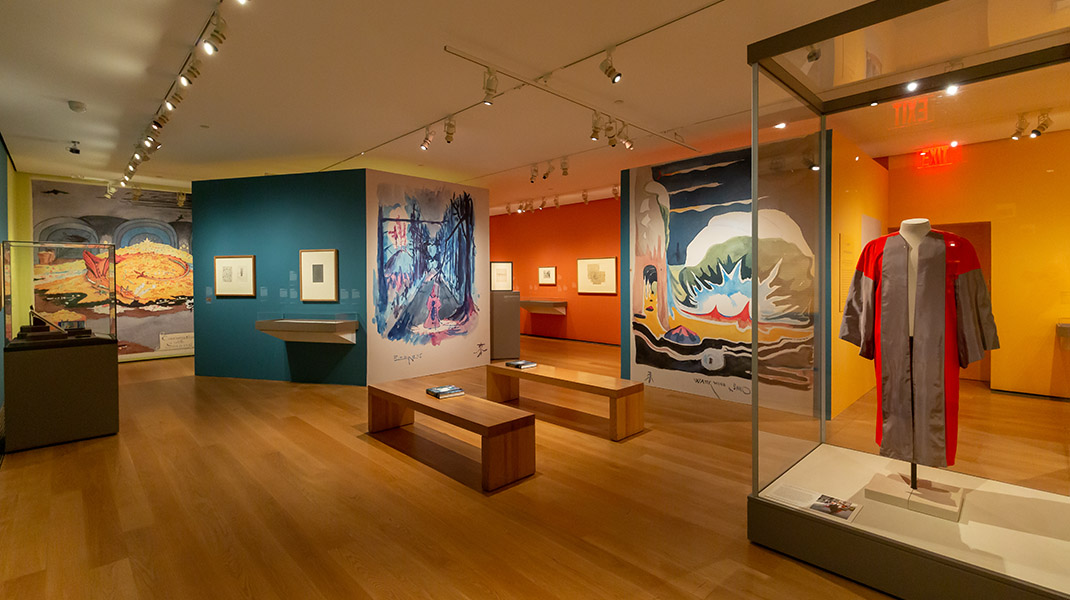
Tolkien: Maker of Middle-earth at The Morgan Library & Museum, January 25 – May 12, 2019

“The Morgan Library & Museum offers a once-in-a-generation opportunity to see a remarkable collection of materials related to one of the world’s most beloved authors, John Ronald Reuel Tolkien (1892–1973). Tolkien’s adventurous tales ignited a fervid spark in generations of readers. From the children’s classic The Hobbit to the epic The Lord of the Rings, Tolkien’s stories of hobbits and elves, dwarves and wizards have introduced millions to the rich history of Middle-earth.

This exhibition provides the largest collection of Tolkien material ever assembled in the United States. First presented at the Bodleian Libraries in 2018, the 117 objects on view include family photographs and memorabilia, Tolkien’s original illustrations, maps, draft manuscripts, artefacts, and designs related to The Hobbit, The Lord of the Rings, and The Silmarillion. The exhibition guides visitors through Tolkien’s development as a writer and artist, from his childhood and student days, through his career as a scholar of medieval languages and literature, to his family life as a husband and father. It presents a unique opportunity to understand the intensely visual imagination, the dedicated scholarship, and the aspects of daily life that shaped Tolkien’s most treasured works.” —  The Morgan Library & Museum

Exhibition entrance. Photograph by Corrado Serra.

J.R.R. Tolkien in his study, ca. 1937, black and white photograph. Tolkien Trust, MS. Tolkien photogr. 5, fol. 94. © The Tolkien Trust 2015.

Installation view. Photograph by Corrado Serra.

J. R. R. Tolkien (1892–1973), The Shores of Faery, 10 May 1915, watercolor, black ink, pencil. Tolkien Trust, MS. Tolkien Drawings 87, fol. 22r. © The Tolkien Trust 1995.

J. R. R. Tolkien (1892–1973), Fantasy landscape, 1915?, watercolor, black ink. Tolkien Trust, MS. Tolkien Drawings 87, fol. 26. © The Tolkien Trust 2015.

Installation view. Photograph by Corrado Serra.

Installation view. Photograph by Corrado Serra.

J. R. R. Tolkien (1892–1973), Conversation with Smaug, July 1937, black and colored ink, watercolor, white body color, pencil. Bodleian Libraries, MS. Tolkien Drawings 30. © The Tolkien Estate Limited 1937.

J. R. R. Tolkien (1892–1973), Dust jacket design for The Hobbit, April 1937, pencil, black ink, watercolor, gouache. Bodleian Libraries, MS. Tolkien Drawings 32. © The Tolkien Estate Limited 1937.

J. R. R. Tolkien (1892–1973), Bilbo comes to the Huts of the Raft-elves, July 1937, watercolor, pencil, white body color. Bodleian Libraries, MS. Tolkien Drawings 29. © The Tolkien Estate Limited 1937.

J. R. R. Tolkien (1892–1973), The Hill: Hobbiton-across-the Water, August 1937, watercolor, white body color, black ink. Bodleian Libraries, MS. Tolkien Drawings 26. © The Tolkien Estate Limited 1937.

Installation view. Photograph by Corrado Serra.

J. R. R. Tolkien (1892–1973), The first map of The Lord of the Rings, c.1937–1949, black, red and blue ink, pencil, colored pencil. Bodleian Libraries, MS. Tolkien Drawings 103. © The Tolkien Trust 1992, 2015.

Installation view. Photograph by Corrado Serra.

Installation view. Photograph by Corrado Serra.

“It is exciting to see so much material in Tolkien’s own hand,” said John McQuillen, Associate Curator of the Printed Books and Bindings Department. “It’s as if we are looking over his shoulder while he composes and illustrates his vision of Middle-earth. We get to glimpse moments in the creation of the narrative, such as when he changes the wizard’s name to Gandalf or suddenly comes up with the idea of the One Ring. It is almost voyeuristic: we have the opportunity to see the creative process that brought us the books with which we are so familiar.”

Tolkien: Maker of Middle-earth is organized by the Morgan Library & Museum in collaboration with the Bodleian Libraries, University of Oxford, and with the support of The Tolkien Estate, The Tolkien Trust, and members of the Tolkien family. The curator of the Morgan exhibition is John T. McQuillen, Associate Curator of Printed Books and Bindings. 

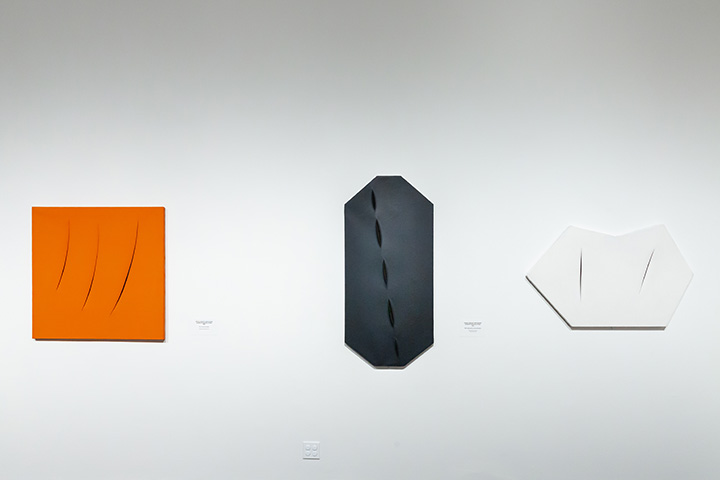
Lucio Fontana: On the Threshold at The Met Breuer, January 23 – April 14, 2019

Lucio Fontana: On the Threshold is the first retrospective of Lucio Fontana (1899–1968) in the United States in more than four decades—will reassess the artist’s legacy through a selection of exquisite sculptures, ceramics, paintings, drawings, and environments made between 1931 and 1968. The founder of Spatialism and one of the most innovative artists of the 20th century, Fontana is widely known for his slashed paintings that became symbols of the postwar era. The exhibition will present extraordinary examples of this iconic series, known as the Cuts (Tagli). It will also explore Fontana’s beginnings as a sculptor as well as his pioneering work with environments, thus contextualizing the radical gesture of the Cuts within his broader practice.” — The Metropolitan Museum of Art 

Photographs by Corrado Serra.

Lucio Fontana: On the Threshold is curated by Iria Candela, Estrellita B. Brodsky Curator of Latin American Art in The Met’s Department of Modern and Contemporary Art. It is organized by The Metropolitan Museum of Art in collaboration with the Fondazione Lucio Fontana. 

Implicit Tensions: Mapplethorpe Now at Solomon R. Guggenheim Museum, January 25 – July 10, 2019 and July 24, 2019 – January 5, 2020

“A yearlong exhibition conceived in two sequential parts honoring the groundbreaking work and sustained legacy of Robert Mapplethorpe (1946–1989), one of the most critically acclaimed yet controversial American artists of the late twentieth century. Implicit Tensions: Mapplethorpe Now is on view in the museum’s Mapplethorpe Gallery on Tower Level 4.

The Guggenheim Museum holds one of the most comprehensive public repositories of the work of Robert Mapplethorpe in the world, having received a generous gift of approximately two hundred photographs and unique objects from the Robert Mapplethorpe Foundation in 1993. This gift also catalyzed the development of the museum’s photography collection and inaugurated the Photography Council, an acquisitions committee dedicated to actively building and strengthening the Guggenheim’s collection of work in photography and new media by both established and emerging artists. Thirty years after the artist’s death, Implicit Tensions: Mapplethorpe Now celebrates the full range of Mapplethorpe’s extraordinary artistic contributions as well as the impact of the Mapplethorpe Foundation’s gift on the museum’s photography collection and exhibition program.” — Solomon R. Guggenheim Museum

Robert Mapplethorpe. Patti Smith, 1976. Gelatin silver print, 35.2 x 34.9 cm. Solomon R. Guggenheim Museum, New York Gift, The Robert Mapplethorpe Foundation 93.4278 © Robert Mapplethorpe Foundation. Used by permission.

Robert Mapplethorpe. Pictures/Self Portrait, 1977. Gelatin silver print, 35.2 x 34.6 cm. Solomon R. Guggenheim Museum, New York Gift, The Robert Mapplethorpe Foundation 93.4280 © Robert Mapplethorpe Foundation. Used by permission.

Robert Mapplethorpe. Pictures/Self Portrait, 1977. Gelatin silver print, 35.1 x 34.6 cm. Solomon R. Guggenheim Museum, New York Gift, The Robert Mapplethorpe Foundation 93.4280 © Robert Mapplethorpe Foundation. Used by permission.

Robert Mapplethorpe. Calla Lily, 1986. Gelatin silver print, 48.9 x 49.1 cm. Solomon R. Guggenheim Museum, New York Gift, The Robert Mapplethorpe Foundation 93.4302 © Robert Mapplethorpe Foundation. Used by permission.

Robert Mapplethorpe. Lisa Lyon, 1982. Gelatin silver print, 48.7 x 38.7 cm. Solomon R. Guggenheim Museum, New York Gift, The Robert Mapplethorpe Foundation 93.4294 © Robert Mapplethorpe Foundation. Used by permission

Robert Mapplethorpe. Ajitto, 1981. Gelatin silver print, 45.6 x 35.6 cm. Solomon R. Guggenheim Museum, New York Gift, The Robert Mapplethorpe Foundation 95.4322 © Robert Mapplethorpe Foundation. Used by permission.

Robert Mapplethorpe. Ken and Tyler, 1985. Platinum-palladium print, 59.4 x 50.2 cm. Solomon R. Guggenheim Museum, New York Gift, The Robert Mapplethorpe Foundation 96.4373 © Robert Mapplethorpe Foundation. Used by permission.

Robert Mapplethorpe. Phillip Prioleau, 1982. Gelatin silver print, 38.4 x 38.9 cm. Solomon R. Guggenheim Museum, New York Gift, The Robert Mapplethorpe Foundation 96.4362 © Robert Mapplethorpe Foundation. Used by permission.

Robert Mapplethorpe. Self Portrait, 1980. Gelatin silver print, 35.6 x 35.6 cm. Solomon R. Guggenheim Museum, New York Gift, The Robert Mapplethorpe Foundation 93.4289 © Robert Mapplethorpe Foundation. Used by permission.

Robert Mapplethorpe. Self Portrait, 1985. Gelatin silver print, 38.7 x 40.5 cm. Solomon R. Guggenheim Museum, New York Gift, The Robert Mapplethorpe Foundation 96.4372 © The Robert Mapplethorpe Foundation. Used by permission.

The exhibition is organized by Lauren Hinkson, Associate Curator, Collections, and Susan Thompson, Associate Curator, with Levi Prombaum, Curatorial Assistant, Collections.

Images courtesy Solomon R. Guggenheim Museum.

Flying High: Women Artists of Art Brut at Bank Austria Kunstforum Wien, Vienna, February 15 – June 23, 2019

Flying High is the first exhibition that is devoted ‘globally’ to female positions in Art Brut produced from 1860 until the present. The exhibition ‘flies high’ in every sense: it has gathered together 316 works by 93 women artists from 21 countries, which in many aspects of content and aesthetics challenge our idea of what art is.

The exhibition adopts the term Art Brut – raw art or outsider art – defined by Jean Dubuffet in 1945 as starting point for the primordial, non-academic art produced outside the cultural mainstream. The diversity and heterogeneity of the works being presented in the Bank Austria Kunstforum Wien demonstrate clearly that the scope of the Art Brut concept today has over time encompassed far more than works of the mentally ill; it also includes the production of ‘mediumistic’ (spiritualist) women artists, ‘lone wolves’ and women artists with disabilities. This broadening of scope derives not least from the radical change in psychiatric medicine and its institutions – from formerly closed buildings to more open structures and even their dissolution. Contemporary Art Brut emerges today to a great extent from studios or from the structures created by the artists themselves.

The history of female Art Brut artists reflects the history of women’s emancipation on a precarious level: they have always been ‘the outsiders among outsiders’. Art Brut has never been treated on a par with the ‘high arts’. Since women first have to conquer their place both within Art Brut and also beyond feminist art, it is high time for a presentation of their works. This is the task that Flying High: Women Artists of Art Brut in the Bank Austria Kunstforum Wien has set itself.” — Bank Austria Kunstforum Wien

Madame Favre. Untitled, 1860. Pencil on paper. Courtesy Henry Boxer Gallery

Aloïse Corbaz. Brevario Grimani (Detail), ca 1950. Crayon on paper. abcd / Bruno Decharme collection. Photo © César Decharme

Misleidys Castillo Pedroso. Untitled, ca 2016. Gouache on paper Collection Amr Shaker, Geneva © Misleidys Castillo Pedroso

Mary T. Smith. Untitled, ca 1980. Acrylic on metal. Hannah Rieger Collection. Photo © DETAILSINN Fotowerkstatt

Ida Maly. Figure from cells, ca 1934. Ink on paper.Private Collection. Photo © Alistair Fuller, Bank Austria Kunstforum Wien

Judith Scott. Untitled, no date. Wool and found object.s abcd / Bruno Decharme collection © Creative Growth Art Center. Photo © César Decharme

Hedwig Wilms. Tray with jug and watering jug, (probably) 1913-1915. Cotton yarn in knotting and crochet techniques. Prinzhorn Collection, Universitätsklinikum Heidelberg (Inv. 90, 91, 92)

Julia Krause-Harder. Nanotyrannus, 2013. Diverse materials. Courtesy Atelier Goldstein. Photo © Uwe Dettmar

Flying High: Women Artists of Art Brut was curated by Ingried Brugger and Hannah Rieger, and assistant curator Veronika Rudorfer.

Images courtesy

Bank Austria Kunstforum Wien.

By Any Means: Contemporary Drawings from the Morgan at The Morgan Library & Museum, January 18 – May 12, 2019

A new exhibition of contemporary drawings from the Morgan’s collection asks, what can drawing do? For many artists, drawing represents an attitude of experimentation and open-endedness more than a devotion to specific materials or techniques. By Any Means: Contemporary Drawings from the Morgan presents twenty-four innovative works on paper, including many recent acquisitions, by artists such as John Cage, Sol LeWitt, Vera Molnar, Robert Rauschenberg, Betye Saar, Gavin Turk, and Jack Whitten. The show presents works from the 1950s to today by artists who have absorbed and built upon the legacy of their Cubist, Futurist, Dada, and Surrealist predecessors. 

Drawing has traditionally been valued as an expression of the singular hand of the artist. But many of the works in this exhibition were not produced ‘by hand’ in any conventional sense. Instead, these artists have pursued drawing by any means, whether by pouring, pressing, rolling, rubbing, folding, pasting, printing, plotting, or pushing. Embracing the contingencies of chance, they have worked in collaboration with cars, trains, gravity, sound, and time.” — The Morgan Library & Museum

Jack Whitten (1939-2018), Dispersal ‘A’ #2, 1971. Dry pigment and Rhoplex AC-33 on paper. The Morgan Library & Museum, 2018.30; Gift of the Modern & Contemporary Collectors Committee, 2018. Courtesy The Estate of Jack Whitten and Hauser & Wirth. Photography by Janny Chiu.

Betye Saar (b. 1926), A Secretary to the Spirits (from the series A Secretary to the Spirits [for Ishmael Reed]), 1975. Collage of cut printed papers and fabrics, with matte and metallic paint and ink stamps on laminated paperboard. The Morgan Library & Museum, 2017.306:1 ; Gift of the Modern and Contemporary Collectors Committee, 2017. Courtesy of the artist and Roberts Projects, Los Angeles, California. Photography by Robert Wedemeyer.

Stephen Vitiello (b. 1964), Speaker Drawing (22.06) , 2006, Pigment and spray fixative. The Morgan Library & Museum, 2012.41; Gift of an anonymous donor. Courtesy of the artist. Photography by Steven H. Crossot.

Gavin Turk (b. 1967), Rosette, 2013, exhaust emission on paper, mounted on linen. The Morgan Library & Museum, 2013.10; Gift of Monaghan. Image courtesy of Gavin Turk.

“These drawings expand on a long, rich history of artistic experimentation, but offer their own playful and distinctive approaches,” said Colin B. Bailey, director of the museum. “By Any Means allows visitors to experience our evolving and growing collection of contemporary works. We are proud to present this multifaceted selection of innovative drawings, which provides an introduction to some of the most dynamic contemporary practices on paper.” 

“Throughout the twentieth century and into the twenty-first, drawing has been one of the most fertile arenas of artistic experimentation,” said Rachel Federman, assistant curator of Modern and Contemporary Drawings and the exhibition’s organizer. “By Any Means offers a focused look at a range of innovation that has occurred over the past sixty years.” 

 Images courtesy The Morgan Library & Museum.

French Book Arts: Manuscripts, Books, Bindings, Prints, and Documents, 12th–21st Century at The Grolier Club, through February 2, 2019

“The Grolier Club unveiled its reconstructed state-of-the-art Exhibition Hall, capping a total renovation of the public spaces in the century-old building. To mark the occasion, The Grolier Club mounted the celebratory exhibition French Book Arts: Manuscripts, Books, Bindings, Prints, and Documents, 12th–21st Century. The approximately 90 works are drawn entirely from The Grolier Club’s own rich and extensive collections.

This inaugural exhibition is a wide-ranging survey of the book arts of France, covering a thousand years of artistic achievements, from Medieval and Renaissance illuminated manuscripts to artists’ books and designer bookbindings of the current generation.  Notwithstanding the many hundreds of public exhibitions that have been displayed at The Grolier Club in its 135 years, it has never before offered such a broad and deep survey of the artistic and typographic monuments of France.

The Grolier Club has maintained a strong Francophile tradition since its founding in 1884, beginning with its name.  The Grolier Club was named for Jean Grolier, the Renaissance collector who was renowned for his patronage of scholars and printers, for the magnificent bindings he commissioned, and for a generous habit of sharing his library with friends.” — The Grolier Club

Binding by the Cupid’s Bow Binder. On: (Pope Nicholas I, ca. 800-867). Nicolae Primi Pont (ificis). Maximi Epistolae. Rome: Francesco Priscianese, 1542. Collection of The Grolier Club. The known provenance is Jean Grolier

Homer. Opera (Greek). Two volumes. Venice: Aldus Manutius, after 31 October 1504. Collection of The Grolier Club

(Book of Hours. Use of Rouen). Horae Beatae Mariae Virginis. Manuscript on vellum. Latin & French. France, Rouen, ca. 1520.  Collection of The Grolier Club

Book of Hours, Use of Rome. Horae Beatae Mariae Virginis. Latin Manuscript on vellum France (probably Toulouse), 1540s. Collection of The Grolier Club

Eugène Grasset. Napoleon in Egypt.  New York: The De Vinne Press for the Century’s Company, 1895. Collection of The Grolier Club

Monsieur Delandre, Directeur General. Timbres de Guerre de l’Armée Française. Paris : Administration des Timbres de l’Armée, ca. 1917. Collection of The Grolier Club

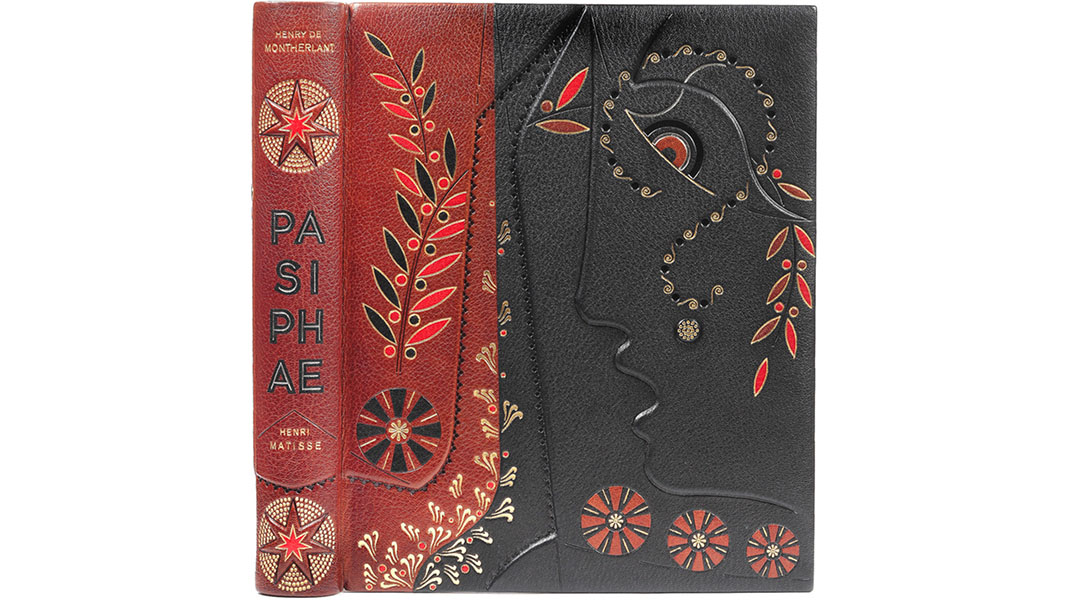
Henry de Montherlant. Pasiphaé : Chant de Minos (les Crétois). Gravures originales by Henri Matisse. Paris : Martin Fabiani, 1944. Collection of The Grolier Club

Jacques Brel. Ne me quitte pas. Gravures originales by Dominique Van Der Veken. Paris : Les Bibliophiles de France, spring 2008. Collection of The Grolier Club

Exhibition was curated by H. George Fletcher.

Images courtesy The Grolier Club.

AES+F Reimagine Giacomo Puccini’s Opera Turandot at Teatro Massimo, Palermo, January 19 – 27, 2019 and at Teatro Comunale, Bologna, May 2019

The Russian multidisciplinary artist collective AES+F, together with Italian director Fabio Cherstich, have conceptualized a bold new reimagining of Giacomo Puccini’s opera Turandot. In Turandot , AES+F’s visual language is transposed to the vocabulary of theater, with the artists creating an innovative stage design, including large-scale video installations, and costumes. With Cherstich, AES+F have reimagined the setting of Turandot as a globalized future, refusing all stereotypical ethnic characterizations in costumes and makeup, and hinting at a hybrid and diverse future society.

This new and thoroughly revolutionary interpretation of Turandot  is set in the year 2070 in Beijing, a futuristic metropolis with biomorphic architecture within an artificial landscape. Heading a renewed, gigantic, and multiethnic Chinese empire, Princess Turandot has imposed a radical techno-matriarchy upon society. The masses are a vulnerable and confused society, trained by those in power to tolerate violence; their public displays of adoration for the princess border on idolatry and mass hallucination. In the story’s time setting, our present time is the past. Turandot’s trauma hence stems from our current time.

“I believe my task, as a director is to help the audience travel in time. In doing so I had the luck of working with AES+F, an artists’ collective whose radically contemporary, non-conformist visions helped break through some stereotypes in my understanding of what opera can be”, commented Cherstich.

Stills from HD video Turandot by AES+F.

Turandot is co-produced by the Teatro Massimo, Palermo and Lakhta Center, Saint Petersburg, with Badisches Staatstheater, Karlsruhe, and Teatro Comunale, Bologna.

Concept by Fabio Cherstich and AES+F. Conductor: Gabriele Ferro. Director: Fabio Cherstich. Set, video and costume design: AES+F.

Images courtesy AFS+F.

Ear to the Ground: Earth and Element in Contemporary Art at New Orleans Museum of Art (NOMA), through August 31, 2019

The New Orleans Museum of Art (NOMA) presents Ear to the Ground: Earth and Element in Contemporary Art. Working with natural elements like earth, wind, water and fire, the artists featured in the group exhibition show how nature can spur artistic innovation and spark new thinking about human culture and community. Drawn predominantly from NOMA’s permanent collection, Ear to the Ground features works by 18 artists across vastly different media, cultures and time periods which each reference earth and element in very different ways.

Artists featured in Ear to the Ground include Dan Alley, Lynda Benglis, Diedrick Brackens, Edward Burtynsky, Chandra McCormick, Clyde Connell, Dawn DeDeaux, Courtney Egan, Olafur Eliasson, Jorge Otero Escobar, Mikhail Karikis, Ronald Lockett, Sara Madandar, Cristina Molina, Jennifer Odem, Bosco Sodi, Pat Steir, and Christopher Wilmarth. While some make materials like dirt and mud their primary medium, some turn to nature as a collaborator or conspirator in the creation of their art, casting sculptures directly upon the ground, or dying textiles with water drawn from rivers and oceans. Other featured artists reference natural processes like weathering, disintegration and sedimentation to address current social and political issues ranging from climate change to questions surrounding immigration and cultural belonging.” — NOMA

Dan Alley, Delta, 2014, Poured Aluminum, 50 x 156 inches, Collection of the Artist © Dan Alley Studio

Sara Madandar, Something Lost, 2015 Canvas and spray paint, 64 x 46 inches, Collection of the Artist © Sara Madandar

Bosco Sodi, Muro, 2017, Fired clay, 25 clay timbers, 4 z 19 ½ x 4 inches (each), New Orleans Museum of Art, Gift of the Artist and Paul Kasmin Gallery, 2017.226.1-25 © Studio Bosco Sodi, Donation courtesy the Artist and Kasmin Gallery

Ronald Lockett, Drought, 1994, Found tin, pencil and nails on wood, 48 ½ x 51 ½ inches, New Orleans Museum of Art, Museum Purchase and Gift of the Souls Grown Deep Foundation from the William S. Arnett Collection, 2017.172 ©Ronald Lockett

Jorge Otero Escobar, Stampede, 2014, Digital print, 53 ¼ x 35 ½ inches, Collection of David Borde ©Jorge Otero Escobar

Jennifer Odem, Earth Mound, 2006, Plaster, soil and brass pressure valve, 60 x 36 x 36 inches, Collection of the artist, ©Jennifer Odem

Diedrick Brackens, Study for Wading Still (Bend, Bow, Pull), 2018, Cotton dyed with Mississippi River water, Collection of the Artist ©Diedrick Brackens

Olafur Eliasson, The Hinged View, 2017, Steel, glass and paint, 59 x 106 3/8 x 29 ½ inches, New Orleans Museum of Art, Museum Purchase with funds provided by Sydney and Walda Besthoff, 2017.23 ©Courtesy of the Artist and Tanya Bonakdar Gallery, New York

Mikhail Karikis, Children of Unquiet, 2015, Single channel video with directional speakers, Collection of the Artist ©2014 Mikhail Karikis

Cristina Molina, Under Three Things, 2018-19 Performance and digital print Collection of the Artist

 “Using earth both as a material and an inspiration, the artists in this exhibition treat nature as a metaphor for the complexities of contemporary cultural life,” said Susan Taylor, NOMA’s Montine McDaniel Freeman Director. “Their art envisions new ways we might relate to the natural world, as well as to one another.” 

Installation photo by Roman Blokhin.

Images courtesy New Orleans Museum of Art.

C C Land Exhibition. Pierre Bonnard: The Colour of Memory at Tate Modern, January 23 – May 6, 2019

“Tate Modern will stage the UK’s first major Pierre Bonnard exhibition in 20 years, showing the work of this innovative and much-loved French painter in a new light. The exhibition will bring together around 100 of his greatest works from museums and private collections around the world. It will reveal how Bonnard’s intense colours and modern compositions transformed painting in the first half of the 20th century, and will celebrate his unparalleled ability to capture fleeting moments, memories and emotions on canvas. Spanning four decades from the emergence of Bonnard’s unique style in 1912 to his death in 1947, Tate Modern’s exhibition will show how the artist constructed his vibrant landscapes and intimate domestic scenes from memory. At once sensuous and melancholy, these paintings express moments lost in time – the view from a window, a stolen look at a lover, or an empty room at the end of a meal.” — Tate Modern

Pierre Bonnard (1867-1947)
. Window Open on the Seine (Vernon) (Fenêtre ouverte sur la Seine (Vernon)), 1911-12. Oil paint on canvas, 780 x 1055 mm. (c) Ville de Nice Musée des Beaux-Arts Jules Chéret. Photo Muriel ANSSENS

Pierre Bonnard (1867-1947). 
Dining Room in the Country, 1913. 
Oil on canvas, 
1645 x 2057 mm. 
Minneapolis Institute of Art

Pierre Bonnard (1867-1947). 
Coffee (Le Café), 1915. Oil paint on canvas, 730 x 1064 mm. Tate

Pierre Bonnard (1867-1947). 
L’Ete (Summer), 1917. Oil on canvas, 2600 x 3400 mm. Fondation Marguerite et Aimé Maeght, Saint-Paul- France

Pierre Bonnard (1867-1947). 
Nude Crouching in the Tub, 1918. 
Oil paint on canvas, 
830 x 730 mm. Paris, musée d’Orsay
Photo © Musée d’Orsay, Dist. RMN-Grand Palais/Patrice Schmidt

Pierre Bonnard (1867-1947). 
Nude in the Bath (Nu dans le bain), 1936-8. 
Oil paint on canvas, 
930 x 1470 mm
. Musée d’Art moderne de la Ville de Paris/ Roger-Viollet

Pierre Bonnard (1867-1947). 
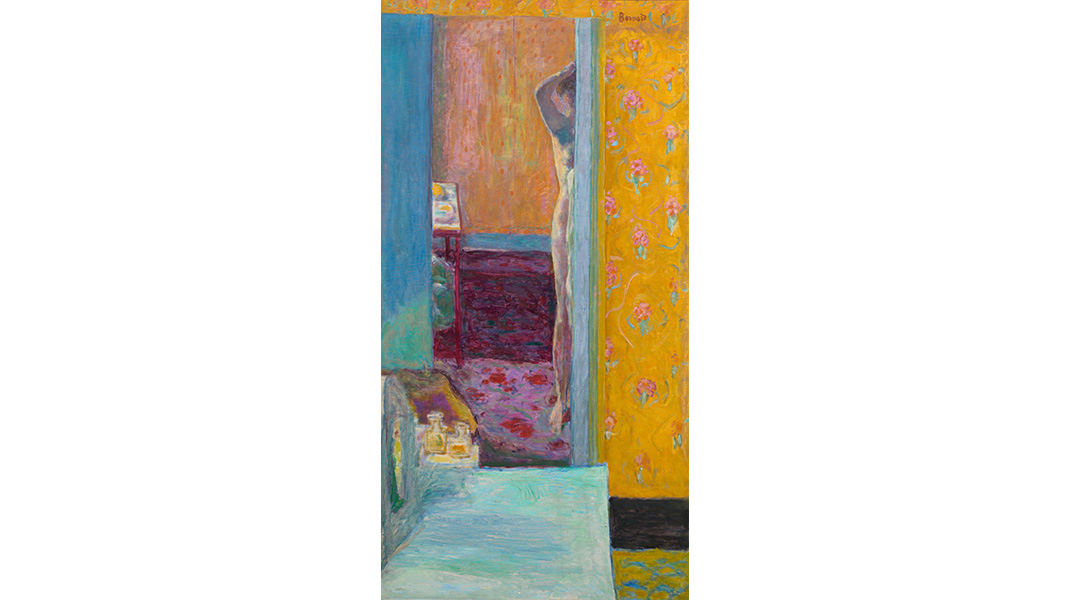
Nude in an Interior, c. 1935. 
Oil paint on canvas, 
1340 x 692 mm
. National Gallery of Art, Washington, USA

Pierre Bonnard (1867-1947). 
The Studio with Mimosas, 1939-46. 
Oil paint on canvas, 
1275 x 1275 mm. 
Musée National d’Art Moderne – Centre Pompidou
Photo (C) Centre Pompidou, MNAM-CCI, Dist. RMN-Grand Palais

Pierre Bonnard (1867-1947). 
Self Portrait, c.1938. 
Oil paint on canvas, 
560 x 685 mm. 
Private Collection

Pierre Bonnard: The Colour of Memory is curated at Tate Modern by Matthew Gale, Head of Displays, with Helen O’Malley and Juliette Rizzi, Assistant Curators. The exhibition is organised by Tate Modern in collaboration with Ny Carlsberg Glyptotek, Copenhagen and Kunstforum Wien.

Images courtesy Tate Modern.

Bruce Nauman: Disappearing Acts at The Museum of Modern Art through February 18, 2019 and at MoMA PS1 through February 25, 2019

“The Museum of Modern Art and MoMA PS1 present the first comprehensive retrospective in 25 years devoted to the work of American artist Bruce Nauman (b. 1941). Co-organized by The Museum of Modern Art and Laurenz Foundation, Schaulager Basel, Bruce Nauman: Disappearing Acts  draws upon the rich holdings of both institutions and nearly 70 lenders. Encompassing Nauman’s full career and featuring a total of 165 works, the exhibition occupies the Museum’s entire sixth floor and the whole of MoMA PS1. This joint presentation provides an opportunity to experience Nauman’s command of a wide range of mediums, from drawing, printmaking, photography, and sculpture to neon, performance, film and video, and architecturally scaled environments.” — MoMA 

“Few artists are able to sustain this level of relentless invention over a 50-year career,” said lead curator Kathy Halbreich. “Nauman has spent half a century devising new forms to convey both the moral hazards and the thrill of being alive. His work has continuously explored how spatial and psychological tensions—provoked by shifting perceptions of time, sound, language, and movement—structure human experience. Nuanced ethical questions are often masked as stark dichotomies, and perceptual tricks unsettle the ways we see ourselves. At a time when the notion of truth feels increasingly under attack, Nauman compels viewers to relinquish the safety of the familiar, keeping us alert, ever vigilant, and wary of being seduced by easy answers.”

Installation views, Bruce Nauman: Disappearing Acts at The Museum of Modern Art, New York (October 21, 2018–February 25, 2019, at MoMA and MoMA PS1). © 2018 Bruce Nauman/Artists Rights Society (ARS), New York. Digital images © 2018 The Museum of Modern Art, New York. Photos: Martin Seck

The exhibition is organized by Kathy Halbreich, Laurenz Foundation Curator and Advisor to the Director, The Museum of Modern Art; with Heidi Naef, Chief Curator, and Isabel Friedli, Curator, Schaulager Basel; and Magnus Schaefer, Assistant Curator, and Taylor Walsh, Curatorial Assistant, Department of Drawings and Prints, The Museum of Modern Art.

Images courtesy The Museum of Modern Art.

Nature’s Nation: American Art and Environment at Peabody Essex Museum (PEM), February 2 – May 5, 2019

“The Peabody Essex Museum (PEM) presents an exhibition of more than 100 works by American artists from the 18th-century through present day that explores evolving ideas about the environment and our place within it. Nation’s Nation: American Art and Environment features major paintings, photographs, works on paper, and sculpture drawn from museum and private collections around the country by artists such as Ansel Adams, John James Audubon, Albert Bierstadt, Frederic Edwin Church, Thomas Cole, Winslow Homer, Dorothea Lange, Kent Monkman (Cree), Georgia O’Keeffe, Jacob August Riis, Jaune Quick-to-See Smith (Salish-Kootenai), and Andrew Wyeth. This is the first exhibition to examine how American and Native American artists reflect and shape our understanding of the environment, from deeply held perspectives of interconnected ties to the universe to colonial beliefs that imagines nature as a hierarchy of species with men at the top, and also the modern emergence of ecological ethics.

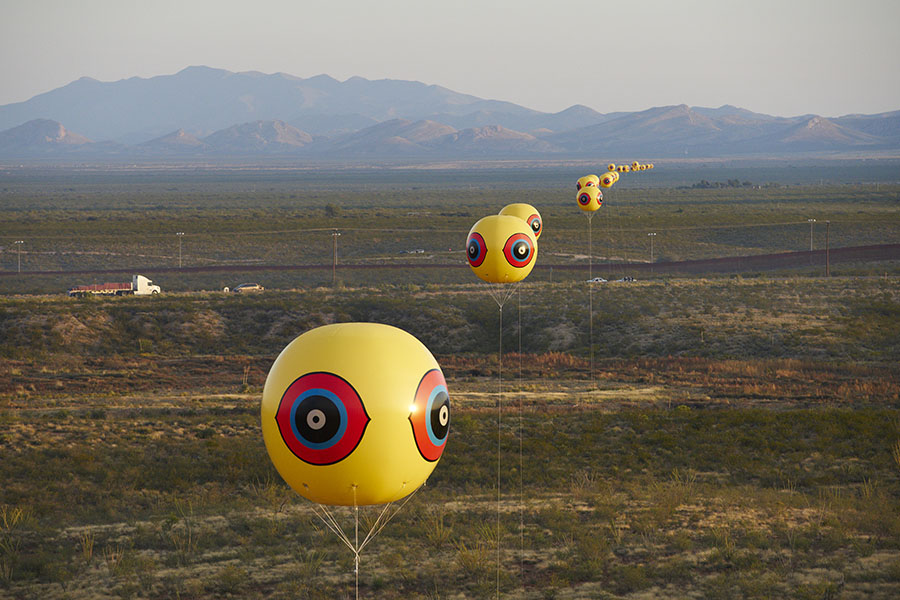
The exhibition opens with a bold, contemporary work, Repellent Fence/Valla Repelente, by an Indigenous artist collective Postcommodity. In 2015, the collective installed 26 tethered balloons along a two-mile route crossing the United States-Mexico border. Each balloon, 10 feet in diameter and floating 50 feet high, looked out on the setting through its “scare eye,” a graphic intended to repel wildlife from property. From this aerial perspective, the “scare eye” is redeployed to “see” land, communities, and ecosystems connected as a unified whole, not divided by artificial, man-made borders and boundaries between cultures and land.” — Peabody Essex Museum

Albert Bierstadt, American, 1830–1902, Bridal Veil Falls, Yosemite, ca. 1871–73. Oil on canvas. North Carolina Museum of Art, Raleigh, Purchased with funds from the North Carolina State Art Society (Robert F. Phifer Bequest) and various donors, by exchange.

Valerie Hegarty, American, born 1967, Fallen Bierstadt, 2007. Foamcore, paint, paper, glue, gel medium, canvas, wire, wood. Brooklyn Museum, Gift of Campari, USA 2008. © Valerie Hegarty.

Tlingit artist, Chilkat blanket, before 1832. Mountain goat wool and cedar bark. Gift of Captain Robert Bennet Forbes, 1832. © 2010 Peabody Essex Museum. Photography by Walter Silver.

Robert Rauschenberg, American, 1925–2008, Earth Day, 1970. Color lithograph with collage. Gift of the Friends of the Princeton University Art Museum. © Estate of Robert Rauschenberg/licensed by VAGA, New York.

David Gilmour Blythe, American, 1815 – 1865, Prospecting/Bullcreek City, ca. 1861–63. Oil on canvas. Westmoreland Museum of American Art, Bequest of Richard M. Scaife.

Mateo Romero, Cochiti Pueblo, b.1966, In and Around These Mountains, 1999. Oil, paper, canvas. Donated by the Margie and James Krebs Fund, 1999. © Peabody Essex Museum.

Subhankar Banerjee, Indian, active in United States, born 1967, Caribou Migration I (Oil and the Caribou, Coleen River Valley), 2002. Digital chromogenic print. Collection Lannan Foundation. © Subhankar Banerjee.

Alexandre Hogue, American, 1898 – 1994, Crucified Land, 1939. Oil on canvas. Gift of Thomas Gilcrease Foundation, 1955 Gilcrease Museum, Tulsa Oklahoma. © Estate of Alexandre Hogue.

Thomas Cole, American, 1801–1848, A View of the Mountain Pass Called the Notch of the White Mountains (C rawford Notch), 1839. Oil on canvas. National Gallery of Art, Washington, Andrew W. Mellon Fund.

Robert Smithson, American, 1938–1973, Bingham Copper Mining Pit, Utah Reclamation Project, 1973. Wax pencil and tape on plastic overlay on photograph. Seibert Family Collection. Art © Holt/Smithson Foundation/ Licensed by VAGA, New York, NY.

Georgia O’Keeffe, American, 1887–1986, The Lawrence Tree, 1929. Oil on canvas. Wadsworth Atheneum Museum of Art, Hartford, CT. The Ella Gallup Sumner and Mary Catlin Sumner Collection Fund. © Georgia O’Keeffe Museum / Artists Rights Society (ARS), New York. Allen Phillips/Wadsworth Atheneum.

Postcommodity, Repellent Fence/ Valla Repelente, 2015. Installation view at U.S./Mexico Border, Douglas, Arizona/Agua Pieta, Sonora, 2015. © Postcommodity. Photo by Michael Lundgren. Courtesy of Postcommodity and Bockley Gallery.

Winslow Homer, American, 1836–1910, A Huntsman and Dogs, 1891. Oil on canvas. Philadelphia Museum of Art: The William L. Elkins Collection, 1924.

Nature’s Nation: American Art and Environment has been organized by the Princeton University Art Museum. The exhibition is co-curated by Karl Kusserow, John Wilmerding Curator of American Art at the Princeton University Art Museum, and Alan C. Braddock, Ralph H. Wark Associate Professor of Art History and American Studies at William & Mary.

Images courtesy Peabody Essex Museum.