Kevin Beasley: A view of a landscape at Whitney Museum of American Art, December 15, 2018 – March 10, 2019

“Kevin Beasley (b. 1985, Lynchburg, VA) engages with the legacy of the American South through a new installation that centers on a cotton gin motor from Maplesville, Alabama. In operation from 1940 to 1973, the motor powered the gins that separated cotton seeds from fiber. Here, the New York-based artist uses it to generate sound as if it were a musical instrument, creating space for visual and aural contemplation. Through the use of customized microphones, soundproofing, and audio hardware, the installation divorces the physical motor from the noises it produces, enabling visitors to experience sight and sound as distinct. As an immersive experience, the work serves as a meditation on history, land, race, and labor. This is Beasley’s first solo exhibition at a New York museum, and his most ambitious work to date.” — Whitney Museum

“The cotton gin, invented by Eli Whitney in 1793, increased the number of slaves by over 70%, deepening the trauma for Black folks in America. As the invention evolved and emancipation was declared, Black people have been working to reconcile our relationship to class, labor, race, and human rights within the structure of laws,” said Kevin Beasley.” For me, this exhibition embodies a continued reconciliation that can extend to the broader public. Are we reflecting on this history collectively? And are we taking the necessary steps to generate a fresh approach and change to systemic issues that persist today?” 

Photographs by Corrado Serra. 

A view of a landscape. A cotton gin motor, 2012-18. Collection of the artist. Courtesy Casey Kaplan, New York

A view of a landscape. A cotton gin motor (detail)

A view of a landscape. A cotton gin motor (detail)

Left: The Reunion, 2018. Right: Campus, 2018. Collection of the artist. Courtesy Casey Kaplan, New York

Left: Campus, 2018. Right: The Acquisition, 2018. Collection of the artist. Courtesy Casey Kaplan, New York

Left: Campus, 2018. Right: The Acquisition, 2018. Collection of the artist. Courtesy Casey Kaplan, New York

The Acquisition, 2018. Collection of the artist. Courtesy Casey Kaplan, New York

The Acquisition (detail), 2018

Kevin Beasley in the Whitney Museum, 2018. The Reunion (detail) in the background

“Kevin has been dreaming about this project for over seven years,” says Christopher Y. Lew, the Nancy and Fred Poses Curator, who organized the exhibition. “It’s an honor to help realize his most ambitious work to date at the Whitney. The work is truly of epic proportions. It re-animates an object that gives voice to the deep and recent pasts as well as our contemporary moment.”

Kevin Beasley: A view of a landscape is part of the Whitney’s emerging artists program. It is organized by Christopher Y. Lew, Nancy and Fred Poses Curator, with Ambika Trasi, curatorial assistant.

The Road Ahead: Reimagining Mobility at Cooper Hewitt, Smithsonian Design Museum, December 14, 2018 – March 31, 2019

Cooper Hewitt, Smithsonian Design Museum presents ‘The Road Ahead: Reimagining Mobility’ featuring 40 projects that explore salient topics around the future of mobility and the urban environment. The exhibition is punctuated with six provocations and a selection of design responses that reimagine livable streets and the way people, goods and services will move in a new age of connected and transformational mobility.

‘The Road Ahead’ addresses the fundamental question: how do people want to live? On view in the third floor Barbara and Morton Mandel Design Gallery, the exhibition examines accessibility, equity, trust, safety and security, the efficient movement and delivery of freight, smart infrastructure and the use of sidewalks and curb sharing. These challenges present a critical opportunity to pursue a new user-centered vision for streets and infrastructure to create more livable, inclusive and equitable cities, with services, ride-sharing and mass-transit solutions that minimize greenhouse gases and address the users’ needs.” — Cooper Hewitt

Blueprint for Autonomous Urbanism, 2017; National Association of City Transportation Officials (US and Canada); Copyright © 2017 National Association of City Transportation Officials. Reproduced with permission.

Photorealistic rendering based off of concepts in the NACTO Blueprint for Autonomous Urbanism. Copyright © 2017 Bloomberg Philanthropies. Reproduced with permission by Bloomberg Philanthropies and the National Association of City Transportation Officials.

Zipline Autonomous Drone Delivery System, 2016; Zipline (Half Moon Bay, CA); Courtesy of Zipline.

CanguRo (prototype), 2018; Designed by Shunji Yamanaka; Fabricated by fuRo (Japan); Chiba Institute of Technology (fuRo). Courtesy of Chiba Institute of Technology (fuRo).

Starship Autonomous Delivery Robot, 2014; Starship Technologies (San Francisco, CA); Starship Technologies. Courtesy of Starship Technologies.

Starship Autonomous Delivery Robot, 2014; Starship Technologies (San Francisco, CA); Starship Technologies. Courtesy of Starship Technologies.

Moveo Foldable Electric Scooter, 2016; Designed by Péter Üveges; Manufactured by Moveo (Mosonmagyaróvár, Hungary); Courtesy of Moveo.

Moveo Foldable Electric Scooter, 2016; Designed by Péter Üveges; Manufactured by Moveo (Mosonmagyaróvár, Hungary); Courtesy of Moveo.

The Artists’ Incubator (concept), 2018; Jiahe Chen, UCLA, Miao He, UCLA, Gautham Varma, ArtCenter College of Design; Photo by Miao He and Jiahe Chen.

The Float Concept Vehicle, 2017; Designed by Yuchen Cai, University of the Arts London for Renault Car of the Future Contest (France); Courtesy of Renault.

-ROAD Electric Vehicle, 2013; Toyota Motor Corporation (Aichi Prefecture, Japan); Courtesy of Toyota.

Hyperloop One; 2014–present; Virgin Hyperloop One (Los Angeles, CA); © Hyperloop Technologies, Inc.

 “‘The Road Ahead’ points to several possible futures for our cities and asks audiences to consider how design will improve and expand options for urban transport,” said Cooper Hewitt Director Caroline Baumann. “Inviting our visitors to consider and creatively think about the possible outcomes provided by the revolutionary new technologies on the horizon—from grocery-delivering robots to autonomous shuttle services—the exhibition encourages public engagement in the civic dialogue needed to ensure that new designs for mobility are sustainable, equitable and life-improving for all.” 

“The Road Ahead” is organized by Cara McCarty, the museum’s director of curatorial; Cynthia E. Smith, curator of socially responsible design; and Julie Pastor, curatorial assistant. Exhibition is designed by Matter Architecture Practice. Exhibition graphics by Pure + Applied. 

Images courtesy Cooper Hewitt.  

1947, Simone de Beauvoir in America at Sous Les Etoiles Gallery, December 13 , 2018 – February 9, 2019

Sous Les Etoiles Gallery is pleased to present 1947, Simone de Beauvoir in America a photographic journey inspired by her diary America Day by Day published in France in 1948. This book was released in the United States in 1999 after its first translation to English in Great Britain in 1952. This exhibition curated by Corinne Tapia, director of Sous Les Etoiles Gallery, aims to illustrate the depiction of De Beauvoir’s encounter with America at the time. It is the first time that this book becomes the subject of an exhibition. 

In January of 1947, the French writer and intellectual, Simone de Beauvoir (1908–1986) landed in New York’s La Guardia Airport, beginning a four-month journey across America. She traveled from East to the West coast by trains, cars and even Greyhound buses. She has recounted her travels in her personal diary and recorded every experience with minute detail. She stayed 116 days, traveling through 19 states and 56 cities.” — Sous Les Etoiles Gallery

“Usually, traveling is an attempt to annex a new object to my universe; this in itself is an undertaking: but today it’s different. I feel I’m leaving my life behind. I don’t know if it will be through anger or hope, but something is going to be revealed – a world so full, so rich and so unexpected that I have the extraordinary adventure of becoming a different of me.” — Simone de Beauvoir, 1947, on her first trip to the United States, a trip that would have changed her life

Esher Bubley, Coast to Coast, SONJ, 1947, courtesy Howard Greenberg Gallery/ Sous Les Etoiles Gallery

Fred Lyon, Post & Powell, Union Square, San Francisco, 1947, courtesy Peter Fetterman Gallery/ Sous Les Etoiles Gallery

Wayne Miller, From ”The Way of Life of the Northern Negro,” Chicago (Afternoon Game at Table 2), 1946-1948 courtesy Stephen Daiter Gallery/ Sous Les Etoiles Gallery

Louis Faurer, New York, NY, 1947 (profile head in El window), Courtesy Deborah Bell Gallery/ Sous Les Etoiles Gallery

Ida Wyman, Looking East on 41st Street, New York , 1947, courtesy Stephen Cohen Gallery/ Sous Les Etoiles Gallery

Vassar Girl, Alumnae Pub Mural , Vassar College 1947, courtesy Archives/ Collection of Vassar College and Sous Les Etoiles Gallery

It is also most certainly a very photographic book. As you read it, you can easily imagine the footsteps of Simone de Beauvoir in places she discovers for the first time, the atmosphere of the night, of the cabarets and their music of this period, impressed by the American way of life that begins to take effect. “I wanted the viewer to be as close to her reality at that time, so most of the photographs exhibited are in the year of 1947”, said Corinne Tapia. 

Images courtesy Sous Les Etoiles Gallery. 

Voice of My City: Jerome Robbins and New York at The New York Public Library for the Performing Arts at Lincoln Center, through March 30, 2019

“Legendary choreographer Jerome Robbins was deeply connected to New York City, drawing inspiration for shows and ballets such as Fancy Free and West Side Story from the people and places around him. This vibrant relationship between the artist and his metropolitan muse serves as the focus of Voice of My City: Jerome Robbins and New York, a new, free multimedia exhibition at The New York Public Library for the Performing Arts at Lincoln Center. Showcasing never-before-seen treasures from the world-renowned Jerome Robbins Dance Division, home to his collection and named in honor of his patronage, the exhibition celebrates Robbins’ centennial and his undeniable mark on dance in New York and beyond.

The exhibition includes Robbins’ sketches, rare photographs of his life and productions, personal ephemera, costumes and other artifacts. Mining the rich moving image materials in the Dance Division’s holdings, Voice of My City also features rarely exhibited video of Robbins in rehearsals and experimenting with movements, performances of his works, and footage Robbins himself recorded of New Yorkers walking around the city–sources of inspiration for both his ballet and theater choreography. 

Voice of My City marks the first time all 24 of Robbins’ unique diaries housed in the Dance Division’s collection will be displayed together. In these accordion-style manuscripts, which span 1971 through 1983, Robbins scribbled notes, painted with watercolors, collected news clippings, and even pasted wildflowers, all in an effort to collect his thoughts and harness inspiration.” — The New York Public Library for the Performing Arts

Jerome Robbins directing dancers during rehearsal for the stage production of West Side Story. 
Silver gelatin print, 
1957. 
Photo by Martha Swope. 
Billy Rose Theatre Division, The New York Public Library for the Performing Arts.

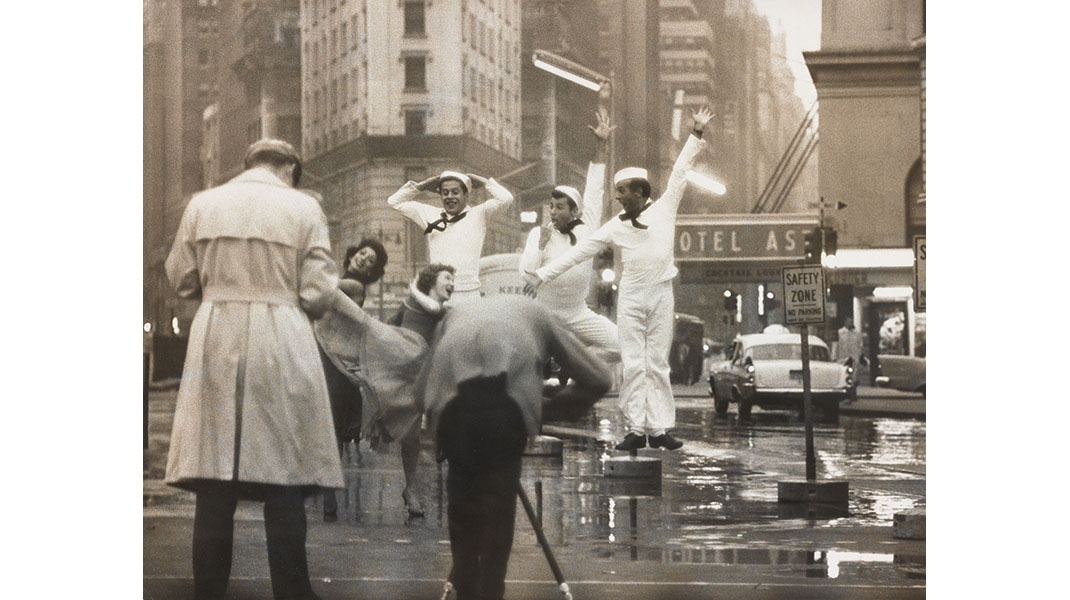
Gordon Parks (leaning over tripod) photographs original Fancy Free cast members Muriel Bentley, Janet Reed, Harold Lang, John Kriza, and Jerome Robbins during a Times Square reunion in 1958. 
Silver gelatin print 
Photographer unknown. 
Jerome Robbins Dance Division, The New York Public Library for the Performing Arts.

Ballets: U.S.A. in N.Y. Export: Opus Jazz. Color transparency, 1958. Copyright Robert A. Freson. Jerome Robbins Dance Division, The New York Public Library for the Performing Arts.

Ballets: U.S.A. in N.Y. Export: Opus Jazz. Silver gelatin print, 1958. Photo by Jerome Robbins. Jerome Robbins Dance Division, The New York Public Library for the Performing Arts.

Jerome Robbins dancing in his living room. Silver gelatin print, 1959. Photo by Philippe Halsman © Halsman Archive Jerome Robbins Dance Division, The New York Public Library for the Performing Arts.

Digital photograph. Adam Hendrickson, Georgina Pazcoguin, and members of New York City Ballet in N.Y. Export: Opus Jazz. Photo by Costas Cacaroukas. Jerome Robbins Dance Division, The New York Public Library for the Performing Arts.

Digital photograph. New York City Ballet in Glass Pieces. Photo by Costas Cacaroukas. Jerome Robbins Dance Division, The New York Public Library for the Performing Arts.

Collage, 1973. Jerome Robbins. Jerome Robbins Dance Division, The New York Public Library for the Performing Arts.

“New York served as a laboratory for Robbins, where he observed people, buildings, traffic–how movement in space could carry meaning and beauty,” explains Julia L. Foulkes, exhibition curator. “The city became the meeting ground between self and world, a way for Robbins to connect stylized ballet and everyday life in dances such as Fancy Free, West Side Story, and Glass Pieces.” 

 Images courtesy The New York Public Library for the Performing Arts.

A Surreal Pairing: Magritte and Dalí at The Dalí Museum, December 15, 2018 – May 19, 2019

“Opening at The Dali Museum in St. Petersburg, Florida on December 15, Magritte and Dali is a first-of-its-kind special exhibition dedicated to the world’s two most celebrated surrealists, Renée Magritte and Salvador Dalí.

This first exhibition to examine the artists in a sole pairing provides an in-depth review of the common threads and creative divergences in their distinctive bodies of work from the late 1920s to the 1940s. During this frenetic and productive period, the two artists displayed works in the same Surrealist exhibitions and passionately explored the techniques and aesthetic points of view which contributed to their respective reputations as monumental figures in art history. Together, their work proposes a stirring challenge to the world of appearances and hints at the deep mystery of life.

Showcasing carefully curated, exemplary pieces from Magritte’s and Dali’s works, Magritte and Dali pushes back the curtain to reveal what lies beyond the simple appearance of painted images. The two preeminent surrealists opened the mind to an alternative view of the world, constantly challenging reality. Following its presentation at The Dalí Museum, Magritte and Dalí will travel to the Magritte Museum in Brussels.” — The Dalí Museum

René Magritte (1898-1967). Dieu n’est pas un saint (God Is No Saint), ca. 1935-36. Oil on canvas, 67.2 x 43 cm. Inv. 11681. Royal Museums of Fine Arts of Belgium, Brussels © 2018 C. Herscovici / Artists Rights Society (ARS), New York. Photo Credit: Banque d’Images, ADAGP / Art Resource, NY

René Magritte (1898-1967). La Magie noire (Black Magic), 1945. Oil on canvas, 79 x 59 cm; Inv. 10706. Royal Museums of Fine Arts of Belgium, Brussels © 2018 C. Herscovici / Artists Rights Society (ARS), New York. Photo Credit: Banque d’Images, ADAGP / Art Resource, NY

René Magritte (1898-1967). L’Île au trésor (Treasure Island), 1942. Oil on canvas, 60 x 80 cm; Inv. 10708. Royal Museums of Fine Arts of Belgium, Brussels © 2018 C. Herscovici / Artists Rights Society (ARS), New York. Photo Credit: Herscovici / Art Resource, NY

Salvador Dalí. Surrealist Object Functioning Symbolically-Gala’s Shoe, 1931 / Reconstructed 1973, object. Collection of The Dalí Museum, St. Petersburg, FL (USA) 2018 ©Salvador Dalí, Fundació Gala-Salvador Dalí, (Artists Rights Society), 2018. In the USA: © Salvador Dalí Museum, Inc., St. Petersburg, FL, 2018

Salvador Dalí. Portrait of Gala, c.1932. Oil on panel. Collection of The Dalí Museum, St. Petersburg, FL (USA) 2018 ©Salvador Dalí, Fundació Gala-Salvador Dalí, (Artists Rights Society), 2018. In the USA: © Salvador Dalí Museum, Inc., St. Petersburg, FL, 2018

Salvador Dalí. Old Age, Adolescence, Infancy (The Three Ages), 1940. Oil on canvas. Collection of The Dalí Museum, St. Petersburg, FL (USA) 2018 ©Salvador Dalí, Fundació Gala-Salvador Dalí, (Artists Rights Society), 2018. In the USA: © Salvador Dalí Museum, Inc., St. Petersburg, FL, 2018

Magritte and Dalí is organized by The Dalí Museum in partnership with The Magritte Museum (a part of the Royal Museums of Fine Arts of Belgium) and is co-curated by Dr. William Jeffett, Chief Curator of Exhibitions at The Dalí Museum, and Michel Draguet, General Director of the Royal Museums of Fine Arts of Belgium.

Images courtesy The Dalí Museum.

Women of Vision: National Geographic Photographers on Assignment at Forest Lawn Museum, December 11, 2018 – April 7, 2019

Women of Vision: National Geographic Photographers on Assignment highlights the influential photography of 11 award-winning female photojournalists. The exhibition is a tribute to the spirit and ambition of these forward-thinking and distinguished female photographers and underscores the momentous work they have done to bring narratives from all over the world to the pages of National Geographic and into the homes of millions of people.

Women of Vision features nearly 100 photographs, including moving depictions of far-flung cultures; compelling illustrations of conceptual topics, such as memory and teenage brain chemistry; and arresting images of social issues, such as child marriage and twenty-first-century slavery. In addition, the exhibition demonstrates how National Geographic magazine picture editors work closely with the photographers to select images and tell stories. Video vignettes present first-person accounts that reveal the photographers’ individual styles, passions, and approaches to their craft.

The exhibition underscores National Geographic’s history of documenting the world through photography and its ongoing commitment to supporting photographers as important and innovative storytellers who can make a difference with their work.” — Forest Lawn Museum

BEVERLY JOUBERT.  A leopard’s spotted coat provides camouflage in the dense forest. National Geographic exhibit “Women of Vision.”

AMY TOENSING. Longtime Ocean Grove visitors take a dip in the roiling Atlantic surf. National Geographic exhibit “Women of Vision.”

CAROLYN DRAKE. To guide their decision-making, the Kyrgyz often seek out shamans to read their fortune with cards. National Geographic exhibit “Women of Vision.”

JODI COBB. A woman in Florence, Italy, savors the message on a large greeting card. National Geographic exhibit “Women of Vision.”

ERIKA LARSEN. A Sami in Sweden mourns the loss of two reindeer that starved after locking horns in a fight for dominance. National Geographic exhibit “Women of Vision.”

KITRA CAHANA. Getting her tongue pierced was “exciting and scary” says a teen who succumbed to pressure from her best friend. National Geographic exhibit “Women of Vision.”

DIANE COOK AND LEN JENSHEL. A double rainbow arcs above the jagged cliffs and dense vegetation of Kalalau, the largest valley on Na Pali. National Geographic exhibit “Women of Vision.”

LYNN JOHNSON. Comatose and on a ventilator, a bird flu patient in Hanoi who was not expected to live made a remarkable recovery. National Geographic exhibit “Women of Vision.”

LYNSEY ADDARIO. Moviegoers thrill to shaking seats and wind machines during a 3-D film at a theater closed during the war. National Geographic exhibit “Women of Vision.”

MAGGIE STEBER. Nestled in their bed in Miami, Florida, four young sisters nap on a Sunday afternoon after attending church. National Geographic exhibit “Women of Vision.”

STEPHANIE SINCLAIR. Nujood Ali stunned the world in 2008 by obtaining a divorce at age ten in Yemen, striking a blow against forced marriage. National Geographic exhibit “Women of Vision.”

“For the last decade, some of our most powerful stories have been produced by a new generation of photojournalists who are women. These women are as different as the places and the subjects they have covered, but they all share the same passion and commitment to storytelling that has come to define National Geographic,” said Kathryn Keane, Vice President of Public Programming and Director, National Geographic Museum. “The exhibition reaffirms the Society’s position as a respected leader in the field of photography.”

Women of Vision: National Geographic Photographers on Assignment is traveled and organized by the National Geographic Society. It is curated by former National Geographic Senior Photo Editor Elizabeth Krist.

Images courtesy Forest Lawn Museum.

Jewelry: The Body Transformed at The Met Fifth Avenue, through February 24, 2019

“What is jewelry? Why do we wear it? What meanings does it convey? The exhibition Jewelry: The Body Transformed traverses time and space to explore how jewelry acts upon and activates the body it adorns. This global conversation about one of the most personal and universal of art forms brings together some 230 objects drawn almost exclusively from The Met collection. A dazzling array of headdresses and ear ornaments, brooches and belts, necklaces and rings created between 2600 B.C.E. and the present day will be shown along with sculptures, paintings, prints, and photographs that will enrich and amplify the many stories of transformation that jewelry tells.” — The Met

“Jewelry is one of the oldest modes of creative expression—predating even cave painting by tens of thousands of years—and the urge to adorn ourselves is now nearly universal,” commented Max Hollein, Director of The Met. “This exhibition will examine the practice of creating and wearing jewelry through The Met’s global collection, revealing the many layers of significance imbued in this deeply meaningful form of art.”

Gold Sandals and Toe Stalls, New Kingdom, Dynasty 18, reign of Thutmose III ca. 1479–1425 B.C. From Egypt, Upper Egypt, Thebes, Wadi Gabbanat el- Qurud, Wadi D, Tomb of the 3 Foreign Wives of Thutmose III. Gold. Sandals: L. 26.4 cm (10 3/8 in.); W. 10 cm. (3 15/16 in.); W. at heel 7 cm. (2 3/4 in.); toe stalls: various. The Metropolitan Museum of Art, Fletcher Fund, 1922

Broad collar of Senebtisi, Middle Kingdom, Dynasty 12, late–early 13 (ca. 1850–1775 B.C.). From Egypt, Memphite Region, Lisht North, Tomb of Senwosret (758), Pit 763, burial of Senebtisi, MMA excavations, 1906–07 Faience, gold, carnelian, turquoise. Falcon heads and leaf pendants originally gilded plaster, restored in gilded silver. Eyes originally gilded beads restored in gilded plaster. Outside diam. 25 cm (9 13/16 in); max w. 7.5 cm (2 15/16 in). The Metropolitan Museum of Art, Rogers Fund, 1908

Large Brooch with Spirals, 1200–800 B.C. Made in Carpathian Basin region. Bronze, 10 15/16 x 4 x 2 9/16in. (27.8 x 10.2 x 6.5cm). The Metropolitan Museum of Art, Purchase, Caroline Howard Hyman Gift, in memory of Margaret English Frazer, 2000

Pair of Gold Earrings with Ganymede and the Eagle, Hellenistic, ca. 330–300 B.C. Gold, rock crystal, emerald, H. 2 3/8 in. (6 cm). The Metropolitan Museum of Art, Harris Brisbane Dick Fund, 1937

Jeweled Bracelets, 500–700. Made in probably Constantinople Gold, silver, pearl, amethyst, sapphire, opal, glass, quartz, emerald plasma Overall: 1 7/16 x 3 1/4 in. (3.7 x 8.2 cm) The Metropolitan Museum of Art, Gift of J. Pierpont Morgan, 1917

Marriage Necklace (Thali), late 19th century, India (Tamil Nadu, Chetiar). Gold strung on black thread. Bottom of central bead to end of counterweight: L. 33 1/4 in. (84.5 cm). The Metropolitan Museum of Art, Gift of Cynthia Hazen Polsky, 1991

Pendant (Marangga), 19th–early 20th century, Indonesia, Sumba Island, East Nusa Tenggara. Gold, L. 12 5/8 in. (32.1cm). The Metropolitan Museum of Art, Purchase, Muriel Kallis Newman Gift, in Memory of Kathleen H. Newton, and Rogers Fund, 1988

“To fully understand the power of jewelry, it is not enough to look at it as miniature sculpture,” stated Melanie Holcomb, Curator, Department of Medieval Art and The Cloisters. “While jewelry is ubiquitous, the cultures of the world differ widely regarding where on the body it should be worn. By focusing on jewelry’s interaction with—and agency upon—the human body, this exhibition brings in a key element that has been missing in previous studies of the subject.”

The exhibition represents a dynamic, collaborative partnership of six curators—lead curator Melanie Holcomb, Curator, Department of Medieval Art and The Cloisters, consulting curator Beth Carver Wees, the Ruth Bigelow Wriston Curator of American Decorative Arts, The American Wing; Kim Benzel, Curator in Charge, Department of Ancient Near Eastern Art; Diana Craig Patch, the Lila Acheson Wallace Curator in Charge, Department of Egyptian Art; Soyoung Lee, the Landon and Lavinia Chief Curator, Harvard Art Museums; and Joanne Pillsbury, the Andrall E. Pearson Curator, Department of the Arts of Africa, Oceania, and the Americas—assisted by Hannah Korn, Collections Management Coordinator, Medieval Art and The Cloisters, with Moira Gallagher, Research Assistant, The American Wing.

Images courtesy Metropolitan Museum of Art.

Disrupting Craft: Renwick Invitational 2018 at Renwick Gallery, Smithsonian American Art Museum, through May 5, 2019

Begun in 2000, the Renwick Invitational is a biennial juried showcase for midcareer and emerging craft artists who deserve wider recognition. The makers selected for Disrupting Craft: Renwick Invitational 2018—Tanya Aguiñiga, Sharif Bey, Dustin Farnsworth, and Stephanie Syjuco—challenge convention and infuse craft with a renewed sense of activism, emotional purpose, and inclusiveness. 

Aguiñiga uses natural fibers to reveal raw personal narratives with universal feelings of vulnerability, often through performative and collaborative ways to connect communities. From utilitarian pots to abstract wall pieces, Bey explores complex cultural histories, while discovering ways his artistic process can interweave his identities as artist, educator, and father. Inspired by the narratives unfolding around him, Farnsworth manipulates wood into haunting storylines with intricate portraits of today’s youth, shining a spotlight on those inheriting societal and economic decay. Syjuco challenges perceptions of ‘types’ in America with social practice projects and the tropes of craft, uncovering the complicated and contradictory ways we understand identity and nationhood. 

These four artists show how craft can reach beyond the art world, revealing broader narratives about skilled making and the handmade. While responding to current pressing issues, they also revisit their own identities and communities. The work featured here offers moments of contemplation on the rapidly transforming world around us, and disrupts the status quo to alter our perspectives, bring us together, and lead us to a more empathetic, compassionate future.” — Renwick Gallery

Tanya Aguiñiga (born 1978, San Diego, CA) is a Los Angeles–based artist, designer, and activist. 

Tanya Aguiñiga, Hand-Felted Folding Chairs, 2006–present, hand-felted metal folding chairs. Collection of the artist. Image courtesy Tanya Aguiñiga Studio

Tanya Aguiñiga, Untitled (Driftless), 2013, raw and hand-dyed canvas, industrial felt, merino wool, cotton rope, sisal, wool yarn, linen, and Chiapas wool. Collection of the artist. Image courtesy Volume Gallery, Chicago

Tanya Aguiñiga, Palapa [foreground], 2017, powder-coated steel and synthetic hair, Nopal [background], 2017, abaca pulp, clay, alpaca, flax, succulents, iron, horsehair, cochineal (live and dead), copper, gold, and human hair. Courtesy Volume Gallery, Chicago. Image courtesy Volume Gallery, Chicago

Tanya Aguiñiga, Nopal (detail), 2017, abaca pulp, clay, alpaca, flax, succulents, iron, horsehair, cochineal (live and dead), copper, gold, and human hair. Courtesy Volume Gallery, Chicago. Image courtesy Volume Gallery, Chicago

Sharif Bey (born 1974, Pittsburgh, PA) produces both functional and sculptural pieces of pottery, using a variety of forms and textures.

Sharif Bey, Carved Blue Jar, 2007, black stoneware. Collection of the artist. Photo by Nathan J. Shaulis/Porter Loves Creative

Sharif Bey, Ceremonial Vessel I, 2016, earthenware and china shards. Collection of the artist. Photo by Nathan J. Shaulis/Porter Loves Creative

Sharif Bey, Star Child Series #1, 2017, earthenware, mixed media, and nails. Collection of the artist. Photo by Nathan J. Shaulis/Porter Loves Creative

Sharif Bey, Nestle, 2018, glass and mixed media. The Petrucci Family Foundation Collection of African American Art. Photo by Nathan J. Shaulis/Porter Loves Creative

Dustin Farnsworth (born 1983, Lansing, MI) carves wood into evocative depictions of human suffering.

Dustin Farnsworth, Promontory, 2013, pine, basswood, poplar, plywood, veneer, bendable plywood, steel, lauan, human hair, and various polychrome. Collection of the artist. Photo by Steve Mann, Black Box Photography. Image courtesy The Center for Craft

Dustin Farnsworth, XLIII, 2016, poplar, reclaimed wood, chair, pencil, and various polychrome. Collection of Sandy Berlin. Photo by Ben Premeaux

Dustin Farnsworth, styx/vodun, 2016, poplar, flowers, and various polychrome. Collection of the artist. Photo by Ben Premeaux

Dustin Farnsworth and Timothy Maddox, WAKE II, 2017, Aqua-Resin, Hydro-stone, various polychrome, canvas, and vinyl acrylic paint. Collection of the artist. Photo by Steve Mann, Black Box Photography. Image courtesy The Center for Craft

Stephanie Syjuco (born 1974, Manila, Philippines), an artist and professor based in Oakland, California, formulates large-scale installations that address contemporary social and economic issues, including political dissent and the legacy of colonialism.

Stephanie Syjuco, Cargo Cults: Head Bundle, 2016, archival pigment print. Pennsylvania Academy of the Fine Arts, Philadelphia, Museum purchase. © Stephanie Syjuco. Image courtesy the artist and Pennsylvania Academy of the Fine Arts, Philadelphia

Stephanie Syjuco, Neutral Calibration Studies (Ornament + Crime), 2016, wooden platform, neutral grey seamless backdrop paper, digital adhesive prints on laser-cut wooden props, dye-sublimation digital prints on fabric, items purchased on eBay and craigslist, photographic prints, artificial and live plants, and neutral calibrated gray paint. Collection of the artist and Nion McEvoy. © Stephanie Syjuco. Image courtesy the artist and Catharine Clark Gallery, San Francisco

Stephanie Syjuco, The Visible Invisible: Colonial Revolution (McCall’s), 2018, cotton muslin chromakey backdrop fabric, polyester satin, crocheted cotton, ribbon, lace, buttons and display form. Collection of the artist. Photo by Jin Zhu. © Stephanie Syjuco. Image courtesy the artist

Stephanie Syjuco, Total Transparency (Background Layer Bleed), 2017, hand-sewn quilting cotton. Courtesy the artist and RYAN LEE Gallery, New York. © Stephanie Syjuco. Image courtesy the artist, Catharine Clark Gallery, San Francisco, and RYAN LEE Gallery, New York

The exhibition is organized by Abraham Thomas, the Fleur and Charles Bresler Curator-in-Charge for the Renwick Gallery of the Smithsonian American Art Museum.

Images courtesy Renwick Gallery.   

Alvin Ailey American Dance Theatre: Ailey 60 at New York City Center, November 28 – December 30, 2018

“Alvin Ailey American Dance Theater grew from a now-fabled performance in March 1958 at the 92nd Street Y in New York City. Led by Alvin Ailey and a group of young African-American modern dancers, that performance changed forever the perception of American dance. The Ailey company has gone on to perform for an estimated 25 million people at theaters in 48 states and 71 countries on six continents – and has reached millions more online and through television broadcasts. In 2008, a U.S. Congressional resolution designated the Company as “a vital American cultural ambassador to the world” that celebrates the uniqueness of the African-American cultural experience and the preservation and enrichment of the American modern dance heritage. 

When Mr. Ailey began creating dances, he drew upon his ‘blood memories’ of Texas, the blues, spirituals, and gospel as inspiration, which resulted in the creation of his most popular and critically acclaimed work, Revelations. Although he created 79 ballets over his lifetime, Mr. Ailey maintained that his company was not exclusively a repository for his own work. Today, the Company continues Mr. Ailey’s mission by presenting important works of the past and commissioning new ones. In all, more than 200 works by over 80 choreographers have been part of the Ailey company’s repertory.

Before his untimely death in 1989, Alvin Ailey named Judith Jamison as his successor, and over the next 21 years, she brought the Company to unprecedented success. Ms. Jamison, in turn, personally selected Robert Battle to succeed her in 2011. In announcing his appointment as Artistic Director, she stated, ‘Combining an intimate knowledge of the Ailey company with an independent perspective, Robert Battle is without question the creative force of the future’.” — Alvin Ailey American Dance Theater

Lazarus. World Premiere. Act 1. Alvin Ailey American Dance Theater. Choreographer: Rennie Harris. Photo: Paul Kolnik

Lazarus. World Premiere. Act 2. Alvin Ailey American Dance Theater. Choreographer: Rennie Harris. Photo: Paul Kolnik

Lazarus. World Premiere. Act 2. Alvin Ailey American Dance Theater. Choreographer: Rennie Harris. Photo: Paul Kolnik

EN. World Premiere. Alvin Ailey American Dance Theater. Choreography: Jessica Lang. Photo: Paul Kolnik

EN. World Premiere. Alvin Ailey American Dance Theater. Choreography: Jessica Lang. Photo: Paul Kolnik

EN. World Premiere. Alvin Ailey American Dance Theater. Choreography: Jessica Lang. Photo: Paul Kolnik

Kairos. Company Premiere. Alvin Ailey American Dance Theater. Choreographer: Wayne McGregor. Photo by Paul Kolnik

Kairos. Company Premiere. Alvin Ailey American Dance Theater. Choreographer: Wayne McGregor. Music: Max Richter. Photo: Paul Kolnik

Kairos. Company Premiere. Alvin Ailey American Dance Theater. Choreographer: Wayne McGregor. Photo by Paul Kolnik

“I am trying to show the world we are all human beings, that color is not important, that what is important is the quality of our work, of a culture in which the young are not afraid to take chances and can hold onto their values and self-esteem, especially in the arts and in dance. That’s what it’s all about to me.” — Alvin Ailey

Title image: Lazarus. Alvin Ailey American Dance Theater. Photo: Paul Kolnik

Images courtesy Alvin Ailey American Dance Theater.

Eye to I: Self-Portraits from 1900 to Today at Smithsonian’s National Portrait Gallery, through August 18, 2019

“At a time when countless ‘selfies’ are being posted on social media channels and identity is proving to be more and more fluid, the Portrait Gallery presents a sampling of how artists have approached the exploration of representation and self-depiction through portraiture. With each self-portrait, artists either reaffirm or rebel against a sense of identity that links the eye to ‘I.’ Drawing primarily from the National Portrait Gallery’s vast collection, ‘Eye to I’ examines how artists in the United States have chosen to portray themselves since the beginning of the last century.

‘Eye to I’ features more than 75 artworks in a variety of styles and media ranging from tiny caricatures to wall-sized photographs, from colorful pastels and watercolors to dramatic paintings and time-based media. The exhibition traces the process through which select artistic practices have transitioned from gazing into the mirror to looking into the camera; from painted, sculpted or drawn surfaces to mechanical reproductions such as prints and photographs; from static forms to video and other digitized modes. Artworks to be included in the exhibition span the art historical timeline from 1901 to today. Early works will include a turn of the century self-portrait by American realist painter Everett Shinn from 1901 and a 1903 charcoal drawing by Edward Hopper. Also on view will be recently made work including a Vimeo video entitled “Who’s Sorry Now” (2017) by Brooklyn-based artist Amalia Soto starring her internet persona Molly Soda; and a 2018 “Internet Cache Portrait” by Berlin-based artist Evan Roth.” — National Portrait Gallery

Self-Portrait by Lee Simonson. Oil on canvas, c. 1912. National Portrait Gallery, Smithsonian Institution; gift of Karl and Jody Simonson

Self-Portrait by Edward Hopper. Charcoal on paper, 1903. National Portrait Gallery, Smithsonian Institution

Self-Portrait by Walker Evans. Gelatin silver print, c. 1934. National Portrait Gallery, Smithsonian Institution © Walker Evans Archive, The Metropolitan Museum of Art

Self-Portrait with Rita by Thomas Hart Benton. Oil on canvas, c. 1924. National Portrait Gallery, Smithsonian Institution; gift of Mr. and Mrs. Jack H. Mooney

Untitled (Self-Portrait) by Louise Nevelson. Ink and watercolor on paper, c. 1938. National Portrait Gallery, Smithsonian Institution; the Ruth Bowman and Harry Kahn Twentieth-Century American Self-Portrait Collection © 2018 Estate of Louise Nevelson / Artists Rights Society (ARS), New York PRESS

Self-Portrait by Andy Warhol. Offset lithograph on silver-coated posterboard, 1966

Left Side Right Side by Joan Jonas. Black and white video, with sound, 33:15 minutes, 1972 © Joan Jonas

Self-Portrait by Lois Dodd. Oil on Masonite, 1989. Gift of Rebecca Mitchell and Ben Harris, © Lois Dodd, courtesy Alexandre Gallery, New York

Self-Portrait by Alice Neel. Oil on canvas, 1980. National Portrait Gallery, Smithsonian Institution © Estate of Alice Neel, 1980

Self-Portrait by Lucas Samaras. Dye diffusion transfer print, 1983. National Portrait Gallery, Smithsonian Institution © Lucas Samaras, courtesy Pace Gallery

Who’s Sorry Now by Molly Soda. Instagram and internet video, 2017. Molly Soda, Image courtesy 315 Gallery, Brooklyn, NY

Aliens Sans Frontières by Enrique Chagoya. Nine color lithograph on handmade Amate paper, 2016. National Portrait Gallery, Smithsonian Institution © 2016 Enrique Chagoya

Self Portrait with Grey Cat by Fritz Scholder. Acrylic on canvas, 2003. National Portrait Gallery, Smithsonian Institution © 2003 Estate of Fritz Scholder

Copper Self-portrait with Dog by Susan Hauptman. Pastel with copper leaf on paper, 2001. National Portrait Gallery, Smithsonian Institution; gift of an Anonymous Donor © Estate of Susan Hauptman, courtesy Forum Gallery, New York City

“Individuals featured in ‘Eye to I’ have approached self-portraiture at various points in history, under unique circumstances, and using different tools, but their representations—especially when seen together—all raise important questions about self-perception and self-reflection,” says Brandon Brame Fortune, chief curator, Smithsonian’s National Portrait Gallery. “Some artists reveal intimate details of their inner lives through self-portraiture, while others use the genre to obfuscate their private selves or invent alter egos.”

Eye to I: Self-Portraits from 1900 to Today” was organized by the Portrait Gallery’s Chief Curator Brandon Brame Fortune. 

Images courtesy National Portrait Gallery.
Gordon Parks: The New Tide, Early Work 1940–1950 at National Gallery of Art, through February 18, 2019

“Within just a decade, Gordon Parks (1912–2006) grew from a self-taught portrait photographer and photojournalist in Saint Paul and Chicago to a visionary professional working in New York for Ebony and Glamour, before becoming the first African American photographer at Life magazine in 1949. For the first time this lesser-known yet incredibly formative period of Parks’s long and illustrious career is the subject of an exhibition, Gordon Parks: The New Tide, Early Work 1940–1950. On view in the West Building of the National Gallery of Art, Washington, the traveling exhibition provides a detailed look at Parks’s early evolution through some 150 photographs, as well as rare magazines, newspapers, pamphlets, and books. It also demonstrates how Parks influenced and was inspired by a network of creative and intellectual figures—including Charles White, Roy Stryker, Langston Hughes, Richard Wright, and Ralph Ellison. A fully illustrated catalog, produced and published by the Gordon Parks Foundation and Steidl in association with the Gallery, features extensive new research and many previously unpublished images.” — National Gallery of Art

“I saw that the camera could be a weapon against poverty, against racism, against all sorts of social wrongs. I knew at that point I had to have a camera” — Gordon Parks, 1999

Gordon Parks. Captain Bill Lafond, 60-year-old fisherman at Gloucester, owns three boats. He is of Dutch French ancestry and has been going to sea since he was 13, November 1944. gelatin silver print. image: 33.34 x 26.35 cm (13 1/8 x 10 3/8 in.). National Gallery of Art, Washington, Corcoran Collection (The Gordon Parks Collection). Courtesy of and copyright The Gordon Parks Foundation

Gordon Parks. Trapped in abandoned building by a rival gang on street, Red Jackson ponders his next move, 1948. gelatin silver print. image: 49.21 x 39.69 cm (19 3/8 x 15 5/8 in.). sheet: 50.64 x 40.8 cm (19 15/16 x 16 1/16 in.). National Gallery of Art, Washington, Corcoran Collection (The Gordon Parks Collection). Courtesy of and copyright The Gordon Parks Foundation

Gordon Parks. Paris Fashions, 1949. gelatin silver print. image: 29.5 x 19.7 cm (11 5/8 x 7 3/4 in.). National Gallery of Art, Washington, Corcoran Collection (The Gordon Parks Collection). Courtesy of and copyright The Gordon Parks Foundation

Gordon Parks. Drug store “cowboys.” Black Diamond, Alberta, Canada, September 1945. gelatin silver. print image: 24.1 x 32.7 cm (9 1/2 x 12 7/8 in.). National Gallery of Art, Washington, Corcoran Collection (The Gordon Parks Collection). Courtesy of and copyright The Gordon Parks Foundation

Gordon Parks. Washington (southwest section), D.C. Negro woman in her bedroom, November 1942. gelatin silver print. image: 35.56 x 27.94 cm (14 x 11 in.). Photographs and Prints Division, Schomburg Center for Research in Black Culture, The New York Public Library, Astor, Lenox and Tilden Foundations. Courtesy of and copyright The Gordon Parks Foundation

Gordon Parks. Grain Boat taking on a load of wheat, Port Arthur, Ontario, Canada, October 1945. gelatin silver print. image: 26.7 x 26.8 cm (10 1/2 x 10 9/16 in.). George Eastman Museum, gift of Standard Oil of New Jersey. Courtesy of and copyright The Gordon Parks Foundation

Gordon Parks. Off On My Own, 1948. gelatin silver print. image: 11.75 x 11.75 cm (4 5/8 x 4 5/8 in.). sheet: 13.02 x 13.02 cm (5 1/8 x 5 1/8 in.). The Gordon Parks Foundation. Courtesy of and copyright The Gordon Parks Foundation

Gordon Parks. Lt. George Knox. 332nd Fighter Group training at Selfridge Field, Michigan, October 1943. gelatin silver print mounted on board with caption. image: 25.4 x 26.35 cm (10 x 10 3/8 in.). sheet: 27.31 x 26.35 cm (10 3/4 x 10 3/8 in.). The Gordon Parks Foundation. Courtesy of and copyright The Gordon Parks Foundation

Gordon Parks. Washington, D.C. Mrs. Ella Watson, a government charwoman, with three grandchildren and her adopted daughter, July 1942. gelatin silver print. sheet: 18.3 x 23.7 cm (7 3/16 x 9 5/16 in.). mount: 24.1 x 29.2 cm (9 1/2 x 11 1/2 in.). Prints and Photographs Division, Library of Congress, Washington, D.C.

Gordon Parks. Charles White in front of his mural “Chaos of the American Negro”, 1941. gelatin silver print. image: 22 x 24 cm (8 11/16 x 9 7/16 in.). framed: 22.3 x 25.2 cm (8 3/4 x 9 15/16 in.). The Charles White Archives. Courtesy of and copyright The Gordon Parks Foundation

Gordon Parks. Pool Hall, Fort Scott, Kansas, 1950. gelatin silver print. image: 24.13 x 33.97 cm (9 1/2 x 13 3/8 in.). matted: 40.64 x 50.8 cm (16 x 20 in.). Collection of Paul Sack. Courtesy of and copyright The Gordon Parks Foundation

Gordon Parks. Washington, D.C. Government charwoman, July 1942. gelatin silver print mounted to board with typewritten caption. sheet: 23.7 x 18.2 cm (9 5/16 x 7 3/16 in.). mount: 29 x 24 cm (11 7/16 x 9 7/16 in.). Prints and Photographs Division, Library of Congress, Washington, D.C.

Gordon Parks. Self-Portrait, 1941. gelatin silver print. sheet: 50.8 x 40.64 cm (20 x 16 in.). Private Collection

Gordon Parks. Washington, D.C. Young boy standing in the doorway of his home on Seaton Road in the northwest section. His leg was cut off by a streetcar while he was playing in the street., June 1942. gelatin silver print, printed later. image: 50.8 x 40.6 cm (20 x 16 in.). The Gordon Parks Foundation. Courtesy of and copyright The Gordon Parks Foundation

The exhibition is organized by the National Gallery of Art, Washington, in collaboration with the Gordon Parks Foundation. The exhibition is curated by Philip Brookman, consulting curator, department of photographs, National Gallery of Art, Washington.

Exhibition Tour: National Gallery of Art, Washington, November 4, 2018–February 18, 2019. The Cleveland Museum of Art, March 23–June 16, 2019. Amon Carter Museum of American Art, Fort Worth, August 31–December 29, 2019. Addison Gallery of American Art, Phillips Academy, Andover, February 1–April 26, 2020

Images courtesy National Gallery of Art.

Mario Merz: Igloos at Pirelli HangarBicocca, through February 24, 2019

“Pirelli HangarBicocca presents ‘Igloos’, a show by Mario Merz (Milan, 1925–2003), bringing together his most iconic group of works: the ‘Igloos’, dating from 1968 until the end of his life. The exhibition spans the whole 5,500 square metres of the Navate and the Cubo of Pirelli HangarBicocca, placing the visitor at the heart of a constellation of over 30 large-scale works in the shape of an igloo: an unprecedented landscape of great visual impact.

Fifty years since the creation of the first igloo, the exhibition provides an overview of Mario Merz’s work, of its historical importance and great innovative reach. Gathered from numerous private collections and international museums, including the Museo Nacional Centro de Arte Reina Sofía in Madrid, the Tate Modern in London, the Hamburger Bahnhof in Berlin and the Van Abbemuseum in Eindhoven, the ‘igloos’ will be displayed together in such a large number for the first time.” — Pirelli HangarBicocca

Mario Merz. La goccia d’acqua, 1987. Installation view at Pirelli HangarBicocca, Milan, 2018. Staatliche Museen zu Berlin, Nationalgalerie. Courtesy Pirelli HangarBicocca, Milan. Photo: Renato Ghiazza © Mario Merz, by SIAE 2018

Mario Merz, “Igloos”, exhibition view at Pirelli HangarBicocca, Milan, 2018. Courtesy Pirelli HangarBicocca, Milan. Photo: Renato Ghiazza © Mario Merz, by SIAE 2018

Mario Merz, “Igloos”, exhibition view at Pirelli HangarBicocca, Milan, 2018. Courtesy Pirelli HangarBicocca, Milan. Photo: Renato Ghiazza © Mario Merz, by SIAE 2018

Mario Merz, “Igloos”, exhibition view at Pirelli HangarBicocca, Milan, 2018. Courtesy Pirelli HangarBicocca, Milan. Photo: Renato Ghiazza © Mario Merz, by SIAE 2018

Mario Merz, “Igloos”, exhibition view at Pirelli HangarBicocca, Milan, 2018. Courtesy Pirelli HangarBicocca, Milan. Photo: Renato Ghiazza © Mario Merz, by SIAE 2018

Mario Merz, “Igloos”, exhibition view at Pirelli HangarBicocca, Milan, 2018. Courtesy Pirelli HangarBicocca, Milan. Photo: Renato Ghiazza © Mario Merz, by SIAE 2018

Mario Merz, “Igloos”, exhibition view at Pirelli HangarBicocca, Milan, 2018. Courtesy Pirelli HangarBicocca, Milan. Photo: Renato Ghiazza © Mario Merz, by SIAE 2018

Mario Merz, “Igloos”, exhibition view at Pirelli HangarBicocca, Milan, 2018. Courtesy Pirelli HangarBicocca, Milan. Photo: Renato Ghiazza © Mario Merz, by SIAE 2018

Mario Merz. Noi giriamo intorno alle case o le case girano intorno a noi?, 1977 (reconstruction 1985). Installation view at Pirelli HangarBicocca, Milan, 2018. Tate. Courtesy Pirelli HangarBicocca, Milan. Photo: Renato Ghiazza © Mario Merz, by SIAE 2018

Mario Merz. Senza titolo, 1985. Installation view at Pirelli HangarBicocca, Milan, 2018. Collezione Merz, Turin. Courtesy Pirelli HangarBicocca, Milan. Photo: Renato Ghiazza © Mario Merz, by SIAE 2018

Mario Merz. Igloo del Palacio de las Alhajas, 1982. Installation view at Pirelli HangarBicocca, Milano, 2018. Museo Nacional Centro de Arte Reina Sofía, Madrid. Courtesy Pirelli HangarBicocca, Milan. Photo: Renato Ghiazza © Mario Merz, by SIAE 2018

Mario Merz. Sentiero per qui, 1986. Installation view at Pirelli HangarBicocca, Milano, 2018. “la Caixa” Collection. Contemporary Art. Courtesy Pirelli HangarBicocca, Milan. Photo: Renato Ghiazza © Mario Merz, by SIAE 2018

Mario Merz, Schaffhausen, Switzerland © Mario Merz, by SIAE 2018 

Vicente Todolí said, “As its starting point, the exhibition ‘Igloos’ takes Mario Merz’s solo show curated by Harald Szeemann in 1985 at the Kunsthaus in Zurich, where all the types of igloos produced up until that point were brought together to be arranged ‘as a village, a town, a ‘Città irreale’ in the large exhibition hall,’ as Szeemann states. Our exhibition at Pirelli HangarBicocca will be a once-in-a-generation opportunity to re-live that experience (but expanded from 17 to more than 30 igloos) created by one of the most important artists of the post-war generation.”

Exhibition curated by Vicente Todolí, Artistic Director of Pirelli HangarBicocca, and realised in collaboration with the Fondazione Merz.