Eye to I: Self-Portraits from 1900 to Today at Smithsonian’s National Portrait Gallery, through August 18, 2019

“At a time when countless ‘selfies’ are being posted on social media channels and identity is proving to be more and more fluid, the Portrait Gallery presents a sampling of how artists have approached the exploration of representation and self-depiction through portraiture. With each self-portrait, artists either reaffirm or rebel against a sense of identity that links the eye to ‘I.’ Drawing primarily from the National Portrait Gallery’s vast collection, ‘Eye to I’ examines how artists in the United States have chosen to portray themselves since the beginning of the last century.

‘Eye to I’ features more than 75 artworks in a variety of styles and media ranging from tiny caricatures to wall-sized photographs, from colorful pastels and watercolors to dramatic paintings and time-based media. The exhibition traces the process through which select artistic practices have transitioned from gazing into the mirror to looking into the camera; from painted, sculpted or drawn surfaces to mechanical reproductions such as prints and photographs; from static forms to video and other digitized modes. Artworks to be included in the exhibition span the art historical timeline from 1901 to today. Early works will include a turn of the century self-portrait by American realist painter Everett Shinn from 1901 and a 1903 charcoal drawing by Edward Hopper. Also on view will be recently made work including a Vimeo video entitled “Who’s Sorry Now” (2017) by Brooklyn-based artist Amalia Soto starring her internet persona Molly Soda; and a 2018 “Internet Cache Portrait” by Berlin-based artist Evan Roth.” — National Portrait Gallery

Self-Portrait by Lee Simonson. Oil on canvas, c. 1912. National Portrait Gallery, Smithsonian Institution; gift of Karl and Jody Simonson

Self-Portrait by Edward Hopper. Charcoal on paper, 1903. National Portrait Gallery, Smithsonian Institution

Self-Portrait by Walker Evans. Gelatin silver print, c. 1934. National Portrait Gallery, Smithsonian Institution © Walker Evans Archive, The Metropolitan Museum of Art

Self-Portrait with Rita by Thomas Hart Benton. Oil on canvas, c. 1924. National Portrait Gallery, Smithsonian Institution; gift of Mr. and Mrs. Jack H. Mooney

Untitled (Self-Portrait) by Louise Nevelson. Ink and watercolor on paper, c. 1938. National Portrait Gallery, Smithsonian Institution; the Ruth Bowman and Harry Kahn Twentieth-Century American Self-Portrait Collection © 2018 Estate of Louise Nevelson / Artists Rights Society (ARS), New York PRESS

Self-Portrait by Andy Warhol. Offset lithograph on silver-coated posterboard, 1966

Left Side Right Side by Joan Jonas. Black and white video, with sound, 33:15 minutes, 1972 © Joan Jonas

Self-Portrait by Lois Dodd. Oil on Masonite, 1989. Gift of Rebecca Mitchell and Ben Harris, © Lois Dodd, courtesy Alexandre Gallery, New York

Self-Portrait by Alice Neel. Oil on canvas, 1980. National Portrait Gallery, Smithsonian Institution © Estate of Alice Neel, 1980

Self-Portrait by Lucas Samaras. Dye diffusion transfer print, 1983. National Portrait Gallery, Smithsonian Institution © Lucas Samaras, courtesy Pace Gallery

Who’s Sorry Now by Molly Soda. Instagram and internet video, 2017. Molly Soda, Image courtesy 315 Gallery, Brooklyn, NY

Aliens Sans Frontières by Enrique Chagoya. Nine color lithograph on handmade Amate paper, 2016. National Portrait Gallery, Smithsonian Institution © 2016 Enrique Chagoya

Self Portrait with Grey Cat by Fritz Scholder. Acrylic on canvas, 2003. National Portrait Gallery, Smithsonian Institution © 2003 Estate of Fritz Scholder

Copper Self-portrait with Dog by Susan Hauptman. Pastel with copper leaf on paper, 2001. National Portrait Gallery, Smithsonian Institution; gift of an Anonymous Donor © Estate of Susan Hauptman, courtesy Forum Gallery, New York City

“Individuals featured in ‘Eye to I’ have approached self-portraiture at various points in history, under unique circumstances, and using different tools, but their representations—especially when seen together—all raise important questions about self-perception and self-reflection,” says Brandon Brame Fortune, chief curator, Smithsonian’s National Portrait Gallery. “Some artists reveal intimate details of their inner lives through self-portraiture, while others use the genre to obfuscate their private selves or invent alter egos.”

Eye to I: Self-Portraits from 1900 to Today” was organized by the Portrait Gallery’s Chief Curator Brandon Brame Fortune. 

Images courtesy National Portrait Gallery.

Gordon Parks: The New Tide, Early Work 1940–1950 at National Gallery of Art, through February 18, 2019

“Within just a decade, Gordon Parks (1912–2006) grew from a self-taught portrait photographer and photojournalist in Saint Paul and Chicago to a visionary professional working in New York for Ebony and Glamour, before becoming the first African American photographer at Life magazine in 1949. For the first time this lesser-known yet incredibly formative period of Parks’s long and illustrious career is the subject of an exhibition, Gordon Parks: The New Tide, Early Work 1940–1950. On view in the West Building of the National Gallery of Art, Washington, the traveling exhibition provides a detailed look at Parks’s early evolution through some 150 photographs, as well as rare magazines, newspapers, pamphlets, and books. It also demonstrates how Parks influenced and was inspired by a network of creative and intellectual figures—including Charles White, Roy Stryker, Langston Hughes, Richard Wright, and Ralph Ellison. A fully illustrated catalog, produced and published by the Gordon Parks Foundation and Steidl in association with the Gallery, features extensive new research and many previously unpublished images.” — National Gallery of Art

“I saw that the camera could be a weapon against poverty, against racism, against all sorts of social wrongs. I knew at that point I had to have a camera” — Gordon Parks, 1999

Gordon Parks. Captain Bill Lafond, 60-year-old fisherman at Gloucester, owns three boats. He is of Dutch French ancestry and has been going to sea since he was 13, November 1944. gelatin silver print. image: 33.34 x 26.35 cm (13 1/8 x 10 3/8 in.). National Gallery of Art, Washington, Corcoran Collection (The Gordon Parks Collection). Courtesy of and copyright The Gordon Parks Foundation

Gordon Parks. Trapped in abandoned building by a rival gang on street, Red Jackson ponders his next move, 1948. gelatin silver print. image: 49.21 x 39.69 cm (19 3/8 x 15 5/8 in.). sheet: 50.64 x 40.8 cm (19 15/16 x 16 1/16 in.). National Gallery of Art, Washington, Corcoran Collection (The Gordon Parks Collection). Courtesy of and copyright The Gordon Parks Foundation

Gordon Parks. Paris Fashions, 1949. gelatin silver print. image: 29.5 x 19.7 cm (11 5/8 x 7 3/4 in.). National Gallery of Art, Washington, Corcoran Collection (The Gordon Parks Collection). Courtesy of and copyright The Gordon Parks Foundation

Gordon Parks. Drug store “cowboys.” Black Diamond, Alberta, Canada, September 1945. gelatin silver. print image: 24.1 x 32.7 cm (9 1/2 x 12 7/8 in.). National Gallery of Art, Washington, Corcoran Collection (The Gordon Parks Collection). Courtesy of and copyright The Gordon Parks Foundation

Gordon Parks. Washington (southwest section), D.C. Negro woman in her bedroom, November 1942. gelatin silver print. image: 35.56 x 27.94 cm (14 x 11 in.). Photographs and Prints Division, Schomburg Center for Research in Black Culture, The New York Public Library, Astor, Lenox and Tilden Foundations. Courtesy of and copyright The Gordon Parks Foundation

Gordon Parks. Grain Boat taking on a load of wheat, Port Arthur, Ontario, Canada, October 1945. gelatin silver print. image: 26.7 x 26.8 cm (10 1/2 x 10 9/16 in.). George Eastman Museum, gift of Standard Oil of New Jersey. Courtesy of and copyright The Gordon Parks Foundation

Gordon Parks. Off On My Own, 1948. gelatin silver print. image: 11.75 x 11.75 cm (4 5/8 x 4 5/8 in.). sheet: 13.02 x 13.02 cm (5 1/8 x 5 1/8 in.). The Gordon Parks Foundation. Courtesy of and copyright The Gordon Parks Foundation

Gordon Parks. Lt. George Knox. 332nd Fighter Group training at Selfridge Field, Michigan, October 1943. gelatin silver print mounted on board with caption. image: 25.4 x 26.35 cm (10 x 10 3/8 in.). sheet: 27.31 x 26.35 cm (10 3/4 x 10 3/8 in.). The Gordon Parks Foundation. Courtesy of and copyright The Gordon Parks Foundation

Gordon Parks. Washington, D.C. Mrs. Ella Watson, a government charwoman, with three grandchildren and her adopted daughter, July 1942. gelatin silver print. sheet: 18.3 x 23.7 cm (7 3/16 x 9 5/16 in.). mount: 24.1 x 29.2 cm (9 1/2 x 11 1/2 in.). Prints and Photographs Division, Library of Congress, Washington, D.C.

Gordon Parks. Charles White in front of his mural “Chaos of the American Negro”, 1941. gelatin silver print. image: 22 x 24 cm (8 11/16 x 9 7/16 in.). framed: 22.3 x 25.2 cm (8 3/4 x 9 15/16 in.). The Charles White Archives. Courtesy of and copyright The Gordon Parks Foundation

Gordon Parks. Pool Hall, Fort Scott, Kansas, 1950. gelatin silver print. image: 24.13 x 33.97 cm (9 1/2 x 13 3/8 in.). matted: 40.64 x 50.8 cm (16 x 20 in.). Collection of Paul Sack. Courtesy of and copyright The Gordon Parks Foundation

Gordon Parks. Washington, D.C. Government charwoman, July 1942. gelatin silver print mounted to board with typewritten caption. sheet: 23.7 x 18.2 cm (9 5/16 x 7 3/16 in.). mount: 29 x 24 cm (11 7/16 x 9 7/16 in.). Prints and Photographs Division, Library of Congress, Washington, D.C.

Gordon Parks. Self-Portrait, 1941. gelatin silver print. sheet: 50.8 x 40.64 cm (20 x 16 in.). Private Collection

Gordon Parks. Washington, D.C. Young boy standing in the doorway of his home on Seaton Road in the northwest section. His leg was cut off by a streetcar while he was playing in the street., June 1942. gelatin silver print, printed later. image: 50.8 x 40.6 cm (20 x 16 in.). The Gordon Parks Foundation. Courtesy of and copyright The Gordon Parks Foundation

The exhibition is organized by the National Gallery of Art, Washington, in collaboration with the Gordon Parks Foundation. The exhibition is curated by Philip Brookman, consulting curator, department of photographs, National Gallery of Art, Washington.

Exhibition Tour: National Gallery of Art, Washington, November 4, 2018–February 18, 2019. The Cleveland Museum of Art, March 23–June 16, 2019. Amon Carter Museum of American Art, Fort Worth, August 31–December 29, 2019. Addison Gallery of American Art, Phillips Academy, Andover, February 1–April 26, 2020

Images courtesy National Gallery of Art.

Mario Merz: Igloos at Pirelli HangarBicocca, through February 24, 2019

“Pirelli HangarBicocca presents ‘Igloos’, a show by Mario Merz (Milan, 1925–2003), bringing together his most iconic group of works: the ‘Igloos’, dating from 1968 until the end of his life. The exhibition spans the whole 5,500 square metres of the Navate and the Cubo of Pirelli HangarBicocca, placing the visitor at the heart of a constellation of over 30 large-scale works in the shape of an igloo: an unprecedented landscape of great visual impact.

Fifty years since the creation of the first igloo, the exhibition provides an overview of Mario Merz’s work, of its historical importance and great innovative reach. Gathered from numerous private collections and international museums, including the Museo Nacional Centro de Arte Reina Sofía in Madrid, the Tate Modern in London, the Hamburger Bahnhof in Berlin and the Van Abbemuseum in Eindhoven, the ‘igloos’ will be displayed together in such a large number for the first time.” — Pirelli HangarBicocca

Mario Merz. La goccia d’acqua, 1987. Installation view at Pirelli HangarBicocca, Milan, 2018. Staatliche Museen zu Berlin, Nationalgalerie. Courtesy Pirelli HangarBicocca, Milan. Photo: Renato Ghiazza © Mario Merz, by SIAE 2018

Mario Merz, “Igloos”, exhibition view at Pirelli HangarBicocca, Milan, 2018. Courtesy Pirelli HangarBicocca, Milan. Photo: Renato Ghiazza © Mario Merz, by SIAE 2018

Mario Merz, “Igloos”, exhibition view at Pirelli HangarBicocca, Milan, 2018. Courtesy Pirelli HangarBicocca, Milan. Photo: Renato Ghiazza © Mario Merz, by SIAE 2018

Mario Merz, “Igloos”, exhibition view at Pirelli HangarBicocca, Milan, 2018. Courtesy Pirelli HangarBicocca, Milan. Photo: Renato Ghiazza © Mario Merz, by SIAE 2018

Mario Merz, “Igloos”, exhibition view at Pirelli HangarBicocca, Milan, 2018. Courtesy Pirelli HangarBicocca, Milan. Photo: Renato Ghiazza © Mario Merz, by SIAE 2018

Mario Merz, “Igloos”, exhibition view at Pirelli HangarBicocca, Milan, 2018. Courtesy Pirelli HangarBicocca, Milan. Photo: Renato Ghiazza © Mario Merz, by SIAE 2018

Mario Merz, “Igloos”, exhibition view at Pirelli HangarBicocca, Milan, 2018. Courtesy Pirelli HangarBicocca, Milan. Photo: Renato Ghiazza © Mario Merz, by SIAE 2018

Mario Merz, “Igloos”, exhibition view at Pirelli HangarBicocca, Milan, 2018. Courtesy Pirelli HangarBicocca, Milan. Photo: Renato Ghiazza © Mario Merz, by SIAE 2018

Mario Merz. Noi giriamo intorno alle case o le case girano intorno a noi?, 1977 (reconstruction 1985). Installation view at Pirelli HangarBicocca, Milan, 2018. Tate. Courtesy Pirelli HangarBicocca, Milan. Photo: Renato Ghiazza © Mario Merz, by SIAE 2018

Mario Merz. Senza titolo, 1985. Installation view at Pirelli HangarBicocca, Milan, 2018. Collezione Merz, Turin. Courtesy Pirelli HangarBicocca, Milan. Photo: Renato Ghiazza © Mario Merz, by SIAE 2018

Mario Merz. Igloo del Palacio de las Alhajas, 1982. Installation view at Pirelli HangarBicocca, Milano, 2018. Museo Nacional Centro de Arte Reina Sofía, Madrid. Courtesy Pirelli HangarBicocca, Milan. Photo: Renato Ghiazza © Mario Merz, by SIAE 2018

Mario Merz. Sentiero per qui, 1986. Installation view at Pirelli HangarBicocca, Milano, 2018. “la Caixa” Collection. Contemporary Art. Courtesy Pirelli HangarBicocca, Milan. Photo: Renato Ghiazza © Mario Merz, by SIAE 2018

Mario Merz, Schaffhausen, Switzerland © Mario Merz, by SIAE 2018 

Vicente Todolí said, “As its starting point, the exhibition ‘Igloos’ takes Mario Merz’s solo show curated by Harald Szeemann in 1985 at the Kunsthaus in Zurich, where all the types of igloos produced up until that point were brought together to be arranged ‘as a village, a town, a ‘Città irreale’ in the large exhibition hall,’ as Szeemann states. Our exhibition at Pirelli HangarBicocca will be a once-in-a-generation opportunity to re-live that experience (but expanded from 17 to more than 30 igloos) created by one of the most important artists of the post-war generation.”

Exhibition curated by Vicente Todolí, Artistic Director of Pirelli HangarBicocca, and realised in collaboration with the Fondazione Merz.

Mildred Thompson: Against the Grain at New Orleans Museum of Art (NOMA), through August 31st, 2019

The New Orleans Museum of Art (NOMA) presents Mildred Thompson: Against the Grain marking the first solo museum presentation of the experimental wood works of the American artist Mildred Thompson (1936-2003) in more than thirty years. The exhibition features three rare early Wood Pictures recently acquired by NOMA for its permanent collection alongside a selection of Wood Pictures and related prints from the Mildred Thompson Estate and Galerie Lelong & Co, New York that reflect Thompson’s deep commitment to the language of abstraction. 

An accomplished painter, sculptor, writer and musician, Thompson began creating her wood assemblages, which she called Wood Pictures, while living in Germany in the early 1960s. Thompson’s abstract work in wood went against the grain of the more representational and overtly political art of her time to offer more subtle reflections on history, memory and place. These sculptural assemblages—which represent a unique contribution to the art of this period—combine found and manipulated wood segments into sophisticated, expressive compositions that blend the traditional categories of painting, sculpture and collage. Often created from wood sourced in the forests of rural Germany, Thompson explored the material’s natural variations to create sensitive juxtapositions of texture, color and form.” — NOMA

Mildred Thompson, Wood Picture, c. 1966, Found wood and acrylic paint, 39 3/8 x 27 1/8 x 2 3/8 inches, New Orleans Museum of Art, Museum Purchase, Leah Chase Fund, 2016.49, Photography by Roman Alokhin, courtesy New Orleans Museum of Art, © The Mildred Thompson Estate. Courtesy Galerie Lelong & Co., New York

Mildred Thompson, Wood Picture, c. 1966, Found wood and acrylic paint, 25 ½ x 38 ¼ x 2 ¾ inches, New Orleans Museum of Art, Museum Purchase, Leah Chase Fund, 2016.50, Photography by Roman Alokhin, courtesy New Orleans Museum of Art, © The Mildred Thompson Estate. Courtesy Galerie Lelong & Co., New York

Mildred Thompson, Wood Picture, c. 1967, Wood, paint, nails, 16 ¼ x 24 ¾ x 4 ¼ inches, Courtesy The Mildred Thompson Estate and Galerie Lelong & Co., New York, © The Mildred Thompson Estate. Courtesy Galerie Lelong & Co., New York

Mildred Thompson, Wood Picture, c. 1971-72, Wood, nails, 34 13/16 x 40 13/16 x 2 3/8 inches, Courtesy The Mildred Thompson Estate and Galerie Lelong & Co., New York, © The Mildred Thompson Estate. Courtesy Galerie Lelong & Co., New York

Mildred Thompson, Wood Picture, c. 1971-72, Wood, nails paint, 39 x 33 x ¾ inches, Courtesy The Mildred Thompson Estate and Galerie Lelong & Co., New York, © The Mildred Thompson Estate. Courtesy Galerie Lelong & Co., New York

Mildred Thompson, Wood Picture, c. 1972, Found wood and acrylic paint, 48 ¾ x 36 x 2 ½ inches, New Orleans Museum of Art, Museum Purchase, Leah Chase Fund, 2016.51, Photography by Roman Alokhin, courtesy New Orleans Museum of Art, © The Mildred Thompson Estate. Courtesy Galerie Lelong & Co., New York

Mildred Thompson, Untitled (No #II), 1973, Silkscreen on paper, 24 1/8 x 16 7/8 inches, Courtesy The Mildred Thompson Estate and Galerie Lelong & Co., New York, © The Mildred Thompson Estate. Courtesy Galerie Lelong & Co., New York

Mildred Thompson, Untitled (No #III), 1973, Silkscreen on paper, 24 1/8 x 16 7/8 inches, Courtesy The Mildred Thompson Estate and Galerie Lelong & Co., New York, © The Mildred Thompson Estate. Courtesy Galerie Lelong & Co., New York

Mildred Thompson, Untitled (No #IV), 1973, Silkscreen on paper, 24 1/8 x 16 7/8 inches, Courtesy The Mildred Thompson Estate and Galerie Lelong & Co., New York, © The Mildred Thompson Estate. Courtesy Galerie Lelong & Co., New York

Mildred Thompson, Untitled (No #VIII), 1973, Silkscreen on paper, 24 1/8 x 16 7/8 inches, Courtesy The Mildred Thompson Estate and Galerie Lelong & Co., New York, © The Mildred Thompson Estate. Courtesy Galerie Lelong & Co., New York

Poster for Allegro in Space: Mildred Thompson, Harvard University, February 25-May 11, 1977, Photography: Karl Peters, Mildred Thompson papers, Stuart A. Rose Manuscript, Archives, & Rare Book Library, Emory University, Series 8, OP 8, © The Mildred Thompson Estate. Courtesy Galerie Lelong & Co., New York

“Made during her self-imposed exile in Europe, Thompson’s Wood Pictures are only recently being rediscovered and presented in the United States,” said Susan Taylor, NOMA’s Montine McDaniel Freeman Director. “NOMA is delighted to feature works by Thompson acquired in 2016, reflecting the museum’s commitment to highlighting on under-recognized artistic voices from the American South.”

The exhibition is organized by the New Orleans Museum of Art through the generous support of Galerie Lelong & Co, New York and is co-curated by Katie Pfohl, NOMA’s Curator of Modern and Contemporary Art, and Melissa Messina, Curator of the Mildred Thompson Estate. 

Images courtesy New Orleans Museum of Art.

Relational Undercurrents: Contemporary Art of the Caribbean Archipelago at Frost Art Museum, Florida International University, through January 13, 2018

“Relational Undercurrents: Contemporary Art of the Caribbean Archipelago is the first major survey of this size and scope of 21st century art. It features more than 67 contemporary artists with roots in Haiti, the Dominican Republic, Cuba, Puerto Rico, Curacao, Aruba, Saint Maarten, Martinique, Guadeloupe, Trinidad, Jamaica, The Bahamas, Barbados and Saint Vincent. Departing from the premise that the concept of Latin America favors mainland countries, the exhibition proposes a mapping of the region that begins with the islands. Arising from a legacy of colonialism, recurrent themes include race and ethnicity, history, identity, sovereignty, migration and sustainability.

The works in this exhibition speak for the Caribbean’s indigenous peoples whose homes were fractured and divided by colonialism. These are spaces that were mercilessly exploited for labor and goods by distant European monarchies. This area also marks the site of one of the West’s first rebellions (the Haitian slave revolt which led to the independence of the island in 1804) and the Cuban War of Independence in 1898, a byproduct of the Spanish-American War.

The Caribbean is inhabited by many different indigenous cultures whose languages include Spanish, Dutch, English, French and Creole. Although the Caribbean has been fragmented by centuries of tyranny and domination, the contemporary artists in this exhibition draw upon themes of connection that often envision what lies beyond imposed borderlines.” — Frost Art Museum

Jeannette Ehlers. Black Bullets, 2012. Video, 5:05 minutes. Courtesy of the artist

Didier William. Dancing Pouring, Crackling and Mourning, 2015. Mixed media on wood, 60 x 48 inches. Courtesy of the Robert and Frances Coulborn Kohler Collection

Edouard Duval-Carrie. Lost at Sea, 2014. Mixed media on aluminum, 96 x 144 inches. Courtesy of the artist

Ewan Atkinson. Empire from the series Starman Visits, 2009. Photograph mounted on light box, 13 x 17 x 3 inches. Courtesy of the artist

Camille Chedda. Wholesale Degradables, 2014-2015. Acrylic paint on plastic bags. Dimensions variable. Courtesy of the artist

amille Chedda. Wholesale Degradables (detail), 2014-2015. Acrylic paint on plastic bags. Dimensions variable. Courtesy of the artist

Kishan Munroe. The Sinking of HMBS Flamingo, 2014. Oil and acrylic on canvas, 60 x 96 x 2 ½ inches. Collection of the Royal Bahamas Defence Force

Miguel Luciano. Amani Kites, SmART Power, Kenya, 2012. Photographic documentation of social practice project on paper, 20 2/3 x 27 ½ inches. Courtesy of the artist

Miguel Luciano. Amani Kites, SmART Power, Kenya, 2012. Photographic documentation of social practice project on paper, 20 2/3 x 27 ½ inches. Courtesy of the artist

“Because of Miami’s geographic proximity to the Caribbean nations, as well as our cultural mosaic which Caribbean cultures have shaped, it was important for us to bring this exhibition to Miami during Art Basel season,” said Dr. Jordana Pomeroy, the Director of the museum. “Our new season opens up a dialogue about global commonalities rather than differences, from ecological changes to societal values around the world.” 

Relational Undercurrents is curated by Tatiana Flores, Associate Professor of Art History and Latino and Caribbean Studies at Rutgers University, this exhibition was organized by the Museum of Latin American Art in Long Beach, part of the Getty Foundation’s Pacific Standard Time LA/LA.

Images courtesy Frost Art Museum.

Fernand Léger: New Times, New Pleasures at Tate Liverpool, November 23, 2018 – March 17, 2019

“Tate Liverpool presents the first major UK exhibition in 30 years of renowned modern artist Fernand Léger (1881–1955). Fernand Léger: New Times, New Pleasures brings together more than 50 paintings from across Europe, including many never before seen in the UK. Featuring abstract and figurative paintings, drawings, a large-scale mural, films, graphic design, books and textiles, the exhibition explores how Léger redefined the value of art to 20th century society. Creating works in a diverse range of media, Léger was a politically-engaged artist, with an unwavering belief in the social function of art for everyone.

Influenced by his early training as an architect, Léger developed a unique visual style that powerfully captured the intense experience and energy of the 1910s Parisian metropolis in which he lived. At a time when photography and new forms of visual communication became predominant, Léger’s artistic style became heavily influenced by street advertising; like posters and neon signs, his paintings made bold, graphic and colourful statements about the bustle and rhythm of modern life. Highlights of this seminal period of Léger’s career include, The Disc 1918 and The Tugboat 1920 where the pure elements of abstract painting – line, form, colour – are used to embody industrial modernity. His interest and admiration for cinema also influenced his work, specifically his experimental film Ballet Mécanique 1924, made in collaboration with director, Dudley Murphy, artist, Man Ray and with music by George Antheil.” — Tate Liverpool

Fernand Léger, 1881-1955 and Charlotte Perriand, 1903-1999. Essential Happiness, New Pleasures. Pavilion of Agriculture, Paris, International Exhibition (Joies essentielles, plaisirs nouveaux. Pavillon de l’Agriculture, Paris, Exposition Internationale), 1937–2011. Acrylic paint, collage and print on paper on board, 3500 x 9410 mm. Museo Nacional Centro de Arte Reina Sofía, Madrid Donated by Archives Charlotte Perriand-Pernette Perriand Barsac, Paris, 2012. © ADAGP, Paris and DACS, London 2018. Photographic Archives Museo Nacional Centro de Arte Reina Sofia.

Fernand Léger, 1881-1955. ABC, 1927. Gouache on paper, 194 x 278 mm. Tate: Presented by Gustav and Elly Kahnweiler 1974, accessioned 1994. © ADAGP, Paris and DACS, London 2018.

Fernand Léger, 1881-1955. Leaves and Shell (Feuilles et coquillage), 1927. Oil paint on canvas, 1295 x 972 mm. Tate: Purchased 1949 © ADAGP, Paris and DACS, London 2018.

Fernand Léger, 1881-1955. Study for ‘The Constructors’: The Team at Rest (Étude pour ‘Les Constructeurs’: L’Équipe au repos), 1950. Oil paint on canvas, 1620 x 1295 mm. Scottish National Gallery of Modern Art, Edinburgh. Purchased 1984. © ADAGP, Paris and DACS, London 2018. Photo: Antonia Reeve.

Fernand Léger, 1881-1955. The Acrobat and his Partner, 1948. Oil paint on canvas, support: 1302 x 1626 mm, frame: 1402 x 1727 x 75 mm. Tate. Purchased 1980. © ADAGP, Paris and DACS, London 2018.

Fernand Léger, 1881-1955. The Disc (Le Disque), 1918. Oil paint on canvas, 650 x 540 mm. Museo Nacional Thyssen-Bornemisza, Madrid. © ADAGP, Paris and DACS, London 2018. Provenance: Museo Nacional Thyssen-Bornemisza, Madrid.

Fernand Léger, 1881-1955. Two Women Holding Flowers, 1954. Oil paint on canvas, 972 x 1299 mm. Tate. Purchased 1959. © ADAGP, Paris and DACS, London 2018.

Fernand Léger, 1881-1955. Young Girl Holding a Flower (Jeune fille tenant une fleur), 1954. Oil paint on canvas, 550 x 460 mm. The Fitzwilliam Museum, Cambridge. © ADAGP, Paris and DACS, London 2018. © The Fitzwilliam Museum, Cambridge.

Fernand Léger: New Times, New Pleasures provides a comprehensive survey of the artist’s career, bringing together major loans from lenders including Centre Pompidou, Fondation Beyeler, and Moderna Museet in Stockholm. The exhibition is curated by Darren Pih, Exhibitions & Displays Curator and Laura Bruni, Assistant Curator, Tate Liverpool. It was initially developed by Lauren Barnes, formerly Assistant Curator, Tate Liverpool.

Images courtesy Tate Liverpool.

Andy Warhol—From A to B and Back Again at Whitney Museum of American Art, November 12, 2018 – March 31, 2019

“Few American artists are as ever-present and instantly recognizable as Andy Warhol (1928–1987). Through his carefully cultivated persona and willingness to experiment with non-traditional art-making techniques, Warhol understood the growing power of images in contemporary life and helped to expand the role of the artist in society. This exhibition—the first Warhol retrospective organized in the U.S. since 1989—reconsiders the work of one of the most inventive, influential, and important American artists. Building on a wealth of new materials, research and scholarship that has emerged since the artist’s untimely death in 1987, this exhibition reveals new complexities about the Warhol we think we know, and introduces a Warhol for the 21st century. This is the largest monographic exhibition to date at the Whitney’s new location, with more than 350 works of art, many assembled together for the first time.” — Whitney Museum

“Everybody has their own America, and then they have the pieces of a fantasy America that they think is out there but they can’t see….And you live in your dream America that you’ve custom-made from art and schmalz and emotions just as much as you live in your real one.” — Andy Warhol, America, 1985

Andy Warhol (1928–1987), Flowers, 1964. Fluorescent paint and silkscreen ink on linen, 24 x 24 in. (61 x 61 cm). The Art Institute of Chicago; gift of Edlis/Neeson Collection, 2015.123 © The Andy Warhol Foundation for the Visual Arts, Inc. / Artists Rights Society (ARS), New York.

Andy Warhol (1928–1987), Christine Jorgenson, 1956. Collaged metal leaf and embossed foil with ink on paper, 13 x 16 in. (32.9 x 40.7 cm). Sammlung Froehlich, Leinfelden-Echterdingen, Germany © The Andy Warhol Foundation for the Visual Arts, Inc. / Artists Rights Society (ARS) New York.

Andy Warhol (1928–1987), Before and After [4], 1962. Acrylic and graphite on linen, 72 1 ⁄8 x 99 3 ⁄4 in. (183.2 x 253.4 cm). Whitney Museum of American Art, New York; purchase with funds from Charles Simon, 71.226 © The Andy Warhol Foundation for the Visual Arts, Inc. / Artists Rights Society (ARS) New York

Andy Warhol (1928–1987), Ethel Scull 36 Times, 1963. Silkscreen ink and acrylic on linen, thirty-six panels: 80 × 144 in. (203.2 × 365.8 cm) overall. Whitney Museum of American Art, New York; jointly owned by the Whitney Museum of American Art and The Metropolitan Museum of Art; gift of Ethel Redner Scull 86.61a‒jj © The Andy Warhol Foundation for the Visual Arts, Inc. / Artists Rights Society (ARS) New York.

Andy Warhol (1928–1987), Self-Portrait, 1964. Acrylic and silkscreen ink on linen, 20 x 16 in. (50.8 x 40.6 cm). The Art Institute of Chicago; gift of Edlis/Neeson Collection, 2015.126 © The Andy Warhol Foundation for the Visual Arts, Inc. / Artists Rights Society (ARS) New York.

Andy Warhol (1928–1987), Big Electric Chair, 1967–68. Acrylic and silkscreen ink on linen, 54 1/8 x 73 1/4 in. (137.5 x 186.1 cm). The Art Institute of Chicago; gift of Edlis/Neeson Collection, 2015.128 © The Andy Warhol Foundation for the Visual Arts, Inc. / Artists Rights Society (ARS), New York.

Andy Warhol (1928–1987), Mao, 1972. Acrylic, silkscreen ink, and graphite on linen, 14 ft. 8 1⁄2 in. x 11 ft. 4 1 ⁄2 in. (4.48 x 3.47 m). The Art Institute of Chicago; Mr. and Mrs. Frank G. Logan Purchase Prize and Wilson L. Mead funds, 1974.230 © The Andy Warhol Foundation for the Visual Arts, Inc. / Artists Rights Society (ARS) New York.

Andy Warhol (1928–1987), Ladies and Gentlemen (Wilhelmina Ross), 1975. Acrylic and silkscreen ink on linen, 120 x 80 in. (304.8 x 203.2 cm). Fondation Louis Vuitton, Paris © The Andy Warhol Foundation for the Visual Arts, Inc. / Artists Rights Society (ARS) New York.

The exhibition is organized by Donna De Salvo, Deputy Director for International Initiatives and Senior Curator, with Christie Mitchell, senior curatorial assistant, and Mark Loiacono, curatorial research associate.

Images courtesy Whitney Museum of American Art.

Outrageous Ornament: Extreme Jewelry in the 21st Century at Katonah Museum of Art, through January 27, 2019

“Jewelry in one form or another has been around since the beginning of time.  From prehistoric evidence of decorating the body with ornamental symbols made of found materials such as shells and bones and the Egyptian, Greek, and Roman use of newly discovered glass to the vibrant, multicolored, carved stone and gem-set gold ornaments of Renaissance Europe, jewelry announced a sense of identity and confirmed the status of the wearer.  Most recently, and especially since the turn of the 21st century, new, very bold, sometimes startling, and often outrageous ‘jewels’ have extended beyond our cultural expectations of personal adornment. The traditional boundaries that have for so many centuries defined body ornaments are reimagined – makers rethink it, remake it, ponder its place in history, and expand our definition of jewelry. This exhibition presents fifty examples of the most striking work being created today. The show features the work of Iris van Herpen from the fashion world, Joyce Scott, Jennifer Trask and Robert Baines – jewelers who use traditional materials in new ways, conceptualist Ted Noten, photographer Lauren Kalman, and Jonathan Wahl, artist, designer, and teacher, among many more international makers.” — Katonah Museum of Art

Robert Baines (Australian, born 1949). Yellow Giraffe bracelet, ca. 2012. Silver, powdercoat, electroplate, paint. 3 15/16 x 4 3/8 x 3 9/16 inches. Courtesy of Gallery Loupe

Gijs Bakker (Dutch, born 1942). Dewdrop neckpiece, 1982. Photo print, PVC, gilded brass. 19 ½ x 21 5/8 x 1/16 inches. The Museum of Fine Arts, Houston, Helen Williams Drutt Collection, museum purchase funded by the Cyvia and Melvyn Wolff Family Foundation with love and in memory of Leah Grossberg, 2002.3591

John Baldessari (American, born 1931). Mr. Bluebird on My Shoulder (with Diamonds), 2013. Enameled silver, diamonds, metal, suede. 3 7/8 x 2 ½ x 3 7/8 inches. Private collection. Courtesy of the artist and Hauser & Wirth, New York, and Marian Goodman Gallery

Naama Bergman (Israeli, born 1982, lives and works in Germany). Salt Necklace 10, 2018 Iron, salt Pendant. 1 3/16 x 6 7/8 x 5 1/8 inches, Chain 17 5/16 inches. Courtesy of the artist and Gallery Loupe

Daniel Jocz (American, born 1943). Pot Shots neckpiece from “An American’s Riff on the Millstone Ruff”, 2007. Formed aluminum, air brushed auto body lacquer, chromed copper and photograph on aluminum panel neckpiece. 12 x 25 ½ x 18 inches, photograph 36 x 30 inches. Courtesy of the artist

Lauren Kalman (American, born 1980). Lip Adornment from the series Hard Wear, 2006. Inkjet print, 23 x 35 inches. Courtesy of Sienna Patti

Ted Noten (Dutch, born 1956). Bitch Bag (Icepick Bag), 2005. Acrylic, ice pick, ring, cocaine, found handbag handle. 8 x 7 5/8 x 2 inches. Collection of Marion Fulk

Marjorie Schick (American, 1941-2017). Spiraling Over the Line, 2008. Canvas, paint, wood, copper alloy. 44 inches diameter. The Nelson-Atkins Museum of Art, Kansas City, Missouri (The collection of Marjorie Schick) 2017.80.2

Joyce Scott (American, born 1948). The Sneak necklace, 1989. Beads and thread, 13 ½ x 11 x 2 ¼ inches. The Museum of Fine Arts, Houston, Helen Williams Drutt Collection, museum purchase funded by the Caroline Wiess Law Foundation, 2002.4077

Jennifer Trask (American, born 1970). Volute neckpiece, 2013. Antique frame, antler, 23k gold leaf. 14 x 16 x 4 inches. Private collection

Jennifer Trask (American, born 1970). Encroachment, 2013. Wood, gold leaf, gesso, antique frame fragments, bone, antler, calcium carbonate, druzy quartz, teeth, resin, mica. 32 x 24 x 7 inches. Courtesy of Gallery Loupe

Iris van Herpen (Dutch, born 1984). Chemical Crows, Skirt, Collar, 2008. Umbrella ribs, boat filament, yarn, leather, metal. 60 x 40 x 15 ¾ inches. Iris van Herpen Studio

Michael Gitlitz, KMA’s executive director remarks, “Even though Grace Kelly noted that, ‘A woman needs ropes and ropes of pearls,’ the desire for ornament has been central to both men and women since the dawn of civilization. Ornamentation and jewelry have always served as one of the most important aspects of human expression and Jane Adlin has curated an extraordinary exhibition presenting the most innovative and sophisticated practitioners of this artistic form.”

Outrageous Ornament is organized by Jane Adlin, former curator in the Department of Modern and Contemporary Art at the Metropolitan Museum, who is currently working on independent, international projects on wide-ranging topics about contemporary architecture and design.

Images courtesy Katonah Museum of Art.

Liu Ye: Storytelling at Prada Rong Zhai, Shanghai, November 10, 2018 – January 20, 2019

“Prada presents Storytelling, a solo show by Chinese painter Liu Ye curated by Udo Kittelmann, with the support of Fondazione Prada. The exhibition project shows the work of Liu Ye through a selection of 30 paintings realized from 1992 onwards. It will take place at Rong Zhai, a 1918 historical residence in Shanghai restored by Prada and reopened in October 2017.

Liu Ye expresses an intimate and sensual imagination, that feeds on heterogeneous sources related to literature, history of art and popular culture from the Western and Eastern hemisphere, giving rise to atmospheres which evoke introspection, purity and suspension. In the artist’s oeuvre the stylistic features of fairy-tales coexist with the sense of humor and a parodic vein.

Referring to his own artistic production, Liu Ye underlined that “every work is my self-portrait”. Combining different elements and sources, his paintings are generated by a plurality of creative forces: memory, observation, imagination and artistic education. All his works are pervaded by a certain ambiguity as they seem suspended between two worlds: reality and invention.

Within the decorated spaces of Prada Rong Zhai, Liu Ye’s enigmatic works acquire a new layer of meaning, engaging a dialogue with the architecture and the unique atmosphere of this historic, early 20th century mansion, which was originally conceived as a place of encounter between European and Chinese traditions.” — Fondazione Prada

Liu Ye. Bird on Bird, 2011. Acrylic on canvas, 22 x 48 cm. Wang Bing Collection, Beijing

Liu Ye. Romeo, 2002. Acrylic on canvas, 65 x 80 cm. Fu Ruide Collection, Netherlands

Liu Ye. Chet Baker, 2009. Acrylic on canvas, 40 x 30 cm. Private Collection, Beijing

Liu Ye. Miffy Getting Married, 2014. Acrylic on canvas, 40 x 30 cm. Private collection, Berlin

Liu Ye. Book Painting No. 1, 2013. Acrylic on canvas. 30 x 40 cm. Liu Lan Collection, Beijing

Liu Ye. Untitled, 1997-98. Acrylic on canvas, 170 x 200 cm. Private Collection of W. Tanoko, Indonesia

Liu Ye. Mondrian in the Morning, 2000. Acrylic on canvas, 180 x 180 cm. Private Collection, Beijing. Photo: Cao Yong (曹勇)

Liu Ye. Prelude, 2018. Acrylic on canvas, 40 x 30 cm. Private Collection, Beijing. Photo: Cao Yongc (曹勇)

Liu Ye. Book Painting No. 20, (Blossfeldt, Urformen der kunst, verlag Ernst wasmuth GMBH, Berlin, 1936), 2017. Acrylic on canvas, 37,5 x 52 cm. Private Collection, Beijing. Photo: Cao Yong (曹勇)

Liu Ye. The Goddess, 2018. Acrylic on canvas, 60 x 45 cm. Private Collection, Beijing. Photo: Cao Yong (曹勇)

As Udo Kittelmann highlights, “I experienced his paintings as sensitive pictorial messages relayed between two worlds that are often viewed as contradictory: Western cultures versus Asian cultures. Even back then, Liu Ye’s paintings struck me as manifesting a dialectical constellation, for his work is not only interwoven in many ways with China’s manifold cultural developments; it also bears witness to a profound knowledge of the history of European culture and painting. His pictures are grounded equally in traditional Eastern and Western intellectual and artistic trends, conjoining the strengths of the past and the future.”

Images courtesy Fondazione Prada.

The Orléans Collection at New Orleans Museum of Art (NOMA), October 26, 2018 – January 27, 2019

“In celebration of the city of New Orleans’ Tricentennial in 2018, the New Orleans Museum of Art (NOMA) presents The Orléans Collection, an exhibition of selections from the magnificent collection of the city’s namesake, Philippe II, Duke of Orléans (1689-1723). Universally praised during his lifetime, the exceptional collection was comprised of some of the most important works in the history of art. The Orléans Collection brings together, for the first time, a selection of masterpieces from institutions such as the National Gallery of London, the J. Paul Getty Museum, and the National Gallery of Scotland to tell the story of the collection’s formation, its reputation, and its impact in early 18th century Paris. 

The Orléans Collection situates Philippe II as the preeminent collector of his time. The astounding number of paintings recorded at the time of the Duke’s death—772—demonstrate the scope of his collection, which remained in his family for two generations until its sale in London in the 1790s during the French Revolution. Its dispersal represents a watershed event in the history of collecting, and contributed to the formation of Europe’s first public museums, among them, the National Gallery of London.” — NOMA

Paolo Caliari, called Veronese (Italian, 1528-1588). Supper at Emmaus, mid 1570s. Oil on canvas, 66 x 79 cm (26 x 31 1/8 in.. Museum Boijmans-van Beuningen, Rotterdam, 2571. Photographer: Studio Tromp, Rotterdam

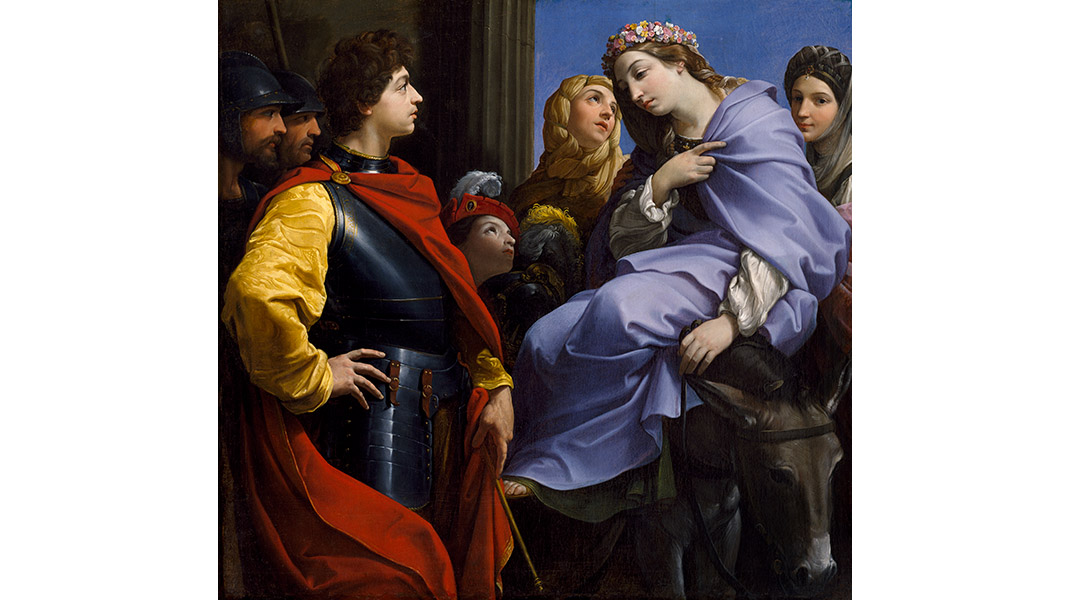
Guido Reni (Italian, 1575-1642). The Meeting of David and Abigail, ca. 1615-20. Oil on canvas, 155.5 x 163.8 cm (61 1/4 x 64 1/2 in.). Chrysler Museum of Art, Norfolk, Virginia, Gift of Walter P. Chrysler, Jr., 71.524

Godfried Schalken (Dutch, 1643-1706). Precious Recognized, late 1660s. Oil on panel, 44.2 x 31.2 cm (17 3/8 x 12 5/16 in.). National Gallery of Ireland, Dublin, Purchased 1898, NGI.476. Photo © National Gallery of Ireland

Francesco Albani (Italian, 1578-1660). Saint John the Baptist Seated in the Wilderness, ca. 1603. Oil on copper, 49.2 x 37.1 cm (19 3/8 x 14 5/8 in.). The John and Mable Ringling Museum of Art, The State Art Museum of Florida, Florida State University, Sarasota, Bequest of John Ringling, 1936, SN115

Nicolas Poussin (French, 1594-1665). Ecstasy of Saint Paul, 1643. Oil on panel,41.6 x 30.2 cm (16 3/8 x 11 7/8 in.). The John and Mable Ringling Museum of Art, the State Art Museum of Florida, Florida State University, Sarasota, Museum purchase, 1956, SN690

Eustache Le Sueur (French, 1616-1655). Alexander and his Doctor, ca. 1648-49. Oil on canvas, 96 x 96 cm (37 13/16 x 37 13/16 in.).The National Gallery, London, Bought with the support of a number of gifts in wills, 1999, NG6576 © National Gallery, London / Art Resource, NY

Attributed to Guy Noël Aubry (French, 18th-century). Philippe II, Duke of Orléans, 1715-1723. Oil on canvas, 248 x 160 cm (97 5/8 x 63 in). Musée des Beaux Arts d’Orléans, Orléans, France, 842.3A © François Lauginie.

“Renowned at the time of the founding of the City of New Orleans, The Orléans Collection celebrates the artistic sensibilities of Philippe II,” said Susan Taylor, the Montine McDaniel Freeman Director of NOMA. “His legacy is his patronage of the arts: architecture, painting, music, dance and theatre. As an institution that is committed to celebrating all of the arts, it is fitting that NOMA takes on this project during New Orleans’ Tricentennial.”

Images courtesy New Orleans Museum of Art.

Luigi Valadier: Splendor in Eighteenth-Century Rome at The Frick Collection, October 31, 2018 – January 20, 2019

“The Frick presents the first monographic exhibition devoted to one of the important figures of eighteenth-century Italian decorative arts, Luigi Valadier (1726–1785). He was a talented draftsman, designer, goldsmith, silversmith, and bronze founder, using precious stones as well as enamel, wood and glass, to create whimsical and elegant works of art for noble clients. Luigi Valadier: Splendor in Eighteenth-Century Rome highlights Valadier’s oeuvre, presenting more than fifty objects as well as drawings that represent the breadth of his career. Never before has an American museum audience been able to view together so many examples of his production, with significant loans coming from public institutions as well as private collections in Europe and the United States.

As with the Frick’s highly acclaimed 2016 exhibition on Pierre Gouthière, this project allows the broader public to enjoy a much-needed study of a significant figure in the decorative arts whose imagination and skills made him one of the soaring figures in his time. In this case, the subject is Roman rather than Parisian, and the exhibition and book add dimension to a strong year of Italian programming at the Frick, which began this summer with an exhibition related to a commission by sculptor Antonio Canova and continues this winter and spring with shows on painters Giovanni Battista Moroni and Giovanni Battista Tiepolo.” — The Frick Collection

Luigi Valadier. Herm of Bacchus, 1773. Bronze, alabastro a rosa, bianco e nero antico, and africano verde. H. 68 7⁄8 inches. Galleria Borghese, Rome. Photo: Mauro Magliani

Luigi Valadier. Herm of Bacchus (detail), 1773. Bronze, alabastro a rosa, bianco e nero antico, and africano verde. H. 68 7⁄8 inches. Galleria Borghese, Rome. Photo: Mauro Magliani

Luigi Valadier. Table with Dodecagonal Porphyry Top (one of two), 1773. Giallo antico, portasanta, bianco e nero antico, gilt wood, gilt bronze, and porphyry. 36 5⁄8 × 55 1⁄8 × 34 5⁄8 inche. Galleria Borghese, Rome. Photo: Mauro Magliani

Luigi Valadier. Caddinet (cadenas) with the Coat of Arms of Henry Benedict Stuart, Cardinal Duke of York, ca. 1785. Gilt silver. 4 x 14 7/8 x 11 7/8 inches. Royal Collection Trust © Her Majesty Queen Elizabeth II 2018

Luigi Valadier. Clock for Don Abbondio Rezzonico, 1765–70. Gilt bronze, shagreen, and other materials. Clock: 26 3/4 x 11 3/4 x 6 3/4 inches. Bracket: 12 5/8 x 13 3/8 x 8 5/8 inches. Private Collection

Luigi Valadier. Casket (cantinetta) for Wine Bottles with the Coat of Arms of Henry Benedict Stuart, Cardinal Duke of York, before 1788. Gilt silver, 13 × 13 3⁄8 × 9 inches. Giordano Art Collections, Italy

Luigi Valadier. St. Louis, ca. 1773. Silver and gilt metal, 48 × 13 × 15 inches. Cathedral of Santa Maria la Nuova, Monreale. Photo: Mauro Magliani

Luigi Valadier. St. Rosalia, ca. 1773. Gilt bronze and silver, 42 1⁄8 × 13 × 15 inches. Cathedral of Santa Maria la Nuova, Monreale. Photo: Mauro Magliani

Luigi Valadier. Egyptian Clock, 1785. Hardstones, various marbles, gilt bronze, and mosaic. 24 3/4 x 14 1/8 x 9 1/2 inches. Private Collection. Photo: Mauro Magliani

Luigi Valadier. The Triumph of Bacchus, 1780. Agate, alabaster, ancient hardstones, ancient glass paste, gold, gilt metal, and gilt bronze. 24 3/4 x 25 x 6 1/8 inches. Musée du Louvre, Paris © RMN-Grand Palais / Art Resource, NY. Photo: Les frères Chuzeville

Luigi Valadier. Reduction of the Temple of Mercury, ca. 1778. Lapis lazuli, amethyst, garnet, red porphyry, portasanta, green porphyry, and gilt bronze. 17 7/8 x 17 3/8 inches. Museo Arqueológico Nacional, Madrid

The exhibition is curated by Alvar González-Palacios, who has dedicated most of his life to scholarship on the artist and is considered its foremost expert.

Images courtesy The Frick Collection.  

Martha Rosler: Irrespective at Jewish Museum, November 2, 2018 – March 3, 2019

Martha Rosler: Irrespective is a survey exhibition of the work of the influential artist Martha Rosler. Rosler is considered one of the strongest and most resolute artistic voices of her generation; she is also a prolific writer, lecturer, professor, and advocate for social justice. She skillfully employs diverse materials to address pressing matters of her time, including war, gender roles, gentrification, inequality, and labor. From her feminist photomontages of the 1960s and 1970s to her large-scale installations, Rosler’s vital work reflects an enduring and passionate vision. 

Martha Rosler: Irrespective showcases both well-known and rarely seen selections from more than five decades of work. Installations, photographic series, sculpture, and video represent a practice continually evolving and reacting to the shifting contours of political life. Throughout, Rosler’s work has been characterized by intellectual rigor and sharp wit, along with a sense of urgency directed at social and political issues that remain as relevant and immediate as when they first emerged.” — Jewish Museum

Martha Rosler, Cleaning the Drapes, from the series House Beautiful: Bringing the War Home, c. 1967-72, photomontage. Artwork © Martha Rosler

Martha Rosler, First Lady (Pat Nixon), from the series House Beautiful: Bringing the War Home, c. 1967-72, photomontage. Artwork © Martha Rosler

Martha Rosler, A Gourmet Experience, 1974, Multipart installation with banquet table, video, slide projections, audio, books, and cookbook readings. Artwork © Martha Rosler

Martha Rosler, still from Semiotics of the Kitchen, 1975, black-and-white video, 6 min., 33 sec. Artwork © Martha Rosler

Martha Rosler, still from Semiotics of the Kitchen, 1975, black-and-white video, 6 min., 33 sec. Artwork © Martha Rosler

Martha Rosler, still from Vital Statistics of a Citizen, Simply Obtained, 1977, color video, 40 min. Artwork © Martha Rosler

Martha Rosler, still from Vital Statistics of a Citizen, Simply Obtained, 1977, color video, 40 min. Artwork © Martha Rosler

Martha Rosler, still from Vital Statistics of a Citizen, Simply Obtained, 1977, color video, 40 min. Artwork © Martha Rosler

Martha Rosler, Unknown Secrets (The Secret of the Rosenbergs), 1988. Detail. Artwork © Martha Rosler

Martha Rosler, Photo-Op, from the series House Beautiful: Bringing the War Home, New Series, 2004, photomontage. Artwork © Martha Rosler

 “Martha Rosler believes that art should teach, provoke, and motivate,” says Darsie Alexander, Susan and Elihu Rose Chief Curator at The Jewish Museum. “From her early photomontages to her pioneering feminist videos and her current work interrogating gentrification and income inequality, Rosler’s art is a call to action.” 

Martha Rosler: Irrespective is organized by Darsie Alexander, Susan and Elihu Rose Chief Curator, with Shira Backer, Leon Levy Assistant Curator, The Jewish Museum, in close collaboration with the artist and her studio.

Images courtesy Jewish Museum.