Lydia Cabrera and Édouard Glissant: Trembling Thinking at Americas Society, through January 12, 2019

Lydia Cabrera and Édouard Glissant: Trembling Thinking is an exhibition that focuses on the ideas developed by the prominent Caribbean thinkers Lydia Cabrera (Havana, 1899-Miami, 1991) and Édouard Glissant (Sainte-Marie, Martinique, 1928-Paris, 2011). The exhibition presents modern and contemporary artists whose works respond to Cabrera and Glissant’s notions of literary ethnography, difference, opacity, and cultural multiplicity.

“Édouard Glissant was one of the most important writers and philosophers of our time. He called attention to means of global exchange that do not homogenize culture but produce a difference from which new things can emerge,” said Hans Ulrich Obrist. “His poems, novels, plays, and theoretical essays are a ‘toolbox’ I use every day in my praxis as an exhibition curator.”

“Lydia Cabrera not only pioneered the study of Afro Cuban traditions, which is a fundamental path for understanding the history and culture of the Caribbean, but examined its various creolizations,” commented Gabriela Rangel. “Cabrera was a self-taught polymath who should be paired to Glissant and who understood José Marti’s idea of the archipelago as a passage to the crossroads of the world. Trained as an artist in Paris in the 1920s, Cabrera’s mastering of ethnographical storytelling requests to be revisited by both artists and social scientists as anticipatory of the role of subjectivity vis-a-vis documentary truth.”

Lydia Cabrera reading, 1925. Cuban Heritage Collection at the University of Miami Libraries, Coral Gables, Florida.

Wifredo Lam, Retrato de Lydia Cabrera (Portrait of Lydia Cabrera), 1940s. Oil on canvas board. 8.75 x 7.38 inches; 22.2 x 18.7 cm. University of Miami, Lowe Art Museum. Bequest of Lydia Cabrera, 91.0295.18. © 2018 Artists Rights Society (ARS), New York / ADAGP, Paris.

Mestre Didi (Deoscoredes Maximiliano dos Santos), EJO AWURU—Serpente da madrugada, 1980s. Palm frond, painted leather, shells, and beads. 11¾ x 22¾ x 5⅞ inches; 30 x 68 x 15 cm. Photo: Andrew Kemp. Courtesy of Almeida & Dale Galeria de Arte, São Paulo.

Etel Adnan, Hommage à Édouard Glissant, 2014. Paper. 13 x 4¾ x ¾ inches; 33 x 12 x 2 cm. Private Collection. Photo: Arturo Sanchez

Édward Glissant, Mounsieur Toussaint: A Play. Washington: Three Continents Press, 2005. Dedicated book. 9 x 6 inches; 22.86 x 15.24 cm. Photo: Arturo Sánchez.

Édouard Glissant, Poèmes Complets. Paris: Gallimard: 1994. Dedicated book. 8.13 x 5.5 inches; 20.7 x 13.97 cm. Photo: Arturo Sánchez.

Wifredo Lam, Homenaje a Jicotea (Homage to Jicotea), ca. 1943. Ink and colored pencil on tracing paper. 6¾ x 8¼ inches; 17.1 x 21 cm. University of Miami, Lowe Art Museum. Bequest of Lydia Cabrera, 91.0295.12. © 2018 Artists Rights Society (ARS), New York / ADAGP, Paris.

Matta, Untitled, circa 1938. Colored wax crayon and pencil on paper, 12.5 x 19.4 inches; 31.75 x 49.28 cm. Private collection.

Matta, Morfologia Psicologica Del Ataque, 1939. Graphite and crayon on paper, 22.6 x 28.6 inches; 57.5 x 72.7 cm. Private collection.

Amelia Peláez, Mujer con pez (Woman with Fish), 1948. Oil on canvas. 51 3/4 x 40 inches; 131.4 x 101.6 cm. Isaac and Betty Rudman Trust.

Julie Mehretu, Topoglyph (Mutation), 2015. Ink and acrylic on canvas. 30 x 40 inches; 76.2 x 101.6 cm. Private Collection. Photo: Tom Powel Imaging. Courtesy of the artist and Marian Goodman Gallery, New York. © Julie Mehretu.

Manthia Diawara. Édouard Glissant: Poèmes complets, 2017. Video; color, sound, 26:45 minutes. Courtesy of the artist.

Asad Raza, Untitled (Q.M. II), 2009. Inkjet pigment print. 43¼ x 27⅝ inches; 110 x 70 cm. Courtesy of Kathrin Jira.

Tania Bruguera, Destierro (Displacement), 1998 [2005 version]. Cuban earth, glue, wood, nails, and textile. Variable dimensions. Courtesy of the artist.

Antonio Seguí, Salir corriendo, 2012. Acrylic on canvas. 57⅜ x 44¾ inches; 146 x 114 cm. Courtesy of Durban Segnini Gallery, Miami. © 2018 Artists Rights Society (ARS), New York / ADAGP, Paris.

Lydia Cabrera and Édouard Glissant: Trembling Thinking is organized in partnership with the Cuban Heritage Collection of the University of Miami and curated by Hans Ulrich Obrist (Artistic Director of the Serpentine Galleries, London), Gabriela RangeI (Chief Curator and Director of Visual Arts, Americas Society), and Asad Raza (Artist) with the assistance of Diana Flatto (Assistant Curator, Americas Society),

Images courtesy Americas Society.

Works & Process at the Guggenheim Museum presents Alvin Ailey American Dance Theater at 60, November 5, 2018

In honor of the Alvin Ailey American Dance Theater’s 60th anniversary, Artistic Director Robert Battle, Artistic Director Emerita Judith Jamison, and choreographer Rennie Harris join in a conversation moderated by author and television producer Susan Fales-Hill that spotlights what truly makes Ailey so special. Ailey’s dancers will perform highlights from signature classics by Alvin Ailey, repertory favorites by Robert Battle and Jamar Roberts and commissioned premieres that continue to break new ground, including Wayne McGregor’s Kairos, and Rennie Harris’ Lazarus – the Company’s first-ever two-act ballet.

Alvin Ailey American Dance Theater returns to the New York City Center stage November 28 – December 30 for a season that has become a holiday tradition. Led by Artistic Director Robert Battle during the Company’s 60th Anniversary celebration, Ailey’s extraordinary dancers will perform an expansive repertory of more than two dozen works, including the world premieres of Rennie Harris’ Lazarus and Ronald K. Brown’s The Call; the Company premiere of Wayne McGregor’s Kairos; new productions of ballets by Robert Battle and Judith Jamison; and Alvin Ailey’s timeless masterpiece, Revelations.

Alvin Ailey American Dance Theater in Alvin Ailey’s Revelations. Photo by Christopher Duggan.

Alvin Ailey American Dance Theater in Alvin Ailey’s Revelations. Photo by Christopher Duggan.

Alvin Ailey American Dance Theater in Alvin Ailey’s Revelations. Photo by Gert Krautbauer.

Alvin Ailey American Dance Theater’s Linda Celeste Sims and Glenn Allen Sims in Alvin Ailey’s Revelations. Photo by Andrew Eccles.

Alvin Ailey American Dance Theater’s Yannick Lebrun in Alvin Ailey’s Revelations. Photo by Paul Kolnik

Alvin Ailey American Dance Theater in Alvin Ailey’s Revelations. Photo by Paul Kolnik.

Alvin Ailey American Dance Theater in Alvin Ailey’s Revelations. Photo by Paul Kolnik.

Members of Alvin Ailey American Dance Theater. Photo by Andrew Eccles.

Alvin Ailey in performance, c. 1950s. Photo by Zoe Dominic.

Artistic Director Emerita Judith Jamison. Photo by Andrew Eccles.

Artistic Director Robert Battle. Photo by Andrew Eccles.

Images courtesy Guggenheim Museum.

Edward Burne-Jones at Tate Britain, October 24, 2018 – February 24, 2019

“Tate Britain presents the first major Burne-Jones retrospective to be held in London for over 40 years. Renowned for otherworldly depictions of beauty inspired by myth, legend and the Bible, Edward Burne-Jones (1833–98) was a pioneer of the symbolist movement and the only Pre-Raphaelite to achieve world-wide recognition in his lifetime. This ambitious and wide-ranging exhibition brings together over 150 works in different media including painting, stained glass and tapestry, reasserting him as one of the most influential British artists of the 19th century.

Edward Burne-Jones charts his rise from an outsider of British art to one of the great artists of the European fin de siècle. Burne-Jones rejected Victorian industrial ideals, offering an enchanted parallel universe inhabited by beautiful and melancholy beings. The exhibition brings together all the major works from across his four-decade career, depicting Arthurian knights, Classical heroes and Biblical angels. Spectacular large-scale paintings like Love among the Ruins 1870-73 and The Wheel of Fortune 1883 shows his international impact, including at the 1889 Exposition Universelle when he emerged on the world stage as the leading light of symbolist art. Two rooms dedicated to the artist’s most famous narrative cycles are shown together for the first time. These huge canvases are among his finest and best-loved works, telling the action-packed story of Perseus and the dreamlike fairy tale of Sleeping Beauty.” — Tate Britain

Phyllis and Demophoön, 1870. 
Watercolour on paper, 93 x 47 cm
. Birmingham Museum & Art Gallery

The Annunciation and the Adoration of the Magi, 1861. Oil paint on three canvases. Tate

Love among the Ruins, 1870-3. Watercolour, bodycolour and gum arabic on paper, 96 x 152 cm. Private collection

Laus Veneris, 1873-8. Oil paint on canvas, 
1194 x 1803 mm. 
Laing Art Gallery (Tyne & Wear Archives & Museums)

The Rock of Doom, 1885-8. 
Oil paint on canvas, 
1550 x 1300 mm. 
Staatsgalerie Stuttgart

The Doom Fulfilled, 1888. Oil paint on canvas,
155 x 140 cm. Staatsgalerie, Stuttgart

The Briar Wood, 1874-84. Oil paint on canvas
,125 x 231 cm. The Faringdon Collection Trust

The Rose Bower, 1886-90. Oil paint on canvas, 
125 x 231 cm. The Faringdon Collection Trust

Perseus and the Sea Nymphs (The Arming of Perseus), 1877. Bodycolour on paper, 1528 x 1264 mm. Southampton City Art Gallery

The Death of Medusa (II), c.1881-2. 
Bodycolour on paper, 1525 x 1365 mm. 
Southampton City Art Gallery

Sir Edward Burne-Jones; William Morris by Frederick Hollyer, platinum print, 1874 © National Portrait Gallery, London

Edward Burne-Jones is curated by Alison Smith, Chief Curator, National Portrait Gallery and Tim Batchelor, Assistant Curator, Tate Britain.

Images courtesy Tate Britain.

ON AIR: Tomás Saraceno at Palais de Tokyo, Paris, October 17, 2018 – January 6, 2019

“ON AIR is thought as an ecosystem in becoming, hosting a renewed choreography and polyphony between human and non-human universes, with artworks revealing common, fragile and ephemeral rhythms and trajectories between these worlds. As a hybrid organism, ON AIR builds itself with the myriad presences, visible and invisible, that meet and cohabit within it. Some voices are reduced into quietude, whilst others, usually less heard, are magnified. The exhibition performs a not-yet-audible hymn of the illegible ties between beings, the unspeakable togetherness of earthly and cosmic phenomena, a reality which is impossible to describe, but can maybe be felt. The works gathered reveal what resists our sight. This to build a space and a time in which our knowledge extends beyond what is visible, making tangible physically and virtually, the strength of the presences floating in the air and the way they affect us: from particulate matter to cosmic dust, from radio frequencies to sonic pollution. Thus, the invisible histories that tie us appear, those inviting us to rethink poetically the way we inhabit the world – and to reevaluate our way of being human. Supporting and promoting an interconnected culture, the show celebrates new modes of knowledge production and opens up to the debate and global challenges posed by the Anthropocene, a word proposed to define the current epoch we live in on Planet Earth, in which some human activities leave an impact so important that they modify the geological layers of our planet and its evolution.

It is especially through the activities of Aerocene, an interdisciplinary artistic project initiated by Tomás Saraceno, that seeks to reactivate a common imaginary to collaborate ethically with the atmosphere and the environment, that the visitors are invited to engage collectively in this exercise of planetary attunement. The carte blanche echoes Tomás Saraceno’s artistic practice as it reunites a great variety of collaborators and collaborations, bringing together scientific institutions, research groups, activists, local communities, musicians, philosophers, animals, celestial phenomena and visitors, who equally take part in the evolution of the exhibition as well. Workshops, jamming sessions with spiders, public symposiums regularly enrich the carte blanche and constantly transform Palais de Tokyo, metamorphosed for a few weeks in a vast ‘cosmic jam session’.” — Rebecca Lamarche-Vadel, ON AIR Curator

Tomas Saraceno. ON AIR installation view © Photography Andrea Rossetti, 2018.

Tomas Saraceno. ON AIR installation view © Photography Andrea Rossetti, 2018.

Tomás Saraceno. ON AIR installation view © Photography Studio Tomás Saraceno, 2018.

Tomás Saraceno. ON AIR installation view © Photography Studio Tomás Saraceno, 2018.

Tomás Saraceno. ON AIR installation view © Photography Studio Tomás Saraceno, 2018.

Tomás Saraceno. ON AIR installation view © Photography Studio Tomás Saraceno, 2018.

Tomás Saraceno. ON AIR installation view © Photography Studio Tomás Saraceno, 2018.

Tomás Saraceno. ON AIR installation view © Photography Studio Tomás Saraceno, 2018.

Tomás Saraceno. ON AIR installation view © Photography Studio Tomás Saraceno, 2018.

Tomás Saraceno. ON AIR installation view © Photography Studio Tomás Saraceno, 2018.

Tomás Saraceno. ON AIR installation view © Photography Studio Tomás Saraceno, 2018.

Tomás Saraceno. ON AIR installation view © Photography Studio Tomás Saraceno, 2018.

Tomas Saraceno. ON AIR installation view © Photography Andrea Rossetti, 2018.

Tomas Saraceno. ON AIR installation view © Photography Andrea Rossetti, 2018.

Tomas Saraceno. ON AIR installation view © Photography Andrea Rossetti, 2018.

All photos courtesy the artist; Andersen’s, Copenhagen; Esther Schipper, Berlin; Pinksummer Contemporary Art, Genoa; Ruth Benzacar, Buenos Aires; Tanya Bonakdar Gallery, New York. Images courtesy Palais de Tokyo.

Palais de Tokyo invited Tomás Saraceno to take over the entirety of the 13,000 m. of its exhibition spaces for the fourth edition of its “Carte Blanche”. The Carte Blanche entitled ON AIR is his largest project to date, bringing a selection of his major works together with ambitious new productions that transform Palais de Tokyo into a uniquely sensory experience. Tomás Saraceno was born in 1973 in Tucumán, Argentina. He lives and works on and beyond planet Earth.

Pablo Reinoso: “L’Arche” through October 21 & “Le Cercle” through November 7, Paris

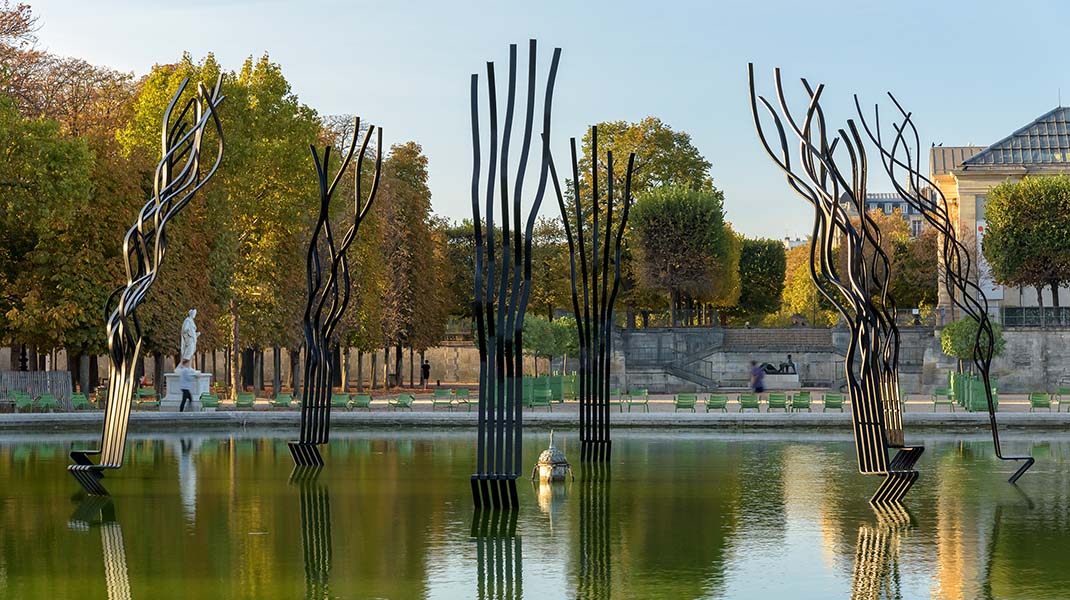
Pablo Reinoso presents two spectacular works in a public space with Waddington Custot: ‘‘L’Arche’’ in front of the Petit Palais and ‘‘Le Cercle’’ in the middle of the octagonal basin in the Jardin des Tuileries.

“L’Arche”, made from matt black painted steel and 6-metre high, is part of the Beam Bench series that Pablo Reinoso began in 2011, and in which he continues his reflections on materials. By setting steel girders free from their original function, he creates conditions that are favourable to the creation of new possibilities. The piece seems to frame the entrance to the building, giving passers-by somewhere to sit and providing a new vantage point between the two palaces.

“Le Cercle” rises in the centre of the octagonal basin in the middle of the Jardin des Tuileries. A historical setting, near the Place de la Concorde, for this installation comprising 8 sculptures that rise 6 metres above the water’s surface. “Le Cercle” is taken from the Garabatos series, on which Pablo Reinoso has been working since 2010. For the small octagonal basin in the Jardin des Tuileries, the artist designed an installation that takes its place along the fabulous perspective that connects the Louvre to the Arc de Triomphe. Extending this exceptional alignment, the sculptures emerge from the water and radiate outwards to form a circle, their movements creating reflections on the water that change with the wind.

Photo: L’Arche, 2018 © KLEINFENN

Photo: Le Cercle, 2018 © KLEINFENN

Photo: Le Cercle, 2018 © KLEINFENN

Beam Bench Series. Throne Beam Stool, 2015 © Rodrigo Reinoso

Beam Bench Series. Ro Beam Loop, 2017 © Rodrigo Reinoso

Beam Bench Series. Love Beam, 2016 © Rodrigo Reinoso

The Garabatos (Scribbles) Series. Chaises de L’Harmonie, 2015 © Rodrigo Reinoso

The Garabatos (Scribbles) Series. Mini Talking Bench, 2016 © Pablo Reinoso Studio

The Garabatos (Scribbles) Series. Huge Sudeley Bench, 2010 © Pablo Reinoso Studio

Pablo Reinoso (born 1955, Argentina) is a Franco-Argentinian sculptor. He has lived and worked in Paris since 1978. He has worked in series since the 1970’s, always rethinking his rapport with material, object and space. He tricks logic through his seemingly living works, giving his works a life of their own, widening the possibilities of reality.

Sanguine – Luc Tuymans on Baroque at Fondazione Prada, Milan, October 18, 2018 – February 25, 2019

Sanguine is a personal interpretation of the Baroque based on innovative juxtapositions and unexpected associations of works by contemporary artists and Old Masters. Avoiding a rigid chronological order or a strictly historiographical approach, Tuymans evades the traditional notion of the Baroque and invites viewers to reconsider 17th  century art, as well as the contemporary research, by placing artists and their role in society at the center of the exhibition narrative.

In the wake of Walter Benjamin’s analysis, according to whom the Baroque marked the start of modernity, Tuymans explores the search for authenticity, the political significance of artistic representation, the emotional turmoil generated by art, the celebration of the author’s personality, and the international dimension of the art scene, recognizing the Baroque as a primary point of reference for today’s art. Not only does Sanguine push the traditional boundaries of the Baroque notion by extending its duration to the present day, but also it shows how over the past two centuries artists have helped redefine it, from the negative sense attributed to the word by art critics during the late 18th  century, to the reassessment operated by Postmodernism and the re-establishment of a Baroque and figurative expressiveness in the art of recent years.

The exhibition title—a word that signifies the color of blood, but also a violent and vigorous temperament, and a pictorial technique—suggests a multiplicity of perspectives to interpret the exhibited works, in which violence and its simulation, cruelty and dramatization, realism and exaggeration, disgust and wonder, terror and ecstasy coexist.” — Fondazione Prada

All images are exhibition views of “Sanguine: Luc Tuymans on Baroque”. A project by Luc Tuymans. Photos by Delfino Sisto Legnani and Marco Cappelletti. Courtesy Fondazione Prada 

Organized with MKHA (Museum of Contemporary Art of Antwerp) and KMSKA (Museum of Fine Arts of Antwerp) and the City of Antwerp, the project will be featured in Milan in a new and more extensive version, following its first presentation in the Belgian city from June to September 2018.

“Sanguine – Luc Tuymans on Baroque” was curated by Luc Tuymans. He conceived an intense visual experience presenting more than 80 works by 62 international artists, including 25 exhibited exclusively at Fondazione Prada.

Celebrating Tintoretto: Portrait Paintings and Studio Drawings at The Met Fifth Avenue, October 16, 2018 – January 27, 2019

“Jacopo Tintoretto (1518/19–1594) was one of the preeminent Venetian painters of the 16th century and was renowned for his dynamic narrative scenes and insightful portraits. In celebration of the 500th anniversary of the artist’s birth, The Met presents Celebrating Tintoretto: Portrait Paintings and Studio Drawings. This focused exhibition unites 21 works from European and American museums and private collections, bringing them into a larger discussion of the artist’s approach to portraiture and painting, as well as the role of drawings in his workshop. 

Characterized by their immediacy, penetrating observation, and startling modernity, Tintoretto’s small-scale, informal portrait heads are an innovative aspect of his portraiture, and one that has been little studied. Seen together for the first time, these portrait studies will reveal Tintoretto’s famous quickness (prestezza) as a painter, capturing both the spirit and appearance of the sitter.

Facets of artistic practice in the Tintoretto workshop will come to light in the exhibition’s exploration of the relationship between Jacopo and his son Domenico. Central here are a series of bold figural drawings and a painting in the Museum’s collection, The Finding of Moses, whose long-debated attribution to both father and son will play a key role in the discussion of this flourishing workshop.” — The Met

Jacopo Tintoretto (Jacopo Robusti) (Italian, Venice 1518/19–1594 Venice). Portrait of an Elderly Man, ca. 1550. Oil on panel. San Diego Museum of Art, Gift of Anne R. and Amy Putnam

Jacopo Tintoretto (Italian, Venice 1518/19–1594 Venice). Portrait of a Man, 1550s. Oil on canvas. The Metropolitan Museum of Art, New York, Gift of George Blumenthal, 1941

Jacopo Tintoretto (Italian, Venice 1518/19–1594 Venice). Portrait of a Man (Self Portrait?), 1550s. Oil on canvas. Private collection

Jacopo Tintoretto (Italian, Venice 1518/19–1594 Venice). Head of a Man (Portrait Study). Probably 1550s. Oil on canvas laid on panel Royal Collection / HM Queen Elizabeth II

Jacopo Tintoretto (Italian, Venice 1518/19–1594 Venice). Head of an Old Man, 1555–65. Oil on canvas. Private collection, Milan

Jacopo Tintoretto (Italian, Venice 1518/19–1594 Venice). Portrait of a Bearded Man, Bust-length, in a Red Gown, ca. 1570 (?). Oil on canvas The Alana Collection, Newark, Delaware

Jacopo Tintoretto (Italian, Venice 1518/19–1594 Venice). Portrait of an Elderly Bearded Man, ca. 1570. Oil on canvas. Private collection

Jacopo Tintoretto (Italian, Venice 1518/19–1594 Venice). Portrait of Jacopo Sansovino, ca. 1570. Oil on canvas. Klassik Stiftung Weimar

Domenico Tintoretto (Italian, Venice 1560–1635 Venice). The Mocking of Christ, 1560–1635. Black chalk, brush and brown ink, gray and white oil paint, on blue paper; squared in black chalk. The Metropolitan Museum of Art, New York, Harry G. Sperling Fund, 1994

Domenico Tintoretto (Italian, Venice 1560–1635 Venice). Reclining Female Nude Figure, 1560–1635. Black chalk, highlighted with white, on blue paper. The Metropolitan Museum of Art, New York, Gift of Robert Lehman, 1941

Domenico Tintoretto (Italian, Venice 1560–1635 Venice). Reclining Female Nude, Early 17th century. Black and white chalk on faded blue paper. The Metropolitan Museum of Art, New York, Robert Lehman Collection, 1975

Domenico Tintoretto (Italian, Venice 1560–1635 Venice). Reclining Female Nude, Early 17th century. Black and white chalk on blue paper.The Metropolitan Museum of Art, New York, Robert Lehman Collection, 1975

Domenico Tintoretto (Italian, Venice 1560–1635 Venice). Reclining Female Nude, Early 17th century. Black and white chalk on blue paper The Metropolitan Museum of Art, New York, Robert Lehman Collection, 1975

Jacopo Tintoretto (Italian, Venice 1518/19–1594 Venice). Reclining Male Figure, 1560s. Black chalk on blue paper; squared in black chalk. The Metropolitan Museum of Art, New York, Robert Lehman Collection, 1975

 “Tintoretto created intensely powerful portraits, and the opportunity to look at these brilliant studies alongside one another allows us to recognize and appreciate the urgency and tremendous skill in these paintings,” said Max Hollein, Director of The Metropolitan Museum of Art. 

Celebrating Tintoretto: Portrait Paintings and Studio Drawings is organized by Andrea Bayer, The Met’s interim Deputy Director for Collections and Administration and Jayne Wrightsman Curator in the Department of European Paintings, and Alison Manges Nogueira, Associate Curator in the Robert Lehman Collection. 

Images courtesy The Metropolitan Museum of Art.

Drawing in Tintoretto’s Venice at The Morgan Library & Museum, October 12, 2018 – January 6, 2019

“The dramatic canvases of Jacopo Tintoretto (1518/1519–1594), with their muscular, expressive bodies, are some of the most distinctive of the Italian Renaissance. His drawings, however, have received less attention as a distinctive category in his oeuvre. Drawing in Tintoretto’s Venice is the first exhibition since 1956 to focus on the drawing practice of this major artist. It will offer a new perspective on Tintoretto’s evolution as a draftsman, his individuality as an artist, and his influence on a generation of painters in northern Italy. 

Organized to mark the five-hundredth anniversary of the artist’s birth, this exhibition brings together more than seventy drawings and a small group of related paintings. It places Tintoretto’s distinctive figure drawings alongside works by contemporaries such as Titian, Veronese, and Bassano, as well as by artists—Domenico Tintoretto, Palma Giovane, and others—working in Venice during the late sixteenth century, whose drawing style was influenced by Tintoretto’s. The exhibition also features a particularly engaging group of drawings that have recently been proposed as the work of the young El Greco during his time in Italy.” — The Morgan Library & Museum

Tintoretto (1518/19–1594), Seated Male Nude, ca. 1549. Black and white chalk, squared, on blue paper. Musée du Louvre, Paris, inv. 5385. © RMN-Grand Palais / Art Resource, NY.

Titian (1488–1576), Embracing Couple, ca. 1568–70, charcoal and black and white chalk on faded blue paper. The Syndics of the Fitzwilliam Museum, University of Cambridge. © The Fitzwilliam Museum, Cambridge.

Tintoretto (1518/19–1594), Venus and Vulcan, ca. 1545, black chalk, pen and brown ink with brown and gray wash, bpk Bildagentur / Kupferstichkabinett, Staatliche Museen zu Berlin /Art Resource, NY. Photography by Jorg P. Anders.

Tintoretto (1518/19–1594), Holy Family with the Young St. John, ca. 1549–50, oil on panel. Yale University Art Gallery, Maitland F. Griggs, B.A. 1896, Fund and Leonard C. Hanna, Jr., Class of 1913, Fund.

Tintoretto (1518/19–1594), Study of a Man with Raised Arms, ca. 1562–66, charcoal, heightened with white, on blue paper, squared for transfer, The British Museum, London. ©The Trustees of the British Museum.

Tintoretto (1518–1594), Studies of Three Men, for the Last Supper at San Trovaso, ca. 1563–64, black and white chalk. bpk Bildagentur / Kupferstichkabinett, Staatliche Museen, Berlin, Germany / Art Resource, NY. Photography by Volker-H. Schneider.

Tintoretto (?) and Workshop (1518/19–1594), Study of Michelangelo’s Samson and the Philistines (recto and verso), ca. 1560–70, charcoal and black chalk with white opaque watercolor on blue paper, The Morgan Library & Museum, Thaw Collection, 2005.234. Photography by Janny Chiu.

Tintoretto (1518/19–1594), Study for Return of the Prodigal Son, ca. 1574–76, charcoal (and black chalk?) with white chalk, on blue paper. Gabinetto Fotografico delle Gallerie degli Uffizi.

Tintoretto (1518/19–1594), Study for a Man Climbing into a Boat (recto), 1578–79, charcoal, squared in charcoal. The Morgan Library & Museum. Gift of J.P. Morgan, Jr. The Morgan Library & Museum, IV, 76. Photography by Graham S. Haber, 2012.

Domenico Tintoretto (1560–1635), Reclining Female Nude, ca. 1590, black and white chalk on blue paper. © The Metropolitan Museum of Art. Image source: Art Resource, NY.

Domenico Tintoretto (1560–1635), Miracle of the Slave, ca. 1611–12, oil over charcoal, squared for transfer. The British Museum, London. © The Trustees of the British Museum.

Attributed to El Greco (ca. 1541–1614), Last Supper, ca. 1575, brown wash with white opaque watercolor, over black chalk, on light brown paper. The Morgan Library & Museum, gift of János Scholz, 1981.96. Photography by Janny Chiu, 2018.

Palma Giovane (1544–1628), Christ Carried to the Tomb, ca. 1610, brush and brown and white oil paint over black chalk on oatmeal paper. National Gallery of Art, Washington, Wolfgang Ratjen Collection, Purchased as the Gift of Helen Porter and James T. Dyke, 2007. Courtesy National Gallery of Art, Washington.

Drawing in Tintoretto’s Venice was curated by John Marciari, Charles W. Engelhard Curator of Drawings and Prints.

Images courtesy The Morgan Library & Museum.

It’s Alive! Frankenstein at 200 at The Morgan Library & Museum, October 12, 2018 – January 27, 2019

“Mary Shelley’s Frankenstein; or, The Modern Prometheus—in which a chemistry student makes a living being out of corpses—has compelled our attention since it was first published in 1818. This exhibition explores its adaptability to stage and screen, its sources in Gothic art and Enlightenment science, and the haunted life of its creator. Frankenstein’s author was the daughter of celebrated writers and the partner of another. She too became famous in 1823, when the story was staged in London, with the monster portrayed by an expressive pantomime actor. Audiences loved it. More than a dozen other theatrical productions appeared, followed by the first film version, less than a century after the novel. James Whale’s 1931 film made Boris Karloff the face of Frankenstein for generations of viewers, and versions in other media— comic books, illustrations, prints, and posters—testify that Mary Shelley’s ‘hideous progeny’ is very much alive. Enter these galleries to meet the monster.” — Introductory Wall Text

William Blake (1757 – 1827), Europe: a Prophecy, London: Printed by Will. Blake, 1794. The Morgan Library & Museum, gift of Mrs. Landon K. Thorne, 1972; PML 77235.1. Photography by Janny Chiu.

Joseph Wright (1734 – 1797), The Alchymist, in Search of the Philosopher’s Stone, Discovers Phosphorus, and Prays for the Successful Conclusion of his Operation, as was the Custom of the Ancient Chymical Astrologers, 1795, oil on canvas, Derby Museums Trust. Photography by Richard Tailby.

Benoît Pecheux, plate no. 4 in Giovanni Aldini, Essai théorique et expérimental sur le galvanisme, Paris: De l’imprimerie de Fournier Fils, 1804. The Morgan Library & Museum, purchased on the Gordon N. Ray Fund, 2016; PML 196238. Photography by Janny Chiu.

Mary Wollstonecraft Shelley (1797 – 1851), Frankenstein, manuscript, MS. Abinger c.56, fols. 20v – 21r, 1816 – 1817. The Bodleian Libraries, University of Oxford.

Lyceum Theatre (London, England), This evening, Monday, July 28th, 1823, will be produced (for the first time) an entirely new romance of a peculiar interest, entitled Presumption! or, the Fate of Frankenstein, [London: s.n., 1823]. The Morgan Library & Museum, purchased on the Gordon N. Ray Fund, 2015; PML 196172, Photography by Janny Chiu.

Jean-François Vilain, Théâtre de la Porte St. Martin, Le monstre, acte premier, scène dernière, ca. 1826, color lithograph. Département des Arts du spectacle—Bibliothèque nationale de France.

Mary Wollstonecraft Shelley (1797 – 1851), Frankenstein; or, The Modern Prometheus, London: Printed for Lackington, Hughes, Harding, Mavor & Jones, 1818. The Carl H. Pforzheimer Collection of Shelley and His Circle, The Morgan Library & Museum, purchased by Pierpont Morgan in 1910. Photography by Janny Chiu.

Mary Wollstonecraft Shelley (1797 – 1851), Frankenstein, or, The Modern Prometheus, London: Henry Colburn and Richard Bentley, 1831. The Morgan Library & Museum; PML 58778. Photography by Janny Chiu.

Auguste Pontenier, wood engraving in Louis Figuier, Les merveilles de la science, ou Description populaire des inventions modernes, Paris: Furne, Jouvet et cie, [1867] – 1870. The Morgan Library & Museum, purchased on the Gordon N. Ray Fund, 2016; PML 196256. Photography by Janny Chiu.

Carl Laemmle Presents Frankenstein: the Man who Made a Monster, lithograph poster, 1931. Collection of Stephen Fishler, comicconnect.com, Courtesy of Universal Studios Licensing LLC, © 1931 Univeral Pictures Company, Inc.

Mary Wollstonecraft Shelley (1797 – 1851), Frankenstein, or, the Modern Prometheus, New York: Grosset and Dunlap, [1931]. The Morgan Library & Museum, purchased on the Gordon N. Ray Fund, 2016; PML 196478. Courtesy of Universal Studios Licensing LLC, © 1931 Univeral Pictures Company, Inc. Photography by Janny Chiu.

Lynd Ward (1905 – 1985), The Monster and Victor Frankenstein Encounter Each Other in the Swiss Alps, in a Field of Ice The Newly Created Monster Tries to Get into Victor Frankenstein’s Bed, proof wood engravings for illustrations in Mary Wollstonecraft Shelley, Frankenstein; or, The Modern Prometheus, New York: Harrison Smith and Robert Haas, 1934. Eberly Family Special Collections Library, Pennsylvania State University Libraries, Permission of Robin Ward Savage and Nanda Weedon Ward.

Dick Briefer (1915 – 1980), Frankenstein, no. 10, New York: Prize Comics, Nov.-Dec., 1947. From the Collection of Craig Yoe and Clizia Gussoni. © First Classics, Inc. Used with permission granted by Trajectory, Inc.

Bernie Wrightson (1948 – 2017), Frankenstein, or, The modern Prometheus. [New York, NY]: Published by Tyrannosaurus Press, 1977. The Morgan Library & Museum, purchased on the Gordon N. Ray Fund, 2017; PML 197644 © 2018 Bernie Wrightson / Artists Rights Society (ARS), New York.

Barry Moser, No Father Had Watched my Infant Days, wood engraving in a suite of prints accompanying Mary Wollstonecraft Shelley, Frankenstein; or, The Modern Prometheus, West Hatfield, MA: Pennyroyal Press, 1983. The Morgan Library & Museum, gift of Jeffrey P. Dwyer; PML 127245.6 © Pennyroyal Press

“The Morgan is in an excellent position to tell the rich story of Mary Shelley’s life and of Frankenstein’s evolution in popular culture,” said director of the museum, Colin B. Bailey. “Pierpont Morgan was fascinated by the creative process, and one of the artifacts he acquired was a first edition Frankenstein annotated by the author. The collection of works by the Shelleys, both at the Morgan and the New York Public Library, has only grown since then. We are very pleased to collaborate with the NYPL in presenting the full version of this extraordinary tale and how it lives on in the most resilient and timely of ways.”

It’s Alive! Frankenstein at 200 is a collaboration between the Morgan Library & Museum and The New York Public Library. It is co-curated by John Bidwell, the Astor Curator and Department Head of the Morgan’s Printed Books and Bindings Department, and Elizabeth Denlinger, Curator of the Carl H. Pforzheimer Collection of Shelley and His Circle at The New York Public Library.

Images courtesy The Morgan Library & Museum

Sarah Lucas: Au Naturel at New Museum, through January 20, 2019

 Sarah Lucas: Au Naturel is the first major survey in the United States of the work of British artist Sarah Lucas (b. 1962, London, UK). The exhibition spans Lucas’s entire career, bringing together some of her most iconic works and series from the late 1980s to today. Sarah Lucas: Au Naturel is curated by Massimiliano Gioni, Edlis Neeson Artistic Director, and Margot Norton, Curator. 

Over the past thirty years, Lucas has created a distinctive and provocative body of work that subverts traditional notions of gender, sexuality, and identity. Since the late 1980s, Lucas has transformed found objects and everyday materials such as cigarettes, vegetables, and stockings into absurd and confrontational tableaux that boldly challenge social norms. The human body and anthropomorphic forms recur throughout Lucas’s works, often appearing erotic, humorous, fragmented, or reconfigured into fantastical anatomies of desire.

The title of the exhibition, ‘Au Naturel,’ is taken from a sculpture Lucas created in 1994, in which an assemblage of objects suggestive of sexual organs adorns a mattress that slumps in the corner as if it were reclining. In an art historical context, ‘au naturel’ commonly refers to paintings of female nude figures, and literally translates from French as ‘in the nude.’ Applying the term to Lucas’s greater body of work, the title speaks to the immediacy, intimacy, and directness of her images and speculates on the possibility of a natural state, perhaps without the limitations of established social structures and gender conformity.” — New Museum  

Photographs by Corrado Serra.

Light Lines: The Art of Jan Groth, Inger Johanne Grytting, and Thomas Pihl at Scandinavia House, October 13, 2018 – January 12, 2019

Light Lines: The Art of Jan Groth, Inger Johanne Grytting, and Thomas Pihl at Scandinavia House celebrates three Norwegian artists who have influenced and continue to influence one another with work that employs the power of the reductive, sharing close ties to the New York community, and representing three generations: Jan Groth (b.1939), Inger Johanne Grytting (b.1949) and Thomas Pihl (b.1964).

Considered the foremost Norwegian artist of his generation, Jan Groth has continuously explored the relationship between line and picture plane. Exhibited extensively throughout his career with major exhibitions including a largescale retrospective at The Guggenheim Museum in New York, Groth’s influence and presence has been widespread both in the Nordic countries and internationally. In his relationships with Grytting and Pihl, the artists share a combined interest in a minimalist, restrained, and conceptual language. Their three practices, however, are distinctly individual.

Each room in the gallery will be dedicated to one artist, enabling visitors to experience a body of work while creating connections to the exhibition and artists as a whole. Jan Groth will also present a site-specific drawing installation.” — Scandinavia House

Jan Groth, Sign III, 1988. Wool tapestry, 59 x 82 2/5 in. (150 x 222 cm). Collection of Erling Neby Henie Onstad Kunstsenter

Jan Groth, Maquette for Open, 2017. Patinated bronze, 46 2/5 x 11 x 9 1/5 in. ( 118 x 28 x 23.5 cm). 1/5 from an edition of 5+2 AP (JG s 62). Collection of Bettina & Hans Peter Jebsen


Inger Johanne Grytting, Untitled No 12, 2016. Graphite pencil on Stonehenge paper, 22 1/4 x 30 in. (57 x 76 cm). Collection of the Artist

Inger Johanne Grytting, Untitled No 3, 2018. Oil on canvas, 36 x 36 in. (91.5 x 91.5 cm. Collection of the Artist

Inger Johanne Grytting, Untitled No 8, 2017. Oil on canvas, 48 x 48 in. (122 x 122 cm). Collection of the Artist

Thomas Pihl, Untitled #4, 2018. Acrylic paint on canvas, 72 x 60 in. (182.9 x 152.4 cm). Collection of the Artist

Thomas Pihl, Untitled #6, 2018. Acrylic paint on canvas, 72 x 60 in. (182.9 x 152.4 cm). Collection of the Artist

Thomas Pihl, Untitled #7, 2018. Acrylic paint on canvas, 72 x 60 in. (182.9 x 152.4 cm). Collection of the Artist

The show is curated by Karin Hellandsjø, Director Emeritus of the Henie Onstad Art Centre, Norway.

Images courtesy Scandinavia House.

Hilma af Klint: Paintings for the Future at Solomon R. Guggenheim Museum, October 12, 2018 – April 23, 2019

“Solomon R. Guggenheim Museum presents the first major solo exhibition in the United States of the Swedish artist Hilma af Klint (1862–1944). When af Klint began creating radically abstract paintings in 1906, they were like little that had been seen before: bold, colorful, and untethered from recognizable references to the physical world. It was several years before Vasily Kandinsky, Kazimir Malevich, Piet Mondrian, and others would take similar strides to free their own artwork of representational content. Yet af Klint rarely exhibited her remarkably forward-looking paintings and, convinced the world was not ready for them, stipulated that they not be shown for 20 years following her death. Ultimately, her work was not exhibited until 1986, and it is only over the past three decades that her paintings and works on paper have received serious attention.

Hilma af Klint: Paintings for the Future offers an opportunity to experience af Klint’s artistic achievements in the Guggenheim’s rotunda more than a century after she began her daring work. Curated by Tracey Bashkoff, Director of Collections and Senior Curator, with the assistance of David Horowitz, Curatorial Assistant, and organized with the cooperation of the Hilma af Klint Foundation, Stockholm, the exhibition features more than 170 of af Klint’s artworks and focus on the artist’s breakthrough years, 1906–20. It is during this period that she began to produce nonobjective and stunningly imaginative paintings, creating a singular body of work that invites a reevaluation of modernism and its development.” — Guggenheim Museum

Hilma af Klint. Group IV, The Ten Largest, No. 7, Adulthood (Grupp IV, De tio största, nr 7, Mannaåldern), 1907 from untitled series. Tempera on paper mounted on canvas, 315 x 235 cm. The Hilma af Klint Foundation, Stockholm. Photo: Albin Dahlström, the Moderna Museet, Stockholm

Hilma af Klint. Group I, Primordial Chaos, No. 16 (Grupp 1, Urkaos, nr 16), 1906-1907 from The WU/Rose Series (Serie WU/Rosen). Oil on canvas, 53 x 37 cm. The Hilma af Klint Foundation, Stockholm. Photo: Albin Dahlström, the Moderna Museet, Stockholm

Hilma af Klint. Group V, The Seven-Pointed Star, No. 1n (Grupp V, Sjustjärnan, nr 1), 1908 from The WUS/Seven-Pointed Star Series (Serie WUS/Sjustjärnan). Tempera, gouache and graphite on paper mounted on canvas, 62.5 x 76 cm. The Hilma af Klint Foundation, Stockholm. Photo: Albin Dahlström, the Moderna Museet, Stockholm

Hilma af Klint. Tree of Knowledge, No. 5 (Kunskapens träd, nr 5), 1915 from The W Series (Serie W). Watercolor, gouache, graphite and metallic paint on paper, 18 1/16 x 11 5/8 inches (45.8 x 29.5 cm). The Hilma af Klint Foundation, Stockholm. Photo: Albin Dahlström, the Moderna Museet, Stockholm

Hilma af Klint. Group IX/SUW, The Swan, No. 17 (Grupp IX/SUW, Svanen, nr 17), 1915 from The SUW/UW Series (Serie SUW/UW). Oil on canvas, 150.5 x 151 cm. The Hilma af Klint Foundation, Stockholm. Photo: Albin Dahlström, the Moderna Museet, Stockholm

Hilma af Klint. Group X, No. 1, Altarpiece (Grupp X, nr 1, Altarbild), 1915 from Altarpieces (Altarbilder). Oil and metal leaf on canvas, 237.5 x 179.5 cm. The Hilma af Klint Foundation, Stockholm. Photo: Albin Dahlström, the Moderna Museet, Stockholm

Hilma af Klint. No. 1 (Nr 1) from The Atom Series (Serie Atom), 1917. Watercolor on paper, 27 x 25 cm. The Hilma af Klint Foundation, Stockholm. Photo: Albin Dahlström, the Moderna Museet, Stockholm

Hilma af Klint. No. 2a, The Current Standpoint of the Mahatmas (Nr 2a, Mahatmernas nuvarande ståndpunkt), 1920 from Series II (Serie II). Oil on canvas, 36.5 x 27 cm. The Hilma af Klint Foundation, Stockholm

Hilma af Klint. Untitled, 1920 from On the Viewing of Flowers and Trees (Vid betraktande av blommor och träd). Watercolor on paper, 17.9 x 25 cm. The Hilma af Klint Foundation, Stockholm. Photo: Albin Dahlström, the Moderna Museet, Stockholm

Title Photo: David Heald. © 2018 The Solomon R. Guggenheim Foundation. Images courtesy Solomon R. Guggenheim Museum.