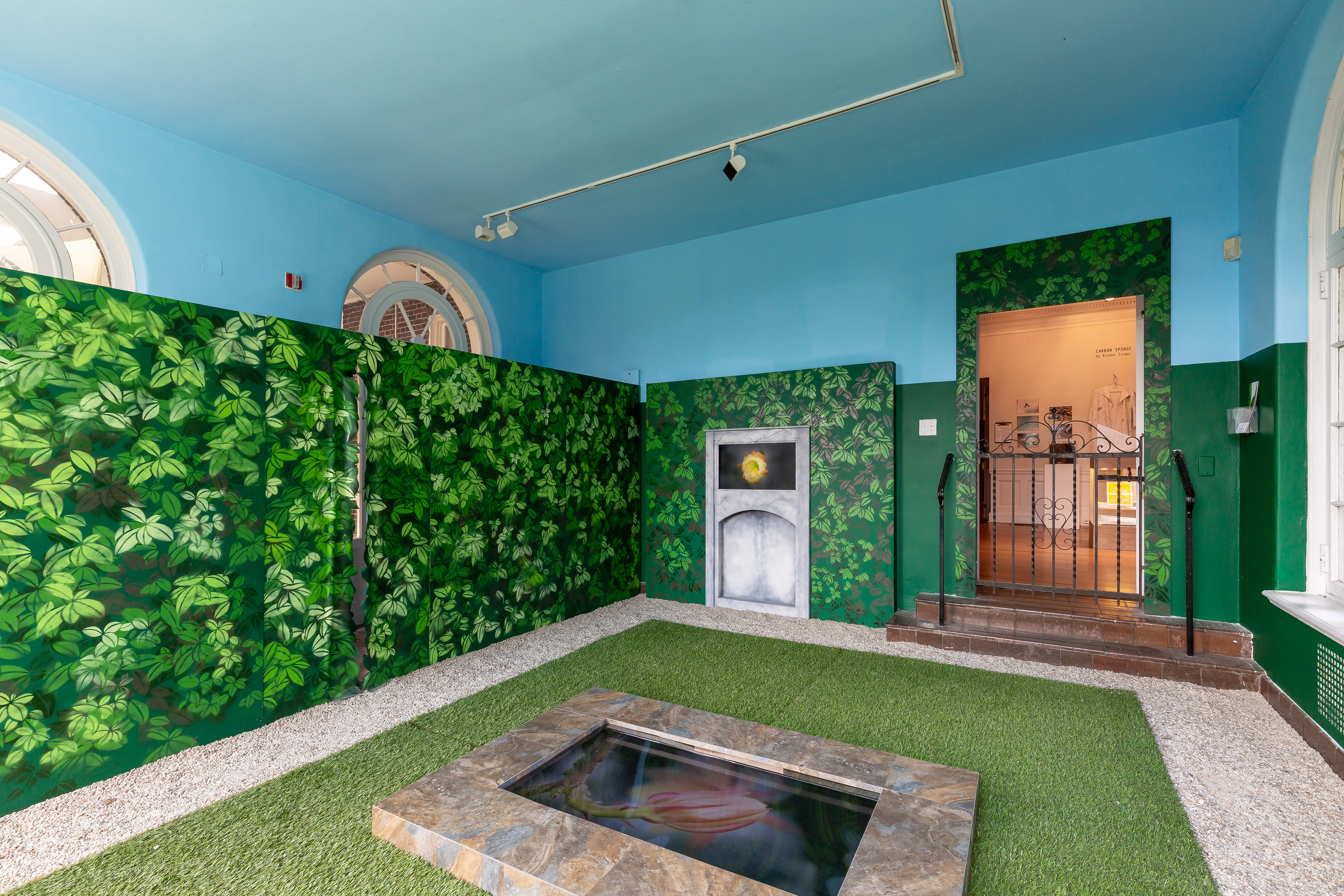
Machines à penser at Fondazione Prada, Ca’ Corner della Regina, Venice, through November 25, 2018

“This exhibition explores the correlation between conditions of exile, escape and retreat and physical or mental places which favor reflection, thought and intellectual production. “Machines à penser” focuses on three major philosophers of the 20th  century: Theodor W. Adorno (1903-1969), Martin Heidegger (1889-1976) and Ludwig Wittgenstein (1889-1951). The latter two shared a life-long need for intellectual isolation: Heidegger spent long periods of his life in a secluded hut in the village of Todtnauberg in the Black Forest in Germany, whilst Wittgenstein retreated on several occasions to a small mountain cabin situated in a fjord in Skjolden, Norway. Adorno, on the other hand, was forced into exile from his native Germany during by the Nazi regime, first to Oxford and then to Los Angeles, where he wrote Minima Moralia , a collection of aphorisms that, among other themes, reflects on the fate of forced emigration. These reflections from the background to an installation conceived by the Scottish artist and poet Ian Hamilton Finlay in 1987 titled Adorno’s Hut , a centerpiece of the exhibition alongside architectural reconstructions of the actual huts in which Heidegger and Wittgenstein wrote their respective masterpieces Being and Time (1927) and Tractatus Logico-Philosophicus (1921). These replicas double as exhibition venues within the Ca’ Corner della Regina, containing artworks and documents pertaining to the architectural archetype of the hut as a site of escape and retreat.” — Fondazione Prada

Exhibition views of “Machines à penser” at Fondazione Prada, Venice. Photos by Mattia Balsamini. Courtesy Fondazione Prada

Goshka Macuga. Left to right: Wittgenstein, 2018; Adorno, 2018; Heidegger, 2018

Front: Mark Riley, Diorama

Patrick Lakey, Villa Aurora in Los Angeles.

C-prints, Guy Moreton, LW 118, Skjolden Norway, 2001 / 2005

Left: Giulio Paolini, Art and space. Four illustrations by Martin Heidegger, 1983. Right: Iñigo Manglano-Ovalle, The Black Forest (Triptych), 2015

Left: Ian Hamilton Finlay, Adorno’s Hut, 1986–87

Susan Philipsz, Part File Score IV and VII, 2014

Ludwig Wittgenstein, Head of a Girl, 1925-1928

Patrick Lakey, Fichte: Fichte’s House, Jena, Germany, II, 2004 (2018)

As Dieter Roelstraete, curator of the exhibition, explains: “these were the places where our protagonists hatched out their deepest thoughts. Isolation, whether chosen or imposed, appears to have inspired them decisively—and over the years their huts have proven to be an inexhaustible source of inspiration in turn for generations of artists, attracted to the fantasy of withdrawal as articulated in its most elemental architectural form.”

The Face of Dynasty: Royal Crests from Western Cameroon at The Met Fifth Avenue, through September 3, 2018

“Four monumental tsesah crests created by Bamileke master sculptors of Western Cameroon are on view at The Metropolitan Museum of Art. Though only a small number of pre-colonial tsesah crests survive today, the genre has a prominent place in the repertory of sculpture from sub-Saharan Africa. The grandeur and originality of the works instantly captured the attention of art critics in the West in the early 20th century, but until this exhibition at The Met, no American museum has displayed more than one tsesah at a time. Showcasing the crests side by side, The Face of Dynasty: Royal Crests from Western Cameroon offers the visitor a rare opportunity to examine several examples of this epic royal art form, while exploring its significance, history, and development in the region starting in the early 18th century. The exhibition is the first public presentation of The Met’s recent acquisition of a tsesah crest. This masterpiece is thought to have been carved 200 years ago and may have been a prototype for the extant tsesah corpus. The other three works are on loan from American collections. The exhibition will be complemented by a 27-feet-long ndop display cloth that was used to delineate the space at royal state events and ceremonies where a tsesah would have appeared.” — The Met

Crest (tsesah). Cameroon, Grassfields region; Bamileke peoples. 18th century. Wood. H. 37 × W. 32 1/2 × D. 11 1/2 in. The Metropolitan Museum of Art, New York, Purchase, Acquisitions and Rogers Funds, and Anonymous, James J. Ross, and Marian Malcolm Gifts, 2017 (2017.35) Met DP-13362-002_RT

Crest (tsesah). Cameroon, Grassfields region; Bamileke peoples. Late 19th century. Wood. H. x. W. x D.: 30 5/16 x 20 7/8 x 10 13/16 in. National Museum for African Art, Smithsonian Institution, gift of Walt Disney World Co., a subsidiary of The Walt Disney Company (2005-6-5) Smithsonian2005-6-5_S20070126

Crest (tsesah). Cameroon, Grassfields region; Bamileke peoples. Late 19th – early 20th century. Wood. H. x. W. x D.: 36 1/8 × 22 3/4 × 13 in. The Menil Collection, Houston (1970-095 DJ) Menil – 1970_095_DJ_v01_M.tif

Crest (tsesah). Cameroon, Grassfields region; Bamileke peoples. 19th century.  Wood. H. x W. x D.: 34 13/16 in. x 21 ¼ x 12 ½ in. Private collection, Courtesy of McClain Gallery McClain Gallery

The exhibition is organized by Yaëlle Biro, Associate Curator, and Alisa LaGamma, Ceil and Michael E. Pulitzer Curator in Charge in the Department of the Arts of Africa, Oceania, and the Americas at The Metropolitan Museum of Art.

Images courtesy The Metropolitan Museum of Art.

Toward a Concrete Utopia: Architecture in Yugoslavia, 1948–1980 at The Museum of Modern Art, July 15, 2018–January 13, 2019

Toward a Concrete Utopia: Architecture in Yugoslavia, 1948–1980 is the first major US exhibition to study the remarkable body of architectural work from Yugoslavia that sparked international interest during the 45 years of the country’s existence. The exhibition investigates architecture’s capacity to produce a shared civic space and common history in a highly diverse, multiethnic society through more than 400 drawings, models, photographs, and film reels culled from an array of municipal archives, family-held collections, and museums across the region. Tasked with constructing a socialist society based on “self-management,” modern architecture was a key instrument in the implementation of a utopian vision in a perpetual state of emergence; many of the featured visionary projects and executed buildings speak to architecture’s aspirational role in terms of both design and social impact.

With galleries dedicated to Modernization, Global Networks, Everyday Life, and Identities, the exhibition explores themes of large-scale urbanization, technological experimentation and its application in everyday life, consumerism, monuments and memorialization, and the global reach of Yugoslav architecture. Featuring work by exceptional architects, including Bogdan Bogdanović, Juraj Neidhardt, Svetlana Kana Radević, Edvard Ravnikar, Vjenceslav Richter, and Milica Šterić, the exhibition examines the unique range of forms and modes of production in Yugoslav architecture and its distinct yet multifaceted character. In addition to architectural work, Toward a Concrete Utopia also includes three video installations by renowned filmmaker Mila Turajlić, newly commissioned photographs by Valentin Jeck, and contemporary artworks by Jasmina Cibic and David Maljković.” — MoMA

Urban Planning Institute of Belgrade. Belgrade Master Plan. 1949–50. Belgrade, Serbia. Plan 1:10000. 1951. Ink and tempera on diazotype, 64 9/16 x 9 3/4″ (164 x 233 cm). Urban Planning Institute of Belgrade

Uglješa Bogunović, Slobodan Janjić, and Milan Krstić. Avala TV Tower. 1960–65 (destroyed in 1999 and rebuilt in 2010). Mount Avala, near Belgrade, Serbia. Exterior view. Photo: Valentin Jeck, commissioned by The Museum of Modern Art, 2016

Milan Mihelič. S2 Office Tower. 1972–78. Ljubljana, Slovenia. Photo: Valentin Jeck, commissioned by The Museum of Modern Art, 2016

Andrija Mutnjaković. National and University Library of Kosovo. 1971–82. Prishtina, Kosovo. Exterior view. Photo: Valentin Jeck, commissioned by The Museum of Modern Art, 2016

Janko Konstantinov. Telecommunications Center. 1968–81. Skopje, Macedonia. View of the Southwestern Block façade. Photo: Valentin Jeck, commissioned by The Museum of Modern Art, 2016

Exhibition poster for the retrospective of architect Janko Konstantinov, 1984. Collage diazotype and tracing paper. Personal archive of Jovan Ivanovski

Vjenceslav Richter. Yugoslav Pavilion at Expo 58. 1958. Brussels, Belgium. Archive of Yugoslavia

Dinko Kovačić and Mihajlo Zorić. Braće Borozan building block in Split 3. 1970–79. Split, Croatia. Exterior view. Photo: Valentin Jeck, commissioned by The Museum of Modern Art, 2016

Ivan Vitić. Apartment Building on Laginjina Street. 1957–62. Zagreb, Croatia. Perspective drawing, 1960. Tempera, pencil, and ink on paper, 27 15/16 × 39 3/8″ (71 × 100 cm). Ivan Vitić Archive, Croatian Academy of Sciences and Arts

Zlatko Ugljen. Šerefudin White Mosque. 1969–79. Visoko, Bosnia and Herzegovina. Interior view. Photo: Valentin Jeck, commissioned by The Museum of Modern Art, 2016

Edvard Ravnikar. Revolution Square (today Republic Square). 1960–74. Ljubljana, Slovenia. Photo: Valentin Jeck, commissioned by The Museum of Modern Art, 2016

Živa Baraga and Janez Lenassi. Monument to the Fighters Fallen in the People’s Liberation Struggle. 1965. Ilirska Bistrica, Slovenia. Photo: Valentin Jeck, commissioned by The Museum of Modern Art, 2016

Jordan and Iskra Grabul. Monument to the Ilinden Uprising. 1970–73. Kruševo, Macedonia. Photo: Valentin Jeck, commissioned by The Museum of Modern Art, 2016

Berislav Šerbetić and Vojin Bakić. Monument to the Uprising of the People of Kordun and Banija. 1979–81. Petrova Gora, Croatia. Exterior view. Photo: Valentin Jeck, commissioned by The Museum of Modern Art, 2016

Miodrag Živković. Monument to the Battle of the Sutjeska. 1965–71, Tjentište, Bosnia and Herzegovina. Photo: Valentin Jeck, commissioned by The Museum of Modern Art, 2016

“Historically speaking, a thorough investigation of the architectural production of socialist Yugoslavia will lead to a better understanding of an important but understudied chapter of architectural history in the bifurcated world order of the Cold War,” said Martino Stierli. “From a contemporary point of view, this body of work serves as a reminder that architecture can only thrive when there is a broad societal understanding of architecture’s power to transform and elevate society and the quality of life it offers citizens.”

Toward a Concrete Utopia: Architecture in Yugoslavia, 1948– 1980 is organized by Martino Stierli, The Philip Johnson Chief Curator of Architecture and Design, The Museum of Modern Art, and Vladimir Kulić , Associate Professor, Florida Atlantic University, with Anna Kats, Curatorial Assistant, Department of Architecture and Design, The Museum of Modern Art.

Images courtesy The Museum of Modern Art.

Magic Realism: Art in Weimar Germany 1919-33 at Tate Modern, July 30, 2018 – July 14, 2019

“Tate Modern explores the art of the Weimar Republic (1919-33) in a year-long, free display, drawing upon the rich holdings of The George Economou Collection. This presentation of around seventy paintings and works on paper will address the complex paradoxes of the Weimar era, in which liberalisation and anti-militarism flourished in tandem with political and economic uncertainty. These loans offer a rare opportunity to view a range of artworks not ordinarily on public display – some of which have never been seen in the United Kingdom before – and to see a selection of key Tate works returned to the context in which they were originally created and exhibited nearly one hundred years ago.

Although the term ‘magic realism’ is today commonly associated with the literature of Latin America, it was inherited from the artist and critic Franz Roh who invented it in 1925 to describe a shift from the anxious and emotional art of the expressionist era, towards the cold veracity and unsettling imagery of this inter-war period. In the context of growing political extremism, this new realism reflected a more liberal society as well as inner worlds of emotion and magic.

The profound social and political disarray after the First World War and the collapse of the Empire largely brought about this stylistic shift. Berlin in particular attracted a reputation for moral depravity and decadence in the context of the economic collapse. The reconfiguration of urban life was an important aspect of the Weimar moment. Alongside exploring how artists responded to social spaces and the studio, entertainment sites like the cabaret and the circus will be highlighted, including a display of Otto Dix’s enigmatic Zirkus (‘Circus’) print portfolio. Artists recognised the power in representing these realms of public fantasy and places where outsiders were welcomed.” — Tate Modern

Albert Birkle (1900 – 1986). The Acrobat Schulz V, 1921. Oil paint on canvas, 920 x 607 mm. The George Economou Collection © DACS, London 2018.

August Heitmüller (1873 – 1935). Self-Portrait, 1926. Oil paint on canvas, 900 x 705 mm. The George Economou Collection.

Conrad Felixmüller (1897 – 1977). The Beggar of Prachatice, 1924. Watercolour, gouache and graphite on paper, 500 x 645 mm. The George Economou Collection © DACS, 2018.

George Grosz (1893 – 1959). A Married Couple, 1930. Watercolour, gouache, pen and ink on paper, 505 x 440 mm. The George Economou Collection © Estate of George Grosz, Princeton, N.J. 2018.

Hans Grundig (1901-1958). Girl with Pink Hat, 1925. Oil paint on cardboard, 704 x 500 mm. The George Economou Collection © DACS, 2018.

Jeanne Mammen (1890-1976). Brüderstrasse (Free Room), 1930. Watercolour, ink and graphite on vellum, 475 x 345 mm. The George Economou Collection © DACS, 2018.

Josef Eberz (1880 – 1942). Dancer (Beatrice Mariagraete), 1923. Oil paint on canvas, 1580 x 785 mm. The George Economou Collection.

Otto Dix (1891 – 1969). Lili, the Queen of the Air (from Circus portfolio), 1922. Etching, drypoint on paper. The George Economou Collection © The Estate of Otto Dix 2018.

Sergius Pauser (1896 – 1970). Self – Portrait with Mask, 1926. Oil paint on canvas, 600 x 730 mm. The George Economou Collection © Angela Pauser and Wolfgang Pauser.

Magic Realism is curated by Matthew Gale, Head of Displays and Katy Wan, Assistant Curator, Tate Modern.

Images courtesy Tate Modern.

The Face in the Moon: Drawings and Prints by Louise Nevelson at Whitney Museum of American Art, Opens July 20, 2018

“Louise Nevelson (1899–1988), an artist best known for her monochromatic wooden sculptures, produced a distinctive body of works on paper over the course of her long career. Drawn entirely from the Whitney’s collection, this exhibition follows her work in drawing, printing, and collage, from her early focus on the human body through her progression into abstraction.

Nevelson frequently used unconventional or recycled materials. In her prints, she layered scraps of fabric to create deeply textured environments containing mystical figures and architectural forms. Her paper collages, like her sculptures assembled from wooden objects, reconfigure the disparate materials from which they are composed, including scraps of paper and foil, into unified, unexpected compositions. Interested in the physical constraints of objects, Nevelson sought to transform the materials that she used and the subjects that she depicted. She believed that art could reorient one’s relationship to the built and natural world, challenging us to see our environments differently through her work.” — Whitney Museum

Louise Nevelson (1899-1988), Untitled, 1928. Fabricated red chalk on paper: sheet, 17 5/8 × 13 3/8 in. (44.8 × 34 cm); mount: 19 9/16 × 15 1/2 in. (49.7 × 39.4 cm). Whitney Museum of American Art, New York; gift of the artist 69.220. © 2018 Estate of Louise Nevelson/Artists Rights Society (ARS), New York.

Louise Nevelson (1899-1988), Untitled, 1930. Pen and ink on paper, 14 3/4 × 12 13/16 in. (37.5 × 32.5 cm). Whitney Museum of American Art, New York; gift of the artist 69.231. © 2018 Estate of Louise Nevelson/Artists Rights Society (ARS), New York.

Louise Nevelson (1899-1988), For Dance Design, 1937. Graphite pencil on paper, 9 1/4 × 17 1/4 in. (23.5 × 43.8 cm). Whitney Museum of American Art, New York; gift of the artist 69.232. © 2018 Estate of Louise Nevelson/Artists Rights Society (ARS), New York.

Louise Nevelson (1899-1988), Portrait, 1953-55. Aquatint and etching: sheet, 24 1/8 × 19 1/4 in. (61.3 × 48.9 cm); plate, 19 5/8 × 15 7/8 in. (49.9 × 40.3 cm). Whitney Museum of American Art, New York; gift of the artist 69.242. © 2018 Estate of Louise Nevelson/Artists Rights Society (ARS), New York.

Louise Nevelson (1899-1988), The Magic Garden, 1953-55. Etching and aquatint: sheet, 9 15/16 × 13 1/8 in. (25.2 × 33.3 cm); plate, 5 13/16 × 8 11/16 in. (14.8 × 22.1 cm). Whitney Museum of American Art, New York; purchase with funds from the Print Committee 96.193. © 2018 Estate of Louise Nevelson/Artists Rights Society (ARS), New York.

Louise Nevelson (1899-1988), The West Queen, 1953-55, printed 1965-66. Etching, aquatint, and drypoint: sheet, 29 7/8 × 22 in. (75.9 × 55.9 cm); plate, 20 3/4 × 13 5/8 in. (52.7 × 34.6 cm). Edition 12/20. Whitney Museum of American Art, New York; gift of Robert Pearlstein 2008.260. © 2018 Estate of Louise Nevelson/Artists Rights Society (ARS), New York.

Louise Nevelson (1899-1988), Untitled, 1963. Lithograph: sheet, 34 × 23 9/16 in. (86.4 × 59.8 cm); image, 32 1/8 × 22 1/4 in. (81.6 × 56.5 cm). Edition 19/20. Whitney Museum of American Art, New York; gift of the artist 69.253. © 2018 Estate of Louise Nevelson/Artists Rights Society (ARS), New York.

The Face in the Moon: Drawings and Prints by Louise Nevelson is organized by Clémence White, curatorial assistant.

Images courtesy Whitney Museum of American Art.

Devotion to Drawing: The Karen B. Cohen Collection of Eugène Delacroix at The Met Fifth Avenue, July 17 – November 12, 2018

“Renowned as a giant of French Romantic painting, Eugène Delacroix (1798–1863) was equally a dedicated and innovative draftsman. The Karen B. Cohen Collection of Eugène Delacroix, generously promised to The Met, presents the exceptional opportunity to examine the central role of drawing in the artist’s practice and the scope of his graphic production. 

Delacroix’s drawings remained largely unknown to the public during his lifetime. The thousands of sheets discovered in his studio upon his death revealed the extent of his devotion to the medium. The privacy of his drawing practice and the significance of these works in his formation and process make them vital to understanding the artist. 

This exhibition traces the variety of ways Delacroix used drawing throughout his career: to train his hand and eye through copying and direct observation of nature; to invent, research, and refine his ideas for paintings, public decorative programs, and prints; and to explore the expressive potential of his materials. 

Delacroix defies easy classification as a draftsman. He rejected the prevailing prescription for a singular method or ideal manner of drawing in favor of an individual approach. In their diversity, his drawings convey the liberating force of an artist whose inexhaustible ambition and curiosity fueled relentless invention.” — Introductory Wall Text

Two Studies of a Reclining Male Nude, after Théodore Gericault (recto); Figure Studies after Rubens’s “Fall of the Damned” (verso), ca. 1820–22. Graphite, pen and brown ink (recto); pen and brush and brown ink (verso). 10 in. × 13 1/16 in. (25.4 × 33.2 cm). The Metropolitan Museum of Art, New York, Promised Gift from the Karen B. Cohen Collection of Eugène Delacroix, in honor of Clement C. Moore II.

Normandy Sketchbook, 1829. Graphite and watercolor on wove paper, period binding. 4 5/16 × 6 in. (11 × 15.2 cm). The Metropolitan Museum of Art, New York, Promised Gift from the Karen B. Cohen Collection of Eugène Delacroix, in memory of Arthur G. Cohen.

Sunset, ca. 1850. Pastel on blue laid paper. 8 1/16 x 10 3/16 in. (20.4 x 25.9 cm). The Metropolitan Museum of Art, New York, Gift from the Karen B. Cohen Collection of Eugène Delacroix, in honor of Philippe de Montebello, 2014.

Page from the Othello Sketchbook, 1855. Watercolor over graphite. 5 1/4 × 3 1/4 in. (13.3 × 8.3 cm). The Metropolitan Museum of Art, New York, Promised Gift from the Karen B. Cohen Collection of Eugène Delacroix.

The Agony in the Garden, ca. 1849. Brush and brown and black wash. 4 7/16 × 7 5/8 in. (11.3 × 19.4 cm). The Metropolitan Museum of Art, New York, Promised Gift from the Karen B. Cohen Collection of Eugène Delacroix.

Figure Studies, related to “Liberty Leading the People”, 1830. Pen and brown ink, brush and brown wash. 8 7/16 x 13 7/16 in. (21.5 x 34.2 cm). The Metropolitan Museum of Art, New York, Gift from the Karen B. Cohen Collection of Eugène Delacroix, in honor of Keith Christiansen, 2013.

The Education of Achilles, ca. 1844. Graphite. 9 5/16 x 11 11/16 in. (23.6 x 29.7 cm). The Metropolitan Museum of Art, New York, Gift from the Karen B. Cohen Collection of Eugène Delacroix, in honor of Emily Rafferty, 2014.

Hamlet Reproaches His Mother, ca. 1834. Graphite. 6 7/8 x 9 3/16 in. (17.5 x 23.3 cm). The Metropolitan Museum of Art, New York, Gift from the Karen B. Cohen Collection of Eugène Delacroix, in memory of Lucien Goldschmidt, 2013.

Crouching Tiger, 1839. Pen and brush and iron gall ink. Overall: 5 3/16 x 7 3/8 in. (13.1 x 18.7 cm). The Metropolitan Museum of Art, New York, Gift from the Karen B. Cohen Collection of Eugène Delacroix, in honor of Sanford I. Weill, 2013

Devotion to Drawing: The Karen B. Cohen Collection of Eugène Delacroix is organized by Ashley E. Dunn, Assistant Curator in The Met’s Department of Drawings and Prints.

Images courtesy The Metropolitan Museum of Art.

YU HANYU: Force of Nature, The Power of the Brush at Ethan Cohen Kunsthalle (KuBe) in Beacon, New York, July 14 – September 2, 2018

Photographs by Corrado Serra.

“A leading figure in the practice of Chinese landscape painting and calligraphy, Yu Han Yu has pioneered a visual vernacular that pushes the ancient art form into the 21st century – without losing touch with its origins. Based in Beijing, he is recognized as both a master of the genre and an experimental visionary, an explorer on land and on the paper. Yu’s ink paintings derive from direct contact with his subject matter: the mountainous regions of Tibet’s Qinghai Plateau, the sweeping peaks of Shangri-La, glacial cataracts and cosmic cloudscapes. Born in 1964, Yu graduated from Hubei Institute of Fine Arts in Wuhan and China Central Academy of Fine Arts in Beijing. He has travelled to Tibet on some 50 occasions in 13 years, often in strenuous conditions. Yu’s explosively jagged confluences of nature suggest his own struggle against the elements in creating his art while conveying the internecine struggle within nature’s fierce forces of creation.” — Ethan Cohen Gallery

Yu Hanyu

Yu Hanyu: Force of Nature, The Power of the Brush, a solo exhibition co-curated by Gan Yu and Ethan Cohen.

David Wojnarowicz: History Keeps Me Awake at Night at Whitney Museum of American Art, July 13 – September 30, 2018

Photographs by Corrado Serra.

“This exhibition is the first major, monographic presentation of the work of David Wojnarowicz (1954–1992) in over a decade. Wojnarowicz came to prominence in the East Village art world of the 1980s, actively embracing all media and forging an expansive range of work both fiercely political and highly personal. Although largely self-taught, he worked as an artist and writer to meld a sophisticated combination of found and discarded materials with an uncanny understanding of literary influences. First displayed in raw storefront galleries, his work achieved national prominence at the same moment that the AIDS epidemic was cutting down a generation of artists, himself included. This presentation  draws upon recently-available scholarly resources and the Whitney’s extensive holdings of Wojnarowicz’s work.” — Whitney Museum

David Wojnarowicz with Tom Warren, Self-Portrait of David Wojnarowicz, 1983–84. Collection of Brooke Garber Neidich and Daniel Neidich.

Installation view of Gallery 1

Center: Untitled (Green Head), 1982. Collection of Hal Bromm and Doneley Meris.

Installation view of Gallery 5

Left: The Newspaper as National Voodoo: A Brief History of the U.S.A., 1986. The Broad Art Foundation, Los Angeles. Right: History Keeps Me Awake at Night (For Rilo Chmielorz), 1986. Collection of John P. Axelrod.

Left: The Death of American Spirituality, 1987. Private collection. Right: Evolution, 1987. Collection of Brooke Garber Neidich and Daniel Neidich.

Mexican Crucifix, 1987. P.P.O.W., New York.

Left: Water, 1987. Collection of the Second Ward Foundation. Right: Earth, 1987. The Museum of Modern Art.

Left: Fire, 1987. The Museum of Modern Art. Right: Wind (For Peter Hujar), 1987. Collection of the Second Ward Foundation.

Installation view of Gallery 9

Left: Something from Sleep II, 1987–88. Collection of Steven Johnson and Walter Sudol; courtesy Second Ward Foundation. Right: Bad Moon Rising, 1989. Collection of Steven Johnson and Walter Sudol; courtesy Second Ward Foundation.

Installation view of Gallery 10

Installation view of Gallery 10

Installation view of Gallery 11

This exhibition is co-curated by David Kiehl, Curator Emeritus, and David Breslin, DeMartini Family Curator and Director of the Collection.

Pacha, Llaqta, Wasichay: Indigenous Space, Modern Architecture, New Art at Whitney Museum of American Art, July 13 – September 30, 2018

Pacha, Llaqta, Wasichay investigates the complex ways in which Indigenous American notions of construction, land, space, and cosmology are represented in contemporary art. The exhibition highlights the work of seven established and emerging Latinx artists based in the United States and Puerto Rico (Latinx is a gender-neutral term for people of Latin American heritage). These artists—william cordova, Livia Corona Benjamín, Jorge González, Guadalupe Maravilla, Claudia Peña Salinas, Ronny Quevedo, and Clarissa Tossin—are inspired by Indigenous thinking about the built environment and natural world; they employ a wide range of references, from vernacular adaptations of pre-Columbian temples to constellations as metaphors for migration routes.

Each of the three title words in Quechua, the Indigenous language most spoken today in the Americas, holds more than one meaning. Pacha denotes universe, time, space, nature, or world; llaqta signifiesplace, country, community, or town; and wasichay means to build or to construct a house. Reflecting the richness of these ideas, the works on view explore the conceptual frameworks inherited from, and still alive in, communities in Mexico, Central America, and South America that include the Quechua, Aymara, Maya, Aztec, and Taíno, among others. By preserving and foregrounding ancestral ideas that transcend the Western concept of architecture, and offering alternate ways to understand the environment around us, the artists in the exhibition challenge colonial legacies and the belief in modernism as the ultimate paradigm of development in the Americas. For them, Indigenous art and architecture remain very much part of—and relevant to—the present.” — Introductory Wall Text

Installation view of works by Livia Corona Benjamín. Photo by Corrado Serra for Arts Summary.

Installation view of works by Guadalupe Maravilla. Photo by Corrado Serra for Arts Summary.

Guadalupe Maravilla, Requiem for a border crossing of my undocumented father #3, 2016. Archival inkjet print, 20 x 30 in. Edition 1 of 5. Collection of the artist.

Claudia Peña Salinas, Cueyatl, 2017. Brass, dyed cotton, and concrete frog, 24 1/2 x 24 x 61 in. Collection of the artist, 2017.

Installation view. Photo by Corrado Serra for Arts Summary.

Ronny Quevedo, quipu, 2017. Screen print, contact paper, and enamel on paper, 44 x 38 in. Collection of the artist. Photo credit: Argenis Apolinario.

Clarissa Tossin, Ch’u Mayaa, 2017, production still. Choreography/Performer: Crystal Sepúlveda; Cinematography: Jeremy Glaholt. Originally commissioned and produced by the City of Los Angeles Department of Cultural Affairs for the exhibition “Condemned to be Modern” as part of Getty’s “Pacific Standard Time:LA/LA.” Courtesy the artist.

Clarissa Tossin, A two-headed serpent held in the arms of human beings, or, Ticket Window, 2017. Silicone, walnut, faux terracotta (dyed plaster), 46 x 53 1/2 x 5 in. Collection of the artist; Courtesy of Commonwealth and Council, Los Angeles.

Left: Clarissa Tossin, Ha’ K’in Xook, from Piedras Negras to Hill Street, 2017. Photo by Corrado Serra for Arts Summary.

This exhibition is organized by Marcela Guerrero, assistant curator, with Alana Hernandez, curatorial project assistant.

Art as a revelation. From the Luigi and Peppino Agrati Collection at Gallerie d’Italia, through August 19, 2018

“In November 1970, as Christo removed the white cloths used to wrap the Monument of Vittorio Emanuele II in Piazza del Duomo in order to cover up the Monument to Leonardo da Vinci in Piazza della Scala on what is now recognised as a historic moment for Milanese contemporary art, Luigi and Peppino Agrati were among those who witnessed the event first-hand, soon contacting the artist to commission a number of installations for the garden of their villa. The Agrati brothers, prominent entrepreneurs, shared the same insight and subtle feeling for art, and were able to grasp the underlying depths of the images that were contributing to ‘build’ their time.

This exhibition features a representative selection of both Italian and American works from the collection generously and foresightedly donated to the Intesa Sanpaolo banking group by Luigi Agrati. It begins with a large nucleus of sculptures by Fausto Melotti, which forms the core of the show, continuing with masterpieces by Lucio Fontana, Alberto Burri, Yves Klein, and Piero Manzoni before delving deeper into the painting of Italy’s Nuova Figurazione, or ‘New Figuration’ movement, with works by Jannis Kounellis and Mario Schifano among others, then going right to the roots of the nascent Arte Povera movement revealed through the explorations of Piero Gilardi, Luciano Fabro, Mario Merz, and Giulio Paolini. 

Thanks to their typically entrepreneurial curiosity and their uncommon ability to penetrate beneath the surface of things, Luigi and Peppino Agrati built up a collection representing the wide range of interests involved in their experience of contemporary art. Their discovery of American art, which expanded along with their growing relations in the United States, resulted in the acquisition of works by the leading artists of the Pop Art movement – including the monumental Triple Elvis by its figurehead Andy Warhol – as well as of minimalist pieces like the large fluorescent installation dedicated to Peppino Agrati by Dan Flavin. The collection forms a complex constellation where Italian art is joined by the extraordinary works of Robert Rauschenberg – extensively collected from the late 1960s until the 1980s – of Cy Twombly, the original mediator between American and Italian culture, and of conceptual artists like Bruce Nauman and Joseph Kosuth whose studies of language form a dialogue with the language-based works by Alighiero Boetti and Vincenzo Agnetti. 

As it introduces the public to these works for the first time, the exhibition evokes the approach of the collection, which is conceived as a revelation, an enrichment, as a way of sharing a possible world of images encapsulating both contemporary existence and the intensity of Luigi and Peppino Agrati’s love of art.” — Introductory Text, Gallerie d’Italia  

Fausto Melotti (Rovereto 1901 – Milano 1986). Gli specchi (The Mirrors) , 1975. Brass, 40 x 91 x 7,5 cm. Collezione Luigi e Peppino Agrati © Fausto Melotti by SIAE 2018

Christo (Christo Javacheff), Gabrovo, 1935. Curtains for P. Agrati’s Garden, 1970. Matita nera, matite colorate, tela su carta, 70 x 55 cm. Collezione Luigi e Peppino Agrati

Christo (Christo Javacheff), Gabrovo, 1935. Wrapped Monument to Vittorio Emanuele (Project for Piazza del Duomo, Milano), 1970. Pencil, coloured pencil, canvas, cord, road map, photo on fibreboard

Mario Merz (Milano 1925 – Torino 2003). Senza titolo (Untitled), 1968. Black felt-pen, metallic mesh, clay, oil, paper on board, 54 x 73 cm. Collezione Luigi e Peppino Agrati

Michelangelo Pistoletto (Biella 1933). Uomo che aggiusta un camion (Man Repairing a Van), 1967. Painted tissue paper, polished mirror-finish stainless steel , 230 x 120 cm. Collezione Luigi e Peppino Agrati

Mario Schifano (Homs 1934 – Roma 1998). Grande pittura (Great Painting), 1963. Enamel and graphite on paper applied onto canvas, 260 x 150 cm. Collezione Luigi e Peppino Agrati

Jannis Kounellis (Pireo, Atene, 1936 – Roma, 2017). Senza titolo (Untitled), 1960. Oil on canvas, 150 x 250 cm. Collezione Luigi e Peppino Agrati © Jannis Kounellis by SIAE 2018

Giulio Paolini (Genova 1940). Senza titolo (Untitled), 1961. Jute, polythene, cord, frame, 120 x 150 cm. Collezione Luigi e Peppino Agrati

Alberto Burri (Città di Castello 1915 – Nizza 1995). Bianco Rosso (White Red), 1954. Burlap, fabric, oil, pumice, canvas, Vinavil glue on pressed cardboard, 75 x 59 cm. Collezione Luigi e Peppino Agrati Fondazione Palazzo Albizzini-Collezione Burri, Città di Castello © by SIAE 2018

Lucio Fontana (Rosario di Santa Fé 1899 – Comabbio 1968). Concetto spaziale (Spatial Concept), 1957. Aniline dye and collage on perforated canvas, 250 x 200 cm. Collezione Luigi e Peppino Agrati © Fondazione Lucio Fontana, Milano by SIAE 2018

Piero Manzoni (Soncino 1933 – Milano 1963). Achrome, 1961. Artificial fibre (glass wool), 100 x 80 x 20 cm. Collezione Luigi e Peppino Agrati

Enrico Castellani (Castelmassa 1930 – Celleno 2017). Superficie bianca. Dittico (White Surface. Diptych), 1967. Tempera on convex, concave, and shaped canvas, 120 x 150 cm. Collezione Luigi e Peppino Agrati

Alighiero Boetti (Turin 1940–Rome 1994). Ononimo, 1973. Red ball pen on carboard 11 elements

Dan Flavin (Jamaica, New York 1933 – Riverhead, New York 1996). Untitled (to Giuseppe Agrati), 1968. Yellow fluorescent lights, 122 x 335 cm. Collezione Luigi e Peppino Agrati

Andy Warhol (Pittsburgh, Pennsylvania 1928 – New York 1987). Triple Elvis, 1963. Acrylic and silkscreen on canvas, 208 x 152 cm. Collezione Luigi e Peppino Agrati © The Andy Warhol Foundation for the Visual Arts Inc. by SIAE 2018

Robert Rauschenberg (Port Arthur, Texas 1925 – Captiva, Florida 2008). Trasmettitore Argento Glut (Neapolitan) [Silver Transmitter Glut (Neapolitan)], 1987. Metal and number plate assemblage, 249 x 320 x 32 cm. Collezione Luigi e Peppino Agrati © Robert Rauschenberg Foundation by SIAE 2018

Jean-Michel Basquiat (Brooklyn 1960 – New York 1988). Financial District, 1985. Acrylic, oil on canvas, 163 x 142 cm. Collezione Luigi e Peppino Agrati © The Estate of Jean-Michel Basquiat by SIAE 2018

Art as a revelation is at Gallerie d’Italia – Piazza Scala, Intesa Sanpaolo museum complex in Milan. The exhibition project was headed by Luca Massimo Barbero, with Gianfranco Brunelli as the general coordinator.

Images courtesy Gallerie d’Italia.

John Bock: The Next Quasi-Complex at Fondazione Prada, July 18 – September 24, 2018

“Conceived by the German artist John Bock (Gribbohm, 1965; lives and works in Berlin) for the Podium exhibition space, the project reflects his own practice that freely employs performative elements with audience engagement, installation, environment among others. His performances, called “lectures” by the artist himself, parody academic presentations and didactic methods. They are enacted in environments crafted from everyday objects, found materials, detritus, furniture etc., arranged to create a deliberately absurdist, or illogical universe. During his live events, visitors are involved in an experiential and participatory relationship with the artist.

For this new project, Bock transforms the ground floor of the Podium into his own eccentric and surreal world, a theatre of the absurd intermingliming dark comedy with disciplines such as philosophy, economics, music, fashion as well as fragments of daily life, altogether overcoming the conventions of contemporary art.

At the center of this new exhibition project are two large installations from the Collezione Prada: the mobile stage of When I’m looking into the Goat Cheese Baiser  (2001) and the living room of Lütte mit Rucola  (2006). Incorporating new experimental architectures, fragmentary walls, make-shift structures and a selection of existing artworks, the project takes the form of a circular path leaving a small plaza in its midst.” — Fondazione Prada

John Bock, Lütte mit Rucola, 2006. Installation with video. Photo: Jan Windszus © John Bock 2006.

John Bock, When I’m looking into the Goat Cheese baiser, 2001. Installation with video. Photo: Knut Klaßen © 2001 John Bock

Images courtesy Fondazione Prada.

Rembrandt: Britain’s Discovery of the Master at Scottish National Gallery, July 7 – October 14, 2018

“Britain’s love affair with one of history’s greatest artists will be explored in the major Festival exhibition at the Scottish National Gallery this summer. Rembrandt: Britain’s Discovery of the Master is the first exhibition to tell the exceptionally rich story of how Rembrandt’s work in Britain has enraptured and inspired collectors, artists and writers over the past 400 years. This major new exhibition, which will only be shown in Edinburgh, will bring together key works by Rembrandt which remain in British collections, as well as treasures that have left the country. Some of the exhibits have never been on public display before, while others return to Britain for the first time in decades, some after even a century or more.

The genius of Rembrandt (1606-69) is so universally admired, and his imagery so ubiquitous, that he has become a global brand like few other artists in history; yet no nation has demonstrated such a passionate, and sometimes eccentric, enthusiasm for Rembrandt’s (or indeed any artist’s) works. As a result, there is a wealth of paintings, drawings and prints by Rembrandt in British collections, and the number of his works that have been here at some point in their history is staggering, surpassing any other country apart from the Netherlands, where they originated.” — Scottish National Gallery

Rembrandt van Rijn (1606-69). Belshazzar’s Feast, c.1635. Oil on canvas, 167.6 x 209.2 cm.  Collection: National Gallery, London Bought with a contribution from The Art Fund, 1964.

Rembrandt van Rijn (1606-69). A Woman in Bed, about 1645 – 1646. Oil on canvas, 81.1 x 67.8 cm. Collection: National Galleries of Scotland, presented by William McEwan 1892. Photo: Antonia Reeve

Rembrandt van Rijn (1606-69). Landscape with the Rest on the Flight into Egypt, 1647. Oil on wood panel, 34 x 48 cm. Collection: National Gallery of Ireland, Dublin, purchased, 1883

Rembrandt van Rijn (1606-69) The Mill, 1645/1648 Oil on canvas, 87.6 x 105.6 cm Collection: National Gallery of Art, Washington, USA Widener Collection

Rembrandt van Rijn (1606-69). A Man in Armour (‘Achilles’), 1655. Oil on canvas, 137.5 x 104.4 cm. Collection: Kelvingrove Art Gallery and Museum Glasgow Life (Glasgow Museums) on behalf of Glasgow City Council, Glasgow

Christopher Baker, Director, European and Scottish Art and Portraiture at National Galleries of Scotland, said: “This exhibition provides an extraordinary opportunity to study the staggering range of Rembrandt’s achievement and its profound impact on British taste and art. Featuring both major international loans and many less well-known rarities, it tells a riveting story. From the collectors of the artist’s own life time in the seventeenth century to today’s painters, Rembrandt has cast a spell on the British imagination. It’s a tale of scholarship and money, of privilege and popularity – and it’s all laid out exclusively in Edinburgh this summer!”

Images courtesy Scottish National Gallery.