Not an Ostrich: And Other Images from America’s Library at Annenberg Space for Photography, through September 9, 2018

“The exhibition is a collection of nearly 500 images – discovered within a collection of more than 14 million pictures – permanently housed in the world’s largest library at the Library of Congress in Washington, D.C. Put together by the distinguished photography curator Anne Wilkes Tucker, the exhibition features the image entitled Not an Ostrich and a large selection of rare and handpicked works from the vaults of the library, many never widely available to the public. Each picture documents a special moment in America’s culture and history. Tucker, named ‘America’s Best Curator’ by TIME, was granted special access to the photographic archives at the Library of Congress.

The images selected for Not an Ostrich: And Other Images from America’s Library span three centuries of photography (1800s, 1900s, 2000s), simultaneously telling America’s story through evocative imagery, while revealing the evolution of photography itself – from daguerreotypes, the first publicly available photographic process, to contemporary digital images. The exhibition’s name, Not an Ostrich, refers to an actual image included in the collection – a photo of actress Isla Bevan holding an ‘Floradora Goose’ at the 41st Annual Poultry Show at Madison Square Garden – and hints at the unexpected and unusual artifacts collected at the Library of Congress over its 218-year history, some of which will be on display inside the Annenberg Space for Photography”. — Annenberg Space for Photography

Robert Cornelius. Self-portrait, 1839. (From the Library of Congress, Prints & Photographs Division)

Benjamin F. Powelson. Harriet Tubman; a hitherto unknown carte-de-visite in the Emily Howland photograph album, 1868 or 1869. (From the Library of Congress, Prints & Photographs Division)

Gerhard Sisters. Geronimo showing photographers reflected in his eye, c. 1904. (From the Library of Congress, Prints & Photographs Division)

Not an Ostrich: ‘Floradora goose’ at 41st annual Poultry Show, Madison Square Garden, 1930. (From the Library of Congress, Prints & Photographs Division)

Unknown. Brünnhilde, 1936. (From the Library of Congress, Prints & Photographs Division)

Dorothea Lange. Destitute Pea Pickers in California. Mother of Seven Children, age 32. Migrant Mother, 1936. (From the Library of Congress, Prints & Photographs Division)

Toni Frissell. Jacqueline Bouvier and John Kennedy on their wedding day, Newport, RI, 1953. (From the Library of Congress, Prints & Photographs Division)

Michael A. “Tony” Vaccaro. Architectural hats, 1960. (From the Library of Congress, Prints & Photographs Division)

Phillip Harrington. New Designs: Ingo Maurer Bulb, 1970. (From the Library of Congress, Prints & Photographs Division)

Dan Esgro. Bella Lewitzky Dance Company, c. 1970–80. (From the Library of Congress, Prints & Photographs Division)

Sharon Farmer. Beatrice Fergerson, age 97, Washington, DC, 1990. (From the Library of Congress, Prints & Photographs Division)

Carol M. Highsmith. Mammy’s Cupboard restaurant, Natchez, MS, 2008. (From the Library of Congress, Prints & Photographs Division)

Dawoud Bey. Fred Stewart II and Tyler Collins, Birmingham Museum of Art from the series Birmingham: Four Girls, Two Boys, 2012. (From the Library of Congress, Prints & Photographs Division)

Carol M. Highsmith. Tough takedown in the Frontier Days arena, Cheyenne, WY, 2017. (From the Library of Congress, Prints & Photographs Division)

“What a pleasure and an honor it was to work with the Library of Congress selecting these photographs. Glamour, worship, invention, bravery, humor, cruelty and love – this collection of photographs preserves all examples of our humanity as well as chronicling America’s history in extraordinary photographs. The Library is an inexhaustible trove available for anyone to explore,” said Anne Wilkes Tucker, Curator Emerita of the Museum of Fine Arts, Houston.

“The Library of Congress not only collects and preserves America’s cultural heritage but also works to make those comprehensive collections accessible to as many people as possible. I am so thrilled about this opportunity to present the Library’s rich photography collection at the Annenberg Space for Photography,” said Librarian of Congress Carla Hayden. “I hope photography and history enthusiasts around Los Angeles and beyond who visit this unprecedented exhibition will have their curiosity piqued about all that is available to them at their national library.”

Images courtesy Annenberg Space for Photography.

Tennessee Williams: Playwright and Painter at Jewish Museum of Florida-FIU, through October 7, 2018

“This exhibit features nine of Tennessee William’s paintings dating from the 1970s. The paintings are on loan from David Wolkowsky, one of Williams’ closest friends and long-standing Key West resident. Wolkowsky entertained Williams at his private island on Ballast Key, nine miles off of Key West and at his Pier House Resort. Williams was one of the most admired playwrights of the 20th century. While he wrote fiction and motion picture screenplays, Williams is most widely known for his plays, which are chiefly set in the South. Several of his plays including, A Streetcar Named Desire, The Glass Menagerie, and Cat on a Hot Tin Roof are considered among the finest of the American stage. Painting was a passion for Williams, almost to the point that it became a second profession. Toward the end of his life, Williams gradually gave up writing for painting; for him, painting was an easier form of self-expression. Critics did not think as much of his painting as his plays, however his artwork remains widely popular among collectors.” — Jewish Museum of Florida-FIU

“The story behind these paintings, and the close friendship between Wolkowsky and Williams, is just one example of the many unexpected treasures in the rich history of Jewish culture in the State of Florida, spanning four centuries,” said Susan Gladstone, the Executive Director of the Jewish Museum of Florida-FIU. “The fact that Williams painted, much less that he painted in Key West, is a surprise to many and his paintings have mostly remained outside of the public eye. We are honored to have these works here at the Jewish Museum of Florida-FIU, and to be one of the few museums that David Wolkowsky has selected to exhibit these works outside of their Key West home.”

Michael York, by Tennessee Williams (1970s), oil and pencil on canvas. On loan from David Wolkowsky.

The Blaze of the Moment, by Tennessee Williams (1970s), oil on canvas. On loan from David Wolkowsky.

Citizen of World III, by Tennessee Williams (1970s), oil on canvas board. On loan from David Wolkowsky.

The Tidings Brought to Mary at Far Rockaway, by Tennessee Williams (1975), oil on canvas. On loan from David Wolkowsky.

She Sang Beyond the Genius of the Sea, by Tennessee Williams (1976), oil on canvas. On loan from David Wolkowsky.

Le Solitaire, by Tennessee Williams (1976), oil on canvas board. On loan from David Wolkowsky.

Tennessee Williams painting in Key West.

A signed portrait from Tennessee Williams, inscribed to David Wolkowsky, reads: “Dear David – It’s been one hell of a trip. Love, Tennessee”

Images courtesy Jewish Museum of Florida-FIU.

Ranjani Shettar: Seven ponds and a few raindrops at The Met Fifth Avenue, through September 16, 2018

Photographs by Corrado Serra.

“Suspended from the ceiling, Seven ponds and a few raindrops is composed of stainless steel elements that have been molded into a series of sensual, curved, amoeba-like forms covered in tamarind-stained muslin—a technique derived from a craft tradition Shettar observed in the small village of Kinnala, India. The shadows cast by the suspended elements give the viewer a sense of having stumbled upon a hidden-away oasis.

Born in 1977, Shettar is based in the South India state of Karnataka. The inspiration for her large-scale installation comes from her observations of the now-threatened natural environs of rural India. She combines natural and industrial materials like beeswax, wood, organic dyes, vegetal pastes, lacquer, steel, and cloth in her work. All of the components in Shettar’s installations are carefully created and have a deliberately imperfect quality. The hued, rough patinas of the materials emphasize the artisanal nature of her practice, while also acknowledging the lives of the materials themselves. While Shettar’s abstract sculptures are resonant with familiar traditions of Western modernist and minimalist sculpture, it is the interplay of techniques and materials, mostly drawn from local sources, that make them distinctive.” — The Met

Seven ponds and a few raindrops, 2017. Muslin, stainless steel, tamarind, natural dyes, 19 ft. 1 in. x 18 ft. 7 in. x 96 in. (581.7 x 566.4 x 243.8 cm). Courtesy Talwar Gallery, New York/New Delhi.

Indian sculptor Ranjani Shettar’s immersive installation Seven ponds and a few raindrops (2017), a recent gift to The Met from the Tia Collection, marks the beginning of the Tia Collection’s two year commitment to support the acquisition of works by South Asian female artists for The Met’s Department of Modern and Contemporary Art.

Ranjani Shettar: Seven ponds and a few raindrops is organized by Shanay Jhaveri, Assistant Curator of South Asian Art in The Met’s Department of Modern and Contemporary Art.

Ecological Consciousness: Artist as Instigator & Sunroom Project Space 2018 at Wave Hill, through August 26, 2018

Photographs by Corrado Serra.

Ecological Consciousness: Artist as Instigator continues Wave Hill’s efforts to examine the ways that artists engage in ecological projects that present calls to action. The exhibition documents environmental art that explores persistent problems throughout New York City.

Artists are the voice of the community. Often they are one of the first to voice social concerns and the most effective at garnering grass-roots support for important issues. Not surprisingly, as communities’ concerns about persistent environmental issues have escalated, artists have been uniquely positioned to actively respond, collaborating with engineers, designers, landscape architects, ecologists, historians and other professionals to bridge the gap between science, art and activism. Wave Hill stands at the center of this shift, providing the impetus for Wave Hill’s summer exhibition that features projects by artists, collectives, and organizations that have initiated environmental projects.

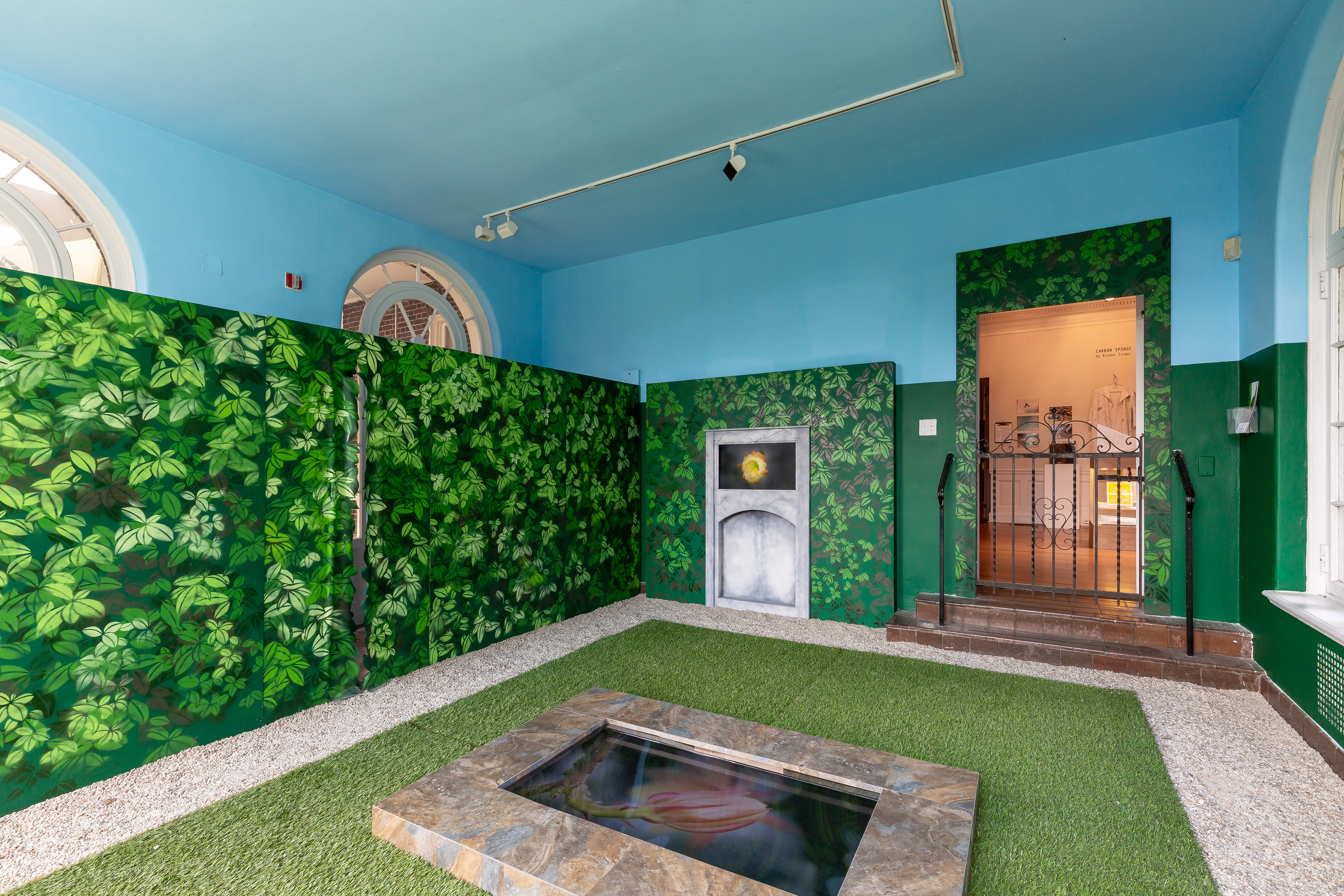
In the Sun Porch Katie Westmoreland’s presentation of kinetic tapestries responds to the space’s architecture, evoking the patterns cast by sunlight through trees and plants. Her immersive installation utilizes the passing light and shadow patterns as active mediums in her work, calling attention to the sun’s enduring, inspirational qualities.

In the Sunroom Project Space Priyanka Dasgupta and Chad Marshall create an installation that uses traditional landscape architecture, such as a conventional English garden maze, to expose the instability of identity in the United States. Dasgupta and Marshall explore the dichotomy of the sanctuary—its ability to protect as well as restrict.” — Wave Hill

The Sunroom Project Space, organized by Eileen Jeng Lynch, Curator of Visual Arts, and Natika Soward, Curatorial Fellow. The Arts at Wave Hill are overseen by Jennifer McGregor, Senior Director of Arts, Education and Programs.

Ecological Consciousness: Artist as Instigator is organized by Wave Hill’s curatorial team, Jennifer McGregor and Eileen Jeng Lynch.

Ecological Consciousness: Artist as Instigator are projects by artists, collectives, and organizations that have initiated environmental projects: CARBON SPONGE by Brooke Singer, DAYLIGHTING TIBBETTS BROOK PROJECTS organized by City As Living Laboratory (CALL) with SLO Architecture, and Bob Braine, LEVEE PROPOSAL FOR LOUIS VALENTINO PARK, RED HOOK, BROOKLYN by Jean Shin, (NERTM) NEW EARTH RESILIENCY TRAINING MODULE by Tattfoo Tan, NEWTOWN CREEK SAMPLING by Greg Lindquist with Willis Elkins/Newtown Creek Alliance, NYC WATERWAYS, SITE OF ACTVITY, SITE OF ACTION by Eve Mosher and Clarinda Mac Low, NYC URBAN FIELD STATION STEW-MAP and artist in residence program, ONBEHALFOF.LIFE by Environmental Performance Agency (EPA), OUTER SEED SHADOW PROJECTS FOR MARBLE HILL HOUSES AND DYCKMAN HOUSES organized by Juanli Carrión, SWALE by Mary Mattingly, THE FAIRY RING: MYCOREMEDIATION MOTHER PATCH, NEWTOWN CREEK by Jan Mun, THE POINT’S SOUTH BRONX RESILIENCY ARTS FELLOWSHIP PROJECTS by artists Blanka Amezkua, Brandon Ballengée, Lynn Cazabon and Alicia Grullon, WATERWASH BRONX RIVER by Lillian Ball.

John Akomfrah: Signs of Empire at New Museum, through September 2, 2018

“The New Museum presents the first American survey exhibition of the work of British artist, film director, and writer John Akomfrah (b. 1957, Accra, Ghana). Since the early 1980s, Akomfrah’s moving image works have offered some of the most rigorous and expansive reflections on the culture of the black diaspora, both in the UK and around the world. Akomfrah’s work initially came to prominence in the early 1980s as part of Black Audio Film Collective, a group of seven artists founded in 1982 in response to the 1981 Brixton riots. The collective produced a number of films notable for their mix of archival and found footage, interviews and realist depictions of contemporary England, and layered sound collages. In works like Handsworth Songs (1986), Akomfrah and Black Audio outlined the political and economic forces leading to social unrest throughout England. Akomfrah and Black Audio’s works were remarkable for their trenchant political inquiries and consistently experimental approach. They were also pioneering in their injection of narratives of black British history and culture into popular media through documentaries made for British television.

Although Akomfrah’s work has had a direct and profound influence on subsequent generations of British artists working across media, the importance of his work has yet to be fully felt in America. The centerpiece of the exhibition at the New Museum is Akomfrah’s celebrated three-screen video installation Vertigo Sea (2015). The work, which first premiered at the 2015 Venice Biennale and makes its New York debut at the New Museum, focuses on the ocean as an environmental, cultural, and historical force, connecting literature and poetry, the history of slavery, and contemporary issues of migration and climate change. The exhibition also includes The Unfinished Conversation (2012), Akomfrah’s complex reflection on the life and ideas of cultural theorist Stuart Hall; Expeditions I – Signs of Empire (1983), the first work produced by Black Audio Film Collective; and Transfigured Night (2013), a two-channel work looking at the relationship between the US and post-colonial African history.” — New Museum

_______________________________________

John Akomfrah, Expeditions One – Signs of Empire, 1983 (stills). Single-channel 35mm color Ektachrome slides transferred to video, sound; 26 min. © Smoking Dogs Films. Courtesy Lisson Gallery

_______________________________________

John Akomfrah, The Unfinished Conversation, 2012 (installation views). Three-channel HD video installation, 7.1 sound, color; 45:48 min. © Smoking Dogs Films. Courtesy Lisson Gallery

_______________________________________

John Akomfrah, Transfigured Night, 2013. (installation views and last image still from video). Two-channel HD video installation, 5.1 sound, color; 26:31 min. © Smoking Dogs Films. Courtesy Lisson Gallery

_______________________________________

John Akomfrah, Vertigo Sea, 2015. (installation views and last image still from video). Three-channel HD video installation, 7.1 sound, color; 48:30 min. © Smoking Dogs Films. Courtesy Lisson Gallery

_______________________________________

The exhibition is curated by Gary Carrion-Murayari, Kraus Family Curator, and Massimiliano Gioni, Edlis Neeson Artistic Director. It is accompanied by a fully illustrated catalog featuring essays by Tina Campt, T.J. Demos, Okwui Enwezor, Aram Moshayedi, Diana Nawi, and Zoe Whitley. 

Images courtesy New Museum. 

Vik Muniz: Photography and the Rebirth of Wonder at The Chrysler Museum of Art, through October 14, 2018

“The Chrysler Museum of Art in Norfolk, Virginia unveils a major retrospective of photographs by celebrated contemporary artist Vik Muniz. Vik Muniz: Photography and the Rebirth of Wonder explores the full breadth of the imaginative artist’s career with more than 100 photographs, including many of Muniz’s most recent works. 

Born in 1961 in São Paulo, Brazil, Muniz is widely recognized as one of the most innovative and creative artists working today. He creates what he calls “photographic delusions” that playfully investigate visual memory and human perception. Muniz’s works begin as sculptural assemblages made from an array of unconventional materials like chocolate syrup, tomato sauce, magazine clippings, dust, trash and diamonds. He then records these creations in sharp detail with a camera. The resulting photographic images often resemble familiar scenes from pop culture or masterpieces from the history of art while drawing attention to our own process of decoding visual information. His recent work utilizes electron microscopes, lasers and manipulated microorganisms to unveil both the familiar and the strange in spaces that are typically inaccessible to the human eye.” — Chrysler Museum of Art 

“Muniz has devoted his creative energies to playfully questioning what our eyes take for granted,” said Seth Feman, Ph.D, Curator of Exhibitions and Curator of Photography at the Chrysler. “The inviting and accessible works meditate on human perception and optics, helping us think about how we see, how we remember and how we’ve come to trust our eyes.”

Vik Muniz (Brazilian, b. 1961). Action Photo after Hans Namuth, from the series Pictures of Chocolate, 1998. Cibachrome print, 61 x 49.2 x 1.9 inches © Vik Muniz and the estate of Hans Namuth, VAGA

Vik Muniz (Brazilian, b. 1961). Marlene Dietrich, from the series Pictures of Diamonds, 2004. Digital C print, 65.2 x 51.6 x 1.9 inches © Vik Muniz/Galerie Xippas, Paris

Vik Muniz (Brazilian, b. 1961). Mahana No Atua (Day of the Gods), after Gauguin, from the series Pictures of Pigment, 2005. Chromogenic print, exhibition,  74.6 x 95.6 x 2.3 inches © Vik Muniz

Vik Muniz (Brazilian, b. 1961). Valentine, The Fastest, from the series Sugar Children, 1996. Gelatin silver print, 22 x 19.3 x 1 inches © Vik Muniz

Vik Muniz (Brazilian, b. 1961). Jerusalem, from the series Postcards from Nowhere, 2015. Digital C print, 74.6 x 111 x 2.3 inches © Vik Muniz

Vik Muniz (Brazilian, b. 1961). Double Mona Lisa (Peanut butter and Jelly), from the series After Warhol, 1999. Digital C Print,  49.6 x 61.4 x 1.9 inches © Vik Muniz/Galerie Xippas, Paris

Vik Muniz (Brazilian, b. 1961). A Bar at the Folies-Bergère after Edouard Manet, from the series Pictures of Magazines 2, 2012. Digital C print,  71 x 98.1 x 2 inches © Vik Muniz/Ben Brown Fine Arts, London

Vik Muniz (Brazilian, b. 1961). Toy Soldier, from the series Monads, 2003. Digital chromogenic print,  92 x 72 inches © Vik Muniz/Galerie Xippas, Paris

Vik Muniz (Brazilian, b. 1961). Marat (Sebastião,) from the series Pictures of Garbage, 2008-11. Digital chromogenic print, 30 x 24 inches © Vik Muniz/Sikkema Jenkins & Co.

Vik Muniz (Brazilian, b. 1961). Sandcastle #10, from the series Sandcastles, 2014. Digital chromogenic print, 71 x 86.9 inches © Vik Muniz/Sikkema Jenkins & Co.

Vik Muniz: Photography and the Rebirth of Wonder is co-organized by the Foundation for the Exhibition of Photography, Minneapolis/New York City/Paris/Lausanne, and the High Museum of Art, Atlanta. It is curated by Arthur Ollman of the Foundation for the Exhibition of Photography.

Images courtesy Chrysler Museum of Art.

Empresses of China’s Forbidden City at The Peabody Essex Museum (PEM), August 18, 2018 – February 10, 2019

Empresses of China’s Forbidden City is the first major international exhibition to explore the role of empresses in China’s last dynasty—the Qing dynasty, from 1644 to 1912. Nearly 200 spectacular works, including imperial portraits, jewelry, garments, Buddhist sculptures, and decorative art objects from the Palace Museum, Beijing (known as the Forbidden City), tell the little-known stories of how these empresses engaged with and influenced court politics, art and religion. On an exclusive U.S. tour, this exhibition is a once-in-a-lifetime opportunity to see rare treasures from the Forbidden City, including works that have never before been publicly displayed and many of which have never been on view in the United States. Coinciding with the 40th anniversary of the establishment of U.S.-China diplomatic relations, the exhibition is organized by the Peabody Essex Museum, Salem, Massachusetts; the Smithsonian’s Freer Gallery of Art and Arthur M. Sackler Gallery (Freer|Sackler), Washington, D.C.; and the Palace Museum, Beijing.” — PEM

“We are very proud to reclaim the presence and influence of these empresses, about whom history has largely been silent,” says Daisy Wang, PEM’s curator for this exhibition. “The exquisite objects related to the empresses give us a better understanding of these intriguing women. Further evidence found in court archives and other historical sources help illuminate their hidden, but inspiring lives.”

“The study of women in history is exciting, timely and necessary,” says Jan Stuart, co-curator at the Freer|Sackler. “By focusing on the material and spiritual world of these women, we begin to fill in details absent from previous accounts of women in Chinese history. To the extent that the empresses’ experience of the expectations and constraints finds echo in our own world, we hope this exhibition will prompt broader reflection on the position of women in society and fosters a sense of commonality and connection across time and cultures.”

Ritual space in the Main Hall of the Palace of Longevity and Health. Courtesy of the Palace Museum, Beijing. © The Palace Museum.

Drinking Tea from Yinzhen’s Twelve Ladies. Court painters, Beijing, possibly including Zhang Zhen (active late 17th–early 18th century) or his son Zhang Weibang (about 1725–about 1775), Kangxi period, 1709–23, hanging scroll, ink and color on silk, Palace Museum, Gu6458-7/12. © The Palace Museum.

Looking at Plum Blossoms from Yinzhen’s Twelve Ladies. Court painters, Beijing, possibly including Zhang Zhen (active late 17th–early 18th century) or his son Zhang Weibang (about 1725–about 1775), Kangxi period, 1709–23, hanging scroll, ink and color on silk, Palace Museum, Gu6458-8/12. © The Palace Museum.

Lobed fan with cranes, peaches, and rocks. Qianlong period, 1736–95, appliqué, silk fabric on silk gauze with pigments; handle: wood and ivory, Palace Museum, Gu136152. © The Palace Museum.

Amitayus Buddha in a niche (detail). Workshop, probably Tibet, Qianlong period, 1771, copper alloy with gilding and pigments; niche: zitan wood with silk damask, Palace Museum, Gu203040. © The Palace Museum.

Dressing case with mirror stand and handheld mirror. Qianlong period, mid- to late 18th century, with later repairs, lacquer with gold and polychrome decoration on wood core, zitan wood, suanzhi wood, mother-ofpearl, bone, metal with gilding; wood-framed mirror with embroidered silk case, Palace Museum, Gu180527. © The Palace Museum.

Festive headdress with phoenixes and peonies. Probably Imperial Workshop, Beijing, Tongzhi or Guangxu period, probably 1872 or 1888–89, silver with gilding, kingfisher feather, pearls, coral, jadeite, ruby, sapphire, tourmaline, turquoise, lapis lazuli, and glass; frame: metal, wires with silk satin, velvet, and cardboard, Palace Museum, Gu59708. © The Palace Museum.

Court hat with phoenixes. Probably Imperial Workshop, Beijing, 18th or 19th century, sable, velvet, silk floss, pearls, tiger’s-eye stone, lapis lazuli, glass, birch bark and metal with gilding, and kingfisher feather, Palace Museum, Gu60084. © The Palace Museum.

Festive robe with bats, clouds, and the character for longevity. Probably Imperial Silk Manufactory, Nanjing (weaving), and Imperial Workshop, Beijing (tailoring), Qianlong period, 1785 or earlier, patterned silk satin and embroidery, polychrome silk and metallic-wrapped threads on silk fabric, Palace Museum, Gu42136. © The Palace Museum.

Festive robe with bats, lotuses, and the character for longevity. Probably Imperial Silk Manufactory, Suzhou (embroidery), and Imperial Workshop, Beijing (tailoring), Jiaqing period, 1796–1820, embroidery, polychrome and metallic-wrapped silk threads on silk tabby, Palace Museum, Gu43302. © The Palace Museum.

Festive robe with eight dragon-phoenix roundels and twelve imperial symbols. Imperial Silk Manufactory, Suzhou (embroidery), and Imperial Workshop, Beijing (tailoring), Guangxu period, about 1888–89, embroidery, polychrome and metallic-wrapped silk threads on silk tabby, Palace Museum, Gu44219. © The Palace Museum.

Platform shoes with tiger heads, the character for longevity, and bats. Guangxu period, 1875–1908, appliqué, silk satin; platforms: wood core covered with cotton, glass beads, Palace Museum, Gu61568. © The Palace Museum.

Empress Xiaoxian. Ignatius Sichelbarth (Ai Qimeng; Bohemia, 1708–1780), Yi Lantai (active about 1748–86), and possibly Wang Ruxue (active 18th century), Qianlong period, 1777 with repainting possibly in 19th century, hanging scroll, ink and color on silk, Peabody Essex Museum, gift of Mrs. Elizabeth Sturgis Hinds,1956, E33619.

Stupa containing Empress Dowager Chongqing’s hair and Amitayus Buddha. Imperial Workshop, Beijing, Qianlong period, 1777, gold and silver alloy with coral, turquoise, lapis lazuli, and other semiprecious stones, and glass; pedestal: zitan wood, Palace Museum, Gu11866. © The Palace Museum.

Empress Dowager Chongqing at the Age of Seventy. Probably Giuseppe Castiglione (Lang Shining; Italy, 1688–1766) and other court painters, Beijing, Qianlong period, about 1761, hanging scroll, ink and color on silk, Palace Museum, Gu6452. © The Palace Museum.

Empress Dowager Cixi. Katharine A. Carl (United States, 1865–1938), Guangxu period, 1903, painting: oil on canvas; frame: camphor wood, transfer from the Smithsonian American Art Museum, Arthur M. Sackler Gallery, S2011.16.1-2a-ap.

Empress Dowager Cixi with foreign envoys’ wives in the Hall of Happiness and Longevity (Leshou tang) in the Garden of Nurturing Harmony (Yihe yuan). Photographed by Yu Xunling (1874–1943), Guangxu period, 1903–05, print from glass-plate negative, Freer Gallery of Art and Arthur M. Sackler Gallery Archives, FSA A.13 SC-GR-249. Smithsonian Institution, Washington, DC, purchase.

With an international team of experts, exhibition co-curators Daisy Yiyou Wang, PEM’s Robert N. Shapiro Curator of Chinese and East Asian Art, and Jan Stuart, the Melvin R. Seiden Curator of Chinese Art at the Freer|Sackler, spent four years travelling to the Forbidden City to investigate the largely hidden world of the women inside. Delving into the vast imperial archives and collection, their fresh research unveils how these women influenced history as well as the spectacular art made for, by and about them. “This exhibition establishes a new model for future international research and museum collaborations,” says Dr. Shan Jixiang, director of the Palace Museum.

Images courtesy The Peabody Essex Museum.

Painter and Poet: the Art of Ashley Bryan at Portland Museum of Art (PMA), August 3 – November 25, 2018

Painter and Poet: the Art of Ashley Bryan is the first major art museum exhibition in Maine for the award-winning 95-year-old artist and Little Cranberry Island resident, a pioneer of African and African American representation in the children’s book medium, who has published more than 50 titles since his first collection of poems in 1967.

This exhibition highlights the breadth of Ashley Bryan’s prolific and varied creative output. It features original art from 14 titles and a selection of independent work, including sketches made while serving in World War II and large puppets made from found objects washed ashore on the Maine island where he has lived for over 60 years. It provides audiences with the full scope of his career, from his earliest books of African folktales to his 2016 book Freedom Over Me: Eleven Slaves, Their Lives and Dreams Brought to Life by Ashley Bryan, which won a Newbery Honor and Coretta Scott King Honors in both Author and Illustrator categories.” — PMA

Extrapolating from sources ranging from South Africa to Angola, Bryan continues to introduce readers to African tales. He notes that “it means a lot to me to open up aspects of black culture to people. I hope that my work with the African tales will be . . . like a bridge reaching across distances of time and space.” In 2003, for instance, he adapted Beautiful Blackbird, a story from Zambia, which he illustrated using a collage-based process. In the book, Blackbird shares his gifts by giving each bird “a touch of black,” demonstrating the importance of inclusion, diversity, and self-worth, saying, “just remember, whatever I do, I’ll be me and you’ll be you.”

Ashley Bryan (American, b. 1923). Front cover illustration, 1974. Walk Together Children: Black American Spirituals Cover, page 30 [Atheneum, 1974]. Linoleum cut on rice paper. Image: 7 1/4 x 8 3/4 in.; Object: ; Mat: Frame: 15 1/8 x 16 7/8 x 7/8 in. Collection of The Ashley Bryan Center

Ashley Bryan (American, b. 1923. Endpapers, ca. 2002. Beautiful Blackbird 2-3 [Atheneum Books for Young Readers, 2003]. Collage of cut colored paper with mixed media on paper. Image: 10 3/8 x 18 7/8 in.; Object: 15 x 22 1/4 in.; Mat: Frame: 20 1/8 x 28 1/4 x 1/2 in. Collection of The Ashley Bryan Center

Ashley Bryan (American, b. 1923). “Oh, when the children sing in peace”, 2006. Let It Shine: Three Favorite Spirituals 24-25 [Atheneum Books for Young Readers, 2007]. Collage of cut colored paper on paper Image: 12 x 20 1/2 in; Object: 14 7/8 x 22 1/8 in.; Mat: 20 x 26 in. Frame: 22 1/8 x 28 1/8 x 3/4 in. Collection of The Ashley Bryan Center

Ashley Bryan in gallery

Painter and Poet: the Art of Ashley Bryan was organized by The Eric Carle Museum of Picture Book Art, Amherst, Massachusetts.

Images courtesy Portland Museum of Art.

Masterpieces & Curiosities: Elaine Lustig Cohen at The Jewish Museum, August 17, 2018 – August 11, 2019

“Masterpieces and Curiosities: Elaine Lustig Cohen features over 30 works by the pioneering graphic designer and artist. One of seven sections that make up the Jewish Museum’s third floor collection exhibition, Scenes from the Collection, ‘Masterpieces and Curiosities’ offers an in-depth examination of a single object or group of objects within a larger cultural, historical, or aesthetic context. This iteration of ‘Masterpieces and Curiosities’ will focus on six Jewish Museum catalogues whose covers and interiors were playfully and ingeniously designed by Elaine Lustig Cohen (1927-2016). Over six decades of practice, Cohen moved between diverse activities including art-making and rare book dealing, as well as design. This exhibition will bring together the public sphere of her graphic design work and the private vision of her paintings, highlighting a pivotal moment and a singular voice in American visual culture of the twentieth century.

The exhibition includes six Jewish Museum exhibition catalogues: Toward a New Abstraction (1963); Recent American Sculpture (1964); Kenneth Noland (1965); Primary Structures (1966); Ad Reinhardt (1966); and Masada (1967). Also included are a selection of paintings from the 1960s and 1970s; approximately ten of Cohen’s typographic, abstract, and photographic book jacket designs that show her unique style and attention to content; and graphic pieces such as posters, bags, and invitations for the Jewish Museum.” — The Jewish Museum

Elaine Lustig Cohen. Untitled, 1967. Acrylic on canvas. Artwork © Estate of Elaine Lustig Cohen

Elaine Lustig Cohen. Design for Queen Esther Ball invitation, 1964. Artwork © Estate of Elaine Lustig Cohen

Elaine Lustig Cohen. Design for a Hanukkah party invitation, 1964. Artwork © Estate of Elaine Lustig Cohen

Elaine Lustig Cohen. Cover design for “Masada,” 1967. Artwork © Estate of Elaine Lustig Cohen

Elaine Lustig Cohen. Cover design for “Primary Structures,” 1966. Artwork © Estate of Elaine Lustig Cohen

Elaine Lustig Cohen. Poster design for “The Hebrew Bible in Christian, Jewish and Muslim Art: The Michael M. Zagayski Collection of Ceremonial Art,” 1963. Offset lithograph on off-white wove paper. Cooper Hewitt, Smithsonian Design Museum, New York, Gift of Tamar Cohen and Dave Slatoff, 1993-31-81. Artwork © Estate of Elaine Lustig Cohen; image provided by Cooper Hewitt, Smithsonian Design Museum / Art Resource, New York

The exhibition is organized by Prem Krishnamurthy, Curator, K, Berlin, and Partner & Director, Wkshps, New York; Cole Akers, Curator and Special Projects Manager, The Glass House, a National Trust Historic Site; and Shira Backer, Leon Levy Assistant Curator, The Jewish Museum. 

Images courtesy The Jewish Museum.

Constantin Brancusi Sculpture at The Museum of Modern Art, July 22, 2018 – February 18, 2019

“Constantin Brancusi (1876–1957) first exhibited his sculpture in New York at the 1913 Armory Show, alongside work by Marcel Duchamp, Henri Matisse, Pablo Picasso, and other vanguard artists. The presentation of international modern art was met with fanfare, and Brancusi’s sculptures were later singled out by Vanity Fair magazine as “disturbing, so disturbing indeed that they completely altered the attitude of a great many New Yorkers towards a whole branch of art.” 

Born in rural Romania, Brancusi came to art through an immersion in craft; in his youth he learned direct carving techniques, eventually becoming a skilled woodworker. In 1904 he moved to Paris, where, like most of his peers, he made sculpture by modeling clay and casting it in bronze. He quickly abandoned this technique, choosing instead to carve his sculptures from stone and wood. With a vocabulary of simplified shapes, he created visually reductive works that evoke rather than resemble the subjects named in their titles, pushing form to the threshold of abstraction. Equally revolutionary was Brancusi’s approach to the pedestal; his bases, composed largely of geometric shapes, performed a dual function, serving simultaneously as components of the artworks and as their supports. This exhibition celebrates an artist whose risk-taking and inventive approach to sculpture resulted in work that looked like nothing else before it and changed the course of the art that followed.” — Introductory Wall Text

Constantin Brancusi. Maiastra. 1910-12. White marble, 22″ (55.9 cm) high, on three-part limestone pedestal 70″ (177.8 cm) high, of which the middle section is Double Caryatid, c. 1908. The Museum of Modern Art, New York. Katherine S. Dreier Bequest. © 2018 Artists Rights Society (ARS), New York / ADAGP, Paris. Photo: Thomas Griesel

Constantin Brancusi. Mlle Pogany. version I, 1913 (after a marble of 1912). Bronze with black patina 17 1/4 x 8 1/2 x 12 1/2″ (43.8 x 21.5 x 31.7 cm), on limestone base 5 3/4 x 6 1/8 x 7 3/8″ (14.6 x 15.6 x 18.7 cm). The Museum of Modern Art, New York. Acquired through the Lillie P. Bliss Bequest (by exchange). © 2018 Artists Rights Society (ARS), New York / ADAGP, Paris. Photo: Imaging and Visual Resources Department, MoMA

Constantin Brancusi. Endless Column. version I, 1918. Oak, 6′ 8″ x 9 7/8″ x 9 5/8″ (203.2 x 25.1 x 24.5 cm). The Museum of Modern Art, New York. Gift of Mary Sisler. © 2018 Artists Rights Society (ARS), New York / ADAGP, Paris. Photo: Thomas Griesel

Constantin Brancusi. The Cock.1924. Cherry, 47 5/8 x 18 1/4 x 5 3/4″ (121 x 46.3 x 14.6 cm). The Museum of Modern Art, New York. Gift of LeRay W. Berdeau. © 2018 Artists Rights Society (ARS), New York / ADAGP, Paris

Constantin Brancusi. Bird in Space. 1928. Bronze, 54 x 8 1/2 x 6 1/2″ (137.2 x 21.6 x 16.5 cm). The Museum of Modern Art, New York. Given anonymously. © 2018 Artists Rights Society (ARS), New York / ADAGP, Paris. Photo: Imaging and Visual Resources Department, MoMA

Constantin Brancusi. Young Bird.1928. Bronze, 16 x 8 1/4 x 12″ (40.5 x 21 x 30.4 cm), on a two-part pedestal of limestone 9 1/4″ (23.5 cm) high, and oak 23 3/4″ (60.3 cm) high (carved by the artist), 47 5/8 x 18 1/4 x 5 3/4″ (121 x 46.3 x 14.6 cm). The Museum of Modern Art, New York. Gift of Mr. and Mrs. William A. M. Burden. © 2018 Artists Rights Society (ARS), New York / ADAGP, Paris

Constantin Brancusi. Fish. 1930. Blue-gray marble, 21 x 71 x 5 1/2″ (53.3 x 180.3 x 14 cm), on three-part pedestal of one marble 5 1/8″ (13 cm) high, and two limestone cylinders 13″ (33 cm) high and 11″ (27.9 cm) high x 32 1/8″ (81.5 cm) diameter at widest point. Acquired through the Lillie P. Bliss Bequest (by exchange). © 2018 Artists Rights Society (ARS), New York / ADAGP, Paris. Photo: Imaging and Visual Resources Department, MoMA

Constantin Brancusi. View of the Artist’s Studio.1918. Gouache and pencil on board, 13 x 16 1/4″ (32.8 x 41.1 cm). The Museum of Modern Art, New York. The Joan and Lester Avnet Collection. © 2018 Artists Rights Society (ARS), New York / ADAGP, Paris

Constantin Brancusi Sculpture is organized by Paulina Pobocha, Associate Curator, with Mia Matthias, Curatorial Fellow, Department of Painting and Sculpture.

Title photo by Denis Doorly. Images courtesy The Museum of Modern Art.

Iridescence at Cooper Hewitt, Smithsonian Design Museum, through March 24, 2019

“The term iridescence derives from Iris, the Greek goddess of the rainbow, and refers to a vibrant optical effect of rainbow-like colors that change in the light. Found on pearls and insect wings, iridescence draws from and celebrates the natural world’s multidimensional colors and organic forms. Since the Middle Ages, designers have experimented with ways to achieve an iridescent effect on the surface of glass and ceramics and incorporated naturally iridescent materials such as mother of pearl into their jewelry and metalwork. Featuring objects from the collection and installed in the museum’s magnificent Teak Room, this exhibition demonstrates how iridescence has maintained a lasting impact on design.” — Cooper Hewitt

Vase; ca. 1895-96; Design Director: Louis Comfort Tiffany (American, 1848-1933); Produced by Tiffany Glass and Decorating Company (New York, New York, USA); Free-blown favrile glass; Gift of Anonymous Donor, 1952-166-33. Photo © Cooper Hewitt, Smithsonian Design Museum

Jar (Eastern Mediterranean); 4th-5th century; Free-blown glass with trailed decoration; Gift of Mrs. Leo Wallerstein, 1961-88-7. Photo © Cooper Hewitt, Smithsonian Design Museum

Vase; 1920–29; Designed by Frederick Carder (American, born England, 1863–1963); Made by Steuben Glass Works (Corning, New York, USA); Blown, iridized, and tooled glass; Museum purchase from Mary Blackwelder Memorial Fund, 1977-56-1. Photo © Cooper Hewitt, Smithsonian Design Museum

Place Setting from Service for Twelve; 1972-73; Designed and made by Beatrice Wood (American, 1894-1998); Thrown luster-glazed earthenware; Gift of Mark Del Vecchio and Garth Clark, 1986-23-1/5

Ring; ca. 1960; Made by Frank Rebajes (American, born Dominican Republic, 1907-1990); Hand-wrought silver, abalone, pearl; Gift of Mr. and Mrs. Eitel Groeschke in memory of Pauline and Frank Rebajes, 1990-138-3. Photo © Cooper Hewitt, Smithsonian Design Museum

Leaf Pitcher; ca. 1901; Designed by Lajos Mack (Hungarian, 1877-1963); Manufactured by Zsolnay, Pècs Factory (Pècs, Hungary); Pressed and hand-shaped, high-fired eosin-glazed fine white earthenware; Museum purchase from Charles E. Sampson Memorial Fund, 2007-3-1. Photo Matt Flynn © Cooper Hewitt, Smithsonian Design Museum

Grand Seascape with Trees Vase; ca. 1900; Designed by Clément Massier (French, 1845-1917); Hand-painted and metallic-glazed thrown earthenware; Museum purchase from Charles E. Sampson Memorial Fund and through gift of Barbara Munves, Dr. Barbra B. and Mr. Hal F. Higginbotham, and Susan Hermanos, 2015-10-2. Photo © Cooper Hewitt, Smithsonian Design Museum

Ocean Imaginings: The Sea in Art from The Nineteenth Century to The Present at MuMa, Musée d’art moderne André Malraux, Le Havre, through September 9, 2018

Ocean Imaginings explores imaginative interpretations of the sea, the ocean and the undersea world in art works from the second half of the nineteenth century and the twentieth century, a period in which attitudes to the marine world were decisively transformed by the new discipline of oceanography. 

Ensconced in the apt setting of MuMa’s architecturally distinguished building overlooking Le Havre’s harbour entrance and seascape, the exhibition itinerary showcases 180 works – paintings, drawings, sculptures, photographs, videos, glass and ceramics – by almost 100 artists including Anna Atkins, Gustave Moreau, Arnold Böcklin, Auguste Rodin, Emile Gallé, Max Klinger, Adolf Hiremy-Hirschl, Jean-Francis Auburtin, Mathurin Méheut, Man Ray, Max Ernst, Brassaï, Jean Painlevé, Philippe Halsmann, Pierre and Gilles, Nicolas Floc’h and Elsa Guillaume. 

Curated by Annette Haudiquet, Director of MuMa, Denis-Michel Boëll, General Curator of Heritage, and Marc Donnadieu, Chief Curator of the Musée de l’Elysée (Lausanne), Ocean Imaginings juxtaposes works that have never previously been seen together from numerous public and private collections based in France and abroad, including the Centre Pompidou (which has loaned 50 works for the exhibition), the Musée d’Orsay, the Petit Palais, the Musée Rodin, the Cinémathèque Française, the Palais des Beaux-Arts de Lille, the Musée de l’Ecole de Nancy, Indianapolis Museum of Art and the Ny Carlsberg Glyptotek in Copenhagen.” — MuMa

Adolf HIRÉMY-HIRSCHL, Aphrodite, c. 1893. Oil on canvas, 110,7 x 275,6 cm. Galerie Tibermont, Paris © Photo : Florian Kleinefenn

Pierre et Gilles, Captain Nemo, 2004. Painted photograph, mounted on aluminum, 129.8 x 189.3 cm without frame, 164 x 224.3 x 9.3 cm with frame. Collection François Pinault © Pierre et Gilles

Georges MALKINE, Sirens, 1926. Oil on canvas, 75 x 54 cm (with frame). Collection de Madame Soazic AUDOUARD © Photo : Florian Kleinefenn © ADAGP, Paris 2018

Raoul DUFY, The Sirens, 1925-1928. Oil on canvas, 38 x 46 cm. MuMa, Le Havre, MuMa – Musée d’art moderne André Malraux © MuMa Le Havre / Florian Kleinefenn ©ADAGP, Paris 2018

Images courtesy MuMa.