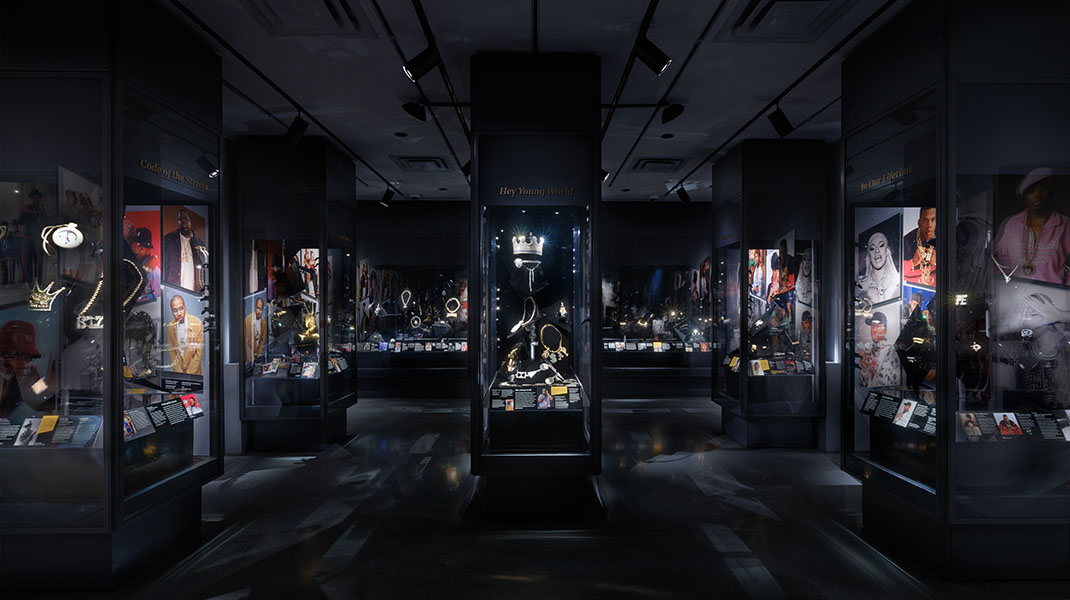
Ice Cold: An Exhibition of Hip-Hop Jewelry at American Museum of Natural History, May 9, 2024 – January 5, 2025

“On May 9, the American Museum of Natural History opened Ice Cold: An Exhibition of Hip-Hop Jewelry, a special exhibition that celebrates hip-hop’s cultural influence through spectacular custom-made jewelry from its biggest stars, including Slick Rick, A$AP Rocky, Nicki Minaj, The Notorious B.I.G., Bad Bunny, Erykah Badu, and many more. Highlighting works of jewelry as enduring statements of individuality, empowerment, and resilience in the hip-hop community with an influence on the worlds of fashion, style, and culture at large, Ice Cold builds on New York City’s celebration of the 50th anniversary of hip-hop as a global phenomenon.

Ice Cold chronicles the evolution of jewelry in hip-hop over the past five decades, starting with the oversized gold chains that were embraced by rap’s pioneers in the late-1970s and moving through the 1990s, when hip-hop’s popularity exploded and artists sported record-label pendants sparkling with diamonds and platinum. With hip-hop’s exponential growth in the new millennium, the genre’s most influential artists turned to multi-colored jewelry with inventive designs that reference high fashion, pop culture, rap history, and more. Ice Cold showcases jewelry from all eras of hip-hop and demonstrates how the decorative art-form has served as a canvas for stories of resilience, rebellion, and creative self-expression.” — American Museum of Natural History

Ice Cold: An Exhibition of Hip-Hop Jewelry at the American Museum of Natural History. Photo: Alvaro Keding/© AMNH

“Throughout the Museum, you’ll see objects that open a window onto our shared past or our current world, whether that’s nature, science, or culture. In Ice Cold, the objects are magnificent jewelry pieces and the window opens into one of the most powerful social and cultural forces of the past 50 years, Hip Hop,” said Sean M. Decatur, President of the American Museum of Natural History. “We’re pleased to showcase these iconic pieces and the cultural phenomenon of Hip Hop, thereby reminding our visitors that culture is not just long ago or far away, but a part of all of our lives that we can reflect on and celebrate.”

“Bringing the Ice Cold exhibit to the American Museum of Natural History is a testament to the cultural significance of this art form and culture,” said Ice Cold guest curator Vikki Tobak. “It’s time to celebrate the artists, jewelers, craftsmen, and everyday people who contributed to the storied history of hip-hop jewelry. This exhibit not only pays homage to hip-hop’s roots with pieces from Biz Markie and Jam Master Jay for example but also highlights its enduring impact on style and society with pieces from contemporary artists like Tyler, the Creator, A$AP Rocky, and FERG.”

The exhibition is curated by guest curator Vikki Tobak, journalist and author of Ice Cold: A Hip-Hop Jewelry History, published by Taschen, and guest co-curators Kevin “Coach K” Lee, founder and COO of Quality Control Music, and Karam Gill, creative director and filmmaker behind the 2021 documentary series ICE COLD.

Images courtesy the American Museum of Natural History.
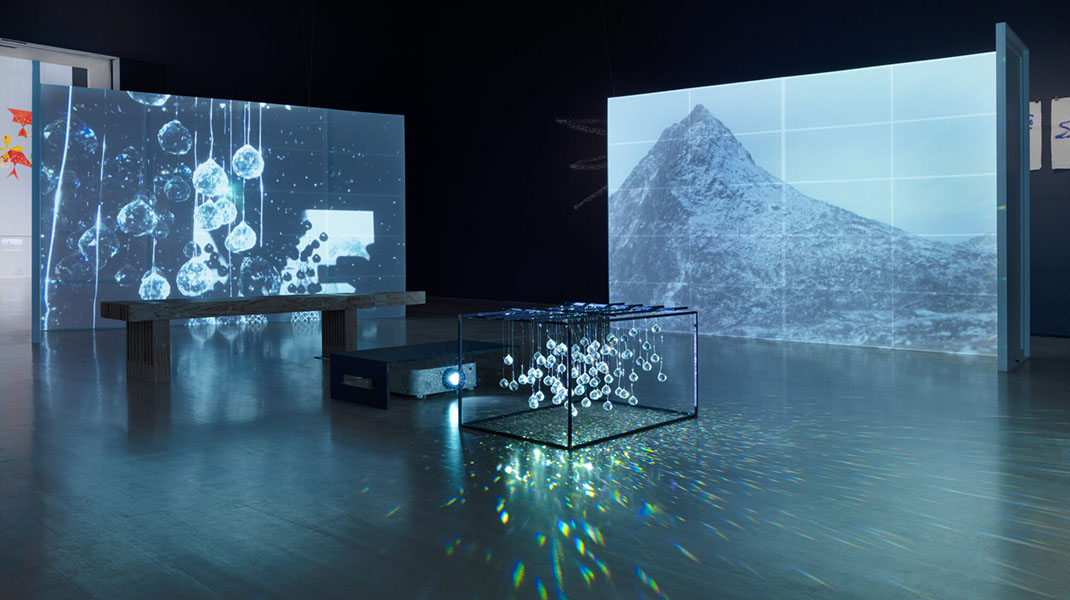
Joan Jonas: Good Night Good Morning at The Museum of Modern Art, through July 6, 2024

The Museum of Modern Art presents Joan Jonas: Good Night Good Morning, the artist’s most comprehensive retrospective in the United States, spanning more than 50 years of her remarkable career. On view from March 17 through July 6, 2024, in the Steven and Alexandra Cohen Center for Special Exhibitions, the exhibition features a selection of works produced from 1968 through the present, including videos, drawings, photographs, and major installations and performances—many of which have been revisited and reconfigured by the artist on the occasion of this exhibition. Joan Jonas: Good Night Good Morning also presents extensive corresponding archival materials.

“It’s been exciting to reconsider old and newer works as they relate in a new context. I am very happy to have the work on exhibition in New York, where I have lived most of my life,” said Jonas, who is working closely with the curatorial team.

Installation views of Joan Jonas: Good Night Good Morning, The Museum of Modern Art, New York, March 17–July 6, 2024. Photos: Jonathan Dorado.

“This highly anticipated exhibition will give an overview of Jonas’s unique role as a trailblazing figure of video and performance and her enduring multimedia legacy for generations of younger artists. It will trace the development of Jonas’s career, from works made in the 1960s and 1970s exploring the confluence of technology and ritual to more recent ones dealing with ecology and the landscape,” said Janevski. “The exhibition also advances the Museum’s commitment to representing the work of key women artists whose practices have been deeply influential in the history of performance, media, and feminist art practices.”

Joan Jonas: Good Night Good Morning is organized by Ana Janevski, Curator, with Lilia Rocio Taboada and Gee Wesley, Curatorial Assistants, Department of Media and Performance. With thanks to Mitchell Herrmann, Mellon-Marron Research Consortium Fellow, and Molly Superfine, Brandon Eng, and Piper Marshall, former Mellon-Marron Research Consortium Fellows, Department of Media and Performance.

Images courtesy The Museum of Modern Art.

The Roof Garden Commission: Petrit Halilaj, Abetare at The Met 5th Avenue, through October 27, 2024

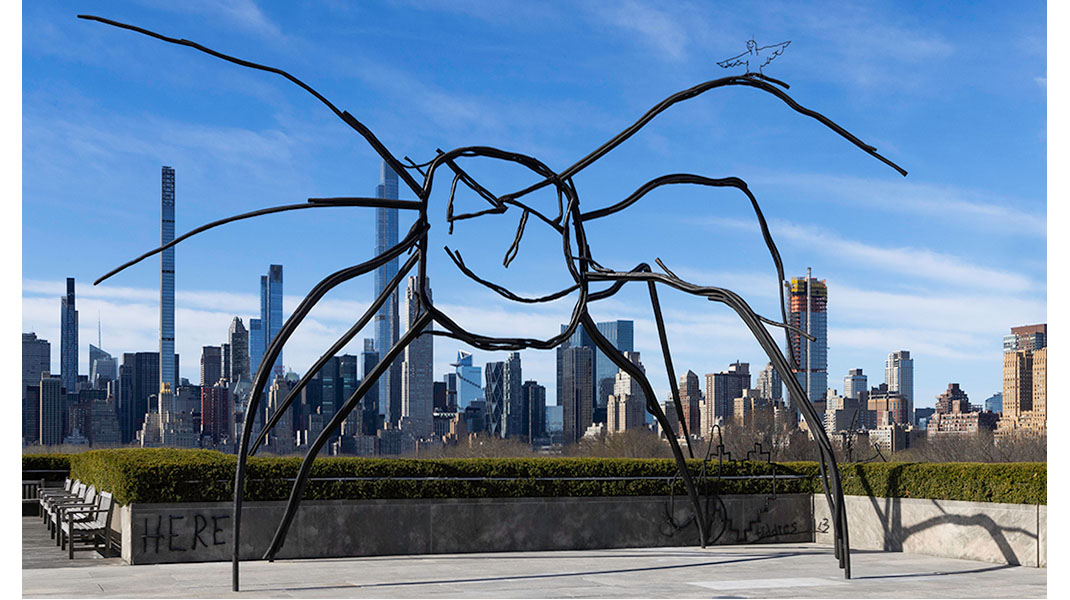
“The Met’s highly anticipated 2024 Roof Garden Commission, by Kosovar artist Petrit Halilaj (born 1986, Kostërc, former Yugoslavia), is now on view through October 27, 2024. For his first major outdoor installation, Halilaj has transformed the Museum’s Iris and B. Gerald Cantor Roof Garden with a sprawling work that explores the intersection of reality and fantasy through the rich world of children’s drawings. The installation’s metal sculptures are inspired by children’s doodles, drawings, and scribblings found on desks at the school he attended in Runik, Kosovo, as well as schools in Albania and countries from the former Yugoslavia, which are now undergoing significant cultural and sociopolitical change. The Roof Garden Commission: Petrit Halilaj, Abetare is the 11th in the series of site-specific commissions for the outdoor space.” — The Metropolitan Museum of Art

“The casual scribbles of schoolchildren done on their desks in moments of boredom or distraction reveal the fantasies and dreams of their minds,” said Halilaj. “I started to explore this in my practice in 2015, and it was important for me then to extend the dreams of my school in Kosovo to Europe, a part of the world from which my country was still isolated. Now, in 2024, numerous desks and scribbles from schools across the Balkans are showcased in a new context and on a new continent. My work here at The Met is dedicated to all the children whose lives have been interrupted and deeply scarred by wars around the globe. I hope their dreams will fly us to a better future.”

Petrit Halilaj (born Kosovo, 1986). Installation views of The Roof Garden Commission: Petrit Halilaj, Abetare, 2024. Courtesy of the artist; Chert Lüdde, Berlin; kurimanzutto, Mexico City / New York; Mennour, Paris. Image credit: The Metropolitan Museum of Art, Photos by Hyla Skopitz. 

 “The Met is thrilled to unveil Petrit Halilaj’s intervention for the Iris and B. Gerald Cantor Roof Garden and share the deeply meaningful conversation it invites between the artist’s work, the Museum, the Manhattan skyline, and beyond,” said Max Hollein, The Met’s Marina Kellen French Director and Chief Executive Officer. “Petrit Halilaj’s inspiring and multilayered work—which is both deeply rooted in the artist’s history and homeland and forward thinking and international in scope—powerfully reframes the complex role of the childhood imagination in history’s retelling of events.”

The Roof Garden Commission: Petrit Halilaj, Abetare is conceived by the artist in consultation with Iria Candela, The Met’s Estrellita B. Brodsky Curator of Latin American Art in the Department of Modern and Contemporary Art.

Images courtesy The Metropolitan Museum of Art.  

Cocteau: The Juggler’s Revenge at Peggy Guggenheim Collection, April 13 – September 16, 2024

The Peggy Guggenheim Collection presents Jean Cocteau: The Juggler’s Revenge, the largest retrospective ever organized in Italy dedicated to Jean Cocteau (1889–1963), the enfant terrible of the French twentieth-century art scene. 

“Organized by eminent Cocteau specialist and New York University art historian Kenneth E. Silver, the exhibition highlights the artist’s versatility, the multiple juggling acts that distinguished his production, which often drew criticism from his contemporaries. Loans from prestigious institutions, such as the Centre Georges Pompidou in Paris, the Phoenix Art Museum, the Nouveau Musée National de Monaco, and the Musée Jean Cocteau, Collection Séverin Wunderman in Menton, as well as major private collections, including the Cartier Collection, gather over one hundred and fifty works in an impressive variety of media. These include drawings, graphics, jewelry, tapestries, historical documents, books, magazines, photographs, documentaries, and films directed by Cocteau, which trace the development of this multifaced artist’s unique and highly personal aesthetics, alongside the highlights of his tumultuous career.” —  Peggy Guggenheim Collection 

Jean Cocteau. Untitled, 1930. Ink on paper, 29,6 x 20,9 cm.
Centre Pompidou, Paris. Musée national d’art moderne / Centre de création industrielle, Gift, 2018 © Adagp/Comité Cocteau, Paris, by SIAE 2024
Jean Cocteau. Oedipus, or, the Crossing of Three Roads (Œdipe ou le carrefour des trois routes), 1951. Oil on canvas, 97 x 129 cm . Private Collection © Adagp/Comité Cocteau, Paris, by SIAE 2024.
Jean Cocteau. Illustrated Letter, Portrait of Peggy Guggenheim s.d. (1956 c.). Ink on paper, 22,5 x 15,5 cm. Private collection © Adagp/Comité Cocteau, Paris, by SIAE 2024.
Jean Cocteau. Untitled, Drawing in Peggy Guggenheim’s third guest book, 1956. Ink on paper, 22,9 x 15,6 cm. Private collection © Adagp/Comité Cocteau, Paris, by SIAE 2024.
Jean Cocteau. Orpheus’s Mirror (Miroir d’Orphée), 1960/1989. Gilded bronze, silver, and copper,
32 x 20 x 9 cm. Edition Artcurial 1/20. Collection Kontaxopoulos Prokopchuk, Brussels.
Photo ©yankont@pt.lu © Adagp/Comité Cocteau, Paris, by SIAE 2024.
Jean Cocteau. Poetry (La Poésie), 1960. Felt-tip pen and pastel on paper, 54 x 37 cm. Collection Kontaxopoulos Prokopchuk, Brussels. Photo ©yankont@pt.lu © Adagp/Comité Cocteau, Paris, by SIAE 2024.
Jean Cocteau . Mask for the Play Antigone (Masque pour la pièce Antigone), 1923. Wire mesh, pipe cleaner, and beads,
23 x 22 x 12 cm. Bibliothèque National de France, Paris, Fonds Charles Dullin (1885–1949) © Adagp/Comité Cocteau, Paris, by SIAE 2024.
Jean Cocteau. The Great God Pan (Did I Love a Dream?) (Le Grand dieu Pan [Aimai-je un rêve?]), 1958. Pastel, ink, and gouache on wove paper, 149,8 x 91 cm.
Collection Nouveau Musée National de Monaco
© Adagp/Comité Cocteau, Paris, by SIAE 2024.

Jean Cocteau: The Juggler’s Revenge provides an ideal opportunity to revisit the art of Cocteau, and to see him with a fresh 21st-century point of view. His astonishing artistic range–for which, in his lifetime, he was often criticized for spreading himself too thin—now looks prescient, a model for the kind of wide-ranging cultural fluidity we now expect of contemporary artists. All this, in addition to his more-or-less forthright homosexuality, as well as his very public struggles with drug addiction, make him look especially modern. Perhaps the world has finally caught up with Jean Cocteau.”, says the curator Silver.

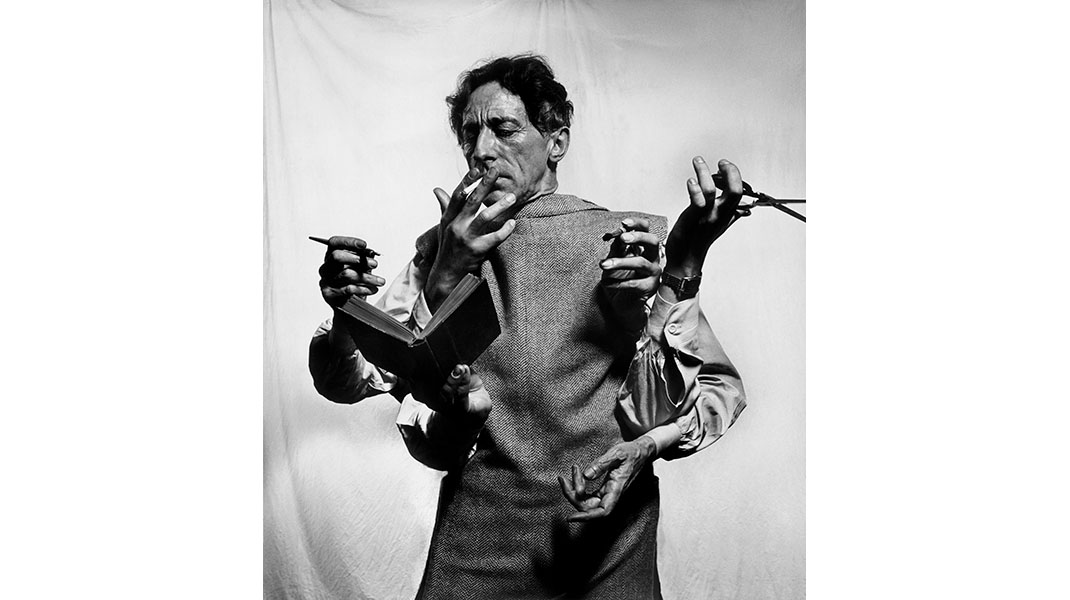
Title image: Philippe Halsman. Jean Cocteau, New York, USA. 1949 © Philippe Halsman / Magnum Photos.

Images courtesy Peggy Guggenheim Collection.

The Rubin Museum of Art presents Reimagine: Himalayan Art Now, March 15–October 6, 2024

“The Rubin Museum of Art presents ‘Reimagine: Himalayan Art Now,’ a Museum-wide group show of 32 contemporary artists from the Himalayas, Asia, and diaspora whose work is presented in dialogue with objects from the Rubin Museum’s collection. A highlight of the Rubin’s 20th-anniversary year, and ahead of its transition to a global museum model in October, the exhibition features 23 new commissions as well as recent work across mediums — including painting, sculpture, sound, video, installation, and performance — that reimagine the forms, symbols, and narratives found within the living cultural heritage of Tibet, Nepal, Bhutan, and other Himalayan regions. The artists, many of whom are exhibiting in the United States for the first time, explore the continuum of the cultures that shape their identities, merging past with present into one space, and posing questions about the potential for transformation today. The exhibition is presented throughout the entire Museum and represents the Rubin’s largest engagement thus far with contemporary artists. As the final exhibition to take place at the Rubin’s 17th Street location, ‘Reimagine: Himalayan Art Now’ provides a platform for artists working in dialogue with traditional Himalayan art, which will continue to be a focus of the museum’s global future.” — The Rubin Museum of Art

Installation view of “Reimagine: Himalayan Art Now” at Rubin Museum of Art. Photo by David de Armas.

“Reimagine: Himalayan Art Now” is curated by Michelle Bennett Simorella, Director of Curatorial Administration & Collections at the Rubin Museum of Art; Tsewang Lhamo, artist and founder of Yakpo Collective (New York); and Roshan Mishra, Director of the Taragaon Next (Kathmandu, Nepal).

Title image: Shushank Shrestha; Two Guardian Lion Dogs; 2023; ceramic, in glaze lustre; 52 × 27 × 44 in.; photo courtesy of Shuhank Shrestha, Massachusetts, USA.

Images courtesy The Rubin Museum of Art.

Fog Swept Cargo — Art from the Faroe Islands at Scandinavia House, April 13 – July 6, 2024

“An exhibition bringing the striking diversity of the Faroe Islands’ contemporary art scene to the U.S. for the fi rst time, Fog Swept Cargo — Art from the Faroe Islands opens at Scandinavia House on April 13, featuring seven versatile visual artists whose works range widely in terms of expression, media, and technique: Hansina Iversen, Rannvá Kunoy, Tóroddur Poulsen, Hanni Bjartalíd, Randi Samsonsen, Alda Mohr Eyõunardóttir and Jóhan Martin Christiansen. Presented in conjunction with Fog Swept Islands: Faroe Islands Culture Days, a showcase held at Scandinavia House during the month of April, and curated by Kinna Poulsen, the works in the exhibition range from abstract painting and sculpture to fi gurative graphic art, textile works, and installations, and will also highlight the pioneering work of lithography studio Steinprent, whose atelier in the capital of Tórshavn attracts artists across the world for collaboration.” Scandinavia House

Hansina Iversen. Purple Rain, 2023. Oil on canvas. 170 x 160 x 2 cm
Alda Mohr Eyõunardóttir. to change what was intended..., 2020. Stone, linen, silk, wool, steel wire and nylon wire. 250 x 250 x 300 cm
Randi Samsonsen. DROP DEAD GORGEOUS BALLS, 2021. Textile. 1.5 (h) x 2 (p) m; ca. 4 kg
Jóhan Martin Christiansen. Don’t tell me cause it hurts, 2023. Sculpture steel, plastic, wheels, fluorescent tube, wires, Coca Cola Zero bottle, red rose
Rannvá Kunoy. :)(3//, 2023 Acrylic, pigments, and dispersion on linen 210 x 140 cm
Tóroddur Poulsen. Wavelengths, 2023. Lithograph. 90 x 80 cm
Hanni Bjartalíd. Untitled, 2023. Drawing on paper. 76 x 56 cm

Title image: Installation view of Fog Swept Cargo — Art from the Faroe Islands at Scandinavia House. Photo by Lori Fredrickson.

Images courtesy Scandinavia House.

Walton Ford: Birds and Beasts of the Studio at The Morgan Library & Museum, April 12 – October 20, 2024

“The Morgan Library & Museum is pleased to present Walton Ford: Birds and Beasts of the Studio. Opening April 12 and on view through October 20, 2024, the exhibition celebrates the 2019 gift from artist Walton Ford (b. 1960) to the Morgan of sixty-three studies and sketches, shown publicly for the first time. Ford is fascinated by the perception of wild animals in the human imagination, and his monumental watercolors subvert historical conventions of animal painting. This exhibition examines the artist’s working process, illuminating the role that historical, literary, cultural, and scientific research plays in his practice. Presented together with drawings of animals and birds selected by the artist from the Morgan’s holdings, this exhibition sheds new light on the museum’s collection from the perspective of a living artist.” — The Morgan Library & Museum

Colin B. Bailey, Director of the Morgan Library & Museum, said, “It is a great pleasure to present this exhibition in collaboration with Walton Ford, celebrating the generous gift of his outstanding studies and sketches to the Morgan. Shown alongside exceptional works selected by the artist from our collection, in addition to being introduced to Walton’s working practice, visitors will also have the opportunity to encounter historic works through the perspective of a living artist.” 

Walton Ford (b. 1960), Study for “Verfolgen,” 2018. Watercolor, gouache, and ink over graphite. The Morgan Library & Museum, gift of the artist, 2019.213. © 2024 Walton Ford. Photography by Janny Chiu.
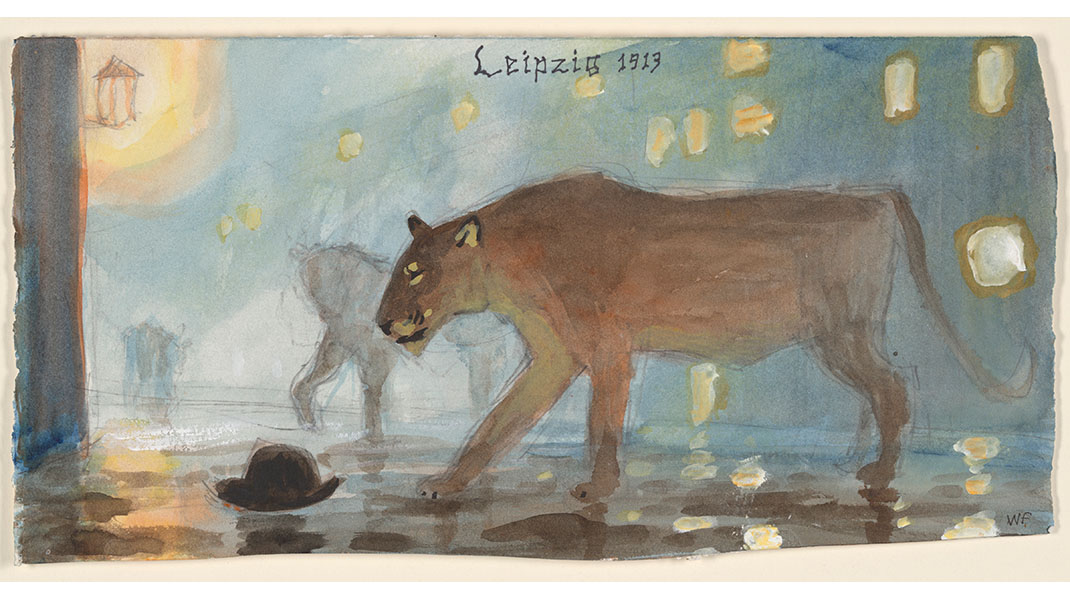
Walton Ford (b. 1960). Study 2 for “Leipzig,” 2018. Watercolor, gouache, and ink over graphite. The Morgan Library & Museum, gift of the artist, 2019.230. © 2024 Walton Ford. Photography by Janny Chiu.
Walton Ford (b. 1960). Ars Gratia Artis, 2017. Watercolor, gouache, and ink. Private Collection. © 2024 Walton Ford. Photography by Christopher Burke.
Walton Ford (b. 1960). Study for “Die Ziege,” 2016. Watercolor, gouache, and ink over graphite
The Morgan Library & Museum, gift of the artist, 2019.208. © 2024 Walton Ford. Photography by Janny Chiu.
Walton Ford (b. 1960). Study for “Flucht,” 2018. Watercolor, gouache, and ink over graphite. The Morgan Library & Museum, gift of the artist, 2019.211. © 2024 Walton Ford. Photography by Janny Chiu.
Walton Ford (b. 1960). Study for “Zürichsee,” 2015. Watercolor, gouache, and ink over graphite.
The Morgan Library & Museum, gift of the artist, 2019.219. © 2024 Walton Ford. Photography by Janny Chiu.
Walton Ford (b. 1960). Study for “La dernière image” (The last picture), 2018. Watercolor and ink over graphite. The Morgan Library & Museum, gift of the artist, 2019.226. © 2024 Walton Ford. Photography by Janny Chiu.
Walton Ford (b. 1960). Study for “Siegesdenkmal,” 2019. Watercolor, gouache, and ink over graphite.
The Morgan Library & Museum, gift of the artist, 2019.239. © 2024 Walton Ford. Photography by Janny Chiu.

This exhibition is organized by Isabelle Dervaux, former Acquavella Curator and Department Head of Modern and Contemporary Drawings, and Jennifer Tonkovich, Eugene and Clare Thaw Curator of Drawings and Prints.

Images courtesy The Morgan Library & Museum.

Nari Ward: Ground Break at Pirelli HangarBicocca, March 28 – July 28, 2024

“Pirelli HangarBicocca presents ‘Ground Break,’ an exhibition dedicated to one of America’s foremost contemporary artists, Nari Ward. Since the 1990s, Ward has produced installation comprising everyday objects and re-purposed highly symbolic materials to make layered references to social issues and historical traumas—past, recent and contemporary. 

In ‘Ground Break,’ the artist stages a monumental choreography of works from the past 30 years alongside new productions, creating a highly engaging dialogue between sculpture, video, and installation. The exhibition, which is accompanied by a program of live performances in collaboration with other artists and musicians, invites reflection on some of the central issues of our time, such as social responsibility, inequality, exclusion, and migration, and offers possible visions of transformation and change.” — Pirelli HangarBicocca

Nari Ward “Ground Break”, exhibition views at Pirelli HangarBicocca, Milan, 2024. Photos Courtesy the artist and Pirelli HangarBicocca, Milan. Photos Agostino Osio. All works © Nari Ward Studio. Courtesy the artist and Lehmann Maupin, New York, Seoul, and London, and GALLERIA CONTINUA. 

Exhibition curated by cura di Roberta Tenconi con Lucia Aspesi.

Title image: Nari Ward. Carpet Angel, 1992. Installation view at Pirelli HangarBicocca, Milan, 2024. The Museum of Contemporary Art, Los Angeles Gift of Jennifer McSweeney, in memory of Joan “Penny” McCall. Photo Courtesy the artist and Pirelli HangarBicocca, Milan. Photo Agostino Osio.

At The Met 5th Avenue, Hidden Faces: Covered Portraits of the Renaissance, April 2 – July 7, 2024

“Opening April 2, at The Metropolitan Museum of Art, Hidden Faces: Covered Portraits of the Renaissance is the first exhibition to examine an intriguing but largely unknown tradition of Renaissance painting: portraits designed as multisided objects in which the sitters’ images were concealed behind a hinged or sliding cover, within a box, or by a dual-faced format. Private portraits were often hidden beneath other paintings that served as witty prologues and protective covers. The reverses and covers of these portraits were adorned with puzzle-like emblems, inscriptions, allegories, and mythologies that reflected the sitters’ characters as well as broader cultural values. The viewer decoded the meaning of the symbolic portrait before lifting, sliding, or turning the image over to unmask the face below.” — The Metropolitan Museum of Art

“This extraordinary, surprising, and revealing exhibition beautifully illuminates a fascinating and little-known tradition of Renaissance painting, tracing the development of these stunning multi-sided masterworks and uncovering the many intriguing stories they tell,” said Max Hollein, The Met’s Marina Kellen French Director and CEO. “Hidden Faces offers a rare opportunity to understand and appreciate the perpetual allure of these mysterious works and celebrate the creativity and inventiveness of the genre.” 

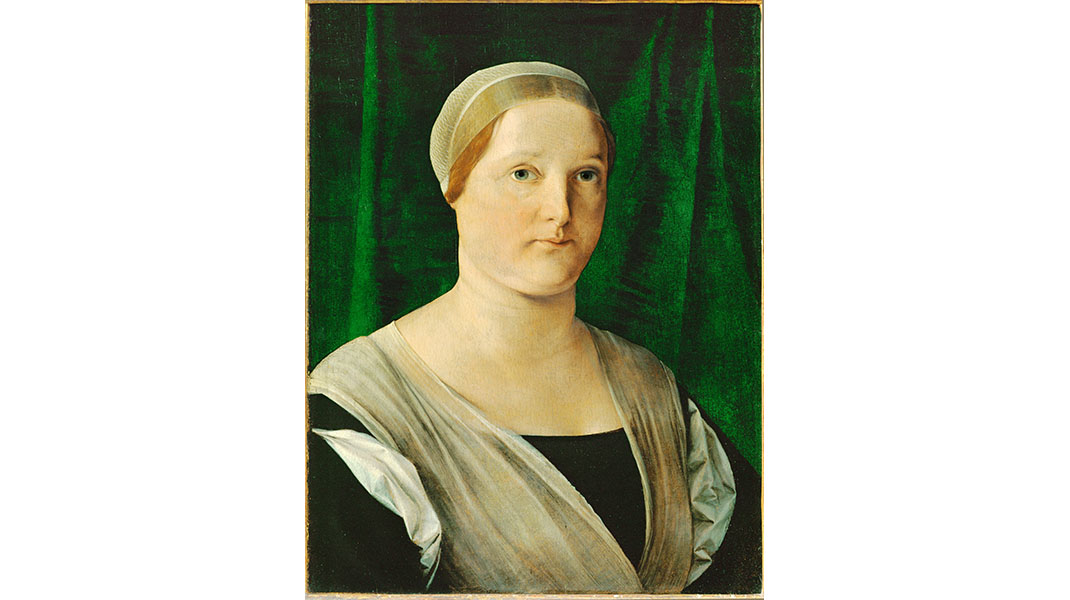
1A. Lorenzo Lotto (Italian, ca. 1480–1556). Portrait of Giovanna de’ Rossi, ca. 1505. Oil on wood. 14 3/16 × 11 in. (36 × 28 cm). Musee des Beaux Arts, Dijon. Photo: Erich Lessing / Art Resource, NY
1B. Lorenzo Lotto (Italian, ca. 1480–1556). Portrait Cover with an Allegory of Chastity, ca. 1505. Oil on panel. 16 7/8 × 13 1/4 in. (42.9 × 33.7 cm). Frame: 21 3/4 × 18 1/4 × 2 1/4 in. (55.3 × 46.4 × 5.7 cm).
National Gallery of Art, Washington, D.C., Samuel H. Kress Collection, 1939.1.147. Photo: Courtesy National Gallery of Art, Washington
(Recto) 3A. Marco Marziale (Italian, Venetian, active 1492/3–1507).
Portrait of Giulio Mellini. Oil on wood. 14 3/16 × 9 13/16 in. (36 × 25 cm). Musée du Louvre, Paris, Département des Peintures, RF 1345. Photo: © RMN-Grand Palais / Art Resource, NY, photo by Daniel Arnaudet
(Verso) 3B. Marco Marziale (Italian, Venetian, active 1492/3–1507).
Allegorical Landscape, 1492–1507. Oil on wood. 14 3/16 × 9 13/16 in. (36 × 25 cm). Musée du Louvre, Paris, Département des Peintures, RF 1345. Photo: © RMN-Grand Palais / Art Resource, NY, photo by Daniel Arnaudet
(Recto) 5A. Hans Memling (Netherlandish, active by 1465–died 1494)
Portrait of a Man. Oil on panel. 11 1/2 × 8 7/8 in. (29.2 × 22.5 cm). Museo Nacional Thyssen-Bornemisza, Madrid, Inv. nos. 284.a (1938.1.a); 284.b. Photo: © Museo Nacional Thyssen-Bornemisza. Madrid
(Recto) 5B. Hans Memling (Netherlandish, active by 1465–died 1494.
Still Life with a Jug of Flowers. Oil on panel. 11 1/2 × 8 7/8 in. (29.2 × 22.5 cm). Museo Nacional Thyssen-Bornemisza, Madrid, Inv. nos. 284.a (1938.1.a); 284.b. Photo: © Museo Nacional Thyssen Bornemisza. Madrid
(Recto) 6A. Bernhard Strigel (German, 1460–1528). Portrait of Margarethe Vöhlin, 1527. Oil on panel. 16 15/16 × 11 13/16 in. (43 × 30 cm). Frame: 19 11/16 × 14 13/16 × 2 in. (50 × 37.6 × 5.1 cm).
National Gallery of Art, Washington, D.C., Ralph and Mary Booth
Collection, 1947.6.5.a,b. Photo: Courtesy National Gallery of Art, Washington
(Verso) 6B. Bernhard Strigel (German, 1460–1528).
Coat of Arms, 1527. Oil on panel. 16 15/16 × 11 13/16 in. (43 × 30 cm). Frame: 19 11/16 × 14 13/16 × 2 in. (50 × 37.6 × 5.1 cm).
National Gallery of Art, Washington, D.C., Ralph and Mary Booth. Collection, 1947.6.5.a,b. Photo: Courtesy National Gallery of Art, Washington

Alison Manges Nogueira, Curator, Robert Lehman Collection at The Met said, “Rather than being affixed to the wall and permanently visible, these three-dimensional objects, which were often stored away and unveiled for special viewings, were designed to restrict access to the sitters’ images. In fact, the viewer was first confronted by emblems and allegories evoking their inner character. The exhibition explores the symbiotic relationship between these physical and symbolic portraits that were bound in form and meaning, like the dual sides of the coins and medals which inspired them.”

Hidden Faces: Covered Portraits of the Renaissance is curated by Alison Manges Nogueira, Curator, Robert Lehman Collection at The Met.

Images courtesy The Metropolitan Museum of Art. 

Jim Dine: Hiroshima at Jewish Museum, March 29 – May 27, 2024 

“Jim Dine’s (b. 1935) Hiroshima series (1982-83), recently acquired by the Museum for its collection, highlights the artist’s politically charged work and his endeavors to support anti-nuclear protests. The 11 works evoke the annihilation and despair unleashed by the atomic bombs the United States dropped in 1945 on Hiroshima and Nagasaki, Japan, at the end of World War II. Dine’s art is an intensely personal exploration of autobiography, often reflected upon through reoccurring, idiosyncratic motifs such as tools, hearts, robes (often considered self-portraits), trees, and a handful of other quotidian objects. The title, Hiroshima, transforms Dine’s familiar symbols into metaphors for the tragedy of weapons of mass destruction. Jim Dine: Hiroshima is the second in a series of installations that refer to the violence of war and its inevitable toll on innocents.” — Jewish Museum

Jim Dine, Hiroshima, 1982-83. Enamel, charcoal and pastel over
lithograph on paper. The Jewish Museum, NY. Gift of the Jim Dine Trust in memory of Alan Solomon. © Jim Dine / Artists Rights Society (ARS), New York.
Jim Dine, Hiroshima, 1982-83. Enamel, charcoal and pastel over
lithograph on paper. The Jewish Museum, NY. Gift of the Jim Dine Trust in memory of Alan Solomon. © Jim Dine / Artists Rights Society (ARS), New York.
Jim Dine, Hiroshima, 1982-83. Enamel, charcoal and pastel over
lithograph on paper. The Jewish Museum, NY. Gift of the Jim Dine Trust in memory of Alan Solomon. © Jim Dine / Artists Rights Society (ARS), New York.
Jim Dine, Hiroshima, 1982-83. Enamel, charcoal and pastel over
lithograph on paper. The Jewish Museum, NY. Gift of the Jim Dine Trust in memory of Alan Solomon. © Jim Dine / Artists Rights Society (ARS), New York.
Jim Dine, Hiroshima, 1982-83. Enamel, charcoal and pastel over
lithograph on paper. The Jewish Museum, NY. Gift of the Jim Dine Trust in memory of Alan Solomon. © Jim Dine / Artists Rights Society (ARS), New York.

Images courtesy Jewish Museum.

Whitney Biennial 2024: Even Better Than the Real Thing at Whitney Museum of American Art, March 20 – August 11, 2024

Whitney Biennial 2024: Even Better Than the Real Thing features the work of 71 artists and collectives, working across media and disciplines, representing evolving notions of American art. The 2024 Biennial marks the 81st edition of the Museum’s landmark exhibition series, the longest-running survey of American art, and addresses many of the most relevant ideas of our time.

Organized thematically, the exhibition presents artwork across most of the Museum’s gallery spaces and through a robust series of film and performance programs available at the Museum and online. The 2024 Biennial focuses on notions of ‘the real.’ This examination of reality is highlighted through various throughlines and connections between artists, material, and ideas and acknowledges that today, society is at a critical inflection point. This apex has been brought on by the introduction of machine learning models to daily life and media, including the use of artificial intelligence, and society’s complex relationship to the body, the fluidity of identity, and the precariousness of the natural world.” — Whitney Museum of American Art

Installation views of Whitney Biennial 2024: Even Better than the Real Thing at Whitney Museum of American Art, New York, March 20–August 11, 2024. Photos by Corrado Serra.

Ser Serpas. taken through back entrances subtle fate matching matte thing soiled …, 2024
Jes Fan. Left and Right: Cross Section (Right Leg Muscle II), 2023. Center: Contrapposto, 2023
Isaac Julien. Once Again… (Statues Never Die), 2022
Left: Eamon Ore-Giron. Talking Shit with Amaru (Wari), 2023. Center & Right: Dala Nasser. Adonis River, 2023
Rose B. Simpson. Daughters: Reverence (Daughter 1), (Daughter 2), (Daughter 3) and (Daughter 4), 2023
Left: Mavis Pusey. Dejygea, 1970. Right: Charisse Pearlina Weston. un- (anterior ellipse[s] as mangled container; or where edges meet to wedge and [un]moor), 2024
Back: Takako Yamaguchi. Issue, 2023. Front: Karyn Olivier. How Many Ways Can You Disappear, 2021
Kiyan Williams. Ruins of Empire II or The Earth Swallows the Master’s House, 2024
Nikita Gale. TEMPO RUBATO (STOLEN TIME), 2023–24
ektor garcia. Left to Right: portal DF/NOLA, 2021, Teotihuacan, 2018, glass chain, 2022-24, cuprum, 2024
Suzanne Jackson. Left: deepest ocean, what we do not know, we might see?, 2021. Right: Palimpsest Grit, 2022-23
Back: Mary Kelly. Lacunae, 2023. Front: Carolyn Lazard. Toilette, 2024

Title image: Tourmaline. Pollinator, 2022. Video, black-and-white and color; 5:08 min. Courtesy the artist and Chapter NY. Photograph by Corrado Serra.

The 2024 Whitney Biennial is organized by Chrissie Iles, Anne and Joel Ehrenkranz Curator and Meg Onli, Curator at Large, with Min Sun Jeon and Beatriz Cifuentes.

Mario Schifano: Germinal at Magazzino Italian Art, March 23 – August 9, 2024

“Magazzino Italian Art is proud to announce the presentation of a newly imagined survey of a decade of breakthrough paintings by the restlessly inventive artist, filmmaker, photographer, and musician Mario Schifano (1934–1998). Organized by Filippo Fossati, Director of Magazzino, in collaboration with the Archivio Mario Schifano and the Archivio Maurizio Calvesi in Rome and titled Germinal, the artist’s own term for paintings of major, generative effect, the exhibition will be on view in Magazzino’s Robert Olnick Pavilion from March 23 through August 9, 2024.”—  Magazzino Italian Art

According to Filippo Fossati, “This exhibition features germinal works from 1960 to 1970, a time of great social, economic, political, and artistic turmoil, in which Schifano was an eager participant. In these years, with his abundant charisma and exuberance, he became one of the most popular artists in Italy and a renowned figure abroad, creating art that he envisioned as being for everyone, and not just for an elite.”

Mario Schifano. Segnaletica, 1961. Enamel and graphite on paper mounted on canvas, 36 x 50 in. (91.5 x 127 cm). Private Collection. Photo by Arte Fotografica – Roma © Fondazione Maurizio Calvesi by SIAE 2024. Courtesy Magazzino Italian Art.
Mario Schifano, En plein air after New York, 1964. Enamel, spray, graphite, and pastel on paper mounted on canvas, 49 2/3 x 88 32/3 in. (126 x 225 cm). Annalisa Zambon Collection, courtesy Galleria dello Scudo, Verona. Photo by Studio Vandrasch, Milan © Fondazione Maurizio Calvesi by SIAE 2024. Courtesy Magazzino Italian Art.
Mario Schifano. En plein air… I love Federico Fellini more than grass, 1964. Mixed media on cardboard, 28 7/8 x 22 7/8 in. (73.4 x 58 cm). Olnick Spanu Collection, New York. Photo by Marco Anelli and Tommaso Sacconi © Fondazione Maurizio Calvesi by SIAE 2024. Courtesy Magazzino Italian Art.
Mario Schifano. Grande oggetto paesaggio, 1965. Enamel, spray, and graphite on canvas,
78 3/4 x 118 1/2 in. (200 x 301 cm). Private Collection. Photo by Marco Anelli © Fondazione Maurizio Calvesi by SIAE 2024. Courtesy Magazzino Italian Art.
Mario Schifano. Lei era certa che rappresentavano il sesso, 1965. Enamel and graphite on canvas, 63 1/8 x 39 3/8 in. (160 x 100 cm). Olnick Spanu Collection, New York. Photo by Marco Anelli and Tommaso Sacconi © Fondazione Maurizio Calvesi by SIAE 2024. Courtesy Magazzino Italian Art.
Mario Schifano. Futurismo rivisitato a colori, 1965. Enamel on canvas and Perspex, 68 7/8 x 118 1/8 in. (175 x 300 cm) (3 panels). Private Collection. Photo by Marco Anelli © Fondazione Maurizio Calvesi by SIAE 2024. Courtesy Magazzino Italian Art.
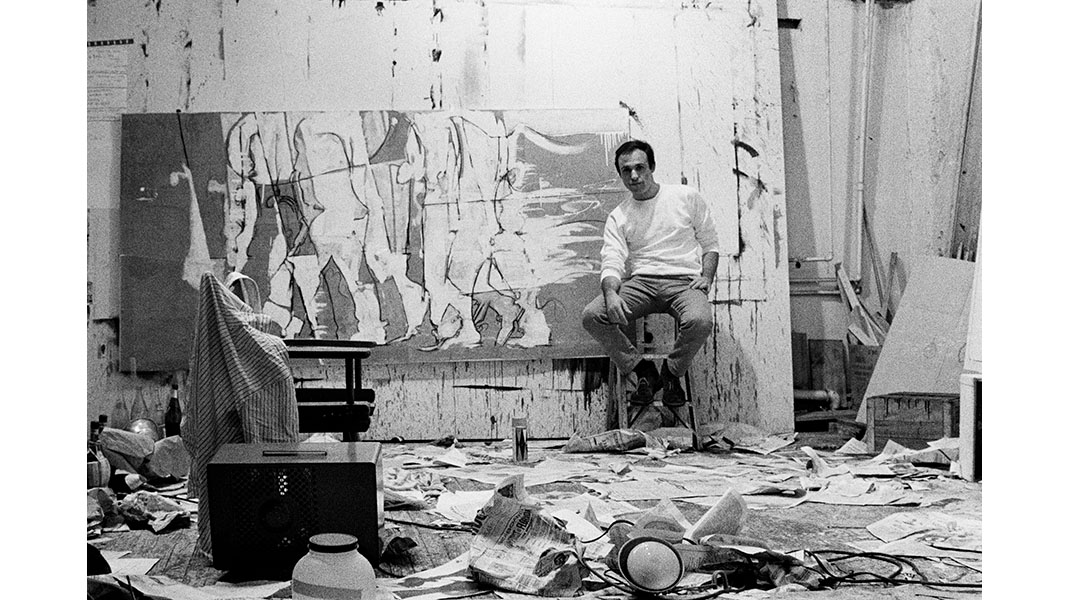
Mario Schifano in his studio in New York, 1964. ©Archivio Mario Schifano by SIAE 2024. Courtesy Magazzino Italian Art.

Germinal is dedicated to the memory of art critic and historian Maurizio Calvesi (1927–2020) and his wife, the writer, editor, and museum director Augusta Monferini (1934–2022), who were the first to propose an exhibition in the U.S. focused on the work of Schifano. Magazzino first took up this project in the exhibition Mario Schifano: The Rise of the ‘60s, curated by Alberto Salvadori, which was shown from September 14, 2023 through January 8, 2024. Using many of the same 80 works, Germinal presents a thoroughly new and different view of Schifano’s achievement, seen from the perspective of Filippo Fossati’s forty-year career in bridging Italian and international contemporary art.” —  Magazzino Italian Art