“Whitney Biennial 2024: Even Better Than the Real Thing features the work of 71 artists and collectives, working across media and disciplines, representing evolving notions of American art. The 2024 Biennial marks the 81st edition of the Museum’s landmark exhibition series, the longest-running survey of American art, and addresses many of the most relevant ideas of our time.
Organized thematically, the exhibition presents artwork across most of the Museum’s gallery spaces and through a robust series of film and performance programs available at the Museum and online. The 2024 Biennial focuses on notions of ‘the real.’ This examination of reality is highlighted through various throughlines and connections between artists, material, and ideas and acknowledges that today, society is at a critical inflection point. This apex has been brought on by the introduction of machine learning models to daily life and media, including the use of artificial intelligence, and society’s complex relationship to the body, the fluidity of identity, and the precariousness of the natural world.” — Whitney Museum of American Art
Installation views of Whitney Biennial 2024: Even Better than the Real Thing at Whitney Museum of American Art, New York, March 20–August 11, 2024. Photos by Corrado Serra.
Ser Serpas. taken through back entrances subtle fate matching matte thing soiled …, 2024Jes Fan. Left and Right: Cross Section (Right Leg Muscle II), 2023. Center: Contrapposto, 2023Isaac Julien. Once Again… (Statues Never Die), 2022Left: Eamon Ore-Giron. Talking Shit with Amaru (Wari), 2023. Center & Right: Dala Nasser. Adonis River, 2023Rose B. Simpson. Daughters: Reverence (Daughter 1), (Daughter 2), (Daughter 3) and (Daughter 4), 2023Left: Mavis Pusey. Dejygea, 1970. Right: Charisse Pearlina Weston. un- (anterior ellipse[s] as mangled container; or where edges meet to wedge and [un]moor), 2024Back: Takako Yamaguchi. Issue, 2023. Front: Karyn Olivier. How Many Ways Can You Disappear, 2021Kiyan Williams. Ruins of Empire II or The Earth Swallows the Master’s House, 2024Nikita Gale. TEMPO RUBATO (STOLEN TIME), 2023–24ektor garcia. Left to Right: portal DF/NOLA, 2021, Teotihuacan, 2018, glass chain, 2022-24, cuprum, 2024Suzanne Jackson. Left: deepest ocean, what we do not know, we might see?, 2021. Right: Palimpsest Grit, 2022-23Back: Mary Kelly. Lacunae, 2023. Front: Carolyn Lazard. Toilette, 2024
Title image: Tourmaline. Pollinator, 2022. Video, black-and-white and color; 5:08 min. Courtesy the artist and Chapter NY. Photograph by Corrado Serra.
The 2024 Whitney Biennial is organized by Chrissie Iles, Anne and Joel Ehrenkranz Curator and Meg Onli, Curator at Large, with Min Sun Jeon and Beatriz Cifuentes.
“Magazzino Italian Art is proud to announce the presentation of a newly imagined survey of a decade of breakthrough paintings by the restlessly inventive artist, filmmaker, photographer, and musician Mario Schifano (1934–1998). Organized by Filippo Fossati, Director of Magazzino, in collaboration with the Archivio Mario Schifano and the Archivio Maurizio Calvesi in Rome and titled Germinal, the artist’s own term for paintings of major, generative effect, the exhibition will be on view in Magazzino’s Robert Olnick Pavilion from March 23 through August 9, 2024.”— Magazzino Italian Art
According to Filippo Fossati, “This exhibition features germinal works from 1960 to 1970, a time of great social, economic, political, and artistic turmoil, in which Schifano was an eager participant. In these years, with his abundant charisma and exuberance, he became one of the most popular artists in Italy and a renowned figure abroad, creating art that he envisioned as being for everyone, and not just for an elite.”
“Germinal is dedicated to the memory of art critic and historian Maurizio Calvesi (1927–2020) and his wife, the writer, editor, and museum director Augusta Monferini (1934–2022), who were the first to propose an exhibition in the U.S. focused on the work of Schifano. Magazzino first took up this project in the exhibition Mario Schifano: The Rise of the ‘60s, curated by Alberto Salvadori, which was shown from September 14, 2023 through January 8, 2024. Using many of the same 80 works, Germinal presents a thoroughly new and different view of Schifano’s achievement, seen from the perspective of Filippo Fossati’s forty-year career in bridging Italian and international contemporary art.” — Magazzino Italian Art
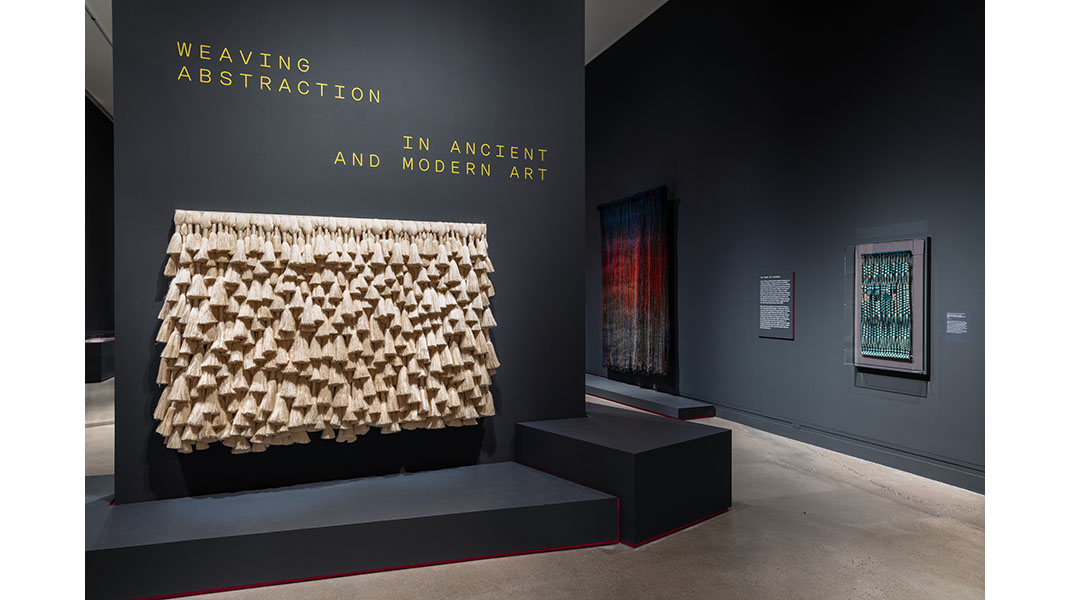
“The process of creating textiles has long been a springboard for artistic invention. In Weaving Abstraction in Ancient and Modern Art, two extraordinary bodies of work separated by at least 500 years are brought together to explore the striking connections between artists of the ancient Andes and those of the 20th century. The exhibition, which opened at The Met on March 5, 2024, features textiles by four distinguished modern practitioners—Anni Albers, Sheila Hicks, Lenore Tawney, and Olga de Amaral—alongside pieces by Andean artists from the first millennium BCE to the 16th century, who, though their names are largely unknown to us, created works of exceptional technical and formal refinement.” — The Metropolitan Museum of Art
Weaving Abstraction in Ancient and Modern Art features more than 50 works, including new acquisitions. The exhibition also includes loans from Buffalo Museum of Science; The Museum of Modern Art; Cooper Hewitt, Smithsonian Design Museum; Museum of Arts and Design, New York; The Josef and Anni Albers Foundation; Lenore G. Tawney Foundation; and private collectors.
The exhibition is curated by Iria Candela, Estrellita B. Brodsky Curator of Latin American Art in the Department of Modern and Contemporary Art, and Joanne Pillsbury, Andrall E. Pearson Curator of the Arts of the Ancient Americas in The Michael C. Rockefeller Wing.
“One of the most salient features of modern and contemporary art is the tendency, and desire, to abandon traditional creative practice, enacting both literal and figurative experimentations beyond the studio. In spring of 2024, the Guggenheim Museum will present By Way Of: Material and Motion in the Guggenheim Collection, an exhibition that will examine artists on the move, demonstrating how saturated contemporary art has become with extramural modes of thinking and working. Spanning the 1960s to the present day, the exhibition will offer a suite of artworks from the museum’s permanent collection and is particularly inspired by the D.Daskalopoulos Collection Gift
For centuries, the studio possessed almost sacred significations around the act of creation: a site for making art, a place of inspiration, invention, experimentation, and technical virtuosity. While studio practice subsists, art-making’s reputation has undeniably transformed. From the twentieth century onward, especially after World War II, contemporary artists became more invested in the potentials of the world outside and began to work in plein air, entrusting their eye over their formal training. Some artists located their inspiration in the street rather than in the academy; others depicted the responsibility of encapsulating memory and identity in a mobile form; while others pushed the boundaries of traditional art materials. By Way Of will encompass the scale and spirit of these investigations in artworks that cross media—video embedded in sculpture, tapestry as experimental painting, sound art housed inside found objects—all within the Guggenheim’s iconic building.” — Guggenheim Museum
By Way Of: Material and Motion in the Guggenheim Collection is organized by Naomi Beckwith, Deputy Director and Jennifer and David Stockman Chief Curator.
“ICP at 50: From the Collection, 1845-2019 is the first survey of the International Center of Photography’s extensive holdings in ICP’s new Lower East Side home and will present over 150 works spanning nearly 175 years of photography from ICP’s archive.
ICP at 50: From the Collection ,1845-2019 chronicles photography’s development from its origins to the present. Arranged roughly in chronological order, the exhibition showcases the work of pivotal photographers including Robert Capa, Gerda Taro, Henri Cartier-Bresson, Weegee, Gordon Parks, Louise Lawler, Laurie Simmons, Lorna Simpson, Carrie Mae Weems, Susan Meiselas, Robert Mapplethorpe, Samuel Fosso, Mickalene Thomas, Jess T. Dugan, Deana Lawson, and more. The exhibition also offers insight into the breadth and depth of ICP’s collection with historically critical images and media that include images taken of the surface of the moon by NASA in 1966, as well as activist posters from the 1980s and ‘90s groups ACT UP New York and Gran Fury.” — ICP
Paul Mpagi Sepuya, Mirror Study (4R2A0884), 2016. International Center of Photography, Purchase, with funds provided by the ICP Acquisitions Committee, 2017 (2017.21.2) Courtesy the artist, Bortolami, New York, DOCUMENT, Chicago, Peter Kilchmann, Paris & Zurich, and Vielmetter Los Angeles
Gerda Taro, Republican militiawoman training on the beach, outside Barcelona, 1936. International Center of Photography, Gift of Cornell and Edith Capa, 1986 (452.1986)
“Photography featured this year reinforce how photographers are the historians of their and our times. They challenge us to confront questions about who we are as individuals and as a society, and who we want to be,” Executive Director David E. Little said. “ICP at 50 and David Seidner celebrate ICP’s commitment to the great diversity, accessibility, and complexity of image making, and how as an institution, we will continue to follow its many emerging forms and its ongoing impact on human experience. We invite the public to join us in this celebration as we continue to shape the present and future of photography and ICP together.”
ICP at 50: From the Collection, 1845-2019, is curated by Elisabeth Sherman, ICP Senior Curator and Director of Exhibitions and Collections; Sara Ickow, ICP Senior Manager, Exhibitions and Collections; and Haley Kane, ICP Coordinator, Exhibitions and Collections.
Images courtesy International Center of Photography.
“Chiara Camoni (Piacenza, 1974; lives and works in Seravezza, Italy) is one of the foremost Italian artists of her generation. Her practice ranges from drawing to vegetable prints, from video to sculpture, with a particular focus on ceramics. Her work is characterized by the use of objects belonging to the domestic world or organic materials that the artist integrates into her production. Herbs, berries and flowers, as well as various types of clay and ashes determine the distinctive natural tones of her works, and recall the earth and vegetation that the artist collects and incorporates into her sculptures. The works are then manipulated and reassembled by Chiara Camoni through ritual gestures with strong connections to ancestral and archaic worlds, aiming to explore the relationship between craftsmanship and the spiritual sphere. The collective and shared dimension is also relevant to her practice, as the artist often collaborates with friends and relatives or organizes workshops and seminars to realize her projects.” — Pirelli HangarBicocca
Chiara Camoni “Call and gather. Sisters. Moths and flame twisters. Lioness bones, snakes and stones.” Exhibition views at Pirelli HangarBicocca, Milan, 2024. Courtesy the artist and Pirelli HangarBicocca, Milan. Photos Agostino Osio.
The exhibition at Pirelli HangarBicocca brings together the largest body of works ever presented by Chiara Camoni and was curated by Lucia Aspesi and Fiammetta Griccioli.
“In 2024, Villa Noailles explores the influence of the sea on architecture by dedicating a monographic exhibition to Jacques Rougerie, a globally renowned French architect, academician, and specialist in marine, underwater, and coastal habitats. Life began underwater 3.8 billion years ago, and Jacques Rougerie invites us to return to it. Seas and oceans cover 71% of the Earth’s surface. Jacques Rougerie identifies himself as a ‘Mérien,’ in contrast to the term ‘terrestrial,’ thus shifting architecture from Earth’s gravity to Archimedes’ buoyancy. Since the early 1970s, this persevering oceanographer architect has been designing underwater habitats in collaboration with oceanographers, biologists, and engineers, grounded in solid scientific explorations – not utopia but anticipation.
His research, exploring the similarities between life and technologies in the worlds of space and underwater, leads him to design architectures dedicated to space and the Moon. Jacques Rougerie personally tests the prototypes of underwater habitats, using every imaginable means. He lives with and under the sea, even participating in a world record by spending 71 days in an underwater habitat in the USA in 1992. The sea is his way of life, and he aims to share it.
The exhibition features numerous original drawings from Jacques Rougerie’s personal archives, some presented for the first time, and a collection of his models, including one of an underwater village borrowed from the Centre Pompidou’s collections. Additionally, the underwater habitat Aquabulle, experimented with numerous times in the Mediterranean, especially off the coast of Hyères, is displayed on the forecourt of Villa Noailles.” — Villa Noailles
“China Institute Gallery will present a special spring exhibition, Shan Shui Reboot: Re-Envisioning Landscape for a Changing World, on view from March 7 through July 7, 2024. The exhibition highlights a new generation of artists in China and the United States who are reinterpreting traditional Chinese landscape painting in the context of today’s global social issues and climate crisis. Shan shui refers to the painting of natural landscapes with brush and ink focused on an awareness of inner spiritual philosophy.
Shan Shui Reboot: Re-Envisioning Landscape for a Changing World features the recent work of seven established and emerging artists born between 1974-1992, including Lam Tung Pang, Yi Xin Tong, Kelly Wang, Peng Wei, Fu Xiaotong, Yang Yongliang, and Ni Youyu. More than 40 works will be exhibited, and many will be shown in New York for the first time.” — China Institute
Lam Tung Pang, The Dictionary of Landscape (West-coast Loop), 2024. Charcoal, acrylics on plywood and print on aluminum. H 2m x 3m, (3 panels, each 2m x 1m), depth 5cm. Courtesy of the Artist and the Kao/Williams Family Collection.
Yi Xin Tong, Animalistic Punk – Fish, 2019. Jacquard tapestry, galvanized metal tube, steel eye bolts, 63.5 x 134 x 3 inches, tapestry size: 63.5 x 125 inches.
Kelly Wang, Cloud Dragon Collage 6, 2023, Cloud dragon paper, ink, pigment, acrylic, stainless steel fiber and resin on aluminum, 43 inches diameter.
Peng Wei, Migrations of Memory—Wild Geese Descend on Level Sands, 2017–21. Installation, nine metal note stands, ink and color on flax paper. Dimensions variable, each leaf: 60 x 38 cm.
Yang Yongliang, Glows in the Arctic, 2022. Two channel 4K video.
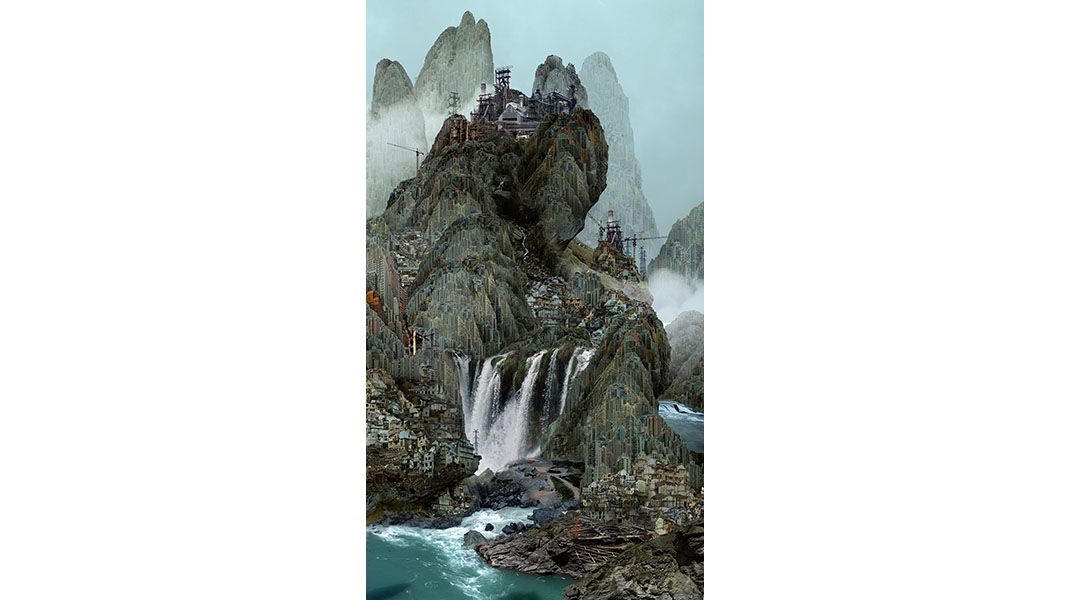
Yang Yongliang, The Falls, 2023. 4K Video, 8’00’’, dimensions variable.
Ni Youyu, Freewheeling Trip (Aunties’ Summer), 2018. Old photos collage, 22 x 70 cm.
As guest curator Tiffany Wai-Ying Beres asks, “How do young artists use the ancient language of Chinese landscape painting (shan shui) to reflect on and respond to change in our contemporary world? In an era when humans have a direct impact on the Earth’s climate and leaving distinctive marks on the geological record, possibly even to the point of extinction, these artists adopt the Chinese tradition of shan shui to conjure metaphoric, rather than purely descriptive representations of nature—visions that address contemporary life and society.”
“The Guggenheim Museum Bilbao presents June Crespo. Vascular, an ambitious exhibition devoted to the work of June Crespo (b. 1982, Pamplona), one of the most important emerging figures on the European art scene today. The show brings together a selection of recent works, as well as a large-scale sculptural assemblage designed specifically for the Museum’s exhibition space. Both spatially and conceptually, this presentation is planned as a turning point in the exhibitions Crespo has held to date.
June Crespo’s sculptural practice is voluntarily situated at the intersection of multiple pathways and contemporary lines of inquiry. On the one hand, she forges a transformative dialogue with the concepts that have characterized Basque art in recent decades, ‘mobile pairs’ like abstraction and gesture, the tragic and the opaque, and lightness and strangeness. She also addresses issues whose urgency was missing from major debates until relatively recently, particularly regarding feminist sensibility and awareness of the devastation that modern lifestyles have wrought on the natural environment, which is now fully subjugated to industrial and post-industrial production and reproduction cycles, as well as the abrasions of the Anthropocene.” — Guggenheim Museum Bilbao
“Neue Galerie New York is delighted to present “Klimt Landscapes,” opening on February 15, 2024. This major exhibition of Gustav Klimt’s (1862–1918) idyllic depictions in the landscape genre, on view through May 6, 2024, features significant paintings made while the artist was on his Sommerfrische (summer holiday) in the Austrian countryside. ‘Klimt Landscapes’ presents highlights from Neue Galerie New York’s holdings, such as Park at Kammer Castle (1909) and Forester’s House in Weissenbach II (Garden) (1914), alongside important loans from museums and private collections in Europe and the United States, including works from the Harvard Art Museums, the Museum of Modern Art, and the Wien Museum. For the last twenty years of his career, Klimt devoted considerable energy to painting landscapes during his summer vacations on the Attersee in the Salzkammergut region of Austria, known for its tranquil lakes. Created purely for his own pleasure, these bucolic scenes became among his most sought-after pictures and were highly coveted by collectors. Most were made in a square format—a reflection of his fascination with photography.” — Neue Galerie
GUSTAV KLIMT (1862-1918). Pear Tree (Pear Trees), 1903 (later reworked). Oil and casein on canvas. Harvard Art Museums / Busch-Reisinger Museum, Gift of Otto Kallir
GUSTAV KLIMT (1862-1918). Forester’s House in Weissenbach II (Garden), 1914. Oil on canvas. Neue Galerie New York. This work is part of the collection of Estée Lauder and was made available through the generosity of Estée Lauder. Photo: Hulya Kolabas
GUSTAV KLIMT (1862-1918). The Large Poplar I, 1900. Oil on canvas. Neue Galerie New York. This work is part of the collection of Estée Lauder and was made available through the generosity of Estée Lauder
GUSTAV KLIMT (1862-1918). Idyll, 1884. Oil on canvas. Design for Allegorien und Embleme, no. 75 Wien Museum, Purchase, Verlag Gerlach & Schenk, 1901. Photo: Birgit and Peter Kainz, Wien Museum
GUSTAV KLIMT (1862-1918). Fable, 1883. Oil on canvas. Design for Allegorien und Embleme, no. 75a. Wien Museum, Purchase, Verlag Gerlach & Schenk, 1901. Photo: Birgit and Peter Kainz, Wien Museum
GUSTAV KLIMT (1862-1918). Two Girls with Oleander, ca. 1890–92. Oil on canvas. Wadsworth Atheneum Museum of Art, Hartford, CT. The Douglas Tracy Smith and Dorothy Potter Smith Fund and The Ella Gallup Sumner and Mary Catlin Sumner Collection Fund
MORIZ NÄHR(1859-1945). Gustav Klimt in the garden of his studio at Josefstädter Strasse 21, April/May, 1911. Vintage gelatin silver print. Neue Galerie New York
“Klimt Landscapes” is curated by Janis Staggs, Director of Curatorial and Manager of Publications at Neue Galerie New York.
Title image: GUSTAV KLIMT (1862-1918). Park at Kammer Castle, 1909. Oil on canvas. Neue Galerie New York. This work is part of the collection of Estée Lauder and was made available through the generosity of Estée Lauder.
“The Metropolitan Museum of Art presents the groundbreaking exhibition The Harlem Renaissance and Transatlantic Modernism from February 25 through July 28, 2024. Through some 160 works, it will explore the comprehensive and far-reaching ways in which Black artists portrayed everyday modern life in the new Black cities that took shape in the 1920s–40s in New York City’s Harlem and Chicago’s South Side and nationwide in the early decades of the Great Migration when millions of African Americans began to move away from the segregated rural South. The first survey of the subject in New York City since 1987, the exhibition will establish the Harlem Renaissance as the first African American–led movement of international modern art and will situate Black artists and their radically new portrayals of the modern Black subject as central to our understanding of international modern art and modern life.” The Metropolitan Museum of Art” — The Metropolitan Museum of Art
William Henry Johnson (American, 1901–1970). Jitterbugs V., ca. 1941–42. Oil on board. Framed: 39 × 21 in. (99.1 × 53.3 cm). From the Hampton University Museum Collection, Hampton, VA.
“This landmark exhibition reframes the Harlem Renaissance, cementing its place as the first African American–led movement of international modern art,” said Max Hollein, The Met’s Marina Kellen French Director and CEO. “Through compelling portraits, vibrant city scenes, history paintings, depictions of early mass protests and activism, and dynamic portrayals of night life created by leading artists of the time, the exhibition boldly underscores the movement’s pivotal role in shaping the portrayal of the modern Black subject—and indeed the very fabric of early 20th-century modern art.”
“We are very pleased to present this wide-ranging exhibition that establishes the New Negro cohort of African American artists and their allies—now known as the Harlem Renaissance—at the vanguard of the portrayal of modern Black life and culture in Harlem and other new Black cities nationwide at a time of rapid expansion in the first decades of the Great Migration,” added Denise Murrell, The Met’s Merryl H. and James S. Tisch Curator at Large. “Many New Negro artists spent extended periods abroad and joined the multiethnic artistic circles in Paris, London, and Northern Europe that shaped the development of international modern art. The exhibition underscores the essential role of the Harlem Renaissance and its radically new modes of portraying the modern Black subject as central to the development of transatlantic modern art.”
The Harlem Renaissance and Transatlantic Modernism is organized by The Met’s Denise Murrell, PhD, Merryl H. and James S. Tisch Curator at Large, Office of the Director, in consultation with an advisory committee of leading scholars.
Title image: William Henry Johnson (American, 1901–1970) Woman in Blue, c.1943. Oil on burlap. Framed: 35 × 27 in. (88.9 × 68.6 cm). Clark Atlanta University Art Museum, Permanent Loan from the National Collection of Fine Art, 1969.013. Courtesy Clark Atlanta University Art Museum. Photo by Mike Jensen.
“The Morgan Library & Museumis pleased to present Beatrix Potter: Drawn to Nature. Opening February 23 and on view through June 9, 2024, the exhibition tells the life story of Beatrix Potter, one of the twentieth century’s best-loved authors of children’s fiction. The exhibition is rooted in Potter’s relationship with the natural world, from the influence of the countryside in her youth to her passion for sheep farming and land conservation in adulthood. Organized by the Victoria and Albert Museum (V&A), London, the exhibition brings together artworks, books, manuscripts, and artifacts from several institutions in the United Kingdom, including the V&A, the National Trust, and the Armitt Museum and Library. Paired with the Morgan’s exceptional collection of Potter’s picture letters, these objects show how her innovative blend of scientific observation and imaginative storytelling shaped some of the world’s most popular children’s books.” — The Morgan Library & Museum
This exhibition at the Morgan is organized by Philip Palmer, Robert H. Taylor Curator and Department Head of Literary and Historical Manuscripts, and was created by the Victoria and Albert Museum in London.








You must be logged in to post a comment.