
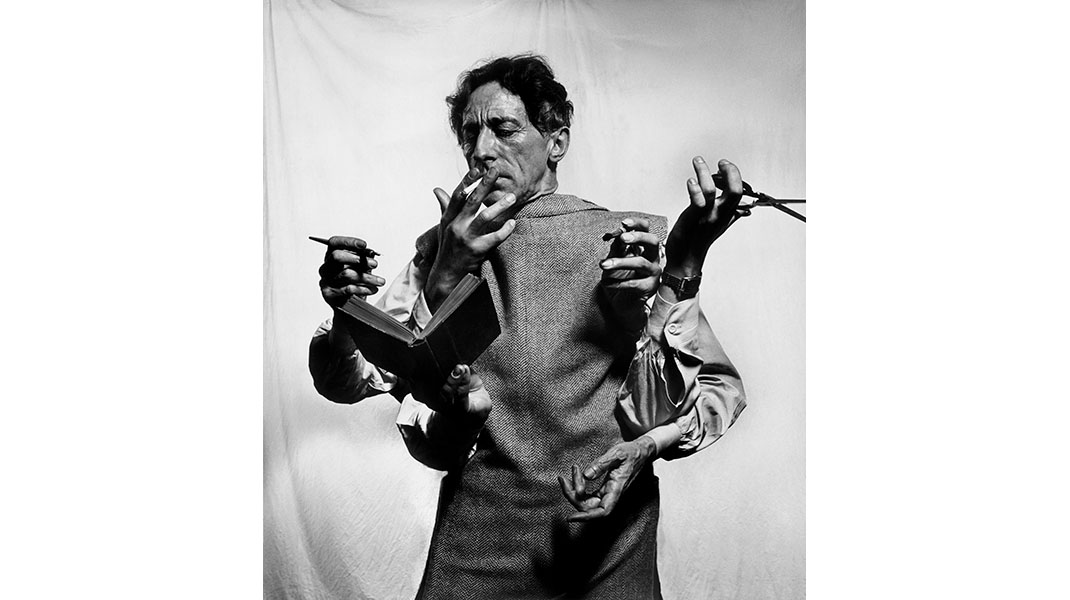
The Peggy Guggenheim Collection presents Jean Cocteau: The Juggler’s Revenge, the largest retrospective ever organized in Italy dedicated to Jean Cocteau (1889–1963), the enfant terrible of the French twentieth-century art scene.
“Organized by eminent Cocteau specialist and New York University art historian Kenneth E. Silver, the exhibition highlights the artist’s versatility, the multiple juggling acts that distinguished his production, which often drew criticism from his contemporaries. Loans from prestigious institutions, such as the Centre Georges Pompidou in Paris, the Phoenix Art Museum, the Nouveau Musée National de Monaco, and the Musée Jean Cocteau, Collection Séverin Wunderman in Menton, as well as major private collections, including the Cartier Collection, gather over one hundred and fifty works in an impressive variety of media. These include drawings, graphics, jewelry, tapestries, historical documents, books, magazines, photographs, documentaries, and films directed by Cocteau, which trace the development of this multifaced artist’s unique and highly personal aesthetics, alongside the highlights of his tumultuous career.” — Peggy Guggenheim Collection

Centre Pompidou, Paris. Musée national d’art moderne / Centre de création industrielle, Gift, 2018 © Adagp/Comité Cocteau, Paris, by SIAE 2024


32 x 20 x 9 cm. Edition Artcurial 1/20. Collection Kontaxopoulos Prokopchuk, Brussels.
Photo ©yankont@pt.lu © Adagp/Comité Cocteau, Paris, by SIAE 2024.


23 x 22 x 12 cm. Bibliothèque National de France, Paris, Fonds Charles Dullin (1885–1949) © Adagp/Comité Cocteau, Paris, by SIAE 2024.

Collection Nouveau Musée National de Monaco
© Adagp/Comité Cocteau, Paris, by SIAE 2024.
“Jean Cocteau: The Juggler’s Revenge provides an ideal opportunity to revisit the art of Cocteau, and to see him with a fresh 21st-century point of view. His astonishing artistic range–for which, in his lifetime, he was often criticized for spreading himself too thin—now looks prescient, a model for the kind of wide-ranging cultural fluidity we now expect of contemporary artists. All this, in addition to his more-or-less forthright homosexuality, as well as his very public struggles with drug addiction, make him look especially modern. Perhaps the world has finally caught up with Jean Cocteau.”, says the curator Silver.
Title image: Philippe Halsman. Jean Cocteau, New York, USA. 1949 © Philippe Halsman / Magnum Photos.
Images courtesy Peggy Guggenheim Collection.
You must be logged in to post a comment.