Public Parks Private Gardens: Paris to Provence at The Met Fifth Avenue, March 12 – July 29, 2018

Photographs by Corrado Serra.

“Following in the footsteps of 19th-century artists who celebrated the out-of-doors as a place of leisure, renewal, and inspiration, the exhibition Public Parks, Private Gardens: Paris to Provence explores horticultural developments that reshaped the landscape of France and grounded innovative movements—artistic and green—in an era that gave rise to Naturalism, Impressionism, and Art Nouveau. As shiploads of exotic botanical specimens arrived from abroad and local nurserymen pursued hybridization, the availability and variety of plants and flowers grew exponentially, as did the interest in them. The opening up of formerly royal properties and the transformation of Paris during the Second Empire into a city of tree-lined boulevards and parks introduced public green spaces to be enjoyed as open-air salons, while suburbanites and country-house dwellers were prompted to cultivate their own flower gardens. By 1860, the French journalist Eugène Chapus could write: ‘One of the pronounced characteristics of our Parisian society is that . . . everyone in the middle class wants to have his little house with trees, roses, and dahlias, his big or little garden, his rural piece of the good life’.

The important role of parks and gardens in French life during this period is richly illustrated by paintings, drawings, photographs, prints, illustrated books, and objects in The Met collection by artists extending from Camille Corot to Henri Matisse, many of whom were gardeners themselves. Anchored by Impressionist scenes of outdoor leisure, the presentation offers a fresh, multisided perspective on best-known and hidden treasures housed in a Museum that took root in a park: namely, New York’s Central Park, which was designed in the spirit of Parisian public parks of the same period.” — The Met

Center: Louis Martin Berthault, Fruit or flower basket, designed 1812; Sèvres Manufactory, 1823

Installation view of section “Parks for the Public”

Camille Pissarro, The Garden of the Tuileries on a Spring Morning and The Garden of the Tuileries on a Winter Afternoon, 1899

Installation view

Installation view

Installation view of section “Revival of Floral Still Life”

Left: Edgar Degas, A Woman Seated beside a Vase of Flowers (Madame Paul Valpinçon?), 1865. Right: Claude Monet, Chrysanthemums, 1882

Left: Vincent van Gogh, Sunflowers, 1887. Center: Claude Monet, Bouquet of Sunflowers, 1881. Right: Vincent van Gogh, Irises, 1890

Installation view of section “Private Gardens”

Left: Paul Cézanne, The Pool at Jas de Bouffan, ca. 1885–86. Right: Berthe Morisot, The Gate at Bougival, 1884

Claude Monet. Left to right: Bridge over a Pond of Water Lilies, 1899; Camille Monet in the Garden at Argenteuil, 1876; Garden at Sainte-Adresse, 1867

Installation view of section “Portrait in the Garden”

Left: Mary Cassatt, Lydia Crocheting in the Garden at Marly, 1880. Center: Mary Cassatt, Portrait of a Young Girl, 1899. Right: Edouard Manet, Madame Manet (Suzanne Leenhoff) at Bellevue, 1880

Left: Franz Xaver Winterhalter, The Empress Eugénie (Eugénie de Montijo, Condesa de Teba), 1854. Center: Edouard Vuillard, Garden at Vaucresson, 1920; reworked 1926, 1935, 1936. Right: Pierre Bonnard, From the Balcony, 1909

Left: Henri de Toulouse-Lautrec, The Streetwalker, ca. 1890–91. Right: Berthe Morisot, Young Woman Knitting, ca. 1883

The exhibition has been organized by Susan Alyson Stein, Engelhard Curator of Nineteenth-Century European Painting, Department of European Paintings, with Guest Curator Colta Ives, Curator Emerita, Department of Drawings and Prints, and the assistance of Research Associate Laura D. Corey, Department of European Paintings.

16th Annual Orchid Show at New York Botanical Garden’s Enid A. Haupt Conservatory, March 3 – April 22, 2018

Photographs by Corrado Serra.

“The 2018 edition of The Orchid Show at The New York Botanical Garden is exhibiting commissioned works by acclaimed Belgian floral artist Daniel Ost. Entering its 16th year, the popular exhibition, showcasing thousands of dramatically displayed orchids in the Botanical Garden’s historic Enid A. Haupt Conservatory, features a series of installations crafted by Ost, each a living sculpture that celebrates the individual beauty of these stunning flowers.

One of the world’s leading floral designers, Ost uses flowers as a means of expression. He identifies himself as a bloembinder, the Dutch term for an artist who works with flowers. His large-scale artworks have been tailored to the unique environment of the landmark Victorian style Haupt Conservatory, complementing the architecture of the building while creating a transformative, dazzling spectacle of color, form, and texture. Bamboo, arranged in grids and calling to mind the glass grids of the Conservatory, and clear tubing, meant to both evoke water and connect to the Conservatory’s glass, are among the materials employed in his artful installations to which individual orchids are attached so that each flower and form can be seen and appreciated. The works pay homage to his training in ikebana, the Japanese art of flower arranging. In ikebana, artists value the ideas of wabi-sabi, a philosophy that finds beauty in imperfection, asymmetry, and impermanence.” — New York Botanical Garden

Zoe Leonard: Survey at Whitney Museum of American Art, March 2 – June 10, 2018

“Over the past three decades, Zoe Leonard (b. 1961) has produced work in photography, sculpture, and installation that is significant for its lyrical observations of daily life, as well as for its rigorous attention to the politics and conditions of image-making and display. Her work is wideranging in both form and subject matter, and addresses themes including gender and sexuality, loss and mourning, migration, displacement, and the urban landscape. Leonard’s approach to photography engages with its history as a utilitarian, vernacular, and popular medium; similarly, her sculptures are often composed of found objects—commonplace items that bear signs of their use. Through repetition, subtle changes of perspective, and shifts of scale, Leonard frames the quotidian in ways that challenge the viewer to reexamine the familiar.

Zoe Leonard: Survey is, as titled, a “survey” exhibition intended to give a broad overview of the artist’s work. But “to survey” is also to look out at a place or site and gauge it from multiple viewpoints in an effort to understand and describe it. It is this kind of mapping that Leonard undertakes both in her work and through the form of the exhibition. She encourages us to consider the Museum itself as a site and to question the conditions—be they cultural, social, economic, or political—that inflect our subjective points of view. Survey offers an opportunity to reflect on the nature of perception and to take the measure of our own relationship to the world.” — Introductory Wall Text

Zoe Leonard, Niagara Falls no.4, 1986/1991.Gelatin silver print, 41 7/8 × 29 1/4 in. (106.36 × 74.3 cm). Collection of the artist; courtesy Galerie Gisela Capitain, Cologne, and Hauser & Wirth, New York.

Zoe Leonard, Dress + Suit (for Nancy), 1990/1995. Gelatin silver print, 30 1/8 × 21 7/6 in. (76.52 × 54.45 cm). Collection of the artist; courtesy Galerie Gisela Capitain, Cologne, and Hauser & Wirth, New York.

Zoe Leonard, The Fae Richards Photo Archive, 1993-96, (detail), 78 gelatin silver prints and 4 chromogenic prints, dimensions variable. Whitney Museum of American Art, New York; Purchase, with funds from the Contemporary Painting and Sculpture Committee and the Photography Committee.

Installation view of Zoe Leonard, Strange Fruit, 1992-97. Orange, banana, grapefruit, lemon, and avocado peels with thread, zippers, buttons, sinew, needles, plastic, wire, stickers, fabric, and trim wax, dimensions variable. Collection of the Philadelphia Museum of Art; purchased with funds contributed by the Dietrich Foundation and with the partial gift of the artist and the Paula Cooper Gallery, 1998. Image courtesy the Philadelphia Museum of Art. Photograph by Graydon Wood.

Zoe Leonard, TV Wheelbarrow, 2001, Dye transfer print, 20 × 16 in. (50.8 × 40.6 cm). Collection of the New York Public Library; Funds from the Estate of Leroy A. Moses, 2005.

Zoe Leonard, Roll #11, 2006/2016. Chromogenic print, 22 × 18 1/2 in. (55.9 × 47 cm). Collection of the artist; courtesy Galerie Gisela Capitain, Cologne, and Hauser & Wirth, New York.

Zoe Leonard, Observation Point/Observation Point, 2011. Two postcards, 3 5/16 × 5 1/2 in.(8.47 × 13.97 cm) each. Collection of the artist.

Zoe Leonard, New York Harbor I, 2016. Two gelatin silver prints, 21 × 17 1/8 in. (53.3 × 43.5 cm) each. Collection of the artist; courtesy Galerie Gisela Capitain, Cologne, and Hauser & Wirth, New York.

Installation view of Zoe Leonard, detail of How to Make Good Pictures, 2016. 429 books, 25 1/4 × 6 1/8 × 248 3/4 in. (64.1 × 15.6 × 631.8 cm) overall. Collection of the artist; courtesy Galerie Gisela Capitain, Cologne. Photograph by Simon Vogel.

Zoe Leonard, You see I am here after all, 2008, (detail), 3,851 vintage postcards, 11 ft 10 ½ in x 147 ft.. Installation view Dia: Beacon, Beacon, NY. Courtesy of the artist and Galerie Gisela Capitain, Cologne. Photo by Bill Jacobson, New York.

Zoe Leonard: Survey is organized by Bennett Simpson, Senior Curator, with Rebecca Matalon, Curatorial Associate, The Museum of Contemporary Art, Los Angeles. The installation at the Whitney Museum is overseen by Elisabeth Sherman, Assistant Curator.

Images courtesy Whitney Museum of American Art.

Grant Wood: American Gothic and Other Fables at Whitney Museum of American Art, March 2 – June 10, 2018

“Grant Wood (1891–1942) became an overnight celebrity following the debut of American Gothic, his now-iconic portrait of a Midwestern farm couple, at the Art Institute of Chicago in 1930. Only a year earlier, he had been a relatively unknown painter of French Impressionist–inspired landscapes in Cedar Rapids, Iowa. His short mature career, from 1930 to 1942, spanned some of the most trying, soul-searching years for the United States, as the country grappled with the aftermath of an economic meltdown and engaged in vigorous, sometimes bitter debates over its core national identity. What emerged as a powerful strain in art and popular culture during this period was a pronounced reverence for the values of community, hard work, and self-reliance that were seen as fundamental to the national character and embodied most fully by America’s small towns and farms. Wood’s farmscapes and portraits epitomized these sentiments. His romanticized depictions of a seemingly more innocent time elevated him into a popular, almost mythic national figure, celebrated for his art and his promotion of Regionalism, the representational style associated with the Midwest that dominated American art during the Depression.

Today, it is clear that the enduring power of Wood’s art owes as much to its mesmerizing psychological ambiguity as to its archetypal Midwestern imagery. An eerie silence and disquiet run throughout his work, complicating its bucolic, elegiac appearance. The tension between his desire to recapture the dreamworld of his childhood and his instincts as a shy, sexually repressed Midwesterner seeped into his art, endowing it with an unsettling solitude and chilling sense of make-believe. Wood’s conflicted relationship with the homeland he professed to adore may be a truer expression of the unresolved tensions in the American experience than he might ever have imagined, more than seventy-five years after his death.” ౼ Introductory Wall Text

Grant Wood, Corn Cob Chandelier for Iowa Corn Room, 1925. Copper, iron, and paint, 94 x 32 x 34 in. (238.8 x 81.3 x 86.4 cm). Cedar Rapids Museum of Art, Iowa; gift of John B. Turner II 81.17.3. © Figge Art Museum, successors to the Estate of Nan Wood Graham/Licensed by VAGA, New York, NY. Photograph © 2017 Mark Tade

Grant Wood, American Gothic, 1930. Oil on composition board, 30 3⁄4 x 25 3⁄4 in. (78 x 65.3 cm). Art Institute of Chicago; Friends of American Art Collection 1930.934. © Figge Art Museum, successors to the Estate of Nan Wood Graham/Licensed by VAGA, New York, NY. Photograph courtesy Art Institute of Chicago/Art Resource, NY

Grant Wood, Parson Weems’ Fable, 1939. Oil on canvas, 38 3⁄8 x 50 1⁄8 in. (97.5 x 127.3 cm). Amon Carter Museum of American Art, Fort Worth, Texas 1970.43. © Figge Art Museum, successors to the Estate of Nan Wood Graham/Licensed by VAGA, New York, NY

Grant Wood, The Midnight Ride of Paul Revere, 1931. Oil on composition board, 30 x 40 in. (76.2 x 101.6 cm). The Metropolitan Museum of Art, New York; Arthur Hoppock Hearn Fund, 1950. © Figge Art Museum, successors to the Estate of Nan Wood Graham/Licensed by VAGA, New York, NY. Image © The Metropolitan Museum of Art, New York; courtesy Art Resource, NY

Grant Wood, Boy Milking Cow, 1932. Oil on canvas, cut out and mounted on fiberboard, 71 1⁄4 x 63 1⁄4 in. (181 x 160.7 cm) framed. Coe College, Permanent Art Collection, Cedar Rapids, Iowa; gift of the Eugene C. Eppley Foundation. © Figge Art Museum, successors to the Estate of Nan Wood Graham/Licensed by VAGA, New York, NY. Photograph by Mark Tade, 2005

Grant Wood, Saturday Night Bath, 1937. Charcoal on paper, 24 1⁄16 x 26 15⁄16 in. (61.1 x 68.4 cm). Museum of Fine Arts, Houston; gift of Dr. Jack Tausend in memory of Mary Nesbit Tausend 2004.1603. © Figge Art Museum, successors to the Estate of Nan Wood Graham/Licensed by VAGA, New York, NY

Grant Wood, Spring in Town, 1941. Oil on wood, 26 x 24 1⁄2 in. (66 x 62.2 cm). Swope Art Museum, Terre Haute, Indiana 1941.30. © Figge Art Museum, successors to the Estate of Nan Wood Graham/Licensed by VAGA, New York, NY

Grant Wood, Spring Turning, 1936. Oil on composition board, 18 1⁄4 x 40 1⁄8 in. (46.4 x 101.9 cm). Reynolda House Museum of American Art, Winston-Salem, North Carolina; gift of Barbara B. Millhouse 1991.2.2. © Figge Art Museum, successors to the Estate of Nan Wood Graham/Licensed by VAGA, New York, NY. Image courtesy Reynolda House Museum of American Art, affiliated with Wake Forest University

Grant Wood: American Gothic and Other Fables is organized by Barbara Haskell, Curator, with Sarah Humphreville, Senior Curatorial Assistant.

Images courtesy Whitney Museum of American Art.

All Too Human: Bacon, Freud and a Century of Painting Life at Tate Britain, February 28 – August 27, 2018

“A landmark exhibition at Tate Britain celebrates how artists have captured the intense experience of life in paint. All Too Human: Bacon, Freud and a Century of Painting Life showcases around 100 works by some of the most celebrated modern British artists, with Lucian Freud and Francis Bacon at its heart. It reveals how their art captures personal and immediate experiences and events, distilling raw sensations through their use of paint, as Freud said: ‘I want the paint to work as flesh does’. Bringing together major works by Walter Sickert, Stanley Spencer, Michael Andrews, Frank Auerbach, R.B. Kitaj, Leon Kossoff, Paula Rego, Jenny Saville, Lynette Yiadom-Boakye and many others, this exhibition makes poignant connections across generations of artists and tells an expanded story of figurative painting in the 20th century and into the 21st century.” ౼ Tate Britain

Cecily Brown, born 1969. Boy with a Cat, 2015. Oil, pastel on linen, 1092 x 1651 mm. Collection of Danny and Lisa Goldberg © Cecily Brown. Photo: Richard Ivey

Euan Uglow, 1932-2000. Georgia,
1973
. Oil paint on canvas, 
838 x 1118 mm
. British Council Collection 
© The Estate of Euan Uglow

Francis Bacon, 1909-1992. Portrait, 1962. Oil paint on canvas, 1980 x 1415 mm. Museum für Gegenwartskunst Siegen. The Lambrecht-Schadeberg Collection/Winners of the Rubens Prize of the City of Siegen
© The Estate of Francis Bacon. All rights reserved. DACS, London.

Leon Kossoff, born 1926. Children’s Swimming Pool, Autumn Afternoon, 1971. Oil paint on board, 1680 x 2140 x 56 mm. Tate © Leon Kossoff

Lucian Freud, 1922-2011. Girl with a White Dog, 1950-1. Oil paint on canvas, 762 x 1016 mm. © Tate

Lynette Yiadom-Boakye, born 1977. 
Coterie Of Questions, 
2015.  
Oil paint on canvas, 
2000 x 1300 x 37 mm. 
Private collection. Courtesy Corvi-Mora, London and Jack Shainman Gallery, New York
© Lynette Yiadom-Boakye

Michael Andrews, 1928-1995. 
Melanie and Me Swimming, 1978-9. Acrylic paint on canvas, 1955 x 1959 x 77 mm. Tate
© The estate of Michael Andrews

Paula Rego, born 1935. The Family, 1988. Acrylic paint on canvas backed paper, 2134 x 2134 mm. Marlborough International Fine Art © Paula Rego

R.B. Kitaj. 1932-2007. The Wedding. 1989-93. Oil paint on canvas, 1829 x 1829 mm. Tate
© The estate of R. B. Kitaj

All Too Human: Bacon, Freud and a Century of Painting Life is curated at Tate Britain by Elena Crippa, Curator, Modern and Contemporary British Art, and Laura Castagnini, Assistant Curator. The exhibition will tour to the Museum of Fine Arts, Budapest later in 2018.

Images courtesy Tate Britain.

T.C. Cannon: At the Edge of America at Peabody Essex Museum (PEM), March 3 – June 10, 2018

“The Peabody Essex Museum (PEM) presents an exhibition celebrating one of the most influential and inventive Native American artists of the 20th-century, T.C. Cannon (1946-1978, Caddo/Kiowa). T.C. Cannon: At the Edge of America explores the dynamic creative range and legacy of an artist whose life was cut short at age 31. Through nearly 90 works, including 30 major paintings, works on paper, poetry and musical recordings, Cannon’s distinctive and affecting worldview shines through in this groundbreaking exhibition that is organized by PEM and will tour the country through 2019. This is the first major traveling exhibition of his work since 1990.

Deeply personal yet undeniably political, Cannon’s artwork adeptly channels his cultural heritage, experience as a Vietnam War veteran, and the turbulent social and political climate that defined 1960s and ‘70s America. Amid ongoing national and global conversations about ethnic identity, social justice, land rights and cultural appropriation, Cannon’s work continues to engage issues that are as relevant now as they were 50 years ago. “Never shying from the complexity and nuance of identity politics, Cannon interrogated American history and popular culture through his Native lens and showed us that Native American history and culture are integral to the American experience,” says Karen Kramer, exhibition curator and PEM’s Curator of Native American and Oceanic Art and Culture.” ౼ PEM

T. C. Cannon (1946–1978, Caddo/Kiowa), Two Guns Arikara, 1974–77. Acrylic and oil on canvas. Anne Aberbach + Family, Paradise Valley, Arizona. © 2017 Estate of T. C. Cannon. Photo by Thosh Collins

T. C. Cannon (1946–1978, Caddo/Kiowa), Self-Portrait in the Studio, 1975. Oil on canvas. Collection of Richard and Nancy Bloch. © 2017 Estate of T. C. Cannon. Photo by Addison Doty.

T. C. Cannon (1946–1978, Caddo/Kiowa), His Hair Flows Like a River, 1973. Oil on canvas. Anne Aberbach + Family, Paradise Valley, Arizona. © 2017 Estate of T. C. Cannon. Photo by Thosh Collins.

T. C. Cannon (1946–1978, Caddo/Kiowa), Waiting for the Bus (Anadarko Princess), 1977. Lithograph. Anne Aberbach + Family, Paradise Valley, Arizona. © 2017 Estate of T. C. Cannon. Photo by Thosh Collins.

T. C. Cannon (1946–1978, Caddo/Kiowa), Favorite Wife, 1972. Oil on canvas. Collection of George Oswalt. © 2017 Estate of T. C. Cannon. Photo by Carla Cain.

T. C. Cannon (1946–1978, Caddo/Kiowa), A Remembered Muse (Tosca), 1978. Woodcut. Anne Aberbach + Family, Paradise Valley, Arizona. © 2017 Estate of T. C. Cannon. Photo by Thosh Collins.

T. C. Cannon (1946–1978, Caddo/Kiowa), Small Catcher, 1973–78. Oil on canvas. Collection of Gil Waldman and Christy Vezolles. © 2017 Estate of T. C. Cannon. Courtesy of the Heard Museum, Phoenix, Arizona. Photo by Craig Smith.

T. C. Cannon (1946–1978, Caddo/Kiowa), Indian with Beaded Headdress, 1978. Acrylic on canvas. Peabody Essex Museum. © 2017 Estate of T. C. Cannon. Photo by Kathy Tarantola.

T. C. Cannon (1946–1978, Caddo/Kiowa), Buffalo Medicine Keeper, about 1974. Acrylic and oil on canvas. William E. Weiss Memorial Fund Purchase, Buffalo Bill Center of the West, Cody, Wyoming. © 2017 Estate of T. C. Cannon.

T. C. Cannon (1946–1978, Caddo/Kiowa), Cloud Madonna, 1975. Acrylic on canvas. Collection of Charles and Karen Miller Nearburg, promised gift to the Hood Museum of Art, Dartmouth College, Dartmouth, New Hampshire. © 2017 Estate of T. C. Cannon.

T. C. Cannon (1946–1978, Caddo/Kiowa), On Drinkin’ Beer in Vietnam in 1967, after 1978. Lithograph. Private Collection. © 2017 Estate of T. C. Cannon. Photo by Allison White.

T. C. Cannon (1946–1978, Caddo/Kiowa), Collector #3, 1974. Acrylic and oil on canvas. Collection of Alexis Demirjian. © 2017 Estate of T. C. Cannon. Photo by Tim Nighswander/Imaging4Art.

T. C. Cannon (1946–1978, Caddo/Kiowa), Hopi with Manta, 1976. Oil on canvas. Anne Aberbach + Family, Paradise Valley, Arizona. © 2017 Estate of T. C. Cannon. Photo by Thosh Collins.

T. C. Cannon (1946–1978, Caddo/Kiowa), Law North of the Rosebud, 1971. Acrylic on canvas. Collection of Charles and Karen Miller Nearburg. © 2017 Estate of T. C. Cannon. Photo by Brad Flowers.

T. C. Cannon (1946–1978, Caddo/Kiowa), Abby of Bacabi, 1978. Oil on canvas. Fred Jones Jr. Museum of Art, University of Oklahoma, Norman, Oklahoma. © 2017 Estate of T. C. Cannon.

T. C. Cannon (1946–1978, Caddo/Kiowa), All the Tired Horses in the Sun, 1971–72. Oil on canvas. Tia Collection. © 2017 Estate of T. C. Cannon.

Portrait of T. C. Cannon, about 1965. Courtesy of Archives of the Institute of American Indian Arts.

Images courtesy Peabody Essex Museum.

2018 Triennial: Songs for Sabotage at New Museum, February 13, 2018 – May 27, 2018

Photographs by Corrado Serra.

“More than ever, images dominate our reality. The artists in “Songs for Sabotage” treat art as a form of propaganda that turns images on their head in order to reveal the ideologies and built worlds behind them. This tendency echoes the historical notion of sabotage, in which actors impede modes of production from the inside to disturb their normal function. These artists share a concern that entrenched powers of colonialism and institutionalized racism continue to exacerbate inequity. They respond by mapping the violent and isolating effects of these powers on bodies and communities, and by producing objects and images that memorialize individual acts of resistance. They make interventions into cities, infrastructures, and networks embedded in everyday life, proposing objects that might create common experience and disrupt these systems of control.

The artists in “Songs for Sabotage” offer models for dismantling and replacing the political and economic networks that envelop today’s global youth. They are further connected by deep engagement with the specificity of local context, addressing communities and landscapes from Hong Kong to Johannesburg to Athens. At the same time, they adopt a critical examination—and embrace—of the internationalism that links them, finding common cause as a generation living under a shared condition of precarity. Their works range widely in medium and form, including painted allegories for the administration of power, sculptural proposals to renew or destroy monuments, and cinematic works that contend with the ways identity is mobilized in our current era. Viewed in ensemble, these works provide models for working against a system that constantly threatens failure.” — Introductory Wall Text

Installation view of 4th floor

Tiril Hasselknippe, Balconies (støp i meg, støp), 2018.

Front: Diamond Stingily, E.L.G., 2018. Back: Series of artworks by Wilmer Wilson IV , 2017

Installation view of 4th floor

Gresham Tapiwa Nyaude: If you want to help us you need to understand, Part 1 and Part 2, 2018

Front: Tiril Hasselknippe: Balconies (støp i meg, støp), 2018. Back: Gresham Tapiwa Nyaud: left: Privilege of the Bed-ridden, 2018; right: The Red General, 2018

Left & right:  Artworks by Cian Dayrits. Center: Haroon Gunn-Salie, Senzenina, 2018.

Left: Paintings by Zhenya Machneva. Right: KERNEL (Pegy Zali, Petros Moris, and Theodoros Giannakis), As you said, things resist and things are resistant, 2018

Zhenya Machneva: left to right: CHP-14, 2016; Project: Landscape # 1 @ “On/Off”, 2012; Guillotine, 2018

Left: Paintings by Chemu Ng’ok. Right: Violet Dennison, M.O.O.P., 2018

Chemu Ng’ok: left to right: In Denial, 2016; Be-friend, 2017; Reflections, 2017; The Boundary Wall, 2017

Violet Dennison, M.O.O.P., 2018

Matthew Angelo Harrison, Prototype of Dark Silhouettes (detail), 2018

Matthew Angelo Harrison, Prototype of Dark Silhouettes (detail), 2018

Left: Painting by Dalton Paula. Right: Paintings by Tomm El-Saieh

Installation view of 2nd floor

Front: Daniela Ortiz, Burn el hielo, 2018. Back: Dalton Paula: left to right: Enfia a faca na bananeira, 2017; Pedrinha miudinha, 2017

Front: Daniela Ortiz, This land will never be fertile for having given birth to colonisers (Esta tierra jamás será fértil por haber parido colonos), 2018

Installation view of 2nd floor

Left: Claudia Martínez Garay, Cannon Fodder / Cheering Crowds, 2018. Right: Julia Phillips, Fixator (#1), 2017

Claudia Martínez Garay, Cannon Fodder / Cheering Crowds, 2018

Hardeep Pandhal, Black By Day, Red By Night (Mood Board), 2018

“Songs for Sabotage” is the fourth edition of the New Museum Triennial, an exhibition series dedicated to emerging artists from around the world. The exhibition is curated by Gary Carrion-Murayari, Kraus Family Curator, and Alex Gartenfeld, Deputy Director and Chief Curator at the Institute of Contemporary Art, Miami, with Francesca Altamura, Curatorial Assistant.

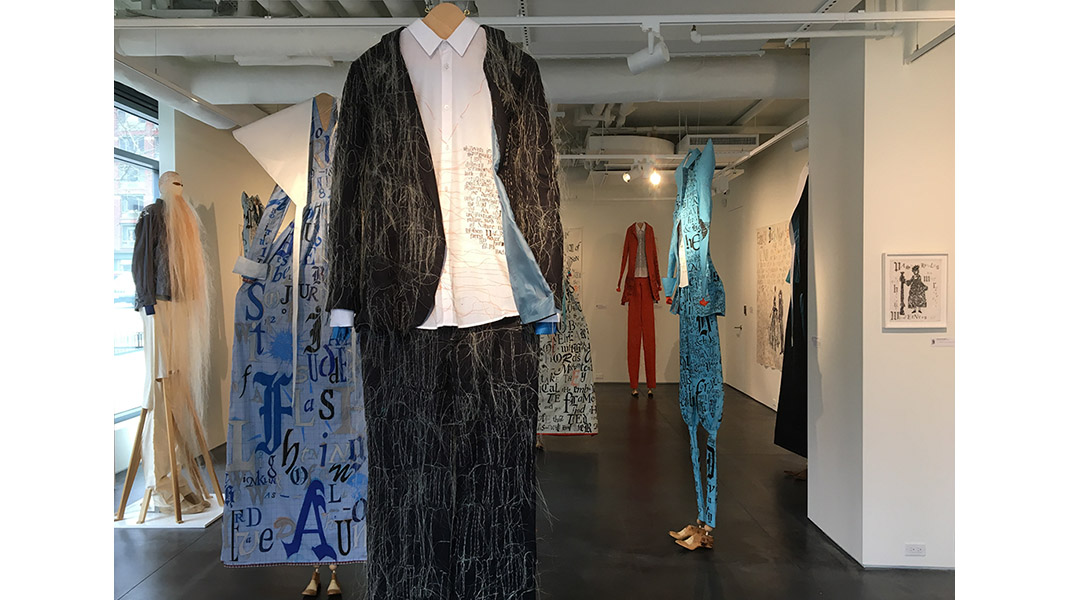
Lesley Dill. Wilderness: Words are where what I catch is me at Nohra Haime Gallery, through March 17, 2018

“Lesley Dill’s first major exhibition in New York since 2014 and first solo exhibition with Nohra Haime Gallery features a new body of work drawing on language, the written word, and the investigation of divinity and deviltry during the wildness of Early America.

Reminiscent of Alberto Giacometti’s sculptures, the long, thin figures appearing in Dill’s work wear the strength of the words of the people they represent. Though differing in specific experience, all of these personas have had a powerful impact through their words, and personally connect with the artist. Dill posits that there is something untamable, fierce, and persistent in each of their beliefs, which ultimately unites them. Dill is drawn to this restrictive time period of limited access to a diversity of written word, and the bravery of these figures’ response. Hutchinson, for example, with her famed testimony of religious freedom, was one of the first American women to have her word recognized, recorded and saved as a part of history.” — Nohra Haime Gallery

Installation view of exhibition

Unredeemed Regions (detail), 2018.

Left: Flewentness of Tongue (Anne Hutchinson), 2017. Center: Omnipotence Enough (Emily Dickinson). Right: Wanderer (Walt Whitman), 2017.

Northern Blast (Edward Taylor) (detail), 2017.

The Wilderness Tattoo (Hester Prynne), 2017.

Mystic Participant, 2017.

John Brown: Meteor of the War, 2017.

Images courtesy Nohra Haime Gallery.

A Queen Within: Adorned Archetypes at New Orleans Museum of Art (NOMA), February 21 – May 28, 2018

“Showcasing rare pieces from one of the world’s largest private collections of Alexander McQueen fashion, the New Orleans Museum of Art (NOMA) presents A Queen Within: Adorned Archetypes. NOMA’s first major fashion exhibition will feature contemporary designers showcased in an immersive gallery presentation. This exhibition’s bold couture explores different archetypes of femininity, and how these mythic characters manifest through storytelling in fashion over the past decade.

Designer Alexander McQueen (1969-2010) was a master of building narratives through his collections and runway shows. Inspired by his sensitivity to historical and literary research, A Queen Within uses fashion to explore seven archetypal personality types of a Queen, or metaphorically, of a woman: The Mother Earth, Sage, Magician, Enchantress, Explorer, Heroine and Thespian. These themes, based upon Swiss psychoanalyst Carl Jung’s work, are derived from recurring motifs in myths and fairy tales of world literature. The story of each feminine archetype—its powers, its weaknesses, its significance—is articulated in A Queen Within through pioneering fashion, photography, and artwork.

A Queen Within: Adorned Archetypes features more than 100 experimental gowns, headpieces, jewelry, and shoes by more than 30 of the world’s most insightful contemporary designers. The exhibition includes household names like McQueen, Prada, Chanel and Comme des Garçons intermixed with other boundary-pushing fashion, like Chromat’s body-positive architectural looks and Iris van Herpen’s dresses that boldly use new technology.” — NOMA

Alexander McQueen, two-piece ensemble with multi-colored crystal print, Natural Dis-tinction, Un-natural Selection, Spring/Summer 2009. Courtesy of Barrett Barrera Projects & RKL consulting. Photo Mattias Lindback.

Iris van Herpen, snake dress, Capriole Couture, 2011. Courtesy of Iris van Herpen. Photo M. Zoeter x Iris van Herpen.

Serena Gili, cashmere beaded top with golden fiberglass skirt, Discipline collection 2012. Courtesy of Serena Gili. Photo Saga Sig.

Alexander McQueen, silk print painting dress with gold painted feathers, Heaven and Hell pre collection Fall/Winter 2010. Courtesy of Barrett Barrera Projects & RKL consulting. Photo Mattias Lindback.

Gucci, gold dress with feather embellishments, Spring/Summer 2011. Courtesy of Barrett Barrera Projects & RKL consulting. Photo courtesy of LaForce & Stevens.

Charlie Le Mindu, Cloudy Day I headdress, 2013. Courtesy Barrett Barrera Projects & RKL consulting. Photo Ciel Lui Bei.

Alexander McQueen, green embroidered feather dress, Windows of Culloden collection, Fall/Winter 2006. Courtesy of Barrett Barrera Projects & RKL consulting. Photo Sarah Carmody.

Comme des Garçons, red dress, Spring/Summer 2015. Courtesy of Barrett Barrera Projects & RKL Consulting. Photo Sarah Carmody.

Jordan Askill, petal and panther headdress, Spring/Summer 2011. Courtesy Jordan Askill, Photo Jordan Askill.

Maison Martin Margiela, Courtesy of Maison Margiela. Cloud top worn with black knitted cocoon catsuit and black leather stilettos, Défilé collection Fall/Winter 2009. Photo Giovanni Giannoni.

Pam Hogg, black dress with collar, Spring/Summer 2013. Courtesy of Barrett Barrera Projects and RKL consulting. Photo Pam Hogg.

Sarah Burton/Alexander McQueen, white floral platform heels, Spring/Summer 2011. Courtesy of Barrett Barrera Projects & RKL consulting. Photo Sarah Carmody.

Omar Victor Diop, print, Aminata, 2013, from the Studio of Vanities series. Courtesy MAGNIN-A Gallery, Paris.

Viktor&Rolf, dress, Wearable Art, Haute Couture Fall/Winter 2015. Courtesy of Viktor&Rolf, Photo Museum of Fine Arts, Boston.

Raúl de Nieves, Day(Ves) of Wonder sculpture, 2007-2014. Courtesy of Raúl de Nieves & Company Gallery, New York. Photo courtesy of Raúl de Nieves.

Antoine Peters, sweater, Looong Sleeve, 2014. Courtesy of Antoine Peters. Virtual sketch by Antoine Peters.

Vivienne Westwood, Gold label UK, Tailored Chelsea Coat and River Dress, Mirror the World collection, Spring/Summer 2016. Courtesy of Vivienne Westwood. Photo Ugo Camera.

Prada, Italy, Platform shoes, Spring/Summer 2013. Courtesy of Barrett Barrera Projects & RKL Consulting. Photo Sarah Carmody.

Comme des Garçons, Japan, Wool plaid jacket, Fall/Winter 2010. Courtesy of Barrett Barrera Projects & RKL Consulting. Photo Sarah Carmody.

A Queen Within shows fashion’s possibility as an art form, full of glamour, theatricality, escapism, wit and innovation. “A Vivienne Westwood coat is from a collection that called for people to unite in an effort to save Venice, and the rest of our planet, from the effects of climate change. Minna Palmqvist’s mannequin busts capture the beauty of nonconforming bodies, showing how fashion’s pioneers are moving away from the standard size zero dress form. Gypsy Sport’s gender-fluid work is seen as the voice for a new generation that calls for a more global, inclusive world,” said exhibition curators Sofia Hedman-Martynova and Serge Martynov of MUSEEA.

Images courtesy New Orleans Museum of Art (NOMA).

Rebel Spirits: Robert F. Kennedy and Martin Luther King Jr. at New-York Historical Society, February 16 – May 20, 2018

“To commemorate the 50th anniversary of the assassinations of Martin Luther King Jr. and Robert F. Kennedy in 1968, the New-York Historical Society presents an exhibition of photographs and artifacts honoring these visionary leaders who irrevocably changed the United States. Rebel Spirits: Robert F. Kennedy and Martin LuthermKing Jr. showcases approximately 60 photographs and 30 documents and artifacts that uncover the relationship between these historic figures.

Martin Luther King Jr. (January 15, 1929 –April 4, 1968) and Robert F. Kennedy (November 20, 1925 – June 6, 1968) were born worlds apart—culturally, geographically, racially, financially, and politically—but by the time they were killed within months of each another in 1968, their worlds had come together. As their respective concerns expanded beyond civil rights and organized crime, their ties deepened to encompass shared interests in supporting the poor and opposing the war in Vietnam. This unprecedented exhibition explores the overlapping paths of their lives through images taken by some of the most renowned photojournalists of the era, including Bob Adelman, Danny Lyon, Henri Dauman, Jacques Lowe, Spider Martin, Steve Schapiro, Lawrence Schiller, and Paul Schutzer, alongside original correspondence, publications, and ephemera.” — New-York Historical Society

Installation photographs by Corrado Serra.

“Now is the time to make justice a reality for all God’s children.” — Martin Luther King Jr.

“Progress is a nice word. But change is its motivator. And change has its enemies.” — Robert F. Kennedy

“Even in our sleep, pain which cannot forget falls drop by drop upon the heart, until, in our own despair, against our will, comes wisdom through the awful grace of God.” — Aeschylus, quoted by RFK after the news of MLK’s assassination, April 4, 1968

“I know, somehow, that only when it is dark enough, can you see the stars.” — Martin Luther King Jr.

Rebel Spirits is based in part on The Promise and the Dream, written by David Margolick and produced by Lawrence Schiller to be published on April 2, 2018. The exhibition was curated by Lawrence Schiller, Cristian Panaite, and Marilyn Kushner. It was produced by Wiener Schiller Productions, Inc. in association with Susan Bloom International with support from Getty Images, The Jacques Lowe Estate, and Steve Schapiro.

Tarsila do Amaral: Inventing Modern Art in Brazil at Museum of Modern Art, February 11 – June 3, 2018

Photographs by Corrado Serra.

” With Tarsila do Amaral: Inventing Modern Art in Brazil, The Museum of Modern Art presents the first monographic exhibition in the United States exclusively devoted to the pioneering work of Tarsila do Amaral (Brazilian, 1886–1973), a founding figure of Brazilian modernism. The exhibition focuses on the artist’s production from the 1920s, tracing the path of her groundbreaking contributions through approximately 120 works, including paintings, drawings, sketchbooks, and photographs drawn from collections across the US, Latin America, and Europe.

Tarsila do Amaral: Inventing Modern Art in Brazil explores the radical vision of an artist who profoundly shaped modernist practice in Brazil, and was a key figure for subsequent generations of Brazilian artists working across media, from literature and theater to fashion and music. A long-overdue introduction to this major Brazilian modernist for North American audiences, the exhibition will survey Tarsila’s career from her earliest Parisian works to the emblematic modernist paintings produced upon her return to Brazil, ending with her large-scale, socially driven works of the early 1930s. Central to the exhibition is the reunion of three landmark paintings: The Black Woman (1923), Abaporu (1928), and Anthropophagy (1929), a transformational series of works that were last exhibited jointly in North America as part of the MoMA exhibition Latin American Artists of the Twentieth Century in 1993.

Born in 1886 in the rural town of Capivari, on the outskirts of São Paulo, Tarsila—as she is affectionately known in Brazil—was raised among the plantation-owning bourgeoisie. Traveling in cosmopolitan circles between São Paulo and Paris, she enrolled at the Académie Julian, a Parisian art school that drew many international students.” — MoMA

“I want to be the painter of my country” —  Tarsila do Amaral

Exhibition entrance

Center: Estudo (Academia no. 2) [Study (Academy no. 2)], 1923.

Left: O Touro (The Bull), 1928. Right: Carnaval em Madureira (Carnival in Madureira), 1924.

Right: A Negra (The Black Woman), 1923.

Left: Manacá, 1927. Right: Palmeiras (Palm Trees), 1925.

Left: Abaporu, 1928.

Right: Urutu (Urutu Viper), 1928.

Left: Composição (Figura só) [Composition (Lonely Figure)], 1930. Right: Floresta (Forest), 1929.

Left: Distância (Distance), 1928. Right: Calmaria II (Calmness II), 1929.

Right: Cartão-Postal (Postcard), 1929.

Left: Antropofagia (Anthropophagy), 1929.

Left: Sol poente (Setting Sun), 1929.

Right: Cidade (A rua) [City (The Street)], 1929.

Left: Operário (Workers), 1933.

Tarsila do Amaral: Inventing Modern Art in Brazil is organized by The Museum of Modern Art and the Art Institute of Chicago, by Luis Pérez-Oramas, former Estrellita Brodsky Curator of Latin American Art, The Museum of Modern Art, and Stephanie D’Alessandro, former Gary C. and Frances Comer Curator of International Modern Art, the Art Institute of Chicago; with Karen Grimson, Curatorial Assistant, Department of Drawings and Prints, The Museum of Modern Art.

Quicksilver Brilliance: Adolf de Meyer Photographs at The Met Fifth Avenue, through April 7, 2018

“A member of the “international set” in fin-de-siècle Europe, Baron Adolf de Meyer (1868–1946) was also a pioneering art, portrait, and fashion photographer, known for creating images that transformed reality into a beautiful fantasy. The “quicksilver brilliance” that characterized de Meyer’s art led fellow photographer Cecil Beaton to dub him the “Debussy of the Camera.”

Quicksilver Brilliance: Adolf de Meyer Photographs will be the first museum exhibition devoted to the artist in more than 20 years and the first ever at The Met. Some 40 works, drawn entirely from The Met collection, will reveal the impressive breadth of his career.

The exhibition includes dazzling portraits of well-known figures of his time: the American socialite Rita de Acosta Lydig; art patron and designer Count Étienne de Beaumont; aristocrat and society hostess Lady Ottoline Morrell; and celebrated entertainer Josephine Baker, among others. A highlight of the presentation is an exceptional book—one of only seven known copies—documenting Nijinsky’s scandalous 1912 ballet L’Après-Midi d’un Faune. This rare album represents de Meyer’s great success in capturing the choreography of dance, a breakthrough in the history of photography. Also on view is the artist’s early snapshots made in Japan, experiments with color processes, and inventive fashion photographs.” — The Met

Adolf de Meyer, American (born France), 1868–1946. Plate from Le Prelude à l’Après-Midi d’un Faune, 1914. Collotype. The Metropolitan Museum of Art, Gilman Collection, Museum Purchase, 2005.

Adolf de Meyer, American (born France), 1868–1946. The Shadows on the Wall. “Crysanthemums,” ca. 1906. Platinum print. The Metropolitan Museum of Art, Alfred Stieglitz Collection, 1933.

Adolf de Meyer, American (born France), 1868–1946. Rita de Acosta Lydig, ca. 1917. Platinum print. The Metropolitan Museum of Art, Gift of Mercedes de Acosta, 1952.

Adolf de Meyer, American (born France), 1868–1946. Etienne de Beaumont, ca. 1923. Gelatin silver print. The Metropolitan Museum of Art, Gift of Paul F. Walter, 2009.

Adolf de Meyer, American (born France), 1868–1946. Josephine Baker, 1925–26. Gum bichromate over platinum print. The Metropolitan Museum of Art, Ford Motor Company Collection, Gift of Ford Motor Company and John C. Waddell, 1987.

The exhibition was organized by Beth Saunders, Assistant Curator in The Met’s Department of Photographs.

Images courtesy The Metropolitan Museum of Art.