Moynihan Train Hall opens at Penn Station in New York City with site-specific art installations by Stan Douglas, Elmgreen & Dragset and Kehinde Wiley

“The new Moynihan Train Hall opened January 1st, along with three unprecedented site-specific art installations by Stan Douglas, artist duo Elmgreen & Dragset, and Kehinde Wiley, counted among the most innovative and revered artists working today. As part of Governor Cuomo’s visionary transformation of the nation’s busiest transportation hub, the artworks were commissioned through a partnership between Empire State Development (New York State’s economic development agency) and Public Art Fund (the leading non-profit that commissions and presents art in public spaces). A testament to New York’s creativity, diversity, and richly layered heritage, the three monumental commissions complement the new cutting-edge Train Hall, while embracing its civic character. Offering the public a fresh perspective on the history and grandeur of the original Pennsylvania Station and James A. Farley Post Office, Douglas’s, Elmgreen & Dragset’s, and Wiley’s installations bring a sense of wonder and humanity to these public spaces, and will evoke civic pride and delight for generations to come.” — Public Art Fund

“Nothing could be more fitting for a great metropolitan transit hub than three astonishing works of art that stop us in our tracks. Each one dazzles with its sheer beauty, epic scale, and technical mastery. Collectively, they also remind us that great art comes from great ideas,” said Nicholas Baume, Director & Chief Curator of Public Art Fund. “Each artist has thought deeply about the history, context, significance, and future of this newly transformed place, creating brilliantly innovative works of art that allow us to see ourselves—past, present, and future—in a truly civic space.”

Stan Douglas (b. 1960 in Vancouver, Canada). Penn Station’s Half Century, 2020. A series of nine photographic panels on view in the seating alcoves of The Ticketed Waiting Room adjacent to the main concourse.

Elmgreen & Dragset. Michael Elmgreen (b. 1961 in Copenhagen, Denmark), Ingar Dragset (b. 1969 in Trondheim, Norway). The Hive, 2020. On view on the 31st Street Midblock Entryway Ceiling.

Kehinde Wiley (b. 1977 in Los Angeles, CA). Go, 2020. On view on the 33rd Street Midblock Entryway Ceiling.

Images courtesy Public Art Fund.

Aliza Nisenbaum at Tate Liverpool, through June 27, 2021*

“Tate Liverpool presents the first, solo exhibition in Europe by NY-based artist Aliza Nisenbaum (b. 1977, Mexico). Bringing together new and existing work, the exhibition runs from 15 December 2020 to 27 June 2021. At its centre there is a new commission of portraits of people from Liverpool who have been key workers during the COVID-19 crisis, consisting of two new largescale group portraits and eleven individual portrait works on paper.

Influenced by the Mexican mural movement and its depiction of social history, Nisenbaum creates paintings that often focus on different members of a community and with the current global health crisis in mind will focus on NHS staff from Merseyside hospitals for her new commission.

The people depicted in the new commission of paintings sat for their portraits in August this year. They range from a student nurse who had planned to travel but instead opted to return to the front lines during the pandemic, along with many other medics in her family; a doctor who out of concern for the emotional aspects of care and the trauma experienced by medical professionals, set up a special story telling support group for his team; and a respiratory doctor returning home to a pregnant wife after every shift, and then to a new-born baby. Other sitters included a hospital porter, a chaplain and a professor of Outbreak Medicine who is a member of SAGE.” — Tate Liverpool

Aliza Nisenbaum. Nimo, Sumiya, and Bisharo harvesting flowers and vegetables at Hope Community Garden, 2017. Oil on linen, 223.52 x 172.72 cm. Courtesy the artist and Minneapolis Institute of Art, Minneapolis, Anton Kern Gallery, New York/ © Aliza Nisenbaum
Aliza Nisenbaum. Morning Security Briefing at the Minneapolis Institute of Art, basement door open onto Guard Lounge Pet Wall, 2017. Oil on linen, 190cm x 240cm. Courtesy the artist and Minneapolis Institute of Art, Minneapolis, Anton Kern Gallery, New York/ © Aliza Nisenbaum
Aliza Nisenbaum. London Underground: Brixton Station and Victoria Line Staff, 2018-19. Oil on polyester, 190 x 361 cm. Courtesy the artist and Art on the Underground, London; Mary Mary, Glasgow; Anton Kern Gallery, New York / © Aliza Nisebaum
Aliza Nisenbaum. Wise Elders Portraiture Class at Centro Tyrone Guzman with En Familia hay Fuerza, mural on the history of immigrant farm labor to the United States, 2017. Oil on linen, 190cm x 240cm. Courtesy the artist and Minneapolis Institute of Art, Minneapolis, Anton Kern Gallery, New York/ © Aliza Nisenbaum
Aliza Nisenbaum. Susan, Aarti, Keerthana and Princess, Sunday in Brooklyn, 2018. Oil on linen, 145cm x 162.6cm. Courtesy the artist and Anton Kern Gallery, New York/ © Aliza Nisenbaum
Aliza Nisenbaum. Calum Semple, professor of outbreak medicine and member of SAGE. © Aliza Nisenbaum. Photography by Jeff McLane, courtesy the artist and Anton Kern Gallery, New York
Aliza Nisenbaum. Naveena, Student Nurse and Succulents, 2020 © Aliza Nisenbaum. Photography by Jeff McLane, courtesy the artist and Anton Kern Gallery, New York
Aliza Nisenbaum Ryan, Respiratory Doctor in Training, 2020 © Aliza Nisenbaum. Photography by Jeff McLane, courtesy the artist and Anton Kern Gallery, New York
Aliza Nisenbaum. Team Time Storytelling, Alder Hey Children’s Hospital Emergency Department, Covid Pandemic, 2020 © Aliza Nisenbaum. Photography by Jeff McLane, courtesy the artist and Anton Kern Gallery, New York. Sitters left to right: Amanda, Tracey, Charlotte, Leanne, Shirley
Aliza Nisenbaum.Team Time Storytelling, Alder Hey Children’s Hospital Emergency Department, Covid Pandemic 2020. Oil paint on canvas. Sitters left to right: Sarah, Jodie, Lalith, Jo, Claire, Kevin, Leah, Rose, Sue
Aliza Nisenbaum in her studio. Photography by Ryan C. Spencer. Courtesy the artist and Anton Kern Gallery, New York

Helen Legg, Director, Tate Liverpool, said: ‘Nisenbaum sees painting as a political practice and in choosing to paint people who have worked tirelessly in support of others, at a time of heightened physical risk and anxiety she not only celebrates them but also asks us to consider whether as a society we place sufficient value on the critical work that they do. Though Nisenbaum is best known for community portraits she always draws out each individual, spending hours talking to them throughout the process and incorporating aspects of their personality and interests within her paintings. In her paintings every individual is unique and is valued. We hope that this exhibition speaks of the enormous gratitude people in this city feel towards all keyworkers.’

Aliza Nisenbaum added: ‘I’ve spoken online with 25 people who work in the healthcare sector in Liverpool. These conversations have provided a fascinating window into each person’s life as a key responder during the Covid pandemic. I have been deeply moved by these stories of service and selflessness, and of resilience through team work and humour. And I am very excited to create a tribute to each individual I’ve met through painting.’

Images courtesy Tate Liverpool.

*Tate Liverpool is currently closed due to Tier 3 local restrictions.

Beth Lipman: Collective Elegy at Museum of Arts and Design (MAD), through August 15, 2021

“The Museum of Arts and Design (MAD) presents Beth Lipman: Collective Elegy, a major midcareer survey that assesses the remarkable achievements of the renowned contemporary artist. From sumptuous displays of excess, including provocative installations comprising hundreds of individual glass elements, to poetic and contemplative works in glass, metal, clay, video, and photography, the works on view are ethereal meditations on time and mortality and simultaneously sobering indictments of our contemporary consumer culture and its impact on the planet.

Lipman’s monumental Laid (Time-) Table with Cycads forms the centerpiece of the exhibition. Melding landscape and tablescape through representations of prehistoric plant life bursting forth through a table laden with goblets, bowls of fruit, books, textiles, and other cultural markers, the work evokes the interdependence and tension between humanity and the natural world.” —  Museum of Arts and Design

“For more than twenty years, Beth has built on the still-life tradition, illustrating the ability of objects to signify wealth, class, and identity. She further critiques Western society’s capitalist values and the environmental consequences of unfettered consumption,” said Samantha De Tillio, MAD’s curator of collections. “A new project, House Album, investigates the subjectivity of history and the necessity of including a wider range of voices in its telling; a topic of particular importance in 2020.”

Installation views of Beth Lipman: Collective Elegy at the Museum of Arts and Design, New York. Photos by Jenna Bascom. Courtesy the Museum of Arts and Design.

Laid (Time-) Table with Cycads, 2015
House Album, 2020

Beth Lipman: Collective Elegy is curated by Samantha De Tillio, MAD’s curator of collections.

Opening in conjunction with Collective Elegy, New York City’s Nohra Haime Gallery presents EVERY LAST THING, the first solo exhibition of Lipman’s work at the gallery, through January 16, 2021.

Engineer, Agitator, Constructor: The Artist Reinvented at The Museum of Modern Art, December 13, 2020 – April 10, 2021

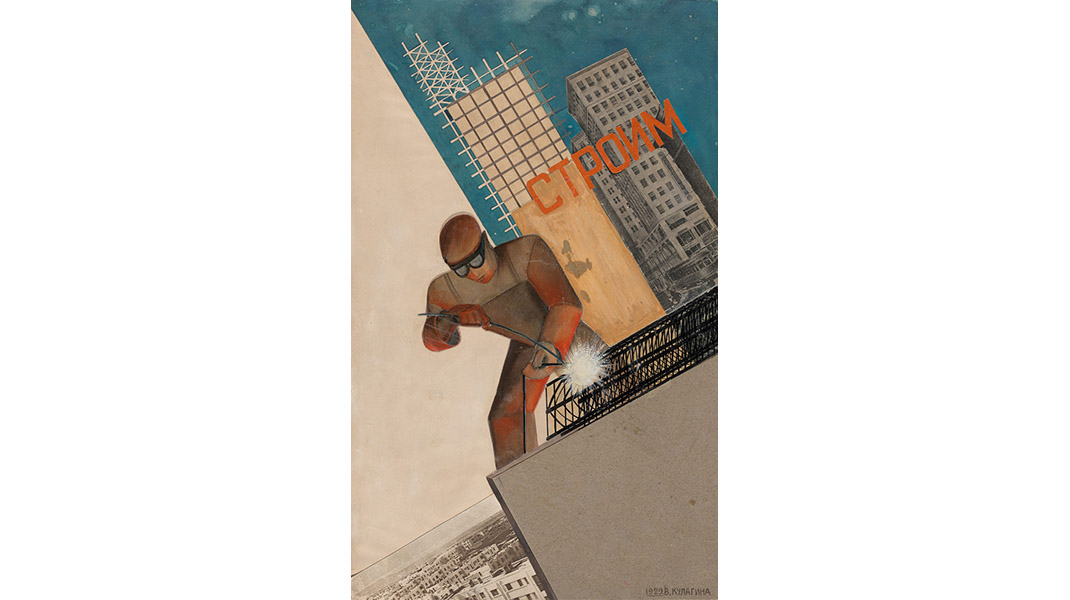
Engineer, Agitator, Constructor: The Artist Reinvented, a major exhibition that presents the political engagement, fearless and groundbreaking visual experimentation, and utopian aspirations of artists in the early 20th century. On view in The Robert B. Menschel Galleries, Engineer, Agitator, Constructor showcases the activities of historical avant-gardes, including galvanizing works of Dada, Bauhaus, De Stijl, Futurism, and Russian Constructivism, and highlights such figures as Aleksandr Rodchenko, Lyubov Popova, John Heartfield, and Hannah Höch. Drawn from the Museum’s outstanding holdings from this period, the exhibition marks a recent acquisition of more than 300 works from the Merrill C. Berman Collection, one of the most significant collections of early 20th-century works on paper in private hands.” — The Museum of Modern Art

“The exhibition asks: during and in the wake of war and revolution, does the artist have a right to exist? If so, on what basis? And in what form? These questions—central to the theoretical debates of the era—will serve as the exhibition’s focus,” says Hauptman. “Just as gripping is the possibility of linking the radical experimentation of the early 20th century with contemporary art. The strategies, practices, and languages of artists involved in Constructivism, Dada, and Futurism, for example, are still reverberating today, and the exhibition will provoke vigorous and challenging conversations across time.”

John (born Helmut Herzfelde) Heartfield (German, 1891–1968). The Hand Has Five Fingers (5 Finger hat die Hand) (Campaign poster for German Communist Party). 1928. Lithograph. Printer: Peuvag-Druckerei, Berlin. 38 1/2 × 29 1/4′′ (97.8 × 74.3 cm). The Museum of Modern Art, New York. The Merrill C. Berman Collection
Hannah Höch (German, 1889–1978). Untitled (Dada). c. 1922. Cut-and-pasted printed and colored paper on board. 9 3/4 × 13′′ (24.8 × 33 cm). The Museum of Modern Art, New York. The Merrill C. Berman Collection
Herbert Bayer (American, born Austria, 1900–1985). Exhibition stand for electrical company. 1924. Gouache, ink, pencil, and cut-and-pasted printed paper on board. 26 3/8 × 14 15/16′′ (67 × 38 cm). The Museum of Modern Art, New York. The Merrill C. Berman Collection
Max Burchartz (German, 1887–1961). Untitled (red square). c. 1928. Cut-and-pasted printed and painted paper on board. 19 11/16 × 13 9/16′′ (50 × 34.5 cm). The Museum of Modern Art, New York. The Merrill C. Berman Collection
Valentina Kulagina (Russian, 1902–1987). Maquette for We Are Building (Stroim). 1929. Cut-and-pasted printed and painted paper, sandpaper, gouache, and pencil on paper. 22 5/8 × 14 1/4′′ (57.5 × 36.2 cm). The Museum of Modern Art, New York. The Merrill C. Berman Collection
Liubov Popova (Russian, 1889–1924). Production Clothing for Actor No. 7 (Prozodezhda aktera No. 7). 1922 (inscribed 1921). Gouache, cut-and-pasted colored paper, ink, and pencil on paper. 12 15/16 × 9 1/8″ (32.8 × 23.1 cm). The Museum of Modern Art, New York. The Merrill C. Berman Collection

Engineer, Agitator, Constructor: The Artist Reinvented is organized by Jodi Hauptman, Senior Curator, Department of Drawings and Prints, MoMA, and Adrian Sudhalter, Consulting Curator, with Jane Cavalier, Curatorial Assistant, Department of Drawings and Prints, MoMA.

Images courtesy The Museum of Modern Art.

Queen Nefertari’s Egypt at Kimbell Art Museum, December 6, 2020 – March 14, 2021

“The Kimbell Art Museum presents a sweeping showcase of female power and influence during the height of ancient Egyptian civilization in the exhibition Queen Nefertari’s Egypt.

At the heart of the exhibition is Queen Nefertari, who was renowned for her beauty and prominence. Called ‘the one for whom the sun shines,’ Nefertari was the favorite wife of pharaoh Ramesses II. She and other women of ancient Egypt are brought to life through 230 objects from temples, tombs, palaces and the artisan village of Deir el-Medina, presenting the richness of Egyptian culture some 3,000 years ago. 

Drawn from the Museo Egizio in Turin, Italy, one of the most important and extensive collections of ancient Egyptian works in the world, these exceptional objects highlight the role of women—goddesses, queens and artisans—in Egypt’s New Kingdom period (c. 1539–1075 B.C.). Visitors can expect to see majestic statues, exquisite jewelry, decorated vases, papyrus manuscripts, carved steles, splendid stone sarcophagi and intricately painted wooden coffins, as well as tools and items of daily life from the craftsmen who built the royal tombs.” — Kimbell Art Museum

Statue of Ramesses II, Seated Between Amun and Mut. Temple of Amun, Karnak. New Kingdom, 19th dynasty, reign of Ramesses II (ca. 1279–1213 B.C.E.). Granite. Cat. 0767. Museo Egizio, Turin, Italy
Statue of the Goddess Sekhmet. Thebes. New Kingdom, 18th dynasty, reign of Amenhotep III (ca. 1390–1353 B.C.E.). Granodiorite. Cat. 0251. Museo Egizio, Turin, Italy
Statue Bearing the Name Thutmose I. Temple of Amun, Karnak. New Kingdom, 18th dynasty, reign of Thutmose I (ca. 1493–1483 B.C.E.). Granodiorite. Cat. 1374. Museo Egizio, Turin, Italy
Stela Depicting Ramesses II. Provenance unknown. New Kingdom, 19th–20th dynasty (ca. 1292–1075 B.C.E.). Limestone. Cat. 1462. Museo Egizio, Turin, Italy
Model of the Lesser Temple of Abu Simbel. Probably Italian. Early 1800s, acquired around 1825. Stuccoed wood. Cat. 7104. Museo Egizio, Turin, Italy
Statue of the Goddess Mut. Unknown provenance. New Kingdom, early 19th dynasty (ca. 1292–1250 B.C.E.). Limestone. Cat. 769. Museo Egizio, Turin, Italy
Statuette of Ahmose-Nefertari. Deir el-Medina. New Kingdom, 18th dynasty (ca. 1539– 1292 B.C.E.). Wood. Cat. 1389. Museo Egizio, Turin, Italy
Model of the Lesser Temple of Abu Simbel. Probably Italian. Early 1800s, acquired around 1825. Stuccoed wood. Cat. 7104. Museo Egizio, Turin, Italy
Box with Floral Motifs. Unknown provenance. New Kingdom, 18th dynasty (ca. 1539– 1292 B.C.E.). Painted wood. Cat. 2448. Museo Egizio, Turin, Italy
Sculptor’s Model of Nekhbet and Wadjet. Unknown provenance. Ptolemaic Period (ca. 332–32 B.C.E.). Limestone. Cat. 7055. Museo Egizio, Turin, Italy
Ostracon Depicting a Prince Valley of the Queens. New Kingdom, 20th dynasty, reign of Ramesses III (ca. 1186–1155 B.C.E.). Limestone with red paint. S. 05637. Museo Egizio, Turin, Italy
Stela of Kel. New Kingdom. 19th dynasty, Ramesses II (1279–1213 BC). Limestone bas-relief. Cat. 1636. Museo Egizio, Turin, Italy
Stela of Nakhi. Probably from Deir el-Medina. New Kingdom, late 18th dynasty (ca. 1300 B.C.E.). Painted sandstone. Cat. 1586. Museo Egizio, Turin, Italy
Stela of Pendua. Probably from Deir el-Medina. New Kingdom, 19th–20th dynasty ( ca. 1292–1075 B.C.E.). Painted limestone. Cat. 1565. Museo Egizio, Turin, Italy
Shabti of Amennakht. Deir el-Medina. New Kingdom, 19th dynasty (ca. 1292– 1198 B.C.E.. Painted wood. Cat. 2528. Museo Egizio, Turin, Italy
Book of Amduat. Thebes. Third Intermediate Period, 21st–24th dynasty (ca. 1075–712 B.C.E.). Papyrus with ink. Cat. 1783. Museo Egizio, Turin, Italy
Shabti of Seti I. Unknown provenance. New Kingdom, 19th dynasty, reign of Seti I (ca. 1290–1279 B.C.E.). Faience. Cat. 2503. Museo Egizio, Turin, Italy
Statue of Idet and Ruiu. Probably from the Theban Necropolis. New Kingdom, early 18th dynasty (ca. 1480–1390 B.C.E.). Painted limestone. Cat. 3056. Museo Egizio, Turin, Italy
Francesco Ballerini, Edoardo Baglione, and Michelangelo Pizzio. Italian. Model of Nefertari’s Tomb, early 1900s. Wood. Provv. 3749. Museo Egizio, Turin, Italy
Funerary Objects from Queen Nefertari’s tomb. Tomb of Nefertari (QV66), Valley of the Queens. New Kingdom, 19th dynasty, reign of Ramesses II (ca. 1279–1213 B.C.E.). Museo Egizio, Turin, Italy
Sarcophagus Lid of Queen Nefertari. Tomb of Nefertari (QV66), Valley of the Queens. New Kingdom, 19th dynasty, reign of Ramesses II (ca. 1279–1213 B.C.E.). Granite. S. 05153. Museo Egizio, Turin, Italy
Coffin of Namenekhetimenipet. Valley of the Queens, Thebes. Late Period, 25th–26th dynasty (ca. 722– 525 B.C.E.). Stuccoed and painted wood. S. 05222. Museo Egizio, Turin, Italy
Lid from the Coffin of Ankhpakhered. Valley of the Queens, Thebes Late Period, 25th–26th dynasty (ca. 722– 525 B.C.E.). Stuccoed and painted wood. S. 05259. Museo Egizio, Turin, Italy

“I hope visitors will appreciate the high level of artisanship in these works, ” said Jennifer Casler Price, curator of Asian, African and Ancient American art, “whether it is a majestic carved stone sculpture, an exquisite piece of jewelry, a precious perfume jar, a beautifully painted piece of domestic pottery, a humble painter’s brush, delicately painted papyri, intricately painted coffins or even a queen’s pair of unassuming palm sandals.”

The exhibition is organized by the Museo Egizio, Turin, and StArt, in collaboration with the Kimbell Art Museum. The organizing curator at the Kimbell Art Museum is Jennifer Casler Price, curator of Asian, African and Ancient American art.

JEFRË: Points of Connection at Orlando Museum of Art, through January 3, 2021

JEFRË: Points of Connection, the first solo exhibition of Florida-based artist JEFRË whose large-scale work has transformed public spaces in the U.S. and abroad, is on view at the Orlando Museum of Art. The exhibition presents 40 works across the variety of mediums including sculpture, video, and site-specific installation.

Designed to be a touchless, interactive exhibition, Points of Connection introduces the audience to JEFRË’s past projects alongside a series of works exemplifying his current studio practice. Across six galleries, visitors are guided by the stanzas of the artist’s poem ‘Heart to Heart’ as they interact with immersive installations exploring his identity as a second-generation immigrant, history with heart disease, and creative work as a city placemaker.

As in his public work where JEFRË experiments with new materials and technologies, aiming to activate public spaces and bring people together through a shared experience, his museum exhibition seeks to illuminate our common humanity across age, gender, ethnicity and nationality.” — Orlando Museum of Art

Installation views of JEFRË: Points of Connection. Courtesy of Studio Jefrë.

Exhibition Entrance
Talking Heads (Collective Conscious Series/COVID-19):  Free | Love | Passionate | Independent | Brave | Confident | Survivor | Unique | Dreamer | Creative | Kind | Respectful | Beautiful | Sensitive | Blessed, 2020. Acrylic, LED neon, interactive QR Program, 58 x 50 x 53 in. (each).
Talking Heads: Collective Conscious Series/COVID-19, 2020
Baks Series, 2020. Stainless Steel
Inside the artist studio. Studio Model. 24 ¼ x 25 x 27 ½ in.
One Peace, One Love (Baks Series), 2020. 13 ½ x 6 x 10 ft. Stainless steel, artificial moss, MDF, projection, facial recognition kiosk. Collection of Virgin Feast (Sir Richard Branson).
Rice Field, 2020. Expired white & Brown rice, 40 x 25 x 10 ft.
JEFRË. Singing in The Rain, 2019

Kandinsky at Guggenheim Museum Bilbao, November 20, 2020 – May 23, 2021

“The Guggenheim Museum Bilbao presents Kandinsky , a comprehensive exhibition of paintings and works on paper of artist Vasily Kandinsky (b. 1866, Moscow; d. 1944, Neuilly-sur-Seine, France) drawn primarily from the Solomon R. Guggenheim Foundation’s rich holdings. The exhibition traces the aesthetic evolution of a pioneer of abstraction, a renowned aesthetic theorist, and one of the foremost artistic innovators of the early twentieth century. In his endeavor to free painting from its ties to the natural world, Kandinsky discovered a new subject matter based solely on the artist’s ‘inner necessity’ that would remain his lifelong concern.

In Munich in the 1900s and early 1910s, Kandinsky began exploring the expressive possibilities of color and composition, but he was abruptly forced to leave Germany following the outbreak of World War I, in 1914. The artist eventually returned to his native Moscow, where his pictorial vocabulary began to reflect the utopian experiments of the Russian avant-garde, who emphasized geometric shapes in an effort to establish a universal aesthetic language. Kandinsky subsequently joined the faculty of the Bauhaus, a German school of art and applied design that shared his belief in art’s ability to transform self and society. Compelled to abandon Germany again when the Bauhaus closed under Nazi pressure in 1933, Kandinsky settled outside Paris, where Surrealism and the natural sciences influenced his biomorphic imagery.

More so than any other artist, Kandinsky is intertwined with the history of the Solomon R. Guggenheim Foundation, established in New York in 1937. Industrialist and museum founder Solomon R. Guggenheim began collecting Kandinsky’s work in 1929 and met him at the Dessau Bauhaus the following year. This exhibition illustrates the full arc of Kandinsky’s seminal career. Divided into four geographical sections, the exhibition follows Kandinsky through critical periods of his artistic development.” — Guggenheim Museum Bilbao

Kandinsky. Black Lines (Schwarze Linien), December 1913. Oil on canvas, 130.5 × 131.1 cm. Solomon R. Guggenheim Museum, New York, Solomon R. Guggenheim Founding Collection, By gift 37.241 © Vasily Kandinsky, VEGAP, Bilbao, 2020
Kandinsky. In the Black Square (Im schwarzen Viereck), June 1923. Oil on canvas, 97.5 × 93.3 cm. Solomon R. Guggenheim Museum, New York, Solomon R. Guggenheim Founding Collection, By gift 37.254 © Vasily Kandinsky, VEGAP, Bilbao, 2020
Kandinsky. Painting with White Border (Bild mit weißem Rand), May 1913. Oil on canvas, 140.3 × 200.3 cm. Solomon R. Guggenheim Museum, New York, Solomon R. Guggenheim Founding Collection, By gift 37.245 © Vasily Kandinsky, VEGAP, Bilbao, 2020
Kandinsky. Composition 8 (Komposition 8), July 1923. Oil on canvas, 140.3 × 200.7 cm. Solomon R. Guggenheim Museum, New York, Solomon R. Guggenheim Founding Collection, By gift 37.262 © Vassily Kandinsky, VEGAP, Bilbao, 2020
Kandinsky. Improvisation 28 (Second Version) (Improvisation 28 [zweite Faßung]), 1912. Oil on canvas, 112.6 × 162.5 cm. Solomon R. Guggenheim Museum, New York, Solomon R. Guggenheim Founding Collection, By gift 37.239 © Vasily Kandinsky, VEGAP, Bilbao, 2020
Kandinsky. Several Circles (Einige Kreise), January–February 1926. Oil on canvas, 140.7 × 140.3 cm. Solomon R. Guggenheim Museum, New York, Solomon R. Guggenheim Founding Collection, By gift 41.283 © Vasily Kandinsky, VEGAP, Bilbao, 2020
Kandinsky. Blue Mountain (Der blaue Berg), 1908–09. Oil on canvas. 107.3 × 97.6 cm. Solomon R. Guggenheim Museum, New York, Solomon R. Guggenheim Founding Collection, By gift 41.505 © Vasily Kandinsky, VEGAP, Bilbao, 2020
Kandinsky. Small Pleasures (Kleine Freuden), June 1913. Oil on canvas, 110.5 × 120 cm. Solomon R. Guggenheim Museum, New York, Solomon R. Guggenheim Founding Collection 43.921 © Vasily Kandinsky, VEGAP, Bilbao, 2020
Kandinsky. Dominant Curve (Courbe dominante), April 1936. Oil on canvas, 129.2 × 194.3 cm. Solomon R. Guggenheim Museum, New York, Solomon R. Guggenheim Founding Collection 45.989 © Vasily Kandinsky, VEGAP, Bilbao, 2020
Kandinsky. Striped (Rayé), November 1934. Oil with sand on canvas, 81 × 100 cm. Solomon R. Guggenheim Museum, New York, Solomon R. Guggenheim Founding Collection 46.1022 © Vasily Kandinsky, VEGAP, Bilbao, 2020
Kandinsky. Around the Circle (Autour du cercle), May–August 1940. Oil and enamel on canvas, 97.2 × 146.4 cm. Solomon R. Guggenheim Museum, New York, Solomon R. Guggenheim Founding Collection 49.1222 © Vasily Kandinsky, VEGAP, Bilbao, 2020
Kandinsky. Fragments, May 1943. Oil and gouache on board, 41.9 × 57.9 cm. Solomon R. Guggenheim Museum, New York, Solomon R. Guggenheim Founding Collection 49.1224 © Vasily Kandinsky, VEGAP, Bilbao, 2020
Kandinsky. Unshaken (Unerschüttert), February 1929. Watercolor and ink on paper, 35.4 × 49.1 cm. The Hilla von Rebay Foundation, On extended loan to the Solomon R. Guggenheim Museum, New York 1970.94 © Vasily Kandinsky, VEGAP, Bilbao, 2020
Erfurth Hugo (1874-1948). Portrait of Kandinsky Paris, Centre Pompidou – Musée national d’art moderne – Centre de création industrielle Photo (C) Centre Pompidou, MNAM-CCI, Dist. RMN-Grand Palais / Guy Carrard © Vasily Kandinsky, VEGAP, Bilbao, 2020

Exhibition is curated by Megan Fontanella, Curator, Modern Art and Provenance, Solomon R. Guggenheim Museum.

Images courtesy Guggenheim Museum Bilbao.

Richard Nielsen: This is Not a Gag at MASS MoCA, On view through 2021

“In March 2020, Los Angeles-based artist Richard Nielsen began painting portraits of people in their COVID-19 face masks. On view at MASS MoCA, This is Not a Gag includes his first set of 49 paintings. Presented in a Zoom-like grid, the series shows the determination behind the eyes of artists, writers, and friends of the artist and MASS MoCA. The subject’s faces may be covered, but variations in masks and individual expressions speak volumes about our lives today. These paintings are not about the pandemic, per se, but about the fiercest and finest parts of human nature.

As the pandemic grew, masks became political – anti-maskers abounded, while others took donning masks not only as a smart health move but also as a sign of shared civic responsibility. This added meaning allows Nielsen to imbue his subjects’ personalities and beliefs into their portraits. For Nielsen, the mask creates an abstract surface on the face, one that his subjects can use for self-expression, while also creating a space that he can play with in paint. The images are full of individuality, showing the essence of each human, even when we cannot see their whole face.” — MASS MoCA

Images: Richard Nielsen, This is Not A Gag, 2020. Courtesy the artist.

Bob Faust (artist/designer, Chicago, IL)
Carly Golvinski (artist, Dover, NH)
Christine Wertheim (artist, Los Angeles, CA/Melbourne, Australia)
Denise Markonish (curator, MASS MoCA)
Erica Wall (gallery director, MCLA, North Adams, MA)
Helga Davis (singer/composer, New York, NY)
Richard Nielsen (artist, Los Angeles, CA)
Clarence Patton (LGBTQI and POC leadership professional, North Adams, MA)
Nick Bennett (Curatorial assistant, Brooklyn Rail, NY)
Joe Thompson (Director, MASS MoCA)
Kambui Olujimi (artist, New York, NY)
Kathryn Pruett (assistant registrar, MASS MoCA)
Nick Cave (artist, Chicago, IL)

When Nielsen shared the first images of this series with MASS MoCA’s senior curator, Denise Markonish, she started to gather mask selfies from museum employees, exhibiting artists, and friends. Nielsen’s paintings are hung in a large grid, like an epic Zoom call, a temporarily catalyzed community, united yet apart. Exhibiton was curated by Denise Markonish.

Images courtesy MASS MoCA.

Alex Da Corte: Rubber Pencil Devil at Prada Rong Zhai, Shanghai, through January 17, 2021

“Conceived in 2018, ‘Rubber Pencil Devil’ is a video work composed by 57 chapters and a prologue. In Rong Zhai the work is presented by the artist in a site-specific exhibition format featuring 51 of the 57 acts on 19 large rear-pro-jection multi-colored video cubes displayed in the two main floors of the building, giving a new spatial configuration to the artwork according to the new venue.

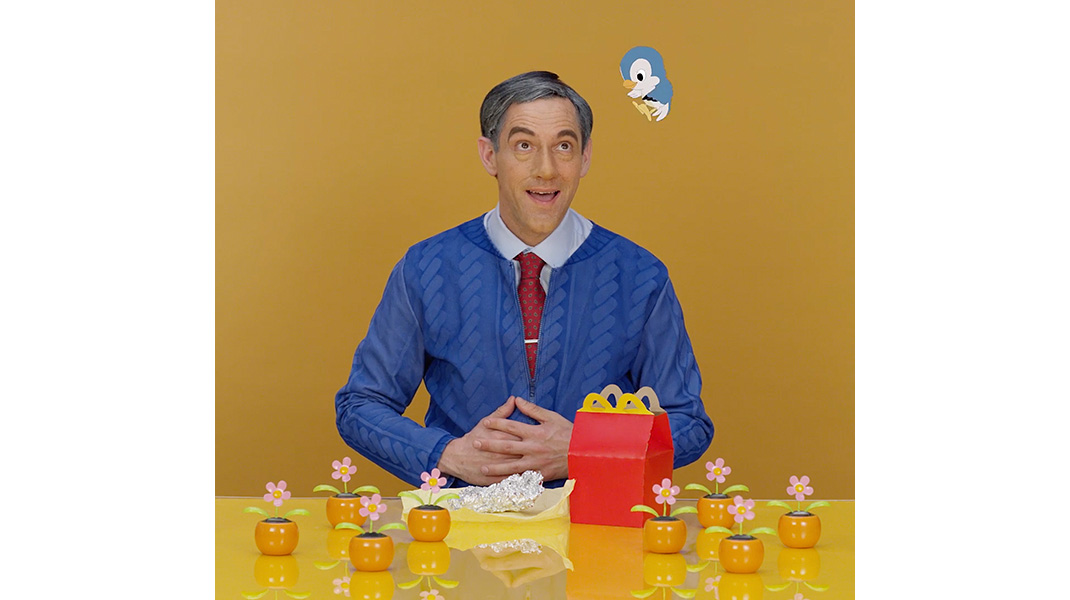
‘Rubber Pencil Devil’ is a looping, two-hour-40-minute stream of highly stylized videos inspired by a wide range of iconographical and cultural sources from vintage television imagery to 20th-century animation, from queer icons to campy Americana. Da Corte’s artwork functions as a hypnotically slow choreography performed by popular and recognizable figures. They are immersed in an over-sized and over-saturated universe composed of everyday objects, domestic symbols and familiar codes. One of ‘Rubber Pencil Devil’ performers is the artist himself, who mutates into various food puppets and iconic characters such as Pink Panther, Sylvester the Cat, Mister Rogers and the devil.

According to Da Corte, ‘Rubber Pencil Devil’ is a ‘Gesamtkunstwerk’, a total work of art, an immersive experience combining video, music and architecture, rich in allusions to avantgarde visual artists, experimental writers, pop singers, show-biz personalities and cartoon characters. For the spaces of Prada Rong Zhai Da Corte has conceived a fragmentary and vividly-hued display, a kaleidoscopic and dream-like journey in which his wish ‘of pushing beyond an image or breaking through the screen and actually touching the thing on-screen’ can be fulfilled.” — Prada Rong Zhai

Exhibition views of “Rubber Pencil Devil” by Alex Da Corte, Prada Rong Zhai, November 13, 2020 – January 17, 2021. Photos: Alessandro Wang. Courtesy Prada.

“Rubber Pencil Devil” is a site-specific intervention by American artist Alex Da Corte with the support of Fondazione Prada. The project is on view in Prada Rong Zhai, a 1918 historical residence in Shanghai restored by Prada and reopened in October 2017.

Working Together: The Photographers of the Kamoinge Workshop at Whitney Museum of American Art, November 21, 2020 – March 28, 2021

“The Whitney presents Working Together: The Photographers of the Kamoinge Workshop, a groundbreaking exhibition featuring over 150 photographs by fourteen early members of the Kamoinge Workshop, nine of whom are living and working today. In 1963 a group of Black photographers based in New York came together in the spirit of friendship and exchange and chose the name Kamoinge—meaning ‘a group of people acting together’ in Gikuyu, the language of the Kikuyu people of Kenya—to reflect the essential ideal of the collective. Focusing on the first two decades of the collective (1963-1983), Working Together celebrates the Kamoinge Workshop’s important place in the history of photography and foregrounds the collective’s deep commitment to photography’s power and status as an independent art form.” — Whitney Museum of American Art

“It’s a privilege to present this exhibition in New York where the collective was founded, and where much of the artists’ influential, early work was created,” said Carrie Springer, assistant curator. “Each artist had his or her own sensibility and independent career, but they shared a commitment to photography as an art form, and the exhibition demonstrates their insightful and inventive portrayal of the communities they saw and participated in. As Louis Draper said in an introductory statement to Kamoinge Workshop Portfolio No. 1, the Kamoinge artists’ ‘creative objectives reflect a concern for truth about the world, about the society and about themselves.’ The photographs of these artists are as significant to the history of photography as they are to the current moment.”

Adger Cowans, Footsteps, 1960. Gelatin silver print, image: 8 1/4 × 13 5/16 in. (20.96 × 33.81 cm). Virginia Museum of Fine Arts, Aldine S. Hartman Endowment Fund, 2018.201. © Adger Cowans
Albert Fennar, Salt Pile, 1971. Gelatin silver print, 6½ x 6½ in. (16.51 x 16.51 cm). Collection of Shawn Walker. © Miya Fennar and The Albert R. Fennar Archive
Anthony Barboza (b. 1944), Kamoinge Members, 1973. Gelatin silver print: sheet, 13 15/16 × 11 1/16 in. (35.4 × 28.1 cm); image, 9 13/16 × 10 in. (24.9 × 25.4 cm). Whitney Museum of American Art, New York; purchase with funds from the Jack E. Chachkes Endowed Purchase Fund 2020.55. © Anthony Barboza
Beuford Smith, Two Bass Hit, Lower East Side, 1972. Gelatin silver print, sheet: 10 15/16 × 13 15/16 in. (27.78 × 35.4 cm), image: 9 3/8 × 13 1/2 in. (23.81 × 34.29 cm). Virginia Museum of Fine Arts, Arthur and Margaret Glasgow Endowment, 2017.36. © Beuford Smith/Césaire
Herb Robinson, Brother & Sister, 1973. Gelatin silver print: sheet, 11 1/16 × 14 1/16 in. (28.1 × 35.7 cm); image, 6 5/8 × 9 in. (16.7 × 22.9 cm). Whitney Museum of American Art, New York; purchase with funds from the Photography Committee 2020.46. © Herb Robinson
Herbert Randall (b. 1936), Untitled (Palmers Crossing, Mississippi), 1964. Gelatin silver print: sheet, 14 × 10 15/16 in. (35.6 × 27.8 cm); image, 13 1/2 × 8 7/8 in. (34.3 × 22.5 cm). Whitney Museum of American Art, New York; purchase with funds from the Photography Committee 2020.57. © Herbert Randall
James “Jimmie” Mannas, No Way Out, Harlem, NYC, 1964. Gelatin silver print, mount: 15 1/16 × 11 in. (38.26 × 27.94 cm), image: 8 5/16 × 6 3/8 in. (21.11 × 16.19 cm). Virginia Museum of Fine Arts, Arthur and Margaret Glasgow Endowment, 2019.201. © Jimmie Mannas
Louis Draper (American, 1935-2002), Untitled (Santos), 1968. Gelatin silver print, sheet: 8 15/16 × 5 7/8 in. (22.7 × 14.92 cm). Virginia Museum of Fine Arts, National Endowment for the arts Fund for American Art, 2013.151. © Courtesy of the Louis H. Draper Preservation Trust, Nell D. Winston, Trustee
Ming Smith, America seen through Stars and Stripes, New York City, New York, printed ca. 1976. Gelatin silver print, sheet: 15 3/4 × 20 in. (40.01 × 50.8 cm), image: 12 1/2 × 18 1/2 in. (31.75 × 46.99 cm). Virginia Museum of Fine Arts, Adolph D. and Wilkins C. Williams Fund, 2016.241. © Ming Smith
Shawn Walker (b. 1940), Easter Sunday, Harlem (125th Street), 1972. Gelatin silver print: sheet, 7 3/4 × 9 3/4 in. (19.7 × 24.8 cm); image, 6 1/4 × 8 1/2 in. (15.9 × 21.6 cm). Whitney Museum of American Art, New York; purchase with funds from the Photography Committee, the Jack E. Chachkes Endowed Purchase Fund, and the Robert Mapplethorpe Foundation 2020.61. © Shawn Walker

The exhibition is organized by the Virginia Museum of Fine Arts (VMFA) and was curated by Dr. Sarah Eckhardt, associate curator of modern and contemporary art. The installation at the Whitney is overseen by Carrie Springer, assistant curator, with Mia Matthias, curatorial assistant.

Images courtesy Whitney Museum of American Art.

Second Careers: Two Tributaries in African Art at The Cleveland Museum of Art, November 1, 2020 – March 14, 2021

 “The connections between historical African art and contemporary practice are deep but not always apparent. Second Careers: Two Tributaries in African Art probes this connection through a smart selection of stellar highlights from the Cleveland Museum of Art’s African collection and loaned works by six contemporary African artists of different generations.

 Second Careers: Two Tributaries in African Art presents objects from nine cultures in Central and West Africa that are juxtaposed with large-scale contemporary installations, sculptures and photographs. The exhibition considers the status of canonical African art objects as they begin their ‘second careers’ upon entering museum collections. It simultaneously examines modes of artistic production in Africa that employ mediums that once served other purposes in everyday life.” — The Cleveland Museum of Art 

“The exhibition’s premise is twofold,” said Ugochukwu-Smooth Nzewi, the exhibition’s curator and former curator of African Art at the CMA, currently the Steven and Lisa Tananbaum Curator of Painting and Sculpture at the Museum of Modern Art in New York. “Second Careers explores the role of historical African art in the Western museum context: how the objects made their way into the museum and the expectations placed on them to educate, to act as vectors of cultural memory and history and, ultimately, to add value to the institution in their second careers. The exhibition’s secondary focus is the relationship between historical arts of Africa and contemporary practices.” 

Mask, early 1900s. Central Africa, Democratic Republic of the Congo, Yaka people.
Wood, cloth, fibers, pigment; h. 47 cm. The Cleveland Museum of Art,
Gift of Katherine C. White.
Untitled (Jua Kali Series), 2014. Tahir Carl Karmali (Kenyan, b. 1987).
Archival pigment print; 45.7 x 30.5 cm. © Tahir Carl Karmali.
Untitled (Jua Kali Series), 2014. Tahir Carl Karmali (Kenyan, b. 1987).
Archival pigment print; 45.7 x 30.5 cm. © Tahir Carl Karmali.
Egúngún Masquerade Dance Costume (paka egúngún), c. 1920–48. Yorùbá. Cotton, wool, wood, silk, synthetic
textiles (including viscose rayon and acetate), indigo, and aluminum; approx.: 139.7 x 15.2 x 160 cm.
Brooklyn Museum, Gift of Sam Hilu.
Tightrope: Non-Essential Speed, 2017. Elias Sime. Reclaimed electronic components and wire on panel; 183.8 x 402.6 cm. © Elias Sime. Courtesy the artist and James Cohan Gallery, New York.
When All Is Said and Done (detail), 2016. Nnenna Okore (Australia, b. 1975). Burlap, jute rope, wire, and dye; 304.8 x 731.5 cm. © Nnenna Okore. Image courtesy the artist.
Earth Growing Roots (detail), 2007. El Anatsui (Ghanaian, b. 1944). Aluminum and copper wire;
236.2 x 401.3 cm. Private Collection. © El Anatsui. Courtesy the artist and Jack Shainman Gallery.

Images courtesy The Cleveland Museum of Art.

Chance: Escape from the Holocaust: Memories of a Refugee Childhood by Uri Shulevitz, Farrar Straus Giroux, New York, October 13, 2020

“I wrote Chance as a memorial to my parents, who are no longer alive, and who can now live forever in my book. I wrote it now while I still have vivid memories of events from over 80 years ago, and before I begin to forget them. I call my memoir Chance because during World War II blind chance decided who shall live and who shall die.

When I began working on the book, I started thinking about my life as a kid. As memories came, I took notes. Once I had many notes, I began writing. As I wrote, more memories came. Some of these memories were very painful, bringing tears to my eyes. There were also humorous moments, bringing comic relief to my story. So that overall writing this memoir was a cathartic experience.

Certain events were of particular importance, which I wanted to bring to the reader’s attention. In order for them not to get lost as words among words, and to slow down the reader, I introduced graphic sequences in which one has to look at pictures and not just read the words.” — Uri Shulevitz

Images from Chance written and illustrated by Uri Shulevitz.

Uri Shulevitz (b. Warsaw, Poland, 1935) has written and illustrated many celebrated children’s books. He won the Caldecott Medal for The Fool of the World and the Flying Ship, written by Arthur Ransome, and three Caldecott Honors for The TreasureSnow, and How I Learned Geography. His other books include One Monday MorningDawnSo Sleepy Story, and the instructional guide Writing with Pictures: How to Write and Illustrate Children’s Books. He lives in New York City.