“Kazuko Miyamoto: To perform a line is the first institutional exhibition to survey the significant artist Kazuko Miyamoto (b. 1942). The exhibition brings together key bodies of the artist’s work, beginning with her contributions to (and subversion of) the Minimalism movement through early paintings and drawings from the late 1960s and moving to her increasingly spatial string constructions of the 1970s, culminating with her kimono series from 1987 through the 2000s. A number of the works that are on view have never been shown together nor been exhibited since they were first created, offering a crucial opportunity for the public to encounter Miyamoto’s rich oeuvre for the first time and providing an overdue re-examination of this singular artist.” — Japan Society
Installation views of Kazuko Miyamoto: To perform a line at Japan Society. Photos by Corrado Serra.
Kazuko Miyamoto: To perform a line was curated by Tiffany Lambert. The exhibition design was by New York-based Ransmeier, Inc.
“[Magic is] the means of approaching the unknown by other ways than those of science or religion.” Max Ernst, 1946
“From April 9 through September 26, 2022 the Peggy Guggenheim Collection presents Surrealism and Magic: Enchanted Modernity, curated by Gražina Subelytė, Associate Curator, Peggy Guggenheim Collection. This is the first large-scale international loan exhibition to focus on the Surrealists’ interest in magic, alchemy, and the occult, and it includes about 60 works by more than 20 artists, from 40 international lenders, including prestigious museums and private collections. Chronologically, it ranges from the ‘metaphysical painting’ of Giorgio de Chirico around 1915, through iconic paintings such as Max Ernst’s Attirement of the Bride (1940) and Victor Brauner’s The Lovers (1947), to the occult symbolism of the late works of Leonora Carrington and Remedios Varo.
The exhibition’s point of departure is the world-class Surrealist holdings of the Peggy Guggenheim Collection, containing emblematic paintings that reflect the Surrealists’ dialogue with the occult tradition. Many artists represented in this show were exhibited by Peggy Guggenheim, who emerged as one of the most energetic collectors and patrons of Surrealism in the late 1930s. Having familiarized herself with Surrealism during her stay in Paris between the wars, she was on intimate terms with Max Ernst and Breton.” — Peggy Guggenheim Collection
The exhibition is organized by the Peggy Guggenheim Collection, Venice, and the Museum Barberini, Potsdam. There, it will be on view from October 22, 2022 to January 29, 2023, curated by Daniel Zamani, Curator, Museum Barberini, Potsdam.
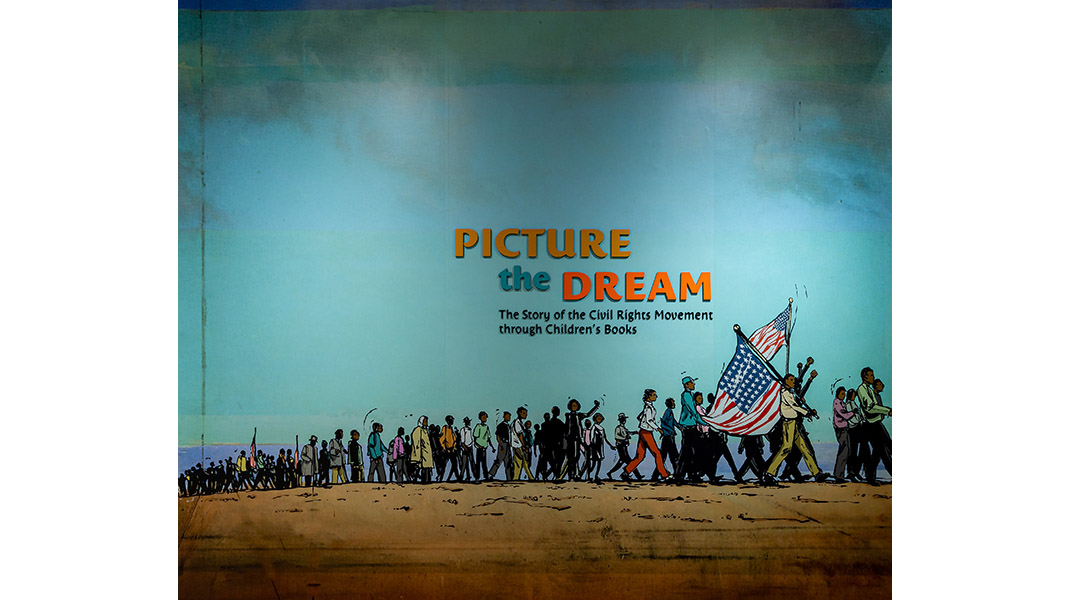
“The New-York Historical Society, New York’s first museum, presents an exhibition that explores the civil rights movement through one of the most emotionally compelling forms of visual expression—the children’s picture book. Picture the Dream: The Story of the Civil Rights Movement through Children’s Books, on view April 1 – July 24, 2022, highlights some of the most consequential moments in American history that continue to impact the nation today. Through illustrations and objects, the exhibition traces the legacy of social justice, thoughtfully presented for young audiences, and provides a jumping off point for important conversations about race, justice, and America’s past. The exhibition is co-organized by the High Museum of Art, Atlanta, where it debuted in August 2020, and The Eric Carle Museum of Picture Book Art, Amherst, Massachusetts.” — New-York Historical Society
“Through an immersive tapestry of images and ideas, the artworks in Picture the Dream: The Story of the Civil Rights Movement through Children’s Books take viewers by the hand and guide them through times of bravery and triumph,” said New York Times bestselling author Andrea Davis Pinkney, the exhibition’s curator and award-winning children’s book creator. “It’s an honor to collaborate on this experience that delivers a front-row seat to the dramatic events that continue to shape our world.”
Installation views of Picture the Dream: The Story of the Civil Rights Movement through Children’s Books at New-York Historical Society. Photos by Corrado Serra.
“We’re so pleased to welcome Picture the Dream: The Story of the Civil Rights Movement through Children’s Books to New York so that our audience can gain a powerful new perspective on the long march towards social justice,” said Dr. Louise Mirrer, president and CEO of New-York Historical. “By showing how the civil rights movement has been interpreted for children throughout the decades, the exhibition demonstrates the important role young people have played and highlights the influential figures and moments that are working towards moving our society forward.”
Picture the Dream: The Story of the Civil Rights Movement through Children’s Books is curated by award-winning children’s book author Andrea Davis Pinkney, and is coordinated at New-York Historical by Alice Stevenson, vice president and director of the DiMenna Children’s History Museum, and Alexandra Krueger, manager of museum affairs.
“In the 1980s, eight-year-old Guadalupe Maravilla fled the violence of El Salvador’s civil war and made a perilous, unaccompanied journey through Central America to the United States, where he reunited with undocumented family members. Nearly two decades later, while preparing for his M.F.A. thesis exhibition at Hunter College in New York City, he learned that he had stage-three cancer and began a grueling course of treatments.
To combat residual pain from the treatment, he was introduced to many types of ancient healing practices including a form of sound-as-medicine, which employs the vibrations and frequencies of gongs to release toxins in the body. Following his recovery, Maravilla devoted his artistic practice—which includes sculptures, drawings, paintings, choreography, sound, and performance—to healing. In his work, the artist engages particularly with the cancer and the undocumented communities of which he is a part, and whose collective trauma has given rise to a great need for care.” — Brooklyn Museum
“Tierra Blanca Joven addresses displacement of my people and our ancestors from the same land across several different points in history; the civil war, gang violence and government corruption, cataclysmic natural disasters, and the trade of cultural artifacts have all exiled Salvadoran and Maya peoples from present-day El Salvador,” says Maravilla. “The exhibition brings together representations of past, present, and future into one room—where the latest sculpture from my Disease Thrower series will meet ancient terracotta healers from the Museum’s collection, for example—as a reflection on intergenerational communal healing. Together, they share our history of displacement, while creating new visual narratives for the entangled genealogies of other border crossing communities.”
Installation views of Guadalupe Maravilla: Tierra Blanca Joven at Brooklyn Museum. Photos by Corrado Serra.
“This is an important moment of recognition for Maravilla, the first contemporary Central American artist to present a solo show at the Brooklyn Museum. His practice speaks eloquently to the urgent need for healing felt by individuals and communities as they seek to recover a sense of physical and psychological equilibrium resulting from the trauma of a global pandemic, political upheaval, and the effects of climate change,” says Eugenie Tsai, John and Barbara Vogelstein Senior Curator, Contemporary Art, Brooklyn Museum.
Guadalupe Maravilla: Tierra Blanca Joven is organized by Eugenie Tsai, John and Barbara Vogelstein Senior Curator, Contemporary Art, Brooklyn Museum, as part of Mindscapes, Wellcome’s international cultural program about mental health.
“In 2022, the Whitney will present the eightieth edition of its flagship exhibition, the Whitney Biennial. Established in 1932 by the Museum’s founder Gertrude Vanderbilt Whitney, it is the longest-running exhibition of its kind. Featuring sixty-three artists and collectives from a variety of generations, working across disciplines and media, the 2022 Biennial takes full advantage of the Museum’s unique architecture to present an exhibition that takes a look at the current state of contemporary art in America.
A constellation of the most relevant art and ideas of our time, the 2022 Whitney Biennial is co-organized by David Breslin, DeMartini Family Curator and Director of Curatorial Initiatives, and Adrienne Edwards, Engell Speyer Family Curator and Director of Curatorial Affairs, with Mia Matthias, Curatorial Assistant, Gabriel Almeida Baroja, Curatorial Project Assistant, and Margaret Kross, former Senior Curatorial Assistant.” — Whitney Museum
Installation views of Whitney Biennial 2022: Quiet as It’s Kept. Photos by Corrado Serra.
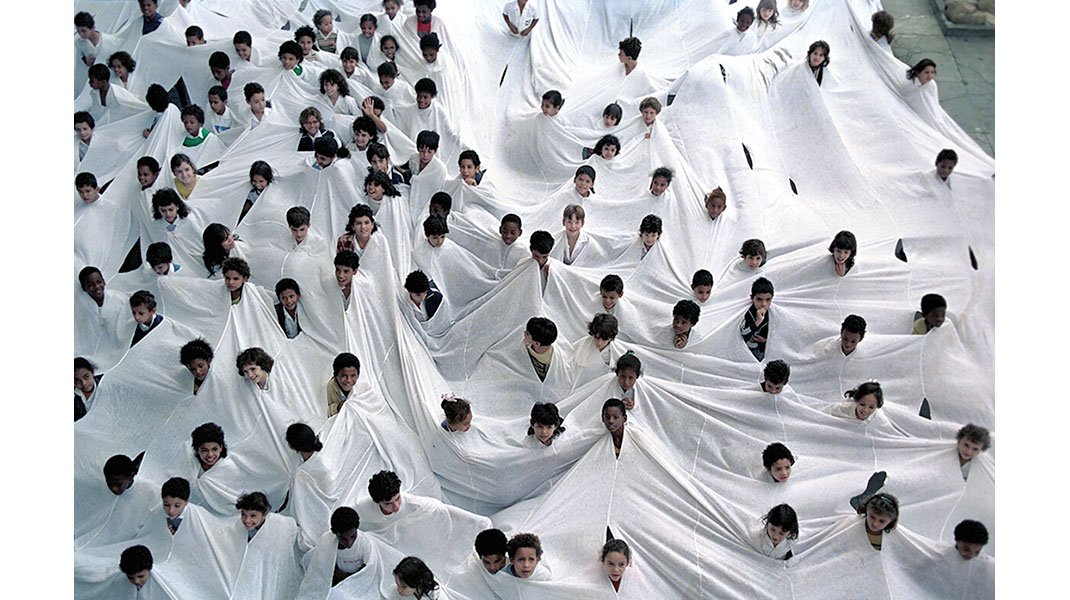
“The Pulitzer Arts Foundation presents Assembly Required, an exhibition of work by nine artists who invite the public to shape and co-produce their artworks. The artists—Francis Alÿs, Rasheed Araeen, Siah Armajani, Tania Bruguera/INSTAR, Lygia Clark, Hélio Oiticica, Yoko Ono, Lygia Pape, and Franz Erhard Walther—were selected for their shared belief in public action and its role in transforming society. Taken as a whole, the work in Assembly Required poses vital questions about how art enables us to imagine new ways of being in the world.
Created between the 1960s and the present, the artworks in Assembly Required respond to distinct social and political moments and issues, from the unrest in the United States during the Vietnam War to Peru’s military dictatorship in the 1990s, and more. Each artist offers unique perspectives on social change, addressing the need for optimism and hope in the face of global tensions.” — Pulitzer Arts Foundation
“Every possible happening is there in potential, ready to be realized in the act. Then for the first time, anyone is fit for the act of creating.” — Lygia Clark
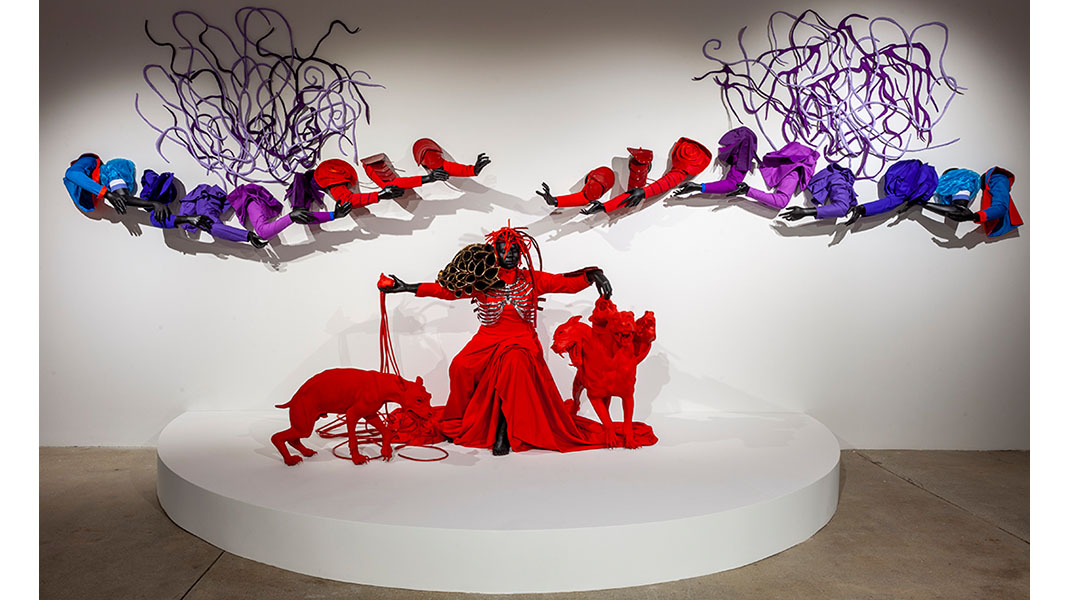
“The Museum of Arts and Design (MAD) presents Garmenting: Costume as Contemporary Art, the first global survey exhibition dedicated to the use of clothing as a medium of visual art. On view March 12 to August 14, 2022, the exhibition examines work by thirty-five international contemporary artists, from established names to emerging voices, several of whom will be exhibiting for the first time in the United States. By either making or altering clothing for expressive purposes, these artists create garments, sculpture, installation, and performance art that transforms dress into a critical tool for exploring issues of subjectivity, identity, and difference.
Garmenting as an artistic strategy emerged during the 1960s and 1970s. Its rise is linked to performance art, as garments used in installations often double as costumes in live and video- based performances. The practice came to increased prominence during the 1990s, its flourishing paralleling the emerging effects of globalization. With its emphasis on craft and the unique object, garmenting has been adopted globally by artists seeking ways to respond to the twenty-first-century blurring of socioeconomic boundaries, cultures, and identities. While some celebrate the hybridization of cultures resulting from globalization, others protest the fading of regional and ethnic traditions and communities; and many do both simultaneously. No matter their perspective, all these artists’ practices were shaped by transnational creative—and commercial—exchange.” — MAD
Installation view of Garmenting: Costume as Contemporary Art at the Museum of Arts and Design, New York. Photo by Jenna Bascom; courtesy the Museum of Arts and DesignInstallation view of Garmenting: Costume as Contemporary Art at the Museum of Arts and Design, New York. Photo by Jenna Bascom; courtesy the Museum of Arts and DesignInstallation view of Garmenting: Costume as Contemporary Art at the Museum of Arts and Design, New York. Photo by Jenna Bascom; courtesy the Museum of Arts and Design Mary Sibande. The Domba Dance, 2019. Life-size fiberglass, bronze, cotton, and silicone, 157 1/2 × 98 × 118 1/8 in. (400.1 × 248.9 × 300 cm). Installation view of Garmenting: Costume as Contemporary Art at the Museum of Arts and Design, New York. Photo by Jenna Bascom; courtesy the Museum of Arts and DesignNick Cave. Left: Soundsuit, 2018. Mixed media including vintage textile and sequined appliqués, metal and mannequin Center: Hustle Coat, 2017. Mixed media including trench coat, cast bronze hand, metal, costume jewelry, watches and chains Right: Soundsuit, 2006. Easter grass, mirrors, cotton, paint, appliqué. Photo by Jenna Bascom; courtesy the Museum of Arts and DesignDevan Shimoyama. February II, 2019. Silk flowers, rhinestones, jewelry, sequins, and embroidered patch on cotton hoodie with steel armature, coated wire and fishing line, 45 × 72 × 12 in. (114.3 × 182.9 × 30.5 cm). Courtesy Private Collection and De Buck Gallery, New York. Photo: Phoebe dHeurleInstallation view of Garmenting: Costume as Contemporary Art at the Museum of Arts and Design, New York. Photo by Jenna Bascom; courtesy the Museum of Arts and Design
Installation view of Garmenting: Costume as Contemporary Art at the Museum of Arts and Design, New York. Photo by Jenna Bascom; courtesy the Museum of Arts and Design
Jeffrey Gibson. The Anthropophagic Effect, Garment no. 4, 2019. Canvas, satin, cotton, brass grommets, nylon thread, artificial sinew, split reed, glass and plastic beads, nylon ribbon, 58 × 72 in. (147.3 × 182.9 cm). Courtesy the artist and Sikkema Jenkins Co., New York.Jaamil Olawale Kosoko. Chameleon (a visual album), 2020. Digital video. Photo by Jenna Bascom; courtesy the Museum of Arts and DesignA young Yu. DMZ Performance (performance still), 2020. Courtesy the artist. Photo: Matthew YuSaya Woolfalk, Expedition to the ChimaCloud. Digital video installation, textiles, painted metal, and 3D prints, 300 × 36 × 267 in. (762 × 91.4 × 678.1 cm). As installed March 1–September 1, 2019, in the Project Space at the Nelson-Atkins Museum of Art, Kansas City, MO. Courtesy Nelson-Atkins Media Services. Photo: Dana Anderson
“Despite the current ubiquity of garmenting as a visual arts practice, it has not previously been examined or theorized. This exhibition centers contemporary artists’ exploration of dress as a formal trope and critical tool, using the language of fashion to address fundamental aspects of subjectivity, including gender, class, race, and ethnicity.” — Alexandra Schwartz
The exhibition is guest curated by Alexandra Schwartz, a New York-based art historian, curator, and adjunct professor in the School of Graduate Studies at SUNY | Fashion Institute of Technology.
“In the spring and summer of 2022, The Frick Collection presents a one-room installation by Italian artist Giuseppe Penone (b. 1947) at the museum’s temporary home, Frick Madison. Displayed in the broader context of the museum’s decorative arts and Old Master paintings and sculpture, this unprecedented exhibition by the acclaimed Arte Povera artist is the first to feature his work in the medium of porcelain. Consisting of eleven disks created during a 2013 collaboration with the Sèvres Porcelain Manufactory in France, works never before shown publicly, this project invites a dialogue with the Frick’s rich holdings in the medium. Penone’s series of disks will be shown on the third floor in concert with a nearby gallery featuring eighteenth-century porcelains by several renowned manufactories.” — The Frick Collection
“When Sèvres asked me to collaborate with them, I simply turned over one of the manufactory’s products, a dish, and asked them to produce convex disks. This required a complex operation given the fluidity of porcelain at high firing temperatures. The prints of my fingers and the drawings I executed for each of the disks were then completed with skillful mastery by the decorators accustomed to the precision and detail that Sèvres porcelain requires. With these works, I wanted to epitomize the complexity of the great tradition to which Sèvres belongs—a tradition whose point of departure, the dish or bowl, is the very first container produced by a human being impressing their hand into a mound of clay.”
“The lyrical works Penone created at Sèvres respond to the longstanding tradition of the most important porcelain manufactory in France. Notable pieces from Sèvres are among the masterpieces of decorative arts at the Frick, and this exhibition, building on the strengths of previous projects, establishes a direct connection between our collection and the work of a significant artist active today.” — Xavier F. Salomon, Deputy Director and Peter Jay Sharp Chief Curator
Propagazioni: Giuseppe Penone at Sèvre is organized by Giulio Dalvit, the Frick’s Assistant Curator of Sculpture, and will be accompanied by a fully illustrated catalogue authored by Dalvit, with an introduction by Xavier F. Salomon, Deputy Director and Peter Jay Sharp Chief Curator.
“The New-York Historical Society presents a landmark exhibition that explores handmade Black dolls through the lens of race, gender, and history. On view February 25 – June 5, 2022, Black Dolls immerses visitors in the world of dolls, doll play, and doll making while examining the formation of racial stereotypes and confronting the persistence of racism in American history. The exhibition examines how these toys serve as expressions of resilience and creativity, perseverance and pride, and love and longing. They provide a unique view of the history of race in America, revealing difficult truths and inviting visitors to engage in the urgent national conversation about the legacy of slavery and racism.
Black Dolls features more than 200 objects, including 110 handmade dolls from the private collection of Deborah Neff, commercially produced 20th-century dolls, textiles, books, games, sewing tools, and ephemera from New-York Historical and other collections. Period photographs from the Neff Collection provide important context. Starting with dolls that reflect the horrors of slavery, the exhibition moves through Reconstruction, Jim Crow, and the beginnings of the civil rights movement of the 1960s.” — New-York Historical Society
Installation views of Black Dolls at New-York Historical Society. Photos by Corrado Serra.
“While the names of the women who created these dolls are largely unknown, every stitch that they sewed into place is invaluable evidence of their lived experience, as well as a reflection of the larger historical forces of slavery and its legacy,” said Dr. Louise Mirrer, president and CEO of New-York Historical. “We’re exceptionally proud to present this eye-opening exhibition and are grateful to all the lenders who have made it possible, led by Deborah Neff.”
Black Dolls is curated by Margi Hofer, vice president and museum director, and Dominique Jean-Louis, associate curator.
“The New Museum presents the first full retrospective in New York of the art of Faith Ringgold (b. 1930, New York, NY). Bringing together over fifty years of work, ‘Faith Ringgold: American People’ provides the most comprehensive assessment to date of Ringgold’s impactful vision. Her role as an artist, author, educator, and organizer has made her a key figure whose work links the multi-disciplinary achievements of the Harlem Renaissance to the political art of young Black artists working today. During the 1960s, Ringgold created some of the most indelible art of the civil rights era by melding her own unique style of figurative painting with a bold, transformative approach to the language of protest. In subsequent decades, she challenged accepted hierarchies of art and craft through her experimental quilt paintings and undertook a deeply studied reimagining of art history to produce narratives that bear witness to the complexity of the American experience.” — New Museum
Installation views of “Faith Ringgold: American People” at New Museum. Photos by Corrado Serra.
“Faith Ringgold: American People” is curated by Massimiliano Gioni, Edlis Neeson Artistic Director, and Gary Carrion-Murayari, Kraus Family Curator, with Madeline Weisburg, Curatorial Assistant.
“The Morgan Library & Museum presents Woody Guthrie: People Are the Song, opening February 18, 2022, and running through May 22, 2022. Curated in collaboration with the Woody Guthrie Center, Woody Guthrie Publications, and music historian Bob Santelli, the exhibition tells the story of the great American troubadour and writer Woody Guthrie in his own words and by his own hand. On view is an extraordinary selection of musical instruments, handwritten lyrics, manuscripts, photographs, books, art, and audiovisual media, assembled from the preeminent holdings of the Woody Guthrie Archive and several private collections. Prominent among these rarely seen objects are the original, handwritten lyrics to ‘This Land Is Your Land,’ one of the world’s most famous protest songs, which Guthrie composed just a few blocks away from the Morgan in 1940. More than eighty years later, this song remains enduringly popular, as Guthrie’s words maintain a vital relevance today.
An icon of the Depression era and the author of more than three thousand folk songs, Woody Guthrie (1912–1967) is one of the most influential songwriters and recording artists in American history. But he was not only a songwriter, and his subject matter extended well beyond labor politics. The full corpus of his creativity—including lyrics, poetry, artwork, and largely unpublished prose writings—encompassed topics such as the environment, love, sex, spirituality, family, and racial justice. Guthrie developed a personal philosophy that has impacted generations of Americans and inspired musician-activists from Pete Seeger and Bruce Springsteen to Ani DiFranco and Chuck D. As Bob Dylan noted of Guthrie, ‘You could listen to his songs and actually learn how to live’.” — The Morgan Library & Museum
Photo by Robin Carson, Courtesy of the
Woody Guthrie Archive.
Photo by Lester Balog, Courtesy of the
Woody Guthrie Archive.
Photo by Eric Schaal, Courtesy of the Woody
Guthrie Archive.
“The Shed presents the largest exhibition in the US to date of works by artist and community activist Tomás Saraceno, producing a multisensory experience throughout the new arts center. On view from February 11 to April 17, 2022, Tomás Saraceno: ParticularMatter(s) features Free the Air: How to hear the universe in a spider/web, a 95- foot-diameter installation commissioned by The Shed that will fill the soaring 17,000-square-foot McCourt space, and an expansive survey exhibition of the artist’s works and projects in The Shed’s Level 2 and Level 4 Galleries. Combined, the exhibition totals approximately 25,000 square feet. Through floating sculptures, interactive installations, and an artistic process that centers collaboration, Saraceno proposes a situated knowledge of climate justice informed by the various perspectives of human and nonhuman lifeforms that have been disregarded, such as the air, spiders and their webs, and communities impacted by inequitable environmental policies and practices.” — The Shed
“At the heart of Tomás Saraceno’s work is a new way of inhabiting and experiencing the world, one that centers on an ecologically post-fossil fuels future. Tomás presents the necessity to reevaluate how we perceive and operate in the world and what to expect from it, which he achieves through interconnected, non- hierarchical collaborations across the human and nonhuman,” said Emma Enderby, The Shed’s Curator-at-Large. “The air and the particles that define it, spiders and their webs, and our visitors are all protagonists in Particular Matter(s) at The Shed.”
Free the Air: How to hear the universe in a spider web? “ Close your eyes, cover your ears, and sense felt vibrations…Gravitational waves resounding the cosmic web, yet to be felt. Infinite sensing of the world, life-forms weave constellations.” — From MULTIVERSE and SPIDER/WEB INTELLIGENCE from Tomás Saraceno’s Arachnomancy Cards, 2019
Installation views of Tomás Saraceno: ParticularMatter(s) at The Shed. Photos by Corrado Serra.
The exhibition is organized by Emma Enderby, The Shed’s Curator-at-Large with Alessandra Gómez and Adeze Wilford, Assistant Curators. The Shed’s multidisciplinary commissioning program is conceived by Artistic Director and CEO Alex Poots with the senior program team, including Emma Enderby; Tamara McCaw, Chief Civic Program Officer; Madani Younis, Chief Executive Producer; and Hans Ulrich Obrist, Senior Program Advisor.
You must be logged in to post a comment.