“This fall, School of Visual Arts (SVA) will honor Lynsey Addario, acclaimed war photographer, MacArthur Genius Grant and Pulitzer Prize recipient, with the 32nd annual Masters Series Award and Exhibition, originally planned for Fall 2020. Curated by Maya Benton and Perri Hofmann, ‘The Masters Series: Lynsey Addario’ will be a comprehensive retrospective of her fearless, two-decade journey documenting humanitarian issues around the globe.
Lynsey Addario’s work has taken her all over the world in her more than 20-year career beginning in 1996, including the frontlines of conflict in Afghanistan, capturing the harsh realities of American troops and Afghan civilians. She has documented major conflicts in Iraq, the Democratic Republic of Congo, Libya, Somalia, Syria, South Sudan, and most recently, Ukraine. Addario has brought a strong focus to women’s issues in her work, including gender-based violence and rape as a weapon of war.” — School of Visual Arts
“It is an incredible honor to be selected for the SVA Masters Series. At a time when truth is being disputed and journalism is under attack, the visibility SVA brings to the content and issues in my photographs helps highlight the importance of photography in fostering a better understanding of the world around us,” says Addario. “I hope the exhibition will give people a greater perspective beyond the borders of the United States. I hope the images are educational and insightful and provide historical context to wars and humanitarian crises of the past two decades.”
An Iraqi woman walks through a plume of smoke rising from a massive fire at a liquid
gas factory as she searches for her husband in Basra, Iraq, May 2003.
US troops carry the body of Staff Sergeant Larry Rougle, who was killed when Taliban
insurgents ambushed their squad in the Korengal Valley, Afghanistan, October 2007.
One hundred nine African refugees from Gambia, Mali, Senegal, Ivory Coast, Guinea,
and Nigeria are rescued by the Italian navy from a rubber boat in the sea between Italy
and Libya, October 2014.
Soldiers with the Sudanese People’s Liberation Army sit by their truck, waiting for it to be
repaired, as a sandstorm approaches in Darfur, Sudan, August 2004.
Noor Nisa, 18 (right), in labor and stranded with her mother in Badakhshan Province,
Afghanistan, November 2009.
Fires burn along the Trans-Amazonian Highway in Brazil’s Amazonas state, in September 2021.
Deforestation continues at extraordinary rates across the Amazon, from meat producers and
cattle ranchers who clear the land and illegal mining.
Firefighters with Cal Fire conduct an operation to contain the Dixie fire south of Highway 44 in
Lassen National Forest, in California, August 2021.
A Ukrainian mother tends to her newborn in a basement maternity ward as Russian forces fight
Ukrainian forces on the outskirts of Kyiv, Ukraine, March 2022.
Eyerus, 40, poses for a portrait in a safe space for victims of sexual assault in the Ayder
Hospital in Mekele, Tigray, Ethiopia, May 2021.
Ukrainians clean up debris after a residential building was hit by Russian missiles in south Kyiv,
Ukraine, February 2022.
“Venus Over Manhattan is pleased to announce its first exhibition with revered Tokyo-based artist Keiichi Tanaami (b. 1936). Breaking rank by bridging traditions of manga and ukiyo-e with Pop in the postwar period, Tanaami shocked the collective nervous system by incorporating Western contemporary cultural references drawn from animated cartoons and commercial advertisements, giving rise to a truly modern visual language that continues to exert international influence. Opening September 8th, this exhibition includes new monumental paintings; intimately-scaled canvases from the artist’s compulsively constructed Pleasure of Picasso series; and the recent video work Red Shadow—all in Tanaami’s optically dazzling style. His deployment of blazing color, dizzying layers of imagery, and canny mixture of American and Japanese cultural references capture the movement and energy of a society at once in constant motion and in search of desperately needed peace.” — Venus Over Manhattan
“The New-York Historical Society is the exclusive New York City venue for the traveling exhibition Black Is Beautiful: The Photography of Kwame Brathwaite, the first major show dedicated to this pivotal figure who helped launch and popularize the ‘Black Is Beautiful’ movement of the 1960s. Organized by Aperture Foundation in partnership with Kwame S. Brathwaite, the exhibition features 40 large-scale color and black-and-white photographs that document how Brathwaite helped change America’s political and cultural landscape during the so-called Second Harlem Renaissance, using his art to affirm Black physical beauty, celebrate African American community and identity, and reflect the vibrancy of Harlem’s jazz scene, local businesses, and events.” — New-York Historical Society
“We are thrilled to bring this exhibition to New York City, Kwame Brathwaite’s hometown and the location of many of his most powerful images,” said Dr. Louise Mirrer, president and CEO of New-York Historical. “His work is a testament to the power of a visual medium to impact the movement towards racial equity. We hope Kwame Brathwaite’s photographs inspire a deeper understanding of the Black empowerment movement and how its legacy resonates today.”
“This stop on the touring exhibition is especially meaningful because this is a New York story,” said Kwame S. Brathwaite. “My father was born in Brooklyn, raised in the Bronx and resides in Manhattan. These images introduce us to the origin of the Black is Beautiful movement that started in Harlem and show us how art, politics, music, and fashion combined to inspire, empower and change the status quo.”
Kwame Brathwaite, Self-portrait, African Jazz-Art Society & Studios (AJASS), Harlem, ca. 1964. Courtesy the artist and Philip Martin Gallery, Los Angeles
Kwame Brathwaite, Man smoking in a ballroom, Harlem, ca. 1962. Courtesy the artist and Philip Martin Gallery, Los Angeles
Kwame Brathwaite, Marcus Garvey Day Parade, Harlem, ca. 1967. Courtesy the artist and Philip Martin Gallery, Los Angeles
Kwame Brathwaite, Grandassa Models at the Merton Simpson Gallery, New York, ca. 1967. Courtesy the artist and Philip Martin Gallery, Los Angeles
Kwame Brathwaite, Grandassa Models at the Merton Simpson Gallery, New York, ca. 1967. Courtesy the artist and Philip Martin Gallery, Los Angeles
Kwame Brathwaite, Grandassa Model on stage, Apollo Theater, Harlem, ca. 1968. Courtesy the artist and Philip Martin Gallery, Los Angeles
Kwame Brathwaite, Sikolo Brathwaite wearing a headpiece designed by Carolee Prince, African Jazz-Art Society & Studios (AJASS), Harlem, ca.
1968. Courtesy the artist and Philip Martin Gallery, Los Angeles
Kwame Brathwaite, Sikolo Brathwaite, African Jazz-Art Society & Studios (AJASS), Harlem, ca. 1968. Courtesy the artist and Philip Martin Gallery, Los Angeles
Kwame Brathwaite, Carolee Prince wearing her own jewelry designs, African Jazz-Art Society & Studios (AJASS), Harlem, ca. 1964. Courtesy the artist and Philip Martin Gallery, Los Angeles
Organized by Aperture in partnership with Kwame S. Brathwaite, Brathwaite’s son and director of the Kwame Brathwaite Archive. Following its presentation at New-York Historical, the exhibition travels to the University of Alabama at Birmingham for the Abroms‐Engel Institute for the Visual Arts in February 2023.
“The Morgan Library & Museum presents Writing a Chrysanthemum: The Drawings of Rick Barton. The first museum exhibition dedicated to this largely undiscovered, yet extraordinary and original draftsman, the exhibition features sixty drawings, two accordion-fold sketchbooks, and five printed works by Rick Barton (1928–1992). The title of the exhibition comes from a story Barton told Etel Adnan (1925–2021) in a San Francisco café in the early 1960s. Adnan, who was enthralled by Barton’s accordion-fold books, later wrote, ‘Rick Barton should have been a San Francisco legend.’ However, he remained an obscure figure until now. Barton’s subjects range from the intimacy of his bedroom to the architecture of Mexican cathedrals, and from the gathering places of Beat-era San Francisco to the sinuous contours of plants. Working almost exclusively in pen or brush and ink, he captured these subjects in a web of lines that evokes both drawing and writing. Though at times his work is simple and economical, more often it is complex and kaleidoscopic.” — The Morgan Library & Museum
Rachel Federman, the Morgan’s Associate Curator of Modern and Contemporary Drawings and the exhibition’s curator, said, “It is thrilling to bring the work of this extraordinary, previously unknown draftsman of the Beat era into public view. Barton’s technical skill is matched by his ability to communicate through line his singular perspective on life, beauty, love, and loss.”
Rick Barton (1928-1992). Untitled [Two figures], June 11, 1961. Pen and ink with graphite, 10 1/4 × 18 in. (26 × 45.7 cm). Rick Barton papers (Collection 2374), UCLA Library Special Collections, Charles E. Young Research Library, University of California, Los Angeles.
Rick Barton (1928-1992). Portrait of Russ Zerbe, 1962. Pen and ink, 14 3/8 × 10 1/4 in. (36.5 × 26 cm). Rick Barton papers (Collection 2374), UCLA Library Special Collections, Charles E. Young Research Library, University of California, Los Angeles.
Rick Barton (1928-1992). Untitled [Interior with fishbowls and map], February 5, 1962. Pen and ink, 22 3/4 × 15 3/8 in. (57.8 × 39 cm). Rick Barton papers (Collection 2374), UCLA Library Special Collections, Charles E. Young Research Library, University of California, Los Angeles.
Rick Barton (1928-1992). Rick Barton’s Chinese Line, April 25, 1960. Pen and ink, 10 1/4 × 14 1/8 in. (26 × 35.9 cm). Rick Barton papers (Collection 2374), UCLA Library Special Collections, Charles E. Young Research Library, University of California, Los Angeles.
Rick Barton (1928-1992). La reina de Mexico (The Queen of Mexico), 1960. Pen and ink, 13 3/8 × 10 in. (34 × 25.4 cm). The Morgan Library & Museum, gift of William and Norma Anthony, 2017.278. Photography by Janny Chiu.
Rick Barton (1928-1992). Barcelona, August 28, 1962. Pen and ink with graphite, 10 1/4 × 14 1/2 in. (26 × 36.8 cm). Rick Barton papers (Collection 2374), UCLA Library Special Collections, Charles E. Young Research Library, University of California, Los Angeles.
Rick Barton (1928-1992). Academia San Carlos, September 1960. Pen and ink, 10 1/4 × 14 3/8 in. (26 × 36.5 cm). Rick Barton papers (Collection 2374), UCLA Library Special Collections, Charles E. Young Research Library, University of California, Los Angeles.
Rick Barton (1928-1992). Untitled [Inmates reading], 1959. Pen and ink, 10 1/4 × 14 1/2 in. (26 × 36.8 cm). Rick Barton papers (Collection 2374), UCLA Library Special Collections, Charles E. Young Research Library, University of California, Los Angeles.
Rick Barton (1928-1992). Untitled sketchbook, [detail], 1962. Brush and ink on accordion-folded book. 28 panels, 11 × approx. 231 in. (28 × 586.7 cm) unfolded. Charles Deering McCormick Library of Special Collections, Northwestern University Libraries, MS 95e. Photography by Tom O’Connell.
“International Print Center New York (IPCNY), New York’s flagship non-profit arts institution dedicated to advancing print as a primary artistic, cultural, and social medium, will be renamed Print Center New York upon the opening of its new home this October.
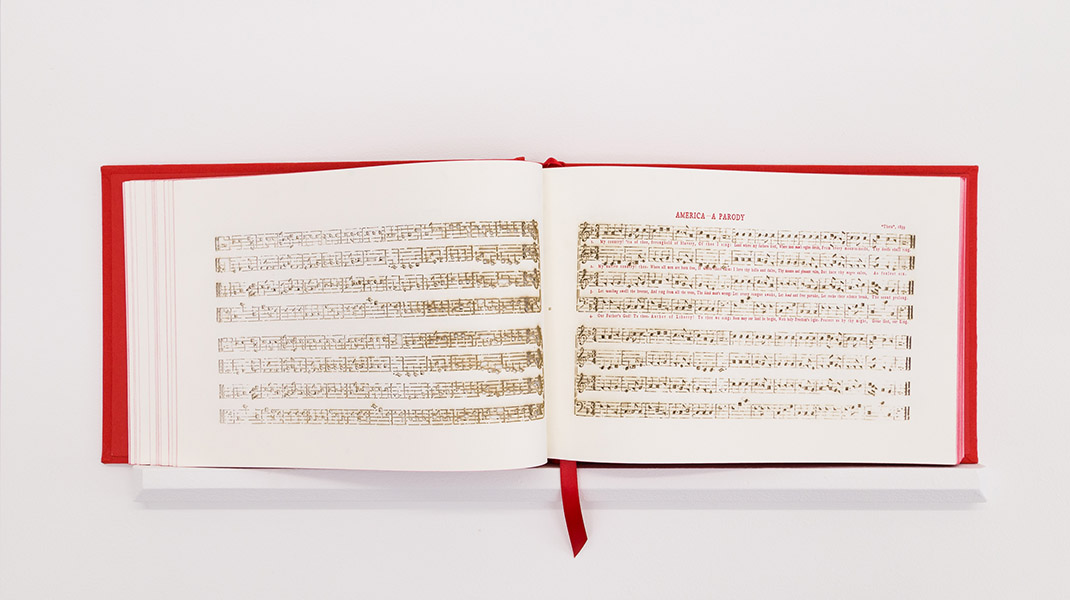
Print Center New York will inaugurate the new, ground floor space at 535 West 24th Street with Visual Record: The Materiality of Sound in Print, an exhibition investigating how artists since the 1970s have employed print-based processes to examine the relationship between sound and its visual representation. Organized by guest curator Elleree Erdos, who has since been appointed Director, Prints and Multiples at David Zwirner, the presentation includes works by 15 artists, including Terry Adkins, John Cage, Bethany Collins, Glenn Ligon, Christian Marclay, Dario Robleto, and Audra Wolowiec, among others. Visual Record will be on view through January 2023.
Rooted in the traditions of both sound and print, the works in Visual Record reflect an increasing interest in how prints relate to and inform broader, multimedia practices on both technical and conceptual levels. Visual Record will highlight artists whose work translates between sound and print using distinctly physical means. Across a wide range of subject matter—from the rhythms of jazz and American nostalgia to the sound of silence and the encoding of race in aural matter—the works demonstrate how the idea of the ‘record’ is bolstered by innovative technical and conceptual approaches to printmaking.” — Print Center New York
“The Museo Civico Archeologico di Bologna presents The Painters of Pompeii. Following critically acclaimed presentations at Oklahoma City Museum of Art and New York University’s Institute for the Study of the Ancient World, the exhibition expands with a much greater number of works as it returns to Italy and marks one of the most anticipated exhibitions of the autumn exhibition season in Europe. Presenting over 100 rare frescoes, with almost half having never left Naples since they were excavated in the 18th century, the show is in collaboration with the National Archaeological Museum of Naples – the largest archaeological painting gallery in the world. Curated by Roman art expert Mario Grimaldi and produced by MondoMostre, it offers the opportunity to view ancient masterpieces in dialogue with the original tools used to create them and reconstructions of Pompeian rooms, featuring wall paintings and items dug by Bourbon archaeologists.
The exhibition draws a renewed focus on the pictores: artists and craftsmen who created the wall decorations in the houses of Pompeii, Herculaneum and the Vesuvian area. Very little information is known about these makers, with their artworks widely baring no signature. Since revealed by the Bourbon excavations, the artifacts they left behind act as valuable pictorial testimonies of Vesuvian life and its organisation. The Painters of Pompeii seeks to contextualise the pictores’ role and economic condition in Roman society whilst highlighting their techniques, tools, colours, and models. Through the wealth of images preserved after the eruption in 79 AD – namely vibrant, often large-scale frescoes – we see a reflection of the tastes and values of various clients while gaining a greater understanding of their production system.” — Museo Civico Archeologico
Philosopher with Macedonia and Persia, Boscoreale, Villa di Fannio Sinistore, oecus (H), west wall fresh, 240 x 345 MANN, Inv. S.n. inv. 906 1st century BC – II style
Hercules and Omphale, Pompeii, IX, 3, 5, House of Marcus Lucretius, triclinium 16, east wall, central section, painting Fresh, 195 x 155 cm MANN, Inv. 8992 1st century A.D. – IV style
Aphrodite and Mars, Pompeii, VII, 2, 23, House of Punished Love, tablinum f, south wall, central section, painting Fresco, 154 x 116 cm MANN, Inv. 9249 1st century A.D. – III style
The Three Graces Pompeii, VI, 17, 31 or 36 Insula Occidentalis, Masseria di Cuomo – Irace Fresco, 57 x 53 cm MANN, Inv. 9231 1st century A.D. – IV style
Polychrome stucco with a female figure at the door, Pompeii, VI, 9, 2-13, House of Meleager, tablinum (8), east wall, upper register stucco – fresco, 178 x 188 MANN, Inv. 9595 1st century AD – IV style
Wall in IV style with “Natura Morta” (xenia), Pompeii, Praedia of Iulia Felix, Reg. II, 4, 3, tablinum (92), south wall fresco, 298 x 447 MANN, Inv. 8598 1st century AD – IV style
‘If classical Grecian painters were deemed ‘‘property of the universe’’ by Pliny the Elder, their Roman pictore contemporaries were skilled craftsmen. Painting was relegated to the work of freedmen, slaves, women and people incapable of political and military life, all tasked with adapting works to suit their clients’ personalities, needs, homes and decoration. Informed by excavations of Vesuvian rooms preserved perfectly in situ, the exhibition uses masterworks from the Collection of Frescoes of the National Archaeological Museum of Naples to offer a re-reading of how pictores operated anonymously within these houses.’ — Mario Grimaldi, exhibition curator
Images courtesy Museo Civico Archeologico di Bologna.
“The San Francisco Museum of Modern Art (SFMOMA) presents Diego Rivera’s America, the most in-depth examination of the artist’s work in over two decades. Diego Rivera’s America brings together more than 150 of Rivera’s paintings, frescoes and drawings—as well as three galleries devoted to large-scale film projections of highly influential murals he created in Mexico and the U.S. On view from July 16, 2022–January 2, 2023, the exhibition focuses on his work from the 1920s to the mid-1940s, the richest years of Rivera’s prolific career. During these two key decades, Rivera created a new vision for North America, informed by his travels in Mexico and the United States.
Diego Rivera’s America builds on SFMOMA’s collection of over 70 works by Rivera, one of the largest in the world. It also features paintings, drawings and frescoes borrowed from public and private collections in Mexico, the U.S. and the U.K., reuniting many for the first time since the artist’s death. Iconic and much-loved works, such as The Corn Grinder (1926), Dance in Tehuantepec (1928), Flower Carrier (1935) and Portrait of Lupe Marín (1938), will be shown alongside paintings that have not been seen publicly since leaving the artist’s studio.” — SFMOMA
“Rivera was one of the most aesthetically, socially and politically ambitious artists of the 20th century,” notes guest curator James Oles. “He was deeply concerned with transforming society and shaping identity—Mexican identity, of course, but also American identity, in the broadest sense of the term. Because of his utopian belief in the power of art to change the world, Rivera is an essential artist to explore anew today, from a contemporary perspective.”
Diego Rivera’s America is curated by James Oles, guest curator, with Maria Castro, assistant curator of painting and sculpture, SFMOMA. The exhibition is co-organized by the San Francisco Museum of Modern Art and Crystal Bridges Museum of American Art.
Images courtesy San Francisco Museum of Modern Art.
A focused exhibition devoted to influential and experimental artist Eva Hesse (b. 1936, Hamburg, Germany; d. 1970, New York) is on view July 8 through October 16 at the Solomon R. Guggenheim Museum. Eva Hesse: Expanded Expansion is both an examination of the artist’s studio practice and an invitation to explore the transformation and afterlife of a restored monumental work, displayed publicly for the first time in 35 years.” — Guggenheim Museum
“I remember always working with contradictions and contradictory forms, which is my idea also in life, the whole absurdity of life, everything for me has always been opposites, nothing has ever been in the middle. . . . it was always more interesting than making something average, normal, right-size.” — Eva Hesse
Eva Hesse: Expanded Expansion is curated by Lena Stringari, Deputy Director and Andrew W. Mellon Chief Conservator, with the collaboration of Richard Armstrong, Director, and Esther Chao, Objects Conservator.
“The Solomon R. Guggenheim Museum presents Sensory Poetics: Collecting Abstraction, an exhibition of works acquired over the past ten years that highlights the institution’s growing collection of contemporary art. On view for the first time at the Guggenheim, from July 8 through October 16, the show’s selection reflects developments in painting, sculpture, and video from the 1960s to today that manifest expressive and embodied gestures through the manipulation of color, form, and material and as a response to the constraints of Minimalism.
Representing a cross-section of diverse aesthetic approaches, the featured artists—originating from Europe and the Americas—are inspired by organic processes and natural phenomena, pursue paths of liberation through the abstraction of the corporeal form, or engage with other art forms, including jazz music, classical architecture, and poetry. Sensory Poetics reaffirms the Guggenheim’s commitment to document the expansive legacy of abstraction that is at the core of its history.” — Guggenheim Museum
Sensory Poetics: Collecting Abstraction is organized by Joan Young, Senior Director, Curatorial Affairs.
“The Jewish Museum presents New York: 1962-1964, an exhibition that explores a pivotal three-year period in the history of art and culture in New York City, examining how artists living and working in New York responded to their rapidly changing world. Installed across two floors, this immersive exhibition presents more than 150 works of art—all made or seen in New York between 1962-1964—including painting, sculpture, photography, and film, alongside fashion, design, dance, poetry, and ephemera.
New York: 1962-1964 is the last project conceived and curated by Germano Celant, the renowned art historian, critic, and curator who passed away in 2020. Celant was approached in 2017 by the Museum to address its influential role in the early 1960s New York art scene during a momentous period in American history. The result is New York: 1962-64, which uses the Jewish Museum’s role as the jumping-off point to examine how artists living and working in New York City responded to the events that marked this moment in time.” — Jewish Museum
Installation view of the exhibition Recent American Sculpture, October 15-November 29, 1964. The Jewish Museum, New York.
Artists featured include Diane Arbus, Lee Bontecou, Chryssa, Merce Cunningham, Jim Dine, Martha Edelheit, Melvin Edwards, Dan Flavin, Lee Friedlander, Nancy Grossman, Jasper Johns, Donald Judd, Ellsworth Kelly, Yayoi Kusama, Norman Lewis, Roy Lichtenstein, Marisol, Agnes Martin, Louise Nevelson, Isamu Noguchi, Claes Oldenburg, Yvonne Rainer, Robert Rauschenberg, Faith Ringgold, Larry Rivers, James Rosenquist, Miriam Schapiro, Carolee Schneemann, George Segal, Jack Smith, Harold Stevenson, Marjorie Strider, Mark di Suvero, Bob Thompson, and Andy Warhol, among many others.
The exhibition and accompanying book have been developed by Studio Celant according to his curatorial vision in close collaboration with the Jewish Museum: Claudia Gould, Helen Goldsmith Menschel Director; Darsie Alexander, Susan and Elihu Rose Chief Curator; Sam Sackeroff, Lerman-Neubauer Associate Curator; and Kristina Parsons, Leon Levy Curatorial Assistant. The exhibition is designed by Selldorf Architects. The 350-page catalogue was developed by Celant and designed by Michael Rock from 2×4.
A Forest for the Trees is an immersive art show created and directed by visionary artist Glenn Kaino, together with The Atlantic and Superblue, that is designed to inspire audiences to reimagine their relationship with the natural world.
A Forest for the Trees is unlike anything that has come before it, taking visitors on a journey through a surreal forest of magic, music, and wonder—with animatronic performing trees, captivating illusions of fire that visitors can control with their hands, and multi-sensory storytelling, all hidden within a 28,000-square-foot space in downtown Los Angeles. The experience is steeped in histories inspired by the people closest to the forests and nearby neighborhoods: from an immersive interactive fire illusion referencing the controlled burns that are central to Native forest stewardship, to the symbolic resurrection of an iconic 144-year-old tree.
“I have worked my entire career to build the tools and relationships that have allowed me to embark upon a project of this unprecedented scale and ambition, both conceptually and formally,” Kaino said. “Intergenerational problems of this magnitude require new thinking and new models about how we bring together traditional ecological knowledge and advanced technology. It is my hope that this show can provide inspiration into how to connect and contribute to some of the most pressing issues of our time, in a dynamic and exciting way that our audience can take home with them.”
Inspired by The Atlantic’s influential body of work on the natural world, A Forest for the Trees reimagines our relationship to nature through the lens of experiential, time-based art. The immersive show is created and directed by artist Glenn Kaino in collaboration with the producer and musician David Sitek and the Lakota producer Laundi Keepseagle. The show is organized in collaboration with The Atlantic and Superblue.
“Art and Race Matters: The Career of Robert Colescott”, through October 9, 2022
“Featuring approximately forty paintings, ‘Art and Race Matters: The Career of Robert Colescott’ highlights the sixty-year-long career of Robert Colescott. Colescott’s bold and richly rendered works traverse art history to offer a satirical take on issues of race, beauty, and twentieth century American culture. Often ahead of his time, Colescott explored the ways in which personal and cultural identities are constructed and enacted through the language and history of painting. He anticipated urgent contemporary discussions around the power of images and shifting political and social values, while asserting the continuing validity of painting as a critical medium for exploring these questions. This exhibition offers a long overdue celebration of Colescott as one of the most consequential artists of his time.” — New Museum
“Art and Race Matters: The Career of Robert Colescott” is co-curated by Lowery Stokes Sims and Matthew Weseley. It is organized by the Contemporary Arts Center, Cincinnati. The presentation at the New Museum is coordinated by Gary Carrion-Murayari, Kraus Family Curator.
“Kapwani Kiwanga: Off-Grid,” through October 16
“‘Kapwani Kiwanga: Off-Grid,’ is the first New York solo show of work by Kapwani Kiwanga (b. 1978, Hamilton, Canada). Over the past decade, the Paris-based artist has created complex installations, sculptures, performance lectures, and films that consider myriad subjects including marginalized histories and systems of power. Drawing on her training in anthropology and the social sciences, Kiwanga’s rigorously researched projects often take the form of installations that stage new spatial environments while exposing the ways in which bodies physically experience and inhabit structures of authority and control.” — New Museum
“Kapwani Kiwanga: Off-Grid” is curated by Massimiliano Gioni, Edlis Neeson Artistic Director, and Madeline Weisburg, Curatorial Assistant.
“Bárbara Wagner & Benjamin de Burca: Fives Times Brazil,” through October 16
“‘Bárbara Wagner & Benjamin de Burca: Fives Times Brazil,’ the first survey exhibition in the United States featuring works by Bárbara Wagner (b. 1980, Brasília, Brazil) and Benjamin de Burca (b. 1975, Munich, Germany). Working together for a decade, the duo produces films and video installations that feature protagonists engaged in cultural production, collaborating with nonactors to make their films—from writing scripts to staging performances on camera. The resulting works are marked by economic conditions and social tensions present in the contexts in which they are filmed, giving urgency to new forms of self-representation through voice, movement, and drama.” — New Museum
“Bárbara Wagner & Benjamin de Burca: Five Times Brazil” is curated by Margot Norton, Allen and Lola Goldring Curator, and Bernardo Mosqueira, ISLAA Curatorial Fellow.
“Doreen Lynette Garner: REVOLTED,” through October 16
“’Doreen Lynette Garner: REVOLTED,’ a solo presentation of new works by Doreen Lynette Garner (b. 1986, Philadelphia, PA), whose practice exposes the histories and enduring effects of racial violence in the United States through the frameworks of medicine and pathology by examining past and present examples of experimentation, malpractice, and exploitation enacted upon Black people. Drawing parallels to contemporary forms of displacement and neo-imperialism, her latest projects survey the forced spread of viruses and diseases to Indigenous lands in the Americas from Europe via the transatlantic slave trade and colonization.” — New Museum
“Doreen Lynette Garner: REVOLTED” is curated by Vivian Crockett, Curator.
Installation views of Summer 2022 Exhibitions at New Museum. Photos by Corrado Serra.
“Mirror Image: A Transformation of Chinese Identity poses the question ‘What remains of ‘Chinese-ness’ once China has become a fully globalized nation?’ Through the artworks of seven artists—all born after 1976 (the year of Mao Zedong’s death), all products of the one-child policy, and all having come of age in an emerging superpower, this exhibition posits that a new transnational sense of self has emerged. Barely considering the traditional East-West dichotomy that dominates discussions of older generations of Chinese artists, these younger artists are full-fledged participants of a global art world.
The title, Mirror Image, refers to the double reflection at the heart of this exhibition. The participants in this exhibition reject the nationalistic label of ‘Chinese artist’ and prefer the banner ‘global artist.’ Eschewing stereotypical iconography and self-Orientalizing, these artists create works that reflect a contemporary China, where Starbucks can be found in the Forbidden City and the internet permits access—albeit with the help of a VPN—to countless sources of influence beyond geographic boundaries. At the same time, as they examine themselves looking inward, they also anticipate the reception of a global audience and challenge distortions of identity that assume Chinese artists are exotic, isolated, or politically motivated. Like a hall of mirrors, there is no one way to interpret their work and no single way of seeing things. — Asia Society Museum
Tianzhuo Chen, Trance, 2019. Two single-channel videos with sound (continuous loop). Duration: 5 minutes, 1 second; 2 minutes, 51 seconds. Courtesy of the artist and BANK/MABSOCIETY. Image courtesy of the artist, BANK/MABSOCIETY, and Asia Society Museum, New York
Cui Jie, Western City Gate, Belgrade, 2020. Acrylic on canvas. Collection of Lisa and Steven Tananbaum. Image courtesy of the artist; Pilar Corrias, London; and Antenna Space, Shanghai
Pixy Liao, I Push You, 2021. Digital chromogenic print. Courtesy of the artist and Chambers Fine Art
Liu Shiyuan, Almost like Rebar No. 7, 2018. Chromogenic print, sandwich mounted, acrylic, and oak frame. Courtesy of the artist and Tanya Bonakdar Gallery, New York/Los Angeles. Image courtesy of the artist and Tanya Bonakdar Gallery, New York/Los Angeles
Miao Ying, Surplus Intelligence, 2021-2022. Single-channel film with sound. Duration: 33 minutes, 27 seconds. Courtesy of the artist. Image courtesy of the artist
Nabuqi, How to Be “Good Life,” 2019. Mixed media. Courtesy of the artist and Kiang Malingue, Hong Kong and Shanghai. Image courtesy of the artist and Kiang Malingue, Hong Kong and Shanghai
Tao Hui, Similar Disguise Stills, 2021. Archival pigment prints, mounted on aluminum panels. Courtesy of the artist; Kiang Malingue, Hong Kong and Shanghai; Esther Schipper, Berlin; and Macalline Art Center, Beijing. Images courtesy of the artist; Kiang Malingue, Hong Kong and Shanghai; Esther Schipper, Berlin; and Macalline Art Center, Beijing
Organized by Barbara Pollack, guest curator, with Han Hongzheng, guest curatorial assistant.




You must be logged in to post a comment.