Agnes Pelton: Desert Transcendentalist at Whitney Museum of American Art, March 13 – June 21, 2020*

“Agnes Pelton (1881–1961) was a visionary symbolist who depicted the spiritual reality she experienced in moments of meditative stillness. Art for her was a discipline through which she gave form to her vision of a higher consciousness within the universe. Using an abstract vocabulary of curvilinear, biomorphic forms and delicate, shimmering veils of light, she portrayed her awareness of a world that lay behind physical appearances—a world of benevolent, disembodied energies animating and protecting life. For most of her career, Pelton chose to live away from the distractions of a major art center, first in Water Mill, Long Island, from 1921 to 1932, and subsequently in Cathedral City, a small community near Palm Springs, California. Her isolation from the mainstream art world meant that her paintings were relatively unknown during her lifetime and in the decades thereafter. This exhibition of approximately forty-five works introduces to the public a little-known artist whose luminous, abstract images of transcendence are only now being fully recognized.” — Whitney Museum of American Art

Messengers

Agnes Pelton, Messengers, 1932. Oil on canvas. Collection of Phoenix Art Museum; Gift of The Melody S. Robidoux Foundation.

Day

Agnes Pelton, Day, 1935. Oil on canvas. Collection of Phoenix Art Museum; Gift of The Melody S. Robidoux Foundation.

Highlights of the Gallery of California Art, Oakland Museum of California

Agnes Pelton, Orbits, 1934. Oil on canvas, 36 1/4 × 30 in. (92.1 × 76.2 cm). Oakland Museum of California; gift of Concours d’Antiques, the Art Guild of the Oakland Museum of California

Pelton_The Blest

Agnes Pelton, The Blest, 1941. Oil on canvas, 37 1/2 × 28 1/4 in. (95.3 × 71.8 cm). Collection of Georgia and Michael de Havenon. Photograph by Martin Seck

Future

Agnes Pelton, Future, 1941. Oil on canvas. Collection of Palm Springs Art Museum, 75th Anniversary gift of Gerald E. Buck in memory of Bente Buck, Best Friend and Life Companion.

Pelton_Departure

Agnes Pelton, Departure, 1952. Oil on canvas, 24 × 18 in. (61 × 45.7 cm). Collection of Mike Stoller and Corky Hale Stoller. Photograph by Paul Salveson

Agnes Pelton: Desert Transcendentalist is organized by the Phoenix Art Museum, and curated by Gilbert Vicario, The Selig Family Chief Curator. The installation at the Whitney Museum is overseen by Barbara Haskell, curator, with Sarah Humphreville, senior curatorial assistant.

Images courtesy Whitney Museum of American Art.

*PLEASE NOTE: Whitney Museum of American Art is temporarily closed.

HAVE YOU SEEN A HORIZON LATELY? at Museum of African Contemporary Art Al Maaden (MACAAL), Marrakech, 25 February 25 – July 19, 2020

Museum of African Contemporary Art Al Maaden (MACAAL), Marrakech presents the group exhibition HAVE YOU SEEN A HORIZON LATELY?. Taking its title from a song by Yoko Ono, the exhibition explores the politics of space and place and is an invitation to see and know the world differently. The exhibition features work from a selection of emerging and established international artists including Yoko Ono (USA), Kapwani Kiwanga (Canada-France), Rahima Gambo (Nigeria) and Amina Benbouchta (Morocco) and is curated by Marie-Ann Yemsi. Through a variety of media and with several new commissions, HAVE YOU SEEN A HORIZON LATELY? sees participating artists question their lived environment in a sensitive and committed way.“(MACAAL)

Whether inspired by architecture, urban archaeology and landscape or personal geographies in relationship to the body and history, the work of these contemporary artists resonates strongly with some of the most pressing issues in the world today. Questions around ecology, the unequal distribution of wealth and power, the colonisation of territories, situations of oppression, and fixed and reductive conceptions of identity are all themes explored in the exhibition.” — MACAAL

Works from HAVE YOU SEEN A HORIZON LATELY? at Museum of African Contemporary Art Al Maaden (MACAAL), Marrakech, 25 February – 19 July 2020. Images courtesy MACAAL

Akira Ikezoe, Coconut Heads around the Ceramic Studio, 2019. SEE IMAGE SHEET FOR FULL CAPTION

Akira Ikezoe, Coconut Heads around the Ceramic Studio, 2019. Oil on canvas, 157x127cm. Image courtesy of the artist and Proyectos Ultravioleta gallery

Amina Benbouchta, Eternel retour du désir amoureux, 2019. SEE IMAGE SHEET FOR FULL CAPTION

Amina Benbouchta, Eternel retour du désir amoureux, 2019. Installation, wood, neons, objects, sound, variable dimensions. Courtesy of the artist

Gaëlle Choisne, N.E.V.A.Q.N.A.L.A., 2016. SEE IMAGE SHEET FOR FULL CAPTION

Gaëlle Choisne, N.E.V.A.Q.N.A.L.A., 2016. Video 8’36’’, mixed media, variable dimensions. Courtesy of the artist

Yoko Ono, HAVE YOU SEEN THE HORIZON LATELY, 1967-2019. SEE IMAGE SHEET FOR FULL CAPTION

Yoko Ono , HAVE YOU SEEN THE HORIZON LATELY?, 1967/2019. Installation view of The Reflections Project organized by the Lower Manhattan Cultural Council, New York. Photographer: Isabel Asha Penzlien. Copyright: Yoko Ono

Maxwell Alexandre, Megazord só de Power Ranger Preto, 2018. SEE IMAGE SHEET FOR FULL CAPTION

Maxwell Alexandre, Megazordsóde Power Ranger Preto, 2018. Latex, grease, henna, bitumen, dye, acrylic, graphite, ballpointpen, charcoal, oilstick, plastic strawand chocolatedrink package on manilapaper. 600x1200cm. Courtesy of the artist and A Gentil Carioac

Felipe Arturo, Tropico Entropico, 2013 (Detail view). SEE IMAGE SHEET FOR FULL CAPTION

Felipe Arturo, Tropico Entropico, 2013 (Detail view). White and raw sugar. 390x306x6cm. Installation at Lugar a dudas, Cali, Colombia. Photo courtesy of the artist

The exhibition is curated by Marie-Ann Yemsi who worked alongside scenographer Franck Houndegla. Conceived as a poetic journey where one theme leads through to another, the exhibition creates a network of interlinking positions and considerations, showing art’s unique ability to question our limits and challenge our perceptions. 

PARTICIPATING ARTISTS: Farah AL QASIMI (United Arab Emirates) Maxwell ALEXANDRE (Brazil), Felipe ARTURO (Colombia), Amina BENBOUCHTA (Morocco), Gaëlle CHOISNE (France), Rahima GAMBO (Nigeria), Akira IKEZOE (Japan), Kiluanji KIA HENDA (Angola), Kapwani KIWANGA (Canada – France), Yoko ONO (USA), Daniel OTERO TORRES (Colombia), Sandrine PELLETIER (Switzerland)

Boro Textiles: Sustainable Aesthetics at Japan Society, March 6 – June 14, 2020

“Japan Society Gallery presents Boro Textiles: Sustainable Aesthetics, an exhibition that examines this traditional handicraft, its history of ingenuity, and its continued legacy within creative practices today.

For the first time in the United States, Boro Textiles: Sustainable Aesthetics assembles over 50 archival pieces from the extensive personal collection of folklorist and cultural anthropologist Chuzaburo Tanaka, alongside contemporary works by influential creators. Included are the pioneers of Japanese avant-garde fashion design, Rei Kawakubo for Comme des Garçons, Issey Miyake, and Yohji Yamamoto, who each explore the dynamic between tradition and transgression. Also on view are textile-based works by Susan Cianciolo and Christina Kim, part of a generation of artists whose work appreciates the aesthetics and ethics of mending and patchwork.

Boro, which translates as rags or tatters, is the Japanese term for textiles that have been patched, pieced, and mended. This traditional style, which originated in Japan in the 19th and early 20th centuries, grew out of necessity for survival in a harsh climate. The cold temperatures of Tohoku in northern Japan made cultivating cotton nearly impossible, thereby fostering the practice of combining and layering remnants of used hemp fabric that were then intricately stitched into utilitarian items, including work coats, blankets, and mittens. These hard-used garments were repeatedly reworked from generation to generation, building bridges through resourcefulness and finding beauty in survival.” — Japan Society

BoroTextiles_installation_photography_01

Installation view of Boro Textiles: Sustainable Aesthetics.

BoroTextiles_installation_photography_02

Installation view of Boro Textiles: Sustainable Aesthetics.

BORO+Shigoto-gi (1)

Shigoto-gi (Work Clothes). Copyright 2019 AMUSE INC. Courtesy of Amuse Museum, Chuzaburo Tanaka Collection.

BORO Donja1 (1)

Donja (Nightgown). Copyright 2019 AMUSE INC. Courtesy of Amuse Museum, Chuzaburo Tanaka Collection.

BoroTextiles_installation_photography_03

Installation view of Boro Textiles: Sustainable Aesthetics.

082

Tabi (Split-toed Socks). Photo by Kyoichi Tsuzuki. Courtesy of Amuse Museum, Chuzaburo Tanaka Collection.

BoroTextiles_installation_photography_04

Installation view of Boro Textiles: Sustainable Aesthetics.

Gray_Suit

Yohji Yamamoto, Suit from Fall/Winter 2006-2007. The Mary Baskett Collection. Photograph by Scott Hisey.

Orange_Sculptural_Shoulder

Rei Kawakubo/Comme des Garçons, Dress from Adult Delinquent Collection, Spring/Summer 2010. The Mary Baskett Collection. Photograph by Rob Deslongchamps.

BoroTextiles_installation_photography_05

Installation view of Boro Textiles: Sustainable Aesthetics.

BoroTextiles_installation_photography_06

Installation view of Boro Textiles: Sustainable Aesthetics.

YoshihiroMakino_O3A2316

Christina Kim, Kaya (mosquito net) (detail). Courtesy of Christina Kim. © Yoshihiro Makino.

03_IMG_4877

Courtesy of Christina Kim.

11_IMG_5485

Courtesy of Christina Kim.

Tapestry3

Susan Cianciolo, Tapestry 3, 2017. Courtesy of the artist and Bridget Donahue, NYC.

Untitled (tapestry)

Susan Cianciolo, Untitled (tapestry), 2015-2016. Courtesy of the artist and Bridget Donahue, NYC.

“Sustainability is one of the most critical subjects in our time and is central to the upcoming Tokyo Summer Games in 2020,” says Yukie Kamiya, Director of Japan Society Gallery. “Through this exhibition, we can rediscover the ethics and aesthetics of an anonymous handicraft from the Tohoku region, which was devastated in the 2011 earthquake. Boro is not only a historical craft but has had a great impact on contemporary cutting-edge creators worldwide, bridging different generations across geographies.”

Boro Textiles: Sustainable Aesthetics is curated by Yukie Kamiya, Gallery Director with Tiffany Lambert, Assistant Curator, and is organized by Japan Society in collaboration with Amuse Museum.

Images courtesy Japan Society.

Hearts of Our People: Native Women Artists at Renwick Gallery, Smithsonian American Art Museum, February 21 – May 17, 2020

“Women have been a predominant creative force behind Native American art, yet their individual contributions, for centuries, have largely remained unrecognized and anonymous. In the first major thematic exhibition to explore the artistic contributions of Native women, Hearts of Our People: Native Women Artists celebrates the achievements of these Native women and establishes their rightful place in the art world.

The presentation at the Renwick Gallery includes 82 artworks dating from ancient times to the present, made in a variety of media, from textiles and ceramics to sculpture, time-based media and photography. This exhibition is multi-lingual with wall text, audio recordings and labels presented in the artist’s Native American or First Nations languages, as well as English, aiming to present the works in the context of each artist’s own culture and voice.

The exhibition is organized according to three overarching themes: ‘Legacy,’ ‘Relationships’ and ‘Power.’ These themes are a testament to the underlying purpose with which Native women have historically made art and enable visitors to note variations in the works of art created for similar purposes across time and Native cultures.” — Renwick Gallery

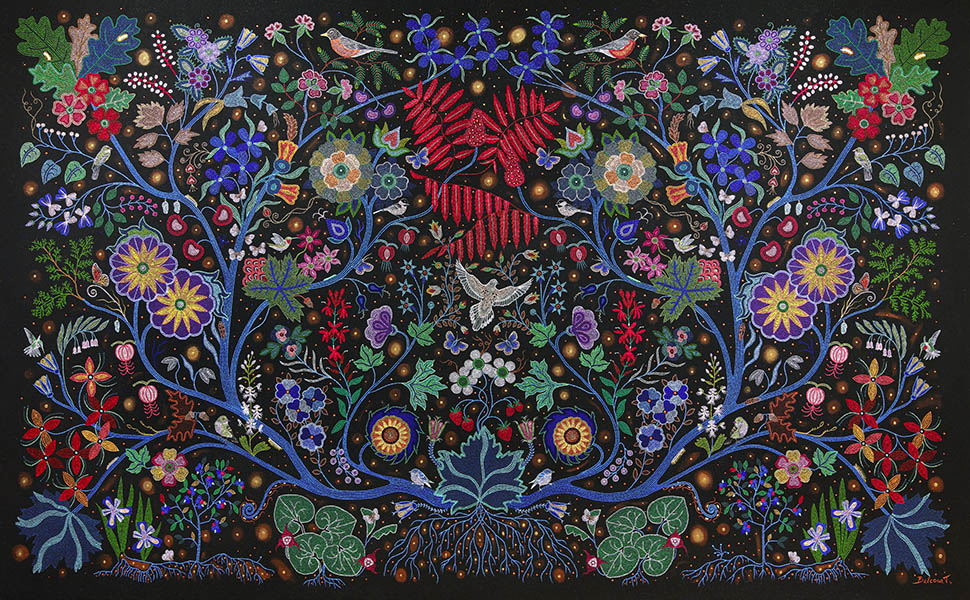
Belcourt_Wisdom of the Universe

Christi Belcourt (Michif), The Wisdom of the Universe, 2014, acrylic on canvas, Collection Art Gallery of Ontario, Toronto; Purchased with funds donated by Greg Latremoille, 2014, 2014/6. © Christi Belcourt

T120814

Sisíthuŋwaŋ Dakhóta artist, Tablecloth, 1900–1910, wool, glass beads, brass beads, and cotton thread, National Museum of the American Indian, Smithsonian Institution, 12/814. Photo by NMAI Photo Services

L2018.193

D. Y. Begay (Navajo), Náhookǫsjí Hai (Winter in the North)/Biboon Giiwedinong (It Is Winter in the North), 2018, wool and natural dyes, The Minneapolis Institute of Art, The Jane and James Emison Endowment for Native American Art, 2019.41. Photo: Addison Doty; Minneapolis Institute of Art. © D. Y. Begay

Hickox_container

Elizabeth Hickox (Wiyot), Lidded container, ca. 1924, twining and porcupine quills, Denver Art Museum Collection: Purchase from Grace Nicholson, 1946.388A-B. Photograph © Denver Art Museum

Okuma_shoes

Jamie Okuma (Luiseño/Shoshone–Bannock), Adaptation II, 2012, shoes designed by Christian Louboutin, leather, glass beads, porcupine quills, sterling silver cones, brass sequins, chicken feathers, cloth, deer rawhide, and buckskin, Minneapolis Institute of Art, Bequest of Virginia Doneghy, by exchange 2012.68.1A,B. Photo: Minneapolis Institute of Art. © 2012 Jamie Okuma

Parrish_The Next Generation

Cherish Parrish (Ottawa/Pottawatomi), The Next Generation—Carriers of Culture, 2018, black ash and sweetgrass, Courtesy of Cherish Parrish – Odawa & Pottawatomi – Gun Lake Band. Photo by Richard Church, Odawa-Pottawatomi. © Cherish Parrish

2014.93.1; 2014.93.2; 2014.93.3a,b

Keri Ataumbi (Kiowa/Comanche)/Jamie Okuma (Luiseño/Shoshone–Bannock), Adornment: Iconic Perceptions, 2014, antique glass, 24-karat electroplated beads, buckskin, 18-karat yellow gold, sterling silver, wampum shell, freshwater pearls, rose and brilliant-cut diamonds and diamond beads, diamond briolettes, Minneapolis Institute of Art, Gift of funds from The Duncan and Nivin MacMillan Foundation, 2014.93.1-3a,b. Photo: Minneapolis Institute of Art. © 2014 Keri Ataumbi and Jamie Okuma

Nez Perce_bag

Nimi’ipuu (Nez Perce) artist, Bag, ca. 1900, corn husk, yarn, rawhide, and wool, Denver Art Museum Collection: Gift of Dr. Charles J. Norton, 1986.261. Photograph © Denver Art Museum

Diesing_Mask, Old Woman with Labret

Freda Diesing (Haida), Mask, Old Woman with Labret, 1974, alderwood, paint, hair, cedar bark, abalone, glass beads, moose hide, bone or plastic, Courtesy of the Royal BC Museum, RBCM15057. Photo: Courtesy of the Royal BC Museum and Archives. © Canadian Westcoast Art

Hill_Women's Voices at the Council

Joan Hill (Muskogee Creek and Cherokee), Women’s Voices at the Council, 1990, acrylic on canvas, Gift of the artist on behalf of the Governor’s Commission on the Status of Women, 1990, Oklahoma State Art Collection, courtesy of the Oklahoma Arts Council. © Joan Hill

Sakiestewa_Nebula22-23

Ramona Sakiestewa (Hopi), Nebula 22 & 23 (diptych), 2009, tapestry, wool warp and dyed wool weft, Collection of Carl and Marilynn Thoma, 2009.021a-b. © 2009 Ramona L. Sakiestewa, courtesy of and photo by the Carl & Marilynn Thoma Art Foundation

Kay Walkingstick Project for NMAI, Smithsonian Institution, Washington DC

Kay WalkingStick (Cherokee), Venere Alpina, 1997, oil on canvas (left), steel mesh over acrylic, saponified wax, and plastic stones (right), Minneapolis Institute of Art, The David and Margaret Christenson Endowment for Art Acquisition, 2018.46a,b. Photo: Minneapolis Institute of Art. © Kay WalkingStick ’97.

2010.56

Rebecca Belmore (Anishinaabe), Fringe, 2007, transparency in light box (one of an edition of three), Minneapolis Institute of Art, Gift of funds from Donna and Cargill MacMillan Jr., 2010.56. © Rebecca Belmore

ext_201809200011

Rosalie Favell (Métis [Cree/English]), The Collector/The Artist in Her Museum, 2005, digital print, Courtesy of the artist. © 2005, Rosalie Favell

Grant and Davidson_dress

Dorothy Grant (Haida) with Robert Davidson (Haida/Tlinglit), Hummingbird Copper Dress, 1989, wool, Denver Art Museum Collection: Native Arts acquisition fund, 2010.490 A-C. Photograph © Denver Art Museum. © 1989 Dorothy Grant and Robert Davidson

Crow_dress

Apsáalooke (Crow) artist, Dress, ca. 1930, cotton, bead, bone, skin, wool, and colorant, Denver Art Museum Collection: The L. D. and Ruth Bax Collection, 1985.46. Photograph © Denver Art Museum

Kelly Church - Sustaining Traditions

Kelly Church (Ottawa/Pottawatomi), Sustaining Traditions—Digital Memories, 2018, black ash, sweetgrass, Rit dye, copper, vial EAB, and flash drive with black ash teachings, Courtesy of the artist. Photo by Richard Church, Odawa-Pottawatomi. © Kelly Church

Growing Thunder_Give Away Horses

Joyce Growing Thunder Fogarty (Dakhóta/Nakoda), Juanita Growing Thunder Fogarty (Dakhóta/Nakoda), and Jessa Rae Growing Thunder (Dakhóta/Nakoda), Give Away Horses (dress and accessories), 2006, deer hide, glass beads, canvas, thread, leather, moose hide, German silver, porcupine quills, feathers, elk hide, brass bells, ribbon, silk ribbons, and brass thimbles, National Museum of the American Indian, Smithsonian Institution, 26/5818-5821. Photo by NMAI Photo Services. © J Growing Thunder

Yup'ik_Parka

Central Yup’ik, St. Lawrence Island, Alaska, artist, Parka, 1890–1910, seal intestine, sinew, walrus fur, aniline dyes, animal hide, polar bear fur, and thread, Fenimore Art Museum, Cooperstown, New York, Gift of Eugene Victor Thaw Art Foundation, Thaw Collection of American Indian Art, T0763. Photo: John Bigelow Taylor, NYC

2010.19

Nellie Two Bear Gates (Gathering of Clouds Woman, Iháƞktȟuƞwaƞna Dakhóta, Standing Rock Reservation), Valise, 1880–1910, beads, hide, metal, oilcloth, and thread, Minneapolis Institute of Art, The Robert J. Ulrich Works of Art Purchase Fund, 2010.19. Photo: Minneapolis Institute of Art

2012.37

Innu (Naskapi) artist, Hunting coat, ca. 1750, caribou hide and pigment, Minneapolis Institute of Art, The Robert J. Ulrich Works of Art Purchase Fund, 2012.27. Photo: Minneapolis Institute of Art

2017.29a-x

Andrea Carlson (Ojibwe), Sunshine on a Cannibal, 2015, oil, acrylic, ink, colored pencil, and graphite on paper, Minneapolis Institute of Art, The Mr. and Mrs. Bernard M. Granum Fund 2017.29A-X. Photo: Minneapolis Institute of Art. © 2015 Andrea Carlson

Marianne Nicolson "The Container for Souls"

Marianne Nicolson (Kwakwa̱ka̱’wakw, Dzawada̱’enux̱w First Nations), Bax̱wa̱na’tsi: The Container for Souls, 2006, Glass, cedar, light fixtures, Collection of the Vancouver Art Gallery, Purchased with funds donated by the Audain Foundation, VAG, 2007.4.1 a-c, Photo: Rachel Topham, Vancouver Art Gallery.

Hearts of Our People: Native Women Artists was organized by Jill Ahlberg Yohe, associate curator of Native American Art at the Minneapolis Institute of Art, and Teri Greeves, an independent curator and member of the Kiowa Nation. Robyn Kennedy, Renwick Gallery manager, coordinated the presentation in Washington, D.C. Anya Montiel, curator of American and Native American women’s art and craft.

Images courtesy Renwick Gallery.

The City Within: Brooklyn Photographs by Alex Webb and Rebecca Norris Webb at Museum of the City of New York, March 11 – September 20, 2020

The City Within: Brooklyn Photographs by Alex Webb and Rebecca Norris Webb features more than 30 images culled from the collaborative eponymous series started in 2014. The show offers a poignant and powerful portrait of the borough that the artists have called home for some 20 years.

Over the course of its history, Brooklyn has transformed from farmland to a bedroom community to a buzzy destination. For The City Within, the Webbs have traversed nearly every corner of Brooklyn, showing its dichotomy as a bustling, diverse metropolis and a place full of green spaces and tranquility. While much of the world now associates Brooklyn with film shoots, hipsters, and artists, it is also an archipelago of neighborhoods that is even more multicultural than it was over a century ago. The duo’s photographs of Brooklyn tell a broader American story, one that touches on immigration, community, nature, and home.” — Museum of the City of New York

“I’m not sure we could have done this (series) without the impetus of our eventual departure from Brooklyn,” says Alex. “The vantage point of our leaving enabled us to see our home borough with fresh eyes. This allowed each of us to say farewell creatively in our own ways — me by photographing the streets, Rebecca by photographing and writing about the green spaces near where we live.”

The show highlights a particularly poignant time for the Webbs to be focusing their lenses on their home versus far-flung locations. Rebecca explains, “Alex and I will be leaving our Park Slope neighborhood sometime in the next few years, so the project is a kind of farewell to Brooklyn – our home for 20-plus years.”

Brooklyn. Brownsville.  Easter Parade/Easter Egg Hunt.  Some Red Hook

Alex Webb. Brownsville, Easter Sunday, 2016. Chromogenic development print. Courtesy of the artist

AW2

Alex Webb. Park Slope, 2018. Chromogenic development print. Courtesy of the artist

Brooklyn.  Park Slope, Williamsburg, Bushwick/Bedford Stuyvesant, streets

Alex Webb. Williamsburg, 2018. Chromogenic development print. Courtesy of the artist

Brooklyn. Street scenes. Ditmas. 18th Ave

Alex Webb. Borough Park, 2016. Chromogenic development print. Courtesy of the artist

Brooklyn.  Flatbush area. Parkside Empire Street Festival.  birthday party

Alex Webb. Prospect-Lefferts Gardens, 2015. Chromogenic development print. Courtesy of the artist

Brooklyn. Around Farragut Housing projects

Alex Webb. Vinegar Hill, 2016. Chromogenic development print. Courtesy of the artist

RNW1

Rebecca Norris Webb. Star, Prospect Park, 2015. Chromogenic development print. Courtesy of the artist

Brooklyn

Rebecca Norris Webb. Our Garden, Brooklyn Botanic Garden, 2016. Chromogenic development print. Courtesy of the artist

The City Within

Rebecca Norris Webb. Shimmering, Prospect Park, 2018. Chromogenic development print. Courtesy of the artist

Stuart, Florida

Rebecca Norris Webb. In the Rain, Brooklyn Botanic Garden, 2017. Chromogenic development print. Courtesy of the artist

RNW9_WebResolution

Rebecca Norris Webb. Family Tree, Prospect Park, 2015. Chromogenic development print. Courtesy of the artist

RNW12

Rebecca Norris Webb. Under the Lilacs, Brooklyn Botanic Garden, 2016. Chromogenic development print. Courtesy of the artist

RNW13

Rebecca Norris Webb. Two Worlds, Prospect Park, 2013. Chromogenic development print. Courtesy of the artist

RNW14

Rebecca Norris Webb. Winter Storm, Prospect Park, 2016. Chromogenic development print. Courtesy of the artist

The City Within

Rebecca Norris Webb. Night Before Aretha Died, Brooklyn Botanic Garden, 2017. Chromogenic development print. Courtesy of the artist

“Alex’s compositions reverberate with the energy of color, contrasting shadow and light, and movement. Rebecca’s stay true to her poetic roots, presenting dreamlike, quiet and nuanced images that are more like a meditation,” says Sean Corcoran, curator of prints and photographs, Museum of the City of New York. “In The City Within, they each create distinctive narratives, but expertly weave their viewpoints together into a harmonious ensemble. And, like the borough itself, their view of Brooklyn is an exquisite union of visual and emotional complexity.”

Images courtesy Museum of the City of New York.

Jim Dine’s Pinocchio at Chrysler Museum of Art, February 28 – May 17, 2020

“The Chrysler Museum of Art presents the original story of a beloved character in Jim Dine’s Pinocchio. The exhibition features the entire portfolio of lithographs by Dine, an internationally acclaimed multimedia artist.  A gift to the Chrysler from Richmond-based collectors Charlotte and Gil Minor, the portfolio is new to the Museum’s collection and includes images as well as words from the first story of Pinocchio.

As an established artist, Dine incorporated Pinocchio into his practice. However, the artist didn’t model his work after the iconic Disney film. Instead, he harkened back to Carlo Collodi’s Le avventure di Pinocchio: Storia di un burattino (The Adventures of Pinocchio: Story of a Puppet). The work of the Italian writer and journalist was published in the serial newspaper Il Giornale per i bambini (Journal for Children) in 1881 and found Pinocchio breaking promises and facing life-threatening dangers. Collodi initially wrote 15 chapters of the story, with Pinocchio dying a violent death by hanging. However, readers loved the figure so much that Collodi resurrected Pinocchio and went on to write 21 additional tales, finally ending the serial in spring 1883. In that same year, a publisher compiled all the stories and bound them into one volume titled Le avventure di Pinocchio (The Adventure of Pinocchio) with illustrations by Enrico Mazzanti.” — Chrysler Museum of Art

All images: Jim Dine (American b. 1935). Pinocchio (portfolio), 2006. A suite of 44 lithographs on Hahnemühle paper contained within a wooden portfolio box. Printed at Atelier Michael Woolworth, Paris and published by Steidl Verlag, Göttingen © Jim Dine, licensed by Artists Rights Society (ARS), New York Gift of Charlotte and Gil Minor 2019.17.1

Dine_Pinocchio_PR_01

Dine_Pinocchio_PR_02

Dine_Pinocchio_PR_03

Dine_Pinocchio_PR_04

Dine_Pinocchio_PR_05

Dine_Pinocchio_PR_06

Dine_Pinocchio_PR_07

Dine_Pinocchio_PR_08

Dine_Pinocchio_PR_09

Dine_Pinocchio_PR_10

When Pinocchio debuted in theaters in 1940, Dine became enamored with the rambunctious wooden puppet’s sordid journey to become a real boy. “I was six years old when I saw the Disney film. It was really frightening,” Dine said. “His story resonates with me as a person who’s been a boy. It is also a wonderful metaphor for the idea of making art; it’s alchemical. It’s an incredibly direct way of speaking about the act.”

This exhibition was organized by the Chrysler Museum of Art. Kimberli Gant, Ph.D. is the Chrysler’s McKinnon Curator of Modern & Contemporary Art.

Images courtesy Chrysler Museum of Art.

Countryside, The Future at Solomon R. Guggenheim Museum, February 20 – August 14, 2020

“The Solomon R. Guggenheim Museum presents Countryside, The Future, an exhibition addressing urgent environmental, political, and socioeconomic issues through the lens of architect and urbanist Rem Koolhaas and AMO, the think tank of the Office for Metropolitan Architecture (OMA). A unique exhibition for the Guggenheim rotunda, Countryside, The Future explores radical changes in the vast nonurban areas of Earth with an immersive installation premised on original research. The project extends investigative work already underway by AMO, Koolhaas, and students at the Harvard Graduate School of Design; the Central Academy of Fine Arts, Beijing; Wageningen University, Netherlands; and the University of Nairobi.

The exhibition explores artificial intelligence and automation, the effects of genetic experimentation, political radicalization, global warming, mass and micro migration, large-scale territorial management, human-animal ecosystems, subsidies and tax incentives, the impact of the digital on the physical world, and other developments that are altering landscapes across the globe.” — Solomon R. Guggenheim Museum

“In the past decades, I have noticed that while much of our energies and intelligence have been focused on the urban areas of the world—under the influence of global warming, the market economy, American tech companies, African and European initiatives, Chinese politics, and other forces—the countryside has changed almost beyond recognition,” stated Koolhaas. “The story of this transformation is largely untold, and it is particularly meaningful for AMO to present it in one of the world’s great museums in one of the world’s densest cities.”

Installation views of Countryside, The Future. Photos by Corrado Serra.

20200219-EW6A3763-Edit

20200219-EW6A3758

20200219-EW6A3723

20200219-EW6A3718

20200219-EW6A3720

20200219-EW6A3722-Edit

20200219-EW6A3751-Edit

20200219-EW6A3728

20200219-EW6A3729

20200219-EW6A3749-Edit-Edit

20200219-EW6A3738

20200219-EW6A3743

Countryside, The Future is organized by Troy Conrad Therrien, Curator of Architecture and Digital Initiatives, Solomon R. Guggenheim Museum, in collaboration with Rem Koolhaas and Samir Bantal, Director of AMO, with Ashley Mendelsohn, Assistant Curator, Architecture and Digital Initiatives, at the Guggenheim.

The Drawings of Al Taylor at The Morgan Library & Museum, February 21 – May 24, 2020

The Morgan Library & Museum is proud to announce a presentation of drawings by painter, sculptor, and draftsman Al Taylor (1948–1999). The Drawings of Al Taylor explores the artist’s lyrical and witty compositions inspired by banal objects and everyday situations. Driven by curiosity and a sense of humor, Taylor drew maps of pet stains, imagined puddles hanging out to dry, and rendered elegant still lifes of tin cans suspended by wires. During his relatively short career, Taylor produced more than five thousand drawings, in which he combined technical skills, Old Master virtuosity, and graphic systems such as charts and diagrams. The exhibition at the Morgan shines a new light on Taylor’s practice, highlighting the artist’s distinctive draftsmanship through works spanning the mid-1970s to the late 1990s. The first U.S. museum exhibition devoted to this subject, The Drawings of Al Taylor comprises nearly eighty drawings and twenty sketchbooks, including many drawings that have never been shown before.” — The Morgan Library & Museum

Al Taylor, Untitled (McGrath) 1982, Estate of the Artist

Al Taylor (1948–1999). Untitled (McGrath), 1982. Acrylic paint on printed magazine pages mounted on paper. The Morgan Library & Museum, New York. Gift of Debbie Taylor, 2019.121. Photography by Janny Chiu. © 2019 The Estate of Al Taylor

Taylor_No_title_D_85_086_ML7TAYAL0916

Al Taylor (1948–1999). No title, ca. 1985. Acrylic paint on printed magazine page. Private collection. Photography Glenn Steigelman. © 2019 The Estate of Al Taylor

Taylor_No_title_D_88_272_ML18TAYAL0196

Al Taylor (1948–1999). No title, 1988. Watercolor, ink, and graphite on paper. Aaron and Barbara Levine. Photography by Ben Cohen. © 2019 The Estate of Al Taylor

Taylor_Hanging_Folding_Study_D_91_097_ML36TAYAL0557

Al Taylor (1948–1999). Hanging & Folding Study, 1991. Graphite, gouache, and correction fluid on paper. Collection Debbie Taylor. Photography by Glenn Steigelman. © 2019 The Estate of Al Taylor

Taylor_Pea_Passing_D_92_050_ML49TAYAL0434

Al Taylor (1948–1999). Pea Passing Device, 1992. Gouache, colored ink and graphite with collage of a photographic print on paper. Collection of Doug Woodham and Dalya Inhaber. Photography Glenn Steigelman. © 2019 The Estate of Al Taylor

Taylor_Hanging_Puddles_TAYAL1124_PRELIM

Al Taylor (1948–1999). Hanging Puddles, 1992. Gouache and graphite on paper. Private collection. Photography by Glenn Steigelman. © 2019 The Estate of Al Taylor

Taylor_Greek_Puddles_D_92_245_ML47TAYAL0522

Al Taylor (1948–1999). Greek Puddles (with Fish Parts), 1992. Gouache and ink on paper. Private collection, London; Promised gift, British Museum, Department of Prints & Drawings. Photography Glenn Steigelman. © 2019 The Estate of Al Taylor

Taylor, Al, 1948-1999, The Peabody Group #29  1992, recto, 2011.7

Al Taylor (1948–1999). The Peabody Group #29, 1992. Watercolor, ink, coffee, graphite, colored pencil, and ball point pen on paper. The Morgan Library & Museum, Gift of the Modern and Contemporary Collectors Committee, 2011.7. Photography by Janny Chiu. © 2019 The Estate of Al Taylor

Taylor_Untitled_Tide_D_93_151_ML51TAYAL1460

Al Taylor (1948–1999). Untitled (Tide Tab), ca.1993. Grease pencil, wax crayon, graphite, and gouache on paper. The Estate of Al Taylor. Photography by Glenn Steigelman. © 2019 The Estate of Al Taylor

Taylor_Untitled_Plant_D_98_150_ML67TAYAL1468

Al Taylor (1948–1999). Untitled (Plant Studies), 1998 Watercolor pencil and graphite on paper. Private collection. Photography by Glenn Steigelman. © 2019 The Estate of Al Taylor

Taylor, Al, 1948-1999, Untitled (100% Hawaiian), 1994,  recto, 2019.53

Al Taylor (1948–1999). Untitled (100% Hawaiian), 1994. Gouache and graphite on paper. The Morgan Library & Museum, Gift of Hamish Parker, 2019.53. Photography by Graham Haber. © 2019 The Estate of Al Taylor

Taylor_Bondage_Duck_Study_TAYAL1127_PRELIM

Al Taylor (1948–1999). Bondage Duck Study, 1998. Graphite, ink, acrylic mica mortar, colored pencil, grease pencil, and wax crayon on paper. Collection Debbie Taylor. Photography by Glenn Steigelman. © 2019 The Estate of Al Taylor

The Drawings of Al Taylor is curated by Isabelle Dervaux, Acquavella Curator of Modern and Contemporary Drawings at the Morgan.

Dervaux said, “Al Taylor’s original contribution to the art of the 1980s and 1990s can be summed up as a combination of virtuosity, humor, precision, and nonchalance that should be a revelation to many visitors.” 

Images courtesy The Morgan Library & Museum.

The Book of Ruth: Medieval to Modern at The Morgan Library & Museum, February 14 – June 14, 2020

“The Morgan Library & Museum is pleased to present The Book of Ruth: Medieval to Modern. The exhibition celebrates the gift made in 2018 by Joanna S. Rose of The Joanna S. Rose Illuminated Book of Ruth to the Morgan. The accordion-fold vellum manuscript, measuring nine inches tall and an astonishing eighteen feet long, was designed and illuminated by New York artist Barbara Wolff, who worked on the project for two years (2015–17). The Rose Book of Ruth is presented in conversation with twelve manuscripts, drawn from the Morgan’s holdings, that unfold the Christian traditions for illustrating the story of Ruth during the Middle Ages. Through the juxtaposition of the modern manuscript with these ancient works, which date from the twelfth to the fifteenth century and include three leaves from the Morgan’s famed Crusader Bible, the exhibition brings into focus the techniques of medieval illuminators that inspired Wolff, as well as her inventive approach to iconography.” — The Morgan Library & Museum

Psalter single leaf, MS M.724, verso

Tree of Jesse; David Proclaimed King; David Battling Zion; Episodes from the Life of John the Baptist; Nativity of Christ. Leaf from the “Eadwine Psalter” England, Canterbury, Christ Church Priory, ca. 1150 MS M.724v Purchased, 1927 The Morgan Library & Museum. Photography by Janny Chiu, 2018.

MS M.851.1, No. 001, Naomi and Elimelech: in Moab, fol. 127r, Bible fragments (MS M.851.1-4), France, ca. 1260.

Naomi Departing Bethlehem; Her Sons, Mahlon and Chilion; Ruth and Orpah; Marriage of Ruth and Boaz; Obed; Jesse. Single Leaf from a Bible, in Latin France, ca. 1260 MS M.851.1 Gift of the Estate of Belle da Costa Greene, 1951 The Morgan Library & Museum. Photography by Janny Chiu, 2018.

MS M.394, fol. 114r, Naomi and Elimelech journey to Maob, Moulins, Guyart des, approximately 1251-approximately 1297, Bible historiale, Paris, France, ca. 1415.

The Family of Naomi and Elimelech Arriving in Moab. Bible historiale, in French Illuminated by the workshop of the Boucicaut Master France, Paris, ca. 1415 MS M.394, fol. 114r Purchased by J. Pierpont Morgan, 1910 The Morgan Library & Museum. Photography by Janny Chiu, 2018.

Old Testament miniatures, MS M.638, fol. 17v

Boaz Asks Ruth’s Identity; Ruth Gleaning; Ruth Dines with Boaz; Workers Stacking the Crop of Boaz. “Crusader Bible,” added inscriptions in Latin, Persian, and Judeo-Persian France, Paris, ca. 1250 MS M.638, fol. 17v Purchased by J.P. Morgan, 1916 The Morgan Library & Museum. Photography by Janny Chiu, 2018.

Old Testament miniatures, MS M.638, fol. 18r

Ruth Threshing and Bringing Grain to Naomi; Naomi Counseling Ruth; Workers Threshing Grain; Ruth Lays at the Feet of Boaz. “Crusader Bible,” added inscriptions in Latin, Persian, and Judeo-Persian France, Paris, ca. 1250 MS M.638, fol. 18r Purchased by J.P. Morgan, 1916 The Morgan Library & Museum. Photography by Janny Chiu, 2018.

MS M.1210, fol 21 Hebrew, Wolff, Barbara (Illustrator), illuminator, book designer, The Joanna S. Rose Illuminated Book of Ruth, New York and Jerusalem, 2015-2017

Ruth Departing the Tent of Boaz. The Joanna S. Rose Illuminated Book of Ruth, in Hebrew and English United States, New York, and Israel, Jerusalem, 2015-17 Commissioned by Joanna S. Rose, written by Izzy Pludwinski, designed and illuminated by Barbara Wolff MS M.1210, fols. 20r-21r Gift of Joanna S. Rose, 2018 The Morgan Library & Museum. Photography by Rudi Wolff. Artwork © Barbara Wolff.

MS M.1210, fol 19 Hebrew, Wolff, Barbara (Illustrator), illuminator, book designer, The Joanna S. Rose Illuminated Book of Ruth, New York and Jerusalem, 2015-2017

The Wing of God. The Joanna S. Rose Illuminated Book of Ruth, in Hebrew and English United States, New York, and Israel, Jerusalem, 2015-17 Commissioned by Joanna S. Rose, written by Izzy Pludwinski, designed and illuminated by Barbara Wolff MS M.1210, fols. 18r-19r Gift of Joanna S. Rose, 2018 The Morgan Library & Museum. Photography by Rudi Wolff. Artwork © Barbara Wolff.

MS M.1210, fol 9 Hebrew, Wolff, Barbara (Illustrator), illuminator, book designer, The Joanna S. Rose Illuminated Book of Ruth, New York and Jerusalem, 2015-2017

The Barley of Beth-Lechem. The Joanna S. Rose Illuminated Book of Ruth, in Hebrew and English United States, New York, and Israel, Jerusalem, 2015-17 Commissioned by Joanna S. Rose, written by Izzy Pludwinski, designed and illuminated by Barbara Wolff MS M.1210, fol. 9r Gift of Joanna S. Rose, 2018 The Morgan Library & Museum. Photography by Rudi Wolff. Artwork © Barbara Wolff.

MS M.1210, fol 13 Hebrew, Wolff, Barbara (Illustrator), illuminator, book designer, The Joanna S. Rose Illuminated Book of Ruth, New York and Jerusalem, 2015-2017

The “Gezer Calendar.” The Joanna S. Rose Illuminated Book of Ruth, in Hebrew and English United States, New York, and Israel, Jerusalem, 2015-17 Commissioned by Joanna S. Rose, written by Izzy Pludwinski, designed and illuminated by Barbara Wolff MS M.1210, fol. 13r Gift of Joanna S. Rose, 2018 The Morgan Library & Museum. Photography by Rudi Wolff. Artwork © Barbara Wolff.

MS M.1210, fol 16 Hebrew, Wolff, Barbara (Illustrator), illuminator, book designer, The Joanna S. Rose Illuminated Book of Ruth, New York and Jerusalem, 2015-2017

Flowers for Perfume. The Joanna S. Rose Illuminated Book of Ruth, in Hebrew and English United States, New York, and Israel, Jerusalem, 2015-17 Commissioned by Joanna S. Rose, written by Izzy Pludwinski, designed and illuminated by Barbara Wolff MS M.1210, fol. 16r Gift of Joanna S. Rose, 2018 The Morgan Library & Museum. Photography by Rudi Wolff. Artwork © Barbara Wolff.

MS M.1210, fol 24 Hebrew, Wolff, Barbara (Illustrator), illuminator, book designer, The Joanna S. Rose Illuminated Book of Ruth, New York and Jerusalem, 2015-2017

Sandal of Ratification. The Joanna S. Rose Illuminated Book of Ruth, in Hebrew and English United States, New York, and Israel, Jerusalem, 2015-17 Commissioned by Joanna S. Rose, written by Izzy Pludwinski, designed and illuminated by Barbara Wolff MS M.1210, fol. 24r Gift of Joanna S. Rose, 2018 The Morgan Library & Museum. Photography by Rudi Wolff. Artwork © Barbara Wolff.

MS M.1210, fol 25 Hebrew, Wolff, Barbara (Illustrator), illuminator, book designer, The Joanna S. Rose Illuminated Book of Ruth, New York and Jerusalem, 2015-2017

Ruth’s Wedding Belt. The Joanna S. Rose Illuminated Book of Ruth, in Hebrew and English United States, New York, and Israel, Jerusalem, 2015-17 Commissioned by Joanna S. Rose, written by Izzy Pludwinski, designed and illuminated by Barbara Wolff MS M.1210, fol. 25r Gift of Joanna S. Rose, 2018 The Morgan Library & Museum. Photography by Rudi Wolff. Artwork © Barbara Wolff.

MS M.1210, fol 7 Hebrew, Wolff, Barbara (Illustrator), illuminator, book designer, The Joanna S. Rose Illuminated Book of Ruth, New York and Jerusalem, 2015-2017

Naomi and Ruth Embracing. The Joanna S. Rose Illuminated Book of Ruth, in Hebrew and English United States, New York, and Israel, Jerusalem, 2015-17 Commissioned by Joanna S. Rose, written by Izzy Pludwinski, designed and illuminated by Barbara Wolff MS M.1210, fol. 7r Gift of Joanna S. Rose, 2018 The Morgan Library & Museum. Photography by Rudi Wolff. Artwork © Barbara Wolff.

This exhibition is organized by Roger S. Wieck, the Morgan’s Melvin R. Seiden Curator and Department Head of Medieval and Renaissance Manuscript. Wieck says, “I think visitors will be amazed at the inspiration that artists – both medieval and modern – have found in the suspenseful and touching story told in The Book of Ruth.” 

Images courtesy The Morgan Library & Museum. 

The Art of Impermanence at Asia Society Museum, February 11 – April 26, 2020

“Through nearly 70 masterpieces of calligraphy, painting, sculpture, ceramics, lacquers, and textiles drawn from two of America’s great Japanese art collections, The Art of Impermanence examines Japan’s unique and nuanced references to transience. Impermanence is a pervasive subject in Japanese thought and art. Objects in the exhibition span from the Jōmon period (ca. 15,000-300 BCE) to the twentieth century. From images that depict the cycle of the four seasons and red Negoro lacquer worn so it reveals the black lacquer beneath, to the gentle sadness evoked in the words of wistfully written poems, this exhibition demonstrates that much of Japan’s greatest art alludes directly or indirectly to the transient nature of life.” — Asia Society Museum

A richly illustrated catalogue copublished by Asia Society Museum and Officina Libraria accompanies the exhibition which is curated by Adriana Proser, John H. Foster Senior Curator of Traditional Asian Art. In her introductory essay for the catalogue, scholar Melinda Takeuchi of Stanford University notes: “Although cultures have decried the impending end of civilization through the ages. . .impermanence takes on a particular urgency—and particular irony—in today’s world.”

1979.191 View A

Descent of Buddha Amida. Japan.   Kamakura period, late 13th century. Hanging scroll; ink, color and gold on silk. H. 38¾ x W. 16½ in. (98.4 x 41.9 cm). Asia Society, New York: Mr. and Mrs. John D. Rockefeller 3rd Collection, 1979.191. Photography by Synthescape, courtesy of Asia Society

Fig 232_1979.204ab

Amida Nyorai. Japan. Kamakura period, mid-to late 13th century. Cypress wood with traces of pigment and cut gold leaf and inlays of crystal. H. 47 x W. 20½ x D. 20½ in. (119.4 x 52 x 52 cm). Asia Society, New York: Mr. and Mrs. John D. Rockefeller 3rd Collection, 1979.204a–b. Photography by Synthescape, courtesy of Asia Society

JC049a

Flame-style Vessel. Japan. Middle Jōmon period, 3500–2500 BCE Earthenware. H. 11⅝ x Diam. 11⅝ in. (29.5 x 29.5 cm). John C. Weber Collection. Photography courtesy of John C. Weber Collection

JL024

Bottle. Japan. Nanbokuchō–Muromachi period, 14th–15th century. Red-and black-lacquered wood (Negoro ware). H. 12¼ x Diam. 8¾ in. (30.9 x 22.2. cm). John C. Weber Collection. Photography by John Bigelow Taylor

JP025ab

Tosa Mitsuoki (1617–1691). Blossoming Cherry Trees at Yoshino (detail). Japan. Edo period, 17th century. Pair of six-panel screens; ink, color, gold, and gold leaf on paper. Each, H. 65 x W. 140 in. (165.2 x 355.4 cm). John C. Weber Collection. Photography by John Bigelow Taylor

JP081 detail 4

The Illustrated Life of Shinran Shōnin (detail). Japan. Edo period, 1699. Four hanging scrolls; ink, color and gold on silk. Each, H. 53⅛ x W. 31½ in. (135 x 80 cm). John C. Weber Collection. Photography by John Bigelow Taylor

JS024

Reliquary in the Form of Five Elements (gorintō).   Japan. Kamakura period, 14th century. Rock crystal with later mercury-gilt copper and wood lotus pedestal base. H. 5⁵⁄₁₆ in. (13.5 cm). John C. Weber Collection. Photography courtesy of John C. Weber Collection

JS029

Wheel-shaped Ring (sharinseki). Japan, Nara Prefecture, Shimanoyama Tomb. Tumulus period, 4th century. Green tuff with red pigment. H. 8½ x W. 7¾ x D. ⁹⁄₁₆ in. (21.5 x 19 x 1.5 cm). John C. Weber Collection 
Photography by John Bigelow Taylor

JP036

Illustrated Poetry Contest with Poets from Various Periods, Tameie Version. Japan. Kamakura period, 14th century. Fragment of a handscroll mounted as a hanging scroll; ink on paper. H. 11 x W. 18¾ in. (28 x 47.4 cm). John C. Weber Collection. Photography by John Bigelow Taylor

JS028

Namikiri Fudō Myōō. Japan. Kamakura period, 13th century. Wood with pigment, lacquer, cut gold leaf, inlaid crystal eyes, and gilt-copper fittings. H. 19½ x W. 14 in. (49.5 x 35.6 cm). John C. Weber Collection. 
Photography courtesy of John C. Weber Collection

Images courtesy Asia Society Museum.

Bill Graham and the Rock & Roll Revolution at New-York Historical Society, February 14 – August 23, 2020

“The New-York Historical Society presents the rock & roll world of Bill Graham (1931–1991), one of the most influential concert promoters of all time. Bill Graham and the Rock & Roll Revolution explores the life and work of the legendary music impresario who worked with the biggest names in rock music—including the Grateful Dead, Jefferson Airplane, Jimi Hendrix, Santana, Led Zeppelin, and the Rolling Stones—and launched the careers of countless music luminaries at his famed Fillmore Auditorium in San Francisco and the Fillmore East in New York City. Organized by the Skirball Cultural Center, which debuted the exhibition in Los Angeles, this comprehensive retrospective of Graham’s life and career explores some of the 20th century’s momentous cultural transformations through the lens of rock & roll. Showcasing more than 300 objects—including rock memorabilia, photographs, and concert posters—the New-York Historical presentation, coordinated by Associate Curator of Exhibitions Cristian Petru Panaite, highlights Graham’s personal connections to New York. The exhibition begins with a site-specific installation of ‘The Joshua Light Show,’ the trailblazing liquid light show conceived in 1967 by multimedia artist Joshua White that served as a psychedelic backdrop to Graham’s concert productions in New York.” — New-York Historical Society

“I never give the public what it wants. I give the public what it should want.” — Bill Graham

Bill Graham and the Rock & Roll Revolution installation views. Photos by Corrado Serra.

20200220-EW6A3829-Edit

20200220-EW6A3828-Edit

20200220-EW6A3824-Edit

20200220-EW6A3824-Edit-Edit

20200220-EW6A3820-Edit

20200220-EW6A3818-Edit

20200220-EW6A3811-Edit

20200220-EW6A3814

20200220-EW6A3806

20200220-EW6A3803

20200220-EW6A3803

20200220-EW6A3801

20200220-EW6A3789

20200220-EW6A3799-Edit

20200220-EW6A3793-Edit

20200220-EW6A3782-Edit-2

20200220-EW6A3782-Edit

Unique to New-York Historical is a special, immersive audio experience, providing a musical tour through the exhibition with songs by rock & roll superstars. A playlist of featured songs is available on Spotify.

Dorothea Lange: Words & Pictures at The Museum of Modern Art, through May 9, 2020

“The Museum of Modern Art presents Dorothea Lange: Words & Pictures, the first major solo exhibition at the Museum of the photographer’s incisive work in over 50 years. Dorothea Lange: Words & Pictures includes approximately 100 photographs drawn entirely from the Museum’s collection. The exhibition also uses archival materials such as correspondence, historical publications, and oral histories, as well as contemporary voices, to examine the ways in which words inflect our understanding of Lange’s pictures. These new perspectives and responses from artists, scholars, critics, and writers, including Julie Ault, Wendy Red Star, and Rebecca Solnit, provide fresh insight into Lange’s practice.” — The Museum of Modern Art

“It seems both timely and urgent that we renew our attention to Lange’s extraordinary achievements,” said Sarah Meister. “Her concern for less fortunate and often overlooked individuals, and her success in using photography (and words) to address these inequities, encourages each of us to reflect on our own civic responsibilities. It reminds me of the unique role that art—and in particular photography—can play in imagining a more just society.”

Toward the end of her life, Dorothea Lange (1895–1965) remarked, “All photographs—not only those that are so-called ‘documentary,’ and every photograph really is documentary and belongs in some place, has a place in history—can be fortified by words.”

108.1940

Dorothea Lange. White Angel Bread Line, San Francisco. 1933. Gelatin silver print, 10 3/4 x 8 7/8″ (27.3 x 22.6 cm). The Museum of Modern Art, New York. Gift of Albert M. Bender

331.1995

Dorothea Lange. Migrant Mother, Nipomo, California. March 1936. Gelatin silver print, 11 1/8 x 8 9/16″ (28.3 x 21.8 cm). The Museum of Modern Art, New York. Purchase

339.1995

Dorothea Lange. Kern County, California. 1938. Gelatin silver print, 12 7/16 x 12 1/2″ (31.6 x 31.7 cm). The Museum of Modern Art, New York. Purchase

474.1959

Dorothea Lange. Tractored Out, Childress County, Texas. 1938. Gelatin silver print, 9 5/16 x 12 13/16″ (23.6 x 32.6 cm). The Museum of Modern Art, New York. Purchase

519.1973

Dorothea Lange. Migratory Cotton Picker, Eloy, Arizona. November 1940. Gelatin silver print, 19 15/16 × 23 13/16″ (50.7 × 60.5 cm). The Museum of Modern Art, New York. Purchase

369.1995

Dorothea Lange. Richmond, California. 1942. Gelatin silver print, 9 ¾ x 7 11/16″ (24.7 x 19.5 cm). The Museum of Modern Art, New York. Purchase

523.1973

Dorothea Lange. Richmond, California. 1942. Gelatin silver print, 7 3/8 x 6 5/8″ (18.8 x 16.9 cm). The Museum of Modern Art, New York. Purchase

793.1968

Dorothea Lange. Man Stepping from Cable Car, San Francisco. 1956. Gelatin silver print, 9 3/4 x 6 7/16″ (24.8 x 16.4 cm). The Museum of Modern Art, New York. Purchase

434.1995

Dorothea Lange. The Defendant, Alameda County Courthouse, California. 1957. Gelatin silver print, 12 3/8 x 10 1/8″ (31.4 x 25.8 cm). The Museum of Modern Art, New York. Purchase

Dorothea Lange: Words & Pictures is organized by Sarah Meister, Curator, with River Bullock, Beaumont & Nancy Newhall Curatorial Fellow, assisted by Madeline Weisburg, Modern Women’s Fund Twelve-Month Intern, Department of Photography, The Museum of Modern Art.

Images courtesy The Museum of Modern Art.