Popular Painters and Other Visionaries, online exhibition at El Museo del Barrio, August 6 to November 8, 2020

“El Museo del Barrio announces Popular Painters and Other Visionaries, the museum’s first online exhibition that examines the work of 30 artists from the Americas and the Caribbean. Curated by El Museo’s Chief Curator, Rodrigo Moura, and originally planned as an in-person experience, the exhibition was adapted as a virtual presentation. The show departs from the term ‘popular painters’ to identify artists working on the margins of modernism and the mainstream art world between the 1930s and 1970s, and will feature nearly 30 works from El Museo’s Permanent Collection, several of them presented for the first time.

Popular visual sources provide the narrative thread of the exhibition, which is divided into thematic sections around labor and daily life; festivities; black Atlantic religion; vernacular architecture; and bodily representation. In addition to these themes, four artists are presented in monographic sections: Andrés Curruchich, José Bernardo Cardoso Jr., Felipe Jesus Consalvos, and Martín Ramírez. Diasporic experiences are shared by the artists featured in the show – whether as African populations in the New World, Latin American and Caribbean people in the United States, or in reference to the displacement of Amerindian populations within their own territories. This is reflected in the impact of migration, exclusion, marginalization, cultural resistance, indigeneity, self-determination, and autobiography that is present in their works.” — El Museo del Barrio

Micius Stephane

Micius Stéphane (b. Bainet, Haiti 1912 – d New York 1966). Untitled (The photographer) [Sin título (El fotógrafo)], c.1945-1965. Oil on masonite. 50.8 x 61 cm. El Museo del Barrio Collection, New York. Donation of Drs. Roslyn and Lloyd Siegel.

dos-prazeres_emdb2007-6-45_cropped-no-frame_webimg

Heitor dos Prazeres (b. Rio de Janeiro, Brasil 1898 – d. Rio de Janeiro, Brasil 1966). Untitled (Poker Game) [Sin título (Juego de poker)], 1963. Oil on canvas, 48.3 x 49.2 cm. El Museo del Barrio Collection, New York. Donation of Gale Simmons, Craig Duncan and Lynn Tarbox in memory of Barbara Duncan, 2007 © Patrimônio Família Heitor dos Prazeres.

Jacques-Richard Chery

Jacques-Richard Chéry (b. Cap Haitien, Haiti 1928 – d. mediados de 1980). Untitled (Religious ceremony  / Voodoo ceremony) [Sin título (Ceremonia religiosa / Ceremonia vudú)], c.1960s. Oil and gouache on panel, 31.8 x 39.4 cm. El Museo del Barrio Collection, New York. Donation of Drs. Roslyn and Lloyd Siegel.

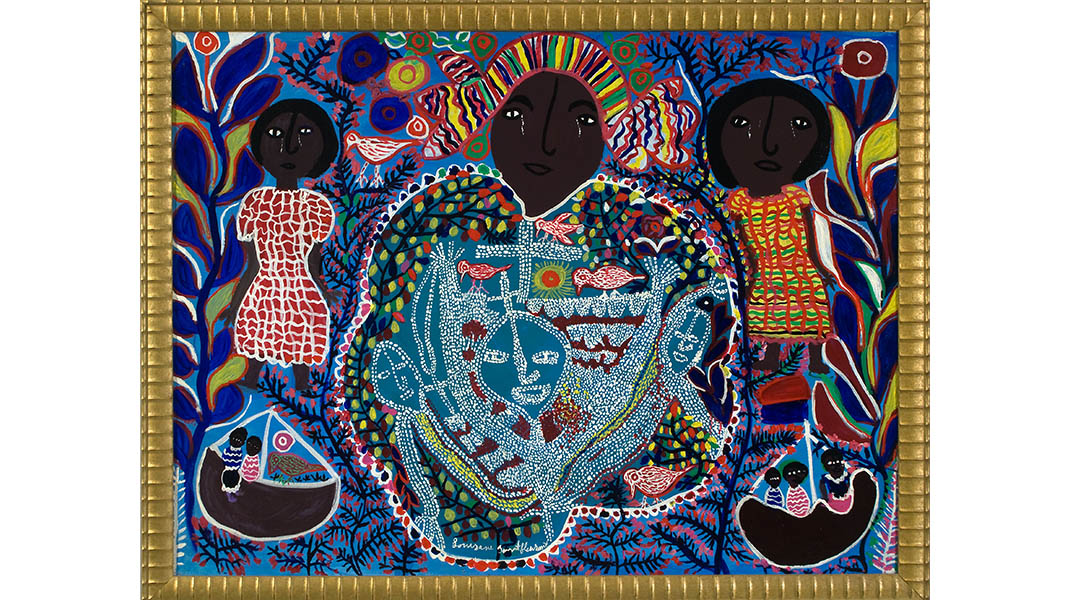
Louisiane Saint Fleurant

Louisiane Saint Fleurant (b. Petit-Trou-de-Nippes, Haiti 1924 – d. 2005). Untitled (Portrait of woman with two girls) [Sin título (Retrato de mujer con dos muchachas)], Undated. Oil on canvas, 76.2 x 101.6 cm. El Museo del Barrio, New York. Donation of Sanford Rubenstein.

Martín Ramírez

Martín Ramírez (b. Jalisco, México 1895 – d. Estados Unidos 1963). Untitled, (Arches, 5 Panels) [Sin título (Arcos, 5 paneles)], c.1960-1963. Gouache, color pencil and graphite on paper, 72.4 x 185.4 cm © Herado de Martín Ramírez. Courtesy of Ricco/Maresca Gallery.

Eloy Blanco

Eloy Blanco (b. Aguadilla, Puerto Rico 1933 – d. New York, New York 1984). 4000 on Green [4000 sobre verde], 1982. Acrylic and felt tip marker on canvas, 45.7 x 35.6 cm. El Museo del Barrio Collection, New York. Donation of Joanne Blanco.

Felipe Jesús Consalvos

Felipe Jesús Consalvos (b. La Habana, Cuba 1891 – d. ca. 1960). Chant of the Jungle [Canto de la jungla], c.1920-1950. Mixed media collage, 106 x 71.1 cm. Courtesy of Andrew Edlin Gallery, New York and Doodletown Farm, LLC.

Images courtesy El Museo del Barrio.

Ad Minoliti: Fantasías Modulares at MASS MoCA, through December 2020

“Populated by gregarious mice and helpful birds, fairy tales have always been the site of lively relationships and communities between multiple species. Ad Minoliti’s Fantasías Modulares, in its emphasis on the co-existence of many species, is no different. Yet unlike many of her childhood literary influences, she does not impose hierarchies between her hybrid beings — grinning triangles, lounging cows, and winking circles all populate the landscapes of Minoliti’s imagined worlds, with equal bearing and status. With her large painting Landscape (2020), installed at the far end of the gallery, the artist envisions a verdant forest: the quintessential fairy-tale scenery. In many fairy tales, nature and wilderness have been unwelcoming, scary sites, especially for female characters. Think of the perils that Little Red Riding Hood or Snow White face when entering the forest. Aware of how nature has often been portrayed as threatening, or a site of violence, Minoliti’s forest of Fantasías Modulares is a more welcoming and inclusive feminist terra.” — Isabel Casso

Ad Minoliti, Fantasías Modulares

Installation view of Ad Minoliti: Fantasias Modulares.

Ad Minoliti, Fantasías Modulares

Ad Minoliti, Cyclope, 2020. Acrylic on canvas. Courtesy of Peres Projects. As installed in the exhibition Ad Minoliti: Fantasías Modulares.

Ad Minoliti, Fantasías Modulares

Ad Minoliti, Cyclope, 2020. Acrylic on canvas. Courtesy of Peres Project. As installed in the exhibition Ad Minoliti: Fantasías Modulares.

Ad Minoliti, Fantasías Modulares

Ad Minoliti, Araña, 2020, Acrylic on wall. Courtesy of Peres Projects. As installed in the exhibition Ad Minoliti: Fantasías Modulares.

Ad Minoliti, Fantasías Modulares

Installation view of Ad Minoliti: Fantasias Modulares.

Ad Minoliti

Installation view of Ad Minoliti: Fantasias Modulares.

Ad Minoliti, Fantasías Modulares

Ad Minoliti, PLAY SIGNIFICANT OTHERNESS, 2020. Code by Mariana Lombard, Net-based project. Courtesy of Peres Projects. As installed in the exhibition Ad Minoliti: Fantasías Modulares.

Ad Minoliti, Fantasías Modulares

Installation view of Ad Minoliti: Fantasias Modulares.

Ad Minoliti, Fantasías Modulares

Ad Minoliti, Landscape, 2020. Inkjet print and acrylic on canvas. Buni, 2020. Mannequin with mask, gloves, and pants wearing t-shirt by BBY WACHA. As installed in the exhibition Ad Minoliti: Fantasías Modulares.

Ad Minoliti, Fantasías Modulares

Ad Minoliti, Square, 2020. Acrylic on wall. Courtesy of Peres Projects. As installed in the exhibition Ad Minoliti: Fantasías Modulares.

Ad Minoliti: Fantasías Modulares was curated by Isabel Casso, M.A. 2020 Williams College Graduate Program in the History of Art

Images courtesy MASS MoCA.

Fotografiska New York Reopening Exhibitions, Opens August 28, 2020

Fotografiska New York, the destination for photography and culture in the Flatiron District of New York City, announced the exhibitions that will be on view when the museum reopens. They will show four distinct solo exhibitions by acclaimed photographers including Martin Schoeller, Cooper & Gorfer, Naima Green, Julie Blackmon, and one group show featuring emerging talent titled New Visions, co-curated with VICE Media Group.

“Part of Fotografiska’s mission is to present a wide range of perspectives and experiences, and to challenge the status quo of what museums show.” says Amanda Hajjar, Director of Exhibitions for Fotografiska New York. “In these exhibitions, the artists explore themes of justice, community, family, identity, and migration. It is our hope that our guests will find inspiration and conversation in the range of creative expressions and voices celebrated here.”

Martin Schoeller, Death Row Exonerees, through January 10, 2021

This exhibition consists of ten moving, digital portraits of individuals who share their stories of how they were convicted and sentenced to death row for crimes they did not commit. Schoeller collaborated with Witness To Innocence, a non-profit led by exonerated death row survivors who work to abolish the death penalty in the United States.

Martin Schoeller - Kwame Ajamu, 2019, video and sound installation, total running time 16_31 minutes. © Martin Schoeller

Martin Schoeller, Kwame Ajamu, 2019, video and sound installation, total running time 16:31 minutes. © Martin Schoeller

Martin Schoeller - Gary Drinkhard, 2019, video and sound installation, total running time 16_31 minutes. © Martin Schoeller

Martin Schoeller, Gary Drinkhard, 2019, video and sound installation, total running time 16:31 minutes. © Martin Schoeller

Martin Schoeller - Juan Melendez, 2019, video and sound installation, total running time 16_31 minutes. © Martin Schoeller

Martin Schoeller, Juan Melendez, 2019, video and sound installation, total running time 16:31 minutes. © Martin Schoeller

Cooper & Gorfer, Between These Folded Walls, Utopia, through February 28, 2021

In a series of richly-imagined portraits, the artistic duo Sarah Cooper and Nina Gorfer explore the idea of Utopia in the age of the new diaspora. Young women who have been forced to uproot their lives are photographed like goddesses inside lustrous and surrealist-inspired sets. These vivid portraits are a judicious and of-the-moment examination of our historical memory and possibility.

Cooper _ Gorfer - Yellow Roseline, 2020 © Cooper _ Gorfer

Cooper & Gorfer, Yellow Roseline, 2020 © Cooper & Gorfer

Cooper _ Gorfer - Israa With Yellow Boxes, 2020 © Cooper _ Gorfer

Cooper & Gorfer, Israa With Yellow Boxes, 2020 © Cooper & Gorfer

Naima Green, Brief & Drenching, through February 7, 2021

Naima Green’s photography conducts experiments in being. Her portrait- making begins in the form of an invitation to her sitter, to co-create a context and allow themselves to evolve within it. Her most recent experiment pictures the transient self at play. Through Pur·suit, a deck of 54 playing cards featuring photographs of queer women, trans, non-binary, and gender-nonconforming people, Green photographed over 100 sitters in 9 days to create an object through which both play and contemporary documentation cohere.

Naima Green - Naima Green, Pur·suit (detail), 2019. Image by Megan Madden

Naima Green, Pur·suit (detail), 2019. Image by Megan Madden

Julie Blackmon, Fever Dreams, through October 11, 2020

The playfully artful and chaotic nature present in the photographs of Julie Blackmon (American, b. 1966) illustrates the everyday people and places that have shaped the artist’s life. These are the familiar and ordinary scenes of Blackmon’s daily routine in her hometown of Springfield, Missouri, which she describes as “the generic American town” in the middle of the United States. Her scenes are often centered around children in backyards, garages and neighborhoods where the absence of adults alludes to a looming potential for danger. Her photographs, otherwise innocuous domestic tableaux, are woven with fantasy and subtle satire that reflect a delicate balance between the darkness and charm of contemporary American life in suburbia.

Julie Blackmon - Bathers, 2019 © Julie Blackmon. Courtesy the artist and Robert Mann Gallery

Julie Blackmon, Bathers, 2019 © Julie Blackmon. Courtesy the artist and Robert Mann Gallery

Julie Blackmon - Ezra, 2019 © Julie Blackmon. Courtesy the artist and Robert Mann Gallery

Julie Blackmon, Ezra, 2019 © Julie Blackmon. Courtesy the artist and Robert Mann Gallery

Fotografiska New York X VICE Media Group, New Visions, through October 11, 2020

Fotografiska New York and VICE Media Group have partnered to curate New Visions, an exhibition showcasing fourteen inspiring, emerging artists from around the world. Informed by personal experiences and underrepresented narratives, the work demonstrates what VICE and Fotografiska consider to be the vanguard of photography. Collectively, the exhibition affirms the discipline’s capacity to foster new understandings of identity, put forth nuanced critiques of the world around us, and find power in play and vulnerability.

VICE - Untitled_2019 © Cristina Bartley Dominguez

VICE – Untitled, 2019 © Cristina Bartley Dominguez

Processed with VSCO with b3 preset

VICE – Returning to Our Flowers, 2019 © Texas Isaiah

VICE - The Shan Hai Jing Hotel Room 002, 2019, Zhongjia Sun

VICE – The Shan Hai Jing Hotel Room 002, 2019, Zhongjia Sun

Title image: Fotografiska New York exterior (detail).

Images and text courtesy Fotografiska New York.

Parcours des Mondes in Saint-Germain-des-Prés, Paris, September 8 – 13, 2020*

Parcours des mondes will celebrate its 19th anniversary, September 8 – 13, 2020*, at Saint-Germain-des-Prés, Paris. This is the largest international art fair for tribal art, Asian art and archaeological artefacts. The iconic Beaux-Arts district will be the backdrop for this well-established and highly regarded week-long event which brings together galleries from all over the world. Some 49 art dealers, 41 specializing in tribal art, 3 in Asian art, 4 in archaeological artefacts and one bookseller, are expected to participate.

Norberto Izquierdo, a collector who is passionate about tribal art, has been selected as the 19th Parcours des Mondes’ honorary president. Izquierdo has nurtured his passion for ‘Arts du Lointain’ (art from remote places) for more than ten years.

“I’ll never forget my first Parcours des Mondes. It represented the first time that I felt confident enough to cross the threshold of some of the top tribal art galleries. Ever since that time, more than 10 years ago, I’ve had a renewed interest in art from far-flung places. The Beaux-Arts district in Saint- Germain-des-Prés takes on a very special, almost exhilarating atmosphere. It’s a great opportunity to meet art lovers, collectors, experts and dealers from all over the world, in some cases, for the first time.” — Norberto Izquierdo

TRIBAL ART

arteprimitivo_chokwe_d

Arte Primitivo, Barcelona. Figure Tshokwe, Angola. 19th century. Wood and sacrificial materials. H.: 25cm © Arte Primitivo

bovis_statue_baoulé_d

Galerie Alain Bovis, Paris. Figure representating the «husband in the hereafter». Baule, Ivory Coast. Late 19th or early 20th century. Oozing patina. H: 48 cm. Provenance: Franco Monti, Milan. Exhibited and published in “49 Sculptures de Côte d’Ivoire”, Galerie Philippe Ratton, Paris, 2014, p. 46; “Tristan Tzara, L’Homme Approximatif, poète, écrivain d’art, collectionneur”, Musée de la ville de Strasbourg, 2016, p. 84. © Vincent Luc – Phar

castellano_dan

Galerie Olivier Castellano, Paris. Dan mask. Dan, Ivory Coast. Collected in situ in the 1930s. H.: 25 cm

claes_dan_d

didier Claes, Brussels. Dan mask. Late 19th century. Wood, metal. H: 20,5 cm. Provenance: Private collection, France, 1979. Armand Arman, New York / USA

daltonsomare_igbo_d_1

Dalton Somaré, Milan. Mask Igbo. Igbo, Nigeria. Late 19th century. Wood, kaolin, pigments, fiber. H.: 60 cm. Provenance: ex Tambaran Gallery, New York, 1988; ex Collection Herbert Levine, New York © Dalton Somaré

dartevelle_songye_d

Galerie Dartevelle, Brussels. Mask. Songye, Democratic Republic of the Congo © Philippe de Formanoir – Paso Doble

ferrandin_songye_bouclier_d

Yann Ferrandin, Paris. Ngabo shield, Songye culture. Democratic Republic of Congo. Circa late 19th century. Wood, pigments. 52 x 27 cm

frohlich_kota_d

Galerie Patrik Fröhlich, Zürich. An important Kota reliquary figure. Kota, Gabon. 19th century or earlier. Wood, thin brass and copper, bone. H.: 43cm. Provenance: Klaus Clausmeyer, Düsseldorf; Ralph Nash, London; Alan Mann, London; William McCarty- Cooper, Beverly Hills; Private collection, Royaume-Uni © Galerie Patrik Fröhlich

heathcote_asmat_d

Wayne Heathcote, London. Asmat ancestral figure – Kawe. Asmat, Papua New Guinea. Wood. H.: 165 cm. Provenance: Karel Joseph Begheijn Collection; Albert Bernardus Wissing Collection

marcelin_kanak_d

Galerie Franck Marcelin, Aix-en-Provence. Portion of a gomoa roof spire. Kanak, New Caledonia. Houp tree wood (Montrouziera cauliflora). H.: 43.2cm. Provenance: Ancienne collection américaine © Galerie Franck Marcelin

ASIAN ART

hioco_Ekamukhaliṅgaṃ_jpg

Galerie Christophe Hioco, Paris. Ekamukhaliṅga. Nothern India. Gupta period, circa 5th century. Pink sandstone. H.: 36 cm © Galerie Christophe Hioco

CAT. Barrère 2006 XP4

Mingei Japanese Arts, Paris. Noh theater mask. Hannya noh-men. Japan. Muromachi period, early 15th century. Wood and lacquer. 25 x 14.5 cm © Michel Gurfinkel / Galerie Mingei

singh_sword_d

Runjeet Singh, Warwickshire. Enamelled Shamshir sword. Lucknow, India. Early 19th century. H.: 104 cm. Provenance: from a private English collection © Runjeet Singh

ARCHAEOLOGICAL ARTEFACTS

arteas_tete_d_1

Arteas Ltd., London. Head from the statue of a private individual wearing a bag wig. Egypt. Saite period, 664-525 BC. Grauwacke, repair to the chin. H.: 10 cm. Provenance: formerly in Lord Mac Alpine collection of West Green, acquired in Braham in 1982 © Edouard de Ganay

bagot_torso_d

J. Bagot Arqueología S.L., Barcelona. Torso of the Hero Diomedes Roman Empire. 1st century AD Marble. H.: 81,30 cm. Provenance: private collection of ancient art of Jeff Junter, New York; Acquired at Royal-Athena Galleries, New York, February 1991; with Jurgen Haering, Fribourg, Germany, March 1987. © Maria Pageo

cybele_poupée_d

Galerie Cybèle, Paris. Votive doll Egypt – Middle Kingdom , 11th Dynasty (2061 – 1991 BC). Wood, blue faience, bitumen, linen thread. 20 x 4,5 cm. Provenance: Galerie Maspero, Ville D’Avray 25 sept 1968; private collection of Bob Willoughby, Cork, Irelande, 1968-2005 © Roger Basille

Images courtesy Parcours des Mondes.

*Subject to permission for the event being granted by the authorities.

Van Gogh, Cézanne, Matisse: The Hahnloser Collection at The Albertina Museum, Vienna, August 27 – November 15, 2020

“The ALBERTINA Museum is devoting this exhibition to one of the most important private collections of French modernist art. The Hahnloser Collection came together between 1905 and 1936, initially on the basis of close and friendly exchange between the collecting couple of Arthur and Hedy Hahnloser-Bühler and artist-friends including Pierre Bonnard, Ferdinand Hodler, Henri Matisse, and Félix Vallotton. Later on, the collection also came to include works by their predecessors including Cézanne, Renoir, Toulouse-Lautrec, Van Gogh, and others. 

Today, this immense collection contains one-of-a-kind work groups—including paintings, sculptures, and works on paper—from Swiss and French modernism, including such prominent works as Bonnard’s Reflection, or The Tub (1909), Cézanne’s Portrait of the Artist (1877/78), Van Gogh’s The Sower and The Night Café in Arles (1888), Vallotton’s The White and the Black (1913), and Maillol’s sculpture Pomona.

For Arthur and Hedy Hahnloser, collecting was a source of meaning in life—and they also actively involved those around them. They conceived of their collection, staged as a total work of art at their Villa Flora in Winterthur, as a ‘teaching museum’. The Hahnlosers motivated friends and relatives to purchase works by the artists whom they favored and also helped these artists to become well known by gifting their works to private collectors and Swiss art museums. This ‘Hahnloser Principle’ was of enormous benefit to Swiss museum collections and their acquisition policies, and it was frequently the case that these donations marked the founding moments of what would later become large modern art collections.” — Albertina Museum

van_gogh_der_saemann_1888_kunstmuseum_bern_dauerleihgabe_jaeggli_stiftung_foto_pedrini

Vincent van Gogh, Der Sämann, 1888. Kunstmuseum Bern, Dauerleihgabe Hahnloser/Jaeggli Stiftung © Foto: Reto Pedrini, Zürich

vincent_van_gogh_la_cafe_de_nuit_a_arles_1888_hahnloserjaegglistiftung_foto_reto_pedrini

Vincent van Gogh, The Night Café in Arles, 1888. Gouache. Hahnloser/Jaeggli Foundation, Villa Flora, Winterthur Foto: Reto Pedrini, Zürich

paul_cezanne_groupe_de_maison_1876_77_dauerleihgabe_an_hahnloserjaegglistiftung_foto_reto_pedrini

Paul Cézanne, Roofs, 1876/77. Oil on canvas. Permanent loan to Hahnloser/Jaeggli Foundation, Villa Flora, Winterthur © Photo: Reto Pedrini, Zurich

paul_cezanne_le_paysan-_1890-1892_privatbesitz

Paul Cézanne, Peasant, 1890–1892. Oil on canvas. Private Collection

henri_matisse_la_femme_en_vert_au_fauteuil_rose_laurette_-_1917_privatbesitz

Henri Matisse, Woman in Green, 1917. Oil on canvas. Private Collection

henri_matisse_femme_assise_devant_la_fenetre_ouverte_1919_dauerleihgabe_an_hahnloserjaegglistiftung_foto_reto_pedrini

Henri Matisse, The Beige Odalisque, 1919. Oil on canvas. Permanent loan to Hahnloser/Jaeggli Foundation, Villa Flora, Winterthur © Photo: Reto Pedrini, Zurich

henri_manguin_les_enfants_hans_et_lisa_hahnloser_1910_dauerleihgabe_an_hahnloserjaegglistiftung_foto_reto_pedrini

Henri Manguin, Hans and Lisa Hahnloser, 1910. Oil on canvas. Dauerleihgabe an Hahnloser/Jaeggli Stiftung, Villa Flora, Winterthur © Photo: Reto Pedrini, Zurich

felix_valloton_le_chapeau_violet_1907_dauerleihgabe_an_hahnloserjaegglistiftung_foto_reto_pedrini

Félix Vallotton, The Violet Hat, 1907. Oil on canvas. Permanent loan to Hahnloser/Jaeggli Foundation © Photo: Reto Pedrini, Zürich

pierre_bonnard_promenade_en_mer_la_famille_hahnloser_-_1924_privatbesitz

Pierre Bonnard, Boat Trip, 1924. Oil on canvas. Private Collection

vuillard_la_partie_de_dames_a_amfreville-_1906_privatbesitz

Édouard Vuillard, A Game of Checkers in Amfréville, 1906. Oil on cardboard. Private Collection, Switzerland

ferdinand_hodler_blumenpflueckendes_maedchen_1887_hahnloserjaegglistiftung_foto_reto_pedrini

Ferdinand Hodler, Little Girl Picking Flowers, 1887. Oil on canvas. Hahnloser/Jaeggli Foundation, Villa Flora, Winterthur © Photo: Reto Pedrini, Zurich

The exhibition was curated by Dr. Matthias Frehner and Dr. Gisela Kirpicsenko, ALBERTINA 

Images courtesy The Albertina Museum.

Homemade at Magazzino Italian Art, through September 7, 2020

“Originally launched as a digital initiative, Homemade moves into Magazzino’s galleries as a special exhibition timed to the public reopening of the museum’s facility on July 10. The exhibition includes more than 30 paintings, works on paper, and installations created by eight New York-based, Italian artists—Alessandro Teoldi, Andrea Mastrovito, Beatrice Scaccia, Danilo Correale, Davide Balliano, Francesco Simeti, Luisa Rabbia, and Maria D. Rapicavoli—during the period of nationwide quarantine. Curated by Director Vittorio Calabrese with Chiara Mannarino, Homemade showcases the creative output of these artists working at home, using new methods and materials, and features additional works to provide an augmented understanding of creative practices and greater bodies of work. Marking a culmination, this in-person exhibition acts as a bridge between the previous period of self-isolation to our current one, and serves as a testament to the power and resilience of art, especially, in its ability to connect us all.” — Magazzino

Installation views of Homemade at Magazzino Italian Art (July 9 – September 7, 2020). Photos by Alexa Hoyer. Courtesy of Magazzino Italian Art.

Homemade

Homemade

Homemade

@ Magazzino Italian Art Foundation

Homemade

Homemade

Homemade

Homemade

Homemade

Painting is Painting’s Favorite Food: Art History as Muse at South Etna Montauk

“Asger Jorn, the great Danish artist and mastermind of the CoBrA movement, always had a zinger up his sleeve. He famously sent a mordant telegram to Harry F. Guggenheim, refusing the Guggenheim Prize with a single sentence: ‘Go to hell with your money, Bastard!’ Jorn titled one of his most famous modifications—his term for painting on top of anonymous thrift store canvases—The Avant Garde Won’t Give Up. And in speaking about the voracious cultural consumption required of the creative act, he declared, ‘Painting is painting’s favorite food,’ encapsulating the vital role that art history plays in most artists’ practice.

Jorn’s quip serves as both inspiration and exposition for Painting is Painting’s Favorite Food: Art History as Muse, the debut presentation at South Etna Montauk, opening July 16, 2020 in the Village of Montauk on the East End of Long Island. Curated by Alison M. Gingeras, this exhibition riffs on Jorn’s cheeky turn of phrase to explore the various ways artists deploy art history as their central muse. The show includes works by Derrick Adams, Glenn Brown, Scott Covert, John Currin, Jesse Edwards, Hadi Fallahpisheh, Rachel Feinstein, Luis Flores, Doreen Garner, Clarity Haynes, Lyle Ashton Harris, Jane Kaplowitz, Karen Kilimnik, Dennis Kardon, Chris Oh, Borna Sammak, Peter Saul, Sally Saul, Betty Tompkins, Piotr Uklański, and Lynette Yiadom-Boakye.” — South Etna Montauk

DADA001_001

Derrick Adams, Four Women 1, Aunt Sarah, 2015, Acrylic, graphite, fabric, on paper, 24 x 18 in, 61 x 45.7 cm. Courtesy the artist, Luxembourg & Dayan, Salon 94, and South Etna Montauk.

2841.GBROW.2007.0003.tif

Glenn Brown, God Speed to a Great Astronaut, 2007, Oil on panel, 63 7/8 x 48 in, 162.2 x 121.9 cm. Private collection, courtesy South Etna Montauk.

SCOV001_001

Scott Covert, Untitled, N.D., Acrylic and pastel on canvas, 53 x 46 in, 134.6 x 116.8 cm. Courtesy the artist and South Etna Montauk.

JCUR001_001

John Currin, Untitled, 2020, Oil on canvas, 18 x 12 in, 45.7 x 30.5 cm. Courtesy the artist, Gagosian, and South Etna Montauk.

RFEI001_001

Rachel Feinstein, Untitled, 2020, Oil on plaster, Dimensions TK. Courtesy the artist, Gagosian, and South Etna Montauk.

DGAR001_001

Doreen Garner, After Her Harvest, 2020, Urethane foam, silicone, hair weave, pearls, steel pins, 38 x 29 x 7 in, 96.5 x 73.7 x 17.8 cm. Courtesy the artist, JTT, New York, and South Etna, Montauk.

ALHO004_001

Andrew LaMar Hopkins, Creole Tête-à-tête, 2020, Acrylic on canvas board, 12 x 16 in, 30.5 x 40.6 cm. Courtesy the artist and South Etna Montauk.

DKAR002_001

Dennis Kardon, Illusions of Security, 2005, Oil on linen, 24 x 36 in, 61 x 91.4 cm. Courtesy the artist, Massimo De Carlo, and South Etna Montauk.

KKIL001_001

Karen Kilimnik, My Nephews in Germany by Winterhalter, 2009, Signed, dated and titled on verso, Water soluble oil color on canvas, 18 x 14 in, 45.7 x 35.6 cm. Private collection, courtesy South Etna Montauk.

MARY023_001

Maryan, The Seated Painter (After Vermeer), 1966, oil on canvas, 40 x 30 in, 101.6 x 76.2 cm. Courtesy Venus Over Manhattan and South Etna Montauk.

COH001_001

Chris Oh, Citrus, 2020, Acrylic on faux fruit, 16 x 8 x 6 1/2 in, 40.6 x 20.3 x 16.5 cm. Courtesy the artist, Fortnight Institute, and South Etna Montauk.

PSAUL159_001

Peter Saul, Untitled (Dear Dali), 2003, Synthetic polymer paint, ink, and colored pencil on board, 40 x 30 1/8 in, 101.6 x 76.5 cm. Courtesy the artist, Venus Over Manhattan, and South Etna Montauk.

SSAU004_001

Sally Saul, High and Low, 2020, Clay and glaze, 18 x 12 1/2 x 6 1/2 in, 45.7 x 31.8 x 16.5 cm. Courtesy the artist, Rachel Uffner, and South Etna Montauk.

BTOM044_001

Betty Tompkins, Women Words Painting (Artemisia Gentileschi #1), 2020, Acrylic on digital print on canvas, 33 x 25 1/2 in, 83.8 x 64.8 cm. Courtesy the artist, P.P.O.W., and South Etna Montauk.

PUKL006_001

Piotr Uklanski, Untitled (Fanny Cornforth), 2020, Oil and acrylic on polyester canvas, 19 x 14 in, 48.3 x 35.6 cm. Courtesy the artist and South Etna Montauk.

LYBO001_001

Lynette Yiadom-Boakye, Clematis, 2014, Oil on canvas, 23 1/2 x 21 7/8 in, 59.7 x 55.6 cm. Courtesy Salon 94, and South Etna, Montauk.

Alison Gingeras remarked: “By separating us from physical access to the trove of treasures we normally take for granted as accessible at museums and galleries, this unprecedented period of confinement has made us more aware of how much we feed on art history as part of our regular visual and intellectual diet. This inaugural exhibition at South Etna Montauk – whose Kilimnik-esque faux Tudor facade is a manifestation of ‘architecture is architecture’s favorite food’ – pays tribute to our collective need for the nourishment provided by art and art history.”

Title image: Exterior night view of South Etna Montauk, featuring hand-painted sign by Julian Schnabel. Courtesy the artist and South Etna Montauk.

Images courtesy South Etna Montauk.

Mira Lehr: High Water Mark at Mennello Museum of American Art, through September, 2020

“Mira Lehr’s entire career as an artist has focused on the natural world and our relationship with our surroundings. Her residence in Miami, with a studio nestled right on the water, has unmistakably navigated her work toward the waterways and open ocean that form a unique and integral part of a life in Florida.

A ‘high water mark’ indicates a literal measurement for the highest point the water level reaches in a given area at a particular time. However, alternate meanings of the term suggest maximum value in various other sectors of life. It seems fitting, then, that this phrase should be applied to the work of an artist whose career spans five decades, building ever forward toward a well-earned new heights. Lehr’s recent work has been lauded by critics for the meaningful and contemplative commentary she offers on a timely and contentious subject — the state of our natural world.” — Mennello Museum of American Art

“Mira’s sense of wonder and faith in humanity’s ability to rise to the occasion with solutions, guides both her life and work.  It is precisely this character trait that inspired the theme of this exhibition, High Water Mark.” She continues, “The experience of standing in the gallery, surrounded on all sides by the expansive panel painting, Siren’s Song, is not unlike visiting an aquarium viewing area, with windows granting vistas of mysterious underwater life.” — Ginger Gregg Duggan, Guest Curator

07. Magenta and Green Mangroves

Magenta and Green Mangroves, 72”x62”. Burned and dyed Japanese paper, ink, ignited fuses and gunpowder on canvas. Courtesy of the artist.

08. Installation image

Installation view of the exhibition High Water Mark at the Mennello Museum of American Art.

10. Installation image

Installation view of the exhibition High Water Mark at the Mennello Museum of American Art.

09. Mangroves - The Protectors

Mangroves – The Protectors. Dimensions Variable. Rope, steel, wire, burned and dyed Japanese paper. Courtesy of the artist.

22. Mangroves - The Protectors

Mangroves – The Protectors (detail). Dimensions Variable. Rope, steel, wire, burned and dyed Japanese paper. Courtesy of the artist.

11. Beachwalk Dusk

Beachwalk Dusk, 60”x72”. Burned and dyed Japanese paper, Japanese ink and acrylic on canvas. Courtesy of the artist.

23. Mixing Currents

Mixing Currents, 2018. Dimensions Variable. Halide bulbs, assorted incandescent bulbs, video, cables, wire.

19. Creation

Creation, 2018 96”x144”. Silver emulsion on panel, ignited gunpowder, burned and dyed Japanese paper and acrylic on wood panel. Courtesy of the artist.

02. 1969-02-World GameVersion1

The creative pioneers chosen by Buckminster Fuller for his 1969 World Game. Courtesy of the artist.

25. Patterns of Energy

Patterns of Energy, 15”x12”. Pigment print from Mira Lehr’s book honoring Buckminster Fuller’s 1969 World Game. Courtesy of the artist.

26. Universal Patterns

Universal Patterns, 15” x 12”. Pigment print from Mira Lehr’s book honoring Buckminster Fuller’s 1969 World Game. Courtesy of the artist.

27. Malthus is Wrong

Malthus is Wrong, 15”x12”. Pigment print – from Mira Lehr’s book honoring Buckminster Fuller’s 1969 World Game. Courtesy of the artist.

28. Mind and Brain

Mind and Brain, 15”x12”. Pigment print from Mira Lehr’s book honoring Buckminster Fuller’s 1969 World Game. Courtesy of the artist.

01-Mira Lehr HD Portrait

Mira Lehr Portrait

Exhibition was curated by guest curator Ginger Gregg Duggan.

Images courtesy Mennello Museum of American Art, Orlando, Florida.

Minia Biabiany “Musa Nuit” at Fondation d’entreprise Hermès, June 27 – September 5, 2020

For the fourth segment of the series “Matters of Concern | Matières à panser” at La Verrière, the Brussels art space of the Fondation d’entreprise Hermès, curator Guillaume Désanges presents a solo exhibition by the artist Minia Biabiany (b. 1988, Guadeloupe).

“Since the early 2010s, Minia Biabiany has developed a corpus of great subtlety, in sculpture, graphic work and film, characterised by its economy of form and its proliferation in space. Her eclectic palette of materials (cotton, wood, plastic, metal rods, bamboo, banana leaves, salt, chalk, and more) is orchestrated with crystalline precision, like a series of clues set down in response to a guiding narrative that is otherwise unseen. And yet this ethereal work – suggestive rather than directive, with a discreet elegance that transcends its (literally) raw materials – may be seen as ‘loaded’, too. It is haunted by issues of identity connected to the history of Guadeloupe and the Caribbean as a whole (the artist’s home region, where she continues to work and reflect). Here, the weight of this geopolitical legacy, marked by French cultural assimilation, colonialism and the transatlantic slave trade, is conveyed in the sounds, materials, words and infinitesimal gestures that constitute her practice. The magnetism of her work, more sensual than discursive, more poetic than overtly political, resides in a ‘memory of things’ comparable to the memory of water: an indelible yet transparent mark, an afterglow that shines through the surface of objects and may be reactivated in the service of creative catharsis.” — From the text by Guillaume Désanges

2_Exposition_Musa_Nuit

Installation The unity is submarine by Minia Biabiany, exhibition “In the Belly of the Whale”, 2016, Witte de With, Rotterdam (Netherlands). Courtesy of the artist © Minia Biabiany

3_Exposition_Musa_Nuit

Installation The unity is submarine by Minia Biabiany, exhibition “In the Belly of the Whale”, 2016, Witte de With, Rotterdam (Netherlands). Courtesy of the artist © Minia Biabiany

9_Exposition_Musa_Nuit

Minia Biabiany, Leyendo plantas, 2015, mixed media. Courtesy of the artist © Minia Biabiany

10_Exposition_Musa_Nuit

Minia Biabiany, Leyendo plantas, 2015, mixed media. Courtesy of the artist © Minia Biabiany

13_Exposition_Musa_Nuit

Minia Biabiany, detail of the installation Murmuran que el cabello es la memoria, 2017, black-and-white digital photograph. Courtesy of the artist © Minia Biabiany

14_Exposition_Musa_Nuit

Minia Biabiany, Sex sintaxis, 2015, mixed media. Courtesy of the artist © Minia Biabiany

15_Exposition_Musa_Nuit copie

Minia Biabiany, jou wouvé, the beginning II, 2017, colour video, 3.21 min. Courtesy of the artist © Minia Biabiany

16_Exposition_Musa_Nuit

Still from Minia Biabiany’s video, Blue Spelling, a change of perspective is a change of temporality, 2017, 2.22 min. Courtesy of the artist © Minia Biabiany

17a_Exposition_Musa_Nuit

Still from Minia Biabiany’s video, flè a poyo, restauring the body, 2015, 5.50 min. Courtesy of the artist © Minia Biabiany

17b_Exposition_Musa_Nuit

Still from Minia Biabiany’s video, flè a poyo, restauring the body, 2015, 5.50 min. Courtesy of the artist © Minia Biabiany

4_Exposition_Musa_Nuit

Minia Biabiany, Toli Toli, 2018, colour video, 10 min. Courtesy of the artist © Minia Biabiany

1_Portrait_Minia_Biabiany

Portrait of Minia Biabiany. Courtesy of the artist © Minia Biabiany Courtesy of the artist © Nicolas Colón

Concurrent with the exhibition “Musa Nuit” at La Verrière, Brussels (Belgium), Minia Biabiany presented “J’ai tué le papillon dans mon oreille” at MAGASIN des Horizons, Grenoble (France).

Images courtesy Fondation d’entreprise Hermès.

Fantastic Women – Surreal Worlds from Meret Oppenheim to Frida Kahlo at Louisiana Museum of Modern Art, July 25 – November 8, 2020

“The exhibition Fantastic Women – Surreal Worlds from Meret Oppenheim to Frida Kahlo at Louisiana Museum of Modern Art is the first major general presentation of female Surrealists. More than 260 works by 34 artists from the USA, Mexico and Europe demonstrate how their involvement and participation in the movement was greater than previously known and described. The exhibition presents works by among others Meret Oppenheim, Louise Bourgeois, Leonora Carrington, Dora Maar, Lee Miller and Frida Kahlo.

Goddess, she-devil, doll, fetish, child-woman or wonderful dream-creation – the woman or the idea of the feminine was the central element in the male Surrealists’ imaginations. At first the female artists became part of the inner circle of Surrealism primarily as models, but soon they broke out of the traditional roles and manifested themselves with their own works.

The exhibition shows how they worked within themes, which in many cases were already associated with Surrealism, but also how they differ from the male artists. The aspect that most clearly differentiates the female Surrealists from their male colleagues is the inversion of perspective. The female artists sought a (new) female identity model. This often involved an investigation of their own reflections and playing with various roles.” — Louisiana Museum of Modern Art

Schirn_Presse_Fantastische Frauen_Bridget Tichenor_Los Surrealistas_1956

Bridget Tichenor, The Surrealists/The Specialists, 1956. Oil on Mazonite, 40 x 30,2 cm. Private Collection, Mexico © Bridget Tichenor

Schirn_Presse_Fantastische Frauen_Cahun_Self Portrait I am in Training_ca 1927

Claude Cahun, Self-portrait (I am in Training… Don’t Kiss Me), ca. 1927. Vintage gelatin silver print, 11,7 x 8,9 cm. Private Collection © Claude Cahun

Schirn_Presse_Fantastische Frauen_Frida Kahlo_Selbstbildnis mit Dornenhalsband_1940

Frida Kahlo, Selfportrait with thorn necklace and hummingbird, 1940. Oil on canvas mounted to board. Collection of Harry Ransom Center, The University of Texas at Austin, Nickolas Muray Collection of Modern Mexican Art © Banco de México Diego Rivera Frida Kahlo Museum Trust / VISDA 2020

Schirn_Presse_Fantastische Frauen_Jacqueline Lamba_CadavreExquis_1938_CE6

Jacqueline Lamba, André Breton, Yves Tanguy, Cadavre exquis, 1938. Collage on paper, The Mayor Gallery, London © VISDA 2020

Schirn_Presse_Fantastische Frauen_Jane Graverol_The school of Vanity_1967

Jane Graverol, The School of Vanity, 1967. Oil and collage on cardboard, 62 x 98 cm. Rosine Ortmans, © Jane Graverol / VISDA 2020. Photo: Renaud Schrobiltgen

Schirn_Presse_Fantastische Frauen_KaySage_At the Appointed Time_1942

Kay Sage, At the Appointed Time, 1942. Oil on canvas. Newark Museum of Art, Bequest of Kay Sage Tanguy, 1964 © Estate of Kay Sage/ VISDA 2020

Schirn_Presse_Fantastische Frauen_Leonor Fini_Chtonian Deity watching over the Sleep of a Young Man_1946.jpg;jsessionid=514EA47497260948FE85B400B65F17B8

Leonor Fini, Chtonian Deity Watching over the Sleep of a Young Man, 1946. Oil on Canvas, 27,9 x 41,3 cm. Weinstein Gallery, San Francisco and Francis Naumann Gallery, New York © VG Bild-Kunst, Bonn 2019

Self-Portrait

Leonora Carrington, Self-portrait, ca. 1937/38. Oil on canvas, 65 x 81.3 cm. The Metropolitan Museum of Art, New York © Leonora Carrington / VISDA 2020

Schirn_Presse_Fantastische Frauen_Louise Bourgeois_Torso, Self-Portrait_1963-64

Louise Bourgeois, Torso, Self-Portrait, 1963-64. Bronze, painted white, wall piece, 62,9 x 40,6 x 20 cm. Collection the Easton Foundation © The Easton Foundation / VISDA

Le paravent

Toyen, Le Paravent, 1966. Oil and collage on canvas. Musée d’Art Moderne de la Ville de Paris © VISDA 2020

Schirn_Presse_Fantastische Frauen_Meret Oppenheim_Urzeit-Venus_1962

Meret Oppenheim, Venus Primitive, 1933-62. Painted terracotta, glaced straw, 64 x 26,5 x 20 cm. Kunstmuseum Solothurn © Meret Oppenheim / VISDA 2020

Schirn_Presse_Fantastische Frauen_Remedios Varo_Creacion con rayos astrales_1955

Remedios Varo, Creación con rayos astrales, 1955. Oil and tempera on masonite, 67,4 x 42,6 cm. Private Colleciton, Courtesy ART VIA Collection © VISDA 2020

Schirn_Presse_Frida_Kahlo_The_little_Deer_1946_photo_Nathan_Keay__c_MCA_Chicago

Frida Kahlo, The Little Deer, 1946. Oil on masonite, 22.5 x 30.3 cm. Private Collection © Banco de México Diego Rivera Frida Kahlo Museum Trust / VISDA 2019. Photo: Nathan Keay, © MCA Chicago

Screen Shot 2020-06-15 at 9.58.47 AM

Leonora Carrington, Portrait of the late Mrs. Partridge, 1947. Oil on wood, 100.3 x 69.9 cm. Private Collection © Leonora Carrington / VISDA 2019. Photo: Nathan Keay, © MCA Chicago

Exhibition is organized by curator Kirsten Degel.

Images courtesy Louisiana Museum of Modern Art, Humlebæk, Denmark.

Variations: Eugène Frey’s Light Set Projections presented by João Maria Gusmão at Nouveau Musée National de Monaco, Villa Paloma, through August 30, 2020

“Variations is an exhibition devoted to the lesser-known art of Light Set projections, a stage design technique established in 1900 in the tradition of shadow theatres and magic lantern shows and developed on the Opéra de Monte-Carlo stage up until the 1930s.

Eugène Frey (Brussels 1864 – Courbevoie 1942) was a painter and an artist whose work has been forgotten by the history of art and stage. In 1900 he invented the technique for ‘Décors Lumineux à transformations’, a complex system of light projections mixing pictorial, photographic and cinematographic techniques to bring diverse variations of colours, lights and forms to stage scenery, while also integrating moving pictures. He developed this unique process for on the stage of the Opéra de Monte-Carlo from 1904 to 1938.

With the aim of rediscovering Frey’s prolific work, the NMNM has invited the artist João Maria Gusmão (Lisbon 1979) to reinterpret his Light Set projection technique.

Likening his research to a metaphysical inquiry in the field of analogue experimental media, with references to early film pioneers (such as Eadweard Muybridge), as well as science philosophers and physicists (James Clerk Maxwell, Ernst Mach), João Maria Gusmão has developed a scenographic installation composed of multiple modified slide projectors. Synchronised in the Villa Paloma’s different spaces, they reactivate Frey’s different animation techniques in the form of a ‘continuous light micro-cinema’.” ― NMNM Villa Paloma

Exhibition views of Variations: Eugène Frey’s Light Set Projections, presented by João Maria Gusmão at Nouveau Musée National de Monaco Villa Paloma. Photos: Andrea Rossetti, 2020.

VIEWS008

Hans ‐ Peter Feldmann, Schattenspiel (Shadow Game), 2002. NMNM Collection. Acquisition with the support of the Association of Friends of the NMNM.

VIEWS009

Lourdes Castro, Teatro de Sombras (Theater of Shadows), 1978. Extracts from the film “Return to Portugal: Lourdes Castro de Madeira “, produced and produced by José Maria Berzosa and broadcast on Antenna 2 in the program “From one country the other” on the 20th august 1978, 3’57 ’’, National Audiovisual Institute.

VIEWS011

Emmanuel Cottier, Théâtre d’ombres (Theater of Shadows), 1915-1920, NMNM Collection.

VIEWS017

Left to right: Léon Sandis, Théâtre d’ombres (Theater of Shadows), n.d.; Georges Redon, Théâtre d’ombres, La Boîte à Musique (Theater of Shadows, The Nightclub of Music), 1897. Collection of the Cinémathèque française; Lotte Reiniger, The Adventures of Prince Ahmed, 1926. National Archive British Film Institute.

VIEWS021

Left: Eugène Frey, Studies for the Light Set of “Terpsichore”, ca. 1900 and Scenes from review shows, n.d. Right: João Maria Gusmão, Light House, 2020.

VIEWS014

Michel Ocelot, Illuminated paintings for “The Castle of the Witchand” and “The Coat of the Old lady”, ca. 1989, Michel Ocelot Collection.

VIEWS038

Eugène Frey, Plates for “La Walkyrie”, ca. 1909 Monte ‐ Carlo Company Sea Baths.

VIEWS031

Alphonse Visconti and Eugène Frey, Scenery model for “La Walkyrie”, Acte III, The Ride of the Walkyries, ca. 1909. Monte ‐ Carlo Société des Bains de Mer in permanent deposit at NMNM.

VIEWS037

Eugène Frey, Studies and glass plates for the light set of “the Damnation of Faust” / “Mephistopheles”, ca. 1905. NMNM Collections, Monte ‐ Carlo Société of the Baths of Sea and Nicéphore Museum Niépce.

VIEWS040

The Songs of Faust on the banks of the Elbe, n.d. Parade of characters, n.d. Magic lantern plates. Collection of the Cinémathèque française.

VIEWS063

Left: Alphonse Visconti, Stage model for “Pompeii”, 2nd painting, 1921. Right: Eugène Frey, Study for the illumination of “Pompeii”, 2nd painting, ca. 1921.

VIEWS073

João Maria Gusmão, RGB, 2020.

VIEWS076

Left to right: João Maria Gusmão, RGB, 2020 (projectors); João Maria Gusmão + Pedro Paiva, Green Orange, 2018; Jules Chéret, Folies ‐ Bergère – La Loïe Fuller, 1893, Collection of the Cinémathèque française.

VIEWS086

Left: Eugène Frey, Painted glass plates for decorations bright, unidentified, n.d. Monte ‐ Carlo Société des Bains de Mer. Right: João Maria Gusmão + Pedro Paiva, Sunset, 2017.

VIEWS087

João Maria Gusmão + Pedro Paiva, Camera inside camera, 2010.

VIEWS088

João Maria Gusmão, Tartan, 2019. Produced by the Biennial of Contemporary Art Anozero ‐ Coimbra in 2019.

Variations: Eugène Frey’s Light Set Projections was curated by Célia Bernasconi.

Title image: Eugène Frey, Study for the light set of “The Enchanted Flute”, ca. 1921. Graphite pencil, black ink and gouache on black card, 24 x 41.2 cm. NMNM Collection, n° 2003.7.93 © NMNM / Marcel Loli.

Images courtesy Musée National de Monaco, Villa Paloma.

KUSAMA: Cosmic Nature at New York Botanical Garden, Spring – Fall 2021*

“Contemporary Japanese artist Yayoi Kusama (b. 1929) is one of the most popular artists in the world, inspiring millions to experience her immersive installations. KUSAMA: Cosmic Nature is our multisensory presentation of Yayoi Kusama’s profound connection with the natural world.

With NYBG as the exclusive exhibition venue, Kusama will reveal her lifelong fascination with the natural world, beginning with her childhood spent in the greenhouses and fields of her family’s seed nursery. Her artistic concepts of obliteration, infinity, and eternity are inspired by her intimate engagement with the colors and patterns of plants and flowers.

Explore Kusama’s eternal love for plants through multiple installations featuring her multifaceted art across NYBG’s 250-acre landmark landscape and buildings—including a seasonally changing flower show in the Enid A. Haupt Conservatory and her nature-based paintings and biomorphic collages in the LuEsther T. Mertz Library.” — New York Botanical Garden

A Special Message from Yayoi Kusama

The passion that I and those at The New York Botanical Garden have poured into this exhibition is still burning. Everyone, I hope you will wait. We aspire for endless love permeated with everyone’s hearts of human love, a wish for peace in the world, our dreams, and wonders of hope—it is our wish that this exhibition can offer these as its greatest gift. I hope you all can wait. With all my heart, Yayoi Kusama

i-want-to-go-to-the-universe

I Want to Go to the Universe, 2013. Acrylic on canvas, 76-3/8 x 76-3/8 in. Collection of the artist. Courtesy of Ota Fine Arts, Victoria Miro, and David Zwirner.

aloneburied-in-a-flower-garden-2014-scaled

Alone, Buried in A Flower Garden, 2014. Acrylic on canvas , 76-3/8 x 76-3/8 in. Collection of the artist. Courtesy of Ota Fine Arts, Victoria Miro, and David Zwirner.

life-2015

Life, 2015. Fiber-reinforced plastic, glass tile. Dimensions variable. Collection of the artist. Courtesy of Ota Fine Arts.

Pumpkins-screaming-about-love-beyond-infinity-2017-scaled

Pumpkins Screaming About Love Beyond Infinity, 2017. Mirrors, acrylic, glass, LEDs, wood panels. Dimensions variable. Collection of the artist.

summer-flower

Summer Flower, 1988. Acrylic on canvas, 45.5 x 53 cm. Collection of the artist.

sunflower_kusama_2000_high

Flower Obsession (Sunflower), 2000. Video still. Collection of the artist.

illusion-in-side-the-heart

Infinity Mirrored Room—Illusion Inside the Heart, 2020 Steel, glass 300 x 300 x 300 cm. Collection of the artist Courtesy of Ota Fine Arts, Victoria Miro, and David Zwirner

nybg_flowerobssesion_kusama_light

Yayoi Kusama, 2020

Yayoi-with-her-family-scaled

The Kusama Family, c. 1929

portrait_kusama_10-years-around

Portrait of Kusama around the age of ten, ca. 1939. Courtesy of the artist.

Images courtesy New York Botanical Garden.

*PLEASE NOTE: New York Botanical Garden is temporarily closed to the public.