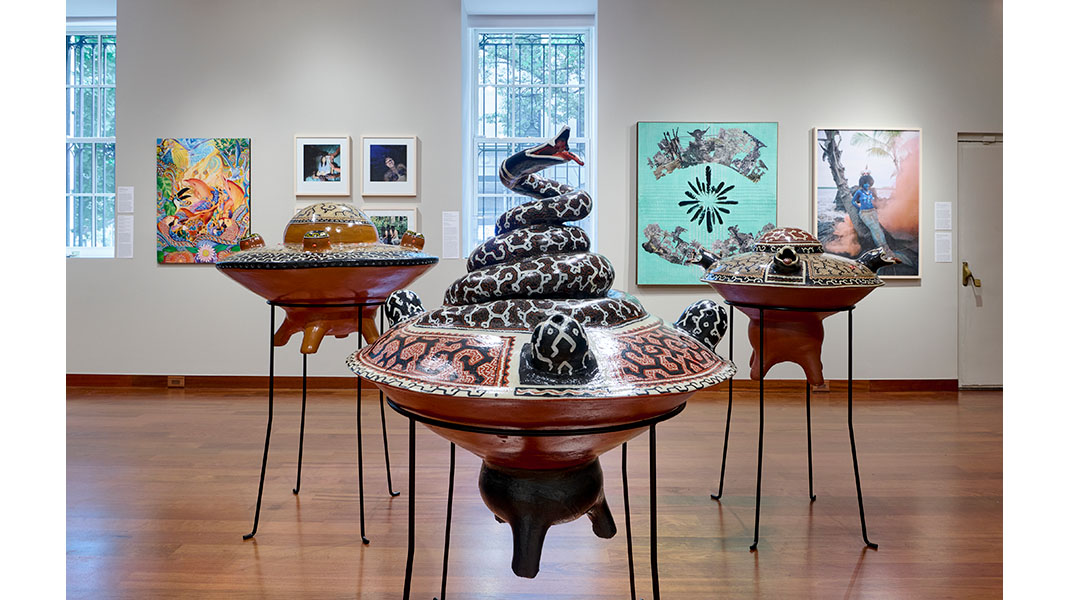
Amazonia Açu at Americas Society, September 3, 2025 through April 18, 2026

“Americas Society presents Amazonia Açu, an exhibition that sheds light on the multiplicities of the Amazon, a region which comprises many different communities each distinguished by its own belief system, culture, and language. On view from September 3, 2025 to April 18, 2026, the show includes paintings, textiles, ceramics, drawings, videos, photographs, and sculptures from artists and collectives of all nine countries of the Pan-Amazon region: Bolivia, Brazil, Colombia, Ecuador, French Guiana, Guyana, Peru, Suriname, and Venezuela.

Amazonia Açu features over fifty contemporary artworks, from 1990 to the present. The exhibition provides a kaleidoscopic overview of the aesthetic, cultural, and material diversity found in the Amazon as a means to upend flattening generalizations typically associated with the territory and to frame the discourse surrounding the region within a context.” — Americas Society

“The ‘Amazonia Açu’ — the latter a Tupi-Guaraní word for ‘large’ or ‘expanded’ —is not only the largest carbon sink on Earth and a sanctuary of biodiversity, but also home to hundreds of languages and other forms of cultural expression,” said Aimé Iglesias Lukin, Americas Society’s Director and Chief Curator of Art. “The exhibition aims to highlight the diversity of the region, encouraging future research and other exhibition projects to expand study of the territory.”

Installation views of “Amazonia Açu”, on view September 3, 2025 to April 18, 2026 at Americas Society, Photos by Arturo Sanchez. Courtesy Americas Society.

“Very much like Amazonia, the exhibition is not self-contained. It is a space of openness, interconnection, and meeting. Each work selected, each narrative constructed, carries within itself a story that adds to other stories, creating a collective quilt,” said Eleison. “The curators, all from different Amazonian territories, are more than art mediators; they are guardians of their cultures, histories, and worldviews. They invite us to look beyond stereotypes of the Amazon, listen to its deeper tones, connect ourselves with its subtler layers.”

The show is co-curated by a committee of representatives from each country within the Amazon region: Curatorial Advisor Keyna Eleison and Mateus Nunes, of B razil, Elvira Espejo Ayca of Bolivia, María Wills of Colombia, Diana Iturralde of Ecuador, T2i and NouN of French Guiana, Grace Aneiza Ali of Guyana, Christian Bendayán of Peru, Miguel Keerveld of Suriname and Luis Romero of Venezuela.

Ruth Asawa: A Retrospective at The Museum of Modern Art, October 19, 2025 – February 7, 2026  

“The Museum of Modern Art announces Ruth Asawa: A Retrospective, the first major museum exhibition to fully consider every aspect of the artist’s expansive, groundbreaking practice, on view from October 19, 2025, through February 7, 2026, in the Steven and Alexandra Cohen Center for Special Exhibitions. Coinciding with the centennial of the artist’s birth, the exhibition will include some 300 objects that highlight the core values of experimentation and interconnectedness pervading all dimensions of Asawa’s practice. The retrospective will span the six decades of Asawa’s ambitious career, presenting a range of her work across mediums, including wire sculptures, bronze casts, paper folds, paintings, and a comprehensive body of works on paper. Artworks will be accompanied by a rich array of archival materials—photographs, documents, and ephemera—that illuminate her public commissions, art advocacy, and meaningful, lasting relationships with members of her community. The exhibition will follow a loose chronological arc, interwoven with thematic sections elaborating on the artist’s inspirations and methods.” — The Museum of Modern Art

 “What’s exceptional about Asawa’s practice is the multiplicity of her artistic pursuits and the marvelous ability to turn the simplest things into subjects of lifelong creative contemplation,” said Manes. “The exhibition aims to offer multiple points of entry into her work, reflecting what Asawa described as the ‘total act’ of artmaking.”

nstallation view of Ruth Asawa: A Retrospective on view at The Museum of Modern Art from October 19, 2025, through February 7, 2026. The Museum of Modern Art, New York. Digital Image © 2025 The Museum of Modern Art, New York. Photo by Jonathan Dorado.
Installation view of Ruth Asawa: A Retrospective on view at The Museum of Modern Art from October 19, 2025, through February 7, 2026. The Museum of Modern Art, New York. Digital Image © 2025 The Museum of Modern Art, New York. Photo by Jonathan Dorado.

Ruth Asawa: A Retrospective is an exhibition partnership between the San Francisco Museum of Modern Art (SFMOMA) and The Museum of Modern Art, New York (MoMA). The exhibition is organized by Cara Manes, Associate Curator, Department of Painting and Sculpture, MoMA, and Janet Bishop, Thomas Weisel Family Chief Curator, SFMOMA; with Dominika Tylcz, Curatorial Assistant, Department of Painting and Sculpture, MoMA; and Marin Sarvé-Tarr, Assistant Curator, and William Hernández Luege, former Curatorial Associate, Painting and Sculpture, SFMOMA. 

Images courtesy The Museum of Modern Art.

Divine Egypt at The Metropolitan Museum of Art, October 12, 2025 – January 19, 2026

Divine Egypt at The Metropolitan Museum of Art—the first major exhibition of Egyptian art at the Museum in over a decade—will explore how images of gods in ancient Egypt were experienced not merely as spiritual depictions in temples, shrines, and tombs but were the instruments that brought the gods to life for daily worship, offering ancient Egyptians a vital connection between the human and divine worlds. Opening on October 12, the exhibition will bring together over 200 spectacular works of art to examine the imagery associated with the most important deities in ancient Egypt’s complex and always-expanding constellation of gods.” — The Metropolitan Museum of Art

Divine Egypt will immerse visitors in the breathtaking imagery of the most formidable ancient deities and expansive universe of the Egyptian gods,” said Max Hollein, The Met’s Marina Kellen French Director and Chief Executive Officer. “The Museum’s galleries for Egyptian art are among the most beloved by our millions of yearly visitors, and this dazzling exhibition brings together some of our most exquisite works with loans from leading global institutions for an exceptional, once-in-a-lifetime exhibition of ancient Egyptian art.”

Goddess Hathor, King Menkaure, and the Deified Hare. nome. ca. 2490–2472 BCE. Stone, Greywack. Museum of Fine Arts, Boston (09.200). Photograph © 2025 Museum of Fine Arts, Boston
Statue group of the god Horus and the king Horemheb. ca. 1323–1295 BCE. Stone, limestone. Kunsthistorisches Museum, Vienna, Egyptian and Near Eastern Collection (AE INV 8301). Photo by Anna-Marie Kellen © The Metropolitan Museum of Art
Statuette of Osiris. 664–332 B.C. Leaded bronze. The Metropolitan Museum of Art, New York, Rogers Fund, 1961 (61.45). Photo by Anna-Marie Kellen © The Metropolitan Museum of Art
Statuette of Amun. ca. 945–712 B.C.. Gold. The Metropolitan Museum of Art, New York, Edward S. Harkness Gift, 1926 (26.7.1412). Photo by Anna-Marie Kellen © The Metropolitan Museum of Art
Relief of the Goddess Maat. ca. 1294‒1279 BCE. Stone, limestone, paint Museo Archeologico Nazionale di Firenze, Florence (2469). Photo by Anna-Marie Kellen © The Metropolitan Museum of Art

“The ways in which the ancient Egyptian gods were depicted are vastly different from the divine beings in contemporary religions and therefore are intriguing to modern audiences,” said Diana Craig Patch, Lila Acheson Wallace Curator in Charge of Egyptian Art. “The identity of an ancient Egyptian god may at first seem easy to recognize but looks can be deceiving, as one form can be shared by many deities. Across more than 3,000 years of history, gods, attributes, roles, and myths were rarely dropped from use, yet the Egyptians of the time had no difficulty understanding and accepting the resulting multiplicity. Through hundreds of spectacular objects, Divine Egypt will allow visitors to understand the complex nature of these deities and help translate the images that were needed to make the inhabitants of the celestial realm available to ancient Egyptians.”   

Divine Egypt is curated by Diana Craig Patch, Lila Acheson Wallace Curator in Charge of Egyptian Art at The Met, with Brendan Hainline, Research Associate, Department of Egyptian Art.

Title image: Triad of Osorkon II. ca. 874‒850 BCE. Glass, Metal, Gold, Stone, Lapis Lazuli. Musée du Louvre, Paris (E 6204). Photo by Mathieu Rabeau © Musée du Louvre, Dist. RMN-Grand Palais / Art Resource, NY.

Images courtesy The Metropolitan Museum of Art.

To the Holy Sepulcher: Treasures from the Terra Sancta Museum at The Frick Collection, October 2, 2025 through January 5, 2026

“Beginning this fall, The Frick Collection presents a stunning exhibition of more than forty objects on loan from the Terra Sancta Museum. Ranging from liturgical objects in gem-encrusted gold and silver to richly decorated vestments in velvet, damask, and other fine materials, the works were created for the Church of the Holy Sepulcher in Jerusalem and were largely unknown until their rediscovery by scholars in the 1980s. They represent the pinnacle of European craftsmanship in these fields during the seventeenth and eighteenth centuries, and many have no parallel anywhere in the world. To the Holy Sepulcher: Treasures from the Terra Sancta Museum offers visitors the opportunity to view these objects for the first time in North America.” — The Frick Collection

Commented Salomon, “This exhibition represents a completely unique opportunity for visitors, building on the Frick’s successful past presentations highlighting masters of European decorative arts. Displayed for the first time in the United States, the exquisite objects in this show are rare survivals, as similar objects were often severely damaged, melted down, or otherwise lost—nothing like them survives in the countries in which they were created. We are deeply grateful for this collaboration with the Custody of the Holy Land as we look ahead to the opening of the Terra Sancta Museum, which will offer a more permanent public display of these treasures.

Installation view of To the Holy Sepulcher: Treasures from the Terra Sancta Museum at The Frick Collection, showing Antonio de Laurentiis’s Throne of Eucharistic Exposition (Naples, 1754) (center) and other works from the Kingdoms of Naples, Portugal, and Spain, courtesy the Terra Sancta Museum, Jerusalem. 
Photo: Joseph Coscia Jr.
Installation view of To the Holy Sepulcher: Treasures from the Terra Sancta Museum at The Frick Collection, showing works from the Kingdom of Spain, courtesy the Terra Sancta Museum, Jerusalem. 
Photo: Joseph Coscia Jr.
Installation view of To the Holy Sepulcher: Treasures from the Terra Sancta Museum at The Frick Collection, showing Pietro, Eutichio, and Sebastiano Juvarra’s Throne of Eucharistic Exposition (Messina, 1665) (top center) and other works from the Kingdom of Spain, courtesy the Terra Sancta Museum, Jerusalem. 
Photo: Joseph Coscia Jr.
Installation view of To the Holy Sepulcher: Treasures from the Terra Sancta Museum at The Frick Collection, showing Al San Lorenzo Giustinian Workshop’s Pair of Torchères (Venice, 1762) flanking Gennaro De Blasio’s Altar Frontal or Antependium (Naples, 1731) along with other works from the Kingdom of Naples and Republic of Genoa, courtesy the Terra Sancta Museum, Jerusalem
. Photo: Joseph Coscia Jr.
Installation view of To the Holy Sepulcher: Treasures from the Terra Sancta Museum at The Frick Collection, showing Al San Lorenzo Giustinian Workshop’s Pair of Torchères (Venice, 1762) flanking Gennaro De Blasio’s Altar Frontal or Antependium (Naples, 1731), courtesy the Terra Sancta Museum, Jerusalem
. Photo: Joseph Coscia Jr.
Installation view of To the Holy Sepulcher: Treasures from the Terra Sancta Museum at The Frick Collection, showing The Resurrection (Naples, 1736) (left) and the Chasuble from the Red “Jerusalem Cross.” Set of Pontifical Vestments Sent by the Commissariat of Lombardy (Milan or Genoa, probably 1600) (right), courtesy the Terra Sancta Museum, Jerusalem. 
Photo: Joseph Coscia Jr.
Installation view of To the Holy Sepulcher: Treasures from the Terra Sancta Museum at The Frick Collection, showing two Chasubles (Milan or Genoa, probably 1600) flanking the entry to a room with works from the Kingdom of France, donated by King Louis XIII, courtesy the Terra Sancta Museum, Jerusalem
. Photo: Joseph Coscia Jr.
Installation view of To the Holy Sepulcher: Treasures from the Terra Sancta Museum at The Frick Collection, showing Claude Caignet’s Large Sanctuary Lamp (Paris, 1617–18), Large Processional Cross (Paris, ca. 1620), and Six Altar Candlesticks (Paris, 1620–21 and 1623–24) and Alexandre Paynet’s (or Penet’s) Red Pontifical Vestments (Paris, 1619), donated by King Louis XIII, courtesy the Terra Sancta Museum, Jerusalem. Photo: Joseph Coscia Jr.

The exhibitionis organized by Xavier F. Salomon, the Frick’s Deputy Director and Peter Jay Sharp Chief Curator, along with Jacques Charles-Gaffiot and Benoît Constensoux, members of the Terra Sancta Museum’s Scientific Committee.

Title image: Antonio de Laurentiis. Throne of Eucharistic Exposition. Naples, 1754. Gold, gilt copper, almandine garnets, amethysts, rock crystal, diamonds, rubies, emeralds, sapphires, carnelians, peridots, smoky quartzes, glass, and doublets. 68 3/4 × 32 1/4 × 15 3/8 in. (174.5 × 82 × 39 cm). Terra Sancta Museum, Jerusalem. Photo: Joseph Coscia Jr.

Images courtesy The Frick Collection.

The New York Sari: A Journey Through Tradition, Fashion, and Identity at The New York Historical, September 12, 2025 – April 26, 2026

“The New York Historical presents The New York Sari, an exploration of one of the world’s oldest-known garments and its impact on New York. Originating in South Asia, the sari has spread across oceans through trade, colonialism, and migration, becoming a truly global garment. This exhibition traces how the sari—and those who wear it—found a home in New York City. Once seen as a marker of distance and exoticism, the sari has become woven into the city’s cultural fabric, embraced by new generations of artists, dancers, entrepreneurs, community leaders, scientists, and changemakers.

The sari, with its endless variations in fabric, pattern, and draping style, carries a story shaped by centuries of textile artistry, global trade, and cultural exchange that began long before Portuguese ships arrived in India in 1498. The distinct variations we see today are a powerful representation of regional tradition, cultural identity, and personal expression. For many, the sari evokes rituals, milestones, and womanhood; for others, it becomes a bold statement of reinvention.” — The New York Historical

Installation views of The New York Sari at The New York Historical, September 12, 2025 – April 26, 2026. Photos by Glenn Castellano. Courtesy The New York Historical.

“At The New York Historical, we are committed to telling stories that reflect the full breadth of the American experience,” said Dr. Louise Mirrer, president and CEO of The New York Historical. “The New York Sari illuminates how a centuries-old garment continues to shape identity, artistry, and community-building across our city. This exhibition is a celebration of the sari’s complexity—not only as a textile but as a powerful cultural symbol shaped by trade, migration, and personal expression. By centering voices from across the diaspora, we invite all New Yorkers to consider the rich histories woven into the fabric of everyday life and how a single garment can hold memory, spark dialogue, and foster belonging in a city as dynamic as New York.”

Sixties Surreal at Whitney Museum of American Art, September 24, 2025–January 19, 2026 

“This fall, the Whitney Museum of American Art presents Sixties Surreal, a sweeping, ambitious, revisionist look at American art from 1958 to 1972 through the lens of the ‘surreal,’ both inherited and reinvented. Opening on September 24, the exhibition features the work of 111 artists who embraced the psychosexual, fantastical, and revolutionary energy of an era shaped by civil unrest, cultural upheaval, and boundless experimentation. 

Rather than adhering to familiar movements of the 1960s like Pop Art, Conceptualism, or Minimalism, Sixties Surreal uncovers alternate histories and recontextualizes some of the decade’s best-known figures alongside those only recently rediscovered. The exhibition considers how artists turned to Surrealism, not as a European import, but as a way to navigate the strange, turbulent realities of American life. Featuring iconic works by Diane Arbus, Yayoi Kusama, Romare Bearden, Judy Chicago, Nancy Grossman, Christina Ramberg, David Hammons, Louise Bourgeois, Jasper Johns, Fritz Scholder, Peter Saul, Marisol, Robert Crumb, Faith Ringgold, H.C. Westermann, Jack Whitten, and many others, the exhibition brings new visibility to a generation of artists who challenged mainstream narratives in pursuit of radical freedom.” — Whitney Museum of American Art

Installation view of Sixties Surreal (Whitney Museum of American Art, New York, September 24, 2025–Jan 19, 2026). From left to right: Miyoko Ito, Untitled, 1970; Jeremy Anderson, Riverrun, 1965; Hannah Wilke, Teasel Cushion, 1967; Deborah Remington, Haddonfield, 1965; Yayoi Kusama, Accumulation, c. 1963; Louise Bourgeois, Fée Couturière, 1963; Judy Chicago, In My Mother’s House, c. 1962-64; Franklin Williams, Untitled, 1967; Eva Hesse, C-Clamp Blues, 1965. Photograph by Quadir Moore/BFA.com. © BFA 2025
Installation view of Sixties Surreal (Whitney Museum of American Art, New York, September 24, 2025–Jan 19, 2026). From left to right: Robert Crumb, Head #1, 1967; Robert Crumb, Burned Out, cover for The East Village Other 5, no. 10, 1970; Mike Henderson, Dufus, 1970; Ming Smith, Kites Inside, Columbus, Ohio, c. 1972; Shawn Walker, Man with Bubble, Central Park (near Bandshell), c. 1960–79; Romare Bearden, Pittsburg Memory 2/6, 1964; Diane Arbus, Five members of the Monster Fan Club, N.Y.C. 1961, 1961; Adger Cowans, Shadows, 1966; Paul Thek, Untitled (from the series Television Analyzations), 1963. Photograph by Quadir Moore/BFA.com. © BFA 2025
Installation view of Sixties Surreal (Whitney Museum of American Art, New York, September 24, 2025–Jan 19, 2026). From left to right: Raymond Saunders, Untitled, 1968; H.C. Westermann, The Plush, 1963-64; William T. Wiley, Shark’s Dream, 1967; David Hammons, Untitled, 1969; Bruce Nauman, Mold for a Modernized Slant Step, 1966; Franklin Williams, Untitled III, 1966; Barbara Chase-Riboud, Confessions for Myself, 1972; Jeremy Anderson, Riverrun, 1965; Hannah Wilke, Teasel Cushion, 1967; Yayoi Kusama, Accumulation, c. 1963; Louise Bourgeois, Fée Couturière, 1963; Deborah Remington, Haddonfield, 1965; Judy Chicago, In My Mother’s House, c. 1962-64; Deborah Remington, Haddonfield, 1965; Franklin Williams, Untitled, 1967; Eva Hesse, C-Clamp Blues, 1965; Lee Bontecou, Untitled, 1961, 1961. Photograph by Quadir Moore/BFA.com. © BFA 2025
Installation view of Sixties Surreal (Whitney Museum of American Art, New York, September 24, 2025–Jan 19, 2026). From left to right: Peter Saul, Saigon, 1967; Daniel LaRue Johnson, Freedom Now, Number 1, August 13, 1963 – January 14, 1964, 1964; Benny Andrews, No More Games, 1970; Timothy Washington, TK (Viet Nam), 1970; Jasper Johns, Flags, 1965; Harold Stevenson, The New Adam, 1962; Ralph Arnold, Collage, 1968; Mel Casas, Humanscape #56 (San Antonio Circus), 1969; T.C. Cannon, Andrew Myrick – Let Em Eat Grass, 1970; Luis Jimenez, Man on Fire, 1969; Fritz Scholder, Indian and Rhinoceros, 1968; Judith Bernstein, Vietnam Garden, 1967; Barbara Jones-Hogu, Mother of Man, 1968. Photograph by Quadir Moore/BFA.com. © BFA 2025
Installation view of Sixties Surreal (Whitney Museum of American Art, New York, September 24, 2025–Jan 19, 2026). From left to right: Diane Arbus, Bela Lugosi as Dracula on Television, 1958; Shawn Walker, Tiffany’s Window on 57th Street, NYC, c. 1968–72; Diane Arbus, Clouds on screen at a drive-in movie, N.J., 1961; Luis Jimenez, Blonde TV Image, 1967; Lee Friedlander, Nashville, 1963; Lee Friedlander, Galax, Virginia, 1962; Lee Friedlander, Florida, 1963; Carlos Villa, My Roots, 1970-71; Edward Owens, Private Imaginings and Narrative Facts, 1966. Photograph by Quadir Moore/BFA.com. © BFA 2025
Installation view of Sixties Surreal (Whitney Museum of American Art, New York, September 24, 2025–Jan 19, 2026). From left to right: H.C. Westermann, Memorial to the Idea of Man If He Was an Idea, 1958; Rupert Garcia, Unfinished Man, 1968; Luis Jimenez, Man on Fire, 1969; Ralph Arnold, Unfinished Collage, 1968; Daniel LaRue Johnson, Freedom Now, Number 1, August 13, 1963 – January 14, 1964, 1964; Benny Andrews, No More Games, 1970; Timothy Washington, TK (Viet Nam), 1970. Photograph by Quadir Moore/BFA.com. © BFA 2025
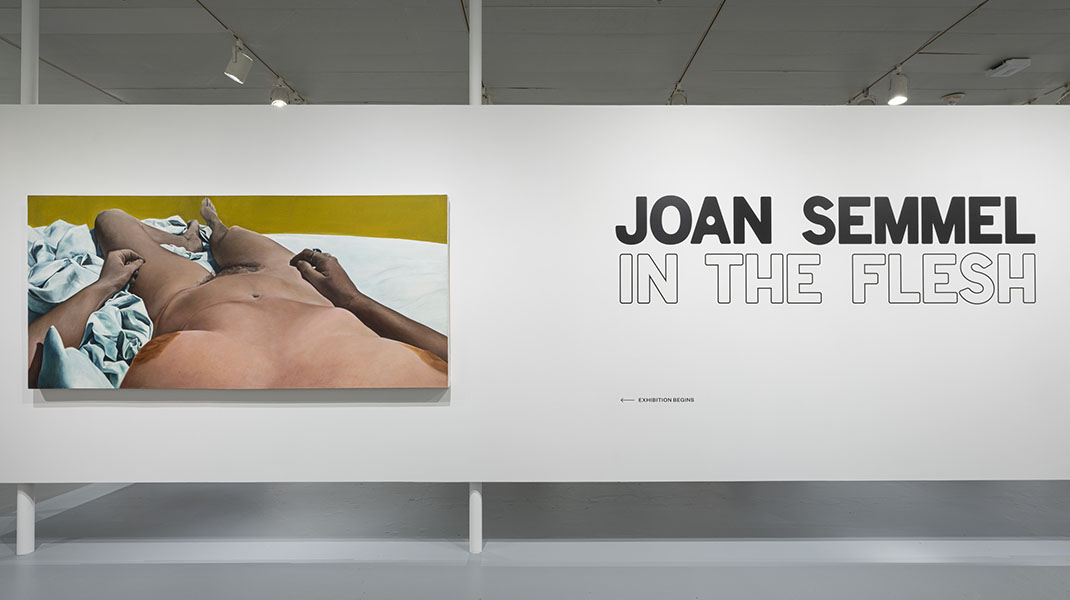
Installation view of Sixties Surreal (Whitney Museum of American Art, New York, September 24, 2025–Jan 19, 2026). From left to right: Carolee Schneemann, Body Collage, 1967; Joan Semmel, Untitled, 1971; Niki De Saint Phalle, Vivian, 1965; Christina Ramberg, Shadow Panel, 1972; Martha Edelheit, Flesh Wall with Table, 1965. Photograph by Quadir Moore/BFA.com. © BFA 2025
Installation view of Sixties Surreal (Whitney Museum of American Art, New York, September 24, 2025–Jan 19, 2026). From left to right: Lynn Hershman Leeson, Giggling Machine, Self Portrait as Blonde, 1968; Christina Ramberg, Shadow Panel, 1972; Nancy Graves, Camel VI, Camel VII and Camel VIII, 1968–1969; Marisol, Women and Dog, 1963-64; Luchita Hurtado, Untitled, 1971. Photograph by Quadir Moore/BFA.com. © BFA 2025
Installation view of Sixties Surreal (Whitney Museum of American Art, New York, September 24, 2025–Jan 19, 2026). From left to right: Shigeko Kubota, Self-Portrait, c. 1970–71.; Jae Jarrell, Ebony Family, ca. 1968; Linda Lomahaftewa, Untitled Woman’s Faces, 1960s; Kiki Kogelnik, Gee Baby – I’m Sorry, 1965. Photograph by Quadir Moore/BFA.com. © BFA 2025
Installation view of Sixties Surreal (Whitney Museum of American Art, New York, September 24, 2025–Jan 19, 2026). From left to right: Robert Smithson, Green Chimera with Stigmata, 1961; Ching Ho Cheng, Sun Drawing, 1967; Barbara Rossi, Male of Sorrows #5, 1970; Wally Hedrick, HERMETIC IMAGE, 1961; Betye Saar, Ten Mojo Secrets, 1972; Eduardo Carrillo, Testament of the Holy Spirit, 1971; Jack Whitten, Christ, 1964. Photograph by Quadir Moore/BFA.com. © BFA 2025
Installation view of Sixties Surreal (Whitney Museum of American Art, New York, September 24, 2025–Jan 19, 2026). From left to right: Carlos Villa, My Roots, 1970-71; Nancy Grossman, Head 1968, 1968; Anita Steckel, The Big Rip-Up, 1964; Suellen Rocca, Foot Smells, c. 1966; Suzanne Jackson, We Were Waiting, n.d.; Barbara Hammer, Tee Corinne Sleeping, 1972; Barbara Hammer, Tee Corinne Sleeping, 1972; Lynn Hershman Leeson, Giggling Machine, Self Portrait as Blonde, 1968; Jay DeFeo, The Eyes, 1958; Robert Smithson, Green Chimera with Stigmata, 1961; Ching Ho Cheng, Sun Drawing, 1967; Barbara Rossi, Male of Sorrows #5, 1970. Photograph by Quadir Moore/BFA.com. © BFA 2025
Installation view of Sixties Surreal (Whitney Museum of American Art, New York, September 24, 2025–Jan 19, 2026). From left to right: Nancy Graves, Camel VI, Camel VII and Camel VIII, 1968–1969; Jean Conner, Are You a Springmaid? II, 1960; Jean Conner, Are You a Springmaid?, 1960; Paul Thek, Untitled from the series Technological Reliquaries, 1966; Jim Nutt, Running Wild, 1969-1970; Claes Oldenburg, Soft Toilet, 1966; Lee Lozano, No Title, 1964. Photograph by Quadir Moore/BFA.com © BFA 2025

“Sixties Surreal has been nearly three decades in the making, dating to my time as a Whitney intern and subsequent college thesis. Through intense collaboration with curatorial colleagues Dan Nadel, Laura Phipps, and Elisabeth Sussman, the project has grown into a sweeping reexamination of a turbulent and transformative chapter in American life and art,” said Scott Rothkopf, the Alice Pratt Brown Director of the Whitney. “Sixties Surreal reveals how artists across the country embraced and reinvented surreal tendencies to challenge conventions and mirror the strangeness of a time marked by radical political, social, and cultural change. By bringing their visionary contributions into fuller view, this exhibition helps to reshape how we understand the art and spirit of the 1960s, as well as our own roiling moment.” 

Sixties Surreal is organized by Dan Nadel, Steven and Ann Ames Curator of Drawings and Prints; Laura Phipps, Associate Curator; Scott Rothkopf, Alice Pratt Brown Director; and Elisabeth Sussman, Curator; with Kelly Long, Senior Curatorial Assistant, and Rowan Diaz-Toth, Curatorial Project Assistant, at the Whitney Museum of American Art.

Title image: Linda Lomahaftewa, Untitled Woman’s Faces, 1960s. Oil on canvas, 36 × 48 in. (91.4 × 121.9 cm). Heard Museum, Phoenix; Gift of the artist. © Linda Lomahaftewa.

Images courtesy Whitney Museum of American Art.


Witnessing Humanity: The Art of John Wilson at The Metropolitan Museum of Art, September 20, 2025 – February 8, 2026

 “This fall, The Metropolitan Museum of Art presents Witnessing Humanity: The Art of John Wilson, the largest exhibition of this artist’s work and his first solo museum show in New York. For over six decades, American artist John Wilson (1922–2015) made powerful and poetic works that reflected his life as a Black American artist and his ongoing quest for racial, social, and economic justice. His art responded to the turbulent times in which he lived, with a focus on such subjects as racial violence, labor, the writings of Richard Wright, the Civil Rights Movement, and street scenes, and also captured intimate images of family life, with a particular focus on fatherhood. Drawing from the collections of The Met, the Museum of Fine Arts, Boston, and a dozen other lenders, this exhibition features over 100 artworks made over the course of Wilson’s career, including paintings, prints, drawings, and sculpture, as well as illustrations for children’s books and archival material; many of the works have not been shown before.” — The Metropolitan Museum of Art 

“While the powerful impact of John Wilson’s art and the enduring relevance of the themes he explored are undeniable, he has not yet received the recognition his work so deeply deserves,” said Max Hollein, Marina Kellen French Director and Chief Executive Officer of The Met. “This landmark exhibition honors Wilson’s extraordinary artistic achievements—illuminating the incredible range of work he produced over five decades— and affirms his place in art history as one of the foremost artists devoted to social justice and portraying the experiences of Black Americans.”

Installation views of Witnessing Humanity: The Art of John Wilson, on view September 20, 2025–February 8, 2026 at The Metropolitan Museum of Art. Photos by Hyla Skopitz, Courtesy of The Met.

Jennifer Farrell, exhibition co-curator and Jordan Schnitzer Curator in the Department of Drawings and Prints at The Met, said, “Wilson’s art is imbued with compassion and empathy while conveying his anger and distress at the wrenching effects of disenfranchisement, racism, and economic inequality. Challenging deep-seated prejudices and omissions within our national history, Wilson centered the experiences of Black Americans to create images that convey strength, resilience, and humanity. Deeply personal yet widely resonant, his work continues to offer a powerful lens through which to consider today’s urgent dialogues about race, equality, and representation.” 

Leslie King Hammond, exhibition co-curator and art historian, professor emerita, and founding director of the Center for Race and Culture at Maryland Institute College of Art, said, “John Wilson was an artist of profound resilience and passion for the innate essence of dignity, beauty, and humanity of Black Americans, which he witnessed in families, community, and all humankind. He was intentional and relentless throughout his life to create imagery that demanded respect for the Black body in an America struggling with its contested legacy of slavery.”

Witnessing Humanity: The Art of John Wilson is co-curated by Jennifer Farrell, Jordan Schnitzer Curator, Department of Drawings and Prints at The Met; Leslie King Hammond, art historian, professor emerita, and founding director of the Center for Race and Culture at Maryland Institute College of Art; Patrick Murphy, the MFA’s Lia and William Poorvu Curator of Prints and Drawings; and Edward Saywell, the MFA’s Chair of Prints and Drawings.

Title image: John Wilson (American, 1922–2015). My Brother, 1942. Oil on panel. 12 x 10 5/8 in. (30.48 x 26.9875 cm). Smith College Museum of Art, Purchased (SC 1943.4.1). Courtesy of the Estate of John Wilson.

Sing a New Song: The Psalms in Medieval Art and Life at The Morgan Library & Museum, September 12, 2025 – January 4, 2026

“The Morgan Library & Museum presents Sing a New Song: The Psalms in Medieval Art and Life, the first exhibition of its kind devoted to the importance of the Psalms throughout medieval art, prayer, and everyday life. On view from September 12, 2025, through January 4, 2026, Sing a New Song traces the impact of the Psalms on people in medieval Europe from the sixth to the sixteenth century, encompassing daily practices and performance, as well as the creation and illumination of Psalters (Books of Psalms). Drawing on five years of scholarly research, the exhibition and accompanying publication take the Psalms out of their established place in religious texts and paint a vibrant picture of the people who used them—men, women, and children—both religious and lay.” — The Morgan Library & Museum“

The Morgan is very pleased to present this comprehensive, interdisciplinary exhibition, which draws on years of research into a topic that is largely unknown to the general public,” said Colin B. Bailey, Katharine J. Rayner Director of the Morgan Library & Museum. “It continues a now well- established tradition at the Morgan of organizing ambitious medieval projects that reflect the strength of our holdings and our commitment to making the latest scholarship available to as wide an audience as possible.”
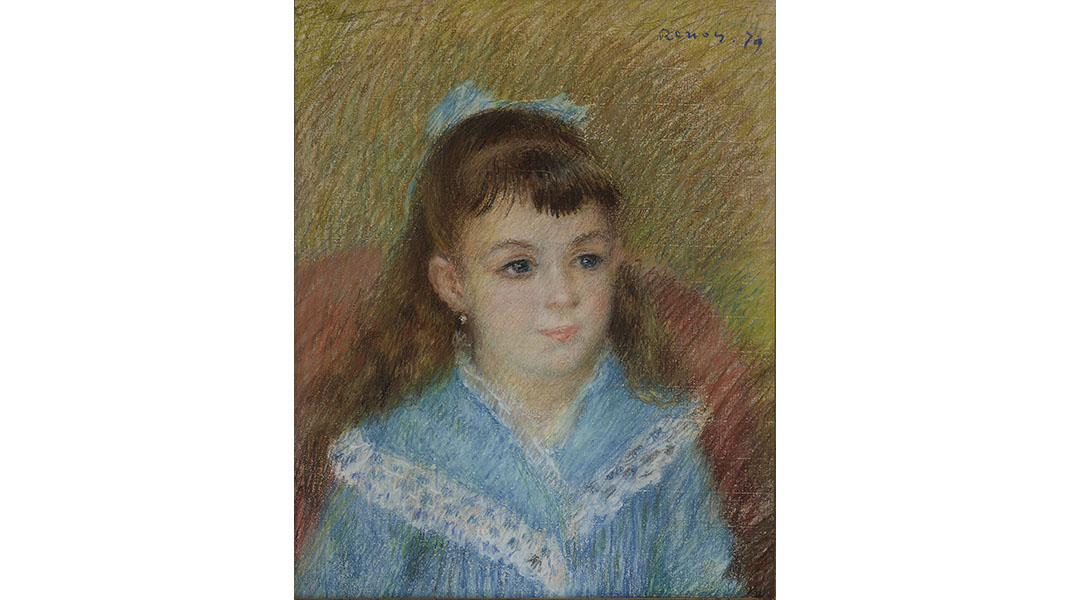
Winchester Bible Leaf. David and Goliath. England, Winchester, ca.. 1160–1180. Morgan MS M.619v. Single Leaf. 580 x 390 mm. The Morgan Library & Museum, Photography by Graham S. Haber.
David Slays Goliath. Crusader Bible. Paris, France, ca. 1244-1254. Morgan MS M.638, fol. 28v. Single Leaf. 390 x 300 mm. David. The Morgan Library & Museum, MS M.638, fol. 28v. Photography by Graham S. Haber.
Books of Truth (Sefrei Emet). Written by Isaac ben Ovadiah for Jacob, son of. Rabbi Benjamin of Montalcino. Illuminated by Mariano del Buono. Italy, 1467. New Haven, Beinecke MS 409, fol 3r. Codex. 111 x 80 mm. Beinecke Rare Book and Manuscript Library, Yale University.
Ingeborg Psalter Workshop. God Commanding Adam and River of Paradise. Psalms in Latin with interlinear French translation and French commentary of Simon de Tournai. Belgium, Tournai, ca. 1200. Morgan MS M.338, fol. 42r. (detail). Codex. 335 x 238 mm. The Morgan Library & Museum, Photography by Janny Chiu.
Attavante degli Attavanti. Pope Leo X Vesting; Leo X Praying. Praeparatio ad missam of Leo X. Italy, Rome, 1520. Morgan MS H.6, fols. 1v-2r. Codex 396 x 266 mm. The Morgan Library & Museum, MS H.6 fols. 1v-2r. Photography by Janny Chiu.
Silvestro dei Gherarducci. Ascension. Gradual of San Michele a Murano. Italy, Florence, ca. 1392–1399. Morgan MS M.653.3. Single Leaf. 590 x 400 mm. The Morgan Library & Museum, Photography by Graham S. Haber.
Giulio Clovio. Death of Uriah and David in Penance. Farnese Hours. Italy, Rome, 1546. Morgan MS M.69, fols. 63v-64r. Codex (only, no binding). 173 x 110 mm. The Morgan Library & Museum, Photography by Janny Chiu.

This exhibition and the accompanying publication really do ‘sing a new song’ as they explore, in a manner that has not been done before, how life and art in the Middle Ages and Renaissance were permeated by psalms,” said Roger S. Wieck, Melvin R. Seiden Curator and Department Head of Medieval and Renaissance Manuscripts at the Morgan Library & Museum. “Along with my colleagues Deirdre Jackson, Assistant Curator of Medieval and Renaissance Manuscripts; Joshua O’Driscoll, Associate Curator of Medieval and Renaissance Manuscripts; and Frederica Law-Turner, Contributing Guest Curator, all of whom helped to shape and broaden the exhibition, I am grateful that the Morgan is able to present an exhibition and handbook as a frame of reference for understanding the role of the Psalms in medieval life.”

Title image: Chanting Clerics, from the Windmill Psalter, England, London, late thirteenth century. The Morgan Library & Museum, MS M.102, fol. 100r (detail). Photography by Carmen González Fraile.

Images courtesy The Morgan Library & Mueum.

Piero Manzoni: Total Space and Yoichi Ohira: Japan in Murano, September 8, 2025-March 23, 2026 at Magazzino Italian Art

“Magazzino Italian Art announced that through the extraordinary generosity of Fondazione Piero Manzoni in Milan and Hauser & Wirth, it has received the gift of two room-size immersive environments conceived by Manzoni in 1961, at a date when conceptualism and installation art were only starting to appear on the art world’s horizon. Magazzino unveiled these exceptional gifts, accompanied by a contextual selection of works by Manzoni on loan from American collections, in the exhibition Piero Manzoni: Total Space, opening to the public on Monday, September 8, 2025.” — Magazzino Italian Art

Nancy Olnick and Giorgio Spanu, co-founders of Magazzino, said, “We are grateful to the Fondazione Manzoni and Hauser & Wirth for entrusting these major gifts to Magazzino, where they can now be seen in the company of the museum’s extensive collection of Arte Povera. Through their generosity, the donors have recognized Magazzino as the primary institution in North America for collecting, exhibiting, and studying the cutting-edge Italian art of the postwar era.”

Rosalia Pasqualino di Marineo, Director of Fondazione Piero Manzoni, said, “These visionary projects by Manzoni have only recently made the transition from pure idea to physical reality. Now that they have been achieved with the assistance of Hauser & Wirth, more than half a century after they were imagined, we are happy that the ideal permanent home for them is Magazzino Italian Art.”

Adam Sheffer, Director of Magazzino, said, “Despite his brief career, Piero Manzoni was among the most innovative, ironic and restlessly inventive young artists in Italy, if not the world. We are proud to exhibit the wonderful gift of these two environments in tandem with several of the Achrome works that preceded them, in which Manzoni broke with the tradition of painting in favor of an art of ‘total space’, where materials, form, and presence eclipse the superficial and open new conceptual dimensions.”

Installation view of Piero Manzoni: Total Space. Photo: Alexa Hoyer

Yoichi Ohira: Japan in Murano, a retrospective of the Japanese-born, Venice-based glass artist’s work in the United States. Curated by Nicola Lucchi, Magazzino’s Director of Research and Education, the exhibition traces the full scope of Yoichi Ohira’s (1946–2022) career in Murano, which spanned nearly 40 years, from his formative experiences at the Fucina degli Angeli glassworks, to his appointment as Artistic Director of the De Majo glassworks, and finally to his work as an independent artist and central figure in contemporary glass art.” — Magazzino Italian Art

Nancy Olnick and Giorgio Spanu, co-founders of Magazzino Italian Art, said, “This rare presentation of Yoichi Ohira’s work will reaffirm his position as one of the preeminent artists of his generation. As a Japanese-born artist in Venice, Ohira brought a fresh perspective to the heritage of glassmaking in Murano, breathing new life into a venerable artform.”

Nicola Lucchi, Director of Research and Education, Magazzino Italian Art, said, “Yoichi Ohira’s work was marked by a particular sensitivity to the history of glassmaking in Murano. Of particular interest in this exhibition are studies on paper that Ohira shared with master glassmakers, illustrating the characteristics he sought to achieve in his work. These documents of thought and invention provide a rare opportunity to delve into the artistic process at the heart of Murano glassmaking.”

Adam Sheffer, Director of Magazzino Italian Art, said, “Yoichi Ohira: Japan in Murano is a testament to the broad scope of Magazzino Italian Art as the only institution in the United States dedicated to the art and culture of post-war Italy. On view concurrently with Piero Manzoni: Total Space, this presentation brings to our audiences a wide perspective on the rich history of this era and its artists.”

Photograph by Marco Anelli/Tommaso Sacconi © @marco_anelli_studio @tommasosacconi

Title image: Photo by William Mulvihill. Courtesy Magazzino Italian Art.

Hope and Reverence: Cristina Mittermeier and Paul Nicklen, September 15-September 28, 2025 at C. Parker Gallery, New York

“Cristina Mittermeier and Paul Nicklen are internationally celebrated visual storytellers. These fine art photographers and conservation champions have created some of the world’s most iconic images. Both artists are recognized for the power of their images, inspiring global change via their 12 million followers worldwide,” says Tiffany Benincasa, the Proprietor of C. Parker Gallery and Curator of the exhibition.

“The gallery show features more than 40 works. Several will be exhibited for the first time, including new works from their most recent expedition to Africa. Mittermeier has been invited to speak at the World Economic Forum (WEF) Cultural Roundtable event during Climate Week NYC ‒ following her presentation earlier this year in Davos for the WEF’s flagship annual gathering. While in New York this month, the artists have been invited to be part of the Atmos Blue Renaissance event at The Frick Collection, on solutions for a living ocean. That same evening, the artists will represent their SeaLegacy.org foundation at President Emmanuel Macron’s event to announce major new developments on the High Seas Treaty’s mission to establish marine protected areas worldwide.” — C. Parker Gallery 

Wild Flowers in My Hair, by Cristina Mittermeier (2023). Suri people, Omo Valley, Ethiopia. Courtesy of C. Parker Gallery. 
Flight at Dawn, by Cristina Mittermeier (2018) Adams River, British Columbia, Canada. Courtesy of C. Parker Gallery. 
Big Eyes, by Cristina Mittermeier (2023) French Polynesia. Courtesy of C. Parker Gallery. 
 ‘Fire and Ice’ Tabular II, by Paul Nicklen (2022) Antarctic. Courtesy of C. Parker Gallery.
Legend, by Paul Nicklen (2025) Kenya. Courtesy of C. Parker Gallery.
Master of the Mara, by Paul Nicklen (2017) Kenya. Courtesy of C. Parker Gallery.

“Our work has always been about connecting people to the beauty — and fragility — of the natural world, and there is no better moment to ignite that conversation than now,” says Paul Nicklen. “We are grateful to C. Parker Gallery for once again giving us the space to bring art and advocacy together in such a meaningful way.” 

Hope and Reverence are, at their heart, a celebration of the natural world. This exhibition is an invitation to pause, to feel, and to see the planet with fresh eyes,” says Cristina Mittermeier. “Through art, we can remind ourselves of all that is still beautiful and worth protecting. I look forward to sharing that experience with New York during Climate Week,” adds Mittermeier.

Man Ray: When Objects Dream at The Met Fifth Avenue, September 14, 2025–February 1, 2026

Man Ray: When Objects Dream at The Metropolitan Museum of Art is the first major exhibition to examine the media-crossing, radical experimentation of American artist Man Ray (1890–1976) through one of his most significant bodies of work, the rayograph. Man Ray coined the term rayograph to name his version of the 19th-century technique of making photographs without a camera. He created them by placing objects on or near a sheet of light-sensitive paper, which he then exposed to light and developed. These photograms—as they are also called—appear as reversed silhouettes, or negative versions, of their subjects. They often feature recognizable items that become wonderfully mysterious in the artist’s hands. Their transformative nature led the Dada poet Tristan Tzara to describe rayographs as capturing the moments ‘when objects dream.’ While Man Ray acknowledged the photographic origins of his new works, he did not think of them as strictly bound by medium. Taking Man Ray’s lead, this presentation will be the first—more than a century since he introduced the rayograph—to situate this signature accomplishment in relation to his larger artistic output.” — The Metropolitan Museum of Art

“Before my eyes an image began to form, not quite a simple silhouette of the objects as in a straight photograph, but distorted and refracted … In the morning I examined the results, pinning a couple of the Rayographs—as I decided to call them—on the wall. They looked startlingly new and mysterious.” — Man Ray

Installation views of Man Ray: When Objects Dream, on view September 14, 2025–February 1, 2026 at The Metropolitan Museum of Art. Photos by Anna- Marie Kellen, Courtesy of The Met.

As one of the most fascinating and multi-faceted artists in the avant-garde movements of the early 20th century, Man Ray challenged traditional narratives of modernism through his daring experimentation with diverse artistic mediums,” said Max Hollein, The Met’s Marina Kellen French Director and Chief Executive Officer. “Anchored by Man Ray’s innovative and mesmerizing rayographs along with new research and discoveries, this exhibition invites visitors to explore his ground-breaking manipulation of objects, light, and media, which profoundly reframed his artistic practice and impacted countless other artists.”

Title image:  Man Ray (American, 1890–1976). Rayograph 1922. Gelatin silver print. 9 1/2 × 7 in. (24.1 × 17.8 cm). The Metropolitan Museum of Art, New York, Bluff Collection, Promised Gift of John A. Pritzker. Photo by Ben Blackwell © Man Ray 2015 Trust / Artists Rights Society (ARS), NY / ADAGP, Paris 2025. Image courtesy The Metropolitan Museum of Art.

Installations by Claes Oldenburg and Alex Da Corte at Fondazione Prada, September 18, 2025 

“Fondazione Prada will present Claes Oldenburg’s Mouse Museum (1965-1977) and Alex Da Corte’s Mouse Museum (Van Gogh Ear) (2022) to the public from 18 September 2025 (Press Preview on 17 September), on the eighth floor of the Torre, within its Milan venue, as part of the exhibition project ‘Atlas.’ For the first time, the audience will have the opportunity to experience these two installations, strictly connected visually and conceptually, in the same space. Viewing the two ‘Mouse Museums’ together offers a chance to reflect on the importance of both collecting and museum displays, artmaking and the self, while marveling at mass production, thus confronting different approaches to consumer culture. 

Through solo presentations or unexpected comparisons between works created by international artists between 1967 and 2022, ‘Atlas’ embodies a possible mapping of the ideas and visions that have contributed to the development of Fondazione Prada’s activities from 1993 to the present day. The project was conceived to evolve, one floor at a time, as part of an ongoing process, yet ready to incorporate new contributions from other artists or institutions. Its dynamic and evolving nature reflects Fondazione Prada’s desire to actively investigate how an exhibition space can be programmed and the role of a permanent project in a campus dedicated to contemporary culture.” — Fondazione Prada

Claes Oldenburg. Mouse Museum, 1965 – 1977. Wood, corrugated aluminum, 385 objects in display cases, acrylic glass, sound. 263 x 960 x 1007 cm, Inv.Nr. ÖL-Stg 258/1. Photo © mumok – Museum moderner Kunst Stiftung Ludwig Wien, On loan from the Austrian Ludwig Foundation
Alex Da Corte. Mouse Museum (Van Gogh Ear), 2022. Wood, corrugated aluminum, and Plexiglas, display case with 121 objects. Photo: Malle Madsen. Courtesy Alex Da Corte studio.

Title image:  Torre – Fondazione Prada, Milan. Photo: t-spacestudio 

Images courtesy Fondazione Prada.