Maria Lai. A Journey to America at Magazzino Italian Art, November 15, 2024–July 28, 2025

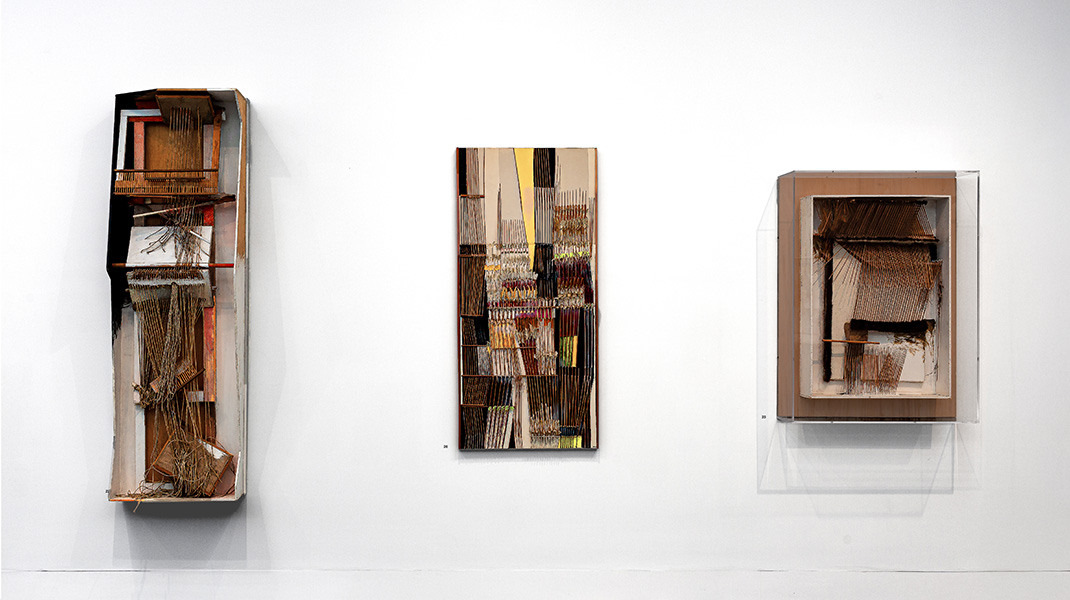
“This fall, Magazzino Italian Art presents the exhibition Maria Lai. A Journey to America, the first retrospective in the United States dedicated to a key figure in 20th-century Italian art, whose eclectic and visionary work bridged the traditions of her native Sardinia, the sensibilities and methods of Arte Povera, and the influence of American culture on the international art scene.

On view from November 15, 2024, to July 28, 2025, the exhibition features approximately 100 works by Maria Lai (Sardinia, Ulassai 1919–Cardedu 2013), including numerous works that will be presented to the public for the first time. Most of the pieces on display have never been exhibited in the United States. This exhibition offers a comprehensive overview of Maria Lai’s work, from her beginnings in the 1950s to the 2000s, with a focus on her innovative approaches to collective and relational art.” — Magazzino Italian Art

Installation views of Maria Lai. A Journey to America at Magazzino Italian Art, November 15, 2024 through July 28, 2025. Photographs by Corrado Serra.

Paola Mura, Artistic Director of Magazzino and the curator of the exhibition, said: “Maria Lai. A Journey to America explores Lai’s creative and personal journey, with Sardinia as her anchor point and as an inexhaustible source of inspiration. From these deep roots, Lai expanded her artistic exploration, intertwining Sardinian traditions with the principles of Arte Povera. In this process, she engaged with the cultural and social debates of her time, embracing the influences of American artists and writers she admired. These unique combinations make Lai an extraordinarily relevant artist in today’s world, where the fusion of historical traditions, different philosophies, and contrasting images is an integral part of our daily lives. I am deeply proud to present the first U.S. retrospective of her work at Magazzino Italian Art, where the museum’s exceptional Arte Povera collection will provide the ideal context to highlight Maria Lai’s unique contribution.”

Adam Sheffer, Director of Magazzino, said: “Just as Maria Lai bridged places and cultures in her art, and in her most celebrated initiative literally tied a village together to unite its people, Magazzino creates a singular place where visitors may encounter the greatest art from post-war Italy. We are exceptionally proud to be able to provide our audience with a broader experience of contemporary Italian art by offering the first North American career retrospective of this remarkable artist.”

Magazzino founders Nancy Olnick and Giorgio Spanu, said: “When we first encountered Maria Lai’s work decades ago, we quickly understood its significance for the development of Arte Povera. Yet her role is still under-recognized. Unmatched among her peers in pursuing a singular vision, Lai carried on her craft with ingenuity and determination. We are honored to present her work to the American public.”
Piet Mondrian: Ever further at Solomon R. Guggenheim Museum, through April 20, 2025  

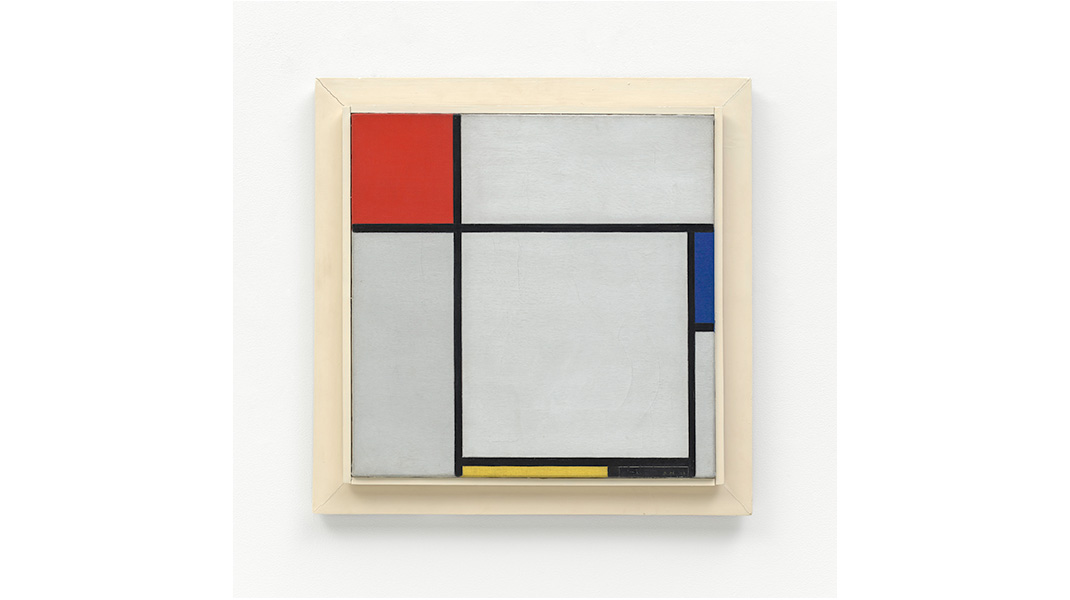
“From November 22, 2024, through April 20, 2025, the Guggenheim New York presents a selection of paintings and drawings by Piet Mondrian (b. 1872, Amersfoort, Netherlands; d. 1944, New York) from its singular collection, one of the most representative in the world. Piet Mondrian: Ever further traces the steady evolution of Mondrian’s art, from his early nature drawings in the Netherlands through his turn to radical abstraction in Paris, which continued into his final years in New York. The exhibition reveals the artist’s life-long pursuit to move painting away ‘ever further’ from the representation of nature to render a universal essence or spirit behind the appearances of the world. Showcasing 18 works, including two rare sketchbooks and a key loan from the Clark Art Institute, together for the first time, the exhibition provides a comprehensive narrative of Mondrian’s artistic path. 

Piet Mondrian: Ever further is the first in a new exhibition series, Collection in Focus, that draws from the Guggenheim’s collection. The series is part of a reinvigorated effort to make the Guggenheim’s world-renowned holdings more accessible to the public.” — Solomon R. Guggenheim Museum

Installation view, Piet Mondrian: Ever further, November 22, 2024 – April 20, 2025, Solomon R. Guggenheim Museum, New York. Photo: David Heald © Solomon R. Guggenheim Foundation, New York.

“We often hear from our visitors that they want to see more of the greatest works from our collection of modern and contemporary art. We do, too, and will present them in focus shows that allow our audiences to engage with specific artists or themes in revelatory and delightful ways,” says Mariët Westermann, Director and CEO of the Solomon R. Guggenheim Museum and Foundation. 

Westermann, curator of Piet Mondrian: Ever further, continues, “It is a joy to start with Mondrian, including works he made in my Dutch hometown of Laren. His greatest innovations in Paris coincided with the inventions of the artists in the Guggenheim’s simultaneous rotunda exhibition, Harmony and Dissonance: Orphism in Paris 1910– 1930, but Mondrian took abstraction in an entirely different direction. His pictures in the Guggenheim allow us to reconstruct his creative journey step by step, and they help us see him as the experimental painter he was—not just the geometric designer he is often thought to be.”

Piet Mondrian: Ever further is organized by Mariët Westermann, Director and CEO, Solomon R. Guggenheim Museum and Foundation.

Images courtesy Solomon R. Guggenheim Museum and Foundation.   

Sigmar Polke. Affinities Revealed, through March 16, 2025, at Museo Nacional del Prado

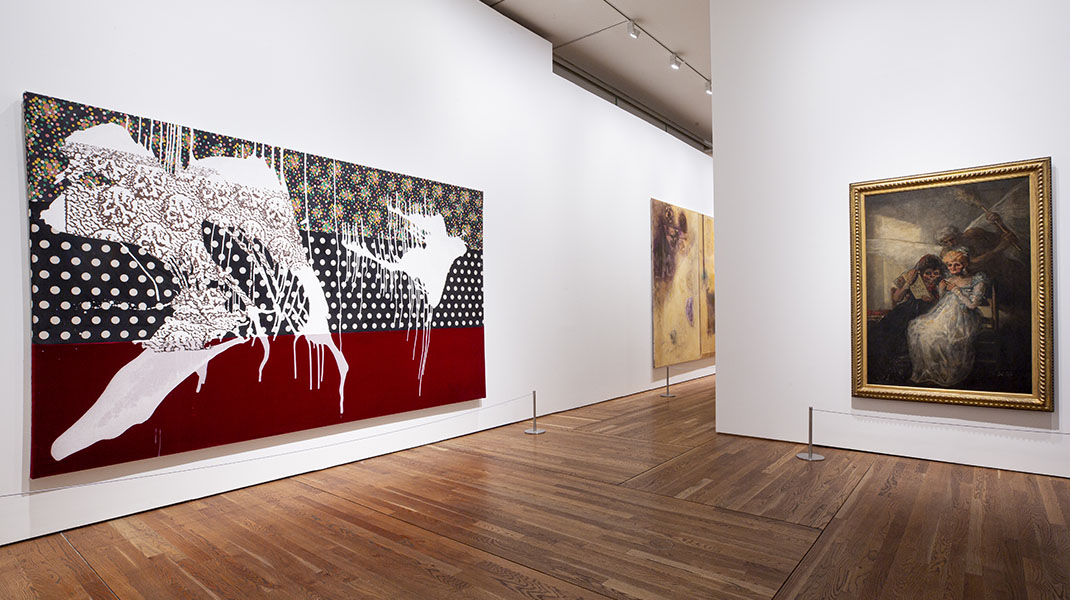
“Until 16 March 2025 in Rooms C and D of the Jerónimos Building, the Museo del Prado and the Fundación Amigos Museo del Prado, in collaboration with the Madrid City Council of Madrid, is presenting the first solo exhibition on Sigmar Polke in Madrid. 

Sigmar Polke. Affinities Revealed offers visitors the chance to learn about the work of one of the most influential names in contemporary European art and to discover the fascinating dialogue he established with the Spanish pictorial tradition, with Francisco de Goya as its maximum exponent. Two artists separated by almost two centuries, but connected by their disruptive and visionary approach. 

The exhibition, curated by Gloria Moure, brings together more than forty works by Sigmar Polke, including paintings, photographs and drawings, together with the magnificent painting +Old Women or Time (1810-12) by Goya, from the collection of the Musée de Lille and presented here for the first time in Spain alongside its X-radiograph, an image that reveals compositions which particularly attracted Polke. This discovery encouraged him to experiment with new directions and offered him a source of inspiration to delve deeper into his own artistic concerns. 

The route through the exhibition unites the legacies of two great masters, establishing a dialogue between Polke’s formal experimentation and the symbolic charge of Goya’s work.” — Museo Nacional del Prado

Image of the exhibition galleries “SIgmar Polker. Affinities Revealed”. Photo ©Museo Nacional del Prado.

Images courtesy Museo Nacional del Prado.

Make Way for Berthe Weill: Art Dealer of the Parisian Avant-Garde at New York University’s Grey Art Museum, through March 1, 2025 

“New York University’s Grey Art Museum presents Make Way for Berthe Weill: Art Dealer of the Parisian Avant-Garde, featuring works by modern artists championed by a dealer who remains relatively unknown. Weill (pronounced “vay”) was the first dealer to purchase works by Pablo Picasso in 1901, and she promoted Henri Matisse and Amedeo Modigliani, among many others. Yet her role in early 20th century modernism has been omitted from most historical accounts. This landmark exhibition sets the record straight. On view from October 1, 2024 to March 1, 2025, the groundbreaking show is the second at the museum’s new and expanded galleries at 18 Cooper Square. 

Some 110 paintings, drawings, prints, and sculpture by modern giants such as Picasso, Matisse, Aristide Maillol, Fernand Léger, and Raoul Dufy are featured alongside works by less well-known artists. Together they create a compelling portrait of Weill (1865–1951), who operated her gallery for four decades in four different Parisian locations and was the first to promote work created exclusively by emerging artists. The exhibition highlights Weill’s influence and examines the sexism, antisemitism, and economic struggles she faced as she advocated for cutting-edge contemporary art in a competitive Parisian art market.” — Grey Art Museum

Henri Matisse, Liseuse en robe violette (Reading woman in a violet dress), 1898. Oil on canvas, 14 7/8 x 18 1/8 in. (37.8 x 46 cm). Musée des Beaux-Arts, Reims, France. 949.1.40 © 2024 Succession H. Matisse / Artists Rights Society (ARS), New York. Photo: Christian Devleeschauwer
Kees van Dongen, La Femme au canapé (Woman on a sofa), c. 1920. Oil on canvas, 35 1/8 x 46 in. (89.2 x 116.8 cm). Montreal Museum of Fine Arts. Gift of Dr. Max Stern, 1978.21 © 2024 Artists Rights Society (ARS), New York / ADAGP, Paris
André Derain, Fishing Boats, Collioure, 1905. Oil on canvas, 14 15/16 × 17 15/16 in. (38 × 45.5 cm). The Museum of Modern Art, New York. The Philip L. Goodwin Collection, 1958, 100.1958 © 2024 Artists Rights Society (ARS), New York / ADAGP, Paris
Marc Chagall, Bella à Mourillon, 1926. Oil on canvas, 18 1/8 x 25 5/8 in. (46 x 65 cm). Private collection © 2024 Artists Rights Society (ARS), New York / ADAGP, Paris
Diego Rivera, Tour Eiffel (Eiffel Tower), 1914. Oil on canvas, 45 1/4 x 36 1/4 in. (115 x 92 cm). Private collection © 2024 Banco de México Diego Rivera Frida Kahlo Museums Trust, Mexico, D.F. / Artists Rights Society (ARS), New York. Photo: Mary-Anne Martin Fine Art, New York
Raoul Dufy, 30 ans ou la Vie en rose (Thirty years or la Vie en rose), 1931. Oil on canvas, 38 5/8 x 50 3/8 in. (98 x 128 cm). Musée d’Art Moderne de la ville de Paris. Donation of Mathilde Amos, 1955, 1924 © 2024 Artists Rights Society (ARS), New York. Photo: CC0 Paris Musées / Musée d’Art Moderne de la Ville de Paris

“This exhibition spotlights the remarkable story of an indomitable woman who maintained a gallery in Paris, the art capital of the world, from 1901 to 1941,” says Lynn Gumpert, director of the Grey Art Museum and one of the curators of the exhibition. “Weill sought out unproven artists, some of whom became household names and some of whom didn’t. But all benefited from her creativity, ingenuity, and passion.”

Make Way for Berthe Weill was organized by NYU’s Grey Art Museum, the Montreal Museum of Fine Arts, and the Musée de l’Orangerie in Paris.

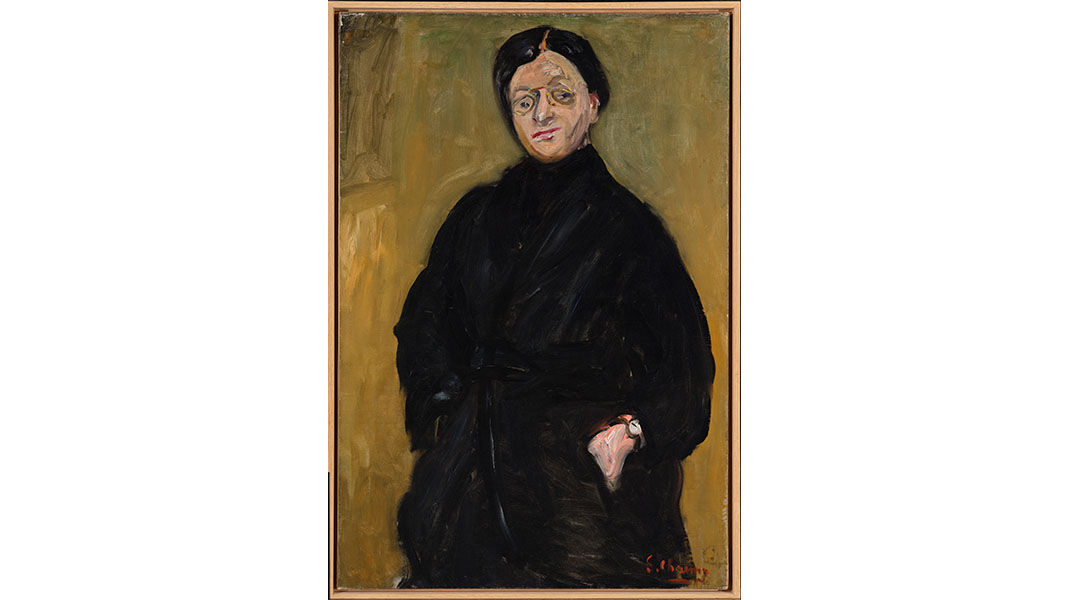
Title image: Émilie Charmy, Portrait de Berthe Weill (Portrait of Berthe Weill), 1910–14. Oil on canvas, 35 3/8 x 24 in. (90 x 61 cm). Montreal Museum of Fine Arts. Purchase, Annie White Townsend Bequest, 113.2024 © Alberto Ricci. Photo: MMFA, Julie Ciot.

Images courtesy New York University’s Grey Art Museum.

Franz Kafka at The Morgan Library & Museum, November 22, 2024, through April 13, 2025   

“The Morgan Library & Museum presents Franz Kafka, on view November 22, 2024, through April 13, 2025, marking the 100th anniversary of the author’s death. The exhibition celebrates Kafka’s achievements, creativity, and continued influence on new literary, theatrical, and artistic creations around the world. Franz Kafka is presented in collaboration with the Bodleian Libraries at the University of Oxford, whose extraordinary Kafka holdings will appearin the United States for the first time. The items on view include literary manuscripts, correspondence, diaries, and photographs, including the original manuscript of his novella The Metamorphosis. The Morgan Library & Museum

The Morgan’s Katharine J. Rayner Director, Colin B. Bailey, said, “The Morgan was delighted at the opportunity to celebrate our centennial in conjunction with the Bodleian and to honor Franz Kafka and his enduring impact on literature. We are honored to be the sole American venue for this landmark literary exhibition.”


Andy Warhol, Franz Kafka, 1980. Courtesy of Ronald Feldman Gallery, New York © The Andy Warhol Foundation for the Visual Arts / Artists Rights Society (ARS), New York / Ronald Feldman Gallery, New York.
Postcard to Ottla Kafka, Schelesen (Želízy), December 1918. MS. Kafka 49, fol. 79r. Jointly owned by the Bodleian Library and the Deutsches Literaturarchiv Marbach © The Bodleian Library, University of Oxford.
Postcard to Ottla Kafka from Versailles (September 13, 1911). MS. Kafka 49, fol. 12v. Jointly owned by the Bodleian Library and the Deutsches Literaturarchiv Marbach © The Bodleian Library, University of Oxford.
Unknown photographer. Franz and Ottla Kafka, Zürau, 1917. MS. Kafka 55, fol. 7r © The Bodleian Library, University of Oxford.
Der Heizer (The Stoker). Illustrated by Elisabeth Siefer. Mexico City, 1985. Private Collection, Photography by Carmen González Fraile, courtesy of The Morgan Library & Museum.
Larissa Theule. Kafka and the Doll. Illustrated by Rebecca Green (b. 1986). New York: Viking, 2021. Bodleian Libraries. Penguin Random House LLC; Artwork © Rebecca Green.
The first page of Franz Kafka’s most famous story Die Verwandlung (The Metamorphosis) with its puzzling opening sentence of Gregor Samsa waking up from uneasy dreams and finding himself transformed into an insect. MS. Kafka 18A, fol. 1r © The Bodleian Library, University of Oxford.
In this notebook Franz Kafka crosses out fragments of stories but keeps untouched a drawing of a horse and cart, possibly a hearse, sketched in the same vein as his famous stick-men. MS. Kafka 19, fol. 18r © The Bodleian Library, University of Oxford.

Sal Robinson, Lucy Ricciardi Assistant Curator of Literary and Historical Manuscripts, said, “This exhibition, the first of its kind on Franz Kafka in the United States, will not only provide a unique opportunity to celebrate Kafka’s work and learn about his life, but will also engage with rarely emphasized aspects of both, from women like Ottla Kafka and Milena Jesenská, who played key roles in his life, to the very much ongoing afterlife of his works as they are translated into other languages and media.”

Franz Kafka is organized by the Bodleian Libraries, University of Oxford, in collaboration with the Morgan Library & Museum, New York. Franz Kafka at the Morgan is organized by Sal Robinson, Lucy Ricciardi Assistant Curator of Literary and Historical Manuscripts.

Title image: Franz Kafka, Altstädter Ring, Prague. © Archiv Klaus Wagenbach.

Images courtesy The Morgan Library & Museum.

Plasticulture: The Rise of Sustainable Practices with Polymers at School of Visual Arts (SVA), Chelsea Gallery, through December 7, 2024

“School of Visual Arts (SVA) presents ‘Plasticulture: The Rise of Sustainable Practices with Polymers,’ an exhibition of works by 15 artists from Project Vortex, an artist collective innovating with plastic debris, and curated by founding artist Aurora Robson. By combining artistic expression with scientific exploration, ‘Plasticulture’ aspires to encourage individuals and communities to embrace more sustainable practices and play a part in fostering a healthier planet. The exhibition is on view Saturday, October 26, through Saturday, December 7, at the SVA Chelsea Gallery, 601 W 26th St, 15th floor, New York City.

Operating at the intersection of art and science, the 45 works in ‘Plasticulture’ inspire a rethinking and reinvention of plastic debris. Plastic is designed with ‘archival integrity,’ so it makes an excellent medium for a vast number of creative applications. Through a variety of practices including sculpture and photography, these artists emphasize the significant environmental repercussions of plastic use and pollution, aiming to increase global awareness, consciousness and action.” — School of Visual Arts (SVA)

Installation views of “Plasticulture: The Rise of Sustainable Practices with Polymers” at School of Visual Arts (SVA), Chelsea Gallery, through December 7, 2024. Courtesy School of Visual Arts.

“This exhibition highlights a variety of methods in which artists are using their visionary skills to envision and create a more sustainable future. Artists can embrace the archival integrity of plastic debris in a way that it becomes an asset rather than a problem,” says Robson.

Additional exhibiting artists from project Vortex include Tom Deininger, Ellen Driscoll, Natalya Khorover, Niki Lederer, Pam Longobardi, Kristyna and Marek Milde, Portia Munson, Studio KCA, Ian Trask, Tyrome Tripoli and Benjamin Von Wong.

Making Home—Smithsonian Design Triennial at Cooper Hewitt, Smithsonian Design Museum, through August 10, 2025

“Making Home—Smithsonian Design Triennial,” opening November 2 at Cooper Hewitt, Smithsonian Design Museum, features 25 debut commissions that illustrate the ways design is embedded in contemporary life. Ranging from domestic objects to built environments to social systems, the exhibition considers home as an expansive framework with varying cultural and environmental contexts, and ‘making home’ as a universal design practice. Organized in collaboration with Smithsonian’s National Museum of African American History and Culture, the seventh iteration of Cooper Hewitt’s Triennial series will be on view through August. 10, 2025.

Installed throughout the Andrew and Louise Carnegie Mansion, the exhibition explores design’s role in shaping the physical and emotional experiences of home across the U.S., U.S. territories and tribal nations. The museum floors are organized by familiar interactions—’Going Home’ (ground and first floor), ‘Seeking Home’ (second floor) and ‘Building Home’ (third floor)—interpreted in 25 installations by designers, architects, artists and their collaborators from across the nation.” — Cooper Hewitt, Smithsonian Design Museum

Installation of “Fahara: Chicago in View” by Robert Earle Paige in “Making Home—Smithsonian Design Triennial” at Cooper Hewitt, Smithsonian Design Museum. Photo: Elliot Goldstein © Smithsonian Institution
Installation of “The Underground Library” by the Black Artists + Designers Guild in “Making Home—Smithsonian Design Triennial” at Cooper Hewitt, Smithsonian Design Museum. Photo: Ann Sunwoo © Smithsonian Institution.
Installation of “Game Room” by Liam Lee and Tommy Mishima in “Making Home—Smithsonian Design Triennial” at Cooper Hewitt, Smithsonian Design Museum. Photo: Ann Sunwoo © Smithsonian Institution
Installation of Vues/Views by Amie Siegel in “Making HomeóSmithsonian Design Triennial” at Cooper Hewitt, Smithsonian Design Museum. Photo: Elliot Goldstein © Smithsonian Institution
Installation of “Welcome to Territory” by Lenape Center with Joe Baker in “Making Home—Smithsonian Design Triennial” at Cooper Hewitt, Smithsonian Design Museum. Photo: Ann Sunwoo © Smithsonian Institution
Installation of “Living Room, Orlean, Virginia” by Hugh Hayden, Davóne Tines and Zack Winokur in “Making Home—Smithsonian Design Triennial” at Cooper Hewitt, Smithsonian Design Museum. Photo: Elliot Goldstein © Smithsonian Institution
Installation of “The Offering” by Nicole Crowder and Hadiya Williams in “Making Home—Smithsonian Design Triennial” at Cooper Hewitt, Smithsonian Design Museum. Photo: Elliot Goldstein © Smithsonian Institution
Installation of “Patterns of Life” by Mona Chalabi and SITU Research in “Making Home—Smithsonian Design Triennial” at Cooper Hewitt, Smithsonian Design Museum. Photo: Elliot Goldstein © Smithsonian Institution
Installation of “So That You All Won’t Forget: Speculations on a Black Home in Rural Virginia” by Curry J. Hackett, Wayside Studio in “Making Home—Smithsonian Design Triennial” at Cooper Hewitt, Smithsonian Design Museum. Photo: Elliot Goldstein © Smithsonian Institution
Installation of Hālau Kūkulu Hawaiʻi: A Home That Builds Multitudes by After Oceanic Built Environments Lab and Leong Leong Architecture in “Making Home—Smithsonian Design Triennial” at Cooper Hewitt, Smithsonian Design Museum. Photo: Ann Sunwoo © Smithsonian Institution
Installation of “We:sic ’em ki” by Terrol Dew Johnson and Aranda/Lasch in “Making Home—Smithsonian Design Triennial” at Cooper Hewitt, Smithsonian Design Museum. Photo: Elliot Goldstein © Smithsonian Institution

Title image: Installation of “The House That Freedoms Built” by La Vaughn Belle in “Making Home—Smithsonian Design Triennial” at Cooper Hewitt, Smithsonian Design Museum. Photo: Ann Sunwoo © Smithsonian Institution. 

The exhibition is organized by Alexandra Cunningham Cameron, Cooper Hewitt’s curator of contemporary design and Hintz Secretarial Scholar; Christina L. De León, Cooper Hewitt’s acting deputy director of curatorial and associate curator of Latino design; and Michelle Joan Wilkinson, curator of architecture and design at the National Museum of African American History and Culture; with curatorial assistants Sophia Gebara, Caroline O’Connell, Julie Pastor, and Isabel Strauss.

Exhibition design by Los Angeles–based Johnston Marklee. Graphic design by New York City–based Office Ben Ganz.

Jewish Museum presents Draw Them In, Paint Them Out: Trenton Doyle Hancock Confronts Philip Guston, November 8, 2024 – March 30, 2025  

Draw Them In Paint, Them Out: Trenton Doyle Hancock Confronts Philip Guston examines Philip Guston’s influence on Trenton Doyle Hancock and both artists’ shared commitment to investigating the legacy of white supremacism in the United States. On view November 8, 2024, through March 30, 2025, the exhibition presents the work of painter Philip Guston (American, b. Canada 1913–1980), the child of Jewish immigrants from Odessa (present-day Ukraine), and Trenton Doyle Hancock (American, b. 1974), a leading Black contemporary artist based in Houston, Texas, in dialogue for the first time. The exhibition explores resonant connections between their work and the role that artists play in the pursuit of social justice. 

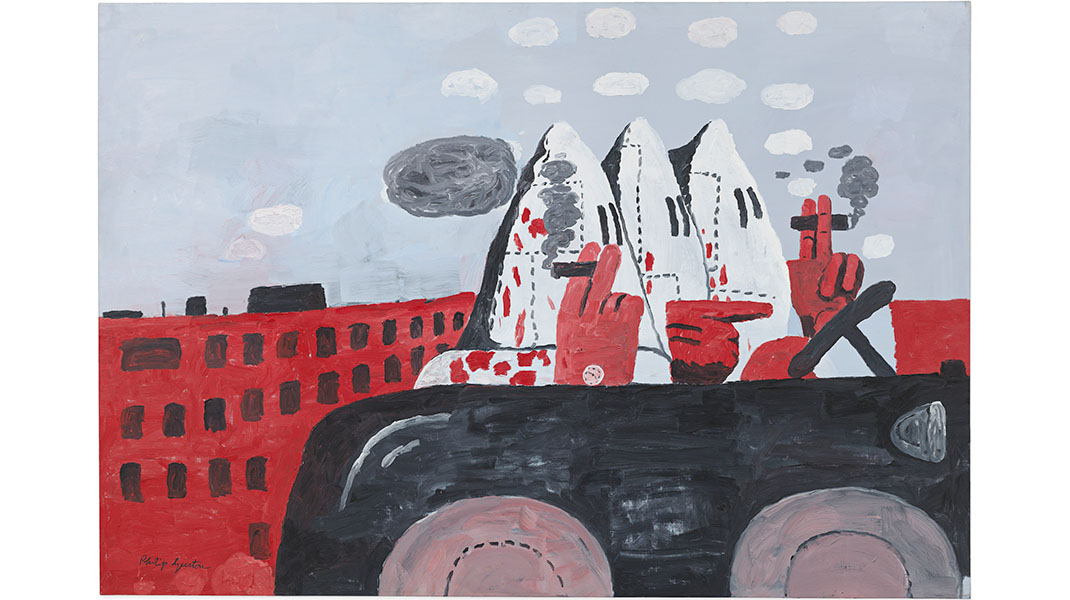
Organized by the Jewish Museum, the exhibition features key works by Guston including his now iconic, late satirical Ku Klux Klan paintings in dialogue with major works Hancock created in response to his inspirational mentor, highlighting their parallel thematic explorations of the nature of evil, self-representation, otherness, and art activism. Foregrounding works that depict the Klan, the exhibition demonstrates how both artists engage with and at times even inhabit these hateful figures to explore their own identities and more broadly examine systems of institutionalized power and their feelings of complicity within them. Yet, despite the difficult subject matter and at times violent imagery presented in their work, both Hancock and Guston share an ability to conquer the pain and emotion of their art through humor that is both dark and undeniable, engaging with their shared embrace of the visual language of comics.” — Jewish Museum

Installation views of “Draw Them In, Paint Them Out: Trenton Doyle Hancock Confronts Philip Guston” at the Jewish Museum, NY, November 8, 2024-March 30, 2025. Photographs by Gregory Carter / Document Art. Courtesy Jewish Museum.

Title image: Philip Guston, Riding Around, 1969, oil on canvas, 54 x 79 in. (137.2 x 200.7 cm). Metropolitan Museum of Art, New York, promised gift of Musa Mayer © The Estate of Philip Guston. Courtesy Jewish Museum.

Draw Them In, Paint Them Out: Trenton Doyle Hancock Confronts Philip Guston is organized by Rebecca Shaykin, Curator, The Jewish Museum, in partnership with Trenton Doyle Hancock. The exhibition is designed by Isometric Studio with graphic design by Morcos Key.

Flight into Egypt: Black Artists and Ancient Egypt, 1876–Now at The Met Fifth Avenue, November 17, 2024–February 17, 2025

Flight into Egypt: Black Artists and Ancient Egypt, 1876–Now will present nearly 200 works of art that demonstrate the many ways in which ancient Egypt has been a source of inspiration and identity for Black artists and other cultural figures

Opening at The Met on November 17, 2024, the major exhibition Flight into Egypt: Black Artists and Ancient Egypt, 1876–Now will examine how Black artists and other cultural figures have engaged with ancient Egypt through visual, sculptural, literary, musical, scientific, scholarly, religious, political, and performative pursuits. The multisensory exploration of nearly 150 years of artistic and cultural production will feature nearly 200 works of art in a wide range of media from The Met collection and public and private collections, including critical international loans from Africa, Asia, the Caribbean, and Europe. Thematic sections will trace how Black artists and other agents of culture have employed ancient Egyptian imagery to craft a unifying identity, the contributions of Black scholars to the study of ancient Egypt, and the engagement of modern and contemporary Egyptian artists with ancient Egypt.” — The Metropolitan Museum of Art

Installation views of Flight into Egypt: Black Artists and Ancient Egypt, 1876–Now, on view November 17, 2024–February 17, 2025 at The Metropolitan Museum of Art. Photos by Eileen Travell, Courtesy of The Met. 

“Ancient Egypt is a symbolic source for people of the African diaspora that continues to inspire. This groundbreaking exhibition brings to light a modern history that has developed over nearly 150 years and is also an active creative tradition existing outside the walls of the Museum and in daily life,” said Max Hollein, The Met’s Marina Kellen French Director and Chief Executive Officer. “Unprecedented in scope, the exhibition broadly lays out the many ways in which Black artists and cultural figures have engaged and continue to engage with ancient Egypt as a point of reference, inspiration, and connection. Our hope is that it furthers and deepens exploration of this topic.” 

“The exhibition takes its title from The Met’s painting Flight into Egypt (1923), an emblem of fugitivity and timeless creativity by the expatriate artist Henry Ossawa Tanner—the first internationally recognized African American painter—who traveled to Egypt in 1897, and includes works as recent as Madeline Hunt-Ehrlich’s film Cleopatra at the Mall (2024), which reflects on the rediscovery of Edmonia Lewis’s major sculpture The Death of Cleopatra (1876),” said Akili Tommasino, Curator in the Department of Modern and Contemporary Art at The Met and the curator of the exhibition. “Flight into Egypt: Black Artists and Ancient Egypt, 1876–Now challenges Eurocentric constructions of ancient Egypt, offering a more expansive history that celebrates the contributions of cultural figures of African descent.”

Flight into Egypt: Black Artists and Ancient Egypt, 1876–Now is organized by Akili Tommasino, Curator, with McClain Groff, Research Associate, in the Department of Modern and Contemporary Art at The Met.

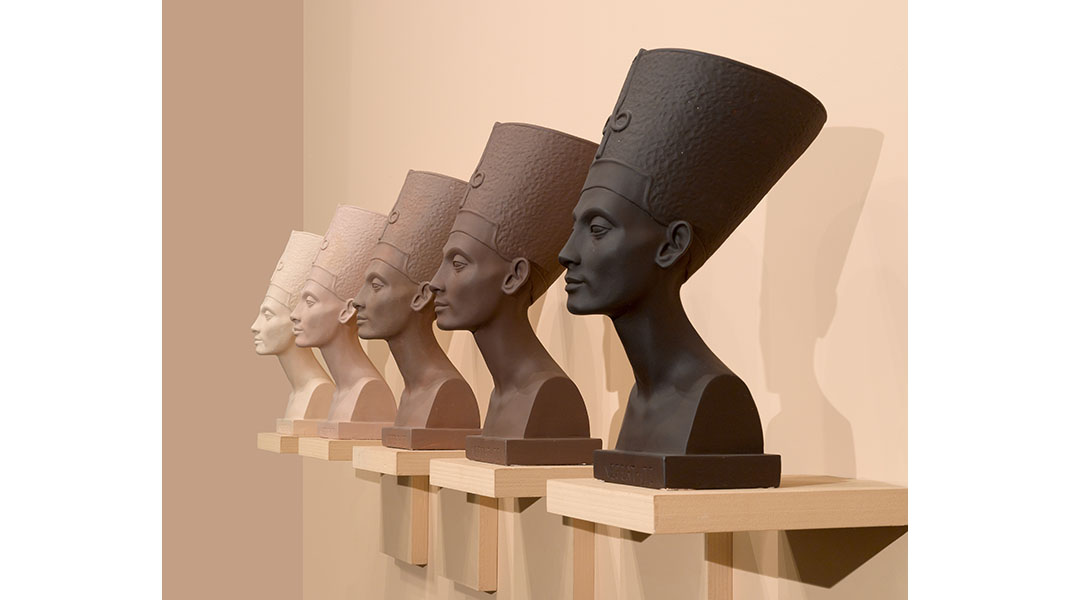
Title image: Fred Wilson (American, born 1954). Grey Area (Brown version), 1993. Brooklyn Museum, Bequest of William K. Jacobs, Jr. and bequest of Richard J. Kempe, by exchange (2008.6a–j).

Harmony and Dissonance: Orphism in Paris, 1910–1930 at Solomon R. Guggenheim Museum and Foundation, November 8, 2024 – March 9, 2025

“The Solomon R. Guggenheim Museum presents Harmony and Dissonance: Orphism in Paris, 1910–1930, the first in-depth examination of Orphism, which emerged in Paris among a cosmopolitan group of artists in the early 1910s—when changes brought on by modernity were radically altering notions of time and space. Open from November 8, 2024, to March 9, 2025, the presentation features over 80 artworks comprising painting, sculpture, works on paper, and ephemera, installed across five levels of the museum’s spiral rotunda. 

The poet Guillaume Apollinaire coined the term ‘Orphism’ in 1912 to describe artists who were moving away from Cubism, toward an abstract, multisensory mode of expression. Apollinaire’s concept referenced the Greek mythological poet and lyre player Orpheus who swayed nature and challenged death with his song equating the ephemeral abstraction of music with Orphism’s transcendent character.” —  Solomon R. Guggenheim Museum

Installation view, Harmony and Dissonance: Orphism in Paris, 1910–1930, November 8, 2024 – March 9, 2025, Solomon R. Guggenheim Museum, New York. Photo: David Heald © Solomon R. Guggenheim Foundation, New York.

Harmony and Dissonance: Orphism in Paris, 1910–1930 is organized by Tracey Bashkoff, Senior Director of Collections and Senior Curator, and Vivien Greene, Senior Curator, 19th- and Early 20th-Century Art, with the support of Bellara Huang, Curatorial Assistant, Exhibitions. 

Title image: Robert Delaunay, Circular Forms (Formes circulaires), 1930. Oil on canvas, 50 3/4 X 76 3/4 in. (128.9 X 194.9 cm). Solomon R. Guggenheim Museum, New York, Solomon R. Guggenheim Founding Collection 49.1184. Photo: Kristopher McKay, Solomon R. Guggenheim Museum, New York.

Images courtesy Solomon R. Guggenheim Museum.

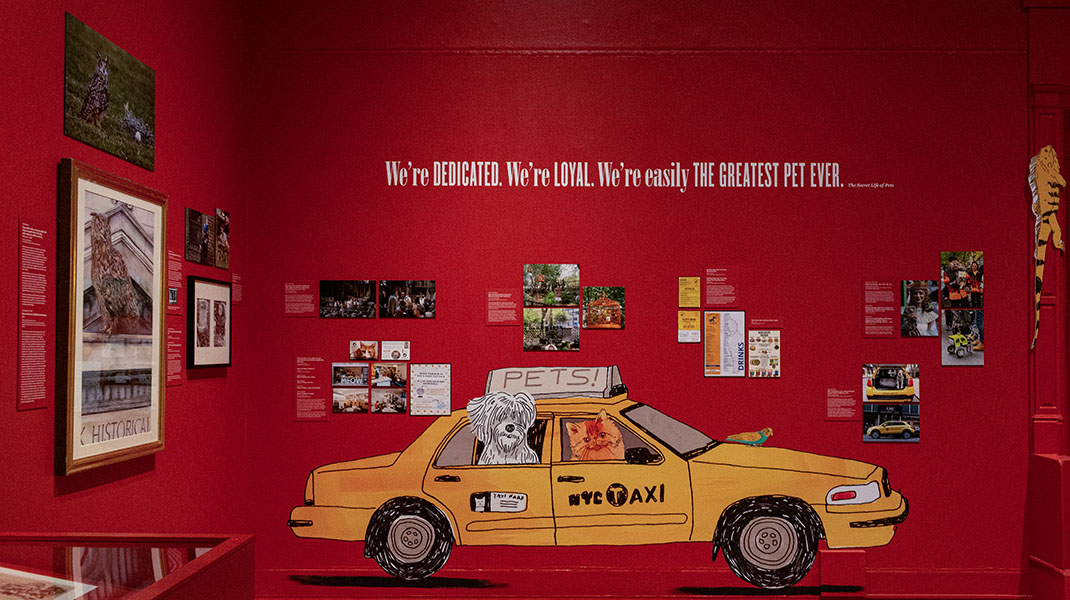
Pets and the City at New-York Historical Society, October 25, 2024 through April 20, 2025

“This fall, the New-York Historical Society presents a special exhibition that explores the rich, complex, and varied relationships between New Yorkers and their animal companions across the last three centuries. Pets and the City, on view October 25, 2024, through April 20, 2025, surveys how the conception of pets has evolved in tandem with the development of New York—from the role of animals among Indigenous cultures, such as the Lenape and Haudenosaunee, and the hunting culture that accompanied settlers from Europe, to the pampered pets that are considered members of the family today. Through a broad spectrum of works of art, objects, photographs, documents, and memorabilia drawn largely from New-York Historical’s Museum and Library collections, as well as film and television clips, the immersive exhibition also examines the broader social context for New York’s pet population and related topics, including pet adoption, the trafficking of exotic animals, animal rights laws, and the role of service animals. Pets and the City is curated by Roberta J.M. Olson, curator of drawings emerita.” — New-York Historical Society

Installation views of Pets and the City at New-York Historical Society, on view October 25, 2024 through April 20, 2025. Photos by Corrado Serra.

“New York City residents have always loved their pets, and this exhibition reveals the important role that pets have played throughout the city’s history beyond providing companionship to their owners,” said Louise Mirrer, president and CEO, New-York Historical. “I hope visitors come away from this exhibition with a deeper appreciation for the profound impact pets have had on our city’s culture and society and a more nuanced understanding of the complexities of our animals.” 

“In New York City alone, it is estimated there are more than two million animal companions who reign over human hearts, homes, and pocket books,” said Roberta J.M. Olson, curator of drawings emerita. “Given that, it’s fascinating to explore how these creatures rose to such a place of distinction. From the origins of pets among Indigenous people to today’s doggy daycares and cat cafés, this exhibition offers a visual journey through the evolving relationship between Gotham’s people and its animals as the city and its population transformed into a diverse metropolis. City dwellers’ relationships with animals and pets illuminate humanity’s relationship with nature and are the bellwether of our shared future and the fate of our planet.”

International Center of Photography (ICP) presents We Are Here: Scenes from the Streets, through January 6, 2025

“The International Center of Photography (ICP) presents We Are Here: Scenes from the Streets, an in-depth exploration into 50 years of contemporary public life documented through the lens of over 30 street photographers from around the world, beginning in the 1970s. Guest curated by Isolde Brielmaier, PhD, with Noa Wynn, Independent Curatorial Assistant, We Are Here opens at ICP on September 25, 2024 and runs through January 6, 2025.

Featuring works by photographers from Algeria, China, Egypt, Germany, India, Japan, Russia, South Africa, the USA, and beyond, We Are Here reframes our understanding of ‘the street’ and the activities and exchanges that occur in diverse public and community spaces. In a world fraught with misunderstanding and societal tension, the exhibition highlights street photography’s unique viewpoints on local culture and unfolding events. Documenting both dramatic and everyday moments—from street style to protests—the works in We Are Here testify to the resilience and similarities of the human experience.” — International Center of Photography

Devin Allen, A Freddie Gray protest in Baltimore, Md., 2015. © Devin Allen
Shoichi Aoki, from the series FRUiTS, 1998. Courtesy Shoichi Aoki
Martha Cooper, Kids climbing a fence in an abandoned lot, Lower East Side, NYC from the series
Street Play, 1978. © Martha Cooper
Farnaz Damnabi, Untitled, Birjand, Iran, 2017. Courtesy of Farnaz Damnabi and 29 Arts In Progress
gallery
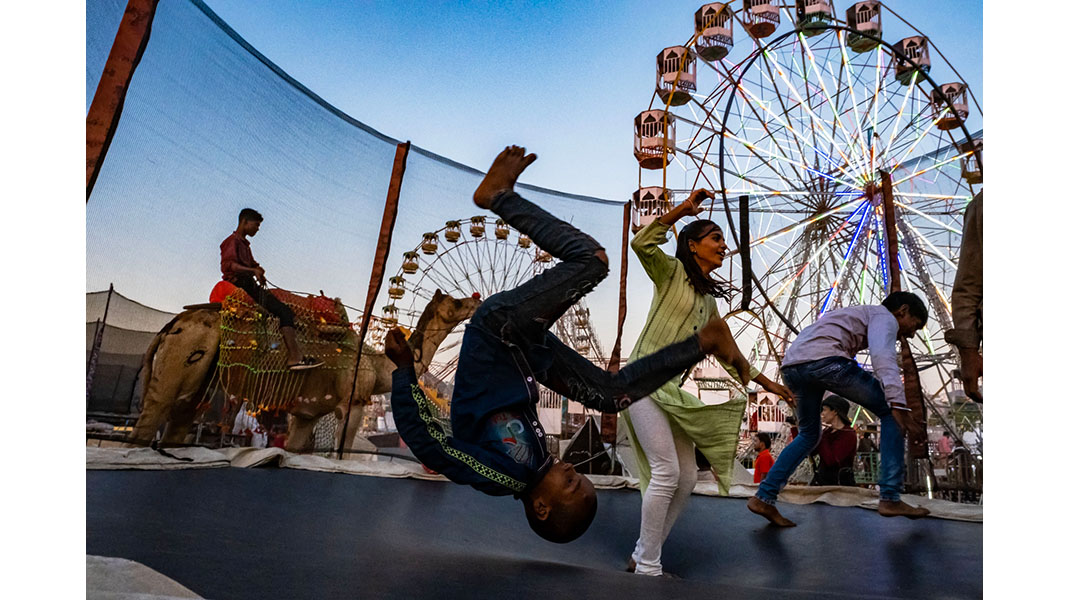
Debrani Das, Cartwheels of Pushkar, from the series Anonymous, 2022. © Debrani Das
Corky Lee, Chinatown Community Young Lions performing at the Lunar New Year parade in
Chinatown, New York,
1996. © Corky Lee/Corky Lee Estate
Daidō Moriyama, Pretty Woman, 2017. © Daidō Moriyama Photo Foundation
Melissa O’Shaughnessy, Canal Street, New York, 2017. © Melissa O’Shaughnessy
Jamel Shabazz, Man & Dog on the Lower East Side, 1980. Courtesy Jamel Shabazz
Trevor Stuurman, Untitled (A Day in Dakar), 2023. © Trevor Stuurman

We Are Here invites viewers to confront the richness and complexities of our modern, multifaceted life, emphasizing our shared humanity beyond geographic and cultural divides,” Brielmaier said of the exhibition. “Today’s world moves fleetingly, but these images prove that though circumstances might change, humanity is not going anywhere; the stories of our lives will remain.”

“Street photographers often navigate the complexities of power dynamics and privilege,” Elisabeth Sherman, ICP Senior Curator and Director of Exhibitions and Collections said. “We hope this exhibition sparks reflection and conversation about the historical and current dynamics of public spaces that are shaped and mediated by gender, race, and socio-economic status, and how we critically understand the ways they govern our lives.”

“As we end ICP’s 50th anniversary celebration with We Are Here, we are reaffirming our mission to educate the public on the power of visual storytelling and to foster international dialogue about what it means to be a concerned photographer today,” said Bob Jeffrey, ICP

Images courtesy International Center of Photography (ICP).