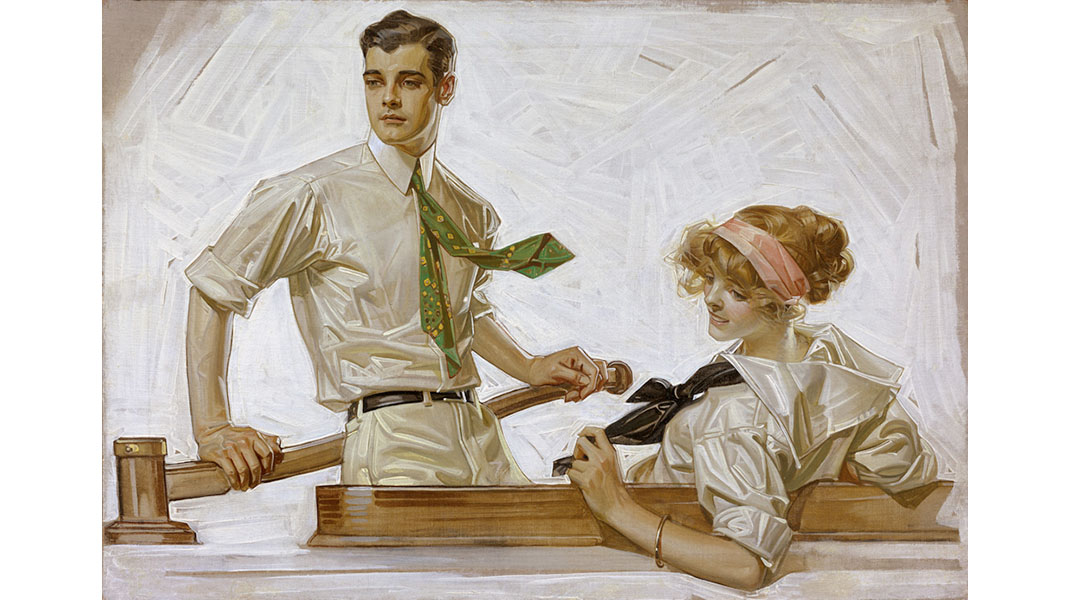
“This spring, a new exhibition at the New-York Historical Society examines the work and influence of J.C. Leyendecker (1874–1951), a preeminent illustrator and commercial artist who helped shape American visual culture in the first three decades of the 20th century through captivating advertising campaigns including the legendary ‘Arrow Collar Man’ and countless covers for the Saturday Evening Post. As a gay artist whose illustrations for a mainstream audience often had unspoken homoerotic undertones, his work is especially revealing for what it says about the cultural attitudes towards homosexuality of the period. Under Cover: J. C. Leyendecker and AmericanMasculinity, on view May 5—August 13, 2023, is organized by New-York Historical from the collection of the National Museum of American Illustration, Newport, RI.” — New-York Historical Society
“Under Cover: J.C. Leyendecker and American Masculinity deepens our understanding of the struggle for full civil rights as Americans of the LGBTQ+ community,” said Dr. Louise Mirrer, president and CEO of New-York Historical. “The exhibition is part of New-York Historical’s ongoing commitment to tell stories of Americans whose lived experience, though important and consequential to our history, is so often absent from textbooks in schools and colleges. New-York Historical’s collaboration with the American LGBTQ+ Museum, which will be housed in our institution’s new wing, will further enable meaningful conversations about LGBTQ+ history and its rightful place within the American narrative.”
J.C. Leyendecker (1874–1951.) Men with Golf Clubs. Painting for Arrow Collar advertisement, ca. 1909. Oil on canvas. National Museum of American Illustration, Newport, RIJ.C. Leyendecker (1874–1951). Men and Woman, Arrow Shirts with Golf Clubs and Collie. Painting for Arrow Collar advertisement, 1910. Oil on board. National Museum of American Illustration, Newport, RIJ.C. Leyendecker (1874–1951). Couple in Boat. Painting for Arrow Collar advertisement, 1912. Oil on canvas. National Museum of American Illustration, Newport, RIJ.C. Leyendecker (1874–1951). Ivory Soap It Floats. Painting for Ivory soap advertisement, 1900. Gouache on board. Private collection, Image courtesy of the National Museum of American Illustration, Newport, RIJ.C. Leyendecker (1874–1951). Thanksgiving: 1628-1928 (Pilgrim and Football Player). Painting for cover of Saturday Evening Post, November 24, 1928. Oil on canvas. Private collection, Image courtesy of the National Museum of American Illustration, Newport, RIJ.C. Leyendecker (1874–1951). Man and Woman Dancing. Painting for Arrow Collar advertisement, 1923. Oil on canvas. National Museum of American Illustration, Newport, RI
“J.C. Leyendecker was an amazingly talented artist whose illustrations have come to embody the look and feel of the first half of the century while simultaneously demonstrating how fluidity in gender expression and gay representation were actually quite common at the time, contrary to current assertions that they are unique to our own moment,” said Donald Albrecht, guest curator. “Not only did his work exemplify the zeitgeist, but it depicts a deeply nuanced view of sexuality and advertising that broadens our understanding of American culture.”
UnderCover is guest-curated by Donald Albrecht, and coordinated at New-York Historical by Rebecca Klassen, curator of material culture. Drawing on three decades of scholarship, the exhibition is aided by a committee of advisors: Dr. Elspeth Brown, Professor of History at the University of Toronto; Dr. Monica L. Miller, Professor of English and Africana Studies, Barnard College; and Dr. Michael Murphy, Associate Professor of Gender and Sexuality Studies at the University of Illinois Springfield.
“The International Center of Photography (ICP) explores love and desire through intimate images taken by lovers in a group exhibition this summer. On view from June 2 through September 11, 2023, Love Songs: Photography and Intimacy features over 250 works throughout ICP’s galleries, presenting photographic projects that read as personal stories by 16 international artists, including Nobuyoshi Araki, Ergin Çavuşoğlu, Motoyuki Daifu, Fouad Elkoury, Aikaterini Gegisian, Nan Goldin, René Groebli, Hervé Guibert, Sheree Hovsepian, Clifford Prince King, Leigh Ledare, Lin Zhipeng (No. 223), Sally Mann, RongRong&inri, Collier Schorr, and Karla Hiraldo Voleau.
Revealing private and powerful intimate relationships, Love Songs includes series dating from 1952 to 2022 by some of the leading and emerging photographers of our time that express complex, elusive, and contradictory entanglements. Taking us through personal, often unseen stories between different couples—from the first days of an affair through marriages, honeymoons, domestic bliss and the pain of separation, even to death and the last days shared between loves—the intimacies depicted by these artists are rarely seen in the history of photography and offer images of love that range from poetic, to romantic, to raw.” — ICP
“I’ve recut and reordered the original visual playlist of the Love Songs exhibition to include bodies of work by artists whose subversive photographic and filmic practices rely on the montage technique of interweaving art and ideas of our time,” said curator Sara Raza. “These works offer a window into the themes of aftermath, contradiction, collision, desire, distortion, and reality.”
The exhibition is organized in collaboration with the Maison Européenne de la Photographie (MEP), Paris, based upon an original idea by Simon Baker, and was curated at MEP by Frédérique Dolivet and Pascal Hoël. The exhibition includes 118 works on loan from the MEP’s collection. The New York presentation of Love Songs is organized by curator and writer Sara Raza, who remixed the show to feature new work.
“Josh Kline: Project for a New American Century, on view at the Whitney Museum of American Art from April 19 through August 13, 2023, is the first mid-career survey of Josh Kline’s work by an American museum. The exhibition offers a thematic examination of over fifteen years of the artist’s work, including a major new installation that will debut at the Whitney and projects that have never been seen before in New York. Kline is best known for creating immersive installations using video, sculpture, photography, and design to question how emergent technologies are changing human life in the twenty-first century. One of the leading artists of his generation, Kline is unique among his peers in directly confronting class, labor, and inequity in the United States today.” — Whitney Museum of American Art
“I have lived in New York since 2002 and make artwork that responds to national and global events as I see and experience them as a New Yorker; however, much of my work has never been exhibited here,” said the artist. “It means so much to show this work in the city where it was conceived, at this time, and at the Whitney Museum of American Art. I can’t wait to bring it all home to NYC and to have a very intense conversation with the public about America’s past, present, and future.”
Installation views of Josh Kline: Project for a New American Century at Whitney Museum of American Art. Photos by Corrado Serra.
“Throughout his artistic career, Kline has taken a hard look at how we live and work in the twenty-first century,” said Christopher Y. Lew. “This was apparent in his early works and it is evermore clear in his new ambitious installations made in response to climate change. It has been thrilling to follow his practice over more than a decade and it’s a great privilege to organize his major mid-career survey at the Whitney Museum of American Art.”
Josh Kline: Project for a New American Century is organized by Christopher Y. Lew, former Nancy and Fred Poses Curator at the Whitney and current Chief Artistic Director at the Horizon Art Foundation and Outland Art, with McClain Groff, Curatorial Project Assistant.
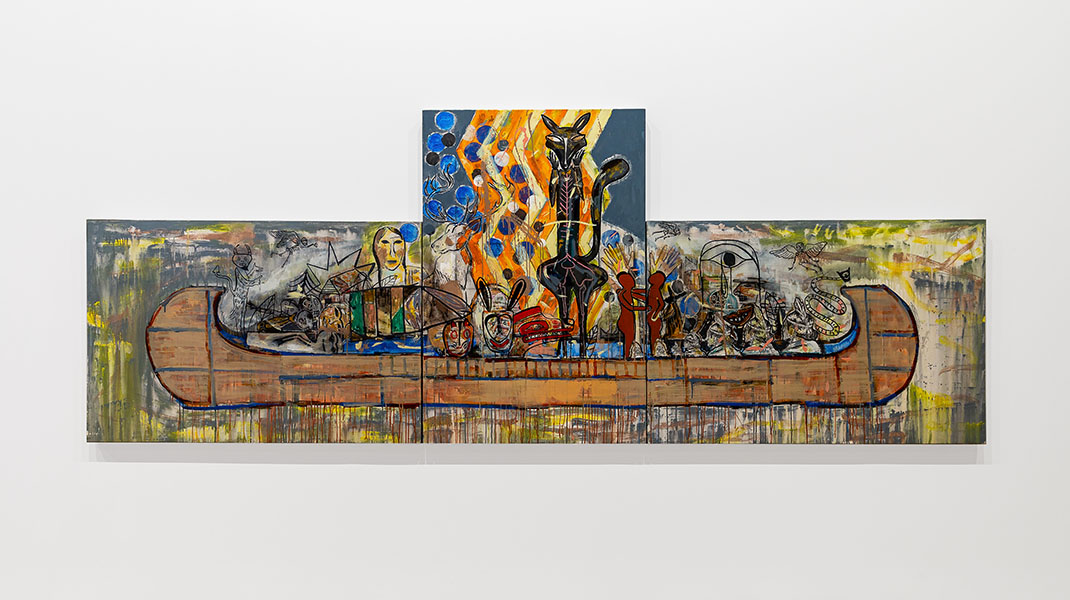
“Jaune Quick-to-See Smith: Memory Map, on view at the Whitney Museum of American Art from April 19 through August 13, 2023, is a recognition of a groundbreaking artist’s work. For nearly five decades, Jaune Quick-to-See Smith, a citizen of the Confederated Salish and Kootenai Nation, has charted an exceptional and unorthodox career as an artist, activist, curator, educator, and advocate. The exhibition highlights how Smith uses her drawings, prints, paintings, and sculptures to flip commonly held historical narratives and illuminate absurdities in the dominant culture.
Memory Map is the largest and most comprehensive showcase of Smith’s career, featuring more than one hundred thirty works. Organized thematically across the Museum’s third and fifth floors, the exhibition offers a new framework to consider contemporary Native American art, addressing how Smith has led and initiated some of the most pressing dialogues around land, racism, and cultural preservation. It celebrates the artist’s dedication to creativity and community and emphasizes her deep political commitments, essential and potent reminders of our responsibilities to the earth and each other.” — Whitney Museum of American Art
Installation views of Jaune Quick-to-See Smith: Memory Map at Whitney Museum of American Art. Photos by Corrado Serra.
“The oldest art museum in New York was inaugurated sometime in the late 1800s, 150 years ago, and there are younger art museums approximately 90 years old, yet I am the first Native woman to have a major retrospective in New York City,” said Jaune Quick-to-See Smith. “The Whitney has jumped off the cliff and shattered the status quo. Hallelujah for them making this risky move. For what is the risk worth? It offers us more Native artists, the Nation’s First Peoples, our Original Peoples, to become part of the mainstream art world. I am deeply grateful to the Whitney, as well as Garth Greenan Gallery, for their kind, supportive, diligent work over four years. We are making history; we are plowing new ground; we are opening a staid, closed, colonial door. I am so thankful, lemlemts, lemlemts.”
Jaune Quick-to-See Smith: Memory Map was organized by Laura Phipps, Assistant Curator at the Whitney Museum of American Art, with Caitlin Chaisson, Curatorial Project Assistant.
“Hailed internationally as a soaring architectural achievement, and housing world-class research facilities and scientific collections, next-generation classrooms, and innovative exhibitions, the American Museum of Natural History’s highly anticipated Richard Gilder Center for Science, Education, and Innovation opened to the public on May 4, catapulting the Museum into an exciting new era.
The Gilder Center embodies the Museum’s mission of science and education in every way—from sparking curiosity and wonder through new exhibits in strikingly designed spaces to providing new facilities where research collections, exhibitions, and learning are situated in close proximity, reinforcing the central role of natural history collections in scientific discovery and providing deeper experiences that connect visitors to the evidence and processes of science through engaging exhibits and programs. At the same time, the new building also enhances the visitor experience by establishing continuous pathways through its four-block campus, connecting buildings that were constructed over the course of nearly 150 years.” — AMNH
“We are thrilled to open this magnificent new resource and facility, especially as the City is more fully emerging from the pandemic period and people are eager for opportunities to learn, to be amazed, and to be inspired,” said Scott L. Bok, Chair of the Museum’s Board of Trustees. “The Richard Gilder Center for Science, Education, and Innovation is the result of an exemplary public-private partnership, and, on behalf of the Board of Trustees, I extend great thanks to the many supporters and partners who have brought this new facility to fruition.”
“As a scientist, I’m excited that the Gilder Center will reveal more of the cross-disciplinary processes of science and be a powerful springboard for an even deeper integration of the Museum’s ongoing research with our exhibition program and education initiatives—all while inspiring our visitors to appreciate and learn about how all life on Earth is connected,” said Sean M. Decatur, President of the American Museum of Natural History. “It will be a great joy to welcome visitors to the new Gilder Center, as it heralds a new era of exploring the wonders of nature at the Museum.”
“The C. Parker Gallery is thrilled to present the work of two of the most internationally acclaimed conservation photographers,” says Tiffany Benincasa, the Gallery’s curator and owner. “Their photographs are included in some of the world’s most important private collections, and have been featured as iconic images by major national media including National Geographic and TIME Magazine. This is an incredible opportunity to witness the beauty of nature in an intimate and personal way, to share their important message, and join their mission advocating for greater conservation and environmental awareness.”
Commitment, by Paul Nicklen (2011). Ross Sea, Antarctica, 33.5 x 22.5 in.
Majesty Surfacing, by Paul Nicklen (2012). Yukon, Canada, 60 x 90 in.
Parenthood, by Paul Nicklen (2011). Ross Sea, Antarctica, 24 x 36 in.
Defying Gravity, by Paul Nicklen (2011). Ross Sea, Antarctica, 31 x 46.5 in.
Face to Face, by Paul Nicklen (2008). Svalbard, Norway, 31 x 46.5 in.
Ice waterfall, by Paul Nicklen (2014). Svalbard, Norway, 40 x 60 in.
“I believe that art, especially photography, has the power to connect people to stories with such deep emotion, that their perspective of the world can change,” says Nicklen. “My work exists at the intersection of art, science, and conservation as a way to showcase the beauty that exists in nature.”
Big Shot, by Cristina Mittermeier (2015). Greenland, 20 x 30 in.
Lady with the Goose II, by Cristina Mittermeier (2008). Yunnan Province, China, 30 x 20 in.
Red Curtain, by Cristina Mittermeier (2021). Galapagos, 20 x 30 in.
The Traveler, by Cristina Mittermeier (2020). Bahamas, 32 x 48 in.
Astrapia, by Cristina Mittermeier (2016). Papua, New Guinea, 20 x 30 in.
“Images can help us understand the urgency to protect wild places that so many of us realize is of the utmost importance,” says Mittermeier. “My work is about building a greater awareness of the responsibility of what it means to be human.”
“Opening April 15 at Scandinavia House, Arctic Highways brings together the artwork and handicrafts of 12 Indigenous artists from Sápmi, Canada and Alaska in an exhibition highlighting the thriving cultural and spiritual communities of the Arctic region. Curated by Indigenous artists Tomas Colbengtson, Gunvor Guttorm, Dan Jåma and Britta Marakatt-Labba, the exhibition includes their own works alongside those of artists Matti Aikio, Marja Helander, Laila Susanna Kuhmunen, Olof Marsja, Máret Ánne Sara, Sonya Kelliher-Combs, Maureen Gruben and Meryl McMaster.
The exhibition includes a wide range of artworks and duodji (Sámi handicrafts) including Britta Marakatt-Labba’s narrative embroidery portraying motifs from Sámi culture and history; sculpture works by Máret Ánne Sara utilizing traditional objects such as the komsekula silver amulet (believed in Sámi culture to have protective powers); handmade clothing and sculpture works by Laila Susanna Kuhmunen; mixed-media sculptures by Gunvor Guttorm; and Tomas Colbengtson’s The Children of the Sun, which incorporates a traditional shaman drum with portraits of Sámi heroes, including poets, artists and linguists.
Many works explore Sámi identity, such as the sculptures of Olof Marsja, which incorporate organic, industrial and handmade materials into ambiguous figures and objects; photographs by Meryl McMaster, which examine the self in relation to land, lineage, history, and culture; and video works by artists Matti Aikio and Dan Jåma. The exhibition also looks at the contemporary context of the Arctic, as in Sonya Kelliher-Combs’s mixed-media art focusing on the changing North and our relationship to nature and each other; images and video by Maureen Gruben, who investigates life in the Arctic within global environmental concerns; and Marja Helander’s photography series North, which examines the dependence between humans and nature through landscapes and portraits.” — Scandinavia House
Máret Ánne Sara, Crowned by foreign fate, 2021. Print on aluminium. 900 x 1220 mm; 35 7/16 x 48 1/32 in. Collection of the artist
Máret Ánne Sara, Moder Jord I (Mother Earth I), 2020. Sculpture made from a globe and scooter spring. 350 mm in diameter; 11 13/16 in. Collection of the artistMatti Aikio, Dohkkáhehkka, 2021. Single channel video. 13:18 min. Collection of the artistTomas Colbengtsson, The children of the sun (Daniel Mortensen, Aina Jonsson, John Saivo, Johan Turi, Nils Nilsson Skum, Ailohas, Elsa Laula, Israel Roung, Anders Fjellnet, Mattias Andersson), 2020. Saemie drum, screenprint oil on canvas, goldleafs, wood, electric motor, brass-ring. 1200 x 900 mm, approx. 200 mm height; 47 1/4 x 35 7/16 x 7 7/8 in. Collection of the artistDan Jåma, Leave No Trace, 2021. Single channel video, 07:27 min. Collection of the artistMaureen Gruben, Aidainnaqduanni, Aurora; Aidainnaqduanni, Morning, 2020. 2 prints on aluminum. 1200 X 800 mm; 47 1/4 x 31 1/2 in. each. Collection of the artistMarja Helander, The Evening Covers Everything, 2020. Print on aluminum. 1694 X 700 mm; 66 11/16 x 27 9/16 in. Collection of the artistMarja Helander, The Secrets of Dusk, 2020. Print on aluminum. 1615 X 600 mm; 63 37/64 x 23 5/8 in. Collection of the artistBritta Marakatt-Labba, Urmoder (Primordial mother), 2020. Stone and bronze. Approx. 200 X 200 X 200 mm; 7 7/8 x 7 7/8 x 7/78 in. Collection of the artistMeryl McMaster, Cartography of the Unseen, 2019. Print on aluminum. 1200 x 800 mm; 47 1/4 x 31 1/2 in. Collection of the artistMeryl McMaster, What Will I Say to the Sky and the Earth II, 2019. Print on aluminum. 1200 x 800 mm; 47 1/4 x 31 1/2 in. Collection of the artist
Olof Marsja, Handen, Hjärtat och Bältet (Hand, Heart and Belt), 2020. Aluminium, wrought iron, the artist’s childhood belt and silver. Approx. 150 x 150 X 500 mm; 5 29/32 x 5 29/32 x 19 11/16 in. Collection of the artist
Olof Marsja, iSurfer, 2019. Earthenware, wood adhesive, carbon fiber, wood, acrylic paint and an iPad. 500 mm; 19 11/16 in. Collection of the artist
Sonya Kelliher-Combs, Credible, Small Secrets, 2021. Cotton fabric, human hair, nylon thread, glass bead, steel pin. 36 pieces, approx. 80 mm long 30 mm in diameter; 3 5/32 in. long 1 3/16 in. in diameter. Collection of the artistKuhmunen, Laila Susanne, Steingiisá (Stone chest), 2020. Stone. 900 x 450 X 300 mm 35 7/16 x 17 23/32 x 11 13/16 in. Collection of the artist
Laila Susanne Kuhmunen. When Two Become One, 2020. Clothing. 3500 x 1700 mm mounted; 137 51/64 x 66 59/64 in. Collection of the artist
Gunvor Guttorm, Čiehkádeapmi (Hiding), 2020. Installation, various materials (fish net, shoes). 900 x 900 x 250 mm; 35 7/16 x 35 7/16 x 9 27/32 in. Collection of the artist
“The Morgan Library & Museum is pleased to present Entrance to the Mind, featuring drawings made by American artist George Condo (b. 1957) over the last forty-five years. On view through May 14, 2023, the exhibition includes twenty-eight drawings, all acquired by the Morgan in 2021.
A spirit of improvisation has characterized Condo’s drawing practice from the beginning of his career. “I kind of draw like you are walking through the forest,” Condo explains. “You don’t really know where you are going. You just start from some point and randomly travel through the paper until you get to a point where you finally reach your destination.” The earliest drawings in the exhibition date to 1975–76, when Condo was a teenager. They show him reimagining past styles of art history—here, Cubism and Surrealism—on his own terms. Their titles, Mind and Matter and Entrance to the Mind, signal the essential correlation between drawing and mental states that has remained central to his art.” — Morgan Library & Museum
Entrance to the Mind: Drawings by George Condo is curated by Isabelle Dervaux, Acquavella Curator and Department Head, Modern and Contemporary Drawings.
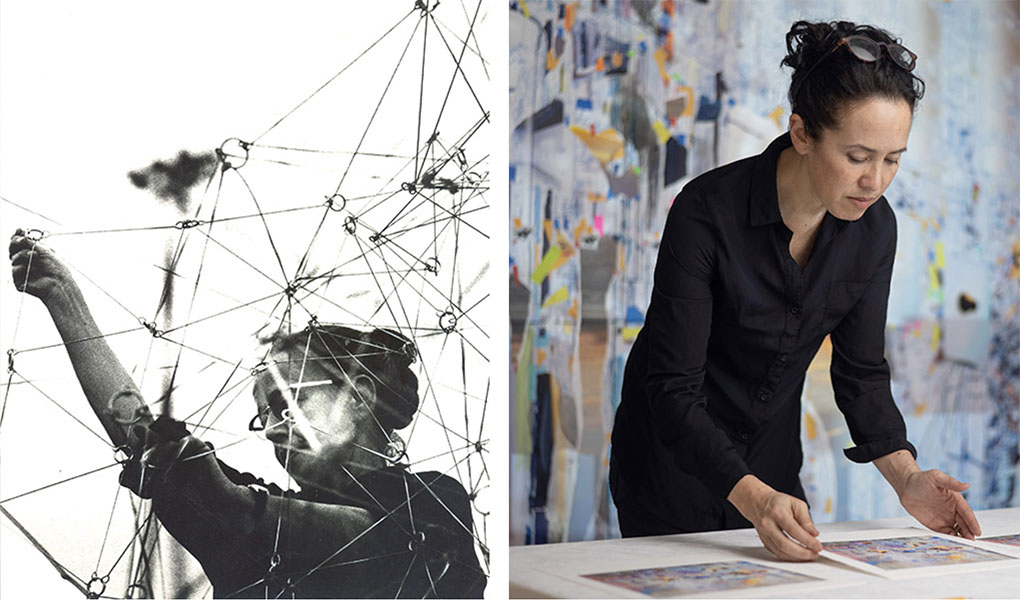
“The Solomon R. Guggenheim Museum presents the first major museum retrospective in New York devoted to the work of Gego, or Gertrud Goldschmidt (b. 1912, Hamburg; d. 1994, Caracas), offering a fully integrated view of the influential German-Venezuelan artist and her distinctive approach to the language of abstraction. On view through September 10, 2023, Gego: Measuring Infinity features nearly 200 artworks from the early 1950s through the early 1990s arranged chronologically and thematically across five levels of the museum’s rotunda. Included are sculptures, drawings, prints, textiles, and artist’s books, alongside photographic images of installations and public artworks, sketches, publications, and letters.
Born into a German Jewish family, Gego first trained as an architect and engineer at the Technische Hochschule Stuttgart (now Universität Stuttgart). Fleeing Nazi persecution in 1939, she immigrated to Venezuela, where she settled permanently, embarking on an artistic career in the 1950s that would span more than four decades. In two- and three-dimensional works across a variety of mediums, Gego explored the relationship between line, space, and volume. Her pursuits in the related fields of architecture, design, and education complemented those investigations.” — Solomon R. Guggenheim Museum
The Solomon R. Guggenheim Museum’s presentation of Gego: Measuring Infinity is cocurated by Pablo León de la Barra, Curator at Large, Latin America, Solomon R. Guggenheim Museum and Foundation, New York, and Geaninne Gutiérrez-Guimarães, Associate Curator, Guggenheim Museum Bilbao, and Solomon R. Guggenheim Museum and Foundation, New York.
“The Solomon R. Guggenheim Museum presents a solo exhibition of Sarah Sze (b. 1969, Boston) featuring a series of site-specific installations by the acclaimed New York–based artist. Sarah Sze: Timelapse unravels a trail of discovery through multiple spaces of the iconic Frank Lloyd Wright building, from the exterior of the museum to the sixth level of the rotunda and the adjacent tower level gallery. The exhibition explores Sze’s ongoing reflection on how our experience of time and place is continuously reshaped in relationship to the constant stream of objects, images, and information in today’s digitally and materially saturated world.
Visitors and passersby will first encounter Sarah Sze: Timelapse outside the museum where the presentation spills into the public sphere. At street level an uninterrupted flow of images trace the contours of the building’s exterior, while a projection on the rotunda’s circular facade mirrors in real time the cycle of the moon over the course of the exhibition. In Sze’s reimagination, the Guggenheim’s iconic, UNESCO World Heritage architecture becomes a public timekeeper in a reminder that timelines are built through shared experience and memory. In the words of the artist, ‘Like the collective efforts used by humans over centuries to communally mark time, to measure and mark it in physical form—ranging from Jantar Mantar, to the Prime Meridian line, to ubiquitous minarets, clock towers, and animated or astronomical clocks around the world—the museum building will become a site to explore the idea of a public clock, and an experiment in collective timekeeping that all in the city can experience’.”— Solomon R. Guggenheim Museum
Sarah Sze: Timelapse is organized by Kyung An, Associate Curator, Asian Art, and was initiated and contributed to by Nancy Spector, former Jennifer and David Stockman Chief Curator.
“The Jewish Museum presents After ‘The Wild’: Contemporary Art from The Barnett and Annalee Newman Foundation Collection, an exhibition highlighting contemporary artworks by 47 intergenerational and internationally based artists made between 1963 and 2023. These works are part of a larger gift to the Museum in 2018 comprising artworks made by the recipients of The Barnett and Annalee Newman Foundation Award. After ‘The Wild’: Contemporary Art from The Barnett and Annalee Newman Foundation Collection is on view at the Jewish Museum from March 24 through October 1, 2023.
The exhibition title is inspired by Barnett Newman’s 1950 painting The Wild. Standing at 8 feet tall and a mere 1 ½ inches wide, the work consists of a dark orange ‘Zip’ set against razor thin bands of black. It contrasts sharply with the heroically scaled paintings for which Newman is well known. In Newman’s own account, The Wild was meant to test whether something modest could hold its own against something grand: in its first presentation, it was shown opposite the painting Vir Heroicus Sublimis (1950-51), a room-filling magnum opus.” — Jewish Museum
Installation views of “The Wild”: Contemporary Art from The Barnett and Annalee Newman Foundation Collection at the Jewish Museum, March 24 – October 1, 2023. Photos by Corrado Serra.
After “The Wild”: Contemporary Art from The Barnett and Annalee Newman Foundation Collection is organized by guest curator Kelly Taxter, with Shira Backer, Leon Levy Associate Curator, The Jewish Museum. Exhibition design is by Ivi Diamantopoulou and Jaffer Kolb, with Nashwah Ahmed, New Affiliates.
“Generation Paper: A Fashion Phenom of the 1960s explores the era’s short-lived phenomenon of paper fashion through more than 80 rare garments and accessories crafted from non-woven textiles. These fashions, introduced in 1966 as a promotional campaign for Scott Paper Company, combined bold, graphic design with space-age innovations in materials. Surfacing a little-known chapter in the history of design, Generation Paper illuminates the creative partnerships of craft and commerce in the development of semi-synthetic and synthetic materials.” — MAD
“Before there was fast fashion, there was paper fashion, which ironically was meant to be a demonstration of paper’s potential to behave like woven fabric,” said Elissa Auther, MAD’s Deputy Director of Curatorial Affairs and William and Mildred Lasdon Chief Curator. “Women who ordered the patterns and confidently wore paper dresses—as many did!—beautifully ushered in a new wave of cutting-edge material innovation.”
Installation views of Generation Paper: A Fashion Phenom of the 1960s at the Museum of Arts and Design, New York (March 18, 2023 to August 27, 2023). Photos by Jenna Bascom; courtesy the Museum of Arts and Design.
Funk You Too! Humor and Irreverence in Ceramic Sculpture
“The Museum of Arts and Design (MAD) presents the first major museum survey of humor and irreverence in modern and contemporary clay sculpture. On view from March 18–August 27, 2023, Funk You Too! Humor and Irreverence in Ceramic Sculpture brings together 50 artworks from the 1960s to the present day in which clay is used as a tool for critique and satire. In the exhibition, pieces by artists of the originating Funk art generation will be placed next to work by contemporary artists who are expanding on Funk’s legacy of humor, subversion, and expressive figuration.” — MAD
“Funk You Too! Humor and Irreverence Ceramic Sculpture arrives at a moment when clay as a sculptural medium is receiving unprecedented attention from the art world,” said Elissa Auther, MAD’s Deputy Director of Curatorial Affairs and William and Mildred Lasdon Chief Curator. “Taking advantage of MAD’s significant collection of historical Funk ceramics, Funk You Too! examines the critical contexts that gave rise to the prominence of humor in ceramic sculpture and advocates for the ongoing relevance of Funk ceramics to a new generation of artists.”
Installation views of Funk You Too! Humor and Irreverence in Ceramic Sculpture at the Museum of Arts and Design, New York (March 18, 2023 to August 27, 2023). Photos by Jenna Bascom; courtesy the Museum of Arts and Design.
“The Rubin Museum of Art is pleased to present ‘Death Is Not the End,’ a new exhibition that explores notions of death and the afterlife through the art of Tibetan Buddhism and Christianity. Featuring prints, oil paintings, bone ornaments, thangka paintings, sculptures, illuminated manuscripts, and ritual objects, ‘Death Is Not the End’ invites contemplation on the universal human condition of impermanence and the desire to continue to exist. This cross-cultural exhibition brings together 58 objects spanning 12 centuries from the Rubin Museum’s collection alongside artworks on loan from private collections and major institutions including the Metropolitan Museum of Art; Morgan Library & Museum; Museum aan de Stroom, Antwerp; Wellcome Collection, London; Nelson Atkins Museum, Kansas City; San Antonio Museum of Art, Texas; Museum of Fine Arts, Boston; Philadelphia Museum of Art; and more. The exhibition is part of the Rubin Museum’s yearlong thematic focus on Life After, exploring moments of change that propel us into the unknown.” — The Rubin Museum of Art
“During a time of great global uncertainty, loss, and turmoil, many question and ponder the various ideas related to the afterlife,” says Senior Curator of Himalayan Art Elena Pakhoutova. “In pairing artworks from Christianity—the most familiar cultural framework in the United States—with those from Buddhism, a less known visual culture in the West, we highlight a universal common ground and encourage visitors’ inquiry as they engage with these diverse objects. I hope that this exhibition inspires conversations around the sometimes challenging or uncomfortable topic of what comes after life, as well as respect for different perspectives and approaches.”
Lords of the Charnel Ground; Smashana Adipati; Tibet; 18th century; painted terracotta; 6 1/2 x 5 1/8 x 1 1/2 in. (16.5 x 13 x 3.8 cm); Rubin Museum of Art; C2002.36.1 (HAR 65149); photography by David De Armas for the Rubin Museum of Art, 2012
Wheel of Life; Tibet or Mongolia; 19th century; pigments on cloth; Rubin Museum of Art; gift of Shelley and Donald Rubin; C2006.66.131 (HAR 78)
A Woman Divided into Two, Representing Life and Death; 1790–1820; oil painting; 16 5/16 × 14 in. (41.5 x 35.5 cm); Wellcome Collection, London; 45063i
Pieter van der Heyden (Netherlandish, ca. 1525–1569); The Descent of Christ Into Limbo; Antwerp; ca. 1561; engraving; first state of two; sheet: 9 1/16 x 11 7/16 in. (23 x 29 cm); lent by the Metropolitan Museum of Art, Harris Brisbane Dick Fund, 1926 (26.72.41)
Yama Dharmaraja; Tibet; 18th century; Woodblock print and pigments on silk; Rubin Museum of Art; gift of Shelley and Donald Rubin; C2006.66.264 (HAR 406)
Sarvavid Album Leaf #53: Liberation from Hell; Inner Mongolia; 18th–19th century; pigments on paper; Collection of the City of Antwerp – MAS; AE.1977.0026.41-54; Photo: Bart Huysmans & Michel Wuyts
Transformation. Smashana Adipati, Lords of the Charnel Ground; Tibet; 15th century; pigments on cloth; Rubin Museum of Art, gift of Shelley & Donald Rubin Foundation; F1996.16.5 (HAR 462)
“Death Is Not the End” is curated by Elena Pakhoutova, Senior Curator of Himalayan Art at the Rubin Museum.







You must be logged in to post a comment.