“The New Museum presents a major solo exhibition of work by Wangechi Mutu, bringing together more than one hundred works across painting, collage, drawing, sculpture, and film to present the full breadth of her practice from the mid-1990s to today. On view March 2–June 4, 2023, ‘Wangechi Mutu: Intertwined’ takes over the entire museum, encompassing the three main floors, lobby, ‘Screens Series’ program on the lower level, seventh floor Sky Room, and a new commission for the building’s glass façade. Curated by Vivian Crockett, Curator, and Margot Norton, Allen and Lola Goldring Senior Curator, with Ian Wallace, Curatorial Assistant, ‘Intertwined’ traces connections between recent developments in Mutu’s sculptural practice and her decades-long exploration of the legacies of colonialism, globalization, and African and diasporic cultural traditions.” — New Museum
“Mutu’s work has long been characterized by a sense of permeable boundaries and hybridity, invested in the complex encounters of bodies, sites, and structures. Her work grapples with contemporary realities and proffers new models for a radically changed future informed by feminism, Afrofuturism, and interspecies symbiosis,” said Vivian Crockett, Curator, New Museum.
“Mutu’s work presciently addresses some of today’s most vital questions concerning historical violence and its impact on women, and our inextricable ties to one another, our ecosystems, and all life forms with which we share our planet,” continued Margot Norton, Allen and Lola Goldring Senior Curator, New Museum.
Installation views of “Wangechi Mutu: Intertwined” at New Museum. Photos by Corrado Serra.
“Ailey II, the renowned second company to Alvin Ailey American Dance Theater, will return to its home, The Ailey Citigroup Theater, for a highly anticipated two-week season—the second led by Artistic Director Francesca Harper—featuring 14 exhilarating performances from March 22-April 2. The gifted ensemble of rising stars will treat audiences to two dynamic programs, Poetic Motion and Empowered, spotlighting works by founder Alvin Ailey, Alvin Ailey American Dance Theater Artistic Director Robert Battle, William Forsythe, Francesca Harper, Andrea Miller, and former Ailey Company member Elizabeth Roxas-Dobrish.
For over four decades, Ailey II has merged the spirit and energy of the country’s best early-career dance talent with the passion and artistry of today’s most outstanding choreographers. Founded in 1974 as a bridge between The Ailey Schooland the professional dance world, the company embodies Alvin Ailey’s pioneering mission to establish an extended cultural community that provides dance performances, training, and community programs for all people.” — Ailey II
“After a successful U.S. tour, I am thrilled for New York audiences to witness the grace, strength, and versatility of the Ailey II dancers that will bring joy to hearts and inspire,” said Artistic Director Francesca Harper. “The two programs will highlight richly diverse works from treasured classics to contemporary favorites; there’s something for everyone.”
Ailey II’s Meagan King. Photo by Nir Arieli.
Ailey II in Francesca Harper’s Freedom Series. Photo by Erin Baiano.
Ailey II in Robert Battle’s Alleluia. Photo by Eric Baiano.
Ailey II in Robert Battle’s Alleluia. Photo by Erin Baiano.
Ailey II in William Forsythe’s Enemy in the Figure. Photo by Erin Baiano.
Ailey II’s Travon M. Williams in William Forsythe’s Enemy in the Figure. Photo by Erin Baiano.
Ailey II in Andrea Miller’s Psukhe. Photo courtesy of Ailey II.
Ailey II with Artistic Director Francesca Harper and Rehearsal Director Lakey Evans-Pena. Photo by Nir Arieli.
Title image: Ailey II in Francesca Harper’s Freedom Series. Photo by Erin Baiano.
“The Jewish Museum presents The Sassoons, an exhibition that reveals the fascinating story of a remarkable Jewish family, highlighting their pioneering role in trade, art collecting, architectural patronage, and civic engagement from the early 19th century through World War II. On view from March 3 through August 13, 2023, the exhibition follows four generations from Iraq to India, China, and England, featuring a rich selection of works collected by family members over time.
Over 120 works—paintings, Chinese art, illuminated manuscripts, and Judaica—amassed by Sassoon family members and borrowed from numerous private and public collections are on view. Highlights include Hebrew manuscripts from as early as the 12th century, many lavishly decorated; Chinese art and ivory carvings; rare Jewish ceremonial art; and Western masterpieces including paintings by Thomas Gainsborough, and Jean-Baptiste-Camille Corot, and magnificent portraits by John Singer Sargent of various Sassoon family members. The Sassoons explores themes such as discrimination, diaspora, colonialism, global trade, and war that not only shaped the history of the family but continue to define our world today.” — Jewish Museum
Installation views of The Sassoons on view at the Jewish Museum, March 3 – August 13, 2023. Photos by Corrado Serra.
The Sassoons is organized by Claudia Nahson, Morris and Eva Feld Senior Curator at the Jewish Museum, New York, and Esther da Costa Meyer, Professor Emerita at Princeton University. The exhibition design is by Leslie Gill and Adam Johnston, Leslie Gill Architect; graphic design by Miko McGinty.
“Nicole Eisenman: Prince focuses on Eisenman’s inventive experimentation and deep engagement with printmaking since 2010. Celebrated for her painting and, more recently, her work in sculpture, Eisenman has also produced a significant body of prints spanning lithographs, etchings, woodcuts, and monotypes. These works evidence the voracious range of references, imagery, and styles for which the artist is known. They also show how Eisenman has pushed these mediums, engaging materials, surfaces, and mark making in unexpected ways. Made in close collaboration with the New York–based print workshops Harlan & Weaver, Jungle Press, and 10 Grand Press, the works in Prince demonstrate how printmaking has been a generative space for experimentation within Eisenman’s broader practice.” — Print Center
Nicole Eisenman: Prince was originally organized by Loretta Yarlow at the University Museum of Contemporary Art at the University of Massachusetts, Amherst. The presentation at Print Center New York is organized by Jenn Bratovich and Judy Hecker.
“Themes and Dreams, a retrospective of collage and assemblage illustration by New York-based artist Joan Hall, will be on view at the Westbeth Gallery from March 4-24, 2023. Self-curated with input from independent curator Lilly Wei, the exhibition will feature seven distinct bodies of work and that explore modernist strategies of fragmentation and re-composition. Produced over a 50-year career, the 100 pieces in the exhibition will be exhibited together for the first time charting the depth and breadth of Hall’s varied interests and talent.
Since 1970, Joan Hall has been using collage and assemblage to explore different cultures, times and places. She creates imaginary spaces and newly arranged realities that have dreamlike qualities infused with humor and irony. Her assemblages tell stories by giving found objects new meanings resulting from unexpected juxtapositions and placements.” — Westbeth Gallery
Parroquin Dreams: Parroquin Dream 20, 2016. Paper Collage, 19”x 15”
Mexico Mi Amor: Sanctuary at Atotonilco, 2017. Paper Collage, 18” x 14”
The Paris Project: Shell, 2011. Mixed-Media Assemblage, 17 ” x 14 ” x 3”
Icons: The Wisher, 2021. Mixed Media Assemblage, 9” x 8” x 3”
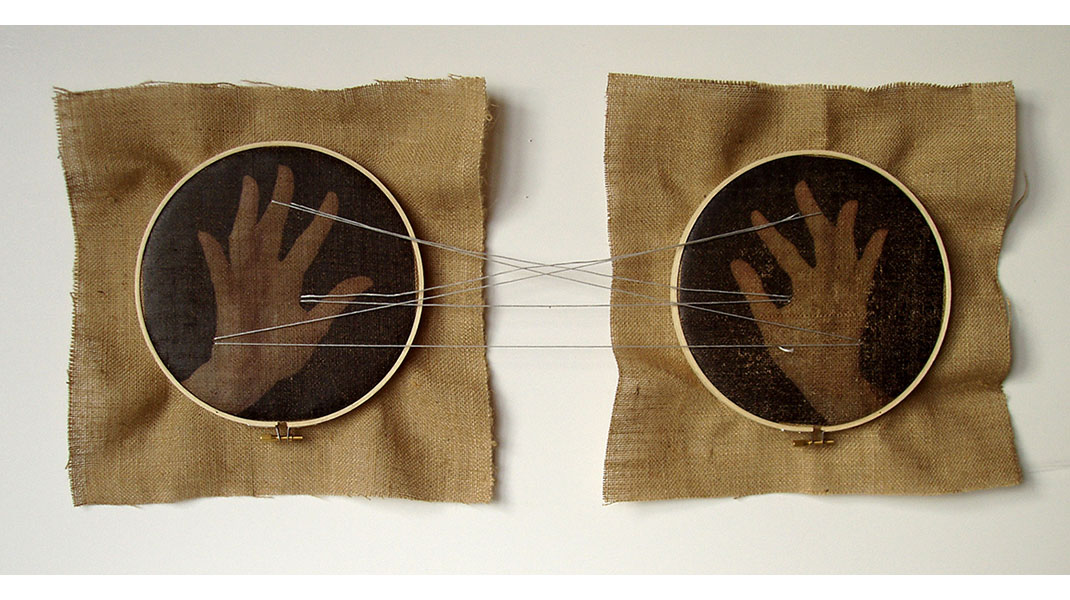
Strings Attached: Cat’s Cradle, 2020. Mixed Media, 13” x 35” x 1″
Boxed Dreams: A New Day, 2020. Mixed Media Assemblage, 11”x 10”
Jill’s Room, 1980. Mixed-media assemblage, 8’ x 2’7” x 1’3’’
“The celebrated holdings of decorative arts objects amassed by Henry Clay Frick have been significantly enriched in recent decades by gifts from other collectors. In 1999, Winthrop Kellogg Edey’s bequest added to the museum’s holdings an important group of European clocks and watches, and in the last decade or so, gifts from Dianne Dwyer Modestini (2008), Melinda and Paul Sullivan (2016), Henry Arnhold (2019), and Sidney R. Knafel (2021) have reshaped the Frick’s holdings of European ceramics with significant groups of Du Paquier and Meissen porcelain, French faience, and Italian maiolica. A remarkable bequest in 2020 from the collection of Alexis Gregory builds on this tradition by enhancing the museum’s existing holdings and introducing to the museum new types of objects. Beginning in February 2023, visitors can enjoy a special exhibition of these works, shown by the Frick for the first time together. The Gregory Gift (February 16 through July 9, 2023) features the twenty-eight acquisitions in a variety of media and forms, curious luxury objects that, shown together, suggest a fine collector’s cabinet or Kunstkammer. Among them are fifteen Limoges enamels, two clocks, two ewers, a gilt-bronze sculpture, a serpentine tankard, an ivory hilt, a rhinoceros horn cup, a pomander, and two stunning pastels by Rosalba Carriera.” — The Frick Collection
James Cox (British, ca. 1723–1800). Musical Automaton Rhinoceros Clock, ca. 1765–72. Gilt bronze, silver, enamel, paste jewels, white marble, and amber. 15 9/16 x 8 3/8 x 3 1/2 in. (39.5 x 21.3 x 8.9 cm). The Frick Collection, Gift of Alexis Gregory, 2021. Photo: Joseph Coscia Jr.
Saint-Porchaire ware (French). Ewer (biberon). Mid-16th century. Glazed earthenware. 10 1/4 x 5 1/16 x 5 1/16 in. (26 x 12.9 x 12.9 cm). The Frick Collection, Gift of Alexis Gregory, 2020. Photo: Joseph Coscia Jr.
Rosalba Carriera (Italian, 1673–1757). Portrait of a Woman, ca. 1730. Pastel on paper, glued on canvas. 23 1/4 x 18 3/4 x 1/2 in. (59.1 x 47.6 x 1.3 cm). The Frick Collection Gift of Alexis Gregory, 2020. Photo: Joseph Coscia Jr.
Attributed to Domenico Cucci and workshop. Manufacture des Gobelins, Paris 1662–1664. Figure of Louis XIV. Gilt bronze, on a porphyry base. 13 5/8 x 11 15/16 x 7 1/16 in. (34 .6 x 30.3 x 17.9 cm). The Frick Collection, Gift of Alexis Gregory, 2021. Photo: Joseph Coscia Jr.
Attributed to Johann Heinrich Köhler (1669–1736). Parade Clock with Cameos, 1700–10. Gilt bronze, cameos, emeralds, diamonds, rubies, heliotrope, and marble. 9 1/2 x 6 3/16 x 3 3/4 in. (24.1 x 15.7 x 9.5 cm). The Frick Collection, Gift of Alexis Gregory, 2021. Photo: Joseph Coscia Jr.
Probably South German. Seated Lion Pomander, ca. 1575. Gold, diamond, rubies, and enamel. 2 13/16 x 1 1/4 x 1 7/8 in. (7.1 x 3.2 x 4.8 cm). The Frick Collection, Gift of Alexis Gregory, 2021. Photo: Joseph Coscia Jr.
Pierre Reymond (French, 1513–after 1584). Jason Confronting the Dragon Guarding the Golden Fleece, ca. 1567–1568. Limoges; enamel on copper, parcel-gilt. Diam.: 7 15/16 in (20.2 cm). The Frick Collection, Gift of Alexis Gregory, 2021. Photo: Joseph Coscia Jr.
Pierre Reymond (French, 1513–after 1584). One of a Pair of Covered Tazzas, late 16th century. Limoges; enamel on copper, parcel-gilt. 8 1/2 x 7 1/4 in. (21.6 x 18.4 cm). The Frick Collection, Gift of Alexis Gregory, 2021. Photo: Joseph Coscia Jr.
Master I.C., probably Jean de Court or Jean Court. Plaque: Jupiter under a Canopy, 16th century. Limoges; enamel on copper, parcel-gilt. 4 3/16 x 3 3/8 in. (10.6 x 8.6 cm). The Frick Collection, Gift of Alexis Gregory, 2021. Photo: Joseph Coscia Jr.
Italian, Venice (?). Dish, early 16th century. Enamel on copper, parcel-gilt. Diam.: 17 1/2 in. (44.5 cm). The Frick Collection, Gift of Alexis Gregory, 2021. Photo: Joseph Coscia Jr.
Comments Ian Wardropper, Anna-Maria and Stephen Kellen Director of the Frick, “Alexis Gregory had one of the finest collections of Renaissance and Rococo decorative arts in this country. His deep affection for the Frick led to his bequest of a selection of a superb group of objects, and we are gratified to mount this exhibition in his memory.” Buku Pongo adds, “ This generous and important gift to The Frick Collection opens new areas of research and lays the groundwork for exciting projects. From research into the context of their creation to technical analyses expanding our knowledge of how these objects were produced, the exhibition at Frick Madison will celebrate Alexis Gregory’s generous gift and The Frick Collection’s commitment to the display of European decorative arts.”
The exhibition is organized by Marie-Laure Buku Pongo, Assistant Curator of Decorative Arts.
“Neue Galerie New York culminates its twentieth anniversary season with the opening of ‘The Ronald S. Lauder Collection,’ a major exhibition featuring approximately 500 works from the collection of the museum’s co-founder and President, many of which have never been on public display. On view at the Neue Galerie from November 11, 2022, through March 27, 2023, the exhibition provides unique insight into one of the finest private collections in the world and introduces visitors to the mindset of a passionate lifelong connoisseur of art, whose forward-thinking vision laid the groundwork for the museum.” — Neue Galerie
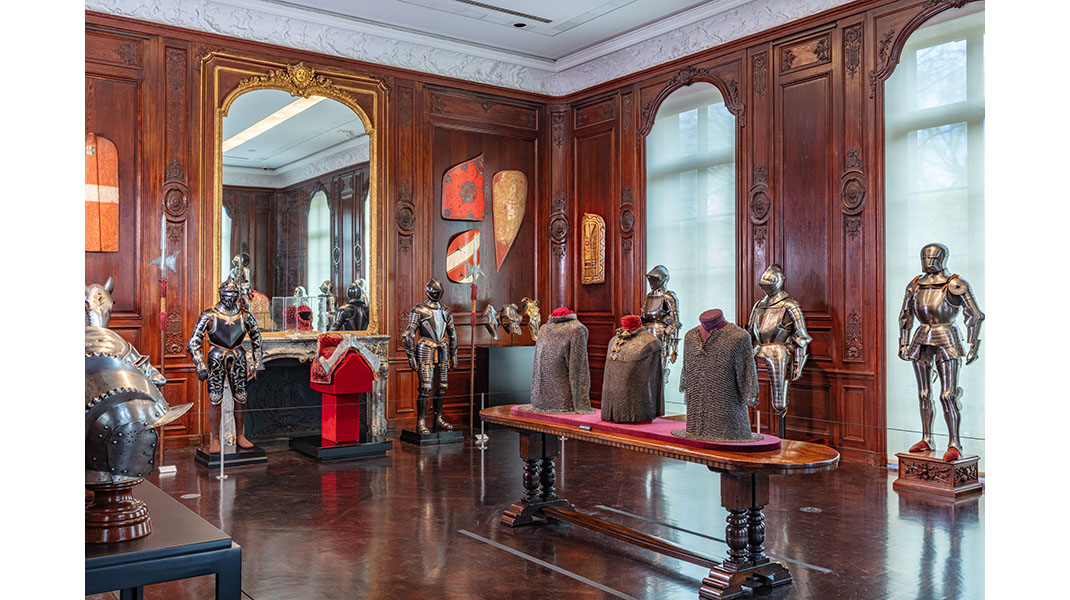
As described by Lauder, “In celebration of our twentieth anniversary, we are offering something that has rarely been done before—inviting our visitors to share in the full experience of my collection. Many of the works included in the exhibition appear in similar arrangements as in my home. This gives the visitor an unusual opportunity not only to see these extraordinary works of art, many of which have yet to be presented publicly, but also to experience the interactions they have with each other and the space. In essence, I am opening my doors for the public to understand the evolution of my collection. The exhibition traces why I became an art collector, why I acquired what I have, and shares these ideas with the public, which I think is a critical part of collecting and connoisseurship.”
Installation views of “The Ronald S. Lauder Collection” on view at Neue Galerie New York. Photos: Hulya Kolabas, courtesy of Neue Galerie New York.
“The Ronald S. Lauder Collection” is organized by curator Elizabeth Szancer for Neue Galerie New York. Tom Zoufaly designed the installation and Peter de Kimpe designed the exhibition.
“The Center for Italian Modern Art (CIMA) announces a new exhibition ‘From Depero to Rotella: Italian Commercial Posters Between Advertising and Art’ from February 16th to June 10th, 2023 at its Soho exhibition and research center. The show examines the cross-pollination between avant-garde art and commercial posters in Italy, with a particular focus on the interwar years and the early post-World War II era, during the country’s economic boom.
The exhibition includes over 30 posters from major Italian institutions and corporate collections, as well as a few select private collections in the United States. Among the artists featured: Erberto Carboni, Fortunato Depero, Nikolai Diulgheroff, Lucio Fontana, Max Huber, Bruno Munari, Marcello Nizzoli, Bob Noorda, Giovanni Pintori, Xanti Schawinsky, Mario Sironi, and Albe Steiner. The works of these individuals illustrated the products of companies that made the history of the Italian economy, such as Barilla, Campari, Olivetti, Fiat, Pirelli.” — Center for Italian Modern Art
Nikolay Diulgheroff. Amaro Cora, 1928. Lithograph, 78 x 55 in (198.1 x 139.7 cm). Merrill C. Berman Collection.
Enrico Prampolini. Théâtre Champs-Elysées. Opéra Italien, 1929. Lithograph on paper, mounted on linen, 28 1/2 x 23 in (72.4 x 58.4 cm). Merrill C. Berman Collection.
Xanti (Alexander) Schawinsky. Illy Caffè, 1934. Lithograph on paper,55 1/8 x 39 1/2 in (140 x 100.3 cm). Merrill C. Berman Collection.
Mario Sironi. L’Ambrosiano Edizione del Pomeriggio, 1934. Off. G. Ricordi & C., Milano. Lithograph backed on linen, 55.5 x 77.5 in. internationalposter.com, Boston MA
Xanti (Alexander) Schawinsky. Olivetti MP1 Portable (ico), 1935. Lithograph, 21 3/8 x 14 in (54.3 x 35.6 cm). Merrill C. Berman Collection.
Armando Testa. Pirelli, 1954-c. 1980. Arti Grafiche Pirovano. Offset print, 39 3/8 x 27 1/2 in (100 x 70 cm). Gemma De Angelis Testa Collection.
GiVi (Giuseppe Vincenti). Watt Radio, 1931. Stabilimento Poligrafico Roggero & Tortia, Torino. Chromolithograph on paper, 99.8 x 70.6 cm. Direzione Regionale Musei Veneto – Museo Collezione Salce Treviso. Su concessione del Ministero della Cultura.
Nicola Lucchi, curator of the exhibition, explains that “while poster art has often been described as derivative in character, the show will demonstrate how, from Futurism onwards, Italian posters acquired a visual and communicative force that elevated the medium to a form of artistic expression in its own right, pushing the boundaries of lithographic techniques, photomontage, and typography. The commercial posters’ peculiar ambition to deliver alluring forms and contents to the masses, rather than to an elite circle, also make them an object of socioeconomic and philosophical interest”.
“The first stop on the national tour of the landmark exhibition Whitfield Lovell: Passages is in South Florida at the Boca Raton Museum of Art (February 15 – May 21), and will continue across six states throughout the American South and the Midwest. This is the largest exhibition ever presented of Lovell’s work that focuses on lost African American history, and raises universal questions about America’s collective heritage. Organized by the American Federation of Arts (AFA) in collaboration with the artist, the exhibition is supported by the National Endowment for the Arts (NEA) and the Terra Foundation for American Art, and encompasses the entire first floor galleries of the Boca Raton Museum of Art (7,500 square feet). This is the first time these multi-sensory installations by Lovell are presented together in a museum-wide show of this monumental size and scope.” — Boca Raton Museum of Art
“I have avoided making images of famous people, and instead I use found images of so-called ‘anonymous’ people, whose names we don’t know and whose lives we can’t know about because they were erased from history,” says Whitfield Lovell. “At one time this person walked the earth, spoke and lived and dreamed, just as we are doing today. I look for the humanity that I can find from each of the nameless images I choose to work from.”
“I see the so-called ‘anonymous’ people in these vintage photographs as being stand-ins for the ancestors I will never know,” says Whitfield Lovell. “I see history as being very much alive. One day, 100 years from now, people will be talking about us as history. The way I think about time is very different – I don’t think it really was very long ago that these things happened, it wasn’t that long ago that my grandmother’s grandmother was a slave,” adds Lovell.
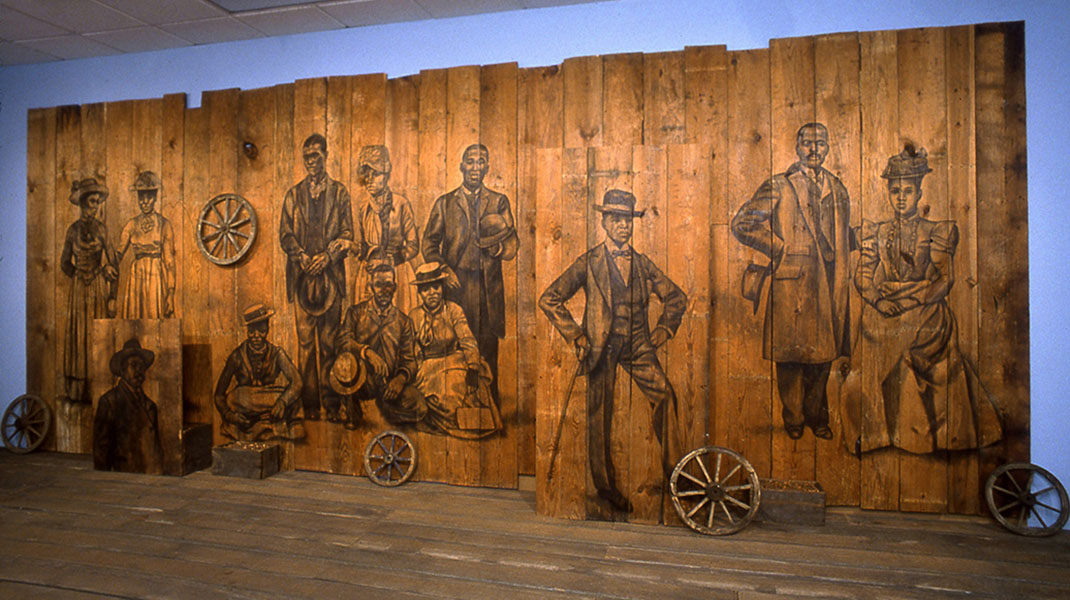
Whitfield Lovell (American, b.1959). America, 2000. Charcoal on wood, 89 x 53 1/2 x 20 in. Courtesy of American Federation of Arts, the artist, and DC Moore Gallery, New York.
Whitfield Lovell (American, b.1959). Visitation: The Richmond Project, 2001. Parlor Dining table, organ, various objects, wooden walls, 223 1/4 x 161 3/4 in. Courtesy of American Federation of Arts, the artist, and DC Moore Gallery, New York.
Whitfield Lovell (American, b. 1959). Deep River, 2013. Fifty-six wooden discs, found objects, soil, video projections, sound. Dimensions variable. Courtesy of American Federation of Arts, the artist, and DC Moore Gallery, New York.
Whitfield Lovell (American, b. 1959). Because I Wanna Fly, 2021. Conté on wood with attached found objects. Diameter: 114 in. Virginia Museum of Fine Arts.
Whitfield Lovell (American, b. 1959). The Red I, 2021. Conté on paper with attached found object, 45 3/4 x 34 x 5 7/8 in. Courtesy American Federation of Arts, the artist, and DC Moore Gallery, New York.
“These installations create a profound immersive experience that enables visitors to become participants in, not just observers of, the experience of these ancestors who were lost to time,” says Pauline Forlenza, the Director and CEO of American Federation of Arts. “Together, these works convey passages between bondage, freedom, and socioeconomic independence, promoting a deeper connection with African American histories through art. An exhibition of this magnitude would not be possible without the support of the National Endowment for the Arts, the Terra Foundation for American Art, and the six museums selected for this tour.”
“An ongoing exhibition of the Museum of Arts and Design’s (MAD) growing permanent collection of more than 3,500 objects, Craft Front & Center will feature a fresh installation of more than 60 historic works and new acquisitions dating from the golden age of the American Craft movement to the present day. Organized into themes of material transformation, dismantling hierarchies, contemplation, identity, and sustainability, the exhibition illuminates how the expansive field of craft has broadened definitions of art. Craft Front & Center opens on February 4, 2023.
Established at the Museum’s beginning in 1956, MAD’s permanent collection was the vision of Museum founder Aileen Osborne Webb, the collector and philanthropist who pioneered an understanding of craft and the handmade as a creative driving force of art and design. With the aim of broadening access to the collection’s holdings, the multiyear exhibition will showcase the value of the handmade in the display of contemporary works and recent acquisitions. Craft Front & Center will be updated periodically with new displays of rarely seen works and recent additions, as well as serve as inspiration for hands-on workshops and off-site field trips.” — MAD
Installation views of Craft Front & Center at the Museum of Arts and Design, New York (February 4, 2023 to January 14, 2024). Photos by Jenna Bascom; courtesy the Museum of Arts and Design.
“This is the first long-term exhibition of the permanent collection since MAD opened its doors at our home in Columbus Circle in 2008,” said Elissa Auther, MAD’s Deputy Director of Curatorial Affairs and William and Mildred Lasdon Chief Curator. “Inspired by the Museum’s radical, founding mission to champion craft as central to the advancement of art, the exhibition expands the story of craft conventionally told by scholars and museums and makes the case for the relevance of the handmade in culture and society today.”
“Hervé Chandès, Artistic Managing Director of the Fondation Cartier pour l’art contemporain and Alex Poots, Artistic Director & CEO of The Shed, are pleased to announce the North American debut of The Yanomami Struggle, a comprehensive exhibition dedicated to the collaboration and friendship between artist and activist Claudia Andujar and the Yanomami people, one of the largest Indigenous groups living in Amazonia today.
Following acclaimed presentations at the IMS São Paulo, the Fondation Cartier, and the Barbican Centre (London), among other venues, the exhibition will be expanded at The Shed to include more than 80 drawings and paintings by Yanomami artists André Taniki, Ehuana Yaira, Joseca Mokahesi, Orlando Nakɨ uxima, Poraco Hɨko, Sheroanawe Hakihiiwe, and Vital Warasi. Visitors will also discover new video works by contemporary Yanomami filmmakers Aida Harika, Edmar Tokorino, Morzaniel Ɨramari, and Roseane Yariana. These works will appear alongside more than 200 photographs by Claudia Andujar that trace the artist’s encounters with the Yanomami and continue to raise visibility for their struggle to protect their land, people, and culture. The dialogue established between the contemporary Yanomami artists’ work and Andujar’s photographs offers an unprecedented vision of Yanomami culture, society, and visual art. The contemporary Yanomami works will be shown in New York for the first time, building the most extensive presentation of Yanomami art in the U.S. to date.” — The Shed
“I think the most important thing is the chance to introduce people to another aspect of our world. At the same time, this other aspect of our world allows us to recognize ourselves in other human beings who deserve to live their lives as they wish and according to their own understanding of the world“. — Claudia Andujar
“Those who do not know the Yanomami will know them through these images. My people are in them. You have never visited them, but they are present here. It is important to me and to you, your sons and daughters, young adults, children to learn to see and respect my Yanomami people of Brazil who have lived in this land for many years”. — Davi Kopenawa, shaman and Yanomami leader
“At a time when Amazonia is threatened once again by unbridled development, deforestation, and illegal mining, this exhibition presents a multilayered narrative of violence and resistance. It also uses art as a platform to amplify the Yanomami voices and expose our responsibilities in the humanitarian and environmental crisis threatening Indigenous societies worldwide”. — Thyago Nogueira, curator
The exhibition is curated by Thyago Nogueira, Head of Contemporary Photography at Instituto Moreira Salles, São Paulo, Brazil (IMS) and organized by IMS, the Fondation Cartier, and The Shed in partnership with the Brazilian NGOs Hutukara Associação Yanomami and Instituto Socioambiental.
“Now on view at Scandinavia House, On the Arctic Edge — Artists Explore the Far North presents three contemporary photo-based artists whose work traverses the regions of the Arctic Circle to probe themes ranging from time and memory, to landscape and the built environment, to science and mythology, to our changing climate: Marion Belanger, Clare Benson, and Steve Giovinco.
The exhibition will be accompanied by two upcoming programs: an Artist Panel on Saturday, February 4 at 1:30 PM with artists Marion Belanger, Clare Benson, and Steve Giovinco in conversation with photographer Erika Larsen. The discussion will examine the individual experiences and work of each artist, as well as the broader perspective the exhibition brings as a collective reflection on the rapidly changing landscape of the Arctic region. On Thursday, February 16 at 7 PM at Scandinavia House, author Lisa E. Bloom will discuss her new book Climate Change and the New Polar Aesthetics: Artists Reimagine the Arctic and Antarctica, exploring how artists, filmmakers, and activists engaged with the Arctic and Antarctic represent our current environmental crises and reconstruct public understandings of them, including Katja Aglert, Subhankar Banerjee, Judit Hersko, Roni Horn, Isaac Julien, Zacharias Kunuk, and others.” — Scandinavia House
Marion Belanger, Rift #20, 2006. Pipes for geothermal energy, Hvergaerdi. Archival pigment print, 30×24 inches (framed).














You must be logged in to post a comment.