Summer of Magic: Treasures from the David Copperfield Collection at New-York Historical Society, June 15 – September 16, 2018

Photographs by Corrado Serra.

Summer of Magic: Treasures from the David Copperfield Collection features highlights from the International Museum and Library of the Conjuring Arts, the incomparable trove of magical historical artifacts from the Emmy Award-winning illusionist David Copperfield. Evoking the New York magic shops that sparked Copperfield’s imagination, displays explore the careers and achievements of legendary magicians from the Golden Age of Magic (1880s–1930s) and showcase iconic objects used by Harry Houdini in his famous escape stunts, culminating with the Death Saw—one of Copperfield’s  groundbreaking illusions.” — New-York Historical Society

“Visitors will be captivated as they discover the tricks, illusions, and escapes that mystified audiences in the late 19th and early 20th centuries,” said Dr. Louise Mirrer, president and CEO of the New-York Historical Society. “Our Summer of Magic is sure to thrill and entertain as we explore the links between magicians and their craft.”

Entrance to Summer of Magic

Front: Legendary magicians from the Golden Age of Magic (1880s–1930s). Back: David Copperfield

Legendary magicians from the Golden Age of Magic (1880s–1930s)

A recreation of a magic shop evokes the legendary New York City stores like Macy’s Magic Counter and Tannen’s Magic Shop that inspired and nurtured many magicians.

Left to right: Harry Houdini’s Metamorphosis Trunk, ca. 1900; Stage costume worn by Beatrice Houdini, early 1900s; Harry Houdini’s Milk Can, ca. 1908

Left to right: Stage costume worn by Beatrice Houdini, early 1900s; Harry Houdini’s Milk Can, ca. 1908; Regulation straitjacket used by Harry Houdini, ca. 1920

David Copperfield

Summer of Magic is curated by Cristian Petru Panaite, assistant curator of exhibitions.

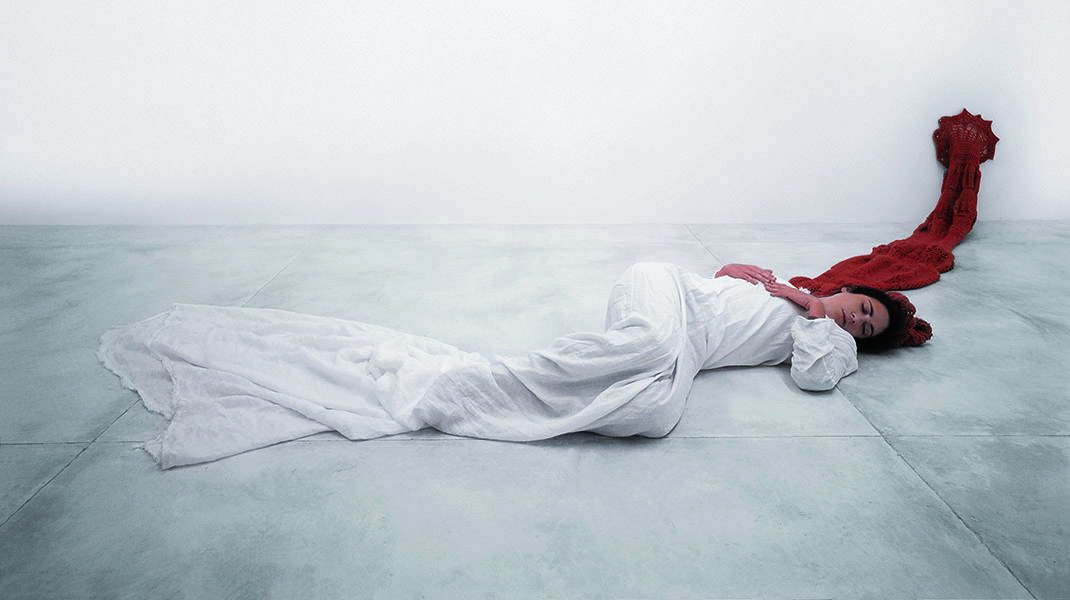
Slight Agitation 4/4: Laura Lima at Fondazione Prada, Milan, June 15 – October 22, 2018

Slight Agitation, a four-part project of newly commissioned, site-specific works hosted in sequence within the Cisterna in the Milan venue of Fondazione, including works by Tobias Putrih (Slovenia, 1972), Pamela Rosenkranz (Switzerland, 1979) and Austrian collective Gelitin, continues with a final installment by Brazilian artist Laura Lima.

Lima presents Horse Takes King, following Putrih’s installation which engaged with ideas of play, politics and emancipation; Rosenkranz’s intervention that offered visitors a multisensory immersion into a new perception of embodiment and collectivity; and Gelitin showcasing a project explicitly addressing classical architectural archetypes and subverting their rhetoric and monumental components. Lima’s work is a whimsical attempt to distort the senses that determine our perception through three large sculptures, displayed in the spaces of the Cisterna, each contributing to the formulation of an apparently absurd taxonomy.

The title of her intervention clearly hints at a chess game, which ultimately creates an illusory space where spectators are invited to move freely, without knowing the broader context that would enable them to understand the artist’s impulse. The works on display, Bird (2016), Pendulum (2018) and Telescope (2018), invite viewers to elaborate what in astronomical terms is described as a ‘syzygy’, traditionally intended as a straight-line configuration of three or morecelestial bodies in a gravitational system. In this case, the connections between displayed elements cannot be reconducted to one univocal definition. The environment Horse Takes Kings prompts is in fact a situational one, in which the three sculptures realized by the artist stand for different roles within a game: the bird stands for the horse, the class is a space for collective enquiry and lastly the pendulum represents the game’s challenge. The King, an imaginary central figure at play, remains an immaterial presence, representing an all-ecompassing power and the main antagonist.” — Fondazione Prada

Laura Lima, Doped (Man=flesh / Woman=flesh), 1996. Photo Eduardo Eckenfels. Collection Instituto Inhotim

Laura Lima, Costumes, 2002. Photo Laura Lima studio. Collection of the artist

Laura Lima, Pheasants with food, 2005. Photo Paulo Innocêncio. Collection of the artist

Laura Lima, Novos Costumes, 2007. Photo Ana Torres. Collection Instituto Inhotim

Laura Lima, Naked Magician, 2010. Photo Sergio Araujo. Collection of the artist

Laura Lima, The Inverse, 2016. Photo Fredrik Nilsen. Studio Collection of the artist

Laura Lima, Bird, 2016. Courtesy the artist. Exhibition view of Slight Agitation 4/4: Laura Lima. Photo Mattia Balsamini

Laura Lima, Pendulum, 2018. Steel, engine, painting. Courtesy the artist. The painting included in the work of art Pendulum is a copy of: Salvador Dalí, Pescador al Sol, 1928 © Salvador Dalì, Gala-Salvador Dalí Foundation by SIAE 2018. Exhibition view of Slight Agitation 4/4: Laura Lima. Photo Mattia Balsamini

Slight Agitation 4/4: Laura Lima, curated by Elvira Dyangani Ose, is the fourth and last chapter of the exhibition project conceived by Fondazione Prada Thought Council, whose current members are Shumon Basar, Elvira Dyangani Ose, and Dieter Roelstraete.

Images courtesy Fondazione Prada.

Joana Vasconcelos: I’m Your Mirror at Guggenheim Museum Bilbao, June 29 – November 11, 2018

“The Guggenheim Museum Bilbao presents the exhibition Joana Vasconcelos. I’m Your Mirror, a selection of thirty works produced between 1997 and the present day by the most internationally reputed Portuguese artist, including a site-specific installation for the Atrium of the Museum and various other new works. In this show viewers can submerge themselves completely in the universe of an artist with a direct and humorous vision of the world, whose work explains many of our society’s contradictions without any apparent effort.

Some of Joana Vasconcelos’ works are extraordinarily complex: they move, make sounds, or light up. These complications are resolved by the artist in her 3000 m2 Lisbon studio with the assistance of a team of more than fifty permanent collaborators. Vasconcelos uses a wide variety of materials from everyday life to make these works, such as household appliances, tiles, fabrics, pottery, bottles, medicines, urinals, showers, kitchen utensils, telephones, cars, and plastic cutlery. With them the artist constructs light-hearted yet strikingly direct images that refer to socio-political issues relevant to post-colonial, globalized and consumerist societies, addressing issues that range from immigration to gender violence. There is always a sense of humor, and the pieces suggest open, non-dogmatic meanings similar to the relational aesthetics that emerged in the late 1990s, since they too require the viewer to participate actively in the perception and interpretation of the artwork.

Rich in external references, from Louise Bourgeois to popular culture, from the goldsmith to the fashion designer, and from handicrafts to cutting-edge engineering, Vasconcelos’s oeuvre addresses identity in all its dimensions, among other key issues, and reflects on her position as a woman and a Portuguese and European artist. Other fundamental aspects of her work are the relationship her pieces establish with the architecture in which they are displayed, a metalinguistic reflection on the nature of the artwork, and the inclusion of purely poetic elements.” — Guggenheim Museum Bilbao

Valium Bed (Cama Valium), 1998. 10 and 15 mg Valium tablets blister packs, painted MDF, glass. 30 x 144 x 200 cm. Museu de Arte Contemporânea de Elvas – Coleção António Cachola. Work produced with the support of Roche Farmacêutica Química © Joana Vasconcelos, VEGAP, Bilbao, 2018.

Meeting Point (Ponto de Encontro), 2000. Chrome-plated metal, wood and upholstery chairs, metallized and thermo-lacquered iron. 120 x Ø 550 cm. Coleção da Caixa Geral de Depósitos, Lisbon © Joana Vasconcelos, VEGAP, Bilbao, 2018.

The Bride (A Noiva), 2001–2005. OB tampons, stainless steel, cotton thread, steel cables. 600 x Ø 300 cm. Museu de Arte Contemporânea de Elvas –Coleção António Cachola. Work produced and restored with the support of Johnson & Johnson, Lda. © Joana Vasconcelos, VEGAP, Bilbao, 2018.

Burka, 2002. Fabrics, metallized and thermo-lacquered iron, painted MDF stage, steel cables, polyurethane, electric system, motor, timer. 670 x 600 x 500 cm. Collection MUSAC, Museo de Arte Contemporáneo de Castilla y León, León © Joana Vasconcelos, VEGAP, Bilbao, 2018.

Red Independent Heart (Coração Independente Vermelho), 2005. Translucent plastic cutlery, painted iron, metal chain, power supply unit, motor, sound installation. 371 x 220 x 75 cm. Museu Colecção Berardo © Joana Vasconcelos, VEGAP, Bilbao, 2018. Photo Daniel Malhão.

Marilyn (AP), 2011 Stainless steel pans and lids, concrete. (2x) 297 x 155 x 410 cm. Collection of the artist. Work produced with the support of Silampos, S.A. © Joana Vasconcelos, VEGAP, Bilbao, 2018.

Lilicoptère, 2012. Bell 47 helicopter, ostrich feathers, Swarovski crystals, gold leaf, industrial paint, dyed leather upholstery embossed with fine gold, Arraiolos rugs, walnut wood, woodgrain painting, passementerie. 300 x 274 x 1265 cm. Private collection. Work produced in collaboration with Fundação Ricardo do Espírito Santo Silva, Lisbon © Joana Vasconcelos, VEGAP, Bilbao, 2018.

Full Steam Ahead (Yellow) [A Todo o Vapor (Amarelo)] #1/3, 2014. Full Steam Ahead (Green) [A Todo o Vapor (Verde)] #1/3, 2013. Full Steam Ahead (Red) [A Todo o Vapor (Vermelho)] #1/3, 2012. BOSCH steam irons, PLC gearmotor, microprocessor-based electronic control unit, low pressure hydraulic system, stainless steel, demineralized water. (3x) 155 x Ø 170 cm. Collection of the artist. Work produced with the support of Robert Bosch Hausgeräte GmbH © Joana Vasconcelos, VEGAP, Bilbao, 2018.

Call Center, 2014-2016. Analogue telephones, metallized and thermo-lacquered mild steel, sound system, oscillators driven by microcontroller. Music: Call Center: Electroacustic Symphony for 168 Telephones, composed by Jonas Runa. 20′ 210 x 80 x 299 cm. Tia Collection © Joana Vasconcelos, VEGAP, Bilbao, 2018.

Pop Rooster (Pop Galo), 2016. Viúva Lamego hand painted tiles, LED, fibreglass, iron, power supply units, controllers, sound system Sound and light by Jonas Runa. 900 x 372 x 682 cm. Collection of the artist. Work produced with the support of Gallo Worldwide © Joana Vasconcelos, VEGAP, Bilbao, 2018.

Ni Te Tengo, Ni Te Olvido, 2017. Ceramic urinals, handmade cotton crochet. 40 x 58 x 30 cm. Collection of the artist © Joana Vasconcelos, VEGAP, Bilbao, 2018.

I’ll Be Your Mirror, 2018. Bronze, mirrors Edition of 7 + 1 AP. 356 x 682 x 537 cm. Collection of the artist © Joana Vasconcelos, VEGAP, Bilbao, 2018.

Joana Vasconcelos. Photo credit: Kenton Thatcher © Unidade Infinita Projectos

Joana Vasconcelos: I’m Your Mirror is curated by Enrique Juncosa and Petra Joos, Guggenheim Museum Bilbao.

Images courtesy Guggenheim Museum Bilbao.

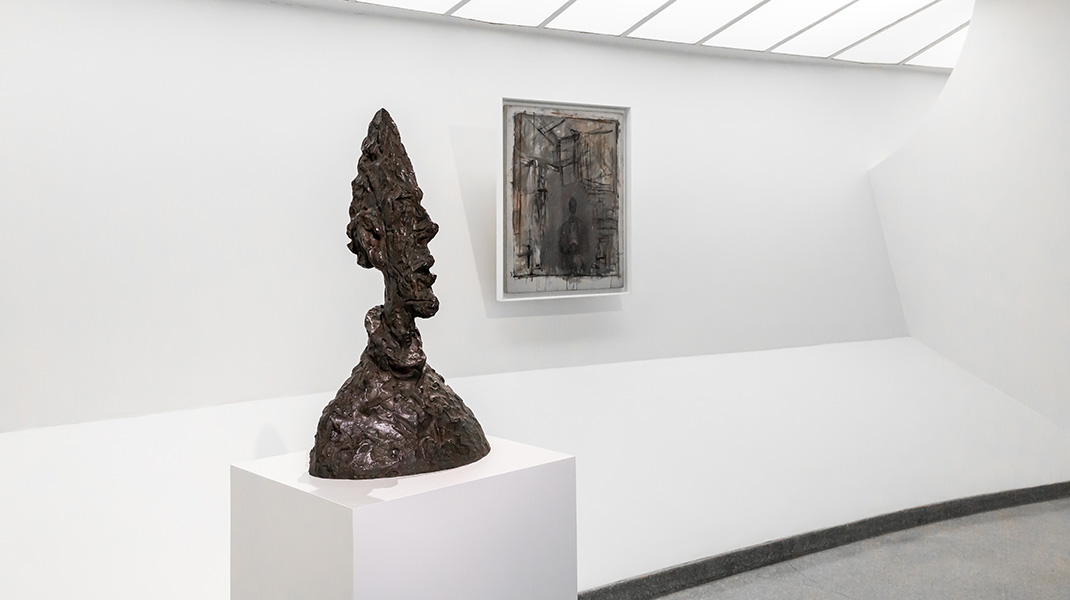
Giacometti at Solomon R. Guggenheim Museum, June 8 – September 12, 2018

Photographs by Corrado Serra.

“A preeminent artist of the twentieth century, Alberto Giacometti (1901–1966) investigated the human figure for more than forty years. This comprehensive exhibition, a collaboration with the Fondation Giacometti in Paris, examines anew the artist’s practice and the unmistakable aesthetic vocabulary he developed through his experiments in painting, sculpture, and drawing.

Giacometti was born in the Swiss village of Borgonovo. His father, Giovanni, a recognized Post-Impressionist painter, introduced him to painting and sculpture at a young age. Giacometti moved to Paris in 1922 and eventually settled in a 15-by-16-foot studio in the artists’ quarter of Montparnasse. He produced the greater part of his oeuvre in this tiny space, which he maintained until the end of his life. Giacometti’s brother Diego, also an artist, became his assistant; he and Annette Arm, whom Giacometti wed in 1949, were the artist’s most frequently rendered models.

During his early years in Paris, Giacometti pursued a deep interest in Cubism and a fascination with the unconscious and dream imagery that led to his association with the Surrealists. African, Cycladic, Egyptian, and Oceanic art captured his attention as well, influencing the formal development of his figures. In the late 1930s he began sculpting pocket-size heads and figures in which he explored perspective and distance; these spatial concerns would remain paramount throughout his career. Giacometti may be best known, however, for the painted portraits and distinctive sculptures that he created in the late 1940s. These innovative works, including a series of elongated standing women, striding men, and expressive busts, resonated strongly with a public grappling with the extreme alienation and anxiety wrought by the devastation of World War II. Giacometti was unflinching in his portrayal of humanity at its most vulnerable.

The Solomon R. Guggenheim Museum and Foundation has a long history with Giacometti. In 1955 the artist’s first museum show was presented in New York at the institution’s temporary quarters on Fifth Avenue. Noting divergent opinions on Giacometti’s art at that moment, one critic recognized the director James Johnson Sweeney for continuing ‘his program at the Guggenheim Museum of bringing forward the most controversial work of the time.’ In 1974 the Guggenheim mounted a posthumous retrospective in its Frank Lloyd Wright–designed rotunda. The present exhibition, featuring major works in bronze and in oil, as well as plaster sculptures and drawings never before seen in this country, aims to provide a deeper understanding of this artist, whose intensive focus on the human condition continues to provoke and inspire new generations.” — Introductory Wall Text

Giacometti is organized by Megan Fontanella, Curator, Modern Art and Provenance, Solomon R. Guggenheim Museum, and Catherine Grenier, Director, Fondation Giacometti, Paris, with support provided by Mathilde Lecuyer-Maillé, Associate Curator, Fondation Giacometti, and Samantha Small, Curatorial Assistant, Solomon R. Guggenheim Museum.

ESCHER. The Exhibition & Experience at Brooklyn’s Industry City, June 08, 2018 – February 03, 2019

ESCHER. The Exhibition & Experience is an exhibition of over 200 works by the iconic Dutch artist M.C. Escher. It is the most important and the largest exhibition of M.C. Escher ever presented in the United States.

Maurits Cornelis Escher (1898 – 1972) is world renowned for his enigmatic sketches and paradoxical designs, executed with incredible detail and mathematic precision to create and construct impossible worlds. Escher had a natural intuition for mathematical drawings, and was captivated by repeating patterns of interlocking tessellations, and the paradoxical representations of infinity. Exploring the intersection between art, mathematics, science, and poetry, Escher’s works have fascinated and astounded generations of artists, architects, mathematicians, musicians, and designers alike.

A one-of-a-kind artist who used to say that ‘wonder is the salt of the earth,’ Escher has broadened the imaginations and perspectives of generations of art lovers, through works in which everything is connected: science, nature, analytical rigor and aesthetic beauty.” Arthemisia

“My work is a game, a very serious game.” — M.C. Escher

M. C. Escher, Regular Division of the Plane I, 1957. Woodcut in red. Private Collection, Usa. All M.C. Escher works © The M.C. Escher Company. All right reserved.

M. C. Escher, Rind, 1955. Wood Engraving and Woodcut. The Walker Collection. All M.C. Escher works © The M.C. Escher Company. All right reserved.

M. C. Escher, Hand with Reflecting Sphere, 1935. Lithograph Private Collection, Usa. All M.C. Escher works © The M.C. Escher Company. All right reserved.

M. C. Escher, Eye, 1946. Mezzotint. The Walker Collection. All M.C. Escher works © The M.C. Escher Company. All right reserved.

M. C. Escher, Three Worlds, 1955. Lithograph. Private Collection, Usa. All M.C. Escher works © The M.C. Escher Company. All right reserved.

M. C. Escher, Day and Night, 1938. Woodcut. The Walker Collection. All M.C. Escher works © The M.C. Escher Company. All right reserved.

M. C. Escher, Relativity, 1953. Lithograph. The Walker Collection. All M.C. Escher works © The M.C. Escher Company. All right reserved.

M. C. Escher, Belvedere, 1958. Lithograph. The Walker Collection. All M.C. Escher works © The M.C. Escher Company. All right reserved.

“Escher was a singular artistic visionary, whose works still beguile and entrance wherever they are seen,” said curators Mark Veldhuysen and Federico Giudiceandrea. “We are thrilled to bring this exhibition to New York, and to expose new audiences, young and old, to an artist whose vast influence can be felt throughout the spectrum of contemporary culture.”

The exhibition is produced by Arthemisia and curated by Mark Veldhuysen (curator of the M.C. Escher Foundation Collection for over thirty years, http://www.mcescher.com) and Federico Giudiceandrea (one of the world’s foremost collectors of, and experts on, the art of M.C. Escher).

ESCHER. The Exhibition & Experience is at Industry City (34 34th Street, Building 6), Brooklyn, New York.

Mary Corse: A Survey in Light at Whitney Museum of American Art, June 8 – November 25, 2018

“For more than five decades, Mary Corse (b. 1945) has pursued a central question in her work: How can a painting embody light? This challenge has long fascinated artists seeking to translate light’s ephemeral glow into color and material form, but Corse has approached the problem differently. Rather than depict the effects of light through paint, she captures it directly, engaging light’s unique properties—the way it travels in waves, bends, and can be reflected and refracted—to create paintings that appear to move, shift, and radiate from within.

This exhibition, the artist’s first museum survey, presents an introduction to Corse’s work and highlights key moments across her career. It begins in 1964, when Corse moved to Los Angeles from Berkeley, California, to attend art school. There she began an extraordinary period of technical experimentation that yielded bold, shaped monochrome canvases and three-dimensional constructions employing industrial materials such as metal, plexiglass, and electric light to achieve luminosity. Her discovery in 1968 of glass microspheres—the tiny beads used in highway signs and lane lines to reflect car headlights—opened the door to the White Light paintings, Corse’s breakthrough series that she continues to investigate today.

Corse’s ongoing interest in perception and in light as both a subject and material of art has aligned her work with that of the West Coast Light and Space movement. Yet while most of the artists associated with that group— such as Robert Irwin and James Turrell—explored light’s ambient qualities by making work to be experienced in a space rather than on the wall, Corse strove to bring the physical and metaphysical qualities of light into the twodimensional field of painting.

Movement and time are critical components in Corse’s work. Through the shifting position of our bodies in relation to the paintings, we become active participants in the creation of our perceptual experiences of them. At once minimal and maximal, material and immaterial, Corse’s paintings resist immediate apprehension and invite us to take part in the act of discovery.” — Introductory Wall Text

Installation view. Photo by Corrado Serra for Arts Summary

Mary Corse (b. 1945), Untitled (Octagonal Blue), 1964. Metal flakes in acrylic on canvas, 93 x 67 1/2 in. (236.2 x 171.5 cm). Courtesy Kayne Griffin Corcoran, Los Angeles, Lehmann Maupin, New York; and Lisson Gallery, London. Photograph © Mary Corse

Installation view. Photo by Corrado Serra for Arts Summary

Mary Corse (b. 1945), Untitled (Two Triangular Columns), 1965. Acrylic on wood and plexiglass, two parts, 92 x 18 1/8 x 18 1/8 in. (233.7 x 46 x 46 cm) and 92 x 18 1/16 x 18 in. (233.7 x 45.9 x 45.7 cm). Whitney Museum of American Art, New York; gift of Michael Straus in loving memory of Howard and Helaine Straus 2016.6a-b

Installation view. Photo by Corrado Serra for Arts Summary

Mary Corse (b. 1945), Untitled (White Diamond, Negative Stripe), 1965. Acrylic on canvas, 84 x 84 in. (213.36 x 213.36 cm). Collection of Michael Straus. Photograph © Mary Corse

Mary Corse (b. 1945), Untitled (Space + Electric Light), 1968. Argon light, plexiglass, and high-frequency generator, 45 1/4 x 45 1/4 x 4 3/4 in. (114.9 x 114.9 x 12.1 cm). Museum of Contemporary Art San Diego; museum purchase with funds from the Annenberg Foundation. Photograph by Philipp Scholz Rittermann

Installation view. Photo by Corrado Serra for Arts Summary

Installation view. Photo by Corrado Serra for Arts Summary

Mary Corse (b. 1945), Untitled (Black Earth Series), 1978. Ceramic, two tiles, 96 x 48 in. (243.8 x 121.9 cm). Courtesy Kayne Griffin Corcoran, Los Angeles, Lehmann Maupin, New York; and Lisson Gallery, London. Photograph © Mary Corse

Title image: Painting: Mary Corse, Untitled (White Multiple Inner Band), 2003. Courtesy Kayne Griffin Corcoran, Los Angeles, Lehmann Maupin, New York; and Lisson Gallery, London. Photo: Corrado Serra for Arts Summary.

The exhibition is organized by Kim Conaty, Steven and Ann Ames Curator of Drawings and Prints, with Melinda Lang, curatorial assistant.

Nick Cave: The Let Go at Park Avenue Armory, June 7 – July 1, 2018

“Animating Park Avenue Armory with the sights, sounds, and movement of renowned interdisciplinary artist Nick Cave, The Let Go transforms the Armory’s Wade Thompson Drill Hall into a dance-based town hall that brings together visitors to participate in a collective act of catharsis. The Armory’s 2018 visual arts commission builds on Cave’s hybrid, multisensory practice with an ambitious project—encompassing performance, installation, dance-based encounters, and soundtracks by some of New York’s leading DJs—that provides a backdrop for audiences to dispel negativity and uplift one another. The Let Go features a series of soundsuits—wearable sculptures that create a second skin to conceal race, gender, and class, that come to life in a new ‘Up Right’ performance conceived for the Armory’s historic interiors.” — Park Avenue Armory  

The Let Go is a testament to Nick’s unwavering commitment to uplifting communities and affecting change through art. His participatory performances have become some of the most beloved experiences to be found in the contemporary art landscape today,” said Tom Eccles, curator of The Let Go. “It is exciting to bring his energy and aesthetic to the Armory, creating a project that includes all New Yorkers in its realization.”

All images: The Let Go, an immersive performance and installation by Nick Cave at Park Avenue Armory. Photos by Da Ping Luo.

Nick Cave. Photo by Sandro.

The Let Go is produced by the artist, Bob Faust and Park Avenue Armory, and curated by Tom Eccles. 

Images courtesy Park Avenue Armory.

Medieval Monsters: Terrors, Aliens, Wonders at The Morgan Library & Museum, June 8 – September 23, 2018

“Medieval artists were experts of the monstrous. From dragons, unicorns, and other fabled beasts, to hybrid creations that combined wings, tails, and limbs in effortlessly inventive ways, the craftsmen and illuminators of the Middle Ages drew on an encyclopedic knowledge of monstrosities to fill the world around them with marvels of imagination. Medieval scholars traced the meaning of the word monster back to the Latin verbs monstrare (to show) and monere (to warn). As divine lessons, they were often thought to be signs of something gone awry or of disruptions in the social order. Unlike our monsters, they were not necessarily made to frighten or entertain—though they could certainly do that, too. Rather, medieval artists constantly adapted their monsters to suit a variety of purposes. Whether offering protection or criticizing authority, embodying social anxieties or giving shape to the unknown, monsters formed an essential part of medieval material culture. Consequently, medieval monsters have much to teach us about the cultures that created them.” — Introductory Text

John the Baptist, from Prayer Scroll, Percival, Canon (active 1500), England, Yorkshire, ca. 1500, The Morgan Library & Museum, MS G.39 section 9. Photography by Graham S Haber 2017.

The Taming the Tarasque, from Hours of Henry VIII, France, Tours, ca. 1500. The Morgan Library & Museum, MS H.8, fol. 191v, detail. Photography by Graham S. Haber, 2013.

St. Firmin Holding His Head, France, Amiens, ca. 1225-75, limestone and pigment, The Metropolitan Museum of Art, acc. nr. 36.81, image copyright © The Metropolitan Museum of Art. Image source: Art Resource, NY.

Martyrdom of St. Bartholomew, from Hungarian Anjou legendary single leaves, Italy or Hungary, 1325-1335, The Morgan Library & Museum, MS M.360.21. Photography by Janny Chiu, 2017.

Initial V, from Twelve Minor Prophets, Northeastern France, 1131-1165, The Morgan Library & Museum, MS M.962, fol. 55r. Photography by Janny Chiu, 2017.

Ethiopia, from Marvels of the World, France, possibly Angers, ca. 1460, The Morgan Library & Museum, MS M.461, fol. 26v. Photography by Janny Chiu, 2018.

Detail from Tapestry with Wild Men and Moors, Alsace, Strasbourg, ca. 1440, linen and wool slit tapestry, Museum of Fine Arts, Boston, Charles Potter Kling Fund. Photograph © 2017 Museum of Fine Arts, Boston. All Rights Reserved.

Siren, from Abus du Monde (The Abuses of the World), France, Rouen, ca. 1510, The Morgan Library & Museum, MS M.42, fol. 15r. Photography by Janny Chiu, 2017.

Wild man, woman, and child, from Book of Hours, Belgium, ca. 1490, The Morgan Library & Museum, MS S.7 fol. 30r. Photography by Graham S. Haber, 2017.

The Annunciation as an Allegorical Unicorn Hunt, Germany, Eichstätt, ca. 1500, The Morgan Library & Museum, MS M.1201. Photography by Janny Chiu, 2017.

Mint, Mummy, and Mandrake, from Compendium Salernitanum, Northern Italy, possibly Venice, 1350-1375, The Morgan Library & Museum, MS M.873, fol. 61v. Photography by Graham S. Haber, 2017.

St. Christopher Carries Christ Child, from Book of Hours, Belgium, Bruges, ca. 1520, The Morgan Library & Museum, MS M.307, fol. 160v. Photography by Graham S. Haber, 2017.

The Whore of Babylon, from Morgan Apocalypse, London, England, ca.1255, The Morgan Library & Museum, MS M.524, fol. 16v. Photography by Graham S. Haber 2017.

“In the medieval world the idea of the monstrous permeated every level of society,” said Colin B. Bailey, director of the Morgan Library & Museum, “from rulers, and the nobility and the clergy, to agrarian and urban dwellers alike. Artists of the Middle Ages captured this phenomenon in images of beings at once familiar and foreign to today’s viewer. We are grateful to our guest curators Asa Simon Mittman and Sherry Lindquist for helping us bring this engrossing subject to the public.” 

Following its exhibition at the Morgan, Medieval Monsters: Terrors, Aliens, Wonders will travel to the Cleveland Museum of Art from July 14 to October 6, 2019 and the Blanton Museum of Art in Austin from October 27, 2019 to January 12, 2020. 

Images courtesy The Morgan Library & Museum.

RFK Funeral Train: The People’s View at International Center of Photography (ICP), through September 2, 2018

“This year marks half a century since Robert F. Kennedy’s funeral train made its way from New York City to Washington DC. Several photographers, including Paul Fusco, traveled on the funeral train and photographed the entire journey from the train. The main subject of these images is the people who stand along the tracks, paying their last respects and expressing bewilderment and sorrow. Terpstra’s film installation aims to reverse the perspective that Fusco offered in his touching photographs by showing the snapshots and 8mm home movies of the train as taken by the spectators combined with their recollections of that day. The people along the track photographed the train for themselves in an attempt to hold on to a moment in history. Terpstra strives to link these images together once more, just as the people stood side by side along the railroad.” — ICP 

Annie Ingram, [Elkton, Maryland], June 8, 1968. From Rein Jelle Terpstra’s The People’s View (2014–18). Courtesy Melinda Watson.

Annie Ingram, [Elkton, Maryland], June 8, 1968. From Rein Jelle Terpstra’s The People’s View (2014–18). Courtesy Melinda Watson.

Annie Ingram, [Elkton, Maryland], June 8, 1968. From Rein Jelle Terpstra’s The People’s View (2014–18). Courtesy Melinda Watson.

Philip Kennedy, [Arbutus, Maryland], June 8, 1968. From Rein Jelle Terpstra’s The People’s View (2014–18).

Philip Kennedy, [Arbutus, Maryland], June 8, 1968. From Rein Jelle Terpstra’s The People’s View (2014–18).

Claire Leary, [Iselin, New Jersey], June 8, 1968. From Rein Jelle Terpstra’s The People’s View (2014–18).

Claire Leary, [Iselin, New Jersey], June 8, 1968. From Rein Jelle Terpstra’s The People’s View (2014–18).

Claire Leary, [Iselin, New Jersey], June 8, 1968. From Rein Jelle Terpstra’s The People’s View (2014–18).

Rein Jelle Terpstra Film Installation

Rein Jelle Terpstra, Still from The People’s View (2014–18); courtesy Rein Jelle Terpstra.

Rein Jelle Terpstra, Still from The People’s View (2014–18); courtesy Rein Jelle Terpstra.

Rein Jelle Terpstra, Still from The People’s View (2014–18); courtesy Rein Jelle Terpstra.

Rein Jelle Terpstra, Still from The People’s View (2014–18); courtesy Rein Jelle Terpstra.

Rein Jelle Terpstra, Still from The People’s View (2014–18); courtesy Rein Jelle Terpstra.

Rein Jelle Terpstra, Still from The People’s View (2014–18); courtesy Rein Jelle Terpstra.

Images courtesy International Center of Photography.

The Magic of Handwriting: The Pedro Corrêa do Lago Collection at The Morgan Library & Museum, June 1 – September 16, 2018

“The Austrian writer Stefan Zweig, one of the great autograph collectors of the twentieth century, once begged Rainer Maria Rilke for a precious gift: the manuscript of one of Rilke’s own poems. “I realize it is a lot to ask,” Zweig told his friend, “for I know the magic of handwriting well, and I know that the gift of a manuscript is also the gift of a secret—a secret that unveils itself only for love.” 

The Brazilian collector Pedro Corrêa do Lago shares Zweig’s conviction that handwriting works magic. At the age of twelve, Corrêa do Lago began sending letters to prominent people to solicit their autographs. Over time, he assembled an extraordinary collection of handwritten letters, manuscripts, and musical compositions as well as inscribed photographs, drawings, and documents in six broad areas of human endeavor—art, history, literature, science, music, and entertainment. From an 1153 papal bull to a 2006 thumbprint signature of Stephen Hawking, the items on view here—selected by Corrêa do Lago from his vast holdings—convey the power of handwriting to conjure what Zweig called a “magic circle” of writers, artists, composers, political figures, performers, explorers, scientists, philosophers, rebels, and others whose actions and creations have made them legends.” — Introductory Wall Text

Michelangelo Buonarroti (1475–1564). Pen and ink drawing with autograph instructions for a marble order for the facade of San Lorenzo, [Florence, 1518]. Collection of Pedro Corrêa do Lago.

Sir Isaac Newton (1642–1727). Autograph manuscript related to coinage during his service to the Royal Mint, undated [after 1696 and before 1727]. Collection of Pedro Corrêa do Lago.

Adam Smith (1723–1790). Autograph letter signed, presumably to Thomas Cadell, [London, March 1767?]. Collection of Pedro Corrêa do Lago.

Wolfgang Amadeus Mozart (1756–1791). Concluding portion of an autograph letter signed, to his father, Leopold Mozart, [Mannheim], 7 February 1778. Collection of Pedro Corrêa do Lago.

Marie Antoinette (1755–1793). Letter signed, to Ferdinand IV, King of Naples, Versailles, 24 September 1788. Collection of Pedro Corrêa do Lago.

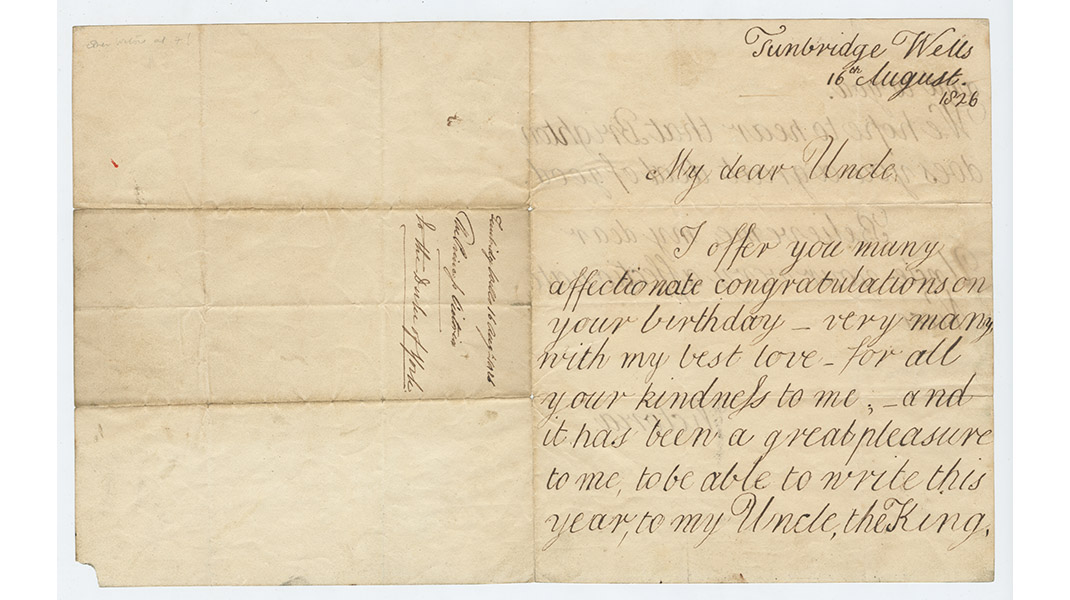
Victoria (1819–1901). Autograph letter signed, from seven-year-old Victoria, the future Queen of Great Britain, to her uncle Prince Frederick, the Duke of York and Albany, Tunbridge Wells, 16 August 1826. Collection of Pedro Corrêa do Lago.

Oscar Wilde (1854–1900). Autograph letter signed, to Bram Stoker, London, [1879 or 1880]. Collection of Pedro Corrêa do Lago.

Signed cabinet photograph of Oscar Wilde (1854–1900), inscribed to James E. Kelly, 1882; photograph by Napoleon Sarony. Collection of Pedro Corrêa do Lago.

Giacomo Puccini (1858–1924). The Girl of the Golden West (La Fanciulla del West), autograph manuscript draft of a portion of act 1, ca. 1908. Collection of Pedro Corrêa do Lago.

Marcel Proust (1871–1922). Swann’s Way (Du côté de chez Swann), autograph manuscript draft of the opening passage, ca. March–April 1913. Collection of Pedro Corrêa do Lago. Image used with permission of the Proust Estate.

Signed photograph of Emiliano Zapata (1879–1919), inscribed to Domingo Arenas Pérez, Tlaltizapán, Mexico, 12 November 1915; photograph by Heliodoro J. Gutiérrez, 1914. Collection of Pedro Corrêa do Lago.

Signed photograph of Sun Yat-sen (1866–1925), by Burr Photo Co., Shanghai, 1912 or later. Collection of Pedro Corrêa do Lago.

Sun Yat-sen (1866–1925). Autograph letter signed, to Ellen Armour Troxel, Tokyo, 2 February 1915. Collection of Pedro Corrêa do Lago.

Signed photograph of Josephine Baker (1906– 1975), inscribed to Mlle Le “Dunf.,” Paris, 1930; photograph by R. Sobol. Collection of Pedro Corrêa do Lago.

Sigmund Freud (1856–1939). Autograph invoice signed, to Roy Grinker, written on a personal correspondence card, Vienna, 30 June 1934. Collection of Pedro Corrêa do Lago.

Antoine de Saint-Exupéry (1900–1944). Signed handprint, [1935]. Collection of Pedro Corrêa do Lago. © Estate of Antoine de Saint-Exupéry.

Albert Einstein (1879–1955). Autograph mathematical manuscript, ca. 1940s. Collection of Pedro Corrêa do Lago.

René Magritte (1898–1967). Autograph letter signed, to Francis Lee, Brussels, 22 January 1946. Collection of Pedro Corrêa do Lago. © 2018 C. Herscovici / Artists Rights Society

Jackson Pollock (1912–1956) and Lee Krasner (1908–1984). Pen and ink, crayon, and pencil drawing by Pollock, mounted on paper, signed by Pollock on behalf of Krasner and himself, [1946], given to Mr. and Mrs. Malcolm Langdon. Collection of Pedro Corrêa do Lago. © 2018 The Pollock-Krasner Foundation / Artists Rights Society (ARS), New York

Frida Kahlo (1907–1954). Signed photograph of Kahlo’s work The Frame (1938), hand-colored and inscribed to Roberto Botelho, 23 October 1947. Collection of Pedro Corrêa do Lago. © 2018 Banco de México Diego Rivera Frida Kahlo Museums Trust, Mexico, D.F. / Artists Rights Society (ARS), New York

Henri Matisse (1869–1954). Autograph note signed with initials, to Albert Skira, Nice, 16 February 1949. Collection of Pedro Corrêa do Lago.© 2018 Succession H. Matisse / Artists Rights Society (ARS), New York

Allen Ginsberg (1926–1997). Signed self-portrait photograph, inscribed, Summit Ayers Rock Self Portrait Arms Length, 24 March 1971 [i.e., 1972]. Collection of Pedro Corrêa do Lago. Courtesy Allen Ginsberg LLC

Stephen Hawking (1942–2018). Signed title page from A Brief History of Time (1993), with thumbprint signature witnessed by Hawking’s personal assistant, Judith Croasdell, inscribed by Croasdell to Philip Dynes, 9 October 2006. Collection of Pedro Corrêa do Lago.

The Magic of Handwriting: The Pedro Corrêa do Lago Collection is organized by the Morgan Library & Museum, New York. 

Images courtesy The Morgan Library & Museum.

The Persistence of Vision: Early and Late Works by Artists with Macular Degeneration at The DAAP Galleries: Philip M. Meyers, Jr. Memorial Gallery at the University of Cincinnati, June 8 – July 29 2018

The Persistence of Vision: Early and Late Works by Artists with Macular Degeneration is an exhibition that explores the versatile, inventive, and personal ways artists respond to the challenge of working with the loss of sight.

The exhibition brings together 50 works by eight artists affected by macular degeneration, a common disease of the retina that results in central vision loss. Artists included in the exhibition are: Lennart Anderson (1928–2015), Serge Hollerbach (1923), Dahlov Ipcar (1917–2017), David Levine (1926–2009), Robert Andrew Parker (1927), Thomas Sgouros (1927–2012), Hedda Sterne (1910–2011), and William Thon (1906–2000). By juxtaposing art produced both before and after the onset of symptoms, this exhibition demonstrates how deteriorating sight can inspire new and unique images. These artists honed their other faculties, drawing from remembered gestures, memories and their imaginations. Through adapting their practices, these artists forged new insights into familiar subjects, and discovered a clarity of inner-vision.

Co-curator A’Dora Phillips, Director of the Vision and Art Project, remarks that “Artists affected by vision loss have extraordinary inner resources that allow them to continue working and producing compelling images. Serge Hollerbach speaks of drawing on his ‘third eye,’ which for him is ‘something that your spirit, or your mind, or your soul, sees.’ William Thon spoke of the presence of instinct and feeling that allows an artist to work like a sailor does, by ’throwing his bowline in the dark.’ Dahlov Ipcar spoke of the hand knowing what line to draw from long experience and body memory. This exhibit shows how powerful art can be when derived from these sources.”

Lennart Anderson, 
Idyll 3, 1979-2011. 
Acrylic on linen, 
77 x 96 inches. 
Estate of Lennart Anderson, Courtesy Leigh Morse Fine Arts. Pre-and post-macular.

Lennart Anderson, 
Three Nymphs on a Bluff
. Acrylic on canvas, 
50 1/4 x 60 1/4 inches. 
Estate of Lennart Anderson, Courtesy Leigh Morse Fine Arts. Post-macular.

Serge Hollerbach, Cityscape (Figures with Dog and Bags), c. 2015. 
Acrylic on linen
, 40 x 30 inches. 
Collection of the Artist. Post-macular.

Dahlov Ipcar, 
Harlequin Jungle, 1972. 
Oil on linen, 
40 x 50 inches
. Estate of Dahlov Ipcar, Courtesy Rachel Walls Fine Art. Pre-macular.

Dahlov Ipcar, 
Sunlight in Forest Glade, incomplete, 2015. 
Oil on canvas, 
30 x 22 inches. 
Collection of AMDF. Post-macular.

David Levine, The Front, 2004. Oil on canvas, 40 x 72 inches. Private Collection. Pre-macular.

David Levine, The Last Battle (incomplete), c. 2007-2008. Oil and charcoal on canvas, 40 x 72 inches. Private Collection. Post-macular.

Robert Andrew Parker, Dog Running, 2014. Oil on board, 18 x 24 inches. Collection of the Artist. Post-macular.

Robert Andrew Parker, Capt. Lt. David Reid’s 2nd Victory. Hand-colored etching. Collection of the Artist. Pre-macular.

Robert Andrew Parker, Antonov, 2011. Acrylic on board, 10 1/2 x 8 3/8 inches. Collection of the Artist. Post-macular.

Thomas Sgouros, 
Remembered Landscape, 2007. 
Oil on linen
, 60 x 64 inches. 
Estate of Thomas Sgouros, Courtesy Cade Tompkins Projects. Post-macular.

William Thon
, Deep Winter, 1976, 22 x 30 inches. Collection of the Caldbeck Gallery
© Portland Museum of Art, Maine. All Rights Reserved. Pre-macular.

William Thon, 
The Birches (Farnsworth Museum Insight Painting), 1996, 18 x 23 1/2 inches. 
Collection of Nancy Warren. . Post-macular.

The exhibition is curated by A’Dora Phillips and Brian Schumacher, from the Vision and Art Project, and Aaron Cowan, Director, DAAP Galleries, and is supported by The American Macular Degeneration Foundation.

Images courtesy DAAP Galleries.

Chagall: The Breakthrough Years, 1911–1919 at Guggenheim Museum Bilbao, June 1 – September 2, 2018

Chagall: The Breakthrough Years, 1911–1919 features more than 80 paintings and drawings from the early career of a unique artist, whose seemingly simple universe conceals a complex reality where opposing worlds intertwine.

Born in 1887 to a Hasidic Jewish family in the small town of Vitebsk, then under the control of the Russian czars, Marc Chagall grew up in a very confined world, where access to Russian culture and art was limited by his own community and the government policy of relegating Jews to ghettos and denying them basic rights. Even so, the young Marc Chagall soon made a break with convention, securing a place in a Russian school, studying art with Yehuda Pen in Vitebsk, and later moving to St. Petersburg, a major city which Jews could only enter with a special permit.

However, the decisive turning point for Marc Chagall came in 1911, when he moved to Paris and began a new life there. He worked in the French capital for three years, until May 1914, producing works that combined recollections of life in the Hasidic community of Vitebsk with the icons of the modern metropolis. Thus, reminiscences of Russian folk art intermingled with the most progressive stylistic experiments of Parisian avantgarde leaders like Pablo Picasso, Robert and Sonia Delaunay, and Jacques Lipchitz.

In 1914 Chagall returned home to attend his sister’s wedding and see his fiancée, Bella Rosenfeld, but the unexpected outbreak of World War I turned what was supposed to be a short visit into an eight-year confinement. At that point, the artist entered into a phase of intense soul-searching that is reflected in his works from this period, comprising self-portraits, everyday depictions of his family and community, drawings of the ravages of war, and images of the new Russia that emerged after the October Revolution.” — Guggenheim Museum Bilbao

“Art seems to me to be above all a state of soul.” — Marc Chagall

The Yellow Room (La chambre jaune), 1911. Oil on canvas, 84.2 x 112 cm. Fondation Beyeler, Riehen/Basel, Ernst and Hildy Beyeler Collection. Photo: Robert Bayer © Marc Chagall, Vegap, Bilbao 2018

The Cattle Dealer (Le marchand de bestiaux), 1912. Oil on canvas, 97.1 x 202.5 cm. Kunstmuseum Basel, purchase in 1950 with a contribution from Dr. h.c. Richard Doetsch-Benzinger, Inv. 2213 © Marc Chagall, Vegap, Bilbao 2018

Homage to Apollinaire (Hommage à Apollinaire), 1913. Oil, gold and silver powder on canvas, 200 x 189.5 cm. Van Abbemuseum, Eindhoven. Photo: Peter Cox, Eindhoven, Países Bajos © Marc Chagall, Vegap, Bilbao 2018

The Flying Carriage (La calèche volante), 1913. Oil on canvas, 106.7 x 120.1 cm. Solomon R. Guggenheim Museum, New York, Solomon R. Guggenheim Founding Collection, 49.1212 © Marc Chagall, Vegap, Bilbao 2018

Strawberries or Bella and Ida at the Table (Les fraises ou Bella et Ida à table), 1916. Oil on cardboard on canvas, 45.5 x 59.5 cm. Private Collection. Photo © Ewald Graber © Marc Chagall, Vegap, Bilbao 2018

Self-Portrait (Portrait de l’artiste), 1914. Oil on cardboard mounted on canvas, 50.5 x 38 cm. Im Obersteg Collection, permanent loan to the Kunstmuseum Basel, 2004,Inv. Im 1081 © Marc Chagall, Vegap, Bilbao 2018

Departure for War (Le départ pour la guerre), 1914.India ink and pencil on paper on Japan paper, 21.1 x 17.1 cm. Private Collection Photo © Ewald Graber © Marc Chagall, Vegap, Bilbao 2018

The Newspaper Vendor (Le marchand de journaux), 1914. Oil on carboard, 98 x 78.5 cm. Musée national d’art moderne, Centre Georges Pompidou, Paris, Donation Ida Chagall, 1984, AM1984-121 © Marc Chagall, Vegap, Bilbao 2018

The clock (La Pendule), 1914. Gouache, oil, colored pencil on paper, 49 x 37 cm. State Tretyakov Gallery, Moscow © Marc Chagall, Vegap, Bilbao 2018

Jew in Black and White (Le juif en noir et blanc), 1914. Oil on cardboard mounted on canvas, 101 x 80 cm. Im Obersteg Collection, permanent loan to the Kunstmuseum Basel, 2004,Inv. Im 1084 © Marc Chagall, Vegap, Bilbao 2018

Study for Music (Fourth panel for the State Jewish Chamber Theater, Moscow) [Étude pour La Musique (Quatrième panneau pour Le Théâtre d’art juif de Moscou)], 1917. Pencil and gouache on sketchbook page on Japan paper, 32 x 22 cm. Private Collection. Photo © Ewald Graber © Marc Chagall, Vegap, Bilbao 2018

Promenade (Promenade), 1917-18. Oil on canvas, 170 x 163.5 cm. State Russian Museum, Saint Petersburg © Marc Chagall, Vegap, Bilbao 2018

Marc Chagall, c. 1910/1911 © Archives Marc et Ida Chagall

Exhibition is organized by the Kunstmuseum Basel in collaboration with the Guggenheim Museum Bilbao, sponsored by Fundación BBVA, and curated by Lucía Agirre, Guggenheim Museum Bilbao

Images courtesy Guggenheim Museum Bilbao.