Kate Crawford | Trevor Paglen: Training Humans at Osservatorio Fondazione Prada, September 12, 2019 – February 24, 2020

“’Training Humans’” is the first major photography exhibition devoted to training images: the collections of photos used by scientists to train artificial intelligence (AI) systems how to ‘see’ and categorize the world. In this exhibition, Crawford and Paglen reveal the evolution of training image sets from the 1960s to today. Their work highlights how the private and public sectors are harvesting people’s online photographs as raw material for human classification and surveillance. Audiences have a rare opportunity to look within the AI technologies that have permeated our society: including facial recognition, gait detection, biometric surveillance, and even emotion recognition.

This exhibition aims to open the black boxes of AI. ‘Training Humans’ exposes the biases, assumptions, errors, and ideological positions within AI technologies. By revealing how AI systems have been devised over the last six decades, Crawford and Paglen show how present-day AI systems perpetuate practices of social classification, surveillance, and segmentation — and how they echo the phrenology and eugenics of the past.” — Fondazione Prada

Exhibition views of “Kate Crawford | Trevor Paglen: Training Humans” at Osservatorio Fondazione Prada, 2019. Photos by Marco Cappelletti. Courtesy Fondazione Prada.

Osservatorio Fondazione Prada - Training Humans 1

Osservatorio Fondazione Prada - Training Humans 2

Osservatorio Fondazione Prada - Training Humans 4

Osservatorio Fondazione Prada - Training Humans 6

Osservatorio Fondazione Prada - Training Humans 8

Osservatorio Fondazione Prada - Training Humans 12

Osservatorio Fondazione Prada - Training Humans 18

Osservatorio Fondazione Prada - Training Humans 22

Osservatorio Fondazione Prada - Training Humans 24

As stated by Trevor Paglen, “when we first started conceptualizing this exhibition over two years ago, we wanted to tell a story about the history of images used to ‘recognize’ humans in computer vision and AI systems. We weren’t interested in either the hyped, marketing version of AI nor the tales of dystopian robot futures.” Kate Crawford observed, “We wanted to engage directly the images that train AI systems, and to take those images seriously as a part of a rapidly evolving culture. They represent the new vernacular photography that drives machine vision. To see how this works, we analyzed hundreds of training sets to understand how these ‘engines of seeing’ operate.”

Exhibition was conceived by Kate Crawford, AI researcher and professor, and Trevor Paglen, artist and researcher.

Beyond Midnight: Paul Revere at New-York Historical Society, September 6, 2019 – January 12, 2020

“The New-York Historical Society explores the life and accomplishments of Paul Revere (1735–1818), the Revolutionary War patriot immortalized in Henry Wadsworth Longfellow’s 1861 poem, ‘Paul Revere’s Ride.’ Paul Revere separates fact from fiction, revealing Revere as a complex, multifaceted figure at the intersection of America’s social, economic, artistic, and political life in Revolutionary War-era Boston as it re-examines his life as an artisan, activist, and entrepreneur. The exhibition, featuring more than 140 objects, highlights aspects of Revere’s versatile career as an artisan, including engravings, such as his well-known depiction of the Boston Massacre; glimmering silver tea services made for prominent clients; everyday objects such as thimbles, tankards, and teapots; and important public commissions, such as a bronze courthouse bell.” — New-York Historical Society

“When many of us think of Paul Revere, we instantly think of Longfellow’s lines ‘One if by land, and two if by sea’, but there is much more to Revere’s story,” said Dr. Louise Mirrer, president and CEO of the New-York Historical Society. “This exhibition looks beyond the myth of Paul Revere to better understand the man as a revolutionary, an artisan, and an entrepreneur, who would go on to become a legend. We are proud to partner with the American Antiquarian Society to debut this exhibition in New York.”

Photographs by Corrado Serra.

20190905-EW6A0827-Edit

20190907-EW6A0885

20190905-EW6A0824-Edit

20190905-EW6A0866-Edit

20190905-EW6A0867-Edit

20190905-EW6A0863-Edit

20190905-EW6A0835

20190905-EW6A0842

20190905-EW6A0860

20190905-EW6A0868-Edit

20190905-EW6A0852

20190905-EW6A0859

20190905-EW6A0853-Edit

20190905-EW6A0855

Beyond Midnight was organized by the American Antiquarian Society in Worcester, Massachusetts, and curated by Nan Wolverton and Lauren Hewes. At New-York Historical Society, it is coordinated by Debra Schmidt Bach, New-York Historical’s curator of decorative arts.

The exhibition will travel to the Worcester Art Museum and the Concord Museum in Massachusetts for a two-venue display (February 13 – June 7, 2020) and to Crystal Bridges Museum of American Art in Bentonville, Arkansas (July 4 – October 11, 2020).

Zarina: Atlas of Her World and Susan Philipsz: Seven Tears at Pulitzer Arts Foundation, September 6, 2019 – February 16, 2020

Zarina: Atlas of Her World 

“Born in Aligarh, India, in 1937, New York-based artist Zarina Hashmi (who prefers to be referred to by her first name only) originally studied mathematics with an interest in architecture—fields that have influenced her work throughout her more than five-decade career. Her prints and sculptures, the works for which she is best known, bring abstraction and minimalism together with an ongoing engagement with themes of memory, place, and loss. 

With some forty prints, sculptures, and collages dating from the 1960s to the present, Zarina: Atlas of Her World is the first exhibition to also include examples of artworks and objects—spanning cultures and centuries—that have inspired the artist throughout her career, from an etching by Dürer, to a drawing by Malevich, to an architectural fragment from Mughal era India. In the process, it will show how Zarina has synthesized these diverse points of inspiration into her unique practice.” — Pulitzer Arts Foundation 

Traces

Zarina, Traces, 1980. Paper cast, 29 1/2 x 29 1/2 x 1 inches (74.9 x 74.9 cm) © Zarina; Courtesy of the artist and Luhring Augustine, New York

Home is a Foreign Place

Zarina, Home is a Foreign Place, 1999. Portfolio of 36 woodcuts with Urdu text printed in black on Kozo paper and mounted on Somerset paper. Edition of 25 and 5 Roman Numeral sets. Image size: 8 x 6 inches (20.32 x 15.24 cm) Sheet size: 16 x 13 inches (40.64 x 33.02 cm) © Zarina; Courtesy of the artist and Luhring Augustine, New York

Delhi Triptych

Zarina, Delhi, 2000. Portfolio of 3 woodcuts printed in black on handmade Nepalese paper, mounted on Arches Cover white paper. Edition of 25. Image size: 17 x 13 inches (43.2 x 33 cm) Sheet size: 25 1/2 x 19 1/2 inches (64.8 x 49.5 cm) © Zarina; Courtesy of the artist and Luhring Augustine, New York

Veil 2012

Zarina, Veil, 2011. 22-karat gold leaf on bamboo blinds, 142 x 48 inches (360.7 x 121.9 cm) © Zarina; Courtesy of the artist and Luhring Augustine, New York

Susan Philipsz: Seven Tears 

“Born in Glasgow, Scotland, in 1965, Turner Prize-winning artist Susan Philipsz is best known for her works that explore the potential of sound—often including her own, untrained voice—to define space and its interaction with architecture. Created in response to specific spaces and their architectural, environmental, and historic contexts, Philipsz’s sound installations bring to life the meaning of the places in which they are sited. She has said, “I work with sound but that sound is always installed in a particular context and that context with its architecture, lighting, and ambient noises forms the entire experience of the artwork. It is a visual, aural, and emotive landscape.” 

Susan Philipsz: Seven Tears will include a specially commissioned installation created for the Pulitzer’s Tadao Ando-designed building. Situated in the museum’s central water court, where a reflecting pool offers dynamic views of the surrounding environment, the installation features Philipsz’s own voice singing a seventeenth-century lament on the themes of reflection, tears, and mourning. Other works—poetic meditations on loss, hope, and longing—will animate the museum’s galleries and surrounding architecture, creating a constellation of singular, immersive environments.” — Pulitzer Arts Foundation

TBG18183_Seven Tears

Susan Philipsz, Seven Tears, 2016. Installation view at Tanya Bonakdar Gallery, New York. Seven-channel vinyl installation. Dimensions variable. Edition 1 of 3, 2 AP. Courtesy the artist and Tanya Bonakdar Gallery, New York / Los Angeles

TBG18183_Seven Tears_detail

Susan Philipsz, Seven Tears (detail), 2016. Seven-channel vinyl installation. Dimensions variable. Edition 1 of 3, 2 AP. Courtesy the artist and Tanya Bonakdar Gallery, New York / Los Angeles

Philipsz_Vernebelt V_2016

Susan Philipsz, Vernebelt V, 2016. Chromogenic print mounted on Aludibond behind glass, 12 7/8 x 19 5/8 inches (32.7 x 49.8 cm). Courtesy the artist and Tanya Bonakdar Gallery, New York / Los Angeles

Philipsz_Vernebelt VII_2016

Susan Philipsz, Vernebelt VII, 2016. Chromogenic print mounted on Aludibond behind glass, 13 3/16 x 19 11/16 inches (33.5 x 50 cm). Courtesy the artist and Tanya Bonakdar Gallery, New York / Los Angeles

Organized by the Pulitzer Arts Foundation, Zarina: Atlas of Her World is curated by Tamara H. Schenkenberg, Curator at the Pulitzer, and Susan Philipsz: Seven Tears is curated by Associate Curator Stephanie Weissberg. 

Images courtesy Pulitzer Arts Foundation.

Roger Brown: Virtual Still Lifes at Museum of Arts and Design (MAD), through September 15, 2019

“The Museum of Arts and Design (MAD) presents an exhibition dedicated to the work of American artist Roger Brown (1941-1997), examining the ways in which collecting, arrangement, and the theatrical informed and enriched his artistic practice. Roger Brown: Virtual Still Lifes features works made in the final years of the artist’s life that combined his passion for collecting with his groundbreaking approach to painting. Marking the first solo museum show in New York devoted to Brown, the exhibition at MAD offers a rare opportunity to view over forty works that trace the artist’s evolution through the lens of collection and display.” — MAD

“Roger Brown is a historically significant figure in American painting,” said Shannon R. Stratton, exhibition curator and former MAD William and Mildred Lasdon Chief Curator, “whose signature style of ominous weather, patterned landscapes, omnipotent points of view, and nods to the theatrical make for a nuanced critique of the artificiality of post-war American culture. His and his contemporaries’ influence can be felt anew, as young artists today re-explore surrealism, pop culture, and vernacular aesthetics as a means to examine contemporary life.”

Installation views of Roger Brown: Virtual Still Lives at the Museum of Arts and Design, New York (May 2–September 15, 2019). Photo by Jenna Bascom. Courtesy the Museum of Arts and Design.

050119_JBascom_5G1A0575

050119_JBascom_5G1A0618

050119_JBascom_5G1A1001

050119_JBascom_5G1A0741

050119_JBascom_5G1A0929

Vase-Noir_1996_

050119 JBascom_5G1A0875

Virtual-Still-Life-11-Mugs-and-Mountains_1995

050119_JBascom_5G1A0864

A-Painting-For-a-Sofa-A-Sofa-For-a-Painting_1995

Virtual-Still-Life-14-Pots-and-Piedmont-and-Piru_1995

Virtual-Still-Life-15-Waterfalls-and-Pitchers_1995

Verdi: Creating Otello and Falstaff—Highlights from the Ricordi Archive at The Morgan Library & Museum September 6, 2019 – January 5, 2020

“After Aida in 1871, except for occasional projects, Giuseppe Verdi (1813–1901), Italy’s pre-eminent composer, retired from opera at the age of 58. This, however, did not prevent constant pleas from his publisher and future librettist for the maestro to return to the operatic stage. Reluctantly coaxed out of retirement, Verdi composed what would become the crowning achievements of his career: Otello and Falstaff. From September 6, 2019 to January 5, 2020, the Morgan Library & Museum will present highlights from the Milan-based, Bertelsmann-owned Ricordi Archive, offering visitors insight into the production of these two operas, as well as the complex enterprise of bringing an opera to life. Based on The Enterprise of Opera: Verdi. Boito. Ricordi, created by Bertelsmann/Ricordi and curated by Gabriele Dotto, Verdi: Creating Otello and Falstaff—Highlights from the Ricordi Archive traces the genesis and realization of Otello and Falstaff through original scores, libretti, selected correspondence, set and costume designs, and more, marking the first exhibition of these rare documents and artifacts in the United States.” — The Morgan Library & Museum  

no_1_Pietro_Tempestini_Verdi_MontecatiniTerme_AS_763

Pietro Tempestini (1843-1917). Verdi a Montecatini Terme, 1899. Photograph. Courtesy of Bertelsmann / Archivio Storico Ricordi, Milan

Exterior_Garter_Inn_Falstaff_Scala_ICON000166-2

Falstaff: A Square; On the Right, the exterior of the Garter Inn, act 3, sc 1. Set design by Adolf Hohenstein (1854-1928). Teatro alla Scala, 1893. Oil on cardboard. Archivio Storico Ricordi, Milan

Falstaff_Furniture_musical_instruments_design_Scala_1893_ICON001838

Falstaff: Furniture and musical instruments. Design by Adolf Hohenstein (1854-1928). Teatro alla Scala, 1893. Watercolor on paper. Archivio Storico Ricordi, Milan

Otello_Vanity_table_design_Scala_1887_ICON001821

Otello: Vanity table, Desdemona’s room. Design by Carlo Ferrario (1833-1907). Teatro alla Scala, 1887. Watercolor on paper. Archivio Storico Ricordi, Milan

Falstaff_costume_design_Scala_1887_ICON001616

Falstaff costume. Design by Adolf Hohenstein (1854-1928). Teatro alla Scala, 1893. Watercolor on paper. Archivio Storico Ricordi, Milan

Otello_Desdemona_act_3_costume_design_Scala_ICON000886

Desdemona costume. Design by Alfredo Edel (1856-1912). Teatro alla Scala, 1887. Watercolor on paper. Archivio Storico Ricordi, Milan

Production_card_listing_printings_of_libretto_Otello_schede lavorazione OTELLO-01

Production card listing printings of the libretto of Otello, 1887-99. Archivio Storico Ricordi, Milan

Verdi_in_garden_Ricordis_house_1892_FOTO00128

Circolo Fotografico Lombardo (active 1889-99). Giuseppe Verdi in the garden of Giulio Ricordi’s house in Via Borgonuovo, Milan, 1892. Photograph Archivio Storico Ricordi, Milan

Giulio_Ricordi_ArchivioRicordiMilan_AS_1288-07

Carlo de Marchi. Giulio Ricordi, early twentieth century. Mixed media. Archivio Storico Ricordi, Milan

Verdi: Creating Otello and Falstaff—Highlights from the Ricordi Archive is organized by the Morgan Library & Museum, New York in cooperation with Bertelsmann/Ricordi Archive.

The curator of the exhibition at the Morgan is Fran Barulich, Mary Flagler Cary Curator and Department Head, Music Manuscripts and Printed Music at the Morgan Library & Museum.

Images courtesy The Morgan Library & Museum.

Long Light. Sean Scully & the Panza Collection at Villa Panza, Varese, through January 6, 2020

“FAI – Fondo Ambiente Italiano (the National Trust for Italy) presents Long Light. Sean Scully at Villa Panza & the Panza Collection, an exhibition of works by the Irish-born American artist, who is a master of light and colour. Curated by Anna Bernardini, Director of Villa Panza & the Panza Collection, the spaces of the villa in Varese play host to a group of works that confirm Scully’s status as one of the leading figures on the contemporary painting scene.

The exhibition at Villa Panza brings together 80 works produced by Scully between 1970 and 2019 – paintings, works on paper, photographs, sculptures, installations and videos – arranged along a chronological and thematic route that casts the spotlight on certain crucial moments in the development of his output. His poetics, at once expressive and minimalist, and his research into colour, gesture, equilibrium, geometry and light blend in perfectly with the ethical and aesthetic sensibility of Giuseppe Panza, creating an elective affinity that is reflected in the staging of the exhibition, whereby Scully’s works enter into a dialogue with the permanent collection, confirming once again FAI’s desire to offer exhibitions that are intrinsically bound up with the venue and that engage with the architecture of the museum, its interiors and its grounds. The exhibition ends in the park surrounding the villa, and specifically in the conservatory, with a new, site-specific work called Looking Outward, which has become part of the permanent collection.” — FAI

“Harmony is coming out of what you know. It’s affirming what you already know. […] So disharmony is much more interesting and life affirming than harmony, because disharmony eventually, through history, we change into harmony.” — Sean Scully (1996)

Long Light_Sean Scully a Villa Panza_Courtesy Magonza, Photo Michele Alberto Sereni (2)

Long Light. Sean Scully at Villa Panza. Courtesy Magonza, Photo Michele Alberto Sereni

Long Light_Sean Scully a Villa Panza_Courtesy Magonza, Photo Michele Alberto Sereni (4)

Long Light. Sean Scully at Villa Panza. Courtesy Magonza, Photo Michele Alberto Sereni

Long Light_Sean Scully a Villa Panza_Courtesy Magonza, Photo Michele Alberto Sereni (5)

Long Light. Sean Scully at Villa Panza. Courtesy Magonza, Photo Michele Alberto Sereni

Long Light_Sean Scully a Villa Panza_Courtesy Magonza, Photo Michele Alberto Sereni (10)

Backs and Fronts, 1981. Long Light. Sean Scully at Villa Panza. Courtesy Magonza, Photo Michele Alberto Sereni

Long Light_Sean Scully a Villa Panza_Courtesy Magonza, Photo Michele Alberto Sereni (9)

Long Light. Sean Scully at Villa Panza. Courtesy Magonza, Photo Michele Alberto Sereni

Long Light_Sean Scully a Villa Panza_Courtesy Magonza, Photo Michele Alberto Sereni (16)

Long Light. Sean Scully at Villa Panza. Courtesy Magonza, Photo Michele Alberto Sereni

Sean Scully_Looking Outward, 2019_Villa Panza_Courtesy Magonza, Photo Michele Alberto Sereni

Sean Scully. Looking Outward, 2019. Villa Panza. Courtesy Magonza, Photo Michele Alberto Sereni

Sean Scully_Looking Outward, 2019_Villa Panza_Courtesy Magonza, Photo Michele Alberto Sereni (4)

Sean Scully. Looking Outward, 2019. Villa Panza. Courtesy Magonza, Photo Michele Alberto Sereni

Sean Scully_Looking Outward, 2019_Villa Panza_Courtesy Magonza, Photo Michele Alberto Sereni (3)

Sean Scully. Looking Outward, 2019. Villa Panza. Courtesy Magonza, Photo Michele Alberto Sereni

Todd Gray: Euclidean Gris Gris at Pomona College Museum of Art (PCMA), September 3, 2019 – May 17, 2020

Todd Gray: Euclidean Gris Gris is a year-long exhibition and residency at Pomona College that includes an evolving selection of new sculptural photographic works derived from Gray’s exploration of the legacies of colonialism in Africa and Europe and a site-specific wall drawing that abstractly evokes a relationship to African deities.

Based in Los Angeles, Gray is best known for photography, performance and sculptural works that address histories of power in relationship to the African diaspora. In the work at Pomona College, he combines photographs from his own archive—assembled over decades—and reconfigures and stacks the framed images on top of each other, resulting in layers that both reveal and conceal. The works include photographs of individuals and rural scenes in South Africa and Ghana (where Gray maintains a studio), formal imperial gardens in Europe, constellations and galaxies and images of rock and pop musicians Gray worked with in the 1970s and 1980s.

The title “Euclidean Gris Gris” references Gray’s examination of the historical constructs of the “logical” and geometrical gardens of Europe—an aesthetic manifestation of the idea of disembodied reason—and the “unpredictable” nature found in African landscapes. Gray deconstructs and layers images in order to rupture the body/mind and nature/culture binaries and examine the intimacies of Black sociality.” — Pomona College Museum of Art

Gifty Versailles_P4A4978

Todd Gray, Euclidean Gris Gris (Gifty/Versailles), 2019. Three archival pigment prints in artist’s frames, 48 5/8 x 41 x 3 5/8 in. Courtesy of the artist, David Lewis, New York, and Meliksetian | Briggs

20190718__L6A5541

Euclidean Gris Gris (The Young Shall Inherit the Earth), 2019. Three archival pigment prints in artist’s frames, 30 3/4 x 30 5/8 x 3 1/4 in. Courtesy of the artist, David Lewis, New York, and Meliksetian | Briggs

20190718__L6A5549

Euclidean Gris Gris (Francis), 2019 Three archival pigment prints in artist’s frames, 49 5/8 x 37 5/8 x 1 3/4 in. Courtesy of the artist, David Lewis, New York, and Meliksetian | Briggs

20190718__L6A5557

Euclidean Gris Gris (Love and Happiness), 2019. Two archival pigment prints in artist’s frames, 37 7/8 x 47 3/4 x 2 3/4 in. Courtesy of the artist, David Lewis, New York, and Meliksetian | Briggs

20190718__L6A5564

Parisian Hoods in Bamboo Village, 2019. Two archival pigment prints in artist’s frames, 45 x 57 x 2 in. Courtesy of the artist, David Lewis, New York, and Meliksetian | Briggs

20190718__L6A5593

Euclidean Gris Gris (Ship of Fools), 2019. Two archival pigment prints in artist’s frames, 60 x 81 3/4 x 2 1/2 in. Courtesy of the artist, David Lewis, New York, and Meliksetian | Briggs

20190718__L6A5602

Euclidean Gris Gris (Paris/Cape Town), 2019. Two archival pigment prints in artist’s frames, 60 3/8 x 89 1/2 x 2 1/2 in. Courtesy of the artist, David Lewis, New York, and Meliksetian | Briggs

20190718__L6A5611

Euclidean Gris Gris (Bamboo/Figure in Leopold’s Garden), 2019. Three archival pigment prints in artist’s frames, 73 1/2 x 57 5/8 x 3 7/8 in. Courtesy of the artist, David Lewis, New York, and Meliksetian | Briggs

20190723__L6A5929

Gris Gris Eye, 2019. Three archival pigment prints in artist’s frames, 73 3/4 x 59 1/8 x 3 in. Courtesy of the artist, David Lewis, New York, and Meliksetian | Briggs

20190723__L6A5952

Euclidean Gris Gris (Scales of Injustice, No Respect), 2019. Five archival pigment prints in artist’s frames, 61 ½ x 98 ¾ x 4 ¾ in. Courtesy of the artist, David Lewis, New York, and Meliksetian | Briggs

In a recent conversation with artist Carrie Mae Weems that will be published in the exhibition catalog, Gray notes his desire for the audience to locate themselves within the multidimensional aspects of his work:

“I wanted to make the viewer conscious of how they are active players in constructing meaning. We tend to think of the veracity of photography, and that it does not lie,” says Gray. “I wanted to shift that and bring attention to the frame, to ask what’s outside of this frame? Because this other frame is covering something up. Then, you are given the task to reconstruct and bring in your narrative, your history, your understanding of what you’re looking at, and then, to name and create a narrative.”

The PCMA exhibition is organized by senior curator Rebecca McGrew with assistant curator Hannah Grossman.

Images courtesy Pomona College Museum of Art.

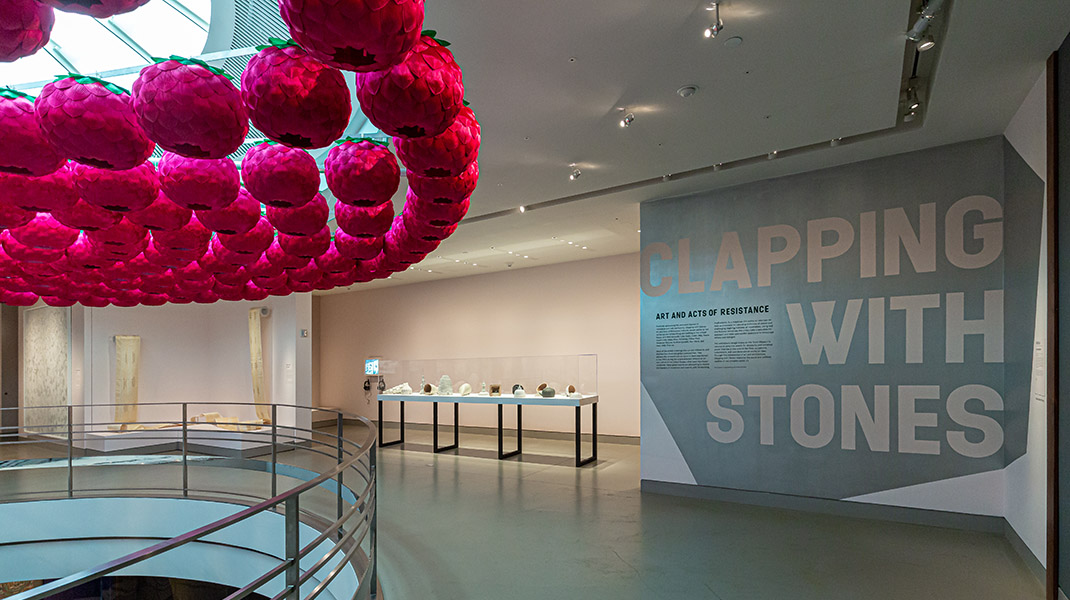
Clapping with Stones: Art and Acts of Resistance at The Rubin Museum of Art, August 16, 2019 – January 6, 2020

“The Rubin Museum of Art presents the third exhibition in its Year of Power programming, Clapping with Stones: Art and Acts of Resistance. The exhibition brings together 10 contemporary artists living and working in the United States and internationally whose works poetically employ non-conformity and resistance as tools to question and upend power in society. Using a range of media — including installation, painting, photography, sculpture, video, and textile — the artists confront history, identity, heritage, and ways of understanding the world at a time when truth is censored, borders reconfigured, mobility impeded, and civil liberties challenged. Bringing together myriad voices, the exhibition presents a meditation on the spirit of defiance expressed through art. Clapping with Stones: Art and Acts of Resistance features works by Lida Abdul, Kader Attia, Nadia Kaabi-Linke, Naiza Khan, Kimsooja, Pallavi Paul, Shahpour Pouyan, Ibrahim Quraishi, Nari Ward, and Hank Willis Thomas.” — The Rubin

Clapping with Stones was organized by guest curator Sara Raza.

20190815-EW6A0762

Shahpour Pouyan (b. 1979, Isfahan, Iran; lives and works in New York); Untitled Dome, detail from My Place Is the Placeless; 2017. Photo by Corrado Serra for Arts Summary.

20190815-EW6A0767-Edit

hahpour Pouyan (b. 1979, Isfahan, Iran; lives and works in New York); Untitled Dome, detail from My Place Is the Placeless; 2017. Photo by Corrado Serra for Arts Summary.

20190815-EW6A0750

Nari Ward (b. 1963, St Andrew, Jamaica; lives and works in New York); installation Breathing Room; 2019. Photo by Corrado Serra for Arts Summary.

The_Calling_02H_DSC_0215

Ibrahim Quraishi (b. 1973 Nairobi, Kenya; lives and works in Amsterdam and Berlin); detail of The Calling; 2012–2018; installation of 8 exploded violins and coffins; photograph by Ibrahim Quraishi from a live installation at Galeri Lumen Travo Amsterdam; image courtesy of the artist.

20190815-EW6A0752-Edit

Pallavi Paul (b. 1986, New Delhi India; lives and works in New Delhi); Burn the Diaries; 2014. Photo by Corrado Serra for Arts Summary.

20190815-EW6A0759-Edit

Left: Hank Willis Thomas (b. 1976, Plainfield, New Jersey; lives and works in New York); The March; 2017. Photo by Corrado Serra for Arts Summary.

Abdul_Clapping

Lida Abdul (b. 1973, Kabul, Afghanistan; lives and works in Kabul and Los Angeles); still of Clapping With Stones; 2005; 16 mm film transferred to DVD; 5 min.; image courtesy of the artist and Giorgio Persano Gallery.

20190815-EW6A0761

Center: Naiza Khan (b. 1968, Bahawalpur, Pakistan; lives and works in London and Karachi); The Robe; 2008. Photo by Corrado Serra for Arts Summary.

20190815-EW6A0745

Naiza Khan (b. 1968, Bahawalpur, Pakistan; lives and works in London and Karachi); The Robe; 2008. Photo by Corrado Serra for Arts Summary.

20190815-EW6A0744-Edit

Left: Nadia Kaabi-Linke (b. 1978, Tunis, Tunisa; lives and works in Berlin); The Altarpiece; 2015. Right: Nari Ward (b. 1963, St Andrew, Jamaica; lives and works in New York); We Shall Overcome; 2015. Photo by Corrado Serra for Arts Summary.

DC_NK_shoot2_15

Nadia Kaabi-Linke (b. 1978, Tunis, Tunisa; lives and works in Berlin and Kiev); The Altarpiece; 2015; photograph by Kevin Todora, 2015; image courtesy of the Burger Collection, Hong Kong.

LAWRIE-SHABIBI-3498

Nadia Kaabi-Linke (b. 1978, Tunis, Tunisa; lives and works in Berlin and Kiev); The Altarpiece; 2015; photograph by Mustafa Aboobacker, 2015; image courtesy of the Burger Collection, Hong Kong.

Title image, top left: Kimsooja (b. 1957, Daegu, South Korea; lives and works in New York and Seoul); Lotus: Zone of Zero (detail); 2017.


Guangzhou Ballet at David H. Koch Theater at Lincoln Center for the Performing Arts, August 17-18, 2019

China Arts and Entertainment Group Ltd. (CAEG) returns to the David H. Koch Theater with two ballet productions Carmina Burana and Goddess of the Luo River performed by the Guangzhou Ballet. Winner of 42 international awards and 159 national awards, Guangzhou Ballet is one of the most outstanding artistic performance organizations in China. Currently, Guangzhou Ballet has a wide repertoire of 18 large-scale dance operas and more than 70 small and medium-sized programs. It has toured in more than 20 countries and regions, such as Russia, the United Kingdom, Canada, France, Australia, and Germany among others.

Carmina Burana

Carmina Burana (3)

Carmina Burana (4)

Carmina Burana (19)

Carmina Burana (13)

Carmina Burana (16)

Carmina Burana (18)

Carmina Burana (17)

Carmina Burana features choreography by American/Chinese choreographer Jiang Qi, who was inspired by ‪Carl Orff‬’s 1936 composition. 

Goddess of the Luo River

Goddess of the Luo River (1)

Goddess of the Luo River (9)

Goddess of the Luo River (11)

Goddess of the Luo River (15)

Goddess of the Luo River (18)

Goddess of the Luo River (19)

Goddess of the Luo River (21)

Goddess of the Luo River was choreographed by the Canadian artist Peter Quanz to music by Du Mingxin.

Images courtesy of China Arts and Entertainment Group.

MASK. In Present-Day Art at Aargauer Kunsthaus, Switzerland, September 1, 2019 – January 5, 2020

“Masks are one of the human cult objects with the longest, richest and at the same time most controversial history. In the interplay between showing and veiling, masks are highly topical in contemporary society and culture as well. The international group show MASK. In Present- Day Art at Aargauer Kunsthaus explores the issue in 160 current works of art.

When thinking of masks, we think of Carnival, African tribal rituals or death masks, theatre, film and fashion – of role playing, changing identities, veiling and protection. Masks are one of the human cult objects with the longest, richest and at the same time most controversial history. They also have an extensive tradition in the fine arts. But how is the subject of the mask treated in contemporary art? The international group show MASK. In Present-Day Art explores this issue in depth. 

MASK shows that contemporary artists are interested in the mask not only as an object but also very much in its social, cultural, political and symbolic implications. In the interplay between showing and veiling and in a society in which adroit self-presentation is seen as a measure of personal success, the mask today is once again a subject of high topicality.” — Aargauer Kunsthaus 


image

Sabian Baumann, Untitled, 2008. Unfired clay, paint, ca. 24 x 15 x 12 cm. In possession of the artist. Courtesy Galerie Mark Müller, Zürich © Sabian Baumann. Foto: Anja Busse

image (1)

Olaf Breuning, Emojis, 2014. C-print/Photo wallpaper, Variable dimensions. Courtesy of the Artists © 2019 Studio Olaf Breuning

image (2)

Edson Chagas, OIKONOMOS, 2011. C-Print, 100 x 100 cm. Courtesy of the artist and APALAZZOGALLERY © Edson Chagas

image (3)

Cecilia Edefalk, At the Moment Untitled, 1997/1998. Oil on canvas, Ø 168 cm. Malmö Konstmuseum © Cecilia Edefalk / Andreas Nilsson / Malmö Konstmuseum

image (4)

Gauri Gill, Untitled, from Acts of Appearance, 2015- ongoing. Pigment print on archive paper, 40.6 x 61 cm. Courtesy Gauri Gill © Gauri Gill

image (5)

Aneta Grzeszykowska, Selfie #19, 2014. Pigment print on cobon paper, 27 x 36 cm. Fotomuseum Winterthur Collection © Aneta Grzeszykowska. Foto: Courtesy of Raster Gallery, Warsaw

image (6)

Christoph Hefti, World Mask, 2014. Dyed wool, natural wool and silk (different pile heights), 100 knots, 305 x 220 cm. Courtesy MANIERA and the artist © Christoph Heki

image (7)

Laura Lima, Nomads, 2008. Acrylic on canvas, 77 x 34 x 3 cm. Courtesy the artist and Galeria Luisa Strina, São Paulo © Laura Lima. Foto: Edouard Fraipont

image (8)

Christian Marclay, Impact (from the series ‘Masks’), 1992. Record covers, archive (adhesive) tape, 126 x 94 cm. Collection of Nancy and Steve Crown © Christian Marclay. Courtesy Paula Cooper Gallery, New York

image (9)

Mike Nelson, Untitled, 2009. Mixed Media, 120 x 60 x 30 cm. ISelf Collection © Mike Nelson. Foto: Sebastiano Pellion di Persano. Courtesy the artist and Galleria Franco Noero

image (10)

Ugo Rondinone, moonrise. south, july, 2003. Casting, polyurethane black, 40 x 22 x 14 cm. Burger Collection, Hong Kong © Ugo Rondinone. Courtesy the artist, Galerie Eva Presenhuber, Zurich / New York. Foto: Stefan Altenburger Photography, Zürich

image (11)

Amanda Ross-Ho, Untitled Apparatus (RED, GREEN, BLUE), 2017. Satin, foam, elastic band, thread. Each 190 x 71 x 5 cm. Courtesy of the artist and Praz-Delavallade, Paris / Los Angeles © Amanda Ross-Ho. Foto: Ruben Diaz

image (13)

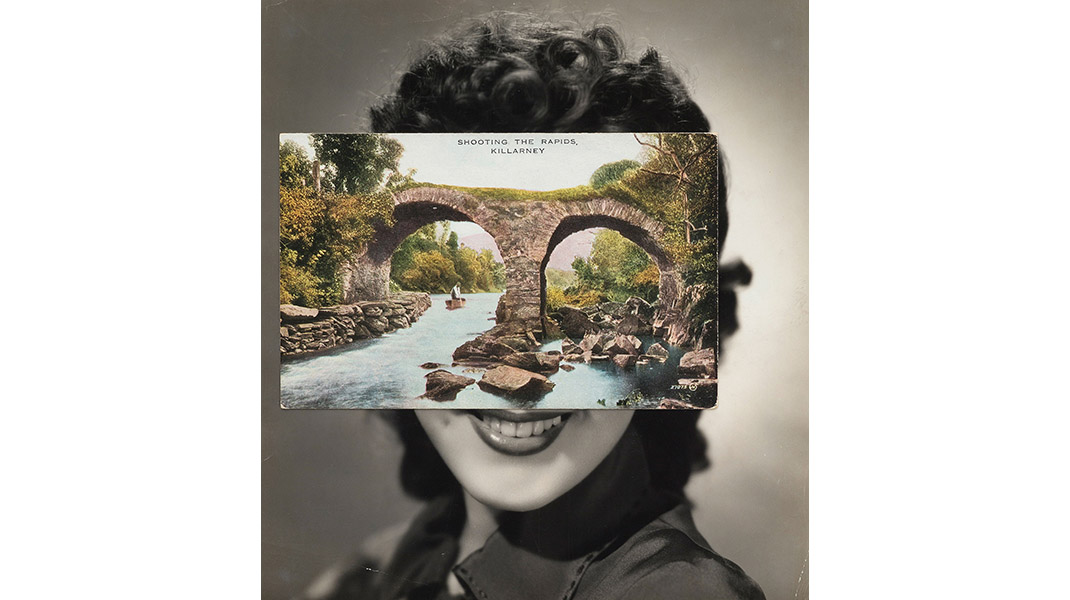
John Stezaker, Mask (Film Portrait Collage) CLXXIII, 2014. Collage, 20 x 17.6 cm. Courtesy the artist and The Approach, London © the artist, courtesy the artist and The Approach, London. Foto: FXP Photography, London, 2014

image (15)

Sislej Xhafa, Again and Again, 2000–2012. C-print, 128 x 300 cm. In collaboration with Donna Musica Orchestra, Courbevoie. Courtesy GALLERIA CONTINUA, San Gimignano / Beijing / Les Moulins / Habana © Sislej Xhafa

MASK. In Present- Day Art curators: Madeleine Schuppli, Director Aargauer Kunsthaus, in collaboration with Yasmin Afschar, Curator Aargauer Kunsthaus. Curatorial Assistant: Luca Rey, research intern Aargauer Kunsthaus

Images courtesy Aargauer Kunsthaus, Aarau, Switzerland.

Last Supper in Pompeii at Ashmolean Museum, University of Oxford, through January 12, 2020

“When the ash from Mount Vesuvius began raining down on Pompeii in AD 79, people in and around the town were engaged in typical Italian activities – eating, drinking and producing food. Located in the sunny paradise of southern Italy, Pompeii was sandwiched between lush vineyards and fertile orchards to one side and the bountiful waters of the Bay of Naples on the other. The town produced more wine, olive oil and fish-sauce than it could consume, and exported its gourmet products across Italy. Everything from the exquisite mosaics from the villas of the wealthy to the remains found in kitchen drains reveal what the people of Pompeii ate and drank. Last Supper in Pompeii explores this ancient Roman love affair with food (and wine), showing where the Romans got their culinary inspiration and how they exported sophisticated ingredients and recipes across the empire, as far afield as Britain. Many of the 300 objects, on loan from Pompeii and Naples, have never before left Italy. They range from the spectacular furnishings of the Roman dining room to actual food which was carbonized as the volcano erupted.” — Ashmolean Museum

Bacchus (c) Museo Archeologico Nazionale di Napoli

Marble statue of Bacchus with a panther. AD 50–150. From the ruins of a temple in Piacenza, Emilia-Romagna. 180 x 64 x 38 cm. Museo Archeologico Nazionale di Napoli

Bread (c) Museo Archeologico Nazionale di Napoli

Fresco wall panel showing the distribution of bread. AD 40–79. Pompeii, House of the Baker. 69 x 60 cm. Museo Archeologico Nazionale di Napoli

Cockerel (c) Parco Archeologico di Pompeii

Still life wall panel fresco showing a cockerel pecking at figs, pears and pomegranates. AD 45–79. Pompeii, House of the Chaste Lovers. 55 x 52 cm. Parco Archeologico di Pompeii

Dinner Party (c) Museo Archeologico Nazionale di Napoli

Fresco wall panel showing a dinner party with painted messages: FACITE VOBIS SUAVITER EGO CANTO and EST ITA VALEAS (make yourselves comfortable; I am singing; go for it!). AD 40–79. Pompeii, House of the Triclinium. 68 x 72 cm. Museo Archeologico Nazionale di Napoli

Etruscan urn (c) British Museum, London

Painted Etruscan funerary urn and lid Terracotta urn with heroic battle scene and Etruscan inscription: Thana Ancarui Helesa. (Thana Ancarui, wife of Hele) Lid (which does not belong to urn) in the form of a reclining young man Chiusi, Tuscany. 150–100 BC. 75.5 x 58.3 cm. British Museum, London

Fish (c) Museo Archeologico Nazionale di Napoli

Polychrome mosaic emblema (panel) showing fish and sea creatures. 100–1 BC. Pompeii, House of the Geometric Mosaics. 103 x 103 cm. Museo Archeologico Nazionale di Napoli

Fortuna (c) Museo Archeologico Nazionale di Napoli

Fresco wall panel showing Isis Fortuna protecting a man flanked by the agathodaemones (protective serpents), with painted message: CACATOR CAVE MALU[m] (‘shitter beware the evil [eye]’). AD 40–79. Pompeii. 68.7 x 80.3 cm. Museo Archeologico Nazionale di Napoli

H00037117 001

Blue glass cup with white speckles. 50 BC–AD 50. Pompeii. 6.2 x 9.4 cm diameter. Parco Archeologico di Pompeii

Satyr (c) Ashmolean Museum, University of Oxford

Bronze reclining satyr from the rim of a vessel. 500–400 BC. Possibly from Chiusi, Tuscany. 4.5 x 6.8 cm. Ashmolean Museum, University of Oxford

Resin lady (c) Parco Archeologico di Pompeii

The body of a woman in her early-30s, preserved in transparent epoxy resin. AD 79. 190 x 120 cm max. Villa B, Oplontis Parco Archeologico di Pompeii

Rhyton (c) Parco Archeologico di Pompeii

Rhyton (drinking or pouring vessel) in the form of a cockerel. AD 1–79. Pompeii, House of the Venus in a bikini. 31.5 x 34.5 cm. Parco Archeologico di Pompeii

Bacchus group from the Temple of Mithras.

Marble head of Serapis wearing a modius (grain measure). AD 180–200. 43 x 22 cm. Walbrook Mithraeum, London © Museum of London

Silver cups (c) Ashmolean Museum, University of Oxford

Gilded silver cups decorated with repoussé olive, vine and myrtle sprays (left to right). 50 BC–AD 150. Ashmolean Museum, University of Oxford

Skeleton (c) Museo Archeologico Nazionale di Napoli

Monochrome mosaic panel of a skeleton holding two wine jugs. AD 1–50. Pompeii, House of the Vestals. 91 x 70 cm.

Terracotta food (c) Parco Archeologico di Paestum

Terracotta votive food: pomegranates (open and closed); grapes; figs; almonds; cheeses; focaccia; honeycomb; mold; long bread. 360 BC. Tomb 11, Contrada Vecchia, Agropoli Parco Archeologico Di Paestum

Dr. Paul Roberts, Head of the Department of Antiquities and exhibition curator, says: ‘The evocative names given to the excavations (the Villa of the Mysteries; the House of the Tragic Poet) have inspired everything from Victorian exhibitions, swords-and-sandals romances to countless scholarly works. Our fascination with the doomed people of Pompeii and their everyday lives has never waned. What better connection can we make with them as ordinary people than through their food and drink?’

The exhibition is organised in collaboration with The Ministero dei Beni e delle Attivita Culturali e del Turismo, Italy; Parco Archeologico di Pompeii; Museo Archeologico Nazionale di Napoli; Parco Archeologico di Paestum.

Images courtesy Ashmolean Museum.

Yang Liping Contemporary Dance: Under Siege, Mostly Mozart Festival at David H. Koch Theater, August 8–10, 2019

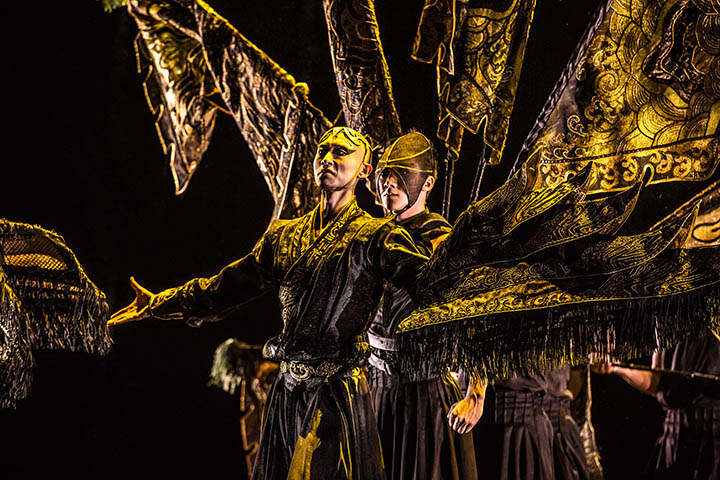
In this U.S. premiere from China’s Yang Liping Contemporary Dance, the astonishing Under Siege portrays the climactic battle between the Chu and Han armies in 202 B.C., an epic struggle that changed the course of Chinese history. Celebrated choreographer Yang Liping employs martial arts, contemporary and Chinese folk dance, gymnastics, and hip-hop to stage her version of the age-old story of love, war, passion, and betrayal that has been passed down through generations. Tim Yip (Oscar winner for his production design of the film Crouching Tiger, Hidden Dragon) creates an intensely beautiful visual landscape and costumes that complement Yang Liping’s melding of ancient traditions with modern sensibilities.

Under Siege photographs by DING Yi Jie.

Under Siege 02 Photographer DING Yi Jie

Under Siege 03 Photographer DING Yi Jie

Under Siege 04 Photographer DING Yi Jie

Under Siege 05 Photographer DING Yi Jie

Under Siege 08 Photographer DING Yi Jie

Under Siege 10 Photographer DING Yi Jie

Under Siege 11 Photographer DING Yi Jie

Under Siege 12 Photographer MA Hong Bo

Under Siege 13 Photographer MA Hong Bo

Under Siege 14 Photographer LI Yi Jian

Under Siege 16 Photographer LI Yi Jian

Under Siege 17 Photographer DING Yi Jie

Under Siege 18 Photographer XIAO Quan

Under Siege 20 Photographer LI Yi Jian

Yang Liping Contemporary Dance: Yang Liping, chief choreographer and director. Tim Yip, visual director/set and costume design.

Images courtesy Lincoln Center.