Picasso: A Cubist Commission in Brooklyn at The Met Fifth Avenue, through January 14, 2024  

“On September 14, 2023, The Met opened Picasso: A Cubist Commission in Brooklyn, the first exhibition dedicated to a captivating but lesser-known chapter in the Cubist period of Pablo Picasso (1881–1973). In 1910, while making radical formal experiments with the human figure that brought him to the brink of abstraction, the artist embarked on a decorative commission for the Brooklyn residence of artist, collector, and critic Hamilton Easter Field (1873–1922). While the commission ultimately went unrealized, it served as a catalyst for Picasso’s exploration of Cubism, as he worked, abandoned, and reworked the panels in various studios in France. In this focused exhibition, six paintings linked to the commission—a group of figure and still life compositions—will be brought together for the first time, along with related works and archival material. It provides a unique opportunity to view these canvases together in the same gallery and to consider them in relation to the architectural space for which they were originally intended.” — The Met

Installation views of Picasso: A Cubist Commission in Brooklyn, on view September 14, 2023–January 14, 2024 at The Metropolitan Museum of Art. Photos by Anna-Marie Kellen, courtesy of The Met   

Installation view of Picasso: A Cubist Commission in Brooklyn, on view September 14, 2023–January 14, 2024 at The Metropolitan Museum of Art. Photo by Anna-Marie Kellen, courtesy of The Met
Pablo Picasso (Spanish, 1881–1973) Man with a Guitar, 1911, reworked in 1913 Oil on canvas 60 5/8 × 30 1/2 in. (154 × 77.5 cm) Musée National Picasso-Paris, Gift of Pablo Picasso Estate, 1979 (MP34) © 2023 Estate of Pablo Picasso / Artists Rights Society (ARS), New York
Pablo Picasso (Spanish, 1881–1973) Man with a Mandolin, 1911 Oil on canvas 63 3/4 × 27 15/16 in. (162 × 71 cm) Musée National Picasso-Paris, Gift of Pablo Picasso Estate, 1979 (MP35) © 2023 Estate of Pablo Picasso / Artists Rights Society (ARS), New York
Installation view of Picasso: A Cubist Commission in Brooklyn, on view September 14, 2023–January 14, 2024 at The Metropolitan Museum of Art. Photo by Anna-Marie Kellen, courtesy of The Met.
Pablo Picasso (Spanish, 1881–1973) Pipe Rack and Still Life on a Table, summer 1911 Oil and charcoal on canvas 19 1/2 × 50 in. (49.5 × 127 cm), irregular 20 × 50 1∕4 in. (50.8 × 127.6 cm), mounted The Metropolitan Museum of Art, New York, The Mr. and Mrs. Klaus G. Perls Collection, 1997 (1997.149.6) © 2023 Estate of Pablo Picasso / Artists Rights Society (ARS), New York
Pablo Picasso (Spanish, 1881–1973) Still Life on a Piano, 1911-1912 Oil and charcoal on canvas 19 11/16 × 51 3/16 in. (50 × 130 cm) Staatliche Museen zu Berlin, Nationalgalerie, Museum Berggruen © 2023 Estate of Pablo Picasso / Artists Rights Society (ARS), New York
Pablo Picasso (Spanish, 1881–1973) Nude Woman, 1910 Oil on canvas 73 3/4 × 24 in. (187.3 × 61 cm) National Gallery of Art, Washington, D.C., Ailsa Mellon Bruce Fund, 1972.46.1 © 2023 Estate of Pablo Picasso / Artists Rights Society (ARS), New York
Pablo Picasso (Spanish, 1881–1973) Reclining Woman on a Sofa, 1910 Oil on canvas 19 15∕16 × 51 in. (49 × 129.5 cm) Private Collection © 2023 Estate of Pablo Picasso / Artists Rights Society (ARS), New York

“As the first-ever exhibition to focus on Picasso’s commission for Hamilton Easter Field, this show will uncover an important chapter in Picasso’s radical Cubist idiom and afford us a fresh angle on the artist’s transcendent work,” said Max Hollein, the Museum’s Marina Kellen French Director and CEO. “The Met is uniquely positioned to present revelatory projects such as this because of the innovative research produced at the Leonard A. Lauder Research Center for Modern Art, our vibrant hub for scholarship on modern art in general and Cubism in particular, now in its 10th year of existence.”

The exhibition is organized by Anna Jozefacka, guest curator, with Lauren Rosati, Associate Curator in the Department of Modern and Contemporary Art and Research Projects Manager in the Leonard A. Lauder Research Center for Modern Art at The Met.

Images courtesy The Metropolitan Museum of Art. 

Wes Anderson – Asteroid City: Exhibition at Fondazione Prada, Milan, September 23, 2023 – January 7, 2024

“Fondazione Prada presents ‘Wes Anderson – Asteroid City: Exhibition’ in Milan from September 23, 2023 to January 7, 2024, in collaboration with Universal Pictures International Italy. The show anticipates the Italian theatrical release on September 28, 2023 of Asteroid City, the latest film by Wes Anderson. On view at Fondazione Prada’s Nord gallery, the project includes a selection of original sets, props, miniatures, costumes, and artworks featured in this movie, which premiered in the 2023 Cannes Film Festival. These immersive installations transport audiences into the creative universe of Anderson’s eleventh feature film. Asteroid City takes place in 1955 in a fictional American desert town famous for its meteor crater and celestial observatory. It narrates a convention of young astronomers and space cadets, bringing together students and parents from across the country and spectacularly disrupted by mysterious events that will change the world.” — Fondazione Prada  

As commented by Wes Anderson, “My personal wish might be to have every prop and costume we ever made for all our movies transferred into the Fondazione Prada to live there indefinitely for all time (if they could spare us the space). Rem Koolhaas also designed one of my very favorite cinemas in the world right in the middle of it.”

Exhibition views of “Wes Anderson – Asteroid City: Exhibition” at Fondazione Prada, Milan. Photos: Delfino Sisto Legnani – DSL Studio. Courtesy: Fondazione Prada.

 “Asteroid City was filmed in Spain, on the outskirts of Chinchón, a small centre in the Community of Madrid. The sets were designed by longtime Anderson collaborator Adam Stockhausen (Oscar® winner for The Grand Budapest Hotel, 2014). For Anderson and Stockhausen, a significant inspiration for the look of the landscape and the urban spaces was Bad Day at Black Rock, the 1955 film directed by John Sturges and starring Spencer Tracy. Other key design references included Billy Wilder’s Ace in the Hole (1951) and Kiss Me, Stupid (1964), as well as Frank Capra’s classic It Happened One Night (1934). The buildings and their interiors, all landscape elements —including mountains, boulders, and rocks— which spectators see on the screen, were all physically constructed on a big scale and laid out in a way that gave the actors and crew the sense of living in a real, perfectly functioning town.” — Fondazione Prada 

Title image: Wes Anderson on the set of Asteroid City. Courtesy of Roger Do Minh/Pop. 87 Productions/Focus Features. Courtesy Fondazione Prada.

The Robert Olnick Pavilion and Exhibitions of Mario Schifano, Ettore Spalletti and Carlo Scarpa at Magazzino Italian Art

“The Robert Olnick Pavilion at Magazzino Italian Art is now open to the public, greatly expanding the offerings on the landscaped campus in Cold Spring, New York with special exhibitions in this new, freestanding 13,000-square-foot building. While the original, 20,000-square-foot building from 2017 will remain dedicated to the Arte Povera movement, which is central to the museum’s renowned Olnick Spanu Collection, the pavilion provides space for Magazzino to range more widely through modern and contemporary Italian art and present significant works on loan. Offering Magazzino an additional two floors of gallery and education space, as well as a café and museum store, the Robert Olnick Pavilion is designed by Alberto Campo Baeza and Miguel Quismondo, the latter being the architect for Magazzino’s original building.

Visitors to the pavilion will be welcomed by a trio of inaugural special exhibitions: a rare survey of trailblazing work from the 1960s and ‘70s by painter Mario Schifano (1934–1998), a focused installation of paintings and sculpture by Ettore Spalletti (1940–2019), and a selection of masterpieces of Murano glass by Carlo Scarpa (1906–1978) from the Olnick Spanu collection.” — Magazzino Italian Art

Robert Olnick Pavilion, Magazzino Italian Art, Cold Spring, NY. Photo by Marco Anelli. Courtesy Magazzino Italian Art.

Mario Schifano: The Rise of the ‘60s is the first major survey of work from the 1960s and ‘70s. On view are eighty works, the great majority on loan from international collections. The exhition was organized by Magazzino Italian Art in collaboration with the Archivio Mario Schifano and curated by Alberto Salvadori, through January 8, 2024.

Installation view of Mario Schifano: The Rise of the ‘60s, curated by Alberto Salvadori, at the Robert Olnick Pavilion at Magazzino Italian Art, Cold Spring, NY. Photo by Marco Anelli and Tommaso Sacconi. Courtesy Magazzino Italian Art.

Ettore Spalletti: Parole di colore is specially conceived for the new pavilion by Fondazione Ettore Spalletti and Alberto Salvadori in collaboration with architect Alberto Campo Baeza. Featuring five works by Spalletti, the project is installed in Gallery 2, an isotropic room built as a perfect cube, in which each wall is punctured by a single square window, through January 8, 2024.

Installation view of Ettore Spalletti: Parole di colore, conceived by Fondazione Ettore Spalletti and Alberto Salvadori in collaboration with the architect Alberto Campo Baeza, at the Robert Olnick Pavilion at Magazzino Italian Art, Cold Spring, NY. Photo by Marco Anelli and Tommaso Sacconi. Courtesy Magazzino Italian Art.

Carlo Scarpa: Timeless Masterpieces, a selection of fifty-six Murano glassworks from the Olnick Spanu Collection. Curated by Marino Barovier, the exhibition reconstructs the creative journey of the architect from 1926 to 1947, a period during which he collaborated with the two most prominent Murano glassmakers of the time: M.V.M. Cappellin & Co. and Venini, through March 31, 2025.

Installation view of Carlo Scarpa: Timeless Masterpieces, curated by Marino Barovier, at the Robert Olnick Pavilion at Magazzino Italian Art, Cold Spring, NY. Photo by Marco Anelli and Tommaso Sacconi. Courtesy Magazzino Italian Art.
Installation view of Carlo Scarpa: Timeless Masterpieces, curated by Marino Barovier, at the Robert Olnick Pavilion at Magazzino Italian Art, Cold Spring, NY. Photo by Marco Anelli and Tommaso Sacconi . Courtesy Magazzino Italian Art.
Installation view of Carlo Scarpa: Timeless Masterpieces, curated by Marino Barovier, at the Robert Olnick Pavilion at Magazzino Italian Art, Cold Spring, NY. Photo by Marco Anelli and Tommaso Sacconi. Courtesy Magazzino Italian Art.

Title image: Robert Olnick Pavilion, Magazzino Italian Art, Cold Spring, NY. Photo by William Mulvihill. Courtesy MQ Architecture.

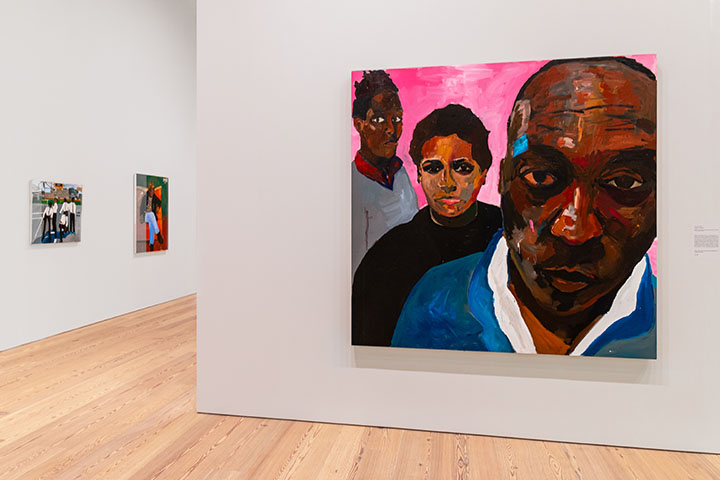
Barkley L. Hendricks: Portraits at the Frick at Frick Madison, September 21, 2023 – January 7, 2024 

I wasn’t part of any “school.” The association I had with artists in Philadelphia didn’i inspire me in any direction other than my own. I spent time looking at the Old Masters. — Barkley L. Hendricks

“Since opening in 1935, The Frick Collection has inspired generations of artists who have engaged with the complex legacies and enduring importance of Old Master painting. Barkley L. Hendricks was one such artist, and the Frick—with its iconic portraits by Rembrandt, Bronzino, Van Dyck, and others—was one of Hendricks’s favorite museums. On view this fall at Frick Madison, Barkley L. Hendricks: Portraits at the Frick presents fourteen early works by this pioneering American artist who, beginning in the late 1960s, revolutionized contemporary portraiture by uniting portraits of Black figures with traditions of European painting. His work has inspired some of the most prominent artists of today, including Derrick Adams, Mickalene Thomas, and Kehinde Wiley. Frick Madison is a particularly appropriate venue for this show, as it was in the Breuer building (then the home of the Whitney Museum of American Art) that Hendricks first showed his art in a New York City museum exhibition, in 1981.” — The Frick 

Lawdy Mama at the exhibition’s entrance, shown with Frick Collection works by Jean-Antoine Houdon and Joshua Reynolds; photo: George Koelle. Barkley L. Hendricks, Lawdy Mama, 1969, oil and gold leaf on canvas, 53 3/4 x 36 1/4 in. (136.5 x 92.1 cm), Studio Museum in Harlem; gift of Stuart Liebman, in memory of Joseph B. Liebman.
Gallery view of Barkley L. Hendricks: Portraits at the Frick; photo: George Koelle.
October’s Gone…Goodnight and Lagos Ladies (Gbemi, Bisi, Niki, Christy) in a gallery of limited-palette paintings in white; photo: George Koelle. Barkley L. Hendricks, October’s Gone…Goodnight, 1973, oil and acrylic on linen canvas, 66 x 72 in. (167.6 x 182.9 cm), Harvard Art Museums / Fogg Museum, Cambridge; Richard Norton Memorial Fund. Barkley L. Hendricks, Lagos Ladies (Gbemi, Bisi, Niki, Christy), 1978, oil, acrylic, and magna on cotton canvas, 72 x 60 in. (182.9 x 152.4 cm), private collection.
Gallery view of Barkley L. Hendricks: Portraits at the Frick; photo: George Koelle.
Miss T and Ma Petite Kumquat flanking a gallery of Frick Collection works by James McNeill Whistler; photo: George Koelle. Barkley L. Hendricks, Miss T, 1969, oil and acrylic on canvas, 66 1/8 x 48 1/8 in. (168 x 122.2 cm), Philadelphia Museum of Art; purchased with the Philadelphia Foundation Fund, 1970. Barkley L. Hendricks, Ma Petite Kumquat, 1983, oil, acrylic, white gold, and silver leaf on linen canvas, 72 x 40 in. (182.9 x 101.6 cm), Collection of Ben and Jen Silverman.
Gallery view of Barkley L. Hendricks: Portraits at the Frick; photo: George Koelle.
Bashir (Robert Gowens) with a signature Breuer window in the Fragonard gallery beyond; photo: George Koelle. Barkley L. Hendricks, Bahsir (Robert Gowens), 1975, oil and acrylic on canvas, 83 1/2 x 66 in. (212.1 x 167.6 cm), Nasher Museum of Art at Duke University, Durham; museum purchase with additional funds provided by Jack Neely.

Barkley L. Hendricks: Portraits at the Frick, which will display paintings drawn from both public and private collections, is organized by the Frick’s Curator Aimee Ng and Consulting Curator Antwaun Sargent.

Comments Ng, “The Frick offers stirring encounters with figures painted centuries ago. As our temporary display at Frick Madison has shown, these works seen in a new light can engage visitors so differently outside of the Frick mansion, in the Brutalist setting of the Breuer building. Here, many of our visitors are new to the Frick, a revelation that has prompted reflection on who the Frick serves, has served, and will continue to serve. This project—the first major museum exhibition and catalogue to focus solely on Hendricks’s early period of portraiture—allows us to consider connections the Frick has made with artists since it became a public museum in 1935. Hendricks’s astonishing portraits of predominantly Black figures, not represented in the Frick’s historic paintings yet who, with their self-assured style, appear right at home among them, grants unprecedented opportunities to celebrate and explore the Frick’s collection, Hendricks’s groundbreaking innovations, and the bridges between them.”

Adds Sargent, “When Aimee and I first began speaking about the Frick and its place in today’s world, I suggested an exhibition on Barkley L. Hendricks—obviously because of his interest in historic art as he developed his own style of portraiture of Black subjects, but also because the quality, dignity, and visual impact of his paintings are what I would think Henry Clay Frick might be drawn to if he were collecting now. The catalogue accompanying the exhibition is an exciting way to highlight and reflect on Hendricks’s own legacies, how he has inspired generations of artists and designers and still does today. Presenting Hendricks’s art at a storied institution like the Frick pays due tribute to the artist’s historic significance, and it also honors the evolving role of the Frick in modern American culture.”

Title image: Lawdy Mama flanked at the exhibition’s entrance with Frick Collection works by Jean-Antoine Houdon; photo: George Koelle. Barkley L. Hendricks, Lawdy Mama, 1969, oil and gold leaf on canvas, 53 3/4 x 36 1/4 in. (136.5 x 92.1 cm), Studio Museum in Harlem; gift of Stuart Liebman, in memory of Joseph B. Liebman.

Images courtesy The Frick Collection.

Manet/Degas at The Met Fifth Avenue, September 24, 2023 – January 7, 2024

“This exhibition examines one of the most significant artistic dialogues in modern art history: the close and sometimes tumultuous relationship between Édouard Manet and Edgar Degas. Born only two years apart, Manet (1832–1883) and Degas (1834–1917) were friends, rivals, and, at times, antagonists who worked to define modern painting in France. By examining their careers in parallel and presenting their work side by side, this exhibition investigates how their artistic objectives and approaches both overlapped and diverged.

Through more than 150 paintings and works on paper, Manet/Degas takes a fresh look at the interactions of these two artists in the context of the family relationships, friendships, and intellectual circles that influenced their artistic and professional choices, deepening our understanding of a key moment in nineteenth-century French painting.” — The Met

“Manet and Degas produced some of the most provocative and admired images in Western art,” said Max Hollein, The Met’s Marina Kellen French Director. “Anchored by the unparalleled holdings of their work in the collections of The Met and the Musée d’Orsay, in addition to incredible loans from more than 50 other institutions and individual collectors, this exhibition offers a riveting new perspective on the storied pair of artists.”

Installation views of Manet/Degas, on view September 24, 2023–January 7, 2024 at The Metropolitan Museum of Art. Photos by Anna-Marie Kellen, Courtesy of The Met. 

Stephan Wolohojian, exhibition co-curator and the John Pope-Hennessy Curator in Charge of the Department of European Paintings, said, “While little written correspondence between Manet and Degas survives, their artistic output speaks volumes about how these major artists defined themselves with and against each other. This expansive dossier exhibition is a unique chance to assess their fascinating relationship through a dialogue between their work.”

Ashley Dunn, exhibition co-curator and Associate Curator in the Department of Drawings and Prints, added: “Works on paper are integral to their story as the two artists purportedly met in the Louvre, where Degas was working on an etching after a painting attributed to Velázquez, a work that Manet also copied. The exhibition presents an exciting opportunity to evaluate how Manet and Degas worked differently across media.”

Manet/Degas is organized by The Metropolitan Museum of Art, New York, and the Musées d’Orsay et de l’Orangerie, Paris.

Manet/Degas is co-curated by Stephan Wolohojian (John Pope-Hennessy Curator in Charge of the Department of European Paintings, The Met) and Ashley Dunn (Associate Curator, Department of Drawings and Prints, The Met), in collaboration with Laurence des Cars (President-Director, Musée du Louvre), Isolde Pludermacher (Chief Curator of Painting at the Musée d’Orsay), and Stéphane Guégan (Scientific Advisor to the President of the Musée d’Orsay and the Musée de l’Orangerie).

Perelman Performing Arts Center at World Trade Center Site opens September 19, 2023

“Perelman Performing Arts Center (PAC NYC), the cultural cornerstone and final public element of the World Trade Center site, will open with its first public performance on Tuesday, September 19, 2023. Led by Board Chair Mike Bloomberg, Executive Director Khady Kamara, and Artistic Director Bill Rauch, the new performing arts center in Lower Manhattan is a dynamic home for the arts, serving audiences and creators through flexible venues enabling the facility to embrace wide-ranging artistic programs. The inaugural year will feature commissions, world premieres, co-productions, and collaborative work across theater, dance, music, opera, film, and more. The vision for PAC NYC first began 20 years ago when Mike Bloomberg, as Mayor of New York City, included a performing arts center as the cultural keystone in the master plan to rebuild the World Trade Center site following 9/11.

Named for businessman, philanthropist, and benefactor Ronald O. Perelman, the Perelman Performing Arts Center is a 138-foot-tall, cube-shaped building with radically flexible capabilities designed by the architecture firm REX, led by founding principal Joshua Ramus. REX’s design, developed in collaboration with executive architect Davis Brody Bond, theater consultant Charcoalblue, and acoustician Threshold Acoustics, is conceived for an artistic program that will have vast and varied needs to serve New York’s extraordinarily diverse arts community. ” — PAC NYC 

View of lower Manhattan including Perelman Performing Arts Center and National September 11 Memorial & Museum. Image Iwan Baan.
Aerial of lower Manhattan including Perelman Performing Arts Center and National September 11 Memorial & Museum. Image Iwan Baan.
Perelman Performing Arts Center designed by REX. Image Iwan Baan.
Perelman Performing Arts Center designed by REX. Image Iwan Baan
Perelman Performing Arts Center designed by REX. Image Iwan Baan.

Title image: Perelman Performing Arts Center designed by REX.  Image Iwan Baan.

Images courtesy Perelman Performing Arts Center (PAC NYC).

Two concurrent exhibitions, Sophia Vari: A Retrospective at The Nohra Haime Gallery and Sophia Vari: A Tribute, Twelve Monumental Sculptures in Park Avenue

The two exhibitions, Sophia Vari: A Retrospective at The Nohra Haime Gallery,  August 7 – September 30, 2023, and Sophia Vari: A Tribute, Twelve Monumental Sculptures in Park Avenue, May 20th – November 5th, 2023, celebrate the work of the esteemed international artist.

Sophia Vari: A Retrospective celebrates the work of Sophia Vari (1940-2023), the Greek artist known internationally for her polychrome paintings, collages, and sculptures. Married to the Colombian sculptor Fernando Botero, Vari died in May 2023. Throughout her career, Vari explored color, form, and volume, interrogating the construction of space and the relationship between object and viewer. The artist cited influences ranging from Cubism, to classical Greek sculptures, to Olmec artifacts.

Sophia Vari: A Tribute, Twelve Monumental Sculptures displays twelve monumental bronze sculptures on Park Avenue between 54th and 62nd Streets. The Nohra Haime Gallery presents them in collaboration with The Sculpture  Committee of The Fund for Park Avenue and the NYC Parks’ Art in the Parks program. The sculptures have previously been shown in public art exhibitions around the world, including in Paris, Rome, Montecarlo, Pietrasanta, Madrid, Athens, Cartagena, Baden-Baden, Geneva, Beijing, and London.

SOPHIA VARI. La femme (Woman), 2005. Bronze, black patina and yellow paint. 118 x 51 1/4 x 48 in. (300 x 130 x 122 cm). Edition of 3. Copyright © NOHRA HAIME GALLERY. All rights reserved.
SOPHIA VARI. La Toute Petite, 1997. Bronze, brown patina and red paint. 48 x 71 1/4 x 49 1/4 in. (122 x 181 x 125 cm). Edition of 3. Copyright © NOHRA HAIME GALLERY. All rights reserved.
SOPHIA VARI. L’Homme qui marche, 2007. Bronze, black patina and white oil. 114 1/4 x 31 1/2 x 37 in. (290 x 80 x 94 cm). Edition of 3. Copyright © NOHRA HAIME GALLERY. All rights reserved.
SOPHIA VARI. Tango, 2011. Bronze, black patina and white paint. 118 x 57 x 51 1/4 in. (300 x 145 x 130 cm). Edition of 3. Copyright © NOHRA HAIME GALLERY. All rights reserved.
SOPHIA VARI. Danseuse Espagnole, 1992. Bronze, black patina and blue paint. 98 1/2 x 51 1/4 x 43 1/4 in. (250 x 130 x 110 cm). Edition of 3. Copyright © NOHRA HAIME GALLERY. All rights reserved.
SOPHIA VARI. Double epee, 1997. Bronze, black and yellow painting. 121 1/2 x 39 1/2 x 27 3/4 in. (309 x 100 x 70 cm). Edition of 3. Copyright © NOHRA HAIME GALLERY. All rights reserved.
SOPHIA VARI. Fleur de nuit, 2009. Bronze, black patina and white oil. 118 x 57 x 51 1/4 in. (300 x 145 x 130 cm). Edition of 3. Copyright © NOHRA HAIME GALLERY. All rights reserved.
SOPHIA VARI. Les serpentes de la guerre, 1993. Bronze, black patina and red paint. 91 x 52 3/4 x 50 1/2 in. (231 x 134 x 128 cm). Edition of 3. Copyright © NOHRA HAIME GALLERY. All rights reserved.
SOPHIA VARI. Point immobile, 1993. Bronze, black patina and yellow paint. 66 1/2 x 58 x 56 in. (169 x 147 x 142 cm). Edition of 3. Copyright © NOHRA HAIME GALLERY. All rights reserved.

Images courtesy Nohra Haime Gallery.

El Dorado: Myths of Gold, Part I at Americas Society, September 6 – December 16, 2023

“The exhibition includes paintings, prints, photographs, sculptures, engravings, and videos that offer new interpretations and questions about the myth. Since the invasion of Europeans to the Americas, rumors spread quickly about a kingdom filled with gold, driving conquistadores to find it. Despite never being found, the mythical El Dorado defined the continent as an empty land up for grabs. 

El Dorado: Myths of Gold brings together artworks and artists that engage with the myth to evaluate its continuity into the present, sometimes offering a critical view and a path of resistance.” — Americas Society 

“Through their use of gold, both physical and metaphorical the artists in this exhibition emphasize to us the ambivalent power of myth in conditioning who we are as a region, opening space for us to resist extractive systems and to reconsider what we are seeking,” writes the exhibition curatorial team. 

Installation views of “El Dorado: Myths of Gold” at Americas Society. Photos: Arturo Sánchez.

The exhibition is co-curated by Aimé Iglesias Lukin, Director and Chief Curator, Art at Americas Society; Tie Jojima, Associate Curator, Manager of Exhibitions, Art at Americas Society and Edward Sullivan, the Helen Gould Sheppard Professor of Art History, New York University.

It was organized in collaboration with Fundación PROA in Buenos Aires (Argentina) and Museo Amparo in Puebla (Mexico), the exhibition will take place in two parts: part I from September through December 2023 and part II from January through May 2024.

Art on Paper at Heller Gallery, Manhattan’s Pier 36, September 7 – September 10, 2023

Heller Gallery is delighted to announce its debut participation at Art on Paper, where it will present a curated selection of works by Kerry Miller, Mel Douglas & Sibylle Peretti. The fair, held at downtown Manhattan’s Pier 36, opens on Thursday, September 7 and runs through Sunday, September 10. 

Heller Gallery, celebrating 50 years as New York’s leading dealer specializing in contemporary glass sculpture and design, champions artists whose materially based work is bending and breaking boundaries of the contemporary art world.

British artist Kerry Miller makes assemblages using vintage books and re-imagines their content using the illustrations found within. Cutting, tinting and collaging flowers, birds and characters from each selected volume she allows them to pop-up and grow from its original confines into a new dimension. German-born artist Sibylle Peretti sculptures and multimedia collages, which combine photography & drawing with surface interventions such as engraving, mirroring and glass slumping. Poetic narratives about the relationship between humans and the natural world, are the central themes in her work. Australian Mel Douglas subtle, elegant, minimalist work explores the potential, versatility, and flexibility of drawing on and with glass and has been praised as quiet, but strangely energetic and animated.

KERRY MILLER

KERRY MILLER, A Midsummer Night’s Dream, 2021. Paper/mixed media/wood framing, 16 1/2 x 13 7/8 x 4 in. (41.9 x 35.2 x 10.2 cm). Heller Gallery.
KERRY MILLER, A Comic Almanack, 2021. Paper/mixed media/framing, 13 1/3 x 17 x 4 in. (33.9 x 43.2 x 10.2 cm). Heller Gallery.

 SIBYLLE PERETTI

SIBYLLE PERETTI, Awakening, 2021. Kiln formed, engraved, painted and silvered glass/paper, 35 x 21 x 1 in. (88.9 x 53.3 x 2.5 cm). Heller Gallery.
SIBYLLE PERETTI, Long River, 2022. Kiln formed, engraved, painted and silvered glass/paper, 17 x 21 x 4/5 in. (43.2 x 53.3 x 2 cm). Heller Gallery.

MEL DOUGLAS

MEL DOUGLAS, Superimposed overlay I, set 1, 2023. Glass drawing on paper/framed, 22 x 22 in. (56 x 56 cm. Heller Gallery.
MEL DOUGLAS. Superimposed overlay II, set 1, 2023. Glass drawing on paper/framed, 22 x 22 in. (56 x 56 cm). Heller Gallery.

Images courtesy Heller Gallery.

The Facade Commission: Nairy Baghramian, Scratching the Back at The Met, September 7, 2023 – May 28, 2024 

“The Met unveiled four new sculptures by Nairy Baghramian (German citizen, born Iran 1971) for the Museum’s facade. This is the first public installation by the artist in New York City. Baghramian’s cast aluminum polychrome sculptures feature components that seem to have washed up like flotsam and jetsam in the voids of their respective niches. These abstract forms at the threshold of the Museum present a metaphor of the institution as a filter of historical fragments deemed representative or exemplary. The project’s title Scratching the Back—a distortion of the idiom ‘scratch the surface’—alludes to the need to move beyond superficially constructed cultural narratives.” — The Met

Nairy Baghramian (German, born Iran, 1971). Installation view of Scratching the Back: Drift (sans Tortillon), 2023, for The Facade Commission: Nairy Baghramian, Scratching the Back, 2023. Cast and powder-coated aluminum, painted aluminum. Courtesy the artist, kurimanzutto, and Marian Goodman Gallery. Image credit: The Metropolitan Museum of Art, Photo by Bruce Schwarz.
Nairy Baghramian (German, born Iran, 1971) Installation view of Scratching the Back: Drift (Tortillon orange), 2023, for The Facade Commission: Nairy Baghramian, Scratching the Back, 2023. Cast and powder-coated aluminum, painted aluminum. Courtesy the artist, kurimanzutto, and Marian Goodman Gallery. Image credit: The Metropolitan Museum of Art, Photo by Bruce Schwarz.
Nairy Baghramian (German, born Iran, 1971) Installation view of Scratching the Back: Drift (Tortillon rose), 2023, for The Facade Commission: Nairy Baghramian, Scratching the Back, 2023. Cast and powder-coated aluminum, painted aluminum. Courtesy the artist, kurimanzutto, and Marian Goodman Gallery. Image credit: The Metropolitan Museum of Art, Photo by Bruce Schwarz.
Nairy Baghramian (German, born Iran, 1971) Installation view of Scratching the Back: Drift (Tortillon jaune), 2023, for The Facade Commission: Nairy Baghramian, Scratching the Back, 2023. Cast and powder-coated aluminum, painted aluminum. Courtesy the artist, kurimanzutto, and Marian Goodman Gallery. Image credit: The Metropolitan Museum of Art, Photo by Bruce Schwarz.

Max Hollein, The Met’s Marina Kellen French Director and CEO, said, “Nairy Baghramian creates expressive, daring, site-specific works that both deeply engage with and question their settings. Defying traditional conventions of sculpture, the artist’s colorful abstract forms appear to spill out from The Met’s sculpture niches—in stark contrast to the monochrome classical architecture of the facade. Her bold yet fragile structures manifest powerfully composed transformations of space, material, and physical relationships.”

Images courtesy The Metropolitan Museum of Art.

Only the Young: Experimental Art in Korea, 1960s–1970s at Solomon R. Guggenheim Museum, September 1, 2023 – January 7, 2024

“The Solomon R. Guggenheim Museum presents Only the Young: Experimental Art in Korea, 1960s–1970s, the first North American museum exhibition dedicated to Korean Experimental art (silheom misul) and its artists, whose radical approach to materials and process produced some of the most significant avant-garde practices of the twentieth century.

This historic presentation examines artistic production from an era of remarkable transformation in South Korea, when young artists who came of age in the decades immediately following the Korean War reflected and responded to the changing socioeconomic, political, and material conditions that accompanied the nation’s rapid urbanization and modernization. The exhibition centers on a network of key artists, including Ha Chong-Hyun, Kim Kulim, Jung Kangja, Lee Seung-taek, Lee Kang-So, Lee Kun-Yong, and Sung Neung Kyung, who, in addition to creating boundary-pushing works of art, pursued exhibitions, performances, publications, and public seminars, often under the rubric of self-organized collectives.” — Solomon R. Guggenheim Museum

Installation views, Only the Young: Experimental Art in Korea, 1960s–1970s, Solomon R. Guggenheim Museum, New York, September 1, 2023–January 7, 2024. Photos: Ariel Ione Williams © Solomon R. Guggenheim Foundation.

Only the Young: Experimental Art in Korea, 1960s–1970s is co-organized by the Solomon R. Guggenheim Museum, New York, and the National Museum of Modern and Contemporary Art, Korea. The exhibition is cocurated by Kyung An, Associate Curator, Asian Art, Solomon R. Guggenheim Museum and Foundation, New York, and Kang Soojung, Senior Curator, National Museum of Modern and Contemporary Art, Korea. The exhibition will open at the National Museum of Modern and Contemporary Art, Korea, on May 26 and close on July 16, 2023. It will travel to the Hammer Museum, Los Angeles, from February 11 to May 12, 2024, following the Guggenheim presentation this fall.

Images courtesy Solomon R. Guggenheim Museum.

Underground Images: A History at SVA Chelsea Gallery, August 29 – October 14, 2023

“School of Visual Arts (SVA) presents ‘Underground Images: A History,’ a new exhibition of more than 200 posters from the College’s iconic Subway Posters collection, which have covered the walls of NYC transit stations for almost 75 years. In addition to the posters, the exhibition includes multimedia installations, progress sketches and paintings, a recreated NYC subway platform, and more. Presented by SVA Galleries in partnership with the SVA Archives, it is on view Tuesday, August 29, through Saturday, October 14, 2023, at the SVA Chelsea Gallery, 601 W 26th St., 15th floor, New York City.

Not long after its inception in 1947 as the Cartoonists & Illustrators School, SVA began commissioning these posters from some of its most esteemed faculty members as creative marketing for the College, then took them to the walls lining the NYC subway platforms. These advertising posters were both thought-provoking and eye-catching and have become an essential part of the fabric of the city’s transit system. Since 2006, the traveling iteration of ‘Underground Images’ has exhibited globally, including in Czech Republic, India, Jamaica, Ireland, Turkey, Argentina, Uruguay, Brazil, Italy, Serbia and many other countries and US cities.” — SVA

1949: Rough to Finish, Cartoonists & Illustrators School.
1958: Without Education, It Isn’t Possible For… Jack Wolfgang Beck (designer).
Installation view of “Underground Images: A History” at SVA Chelsea Gallery. Photo: Adam Cable, SVA Galleries.
1968: At 35, Paul Gauguin Worked In a Bank. It… Gene Case (art director and copywriter), Silas H. Rhodes (art director)
1974: Having a Talent Isn’t Worth Much Unless…, Marshall Arisman (illustrator), Richard Wilde (designer), Dee Ito (copywriter), Silas H. Rhodes (art director).
1978: To Be Good Is Not Enough When You Dream…, Paul Davis (illustrator and designer), Dee Ito (copywriter), Silas H. Rhodes (art director).
Installation view of “Underground Images: A History” at SVA Chelsea Gallery. Photo: Adam Cable, SVA Galleries.
1982: To Be Good Is Not Enough, When You Dream…, Marvin Mattelson (illustrator), William Kobasz (designer), Dee Ito (copywriter), Silas H. Rhodes (art director).
1987: To Be Good Is Not Enough When You Dream…, Paula Scher (designer), Silas H. Rhodes (art director).
Installation view of “Underground Images: A History” at SVA Chelsea Gallery. Photo: Adam Cable, SVA Galleries.
2001: I Love NY More Than Ever, Milton Glaser (designer), Silas H. Rhodes (creative director).
Installation view of “Underground Images: A History” at SVA Chelsea Gallery. Photo: Adam Cable, SVA Galleries.
2023: Think About Art…, Carol Fabricatore (illustrator), Dee Ito (copywriter), Anthony P. Rhodes (executive creative director), Gail Anderson (creative director), Brian E. Smith (art director).

“Since the earliest days of the College, the subway posters have done more than just generate interest in SVA. They’ve stirred the imaginations of New Yorkers and the countless aspiring and practicing artists who visit the city each year,” said SVA President David Rhodes. “Exhibiting them all over the world has been an adventure, but we are thrilled to present this collection and its fascinating history in the place where it all began.”

Title image: Installation view of “Underground Images: A History” at SVA Chelsea Gallery. Photo: Adam Cable, SVA Galleries.

Images courtesy School of Visual Arts.